



Abstract
This article considers the potential contribution of life coaching to work with offenders. It draws on a qualitative evaluation of a UK-based initiative which has been coaching offenders (exclusively female at the time of the fieldwork, but now also including men) in prison and in the community. The positive impact of coaching perceived by its recipients is set out and assessed against the theory of change which underpins coaching. The contribution to this process of engagement and the relationship between coach and client is also considered.
Introduction
Recent years have seen something of a return to favour for models of intervention with offenders in which there is emphasis on engagement skills and the relationship between worker and client (see, for example, Rex et al., 2012). A key part of this has been research into desistance from offending which has highlighted the importance of respecting individuality and building positive relationships (Weaver and McNeill, 2007). This has gone hand in hand with observations that effective intervention is often at least as much to do with ‘who works’ as ‘what works’ (McNeill et al., 2005).
While efforts are being made to incorporate these lessons into mainstream probation practice (Rex et al., 2012), other ways of bringing it about are also being advanced, not least because of the limited capacity of offender managers with high caseloads and the emphasis on risk management in modern probation work. Mentoring in different forms (peer and otherwise) appears to be the favoured approach. Independent projects and probation trusts alike are recruiting volunteer mentors to work with offenders, and Justice Minister Chris Grayling apparently sees them as the answer to the short prison sentence ‘revolving door’ syndrome (BBC News, 2013). The evidence for the effectiveness of mentoring as a response to offending is tentative at best (Taylor et al., 2013).
A key element of mentoring is guidance, allowing the mentee to learn from the experience of the mentor. A contrasting interpersonal approach currently being offered to offenders by two UK-based initiatives, is that of life coaching which avowedly does not set out to advise or guide its subjects. This article draws on a recent qualitative evaluation by the author to assess the potential contribution of one of them to work with offenders. Coaching Inside and Out (CIAO) 1 which was established in the North West in 2011 works with offenders both in custody and in the community, initially women only. It now also coaches men, but the evaluation covered its earlier phase, and hence the client group referred to here is entirely female.
Coaching is a relatively recently established discipline or, more accurately, group of disciplines in that the term covers a range of approaches. Coaching ‘means different things to different people’ (Jackson, 2005: 45) and may on occasions be confused with other one-to-one interventions such as counselling and mentoring. The term covers a spectrum of activity with, at one end the explicit conveyance of instruction and expert knowledge – in some business contexts for example (see, for example, Holliday, 2001). At the other end are models of life coaching, sometimes called ‘pure’ coaching (Bridle, 2009) in which ‘the coach is not imparting any particular knowledge but … asking the questions to draw the person out and get them to think through issues and outcomes desired’. Ives (2008) on the one hand describes a consensus which sees coaching as non-directive in contrast to the more instructional approach of mentoring, yet maintains that this is not clear cut, with the coach still regarded as a guide in some circles.
CIAO is very much in the pure or non-directive camp, reflecting the approach advocated by Rogers (2008: 7−8), who identifies six principles to differentiate coaching from other ways of working, as follows: The client is resourceful – has the resources to solve his or her own problems. The coach’s role is to develop the client’s resourcefulness through skilful questioning, challenge and support – a coach should not give advice, which risks creating dependency. Coaching addresses the whole person – past present and future (though the focus will be more on the present and the future). The client sets the agenda. The coach and the client are equals – it is a partnership approach, and judgement must be suspended. Coaching is about change and action – ‘clients come to coaching because they want something to change’; to that end, coaching is goal-focused.
Thus coaching is predicated on the notion that people are assisted to tap into their own inner resource; that they identify areas in their life that they want to change, and they put in place plans to bring that change about.
CIAO’s work with any given client begins by asking them, using the ‘Outcomes Star’ (see below) to identify any areas in their life where they would like to initiate change. A further five sessions are then available in which to support, enable and challenge them in setting and achieving manageable goals towards that end. As one coach put it: … it’s about helping the individual… work out who they are, what they want to change and how they can change it for themselves; not making suggestions about what they want to change or any suggestions about how to change it, but helping them come up with their own ideas and solutions.
Life coaching is frequently delivered as a service purchased privately by individuals looking at the direction their life is taking or by companies for senior staff to promote clarity in carrying out their role; in this context it would be termed ‘executive coaching’. It is much less frequently linked with the provision of services for vulnerable groups. The literature would bear this out, typically focusing on executive type situations. This is not exclusively the case, however. Life coaching, as pointed out by Green et al. (2005: 127) is ‘concerned with the individual’s whole life’ as opposed to business, executive and workplace coaching which concentrate on work or team goals. There are indications that coaching is being brought to bear on a growing range of issues, for example smoking reduction (Mantler et al., 2013) and ‘school students’ differentiated learning’ (Hudson, 2013).
As a discipline, coaching is in the early stages of efforts to build an evidence base, as witness the publication over the last ten years of the International Journal of Evidence Based Coaching and Mentoring, and an increasing output of other academically based coaching literature. Studies have explored the impact of coaching in various contexts, finding in some (but not all) cases elements of discernible change in areas such as goal attainment, a sense of well-being and mental health (e.g. Campbell & Gardner, 2005; Green et al., 2005; Ladegård, 2011; Zandvoort et al., 2009). Coaching also draws on a range of more established approaches, being described by Vaughan-Smith (2007: 20) as: An integration of cognitive-behavioural / solutions-focused / positive psychology approaches, together with a motivational theory within a humanistic tradition.
A Scottish resettlement initiative known as Routes out of Prison (RooP) is described by Schinkel and Whyte (2012) as offering coaching, though on closer examination, their method is more akin to peer mentoring than life coaching in the true sense. It recruits ‘ex-offender Life Coaches… (who) might best be described as mentors’ (Schinkel and Whyte 2012: 362), offering advice and practical assistance in overcoming the obstacles which typically face short-sentence prisoners on release. If nothing else, this illustrates the differing uses of terminology where coaching, mentoring and counselling are concerned.
Framework
Coaching is not a systematically regulated profession (National Careers Service, 2012): it encompasses a range of practices and a variety of qualifications are available, demanding different levels of rigour. Codes of ethics exist (see, for example, International Association of Coaching, 2014), but cannot be routinely imposed on anyone calling him or herself a coach. It is therefore vital for any organization offering a service in this field to set out a clear ethical base. CIAO has committed itself to certain ethical standards and ways of working as, for example, in the line taken on confidentiality; it has in turn required these standards of its coaches and that they be qualified in its adopted mode of coaching.
Evaluation of CIAO: Methodology
The evaluation under consideration here was a small qualitative study which sought to assess the impact of CIAO’s work in the light of the theory of change which underpins it.
Direct research entailed semi-structured interviews with: seventeen of CIAO’s clients (12 coached in custody, five in the community); thirteen coaches;
2
eighteen people in official positions who were able to comment on the progress reported by 11 of the sample of clients; and twenty-one other representatives of partner organisations.
Interviews were supplemented by attending meetings, access to documentation, Outcomes Star and throughput data, a review of relevant literature and interviews with three individuals involved with the PACT and Spark Inside projects mentioned above. The intention was to secure as comprehensive a sample of clients as possible. In Styal, CIAO sought to invite all women who had received coaching and remained in the prison for interview. This resulted in 18 interviews being arranged, of which 11 were ultimately conducted; in one case, a client who did not keep two interview appointments subsequently filled in a written questionnaire.
Consent from clients coached within the community was sought both by offender managers and CIAO: five of 12 agreed and were interviewed over the telephone. It should be noted that this sample may not be entirely representative of CIAO’s total client base. A client agreeing, and making the effort to be interviewed would more likely be someone whose experience was positive than negative, and who had taken full advantage of all available sessions. Sixteen of 17 clients interviewed had done this, whereas at least 20 per cent of CIAO’s clients withdraw early.
The evaluation was not in a position to secure objective statistical data concerning the impact described by clients, nor (three relatively short term follow-up contacts aside) any information on longer term impact. An attempt was made to compensate for this by seeking where possible, 3 independent corroboration of clients’ assessment of their own progress. This was secured in the case of 11 clients by speaking to, in all, 18 people working in a prison and/or probation context. Eleven members of partner organizations (working in or with the prison and probation services) were interviewed for more general impressions of the coaching initiative.
Interviews focused on the experience and outcomes of coaching, allowing interviewees to articulate their own perceptions, and facilitating comparison of coaching’s theory of change as delivered and received. Interview findings were also supplemented with ‘Outcomes Star’ data on 22 of CIAO’s previous clients (McGregor, 2012). The Outcomes Star is a self-assessment tool, designed to identify an individual’s problems and map their progress. Each area of potential need is shown as a ladder, scored from one to ten, with descriptive meanings for each ‘rung’, in essence ranging from ‘stuck – not interested in making change’ (1) to ‘no issues in this area’ / ‘professional help not needed’ (10). Coaching clients record where they are at the beginning and end of the process, thus allowing their progress to be mapped numerically. Inevitably, it is a subjective measure, but it does have some acceptance as a potentially useful tool. 4
Data was analysed thematically, assessing client perceptions of their experience of coaching against different aspects of the theory of change articulated by coaches. Partner interviews were similarly themed, in order to assess their grasp of how coaching is intended to operate, and how consistent were the outcomes they identified.
Evaluation of CIAO: Overview of findings
CIAO’s clients, both in custody and in the community, were overwhelmingly positive about their experience of coaching, with just one exception who gave the impression that she would have preferred a more directive approach. Many talked about coaching with an almost evangelistic fervour, listing numerous benefits. Quotes such as these were not uncommon: I am more assertive, I have more confidence and self worth, but I’m a stronger character. (Sonia)
5
I’m more confident. Self-esteem is up there somewhere; self-worth is up there somewhere, you know. I’m a different person. (Sandra) I see life differently… I understand myself and who I am; I didn’t understand myself before. I know what I want to do in my future; I know what my children want and need. I’ll have confidence and self-belief to do everything. (Steph) If I’d had coaching earlier I think it would have stopped me coming to prison. I think it would have saved my life − it has saved my life. (Sarah)
Corroborating interviews supported client statements about change, with one exception in the case of a client who had ‘always’ been ‘well-behaved’. These interviewees were not able to specifically attribute that change to coaching, with some noting that women had also participated in other interventions. Some clients had alluded to helpful contributions from other programmes and activities; in fact, there was a strong sense of coaching complementing other interventions – making women more inclined to take them up, and better equipped to take advantage of them when they did.
Favourable impressions of coaching more generally were shared by ten of eleven partner interviewees who gave accounts of the positive impact of coaching, of clients speaking well of their experience (sometimes contrasting it with that of other interventions) and of it complementing programmes or playing its part in a multi-agency approach to meet the needs of offenders. One member of probation staff described coaching as a very useful shortcut to readiness, particularly for short-term prisoners with whom there was not time to form a fully effective working relationship; she suggested that it put women in a position to consider and work on issues through other interventions. Another spoke of women who had been coached taking greater advantage of what was on offer within the prison and showing signs of positive planning. The one exception was more sceptical, suggesting that while he had come across women who raved about coaching, he could see no discernible impact on their behaviour, which in his view continued to be anti-social in a number of cases.
CIAO’s Outcomes Star data is, on the face of it, impressive, showing positive movement in the average scores across all areas, most pronounced in motivation/responsibility and emotional and mental health. The movement in the lowest scores accentuates this trend: in all areas bar one (accommodation), this was 1 or 2 (effectively not or only fleetingly considering change) at the start of coaching, rising to at least 5 (conscious desire for change). The extent of change ranged from a factor of 2.5 to 5. However, as noted above, this data remains subjective, and can only be taken as indicative.
Theory of change
As indicated above, the evaluation of CIAO was built around its theory of change. This might seem a rather abstract approach but is important in tracing a conceptual link between apparent outcomes and the service being delivered (Connell and Kubisch 1998).
CIAO’s theory of change, divined from its documentation and from interviews with coaches emerged as very much in keeping with Rogers’ key principles outlined above, and can be distilled as shown in Figure 1.
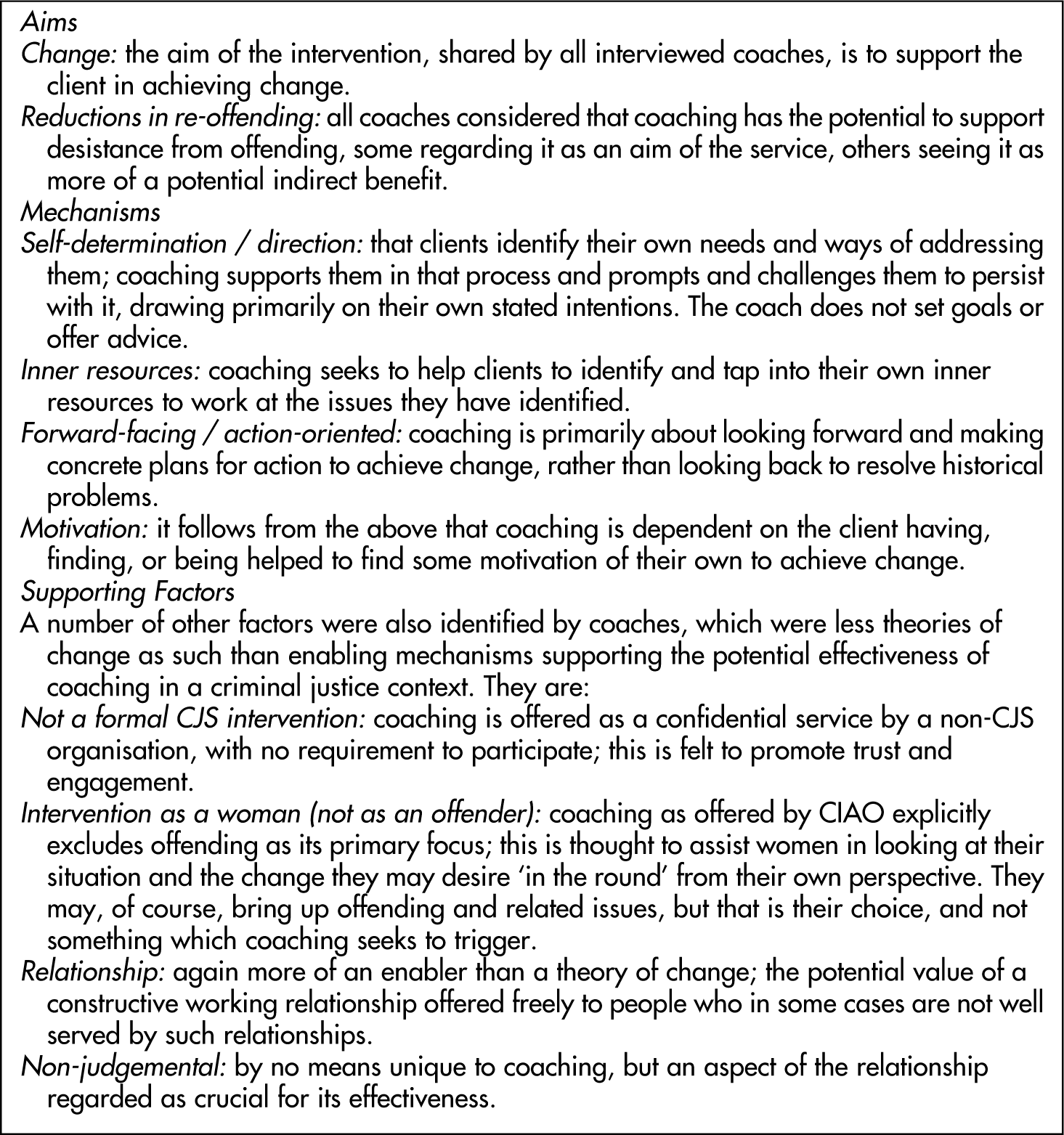
Summary of CIAO's theory of change.
A strong correlation did emerge between this theory of change as set out by CIAO and the service and outcomes described by clients. This is explored below.
Aims
Clients were clear that the aim of coaching was to: … make a change to a lot of people’s lives, definitely.… It’s not just all about prison and it’s like day to day things, day to day life… what would you want to change? What would you want to better yourself at doing? Setting yourself challenges and saying ‘right, let’s go down there, let’s do this, let’s do that. Right okay that failed; no problem’. (Sharon) Because it works — they don’t want people coming back; (It) can be effective in preventing re-offending for those who might re-offend; and for those (like me) who wouldn’t anyway, it can make us not want to die.
Self-determination/direction
There was strong consensus about the self-determined nature of the experience, and how for many this gave them a greater sense of control over their own lives. This was endorsed by the one client in the sample who did not find coaching helpful, suggesting that she was not ready for this way of doing things. Stacey wanted to (but couldn’t) find a better way of putting it than ‘I am the boss’: That’s not quite the right way of expressing it, but it was around me and what I wanted to do — the message from the off was ‘this is for you — what do you want?’ It was helping me to deal with my issues, but by myself, by using my own strengths… and I think that’s important because you need to be able to deal with things yourself. (Sam) You come up with things and do them. (Chloe) It is empowering. It enables me to tap into my own resources and build on my strengths. (Stacey)
Development of inner resources
A number spoke of finding insights 6 and inner resources not previously apparent to them, and indicated that applying these in action gave them confidence to go further, take bigger steps and a realization that they could exert control in their lives, whether in custody or out (or both). Thus, for example, Sandra and Stacey expressed a new-found confidence that substance misuse was behind them; Sarah progressed from feeling helpless to affect her situation, to exerting control over everything from biting her fingernails to having contact with (and subsequently being released to live with) her children; Chloe described herself as overcoming significant mental health issues to force herself to meet what for her were the significant challenges of interacting with (and on one occasion going to assist) strangers; and Steph went from being the little mouse in the corner to someone taking lead responsibility for a high profile project within the prison and securing day release to attend related national conferences.
The capacity of coaching to help its clients acquire confidence and control was a theme throughout most interviews. It had helped in overcoming experiences and situations frequently bearing the hallmarks of those identified by Baroness Corston (2007) as common to many women in the criminal justice system; these included low sense of self-worth, substance misuse, duress and influence from men to become involved in offending. As CIAO expands its service to cover male offenders it will be interesting to see if it is experienced in the same way, and this may be a subject for further investigation.
This sense of taking control and making choices was reinforced by the process of identifying their own problems and the actions they would take in response. It is typified by Steph who maintained that: … nobody else will control my life ever again, it will be me who controls it. I did it because I wasn’t going to do it… I went away, I couldn’t return without having done anything — I had been so full of it, I had to live up to that.
Forward-facing / action-oriented
This also illustrates the action-oriented, forward-facing aspect which is another key element in the modus operandi of coaching. The focus was not upon what had happened to Catherine or her depression about it, but on the action required to move on. Two women contrasted coaching with counselling which they had experienced previously, seeing counselling as coming to terms with the past (Stacey) or more negatively, being asked questions that you don’t know how to answer (Steph), while coaching was about moving forward. Some had used coaching to raise issues from their past, but had identified tangible actions to help deal with them.
Again, all the women interviewed (or all the 16 who were positive about coaching at least) were able to identify actions they had taken as a result of their coaching. Some were more tangible than others, including: setting up a business; contacting an ex-partner to request the opportunity to speak to her children; giving up smoking; and writing to her family to explain that her previous ‘everything is okay’ demeanour had been a cover for her unhappiness. This translation of coaching into action applied both to women in custody and in the community. Once release is imminent for those in custody then the need to look ahead and plan specific actions takes on a new urgency, and this emerged in interviews with women in this position. For some, taking these actions was transformative in itself; for others, as indicated above, they were a stepping stone to greater actions and also to feeling better about themselves and their situation. Working to carry out plans by the next session was a helpful discipline. However, there was a sense from a number of women (referred to directly by a couple) of the process continuing after coaching: they had learned the technique of problem identification/planning and were continuing to use it for themselves as a tool. They had developed a mindset where they would make plans for the important things they were going to do, including, for those to whom this applied, for their release from prison. This in turn reinforced the sense of control over their lives.
Motivation
As in most forms of intervention, the need for some element of motivation to change was stressed by coaches. This tended to be confirmed by clients. In Chloe‘s words: They’ve got to want to change — it gives you the tools but you have to fix it; it’s a two-way thing. I remember (my coach) saying … you were a really angry person when you first came in, because I didn’t know what it was, or who had put me in for it and like ‘hmmm’, I sort of like sat there, very reluctant.
Sarah had agreed to be coached thinking it would be just a day and I would get a certificate. In the event, it was rather more than a day, and she has no complaints. She takes the view that had there been any element of compulsion, she might have been resistant at first, but thinks her coach would have won her over.
Separation from CJS: Focus not on offending
It is worth mentioning in this context that CIAO’s Canadian precursor, the PACT LifePlan Coaching Program does work with mandated clients on court orders. While creating an initial obstacle, which is by no means always overcome (in the years 2006−2011 completion rates varied from 14% to 50%), PACT have instituted a three-month trial period: provided a young person co-operates during this period they are then allowed to opt out if they so wish. This gives an opportunity to build trust and show a young person the potential benefits of coaching which does persuade a proportion to remain with them and enjoy positive outcomes (PACT, 2013).
Consideration of the interplay between what coaching is, how it is delivered and by whom also links to CIAO’s delivery of its services as an explicitly separate organization from prison and probation authorities. Coaching is entered into as a confidential arrangement, to which risk-related disclosures are the only exception. This separation was described as being important for more than a third of those interviewed: I think it helps because you don’t get treated like…. You just get treated like a person, not just a prisoner, just better. (Sam) … with somebody coming in I think you can be a bit more relaxed; you can be a bit more open with them because they’re not in here and with the confidentiality thing I think there’s more trust … and I think that’s great, that they volunteer to come in and do that with people. (Sharon) They treated me like any other person, as if we weren’t here in a prison environment. I could have been going to their offices seeing them. It just made not the slightest bit of difference at all … I thought it was great, yeah. (Sandra) (My coach) never, ever judged and I think that’s very important for people in this situation, to feel that you are never judged, and she never, ever did. With probation you have no choice, it carries a lot of baggage – fear of being breached and so on. (My probation officer) is very nice. I’ve never not attended, I’m very reliable, but you go and you’re uncomfortable and there are horrible people there, it’s not a nice place to be. People perceive the probation relationship as judgemental or labelling; you’re with an authority figure and respond accordingly … (whereas with coaching) there’s no forcing, you’re there because you want to be and recognise the value of it.
This separation from the criminal justice system is emphasized in the way the Outcomes Star is used at the outset of coaching. It covers ten areas of need including accommodation mental health, substance misuse, learning disability and – normally – offending. However, as employed by CIAO, this is crossed off at the outset and the client invited to score and identify priorities within the other nine. For Sue this demonstrated that: My coach was more interested in me than what I was here for and I’m thinking ‘eeh my goodness, this is unusual’. I thought … ‘yeah, they’re going to get to that bit, why I’m here’ and I was waiting for it. I was really waiting for it but it never came. It never came. In the finish I told her - do you know what I mean? I ended up telling her, but that was my choice. … some people are very uncomfortable speaking about it because at the end of the day they’ve been to court, they’ve been judged and now they’re being punished and they don’t want to go over all things like that, so I think for them to say that at the start is really refreshing.
Relationship
Implicit in some of the above comments is the contribution of the coach−client relationship. Considered in a ‘who works?’ context, this might not, on the face of it, be thought such a key element as in, say, mentoring, which is clearly built around a relationship; coaching is more of a facilitative process. Nevertheless, it clearly emerged as a significant part of the coaching experience. This might not be regarded as surprising for women in prison or on community sentences, perhaps unused to another person taking a professional interest in what is important to them. All clients were positive about their coach, even Colette, who had not enjoyed coaching. Sarah, for example, notes that: (my coach) could cheer me up even when I didn’t want to be cheered up. … it was, yeah, a match made in heaven … to make a connection as strong as I feel that I got from that coaching.
Concluding remarks
As with any intervention hinging to a greater or lesser extent on personal relationships, it becomes difficult to separate out which aspect(s) of the coaching experience has prime responsibility for any impact. Allied to the cautionary note sounded above regarding the subjectivity and short-term nature of information available to the author’s evaluation, this does mean that it cannot claim to ‘prove’ the impact of coaching in achieving specific outcomes such as the reduction of reoffending. It has, nevertheless, secured a very positive account of its potential benefits for women in the criminal justice system. The assessment in relation to CIAO’s theory of change also shows its delivery and perceived benefits to be entirely consistent with what it professes to offer.
Life coaching is a relatively new discipline which in its own right is seeking to build an evidence base. It fits some of the key lessons being put forward from desistance research and it also fits well with the current emphasis on engagement and motivational interviewing in work with offenders. The active working relationship is clearly an important element, certainly in the case of the evaluation discussed here.
CIAO has sought to work with offenders who have some motivation to change and opt into its service; it stresses the importance of its position working alongside, but not as a part of the criminal justice system. It has, however, in some cases at least, demonstrated that an initial desire to be coached is not necessarily a prerequisite for benefiting from the service. There are then good grounds for thinking that life coaching has much to offer to the right people at the right time in a criminal justice context. It would seem fundamental to what is distinctive about coaching that the client remains free to set the agenda, and hence the model of a service sitting alongside formal supervision rather than being delivered within it is important, albeit within agreed standards of ethics. That need not rule out offenders being asked to at least engage in an initial exploration of the potential benefits of coaching, though there is little mileage in attempting to require them to participate longer term.
Criminal justice agencies seeking shortcuts have typically been too ready to seek a ‘one size fits all’ approach. Coaching is not that, but has the potential to take its place amongst a range of useful interventions for people in prison and under supervision in the community. In a ‘who works?’ context, it can bring a new set of people with a distinctive skill-set to the task of engaging with offenders. If, as Deering (2014) suggests is likely, Transforming Rehabilitation makes an emphasis on engaging offenders more difficult to achieve within mainstream criminal justice, it will be all the more important that this sort of avenue is explored further.