




Abstract
Warning letters may be issued to probation service users in the community on licence as an alternative action to recalling them to prison, when the risk of serious harm can be managed safely. Template-based, formalized warning letters may inadvertently increase or compound risk when working with high-risk clients with personality difficulties. As an alternative, psychologically-informed warning letters can be used. The aim of the letters is to facilitate joint meaning-making of violations and breaches of licence conditions between a client and an offender manager, whilst reinforcing boundaries in a thoughtful, empathic way. Practical guidelines are provided for writing and issuing psychologically-informed warning letters in probation when working with high-risk clients with personality difficulties, along with a case study. Finally, possible barriers to using these letters are identified and potential ways to overcome them are suggested.
Keywords
Introduction
The Yorkshire and Humberside Personality Disorder Partnership (YHPDP) describes the joint initiative between the North East National Probation Service (NE NPS) and the Leeds and York Partnership NHS Foundation Trust to implement the Offender Personality Disorder (OPD) strategy. Within this, much of the work in the community involves psychological practitioners providing consultation to probation colleagues in developing psychologically-informed risk management practices with men and women with personality difficulties. This includes considering how to respond to behaviour which may be indicative of an initial increase in risk when supervising service users on licence in the community. Probation practitioners have various options to respond to unacceptable behaviour or an escalation in risk in these circumstances. These include recall back into custody, issuing ACO warnings or issuing a warning letter. As a general rule, offender managers must consider whether to seek recall in cases where the offender’s behaviour indicates that they present an increased risk of serious harm to the public or an imminent risk of further offences being committed. There are robust processes to ensure the test for recall has been met and that alternatives to recall have been considered. This may include the addition of further licence conditions, licence warnings, manager’s warning letter, ACO warning letter and now a psychologically-informed warning letter. Warning letters are also used as an alternative to breach action, for those serving community sentences. The development of the psychologically-informed warning letter has been undertaken in the OPD partnership in North East NPS balancing the need for the NPS to meet its statutory obligation to manage and enforce the orders of the Court together with its primary aims of protecting the public and reducing re-offending, whilst recognizing the psychological needs of the service user. Both are equally important and co-dependent in managing the risk of serious harm, and it is the promotion of an either/or approach that undermines quality of services (Barrett, 2011). Of course there are times when recall is absolutely necessary in order to protect the public and reduce the risk of re-offending, for example when risk is assessed as imminent, when the offender has disengaged and their whereabouts is unknown or when risk factors have become so acute that the risk posed is no longer manageable in the community. However, in cases where alternatives to recall are being considered, psychologically-informed warning letters can be helpful, in preventing risk escalation to a point where recall is the only option.
Working with high-risk service users with personality difficulties in probation presents a range of complex challenges for practitioners. The very nature of ‘personality disorder’ means that relationships are likely to feel disrupted and distorted, which can challenge our ability to consistently and mindfully stay attuned to the service user’s underlying needs and risks. Moreover, by holding in mind a service user’s traumatization and their risk potential, practitioners are usually aiming to strike a delicate balance between compassion and control. The aim is to offer an empathic understanding of the service user’s emotional experience along with very clear limits about what behaviour is not acceptable. Whilst standardized warning letters are a good example of holding clear limits on what is acceptable behaviour and what is not, psychologically-informed warning letters may be one way of showing empathic understanding, but also being explicit and clear about the limits and the consequences of pushing these limits.
By being reviewed along with the service user, they may also be an opportunity to co-construct a hypothesis about the reasons for the behaviour and so invite them to collaborate in the risk assessment process. These letters could be an opportunity for the offender manager to be experienced as a ‘healthy parent’ – an individual who can be consistently available for empathic support and interested in understanding the behaviour attuned to the emotional state of the service user, but who is also able to be clear about what is acceptable and what is not with an explicit explanation of what any consequences may be of breaking the rules.
Repeating relationship patterns from a client’s personal history
Professionals working with a high-risk client group with personality difficulties are likely to experience a wide range of intense emotions. These emotions, which may include anxiety, anger, hopelessness, shame, fear (and in some cases indifference or detachment), often mirror the emotional turmoil experienced by services users themselves, who have survived trauma in their early life. As such, it can be helpful, if not key, for all professionals tasked with managing risk with this client group to take a reflective approach and specifically consider their own emotional reactions and responses. Both the service user and the probation practitioner can find themselves in a confusing, and perhaps overwhelming, emotional and relational tangle, particularly when the limits of acceptable behaviour are being pushed or violated by the service user. Under these circumstances, it is understandable that the ability to think and plan clearly and rationally can be extremely challenging, meaning that thoughtful and non-reactive responses to breaches or poor behaviour can be difficult.
Under these pressured circumstances, the offender manager may feel a pull to make decisions about the management of the case or interact with the service user in a way which echoes roles from the service user’s past around control, neglect, abuse, punishment, reprimand, indulgence or rejection. This repeating pattern, whereby past trauma leads to emotional intensity and relational dynamics that mirror the service users’ past, has been referred to as an enactment in the psychoanalytic literature (see Brown and Lane, 2000). If we struggle to consider these emotional reactions and enactments in a psychological framework then practitioners may inadvertently fall into unhelpful relational dynamics, which actually serve to increase and compound risk as opposed to mediating or ameliorating it.
Personality difficulties and ‘rule breaking’
In our experience, for those with personality difficulties rule breaking and challenging behaviour is almost always in response to an emotional event in a relationship. These behaviours represent a poor attempt at either relationship-management and/or self-management, both of which can become impaired through early life adversity and both of which are central to understandings of personality disorder. 1 For example, a child whose parents enforce boundaries through attack and brutality on some occasions, and do not enforce them at all on others, may become a man who has a powerful drive to control others to feel a sense of security in relationships. He may have a strong need to be independent and resist rules and limits, as they are associated with feeling unpredictably controlled, subjugated and abused by others. In the face of interpersonal adversity, such as feeling controlled, belittled or restricted by a partner, peer or professional, he may experience such distress, rage or ‘detachment’ that he strives for autonomy and becomes non-compliant with his licence conditions, breaks the rules of an Approved Premise or violates moral or legal norms. These dangerous and risky ways of coping have their origins in the psychological survival of the neglected and abused child he once was.
Standardized warning letters as possible enactments
In our experience, if a warning letter is to be issued to a service user then standard templates are used. These templates detail the failure to comply with a requirement, such as a Community Order or Licence Condition, and outline the behaviour leading to this failure. The letter is clear about the behaviour that is needed to remedy this failure and the consequences should it not happen. In our discussions with NPS colleagues, NHS colleagues and service users we have noticed a consensus that whilst the tone of the letters is often clear and firm, it may also be experienced as punitive, impersonal or controlling, with persistent references to failure and language which implies obligation or compulsion. 2 Moreover, the focus is often on behaviours, with little or no acknowledgment of context, emotions or the purpose the behaviour may serve. The use of stern and impersonal templates may be based on the erroneous assumption 3 that individuals with personality difficulties are simply able to modify their behaviour in response to increasingly negative consequences (such as a warning or ‘punishment’). This means that the important link between the service user’s struggle to understand their own emotional states 4 (which often underpins risky behaviour) and risky behaviour is overlooked. Moreover, there may be a missed opportunity to help the service user consider that their behaviour may serve a purpose for them (such as venting anger, feeling a sense of control or rejecting someone before they get rejected).
There is the possibility that the use of standardized and impersonal warning letters is an enactment. That is to say, the dynamic that emerges between the client and the practitioner may mirror various relational patterns from a service user’s early life – the tone of a standardized and impersonal warning letter may reflect this in various ways: A lack of attunement and labelling of emotional states of the service user An experience of feeling shamed and exposed A sense of being controlled and forced to comply A detached, dismissive tone A possible sense of underlying threat and hostility
Given the abuse and neglect histories of many of the men and women we work with, we can hypothesize that they are particularly attuned to signs that another person will shame, expose or control them. Moreover, based on their life experiences of relationships, we may assume that they are likely to interpret the intention of the other as maleficent and threatening. It is not unreasonable to assume therefore that a standardized warning letter may actually act as a potential trigger for the emotional material associated with feelings of shame, inadequacy or impaired autonomy from childhood. In an attempt to cope with these overwhelming emotions service users may use unhelpful coping strategies which they have learnt throughout life, such as acting out; becoming aggressive and abusive; using drugs or alcohol; disengaging; blaming others; breaking rules and offending; or resisting authority. These coping strategies could clearly indicate an inadvertent escalation of dynamic risk factors or a threat to the alliance with the offender manager. So it is clear that when the limits are pushed by service users and the risks increase, we have to react in clear, firm, thoughtful and consistent ways to ensure risk is managed as effectively as possible. Psychologically-informed warning letters may be one way to do this.
What are psychologically-informed warning letters?
The authors developed practical guidance on writing and issuing a psychologically-informed warning letter and carried out a briefing and consultation process with a range of probation professionals in the North East NPS. This included gathering feedback from Offender Managers, Probation Services Officers, Assistant Chief Officers (ACOs), Approved Premise (APs) staff, residents in APs and Clerical Officers. The feedback was grouped into themes using thematic analysis principles (Braun and Clarke, 2006) and these were then used to inform and shape the final set of guidance on writing and issuing a psychologically-informed warning letter, which is set out in Boxes 1 and 2. The results from the thematic analysis also informed our understanding of potential barriers to implementing the use of a psychologically-informed warning letter, which is outlined in Table 1.
The guidelines for writing a psychologically-informed warning letter.
Stick to the facts
Use straightforward and simple language and sentences
Be neutral and avoid value judgements at this point
Try and describe what may have been happening from the service user’s perspective
Consider what may have been driving the behaviour and perhaps what they were trying to protect themselves from or deal with
Don’t write as if it were definite – be tentative by using language such as “perhaps you felt…”, “maybe you thought that…”, “it might that be you’re trying to feel….”
Describe the behaviour
Tentatively label the possible emotion behind the behaviour
Make sure they are linked, but seen as separate
Possibly acknowledge that the behaviour may have made sense/helped them to cope when they were growing up, but now it keeps their problems going.
An acceptance of the emotions, but not the behaviour
State clearly that the service user behaved in this way and that it is a breach / not acceptable
Be clear and to the point – make it clear that the behaviour will lead to consequences
Ensure that the tone is emotionally neutral and keep to a statement of facts
Specific pointers that may draw from anger management, dialectical behaviour therapy skills or offending behaviour programmes in custody
Sense of joint working and your desire to do so
Specific details and plans for next session
Opportunity for them to decide what to discuss too
The guidelines for issuing a psychologically-informed warning letter.
Do it face-to-face, not via post Use the letter to structure the supervision session. It is an opportunity to be tentative and check out with the client whether the emotions and content are reflective of their understanding or experience. Use the letter to facilitate dialogue and reflection together as part of collaborative risk management. Make changes in a collaborative manner and negotiate where needed. If there is a disagreement, include both opinions and state that there is a difference of opinion. Verbally reinforce what is not acceptable and be clear. Be clear that the service user should take the letter away. This is to comply with statutory requirements and perhaps to continue their own thinking outside of the supervision about the breach session and discussion.
Potential barriers and possible ways forward.
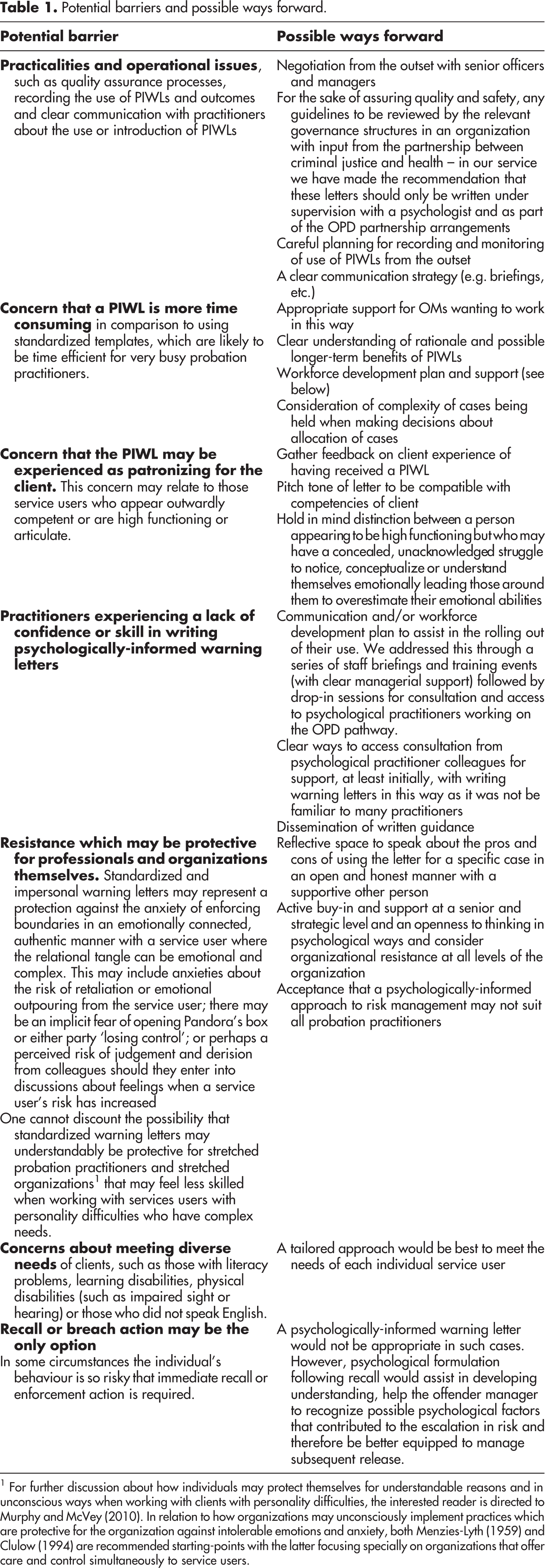
Potential barriers and possible ways forward.
1 For further discussion about how individuals may protect themselves for understandable reasons and in unconscious ways when working with clients with personality difficulties, the interested reader is directed to Murphy and McVey (2010). In relation to how organizations may unconsciously implement practices which are protective for the organization against intolerable emotions and anxiety, both Menzies-Lyth (1959) and Clulow (1994) are recommended starting-points with the latter focusing specially on organizations that offer care and control simultaneously to service users.
Overall, the aim should be for a warning letter that is no longer than a side and a half of A4 and, crucially, the Offender Manager needs to ‘own’ the letter and feel comfortable with the tone and style.
Case study 5
Joe is a 53-year-old man and is currently subject to a 24-month Community Order for offences of Common Assault, which were committed in a domestic context. He has an extensive offending history, which includes sexual offences against a child and violent offences against his partner. He was screened in to the Personality Disorder Pathway.
Joe reports that he lived with his parents into adulthood. He was physically and sexually abused by his father, who was imprisoned for these offences. His mother died 15 years ago. As a child Joe witnessed domestic abuse between his parents on a regular basis. He has struggled in his own adult relationships, which have been characterized by domestic abuse, including verbal aggression and physical violence. He does not like to talk about his childhood, although he says he had a good relationship with his mother. Joe reports feeling terrible about having committed similar offences to that of his father. He has a long history of alcohol misuse, which is considered to be a key risk factor in his violent offending behaviour. He has reported low mood and suicidal ideation. Joe has previously served a long period of custody and a period on licence supervision. Records indicate this was problematic in that whilst he attended appointments, his engagement was at best superficial.
The Offender Manager was advised that there had been an increase in police call-outs to Joe’s address, in response to domestic incidents (four call-outs in three months). In addition, in his supervision sessions his behaviour was becoming increasingly verbally aggressive and there were concerns that he was not being open and honest. He had also displayed aggressive behaviour in his accredited programme group. He had already had a first warning letter (using the standard template) prior to the increase in police call-outs. He was on the brink of being taken back to Court in breach of his Community Order. Following discussion with a Senior Probation Officer and a psychologist, the Offender Manager considered that Joe’s behaviour could be an expression of distress. Wanting to explore this further, she decided to use a psychologically-informed warning letter (see Box 3). This would meet the organizational requirement to respond to and take positive action, whilst also being responsive to the psychological needs of the service user.
Dear Joe,
I am sending you this letter because I am concerned that: You have not been open with me during our supervision appointments You have been aggressive in your Building Better Relationships Course
It is very important that we are both clear about what is acceptable and what is not.
On 4th November 2016 you were involved with police call-out for a domestic violence related incident. When I asked you about your relationship in our supervision session shortly afterwards you did not tell me about this and told me that everything with you and your partner was fine.
On the last session of your Building Better Relationships Course you raised your voice, shouted, swore and made inappropriate comments to the facilitator. This was aggressive behaviour.
Perhaps you felt
Maybe in the BBR course having your beliefs challenged by others makes you feel
In supervision, you hid the truth from me.
In BBR, you shouted and acted in aggressive ways.
This behaviour is not an acceptable way to deal with your emotions.
Feeling angry Hiding things from me or telling me lies
Feeling upset Being aggressive
Feeling ashamed
If there are further police call-outs and you hide the truth from me or do not tell me about this, breach action may be taken which could mean that you are
If you behave in aggressive ways and are removed from the course, breach action will be taken which could mean that you are
As part of our supervision we shall be discussing your relationship. It is important for you to be honest in disclosing any disagreements and also any positive factors. It is also important you continue to tell me about other things happening in your life, which I know is something you already do. I would like you to continue to do this.
Should you struggle with the BBR course I ask that you speak with the tutors at an appropriate time such as during the break or after the session. It is important you do this in a way which does not include raising your voice or using any personal remarks towards the facilitators. You could start off by saying: I feel angry because…. I am feeling frustrated because….
You can also contact myself to discuss any worries you may have. It is very positive that you have attended all appointments organized to date.
It is important that we discuss your thoughts about this letter. It feels important that I understand what led to your behaviour and for us to talk about what you and I are able to do to try and stop this happening again in the future. I look forward to seeing you soon.
Yours sincerely
Clare McClareson
Offender Manager
Initially the Offender Manager was unsure about how much Joe took in during the supervision session in which the letter was issued and spoken about, although he agreed with much of what was discussed. He took the letter away with him. Since the issuing of the letter, the Offender Manager has noted some difference in Joe’s presentation and in his communication. There has been one police call-out in the two months since the letter was issued. Whilst this is worrying, it can be seen as a decrease in frequency. The Offender Manager notes that Joe appears better able to be open with her in supervision and to express his feelings. He reported that he had re-read the letter. It was noticed that he had started using the language of the letter, such as I am feeling angry because…The Offender Manager believed her relationship with Joe has improved because he had begun to speak openly about their relationship – he told her that previously he thought she ‘looked down on him’ and he felt anxious about coming to see her. He reported feeling more able to trust her and was considered to be more honest about his alcohol use – previously he used to chew gum to hide the fact that he had been drinking, whereas now he says ‘I’m not going to lie to you. I have been drinking’. He had also begun to engage with alcohol support services. There is little doubt that Joe will continue to require significant support in order to manage his complex needs and he will in all likelihood continue to challenge services. However, the change in approach of using the psychologically-informed warning letter appears to have had a positive impact, in that it has provided him and his Offender Manager with an opportunity to reappraise their working relationship and a platform from which to progress.
Possible barriers to using psychologically-informed warning letters
Through the consultation process various concerns and issues were raised which we consider to be possible barriers to using psychologically-informed warning letters. These are summarized below with possible ways forward. As a caveat, we acknowledge that there of course may be circumstances in which professionals make a careful and considered decision not to use psychologically-informed warning letters (PIWLs), perhaps due to the limits of resources or due to a service user’s struggle to tolerate conversations about any emotion at all without becoming agitated or very distressed. On other occasions it may be that a practitioner is not particularly suited to or comfortable with working with clients with personality difficulties in a psychologically-informed way.
Reflections on working in partnership
The two authors worked together, with support from colleagues from each of their respective organizations, on developing and using psychologically-informed warning letters as part of the Offender Personality Disorder strategy in Yorkshire and Humberside. This was not without its challenges – open disagreements and debates occurred between us about the content and tone of the letter as we strived to strike the ever-important balance between care and control. Whilst difficult and frustrating at times for both of us, we consider handling disagreement and conflict in professional, curious, open and authentic ways to be an important, enriching and effective part of the ‘work’ for professionals and systems offering support and managing risks for people with personality difficulties Previous explicit agreements through contracting about how we would handle this inevitable ‘tussle’ between us helped us stay on task whilst being open with one another and capitalizing on our respective expertise (see Harvey and Ramsden (2017) for guidance on contracting between professionals working in this context).
Future directions
We would encourage those working with service users with personality difficulties and who pose a high risk of harm to other people to implement the use of psychologically-informed warning letters. We would also encourage these professionals to improve and amend the guidance set out in this article and share this with the community of colleagues whose job it is to address risky behaviours and enforce boundaries, whilst also attuning to the often unacknowledged psychological distress that drives such behaviours. We consider the work outlined in this article to form part of a wider potential move to consider psychologically-informed and relational communication across probation services, including written communication. We are aware of a small pilot of psychologically-informed ending letters (Townsend and Maltman, 2017) being used for men and women with personality difficulties as they come to end of their licence to mediate the risks associated with stress that can be inherent at times of transitions and endings, such as license end dates. Perhaps it is most important to find ways of understanding the usefulness or impact of these letters. We are enthusiastic about the possibility of a qualitative single case study design exploring the experiences and perspectives of one dyad (the Offender Manager and the service user) in relation to having written and received a psychologically-informed warning letter, respectively. Case studies using this approach, whereby various perspectives of one phenomenon are explored, have the aim of generating rich accounts to help develop new ways of considering areas of study or practice (Smith et al., 1997; Elliott et al., 1999).
Footnotes
Acknowledgement
Thanks go to Samantha Short for her diligent assistance and enthusiasm in the thematic analysis and to Jo Ramsden for being a reflective sounding board and for offering insights and thoughts about draft versions of this article. Thanks also to our colleagues, especially the Offender Managers, on the OPD pathway across Yorkshire and Humberside who have helped us shape our thinking based on their experience of using these letters.
Declaration of Conflicting Interests
The author(s) declared no potential conflicts of interest with respect to the research, authorship, and/or publication of this article.
Funding
The author(s) received no financial support for the research, authorship, and/or publication of this article.