




Abstract

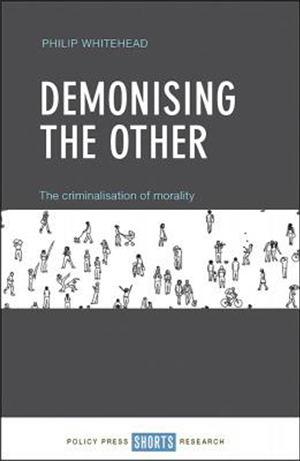
In this short monograph, Philip Whitehead takes on the huge and imminently relevant task of challenging the underlying thinking which allows us to demonise other people. Whitehead starts by defining the problem: ‘Arguably, we have moved into a situation where there is a greater disposition towards othering than towards the well-being and flourishing of all’ (p. 4). Unashamedly, he relates this to a social construction which seeks to maintain the, ‘privilege of the elite…[through]…the production and reproduction of the demonised and relegated others’ (p. 5). But what is othering and the other, and how is this relevant to the work of practitioners in the criminal justice system?
In the first of four short but informative and well-written chapters, Whitehead begins to unpack the relevance of othering to criminal and social justice within a historical context. As he explores the impact of, ‘the capitalist spirit of recent centuries’ (p. 14), the first point of significance to practice is highlighted: the construction of an anxiety-driven culture. From my experiences of probation practice, it was the use of this anxiety-driven culture which led to the development of an overtly risk-dominated culture in which a justifying narrative of public protection is used to dominate the lives of people who are quintessentially demonised as others in the form of offenders.
After highlighting this issue, Whitehead turns to the world of criminology to seek a positive alternative approach. Importantly, challenging the notion of otherness of offenders, he observes that ‘offenders are just like us, indistinguishable from the law-abiding’ (p. 25). Whitehead notes how this is a challenging notion for a politicised criminal justice system which, since the era of Howard and Major, has sought to demonise those who offend (along with trade unionists, benefit cheats, the unemployed, etc.) whilst not applying the same othering process to tax avoiders. Of particular interest is the exploration of how the work of probation has deliberately been eroded as a result of this narrative, narrowing the discussion to individual choice rather than a wider discussion regarding the socio-economic context.
With the context explored the style of the third chapter varies, as Whitehead seeks to bring the evidence to bear in the form of a court case. Calling a number of witnesses to represent a variety of wisdoms, the chapter considers what it is to be human and the impact of capitalism on this with respect to criminal justice. For me, this was a particularly interesting chapter, not just because of its unique style in representing a trial, but also as its contents paralleled much of my own research regarding Christianity and criminal justice. Towards the conclusion of this chapter Whitehead discusses the scandal of love as a contesting idea to the more self-interested domination of risk. Here we find one of the most challenging, but profoundly true, statements in the book when he says ‘it is not just what probation achieves, but what it stands for, which is of real significance’ (p. 78).
Drawing the work together in the fourth chapter, readers are encouraged to critique the ‘barren wastescape of economy, efficiency, effectiveness, value for money and a monochrome culture that manages more than it understands the lives of others’ (p. 83). Whitehead suggests we need to challenge the depth of a language of reform to demonstrate a greater level of shared responsibility. It is perhaps this point which might be most practically explored by practitioners wishing to apply some of the principles of this book to their own work life in the challenge to apply shared responsibility to decision-making whilst under supervision.
Overall, this is a well-considered analysis which motivates towards a fresh approach. It will be difficult for practitioners to apply some of the ideas instantly, but this is the point: what is needed is more than ‘tinkering at the edges’ (p. 92). Ultimately, the conclusion of this book (and my own conclusion when I resigned from the probation service) is that ‘the criminal justice system cannot be reformed, and nor can the neoliberal platform that supports it. Rather, system and platform must be transformed by a foundational ethico-political act’ (p. 91). Whilst this may sound like a depressing conclusion, in my view it liberates us to see it is not the process of our work that counts, but how we approach our relationships with individuals and society that will genuinely challenge otherness.