



Abstract
This paper utilizes the notion of ‘policy disasters’ to examine the policy developments that led to the part-privatization and marketization of probation services in England and Wales – Transforming Rehabilitation. Specifically, it examines the ‘internal’ component of policy disasters, drawing on semi-structured interviews with senior policymakers and other relevant sources. The findings presented demonstrate that the policy dynamics relating to Transforming Rehabilitation specifically, and the departmental budget as an important underlying component, were both distinctly ‘unbalanced’. This is argued to be an important explanatory factor in its damagingly swift implementation and operationalization. In closing, the paper reflects on the policy studies notion of ‘policy equilibrium’ to consider whether the policy landscape relating to probation in England and Wales has reached a ‘steady state’, or whether the ongoing apparent failings of the Transforming Rehabilitation reforms may result in a further round of considerable policy change.
Introduction
This paper adopts the political science notion of ‘policy disasters’ (Dunleavy, 1995) to examine the policy developments that led to the part-privatization and marketization of probation services in England and Wales – Transforming Rehabilitation (TR). It sets out plausible reasons for casting TR as a policy disaster, against the criteria established for its use as a definitional term. The paper then utilizes Dunleavy’s approach to the ‘internal’ component of policy disasters as a schematic device to explore the positions of the key policy participants in relation to the reform of probation trusts during the 2010–15 government.
In order to do so, the paper draws on 26 semi-structured interviews conducted with senior policymakers. The interviews, conducted between March 2014 and August 2016, formed the central plank of a research project that sought to examine English penal policymaking in the novel conditions of the 2010–15 coalition government, as a case study of the ways in which ‘external’ conditions are understood, and reacted to, by those operating ‘internally’ to penal policy change (see also Annison, 2017). The TR reforms, as a crucial development in this period, were often a central focus of these research interviews.
Respondents comprised: eight civil servants with primary responsibility for policy development (termed policy officials, PO); four Conservative political actors (Con); five Liberal Democrat political actors (LD); six charities, campaigners, and other policy participants (Ch); and three other parliamentarians involved in criminal justice policy (Pa). These ‘elite interviews’ were complemented by analysis of relevant policy papers, reports, Hansard debates and speeches.
The findings presented demonstrate that the policy dynamics relating to TR specifically were distinctly ‘unbalanced’, affected also by the unbalanced dynamics regarding the departmental budget. This is argued to be an important explanatory factor in its ‘successful’ implementation. In closing, the paper reflects on the concept of ‘policy equilibrium’ to consider whether the policy landscape relating to probation in England and Wales has reached a ‘steady state’, or whether further policy change is on the horizon.
Transforming Rehabilitation as policy disaster
Scholarly understanding of policy ‘disasters’ – what some scholars alternatively refer to as ‘blunders’ (King and Crewe, 2013) – has been particularly influenced by Dunleavy’s definition of ‘significant and substantially costly failures of commission or omission of government’ (Dunleavy, 1995: 52). Dunleavy further adds an element from Tuchmann’s discussion of ‘policy fiascos’: situations where ‘the mistakes made are eminently foreseeable – but decision-makers systematically choose to ignore an abundance of critical or warning voices in order to persevere with their chosen policy’ (Dunleavy, 1995: 52).
Common categories of policy disasters include public buildings and stadiums; transport infrastructure; IT projects; benefits and tax systems; and defence projects (see King and Crewe, 2013; Flyvberg et al., 2003). Specific examples include the delays and technical problems faced by Berlin Brandenburg Airport; the cost over-runs and delays of the Sydney Opera House; the cost over-runs and limited completion of the Edinburgh Trams project; and almost every Olympic Games (Jennings et al., 2018b).
Does TR qualify as a ‘policy disaster’? The dangers of TR’s part-privatization and part-marketization of probation services in England and Wales were certainly clear in advance. The Justice Committee’s observations in 2014 (during the latter stages of its hasty implementation) were not reassuring: …witnesses, including some supportive of the proposed changes, had significant apprehensions about the scale, architecture, details and consequences of the reforms and the pace at which the government is seeking to implement them. (Justice Committee, 2014: 57)
By July 2018, the fundamental problems with the reforms had become too glaring for government to ignore. The Ministry of Justice announced that existing contracts for the Community Rehabilitation Companies would be ended early (in 2020), ‘using the lessons learnt so far to put in place improved services in the future, with more effective commercial arrangements’. 1 A total of £170 million will be paid to Community Rehabilitation Companies amidst fears of provider failure, further to an earlier £342 million of extra funding paid to CRCs.
Competing accounts of, and explanations for, ‘policy disasters’ (and ‘blunders’) have been an ongoing feature of political science. While some have focused on individual actors (usually politicians or civil servants), others have centred their analysis on the constitutional structures underpinning particular political systems (and the concomitant lack of checks and balances, for example). Further, some have focused on the importance of the lack of resources sufficient to support the particular failed reform under consideration (see Jennings et al., 2018b; Flyvberg et al., 2003). Criminal justice developments have of course not escaped such critiques, not least as regards the populist ‘arms race’ seen to have developed in England and Wales and in other western nations (see for example Green, 2008; Lacey, 2008; Tonry, 2004).
In their recent comparative study of the causes of policy disasters, Jennings et al. (2018b) argue that ‘blundering’ (i.e. government reforms that end in disaster) ‘is not an inherently system-specific feature, but one that occurs across [different] political systems’ (Jennings et al., 2018b). Administrative capacity – i.e. over-ambition of project goals relative to available resources – is almost always an important explanation for specific disasters. The means adopted (i.e. instrument choice) – e.g. inappropriate use of Private Finance Initiative (PFI) contracts – is similarly ‘an almost always necessary condition for severe blunders’ (Jennings et al., 2018b).
But, importantly, Jennings et al. (2018b) conclude that an ‘element of active choice or agency’ is also a crucial causal factor. In short, political choices matter. Here I focus on these elements of ‘active choice’ by examining the goals and viewpoints of a range of relevant policy actors. I do this via a schematic device derived from Dunleavy’s examination of British policy disasters (Dunleavy, 1995). This provides us with one valuable vantage point from which to consider the ways in which individual actions coalesce into specific outcomes. Further, it attunes us to the tensions and ‘frictions’ that occur between different actors and groups. 2
The internal dimensions of policy development
In seeking to explain the internal core arrangements in British policy-making, and how they can lead to policy disasters, Dunleavy set out a schematic summarized in Figure 1. The schematic lists the key ‘internal’ actors in policy development in England and Wales. It sets them out in relation to the position they take, in ‘normal’ policymaking conditions, in relation to potential policy reforms. While most categories are likely self-explanatory, where they are not they are explained in the relevant sub-section below.
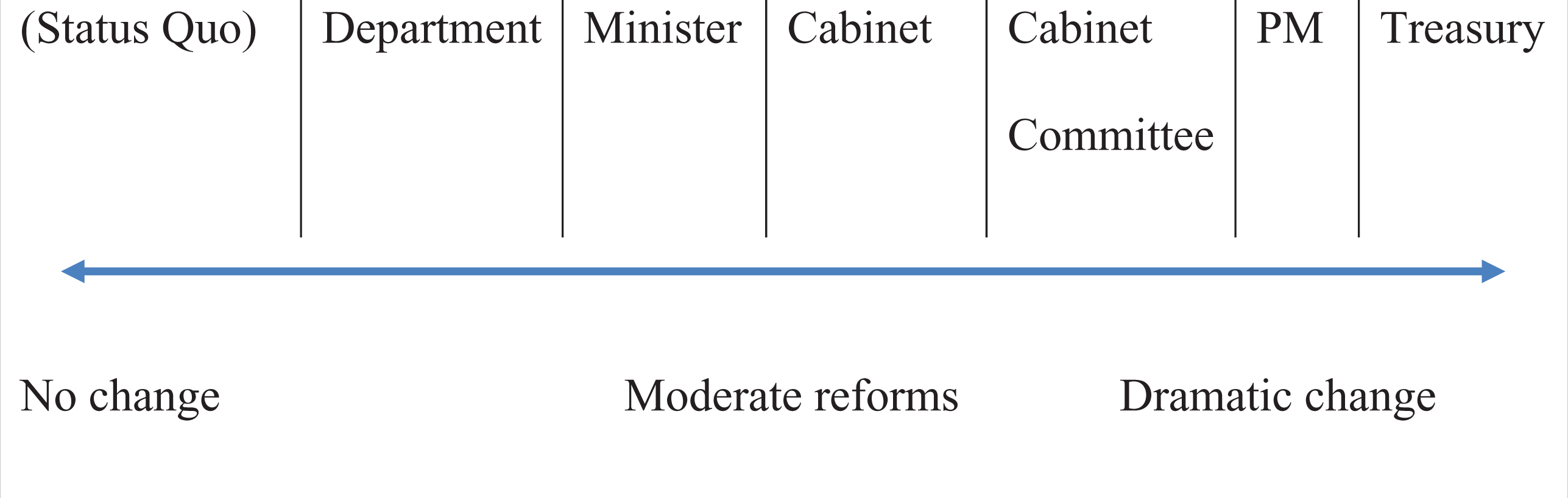
Schematic of key ‘internal’ policy actors and tendencies towards change. Source: Adapted from Dunleavy (1995).
Using the specific example of departmental budget-setting, Dunleavy argues that: Despite starting from very different initial department and Treasury positions, by dint of anticipated reactions the ‘normal’ operation of British core executive decision-making tends to produce convergence on a narrower and more centrist range of options. (Dunleavy, 1995: 66)
The Treasury, on the other hand, usually desire maximum reductions in departmental budgets (relative to other relevant actors). Dunleavy suggests that, in practice, the Treasury will not actually advocate its preferred position, knowing that it is both far removed from the Minister’s desired outcome but, more importantly, that of the Cabinet. In many cases the Prime Minister will not directly intervene. Dunleavy argues that under normal circumstances, even if they do, the department (and the minister) is heavily incentivized to argue strongly for a form of relatively moderate reform and is likely to be successful in achieving one of these outcomes. This appears to show that the British system is generally well-placed to generate ‘moderate’ or ‘centrist’ outcomes-both in relation to budgetary decisions, and more generally.
But Dunleavy goes on to argue that the system can easily be ‘thrown off from a centrist tendency if actors adopt other positions’ (Dunleavy, 1995: 66). For example, if the minister takes a position favouring more stringent cutbacks than even the Treasury wish to achieve (dramatic change), then this ‘suffices to destabilize the system, knocking out the whole system of checks and balances’ (Dunleavy, 1995: 67). The department (as an independent actor) loses its traction, and the centre of gravity shifts further towards ‘dramatic change’ (see Figure 1). In some cases the Cabinet and Prime Minister will agree with this position; in others the decision will effectively have been taken before they are able to affect the final decision. 3
The internal dimensions of Transforming Rehabilitation
Dunleavy’s schematic will now be utilized as a device by which to structure an examination of the positions of, and interactions between, the key policy actors in the part-privatization and part-marketization of the probation services in England and Wales, known as Transforming Rehabilitation. We ask, in other words, where were the policy participants ‘placed’ and was the overall result an unbalancing of the normal process (in Dunleavy’s terms)?
We need first to attend briefly to two preliminary matters: the adjustments required to the schematic due to the structure of the 2010–15 government; and the sources on which this paper draws. The 2010 General Election saw a hung parliament, which led to the first peacetime coalition since the 1930s. This comprised the Conservative party as majority partner and the Liberal Democrats as minority partner.
This means that the ‘minister’ category used here involves both (dominant) Conservative ministers – including primarily the Secretary of State – and (minority) Liberal Democrat ministers. Further, the Prime Minister (PM) category requires the addition of Deputy Prime Minister (DPM) as a formalized position – the detail is set out below. While the Cabinet/Cabinet Committee category remains the same in broad terms, the specific altered dynamics are discussed below. Other elements remain broadly unchanged.
Those unfamiliar with the intricacies of British politics may find useful a brief summary of some of the key ministerial incumbents during this period. As regards the Conservative party, they were led by David Cameron, who simultaneously had sought to ‘modernize’ the party in social policy terms, thus expanding its electoral appeal, while campaigning for a hard-right, anti-Keynesian response to the global financial crisis of 2008 that would require substantial cuts to state expenditure (Hazell and Yong, 2012).
Two Justice Secretaries held office during the period 2010–15. First was veteran conservative politician Kenneth Clarke, a highly experienced minister whose collegiate manner, coupled with his political views – socially liberal (hence concerned about over-use of prisons) and economically liberal (i.e. pro-market) – tended to align him well with many of his Liberal Democrat colleagues. In 2012 he was replaced by Chris Grayling, a much more stridently right-wing conservative politician, both in his social views (hence having no issue with imprisonment, and harsh conditions for prisoners) and his economic views (i.e. pro-market, as Clarke).
As regards the Liberal Democrat party, they were led by Nick Clegg, who it became clear found strong affinities – both personally and as regards policy – with David Cameron. The relevant ministers comprised Lord McNally, the Liberal Democrat minister in the Ministry of Justice during the first part of the coalition period. He was then replaced in 2013 by Simon Hughes, a longstanding member of Parliament.
Ministers – Conservatives phase one
We have seen above that resourcing (or lack thereof) is often an important factor in policy disasters. On the departmental budget, the initial Justice Secretary Kenneth Clarke took a position wholly in line with the austerity drive of the time, and in that sense pushed for ‘dramatic change’, in Dunleavy’s terminology. The Justice Secretary: ‘had one phone call, and gave [the Chancellor] a figure he should have been pleased with’ (Policy participant).
The Treasury was indeed delighted. The outcome of the initial spending review resulted in agreed spending cuts of 27 per cent from 2010–11 to 2014–15; since this early decision the Ministry of Justice budget has declined significantly and been subject to heavier reductions than any other department (Garside and Ford, 2015; Garside et al., 2018).
Contrasted with this position on department budget, going beyond even what was hoped for by the Treasury itself (see Laws, 2016: 33–47), was the Justice Secretary’s more cautious position on both the nature and pace of probation reform. The notion of payment by results was promoted, but subjected to cautious piloting (Garside and Ford, 2015). Probation reform was mooted, but plans developed continued to envisage a coherent and wholly public service, albeit with Probation Trusts moving far closer to the role of commissioner than provider of services.
There were hopes that the TR agenda would tie in with Police and Crime Commissioners (PCCs), that there would be movement on the Justice Reinvestment agenda and efforts to link up with broader localism efforts. PCCs, locally elected figures with responsibility for over-arching policing priorities, were argued by proponents to ensure greater democratic engagement by, and representation for, local populations. Up to the ministerial reshuffle in 2012, ‘the idea was going to be that PCCs would be the ones to take on devolved probation’ (Ch). Nick Herbert, a Conservative politician, had been appointed as Minister for Policing and Criminal Justice – a post spanning the Ministry of Justice and the Home Office – and his particularly keen interest in the Police and Crime Commissioners (PCC) policy proposal appeared to make him central to such developments.
There was thus potential for significant involvement from the Home Office, but this did not occur. One policy participant recalled, on the basis of their close observation of events, that it looked like a ‘story of failure’ on Herbert’s part: He obviously expected PCCs to look different, to be handed a lot more power than they eventually were, particularly over probation, and then he sort of decided to walk off rather than live with it and try to mitigate it. And maybe the entire second half of the coalition’s approach would have been completely different had he been around. (Ch)
Ministers – Conservatives phase two
The halfway point of the 2010–15 government saw Conservative politician Chris Grayling appointed Justice Secretary. While the policy position regarding the departmental budget had in effect already been set on a bitingly tight course by the early decision taken by his predecessor, Grayling was ideologically committed also to avoiding reductionist measures in relation to the prison population.
As regards probation reform, the caution of his predecessor was wholly abandoned. A Conservative political actor recalled his ‘monomaniacal fervour to get the probation reforms through’ (Con). The payment by results pilots, as a meaningful part of shaping probation reforms, were cast to one side. The political decision was taken to ensure delivery (i.e. irreversible legislative and contractual implementation) of the policy before the 2015 general election.
And the very nature of the proposed reforms sharply changed course. The envisaged localism, the continuing centrality of public sector probation, of the earlier period shifted dramatically to a form of heavily centralized contracting-out to the private sector: ‘[Chris Grayling] was very ambitious. He came in with three priorities and one of them was to privatize the probation service basically, and he did it’ (Ch).
The ceaseless message from the Justice Secretary was to achieve the policy goal no matter the obstacles: There were civil servants who I know quite well who [were saying], ‘Yeah, we’re working day and night to get this thing that we think is essentially a bad idea through and as good as possible because we just have to meet the deadlines. Grayling is not allowing us to stop. He is not allowing us to delay. He is not allowing us to pause.’ (PO)
Ministers – Liberal Democrats
As regards the Liberal Democrat ministerial team, their minority role within the department (as within government as a whole) meant that they were generally able only to ease or somewhat slow, but not fundamentally alter, the direction of travel set by the Conservative Justice Secretary. In terms of the overall departmental budget, the initial Liberal Democrat departmental minister saw in hindsight that he had ‘missed a trick’, accepting Justice Secretary Kenneth Clarke’s decision to propose severe budget reductions where the department felt that he ‘could have fought harder and saved more’ (Institute for Government, 2015a: 4).
Specifically in relation to probation reforms, one Liberal Democrat political actor recalled that: ‘We were in favour of it. The reason we were in favour of it…Look at reoffending rates before TR and tell me that that was a success’ (LD). There was a frustration with a ‘homogenous’ National Offender Management Service (NOMS, now replaced by Her Majesty’s Prison and Probation Service) and a National Probation Service that always ‘says no’ (LD). There was demonstrated in some interviews a notable distrust of state (i.e. public sector) organizations and employees, which went beyond liberal concerns with overbearing state power. NOMS was viewed as being ‘so opposed to any change whatsoever and there are vested interests that protect themselves in there’ (LD). The main thrust of the work, which I agree with, [was] first of all in the rehabilitation of offenders legislation, and the transforming justice legislation; I was on all the departmental committees that worked on that and you know, again, the stuff that’s in there was fully square with certainly my own views and with Liberal Democrat Party views. For example, the extension of oversight of released prisoners to those serving less than 12 months is again I think transformational, because most reoffending is from people who have served short sentences. (Institute for Government, 2015a: 7) The most difficult battles to fight were obviously delivering Transforming Rehabilitation through the department, which obviously had much opposition from the Probation Service or many of them. (Institute for Government, 2015b: 8)
To return to Dunleavy’s schematic, we have seen so far a situation in which the initial Justice Secretary favoured ‘dramatic change’ on budget, but was much more limited on probation reform specifically. The second Justice Secretary remained dramatically reductionist on the budget (albeit at this stage this position is effectively locked in), but on probation reform also drove towards dramatic change. The Liberal Democrat ministers had little discernable effect on any of these positions.
Department
Dunleavy’s schematic assumes that departments tend to follow their minister, notwithstanding the ‘yes, minister’ perceptions of the Civil Service that sometimes still persist. 4 Since the publication of Dunleavy’s paper in 1995 this has only increased: ever more obsession with ‘delivery’, with ‘private sector’ mentality and processes being followed by the Civil Service.
Close observers’ recollections supported the view that probation reforms were an exemplar of the Civil Service adopting this ‘delivery’ perspective. Q: What contributed to this success? Hughes: Phenomenally good work by the Civil Service. I mean very high-quality work by the Civil Service – real commitment, real skill, real ability. (Institute for Government, 2015b: 9) I think you have to separate out the political ideology from the Civil Service interest in making this work. We…found, yes, that the Civil Service was very aware of the issues that we were raising…But there was a very clear line they could not cross, which was to question the extent to which charities should be expected to take part in commercial contracts at all…the actual core politics that we want to bring the market into this, we think that’s how we’re going to make sure rehabilitation happens, that was not up for debate. (Ch)
As ever, the question of ‘who is in the room?’ is key: who is being consulted and indeed what officials are being empowered to lead on policy change? 5 There is always the potential for amenable civil servants to be empowered and ‘difficult’ officials sidelined. Exacerbating this potential tendency, at that time, were changes to the structures and processes in the Ministry of Justice, with ‘much greater focus on how resource is deployed to meet business critical requirements’, operating ‘a flexible resourcing model’ (Gash and McCrae, 2010: 20). This, coupled with general incentivizations for civil servants to ‘deliver’, prioritized and preferred those who were willing and able to ensure swift progression of the chosen policy.
Prime Minister and Deputy Prime Minister
Prime Minister David Cameron’s time as leader of the Conservative Party saw him take positions (somewhat sporadically) which were rhetorically supportive of rehabilitating offenders but couched within arguments for (private) prison-building and within a framework of continued emphasis on punishment. Thus we saw speeches on ‘how we’re reforming the broken criminal justice system to fight crime and improve punishment’ where prisoners would be required ‘to work hard and reform themselves’. 6
Cameron’s tendency to operate as a chairman rather than chief executive saw ministers generally given leeway to develop and pursue their own agendas. He ‘had never really been a man for policy detail’ (Laws, 2016: 73). There was, rather, a tendency for ‘remedial action’ to be taken against ministers being too ‘soft’ or ‘anti-business’, 7 whereas efforts at marketization and privatization tended to be bolstered. Hence the movement towards centralized marketization in the second part of the coalition government was not driven directly by the Prime Minister, but was very much facilitated by him.
The coalition dynamics meant that the role of Deputy Prime Minister was more formalized than would normally be the case. However, the Deputy Prime Minister – Liberal Democrat leader Nick Clegg – was markedly positive about the Transforming Rehabilitation project. Clegg perceived an increasingly ‘liberal, more tolerant and less violent society’ where ‘the government and public can bring about the necessary changes that will ensure a future where more people are free from crime and the fear of crime’ through a ‘Rehabilitation Revolution’ of which the changes to probation were a central plank (Clegg, 2013). It was a set of proposals that he hoped would ‘leave a bigger, more lasting imprint on British society than almost anything else that the coalition government might achieve’ (Clegg, 2013).
One policy participant considered that this kind of grand rhetoric made clear the failure by the Liberal Democrats to work through in detail ‘what a Liberal Democrat justice policy would look like’: ‘What was their framework for deciding what was good and what was bad, what they were going to agree to, what they weren’t when it comes to justice?’ (PO).
Cabinet/Cabinet Committee
Due to the sheer scale of government activity, many policies are not discussed (and certainly not at any length) at Cabinet – the regular formal meeting of government ministers. Many policies are therefore ‘signed off’ at the level of Cabinet Committee, sub-groupings of Cabinet which deal with specific policy areas. Due to the dynamics of coalition government, the Home Affairs Cabinet Committee – which included matters relating to criminal justice – was chaired by Liberal Democrat leader Nick Clegg (Hazell and Yong, 2012: 54).
Policies must be agreed across government, and in this Coalition period there was a requirement for all policies to be formally agreed by relevant representatives of both parties (Hazell and Yong, 2012: 90). It was therefore possible in theory that the Liberal Democrats would have blocked the emerging end-point to which the TR reforms were heading following Chris Grayling’s appointment as Justice Secretary in 2012.
However, one policy participant recalled that: ‘It wasn’t my experience on TR especially that the Lib Dems provided much of a challenge’ (Ch). Another policy participant interpreted this as demonstrating that: ‘The Lib Dems don’t have an objection necessarily to outsourcing. They either shared Mr Grayling’s faith on the role of the market, or they didn’t take much of an interest, or didn’t see how else it could be done’ (Ch).
Further support is provided by consideration of the internal Liberal Democrat debates of the early 21st century. On the one hand, the ‘Orange Book’ liberals (so called due to a book of the same name: Marshall and Laws, 2004) were seen to be economic liberals to the point of embracing neoliberal imperatives. However, influential Liberal Democrats who sought to set out an alternative – more leftist – path sought to promote cohesion, arguing that ‘all British liberals are social liberals, even the ones who claim to be more “economically” liberal than others’ (Howarth, 2007).
That said, there was never wholesale consensus: Liberal Democrat minister Simon Hughes recalled that ‘some of my colleagues were quite uncomfortable about’ Transforming Rehabilitation (Institute for Government, 2015b: 9); a Conservative political actor had similarly gained the impression that: ‘[Liberal Democrats] weren’t massively happy about the probation reforms but it was sort of getting to the end [of the 2010–15 government] by that point’ (Con). 8
Respondents saw the dominant Conservative view – and hence what was most influential at the level of Cabinet Committee decision-making – to be relaxed about privatization, and optimistic about the market’s ability to ‘come up with the right answers’ (PO): I was introduced to a Tory view that with any organization, if you leave it to run for any reasonable amount of time, it gathers inefficiency, it picks up costs and responsibilities and expenses that it shouldn’t incur. There was a view that you need to ‘squeeze’ them periodically in order to get rid of all the fat, to ensure that you’re back to the lean meat. (LD)
Treasury
The Treasury, as is always the case, is focused on reducing expenditure and limiting funds available to government departments. It is the department that says ‘no’. The Treasury had required initial substantial savings to be proposed by nearly all government departments, including Justice, with further substantial reductions then required throughout the coalition period (and beyond) (Garside and Ford, 2015; Garside et al., 2018). As noted above, the Justice Secretary had swiftly agreed to significant cuts (Laws, 2016: 33).
This initial direction of travel remained in place. As regards the probation reforms specifically, the stated position was that the reforms would be resource neutral – in the words of the Coalition Agreement ‘paid for by the savings this new approach will generate within the criminal justice system’ (Cameron and Clegg, 2010: 23). The role of the Treasury was therefore essentially to ‘hold firm’, rather than being required to exert any additional pressure on the department.
Unbalanced policy dynamics, and a settled equilibrium?
Dunleavy’s (1995) influential paper on ‘policy disasters’ has been utilized here to contend, first, that TR can appropriately be cast as a policy disaster in the technical sense of the term. Second, I will argue that, drawing the strands together, we see that TR is exemplary of the ‘unbalanced’ dynamics that can occur within the British political system.
We have seen that there were two related issues in play: departmental budgets (and hence resources available for any major reform projects, absent additional funds) and the specific reform of probation services. As regards the former, we saw that the initial position of the first Justice Secretary in 2010–15 was the most ‘extreme’, at the ‘dramatic change’ end of the scale set out in Figure 1. Very significant cuts were proposed and gladly accepted by the Treasury. The department certainly did not want to go so far and so fast, but recognized the direction of travel and could in any case do nothing but accept this new reality. Its desires, for the minister to ‘fight harder and save a bit more’ (Institute for Government, 2015a: 4), were essentially redundant.
As regards other actors such as the Prime Minister, Dunleavy notes that where the minister has settled with the Treasury in bilateral negotiations, ‘the cabinet committee, PM or median Cabinet member [do not] ever get involved in decision-making’ (Dunleavy, 1995: 66). The system has been ‘destabilized’ compared to the moderating norm that Dunleavy approvingly described, which we sketched out earlier.
As regards the probation reforms specifically (of which the budgetary dimension set out above is an important context), we have seen that the positions of the relevant actors moved in significant ways through the 2010–15 period. Initially, during the years 2010–12 with Kenneth Clarke as Justice Secretary, a relatively cautious position was taken. This can, in fact, best be understood as a restrained attempt at moving along a trajectory that was emerging during the latter days of the preceding Labour government. As one respondent put it, even during that period it was clear to ministers and civil servants ‘where things were going’ (Con).
But payment by results was subject to a number of relatively small pilot projects; greater involvement of the private and third sector in probation services was being explored through a structure that would both retain the existing structure and give local Probation Trusts decision-making (albeit through compelled commissioning) power. Therefore, at the mid-point of the coalition government the position was one of ‘moderate change’ on Dunleavy’s scale. The relevant ministers took centre stage in arriving at this position: the department, and other actors including the PM, deputy PM and the Cabinet, did not play an important role in terms of shifting this centre of gravity.
In sum, this gives us in this initial period a ‘centrist tendency’ on probation reform, in line with Dunleavy’s schematic of ‘normal’ policy dynamics (Dunleavy, 1995: 66). Indeed in this specific case it had led, by September 2012, to a position where, as Garside summarized it, ‘the Ministry appeared overwhelmed by the complexity of the task’ of probation reforms and unable to go further or faster (Garside and Ford, 2015: 18).
By contrast, we have seen that from 2012, and the appointment of Chris Grayling as Justice Secretary, the position shifted dramatically. The Justice Secretary took a position that was far more ‘radical’ than what had been envisaged to that point, both in terms of the role of the private sector, the extent to which the existing probation structure would be re-shaped and the pace of change. The PM and DPM’s interest in the issue, and public statements, dramatically increased and – while not necessarily in accord fully with the Justice Secretary’s desired end-state or methods – provided rhetorical support for both the direction of travel and the speed of the reforms. Hence, taken together, the position is far closer to that of ‘dramatic change’.
As with the initial decisions on budgets, the department had little choice but to fall in line. However, the relevant position of the department (i.e. those actors within the department who were made integral to the reform process, coupled with the apparent sidelining of those who did, or would, raise concerns) here was markedly more favourable to the ministerial policy position. The full Cabinet’s position was of little importance given this context; for the Treasury the central goal was to avoid significant additional expenditure. Despite the implausibility of these reforms being resource-neutral (or indeed cost-saving), this was the assertion made by the department and which was accepted by the Treasury. By taking this position on budgeting, the ministerial team effectively bypassed rigorous oversight from either the Treasury or from other Cabinet colleagues.
We have seen, in sum, a situation where the policy dynamics had become markedly ‘unbalanced’. With the usual state of affairs destabilized – primarily due to the Justice Secretary’s position and the lack of push-back from other influential actors – there was little to prevent the swift implementation of a policy which, as Raynor summarizes, ‘has made community sentences less reliable and less safe, and has done little to create the new resettlement services for short-term prisoners that were part of the rationale for the policy’ (Raynor, 2018: 70).
A settled equilibrium?
Having explored important causal elements of how we have reached the present position, we can by way of conclusion consider the possible future trajectory. We can do so by considering another political science concept, that of punctuated equilibrium. Punctuated equilibrium theory was prompted by the observation of the extent to which policymaking is often characterized by stasis and equilibrium, disrupted sporadically by significant disruption and change (see Baumgartner and Jones, 1993, 2009). Jennings et al. (2018a) summarize the central components of the resulting theory thus: (1) policy monopolies as institutional arrangements that maintain stable and entrenched patterns of decision-making around an issue, supported by (2) an established issue frame or definition, and (3) positive feedback processes that give rise to sudden realignments in public policy (i.e. ‘policy punctuations’) – due to disruption of those policy monopolies and issue definitions.
From this perspective, the TR reforms stand as a ‘natural’ endpoint of these trends, in the same way that the ‘prisoners’ dilemma’ of a locked-in punitive rhetoric on criminal justice is the logical outcome of the trends which Jennings et al. (2018a) and various others have surveyed (see especially Lacey, 2008). However, the extent to which a settled equilibrium has been reached in probation policy remains to be seen. The Ministry of Justice in summer 2018 launched a consultation entitled ‘Strengthening Probation, Building Confidence’, 10 which somewhat euphemistically speaks of some ‘challenges’ that have been faced under the system implemented in 2015. It has nonetheless sought to keep fundamental questions about the structure of probation services (the public-private split instigated in order to facilitate its part-privatization/marketization) off the table. While under the plans probation in Wales will achieve what some have termed ‘TRexit’ (the recombining of the split services into one probation service), the consultation is clear that the goal is to establish ‘a more effective commercial framework’ rather than fundamentally altering the structures established by Transforming Rehabilitation. 11
That may be suggestive of a resettling into a period of stasis, of ‘stable and entrenched patterns of decision making’ (Jennings et al., 2018a: 241). But the problems are myriad. Millions of pounds of additional funding have been provided to the private sector providers running the CRCs in order to keep the show on the road. The generally parlous state of the criminal justice system – driven by years of dramatic funding cuts but influenced also by the deleterious effects of privatization – may be easier to hide, and of less public salience, than some other public services.
But its problems are becoming harder to obscure and may make increasingly implausible efforts to maintain a system in probation (and in criminal justice more generally) that cannot hope to achieve the lofty goals sporadically espoused by politicians, let alone meet basic standards of safety and decency. This is certainly becoming apparent in the prisons context, where at the time of writing four prisons have been subject to the Prison Inspectorate’s urgent notification protocol since November 2017, in a context more generally of worryingly high levels of self-harm, assaults, suicides and other concerning incidents across the prison estate (Prison Reform Trust, 2018). 12
Speaking in 2016, one Liberal Democrat actor recalled a conversation with a colleague regarding at what point one could reasonably assess the success or otherwise of the probation reforms: [We agreed that] it’s fair to say that you can’t really make a snap judgement on TR because of the time scales of delivery and even then it’s difficult to disassociate that from other factors, societal or influential factors. So maybe we don’t see an answer till 2018, 2019. (LD)
Footnotes
Acknowledgements
I am grateful to Jill Annison and the anonymous reviewers for helpful comments on earlier versions of this paper.
Declaration of Conflicting Interests
The author(s) declared no potential conflicts of interest with respect to the research, authorship, and/or publication of this article.
Funding
The author(s) disclosed receipt of the following financial support for the research, authorship, and/or publication of this article: The empirical research was supported by a Southampton Law School Research Fund grant.
