




Abstract
Modern slavery and human trafficking (MSHT) continue to present complex challenges internationally and in the United Kingdom, especially when intersecting with migration systems, labour markets, criminal justice and welfare regimes. This article presents the first comprehensive review of MSHT partnerships in the city-region of Greater Manchester, which has aspects of devolved governance and a well-established culture of cross-sector collaboration. Drawing on qualitative interviews, a practitioner survey and social network analysis, we examine how statutory bodies and NGO/charity organisations coordinate their responses to MSHT, as well as the overlapping areas of homelessness, migration and asylum. Our findings show a broadly cohesive and collaborative partnership landscape, yet one that is held back by the absence of a longer-term vision and governance strategy, lack of resources, inconsistent survivor support and limited private sector engagement. We argue that meaningful MSHT responses and partnerships require not only inter-organisational cooperation, but also clear strategic direction, sustainable investment, and more consistent involvement and acknowledgement of people with lived experience. The article provides evidence-based recommendations to strengthen city-region MSHT partnerships and contributes wider insights for multi-organisational approaches to exploitation.
Keywords
Introduction
Modern slavery and human trafficking (MSHT) continue to present some of the most complex social, criminal, labour-related and human rights challenges facing the world (ILO, 2025; UNODC, 2024). Despite legislative reforms, most notably the Modern Slavery Act (MSA) 2015, the prevalence of MSHT does not appear to be receding in the UK, with National Referral Mechanism (NRM) referrals reaching their highest levels to date (Home Office, 2026), despite over a decade of efforts to address it. MSHT includes diverse forms of exploitation, intersects with migration systems, policing priorities, labour markets and welfare regimes, and disproportionately affects people who experience socio-economic precarity, limited labour protections, insecure immigration status and structural marginalisation (Broad and Turnbull, 2019; Malloch and Rigby, 2016). These intersecting harms crosscut organisational remits and areas of expertise, thereby creating a pressing need for cross-sector multi-agency/multi-organisation and partnership responses 1 that bring together statutory bodies, civil society organisations, businesses and people with lived experience (PLE).
While partnership working has long been a foundation for addressing MSHT, these arrangements can be uneven in design, their expected results, and are shaped by political-economic constraints such as fragmented funding and inconsistent national policy (Cockayne, 2015; Gadd and Broad, 2018; Rights Lab, 2017). Within this national landscape, city-regions such as Greater Manchester, with its devolved governance arrangements and history of collaborative policymaking, provide useful ground to understand how MSHT partnerships operate, and what challenges and opportunities are associated with their development. As part of this broader MSHT framing, His Majesty's Prison and Probation Service (HMPPS) may have some emerging challenges to anticipate. For instance, probation practitioners are unlikely to encounter MSHT offenders in the community, not least because some of those in custody may be deported (GovUK, 2026). However, many people on probation may be at risk of exploitation, such as those who are in debt, homeless and/or substance dependent (Senior and Ward, 2016), which makes the role of HMPPS and their partnerships highly relevant across these spaces.
This article presents the first wide-ranging review of MSHT partnerships in Greater Manchester (Davies et al., 2025) – commissioned by Greater Manchester Combined Authority (GMCA) between 2024 and 2025. We included homelessness, migration and asylum within the scope of the review since, although they are closely connected to MSHT, they are often addressed by different agencies and policy frameworks, which can lead to disjointed responses. The review, which was intended as a snapshot of existing good practice and areas of development, was informed by qualitative semi-structured interviews (n = 33), surveys (n = 35), social network analysis (SNA), and included professional insights from across the public, private, and Voluntary, Community, Faith and Social Enterprise (VCFSE) sectors. While existing research has examined partnership approaches nationally or in general terms (e.g., Lagon, 2015; Macaveiu et al., 2024; Van Dyke, 2017), few studies have provided an in-depth, more localised analysis that situates MSHT within wider systems of governance, as well as overlapping concerns such as homelessness and migration and asylum.
Therefore, this article contributes by examining how Greater Manchester's MSHT responses function as an interconnected system, by identifying the strengths of its collaborative culture while examining gaps in strategic direction, survivor support, governance and engagement with the private sector. Our approach is grounded in the view that partnerships cannot be understood solely through organisational structures or formal strategies but must be analysed through practitioner and victim/survivor experiences, and the wider political-economic context (Clarke, 2021; O’Flynn, 2021). Incorporating a Lived Experience Consultant into the project helps to ensure that survivor-centred perspectives are embedded within analysis and that recommendations are grounded in practical terms (Asquith et al., 2022; Wright et al., 2023). The article proceeds in three stages. First, we contextualise MSHT partnership approaches within the UK policy landscape, by highlighting the tensions and structural limitations that shape local practice. We then outline Greater Manchester's governance structures and MSHT data before discussing key findings from our review. The final section sets out key recommendations to strengthen coordination, governance and survivor-centred practice across the city-region. The article provides a timely and evidence-based analysis that is relevant to policymakers, practitioners and researchers seeking to develop partnership responses to MSHT.
Contextualising MSHT and MSHT partnership approaches
Efforts to address MSHT in the UK are shaped by a national framework that combines criminal justice objectives with victim protection responsibilities yet frequently struggle to reconcile these goals in practice, often because the policing of borders and organised crime takes precedence (Broad and Gadd, 2022). Partnership working has therefore become the default – albeit uneven – architecture through which different organisations attempt to respond to complex victim/survivor needs and systemic drivers of exploitation. The following section contains an examination of this landscape by discussing the challenges and opportunities that inform local and regional responses such as those found in Greater Manchester.
Partnership work across the MSHT sector
In the UK, the MSA 2015 provided legislation that criminalised situations where people are controlled, coerced, or deceived for the purposes of exploitation. Prior to this Act, activities associated with human trafficking were criminalised under a range of different legislation, whereas the MSA brought these offences under one Act (Broad and Turnbull, 2019). Activities covered by the Act include forced labour servitude, human trafficking, sexual exploitation, criminal exploitation and domestic servitude. While data on MSHT is problematic due to factors such as under-reporting, figures from the National Referral Mechanism (the system through which victims of modern slavery are identified) indicate that modern slavery is increasing – or at least that reporting is increasing. In 2024, there were 19,125 referrals of potential victims which represents the highest number recorded since 2009 – when the NRM was launched - and a 13% increase compared to 2023 (Home Office, 2025). Nearly one-third of all potential victims considered by the NRM in 2024 were children. Men and boys accounted for three quarters of all referrals, and UK nationals were the largest single nationality group, although victims were identified from numerous countries. Labour exploitation was the most common form for adults, whereas criminal exploitation was most common among children (Home Office, 2025).
Despite being primarily treated as a crime problem, the shape of MSHT policy has been long debated at the nexus of policy responses to organised crime, migration and labour markets (Broad and Turnbull, 2019). Although the UK's MSA was depicted as ‘world-leading’ by its architects at the time of its development, it has not brought the resolutions it promised, with low levels of prosecutions and piecemeal support received by victims/survivors following positive decisions through the NRM (Gadd and Broad, 2024). The range of offences that fall under the MSA and their intersection with migration systems, labour markets, illicit markets and organised crime mean that institutional siloed approaches are inherently limited (Broad and Findlay, 2025; Malloch and Rigby, 2016). Therefore, anti-slavery strategies depend on multi-agency/organisational and partnership approaches, by integrating relevant agencies and organisations including law enforcement, social care, health providers and non-governmental organisations (NGOs) (Robinson and Payton, 2018). Partly due to limited national guidance on developing partnership frameworks for MSHT, partnerships have tended to emerge locally and have taken various shapes, with varying levels of success and integration of statutory and non-statutory partners (Gardner, 2018; Rights Lab, 2017). In some areas, this has been strengthened by coordinated events and action, while in other areas, efforts have fallen short of expected outcomes (Rights Lab, 2017).
Partnership approaches to MSHT often draw upon research on collaborative responses to other forms of general crime prevention, as well as from within the fields of domestic abuse and hate crime. Partnership work offers a more comprehensive approach by facilitating information sharing and the pooling of professional expertise to strengthen problem understanding and responses, thereby enabling both a focus on redressing emerging problems and improvements in policing and criminal justice responses that rely upon intelligence sharing and victim engagement (Cleaver et al., 2019; Wood and Kemshall, 2008). Common challenges include competing priorities and decision-making processes, reliance on the police as a key authority, precarious funding for specialist VCFSE partners, (Wood and Kemshall, 2008), and the technical and legal challenges associated with sharing personal information (Cleaver et al., 2019). Inconsistent understandings of MSHT may also limit partnership work, especially when organisations lack good-quality, consistent training (Machura et al., 2019). Although partnership approaches are essential to securing good outcomes for survivors, two concerns need particular attention. First, the dominant organised crime framing of MSHT risks sidelining public health, labour-related and human rights perspectives and masking structural conditions that enable exploitation, including socio-economic inequalities (Broad and Findlay, 2025). Second, NGOs’ unstable and short-term funding can undermine long-term planning for survivor support (Malloch and Rigby, 2016) – pulling some parts of the sector away from the provision of support services and towards awareness campaigns that tap into public preconceptions of ‘deservingness’. The predicament these tensions generate underline the need for sustained government investment to underpin partnership frameworks. Such challenges filter down to local and regional areas as well – in this case, the city-region of Greater Manchester.
The MSHT picture in Greater Manchester
Greater Manchester is a metropolitan county comprised of 10 local authorities that collectively navigate overlapping challenges around poverty, housing insecurity, migration and social exclusion. While each local council delivers statutory services independently, collaboration is important in areas such as homelessness, safeguarding and support for asylum seekers. Greater Manchester Police (GMP) have a central role in identifying and responding to MSHT, working with local authorities, immigration services and specialist charities. The VCFSE sector provides crucial frontline support, especially for people with insecure immigration status or no recourse to public funds – and often fills gaps left by statutory provision through safe spaces, casework and legal support. Businesses in the city-region have also emerged (albeit sporadically) as partners in prevention and survivor support, including through ethical supply chains and safe employment pathways (Causeway, 2025; GMP, 2024). The positioning of such actors within areas of shared interest means that Greater Manchester contains a distinct multilevel governance environment that is theoretically conducive to partnership-based responses to MSHT.
Within this structure, Greater Manchester Combined Authority (GMCA), led by the directly elected Mayor, provides strategic coordination across housing, transport, policing, gender-based violence, violence reduction and economic development. GMCA has increasingly advocated integrated, cross-sector approaches to vulnerability, including initiatives such as ‘A Bed Every Night’ (GMCA, 2025a), and facilitates multi-stakeholder efforts around migration and MSHT. Although immigration powers are located with the UK government rather than local authorities, GMCA advocates for more devolved models that would enable more locally tailored interventions. This reflects a broader trend in English devolution whereby city-regions seek to mitigate the local impacts of national immigration and welfare policies, especially for those most at risk of exploitation. Programme Challenger has formed the operational backbone of Greater Manchester's response to serious and organised crime and includes the Modern Slavery and Organised Immigration Crime Unit (MSOICU), which is a police-led programme, for over a decade. Established in 2015 within a wider partnership framework, the MSOICU has adopted a victim-centred and capacity-building approach, thereby contributing to a substantial network of trained Victim Liaison Officers and Tactical Advisors across GMP (Programme Challenger, 2025).
Greater Manchester has seen a gradual increase in MSHT referrals in recent years, with 1023 NRM and Duty to Notify 2 referrals recorded in 2024–2025, which is almost double the figure reported in 2020–2021 and broadly reflects national upward trends (Davies et al., 2025; Home Office, 2026). Children constituted a substantial proportion of referrals between 2020 and 2025 (43%), which highlights the importance of distinguishing between child and adult support pathways, given the enhanced statutory safeguards available to children when compared to the more conditional support that adults can receive under the Modern Slavery Victim Care Contract. Nationality patterns also mirror national data, with British nationals forming the largest group of referrals and, for example, were most associated with criminal exploitation in 2024–2025, whereas non-UK nationals, especially Albanians, Eritreans, Sudanese and Vietnamese, were more frequently linked to labour exploitation or cannabis cultivation.
These nationality-based factors relate to differences in NRM decision-making, since UK nationals were significantly more likely to receive positive Reasonable Grounds decisions, while non-UK nationals experienced disproportionately high rejection rates, contributing to the decline in positive Conclusive Grounds decisions in 2024–2025 following stricter Home Office evidential thresholds (Davies et al., 2025). Labour exploitation is the most prevalent form of MSHT when out-of-force cases are included, 3 although criminal exploitation and sexual exploitation have dominated cases that originate within Greater Manchester, reflecting both local organised crime activity and broader national patterns (Cockbain and Bowers, 2019; Davies and Malik, 2024). Hence, the data show that the city-regional landscape of exploitation is shaped by various demographic factors which have significant implications for support provision, identification practices, and access to protection. It is to the assessment of these provisions and supporting partnership work that we now turn, starting with the data collection methods.
Methods
The methods that informed the original report (Davies et al., 2025), as well as this article, consisted of qualitative and quantitative data to examine partnership work across MSHT, homelessness and migration and asylum spaces in Greater Manchester. Importantly, we engaged a Lived Experience Consultant during key stages of the review, which is generally intended to help ensure that victim/survivor experiences are embedded into projects rather than being afterthoughts or disconnected from the research process (Asquith et al., 2022; Wright et al., 2023). Our approach was a combination of purposive and snowball sampling, which according to Parker et al. (2019), are practical ways to engage with groups such as professionals, and to follow up on key points with others that initial participants may recommend. The approach to data collection consisted of four concurrent parts.
First, 33 semi-structured interviews with 38 professionals who were working mostly in the public sector (e.g., local government, law enforcement) and the VCFSE sector (e.g., charities, NGOs) were conducted. Most participants were based in Greater Manchester, although some were located beyond the city-region and/or worked for national organisations. Accessing professionals can be a time-consuming process depending on their schedule and workload, as well as their awareness of and commitment to the project being undertaken (Wincup, 2017: 62–63). Fortunately, participants were generally aware of the review and were keen to take part, which mitigated concerns with gaining access. In line with existing literature on semi-structured interviews (e.g., Charmaz, 2014), we judged that this option provided a practical combination of pre-set questions as well as flexibility to discuss issues beyond the formal interview schedule. While some survey respondents indicated that they worked for HMPPS, it was unclear whether their roles related specifically to probation. Although we invited a range of HMPPS practitioners to participate in interviews, none responded. This may reflect the requirement for researchers to first obtain approval from the HMPPS National Research Committee before engaging with staff – an approval process that was not feasible within the narrow timeframe of the review. Nonetheless, we acknowledge the important role that probation officers play in Greater Manchester, especially those co-located with the Challenger team, who are well placed to share information and support MSHT partnership activity. During interviews, participants (see Figure 1) were asked questions on perceived strengths, limitations and suggested ways forward with MSHT partnerships in the city-region. Interview data were thematically analysed, which is widely used in qualitative research to understand and organise recurring and/or important areas of interest (Naeem et al., 2023).
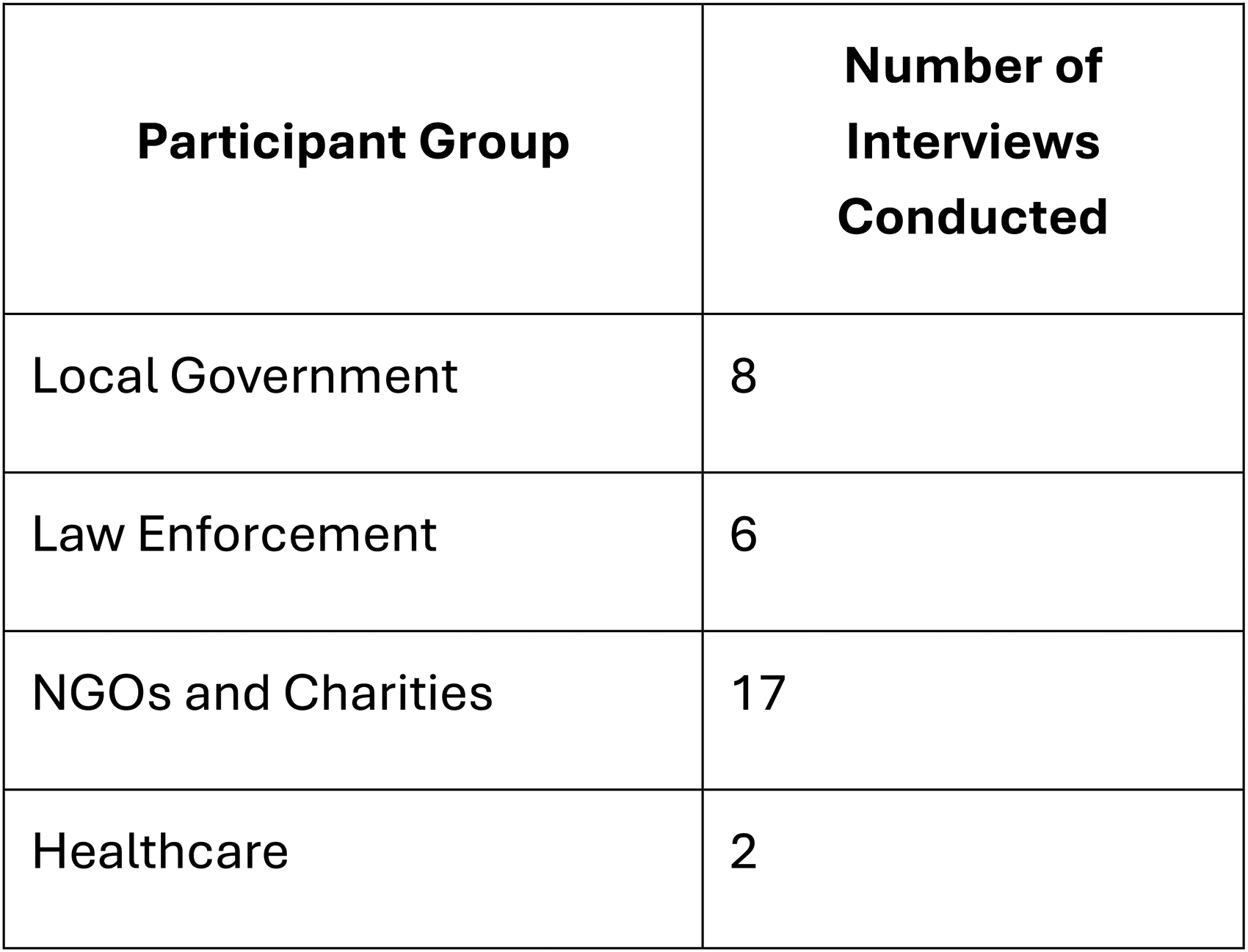
Summary of interviews conducted.
Second, through existing GMCA communication networks, we distributed a survey to professionals working in the MSHT, asylum, migration and homelessness spaces within Greater Manchester, which resulted in 35 usable responses. Respondents were asked questions about which key organisations they collaborated with, which fed into the social network analysis (see below). The main purpose of this survey was to get an overview of which organisations were connected to who, and what implications this may have for partnership work being undertaken. Third, we conducted a descriptive analysis of existing GMP MSHT data (covering the years 2020–2025) for the region, as outlined earlier.
Finally, data from the surveys and interviews fed into a social network analysis (SNA) to help assess the various partnerships and organisations addressing MSHT across Greater Manchester. SNA is an analytical approach to map out, visualise and assess the structure of relationships between ‘nodes’, which could be individuals, organisations or even societies (Scott, 2017). In this case, the SNA consisted of organisations named as collaborators, which assisted in analysing these patterns (see Figure 2). The identification of themes from across these methods grounded our analysis and key recommendations, to which we now turn.
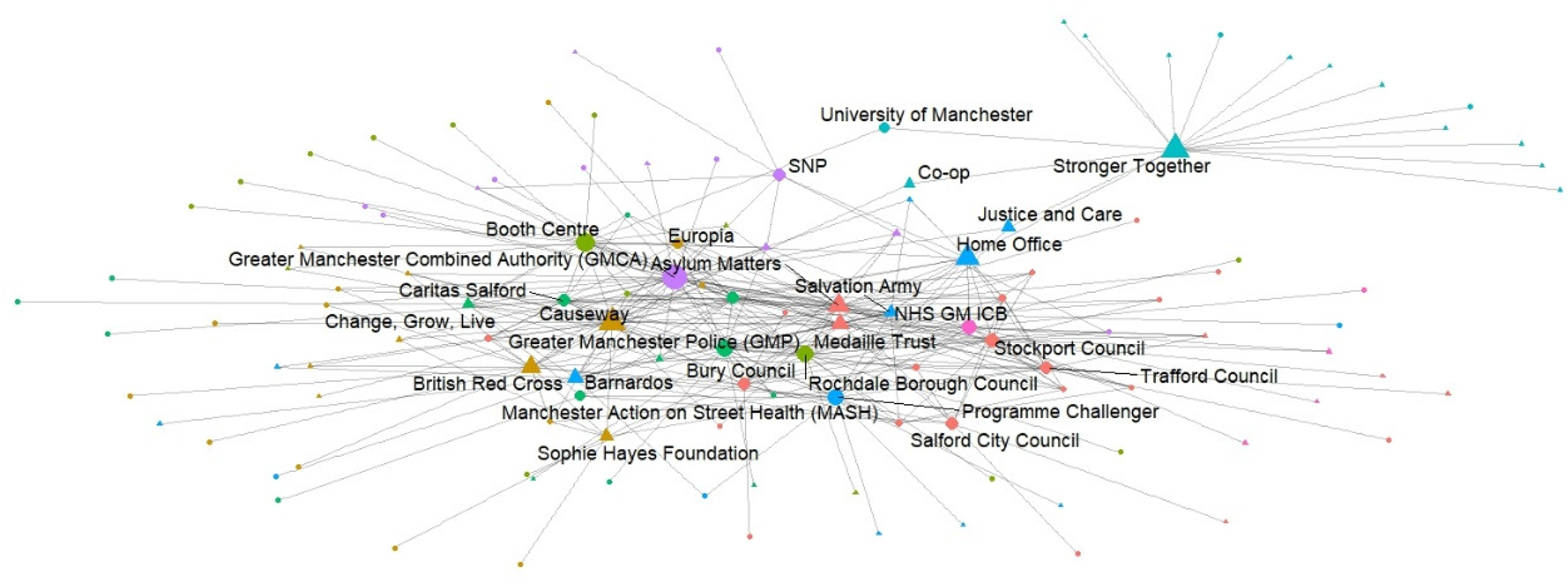
Visualisation (sociogram) of MSHT partnerships in Greater Manchester.
Understanding the dynamics of Greater Manchester's MSHT partnerships
For the rest of this paper, we set out the key findings and recommendations, which are characterised by, on the one hand, positive aspects, such as a strong culture of collaboration across MSHT partnerships and a seemingly coherent network of partners. On the other hand, gaps and limitations of existing MSHT work are discussed, especially regarding a perceived lack of long-term strategy and governance, the need for more consistent victim and survivor support, broader political-economic (structural) barriers, as well as the limited role of businesses / the private sector in partnership. These findings feed into a series of recommendations that are outlined at the end of this section.
Coherent network and strong culture of collaboration
In most cases, interview participants commended a positive and collaborative environment when engaging in MSHT partnerships work across the city-region: Partnership and collaboration is vitally important and it has become increasingly so over the years because the needs of the people we support are so varied they cannot be met by any one organisation. There are a range of interventions required that are provided by different organisations. (NGO-09) A big chunk of our information on modern slavery is from referrals, and by referrals, I mean from outside of the police. When we look at some of our success stories and some of our convictions we've had for modern slavery, and we have really positive stories from the survivors afterwards. When you look at the origin of that, they were referred in from a partner. (Law-Enforcement-01)
These points relate to existing research on the importance of cooperation and communication (Cockayne, 2015), whether these factors are framed in terms of partnerships, informal collaboration, data sharing or multi-agency collaboration. While to some, the above may be an obvious foundation for partnerships, it is arguably worth reinforcing these points, if nothing else to maintain an up-to-date evidence base for the value of such approaches in addressing MSHT.
Such positive perceptions of MSHT partnerships are supported by the SNA (see Figure 2), which consists of 124 organisations and groups (nodes) that participants referred to across the surveys and interviews. The SNA indicates a cohesive, well-connected system that is characterised by short communication pathways and efficient cross-organisational reach. Although some nodes, such as GMCA and GMP, appear to be key connectors, no single organisation dominates the network, which suggests it is sufficiently centralised for coordination yet balanced enough to remain dynamic – which is an arrangement consistent with existing research on collaborative governance and networked service delivery (Ansell and Gash, 2008). The network's composition consists of locally focused and nationally operating organisations, which arguably provides a good foundation to combine local-regional expertise with wider strategic capacity, albeit with variation in local engagement. For example, while the Home Office was described as an important partner from interview data, in the SNA they are underrepresented in the partnership network, despite providing additional work for the city-region via NRM dispersal processes.
Distinct clusters – some of which are regionally oriented and others more local – suggest strong partnership activity across local authorities and the VCFSE sector, especially in overlapping thematic areas where joint responses are important, such as MSHT and migration. This mirrors findings that partnership responses to exploitation and vulnerability benefit from cross-sector density and shared problem ownership (Clarke, 2021). Overall, the SNA suggests a functional and interconnected landscape with identifiable hubs and a broad organisational base, which helps to facilitate coordinated action across intersecting policy areas. Despite the above positivity, there were still several areas where participants had concerns with MSHT partnership work across the city-region. Arguably, the most prominent concern revolved around a perceived lack of longer-term strategy, vision and governance.
Governance, vision and coordination challenges
Most participants highlighted concerns with the lack of a shared vision and associated challenges with ‘joining the dots’ across the MSHT, homelessness and asylum and migration spaces: What's potentially missing is that clear sense of shared direction of what we are all working towards, which would enable more productive conversations to come together. (Local-Government-01) If you have an individual who is really on board, as soon as they leave that post, you have to start all over again. So, it's about ingraining the importance of the work in the culture part of an organisation, rather than just resting on one individual who gatekeeps that information. (NGO-02) The funding is separated, and the evaluation work is always separated as well. What is currently happening is the Combined Authority do something, the local authorities do something else, another organisation is doing something else. They're not speaking to each other. And by the time they get to know each other, the funding is finished, and the post is gone. All the knowledge and learning is gone. (NGO-07)
There are at least three distinct (albeit crosscutting) issues worth discussing here. First, concerns with the absence of a clearly articulated strategic direction across the MSHT partnership landscape in Greater Manchester. Although there are structures such as the Greater Manchester Anti-Trafficking and Slavery NGO Forum which circulate purpose statements, as well as national strategies like the Home Office's 2025 Action Plan on Modern Slavery (Home Office, 2025), awareness of these aims and objectives appears to be uneven. Such ambiguity can weaken collaborative capacity, since research on inter-organisational networks consistently shows that shared goals and common frames of reference are critical for longer-term cooperation and collective problem-solving (Clarke and Fuller, 2010; Cockayne, 2015). Part of this concern also links with a perceived need to embed lived experience perspectives into a wider range of projects to ensure that services were meeting survivor needs, with current inclusion of lived experience often as an afterthought.
Second, there appears to be an over-reliance on individuals who accumulate specialist knowledge through experience or long-term engagement. When this expertise is not fully embedded within organisational structures/cultures or developed into designated roles, it becomes susceptible to staff turnover and workload pressures, which reflects wider concerns about the fragility of ‘person-dependent’ partnership arrangements (e.g., Broadhurst et al., 2010). In a similar vein, many participants expressed concern that they did not have named leads or MSHT points of contact for local authorities across Greater Manchester, which suggests that such work is not as embedded within organisational structures and cultures as it could be. This could be an important oversight, especially since the Human Trafficking Foundation (2025: 11) suggests that out of 218 local authorities that made NRM referrals for adults in 2023, the nine with a designated modern slavery position made up 18% of all NRM referrals. Third, participants highlighted ‘siloing’ or ‘tunnel vision’ across local authorities and other organisations, including NGOs and charities. Despite strong individual specialisms such as child protection or homelessness support, these operational boundaries sometimes masked the wider MSHT landscape and limited more integrated partnership responses between local authorities. Such tendencies towards fragmentation are well documented in previous research, where institutional remits, resources and professional identities can limit cross-sector coordination (Malik et al., 2022; O’Flynn, 2021). Taken together, these three overlapping concerns about vision and strategy risk undermining the support that victims and survivors of MSHT need, which feeds into broader political-economic factors that may be beyond the control of practitioners in Greater Manchester.
Political-economic barriers to MSHT partnerships
As outlined earlier in this paper, there are various macro-level and structural challenges associated with MSHT that can affect partnership work, especially around political rhetoric that conflates different challenges, the process of how projects are funded, as well as services operating in the post-2010s context of austerity: We’ve seen that during the riots in the summer [of 2024], there were incidents where some of our service users and staff had bad experiences, and we feel that all of that is around the rhetoric that built up around immigration. There's been that conflation of immigration and modern slavery that we have battled against for many years. (NGO-09) The biggest challenge that is preventing a lot of that activity is the availability of resources and response there. Because as soon as you turn over the rock, you’ve then got to respond to it. Sometimes there is the willingness but not the capacity to be able to do that, so people don’t want to turn over the rock. (Local-Government-02) Although we come under a Combined Authority, the individual localities still have their own priorities. Funds and commissioning are all in different places and their pictures of modern slavery can sometimes be different. (Law-Enforcement-02)
There are long-standing concerns within research and the VCFSE sector about unhelpful governmental and policy-related conflations between MSHT and issues such as immigration and smuggling (e.g., Anti-Slavery, 2025; Broad and Gadd, 2022). Conflating modern slavery with immigration or smuggling is unhelpful, not least because it risks shifting attention from exploitation and harm towards immigration control, which could negatively affect the protection needs of survivors and increase the possibility that they are treated as offenders rather than as individuals in need of support (Gadd and Broad, 2024). The reference to the 2024 riots across parts of the UK hints at broader societal divisions and associated pressures related to public perceptions of immigration, as well as (perceived) links between immigration and crime (Bowling and Westenra, 2020). Such flashpoints illustrate how swiftly public sentiment can harden in response to political rhetoric and misinformation, thereby creating an environment in which nuanced discussions about exploitation, vulnerability and protection become increasingly difficult to manage.
In addition to such concerns, the ways in which local and regional governments are funded and resourced come under scrutiny in the above extracts. While the lack of resources in local government and NGOs is hardly a new phenomenon, especially after the austerity-led years of the 2010s (Robinson, 2015), the knock-on effects to MSHT survivors is especially noteworthy here. Concerns over the disconnect between local authorities were commonly reported, despite more strategic input from GMCA. One key implication of governments under-resourcing local authorities and statutory services is that it legitimises a reliance on the VCFSE sector to conduct the support work that governments themselves cannot or will not fund (Gadd and Broad, 2018: 1446). This potentially introduces additional layers of fragmentation, complexity and disconnect or inconsistency from services being delivered to survivors.
Where funding was available for MSHT-related projects, participants criticised the ways in which it was dispensed – ‘it's a year-on-year project … It's March and we still don't know if we've got money from April. But that's not unusual, is it?’ (NHS-01). The traditional funding model from key government departments such as the Home Office, and by extension, the Treasury, means that funding for many projects is guaranteed only on a yearly basis, which makes longer-term planning and partnership development difficult to manage. However, following the 2025 Spending Review (HM Treasury, 2025), the UK government appears to be shifting away from single-year funding for many departments, and will establish multi-year funding plans, which in practical terms could help to ensure longer-term planning for MSHT-related projects, and arguably an enhanced service delivery for the benefit of survivors. Nevertheless, these political-economic issues highlight that there are various factors beyond the direct control of local governments and other organisations operating in Greater Manchester – although these issues still have tangible impacts on the quality of MSHT partnership work. Associated with these ‘bigger picture’ challenges is the role of the private sector in the MSHT space, which has traditionally been somewhat overlooked.
Limited engagement with the private sector
Most participants did not directly refer to the role of private sector businesses in relation to partnership work across the MSHT, homelessness and asylum and migration spaces. Indeed, the SNA results indicate that businesses are not central to the existing MSHT partnerships network. This could suggest that businesses are collectively an underutilised resource, although from a more critical perspective, businesses arguably benefit (sometimes unwittingly) from obscurity in their supply chains and from casual labour practices (e.g., LeBaron, 2021). Where the private sector was mentioned in interviews, it was usually in aspirational terms: We have no choice but to engage the private sector in a range of different settings. A large number of children's accommodation is now run by the private sector. You've got, for example, the night-time economy and other businesses that are integral to models of exploitation. And so, we need to engage hotels, we need to engage fast food shops, we need to engage taxis and licensing, all of those. (NGO-10) Whilst homelessness might not seem like an immediately obvious thing for a business to be prioritising, where in the region that they work in, that is a challenge, that could be indirectly creating an increased risk of forced labour within their business and supply chain. (NGO-14)
Efforts to engage businesses in MSHT partnerships were noted by participants as unidirectional and were focused mostly on awareness-raising rather than routine collaboration. However, businesses occupy key positions in sectors where labour exploitation occurs, including agriculture, construction, social care, hospitality and delivery services (Davies and Malik, 2024). Limited private sector engagement can therefore restrict the development of local intelligence and hold back a more complete understanding of city-regional exploitation dynamics. Although Section 54 of the MSA requires large companies to publish annual modern slavery statements, the broader UK framework still relies heavily on voluntary action, despite assertions that mandatory due diligence regimes, such as those emerging in the EU, may strengthen corporate accountability (European Commission, 2022). Enhancing business involvement in local MSHT partnerships may thus offer both operational value and a credible means for firms to meet rising human-rights due diligence expectations – especially in sectors where exploitation may be more prevalent, such as food processing or construction.
The findings and discussion points above point to the value and complexity of MSHT partnership work across Greater Manchester. Some of these challenges are not solely within the remit of local government and other organisations working in the city-region to resolve but nevertheless have an impact on various support services that victims and survivors encounter. In this spirit, below we make a series of recommendations to guide future practice.
Outline of recommendations
We propose six key recommendations for partners across Greater Manchester to operationalise and tailor to their own practice, whether they are based in the public, private or VCFSE sectors. Other practitioners beyond the city-region (and potentially beyond the MSHT sector) may also benefit from these points to consider for their own partnership efforts. These recommendations are not intended to be disconnected or isolated from each other. Indeed, there are elements of overlap between them, which should provide a practical and flexible starting point for practitioners to narrow down and operationalise.
Develop a vision and clear objectives for MSHT partnership work across Greater Manchester
Participants emphasised the need for a unified, clearly communicated city-region strategy. Despite the sense of existing strong collaboration, operational silos and unclear governance can limit coordination. A shared framework, perhaps led by GMCA and/or the NGO Anti-Trafficking Forum, should outline priorities, outcome indicators, and expectations for all partners. Our SNA shows a well-connected network with several central organisations that are well placed to help develop and lead this longer-term strategy (Davies et al., 2025). Maintaining Greater Manchester's strong culture of collaboration, which is characterised by trust and constructive discussions, will require ongoing investment to avoid partnership ‘fatigue’. Consistent opportunities for cross-sector dialogue are essential, alongside attention to external pressures such as funding constraints and national policy changes (e.g., The Law Society, 2025). Simply put, a unified strategy would help to deliver more consistent and coordinated support for survivors. Embedding clear outcomes related to factors such as survivor safety and long-term stability within this strategy would help to ensure that partnership efforts lead to tangible improvements in people's lives.
Establish formalised governance structures to lead MSHT work in Greater Manchester
Ambiguity around governance, especially between GMCA, local authorities and NGOs, risks duplication and limits strategic oversight. Clearer roles, responsibilities and escalation pathways would be useful, especially if these were underpinned by GMCA support to ensure statutory authority and minimise non-engagement. Stronger governance structures would improve alignment with major regional agendas/strategies such as homelessness (GMCA, 2025b), gender-based violence (GMCA, 2025c) and migration and asylum (GMCA, 2025d). Improved sector-specific awareness is also required, especially in housing, health, licensing and the private sector. Consistent training and sector-tailored frameworks would help to embed MSHT considerations into everyday practice. Formalised governance would likely improve accountability and create a more consistent journey for survivors.
Identify and engage named individuals in local authorities to support MSHT coordination
A lack of consistent MSHT contact points in local authorities often disrupts coordination. Each authority should appoint named individuals with clear responsibilities and decision-making capacity, including internal leads and external-facing single points of contact. Embedding these roles in strategic and operational forums would help to enhance continuity and information flow. Named individuals could also facilitate joint training, shadowing and secondments across the MSHT, homelessness and migration and asylum spaces, which would help to break down silos. They would be well placed to strengthen data-sharing arrangements and coordinate shared data platforms. Clear handover processes are essential to mitigate the impact of staff turnover. For survivors, this will mean more consistent contacts, improved coordination and fewer missed opportunities for support. By ensuring clearer and more consistent points of contact, this approach can strengthen survivors’ sense of safety and support their longer-term integration into communities.
Ensure a consistent positive experience for victims and survivors of MSHT across Greater Manchester
Existing support for victims/survivors is essential but also limited, whereby experiences across Greater Manchester vary widely, especially in housing, legal access, mental health and post-NRM pathways. Support for those who are excluded from or face negative decisions within the NRM is inconsistent. A survivor-informed approach, which could be supported by minimum service standards or agreed best practice, would be a step to reduce fragmentation and ensure that no one is left without support due to national eligibility constraints. Frequent criticisms of the NRM (e.g., Lumley-Sapanski et al., 2024; Schwarz and Williams-Woods, 2022) mean that in the longer-term, a devolved/decentralised version of the NRM with a stronger role for local and regional leads may help to enhance survivor experiences by improving efficiency and anticipating a wider range of contextual factors (e.g., appropriate local housing, healthcare, and employment options) to be considered in decision-making and wider support processes. Prioritising safety and the conditions needed for community/societal integration should underpin the development of any consistent support model.
Include people with lived experience in developing services and responses to tackle MSHT
Participants regarded PLE involvement as important to help ensure that services are delivered in ways that are relevant and ethical for survivors. Such roles would need to be appropriately resourced and embedded, rather than merely being tokenistic or an ‘afterthought’. Mechanisms such as advisory panels and co-production roles should be standard practice where resources allow for this. Meaningful PLE engagement is intended to ensure that services reflect survivors’ realities and strengthen their long-term recovery and further opportunities. Care should be taken to avoid assuming one survivor can speak for all, and resource needs to be invested to support and enabled those who do provide this expertise, anticipating that many have had to overcome multiple life experiences and trauma. Incorporating PLE perspectives more directly into decisions about safety, recovery and integration can help to align partnership responses with the outcomes that matter most to survivors themselves.
Develop a stronger MSHT partnership with the private sector
Business engagement with MSHT partnership work appears to be limited, despite high-risk sectors such as construction operating in the city-region. An engagement strategy that contains clear incentives for businesses and industry/employer associations, such as emphasising reputational benefits, combined with the prominence of mandatory corporate due diligence requirements (European Commission, 2022), may help to build sustainable partnerships, and in a similar vein, help to address exploitation within businesses and their supply chains. Ongoing efforts to re-establish and develop the Greater Manchester Modern Slavery Business Network provide a useful platform, alongside options such as consumer-focused awareness, collaboration with the Good Employment Charter and other regional business networks. Stronger public–private sector partnerships are likely to support prevention, earlier identification and more ‘ethical’ employment pathways for survivors. More widely, many survivors may see such employment as a key aspect of their (economic) independence and longer-term recovery and engagement with society (Balch and Williams-Woods, 2023). Expanding private-sector involvement is key to supporting safe employment pathways that enhance survivors’ long-term integration and reduce vulnerability to re-exploitation (e.g., Causeway, 2025).
These recommendations outline a pathway towards a more coordinated, accountable and survivor-centred response to MSHT across Greater Manchester. Strengthening structures, relationships and survivor involvement would help to ensure that support is consistent and resilient in the context of evolving (national) social and policy-related challenges.
Concluding thoughts
The purpose of this article has been to examine the landscape of MSHT partnership working in Greater Manchester, by providing the first comprehensive review of how statutory, VCFSE and private-sector actors collectively respond to exploitation across the city-region. By drawing on interviews, a survey, and SNA, our findings highlight a partnership network that is generally characterised by strong collaboration, a good level of inter-organisational connectivity, and a shared commitment to supporting victims and survivors. The SNA suggests that Greater Manchester has already developed a cohesive partnership structure that includes local and regional organisations, spans multiple thematic areas (i.e., MSHT, homelessness, asylum and migration and more), and enables efficient information flows. Our research also suggests significant challenges, such as the absence of a shared strategic vision and strategy for delivery; over-reliance on individual ‘champions’ in some cases rather than embedded organisational roles; fragmentation across various services; pressures arising from austerity, short-term funding cycles and national political narratives and limited engagement with the private sector. If left unaddressed, these issues may affect long-term planning, inconsistencies in survivor support, and limit the ability of organisations to adopt preventative approaches to MSHT. Recent events such as the 2024 riots reflect wider societal/national tensions around immigration, ethnicity and their perceived (if misplaced) links to crime (e.g., Bowling and Westenra, 2020; Godshaw and Singleton, 2025). These processes show how quickly some public attitudes can harden in response to political rhetoric, which could make it more difficult to maintain balanced, evidence-based discussions about exploitation, partnerships and protection. The current Labour government therefore has a fine line to tread between managing public perceptions of immigration (control), and delivering a robust framework that appropriately supports those affected by MSHT and associated challenges such as homelessness.
As part of this process, although probation practitioners may not supervise individuals convicted of crimes related to MSHT, HMPPS still plays an important role within the wider exploitation landscape. Many people on probation face various conditions that can heighten vulnerability to exploitation (Senior and Ward, 2016). This positions HMPPS as a key partner in early identification and safeguarding efforts, especially where probation staff work alongside cross-agency teams. Strengthening these links would help to ensure that emerging risks are recognised sooner and that vulnerable individuals receive coordinated support across Greater Manchester's MSHT, homelessness and migration spaces.
Several of our findings have a wider relevance for understanding partnership responses to exploitation. First, partnerships depend not only on collaboration but on clarity, including clear governance arrangements, consistent communication and shared strategic direction (Cockayne, 2015). The lack of such clarity in Greater Manchester reflects national evidence that suggests partnerships can be affected when responsibilities are ambiguous or when organisational cultures and professional identities limit the amount of integration (Clarke and Fuller, 2010; Cleaver et al., 2019). Second, while easier said than done in the ‘post-austerity’ context, partnership sustainability requires long-term, multi-year investment rather than solely relying on precarious project-based funding. Without stable resources, expertise may come and go, siloed working develops and survivor support becomes inconsistent (Malloch and Rigby, 2016; Robinson, 2015). Third, meaningful inclusion of PLE is important for projects but requires well-resourced structures to avoid tokenism and ensure that contributions influence strategic practice (Asquith et al., 2022; Keighley et al., 2023). Finally, the private sector, despite its centrality to labour market dynamics, is not always seen as – and does not always (want to) maximise the opportunities of becoming – an embedded partner in MSHT responses. Strengthening these relationships would align Greater Manchester with emerging international debates on corporate accountability and mandatory (human rights and environmental) due diligence regimes, which have gained prominence especially through EU policy developments and global supply chain reforms (European Commission, 2022).
By situating these findings within local and national governance contexts, this article demonstrates how city-regions like Greater Manchester both shape and are constrained by wider political-economic conditions. The contribution of this article lies not only in mapping the existing architecture but also in communicating a set of actionable recommendations that are designed to enhance governance structures, embed survivor-centred practice, reduce fragmentation and strengthen engagement with businesses. These insights extend beyond MSHT, and offer support for partnership responses to homelessness, migration, the broader exploitation 'spectrum', domestic abuse and other complex social issues that require cross-sector collaboration. Future research may benefit from longitudinal studies that track the development of MSHT partnerships over time, analyse survivor outcomes across different support pathways, and perhaps even comparative research that examines different local areas, city-regions, and/or countries to identify transferable ‘good practice’. As discussions on exploitation, housing, migration and labour markets intensify in the UK and internationally (ILO, 2025; UNODC, 2024), there is a need for evidence-driven approaches that promote survivor voices and facilitate partnerships. By providing the first in-depth review of Greater Manchester's MSHT partnerships, this article contributes a foundation upon which policymakers, practitioners and researchers can build and refine more sustainable responses to MSHT and exploitation.
Footnotes
Acknowledgements
The authors would like to thank all participants of the original review on which this publication is based, as well as the editors and reviewers for their comments on earlier drafts of this article.

Ethical approval and informed consent statements
Full institutional ethics approval was not needed for the research that informs this article, since data collection did not involve any populations or individuals deemed as ‘vulnerable’. However, all participants provided informed consent (written or verbal), were anonymised and agreed to the use of anonymised quotes.
Funding
The authors disclosed receipt of the following financial support for the research, authorship and/or publication of this article: The original project on which this article is based was commissioned and supported by Greater Manchester Combined Authority.
Declaration of conflicting interest
The authors declared the following potential conflicts of interest with respect to the research, authorship and/or publication of this article: One of the authors (Payne), as an employee of Greater Manchester Combined Authority, was involved in commissioning and overseeing the original review on which this article is based.
Data availability statement
Any requests to access the raw data related to this article will be considered on a case-by-case basis by the authors.