




Abstract
This study aims to identify, describe, and analyse strategies used by a teacher to support the mobility of students with visual impairment in various school environments. A female student with visual impairment in Brazil, aged 5 years, and her classroom teacher participated in the study. Their interactions were videotaped, and later, their dialogue and actions were transcribed. Six themes of analysis were elaborated, one for each support strategy used by the teacher. The results revealed that the strategies employed by the teacher often hampered the child’s orientation and mobility. This was probably the result of a lack of assistance by professionals specialised in Orientation and Mobility, as stipulated in Brazilian legislation.
Introduction
Inclusion policies for students with disabilities were first adopted in Brazil in 1996 under the Law on National Educational Bases and Guidelines, Law no. 9.394/96, which in article 59 stipulates that teaching systems shall ensure that all students have specific curricula, methods, resources, and organisations able to meet their learning needs (Brazil, 1996).
Brazil, having signed the United Nations (UN) Convention on the Rights of Persons with Disabilities, approved in 2006 and the Salamanca Declaration, has supported inclusion policies at every level of education, striving to achieve environments that maximise academic and social development and full participation and inclusion for all (Brazil, 2007).
Under the National Policy on Special Education, the need of children with disabilities for regular classroom care as well as specialised educational care is recognised. This care complements and/or supplements student education aimed at achieving autonomy and independence in school and outside it, that is, it does not replace teaching in the regular classroom (Brazil, 2007). This care includes ‘Orientation and Mobility’ programme that involves learning how to achieve independent, safe mobility as well as maintaining orientation in one’s environment (Ambrose, 2000; Bruno, 1992; Casáis, 1989; Hill, Rosen, Correa, & Langley, 2004; Maciel, 1988; Novi, 1996; Shumway-Cook & Woollacott, 2003). The special education teacher’s job includes the function of advising the regular classroom teacher about strategies that favour student autonomy and involvement in all activities proposed to the group, including in relation to student orientation and mobility in the school environment (Alves, 2006). Besides this special service, Brazilian legislation stipulates that the Ministry of Education shall provide technical and financial support to train managers, educators, and other school professionals for inclusive education (Brazil, 2007).
For the child with visual impairment to move about in a fitting and well-orientated manner in the school environment, she or he needs mediation from the classroom teacher (Brazil, 2002; Bruno & Mota, 2001). The importance of educational intervention being provided as early as possible is now universally accepted. The early intervention programme will enable good practice to become established from the outset and avoid the development of bad habits or practice which would then need to be modified at a later stage (Miller, Wall, & Garner, 2011), because fundamental concepts for a good orientation and mobility such as body awareness, body image, laterality, temporal space relation, and others should be taught in this period.
In Brazil, children with visual impairment are placed in the school environment as early as possible so that this environment can provide the child with full developmental opportunities; this study aims to investigate the strategies used by one classroom teacher to support the mobility of a child with visual impairment while the child is actually mobile.
Method
The study was approved by the Ethics Committee of the College of Philosophy and Sciences (ruling number 0406/2007).
Characterisation of participants
The participant in this study was a female child, 5 years of age, diagnosed with congenital visual impairment and without any other associated disabilities who was being cared for in an early intervention programme and receiving Orientation and Mobility training outside the ambit of the school, and the teacher responsible for the class in which the student was enrolled. The teacher was not a specialist in visual impairment and had not received training in Orientation and Mobility.
Data-collection procedure
A descriptive study model was implemented, using video recording to ascertain the level of assistance and the way resources were employed to support the mobility of the child with visual impairment in the school environment, inside and outside the classroom (André & Lüdke, 1986; Cervo & Bervian, 2002; Fagundes, 1981).
The researcher visited the school 5 days a week to observe and register the child’s routine and to familiarise the students with the camera and the researcher. Intercurrences that could enable an analysable situation or conversely that could harm information collection were identified. In order to minimise ‘research effects’, the researcher stayed at the school with the video-recorder until the students became familiar with the camera and the researcher herself. After 5 days, the researcher’s presence no longer interfered with student behaviour. Furthermore, a distance of more than 3 m was maintained between the researcher/camera and the students in open environments, and at least 3 m in closed environments.
After the observation period, it was established that the class’s routine was the same every day; then, a recording was made of 3:27:20 (3 hr, 7 min, and 20 s) of class activity, that is, 1 day of activities (since students of this age in Brazil only go to school for a half day). The camera included a wireless microphone attached to a belt the student wore on her waist, making it possible to simultaneously collect information on her movements and on dialogue between her and surrounding people.
Analysis procedures
Data analysis employed the following steps: (1) identification and description of strategies used by the teacher during the child’s movement and (2) elaboration of themes expressing the nature of all strategies used by the teacher.
1. Identification and description of strategies used during the child with visual impairment’s mobility.
After watching the tapes, the researcher observed the child’s routine in different school environments: schoolyard, cafeteria, playground, and classroom. Then, the researcher watched the tapes six times, aiming to identify the contexts of the child’s mobility in the different school environments and the situations that arose.
The tapes were recorded in DVD format; the recording had a timer, permitting the annotation of the initial and final moments of each established situation. The recording of the initial and final moments was edited to retain only those situations involving mobility.
After the identification of the mobility situations, the videotapes were transcribed, and after the editing of the recordings, the identified situations pre-established by the researcher, in accordance with the study’s objective, were transcribed in full. In each situation, the researcher described the students’ actions and dialogue and organised them in tables with three columns containing the child’s, the teacher’s, and the other students’ behaviour, respectively (Fujisawa, 2003).
Transcription involved three steps: (1) dialogue was transcribed as it occurred (ipsis litteris), with T used to indicate the teacher and C, the child; (2) for transcription of actions, the specific movement the child made and the type of assistance needed to make it were considered – for example, the teacher might hold the child’s arm and pull her diagonally to get her in line; and (3) the researcher watched the recordings again and adjusted transcriptions when needed. The transcription of actions and dialogue was clear and concise, reflecting the sequence of events, as recommended by Fagundes (1981).
The completed transcriptions were evaluated by two judges, along with a DVD recording of the episodes and a written report with information on the research objectives and data-collection instrument. The transcriptions were presented underneath this information in table form, and sequenced according to the order of the situations. The judges watched the DVD and verified whether the description of the situation corresponded to the image, using the abbreviations A (agree), D (disagree), and PA (partially agree). Judge selection was based on background in special education and especially in Orientation and Mobility. The rate of agreement obtained between the researcher (R) and judge A was 95%, that between the researcher and judge B was 97%, and that between judges A and B, 97%.
2. Elaboration of themes for analysis – strategies used by the teacher.
To properly elaborate themes, the criteria adopted were morphology and functionality, alone or in tandem. Classification in terms of morphology is associated with the individual’s posture, appearance, and movements, while functional classification – which is based on the modifications or effects produced in the environment – uses aspects external to the individual as a reference (Danna & Matos, 1982). The themes and subthemes of the strategies used by the teacher, both those that helped and those that hindered the child’s mobility, are presented in Table 1.
Themes and subthemes of strategies used by the teacher.

Theme 1, ‘Verbal instruction’, was considered dialogue between the teacher and the child with visual impairment or between the teacher and the other students during the child with visual impairment’s orientation and mobility processes in different school environments. This theme was divided into subthemes. The first (1.1) was instruction for orientation offered to the student, that is, guidance in relation to space, time, or her own body. Orientations were considered in relation to whether they suggested (1) the direction to be followed (every instruction offered to guide the direction to be taken), (2) the place that was the goal (every instruction offered to guide to some place in the school to go to), (3) the existence of an uneven area or obstacle (every instruction offered to the student to indicate an uneven area or obstacle), (4) the movement and/or posture to be executed, and (5) the environment (every instruction offered to the student to indicate environment information). The second subtheme (1.2) was incentive (instructions offered to the student that constituted some form of incentive to perform the movement).
Theme 2, ‘Physical contact’, included all actions where the teacher touched the child without displacing her body in space and/or offered her some object.
Theme 3, ‘Motor aid’, considered actions in which the teacher touched the child in such a way as to cause displacement of her limbs and/or body, such as pushing or pulling.
Theme 4, ‘Verbal instruction and motor aid’, involved actions where the teacher speaks and touches the child in a way that causes displacement of her limbs and/or body.
Theme 5, ‘Verbal instruction and physical contact’, referred to actions where the teacher speaks and touches the child without displacing her body and/or offers her some object.
In Theme 6, ‘Without strategy’, none of the aforementioned strategies was used.
Again, the evaluation of two judges was sought to verify whether the described situations fit the themes and subthemes elaborated. The rate of agreement obtained between the researcher (R) and judge A was 94.7%; that between the researcher and judge B was 90.2%, and that between judges was 84.9%.
After the identification and description of the strategies used by the teacher during the child’s mobility in different school environments, they were analysed and discussed in terms of whether they helped or hindered the child’s orientation and mobility on the basis of the literature on orientation and mobility in preschool.
Results and discussion
Below, some situations observed during filming are described, analysed, and discussed. These situations are organised in boxes with three columns, respectively covering the behavioural situation in which the child needed teacher intervention (behaviour of C), the intervention performed by the teacher (behaviour of T), and the child’s response (again, behaviour of C) (Fujisawa, 2003).
Verbal instruction
The teacher’s verbal instructions orientated the student in relation to space, time, or her own body, while encouraging her towards mobility.
Subtheme: direction to be followed by the child
In the following situation, the student stopped in the schoolyard after putting away her toys, waiting for information on which direction to move in. The teacher was more than 5 m away.

Here, the teacher employed a strategy favouring child orientation and mobility: using her voice to help the child perceive and move towards the sound source, and thus to self-orientate aurally and move safely (Kelly, 1981).
Another aspect here is the teacher’s self-positioning, which allowed the child to move in a straight line – a movement in which orientation is important. This strategy should be taught to children with visual impairment, since it allows them to develop a notion of the distance between one point and another and eventually a mental map of the environment (Maciel, 1988).
In another situation, the child was descending a ramp alone after her classmates. The teacher’s strategy here hampered the child’s orientation and mobility: even though the teacher offered instruction when requested, the student walked towards the teacher diagonally.

Walking diagonally can be efficient when there is tactile paving and when the visually impaired person uses a cane or pre-cane. Neither condition was present here. Furthermore, a child with visual impairment who walks diagonally can lose any notion of distance between one point and another, compromising his or her safety (Maciel, 1988).
Ways to stimulate environmental knowledge and encourage movement in the right direction are to help the child memorise straight-line routes and to draw the child’s attention to the environment’s characteristics, such as floors, grass, steps, or ramps, which can be easily followed and used as landmarks, reducing the child’s dependence on adults (Hill et al., 2004).
Subtheme orientation: place to be followed
Below is an example of a situation that favoured the child’s mobility, where the teacher indicated where the child should move as a goal place.

This instruction helped the child get ready for action, as indicated by the fact that she stood up to take action when the teacher indicated a place to be reached. According to Bruno (1992), description and anticipation of events can help a child with visual impairment understand what is happening around him or her. Furthermore, this strategy can contribute towards the acquisition of a mental map of the route and thus help deepen the child’s spatial faculty (Hill, 1976; Mauerberg-DeCastro, Paula, Tavares, & Moraes, 2004).
Next, there is the situation of the arrival of the students at school in the morning, when they put their backpacks in a box in the schoolyard. Here, the teacher’s instructions hindered the child’s orientation and mobility.

Although the child successfully performed the action, the teacher could have provided more consistent information, informing the child that she had the wrong place and should find the box using a haptic object-identification system. Being prompted in this way would also stimulate the development of an improved notion of space (Bruno, 1992).
Subtheme orientation: uneven and/or obstacle
Next, the teacher indicates the presence of a stair (i.e., a sudden rise) in the classroom using a strategy that favours the student with visual impairment’s mobility and orientation.

Even though the teacher does not explain whether the step is ascending or descending, the child is able to get by the obstacle, demonstrating that she already has a mental representation of that part of her environment. It is also important to stress that the indication of a step in the classroom may not need many details because the child is seen to use the doorjamb as a point of reference.
On the other hand, in a more complex and less familiar environment, the teacher uses the same phrase to orientate the student to the presence of a step in the schoolyard, which hampers the student’s orientation and mobility.

In this case, where there is no reference point in the form of the doorjamb, it would have been better for the teacher to instruct the child as to whether the obstacle is ascending or descending, so she could move safely through the environment, since she does not use a cane or pre-cane. Furthermore, it would be necessary for the teacher to describe the positioning of the step relative to the child and/or the environment, so the child could learn the position of the obstacle and deepen her mental representation of the environment (Brasil, 2002).
Subtheme orientation: movement and/or posture to be adopted
Next, the teacher’s instructions to the child to adopt certain postures and movements – specifically, to orientate the child – help her stop and sit precisely and help her orientation and mobility.

It is important for the teacher to stimulate the child to move in order for her to acquire sensorimotor experiences and learn to reproduce the movement when asked, as here (Bruno, 1992). According to Casáis (1992), the teacher can provide cooperative support in the form of co-active movements for a child with visual impairment that permit a sensorimotor experience in which the teacher and student act as a single person. Additionally, the teacher needs to be aware that clear, continuous, precise, and consistent verbal instruction is fundamental if the child with visual impairment is to learn to perform the action herself.
In the next situation, the child walks backward to the stairs on the slide, and the strategy adopted by the teacher hampers the child’s orientation and mobility, in that she uses a non-specific instruction and does not define the direction in which the child should turn.

In situations like these, it is important for the teacher to stimulate the learning of spatial concepts that indicate actions or movements, such as the 45° turn (1/4 turn), the 180° turn (1/2 turn), and the 360° turn (full or complete turn). It is also important for all people who deal with the child to use standard instructions, so that she can memorise them and be able to orientate and move herself safely (Bruno, 1992; Masi, 2003).
Subtheme orientation: environment
In this subtheme, all orientations provided favour the child’s orientation and mobility, as described below.

The teacher’s description of the activity here supported the child’s orientation and mobility, because it helped her prepare herself for it and create a mental map of what to do to reach the target environment and participate in the activity (Bruno, 1992).
One way to stimulate the organisation or construction of a mental map for the school environment is to establish routines that occur at the same times and places. The teacher can also describe the route to be followed by the child, stimulating her to learn other routes in the school and incorporate them into routines to be carried out when needed.
Incentive
Next, the child is in the schoolyard and the teacher stimulates her to walk around independently.

In this situation, the teacher provides incentive strategies that favour the child’s orientation and mobility, since they provide positive feedback. It is important for the teacher to stimulate the child to conduct correct movements and to affirm the child’s success when they are correctly executed, because it increases the child’s sense of safety and comfort (Bruno, 1992).
Physical contact
Physical contact can be used as a strategy by a classroom teacher to indicate direction. Touching the child’s body can orientate the child in terms of which direction to turn in, or can convey and reinforce hints like ‘move forward’, ‘move backward’, ‘move to one side’, and so on.
Furthermore, physical contact can also be used to develop touch techniques. According to Brasil (2002), the touch technique is one of the first mobility techniques that child should learn to aid the acquisition of perceptive skills, helping him or her with orientation and mobility. Through physical contact with the body of a sighted guide, this technique permits the child with visual impairment to detect the characteristics of the route, such as slopes and changes in direction.
In this study, however, all the situations in which the teacher used physical contact hindered the child with visual impairment’s orientation and mobility. In the next situation, the teacher walks hand-in-hand with the child in the schoolyard and the classroom, which hinders the latter’s orientation and mobility.

This ‘sighted guide’ technique should be led by the child with visual impairment in a more active manner – to do this, it is preferable for her to hold on to the teacher’s wrist or elbow. By positioning herself one step behind the sighted guide, the child is able to capture the environment’s information through bodily oscillations while still holding the guide’s arm.
Verbal instruction and physical contact
This indicates situations in which the teacher spoke with the child and touched her without displacing her in space. Next is an example of a situation that favoured the child with visual impairment’s orientation and mobility in the schoolyard, where the teacher used physical contact and instructions on direction. This was effective since, besides giving very specific verbal instructions, the teacher touched the child’s chest, reinforcing the direction that the child was to take.

In the next situation, the teacher uses physical contact and verbal instruction in a way that hinders the child’s orientation and mobility.

In this case, the teacher can stimulate mobility bodily as a sighted guide using tactile-kinaesthetic perception. The teacher stimulates the child to move while holding onto the teacher (ideally his or her wrist and not hand or t-shirt) (Garcia, 2003).
Motor aid
In this study, the motor aid strategy was identified in situations where the teacher touched the child causing displacement of her limbs and/or body. In every situation in which the teacher used only the motor aid strategy, she hindered the child’s orientation and mobility.
For instance, in the next situation, the strategy adopted by the teacher to position the child in the schoolyard hindered the student’s orientation and mobility, since verbal instruction was not used simultaneously to describe the action. Physical displacement of the child must be guided and properly orientated so that she does not lose her spatial orientation (Bruno, 1992).
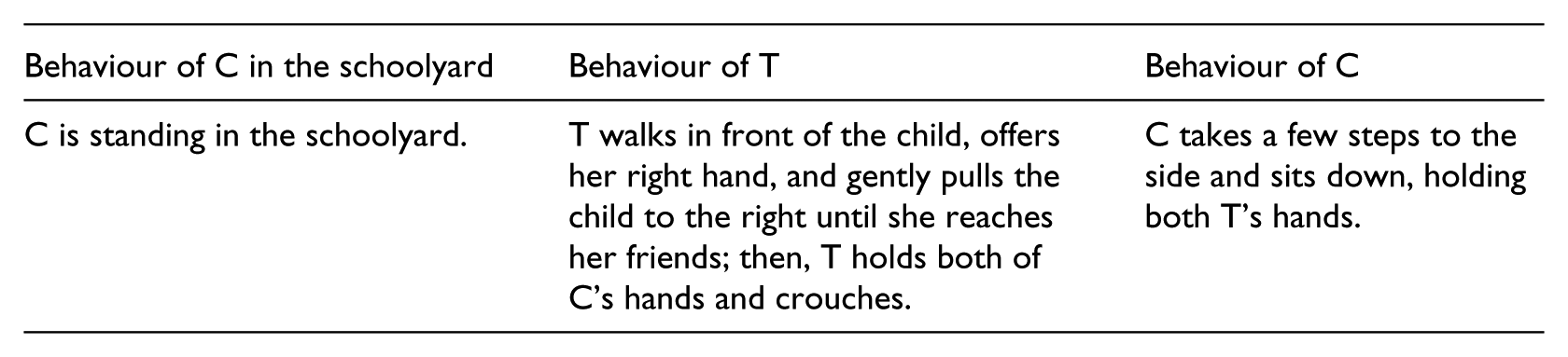
More effective is the use of the motor aid strategy alongside verbal instruction, to avoid disorientating in space. Motor aid through co-active movement, that is, movement made together with the child, stimulates the child’s recognition of the action, which promotes action movement and learning (Brazil, 2003; Bruno, 1992; Bruno & Mota, 2001).
Verbal instruction and motor aid
This strategy was identified in situations where the teacher spoke to the child and touched her so as to cause displacement of limbs and/or body. In the next situation, the use of motor aid and direction instructions hindered the child’s orientation and mobility.

With this strategy, the teacher hindered the child’s orientation and mobility. Although she used the instruction ‘forward’, which is appropriate, she also displaced the child in a forward direction. Instead, she could have stimulated mobility through guidance plus verbal instruction (Machado, 2003).
Without strategy
Non-use of any strategy refers to situations in which the teacher did not use verbal instruction, physical contact, or motor aid. In the next situation, the student is unable to orientate or move adequately in the schoolyard.

The teacher hindered the child’s orientation and mobility by making no intervention. Instead, she could have acted as a mediator to promote the child’s understanding of the situation from beginning to end, including the origin of objects and relations of cause and effect (Bruno, 1992).
Final remarks
This study has shown that teachers very often do not contribute to proper locomotion on the part of their students with visual impairment. Although the child had received orientation and mobility training from a specialist outside school, the teacher and child cannot benefit from specialist guidance in class. This lack may have been the main cause of the inappropriate strategies used by the teacher to facilitate the child’s movements/locomotion.
In the box below, some problems or inadequate strategies and suggestions for adaptations are presented.

Brazil has signed both the Convention of the Rights of Persons with Disabilities and the Salamanca Declaration; however, it is also necessary to implement and enforce policies and actions that actually ensure the rights of disabled individuals. This study concludes that the presence of a professional specialist on orientation and mobility should be mandatory in classes containing students with visual impairments, for their safe and independent mobility. The study has shown the difficulties faced by both the teacher and the impaired child when this specialist is absent. Perhaps the results would have been even richer if there had been interviews to verify the teacher’s perception of whether the strategies used were appropriate or not, and also the child’s feelings about the strategies offered by the teacher: whether they were safe, helpful, and so on. This is a suggested area of work for future studies seeking to assess the inclusion of students with disabilities in classrooms.
Footnotes
Declaration of conflicting interests
The author(s) declared no potential conflicts of interest with respect to the research, authorship, and/or publication of this article.
Funding
This research received no specific grant from any funding agency in the public, commercial, or not-for-profit sectors.