



Abstract
The move towards greater inclusive practice in recent years has resulted in significant changes in curriculum design, delivery and support for children and young people with vision impairments, including increasing placement in settings not designated for pupils with vision impairments. Within these settings, pupils will participate in most curriculum areas alongside their sighted peers with support provided by a range of practitioners including a specialist teacher of children and young people with vision impairments. This article is concerned with analysing the distinctive function and role of the specialist teacher across settings in helping to facilitate an appropriate balance of curriculum ‘access’. Drawing upon recent work in this area, a dual model of access is presented as a means of illustrating the specialist teacher’s role in (1) ensuring that the child’s environment is structured to promote learning throughout their education (‘access to learning’) and (2) supporting the child to learn distinctive skills in order to afford more independent learning (‘learning to access’). While it can be challenging for specialist teachers to find the balance between these two roles, its importance is highlighted in literature which associates independence skills with positive employment outcomes. An ecological systems theory is used as a lens through which to conceptualise and navigate the issues teachers negotiate in facilitating an appropriate curriculum balance. We illustrate the multi-faceted role of the specialist teacher in providing support ‘within’ and ‘between’ the different ‘systems’ within this theoretical framework with a particular focus on the professional ‘standards’ that are used in England and Scotland, respectively. The article is original in being the first to examine the role of the specialist teacher of children and young people with vision impairments through such an analysis. In providing a theoretical framework and related vocabulary illustrated with examples from practice, it therefore has significance for educators and researchers concerned with facilitating curriculum access across national contexts and educational settings in order to reduce future barriers to learning and participation.
Introduction
A central tenet of inclusive education (IE) for children and young people with vision impairments is the notion of ensuring access to a broad and balanced curriculum which is equitable to that provided for all children (e.g., Douglas & McLinden, 2005; Douglas et al., 2009; Mason et al., 1997; McLinden & Douglas, 2013). Nevertheless, the move towards greater IE practice in recent years has resulted in significant changes in curriculum design, delivery and support for these children and young people (e.g., McLinden & Douglas, 2013). The majority of children and young people with vision impairments but no additional disabilities are now educated in mainstream settings. Within these settings, they will participate in many subject areas alongside their sighted peers with individual teaching activities normally limited to particular curriculum areas that are designed to support the child in accessing the mainstream curriculum or developing particular skills (e.g., mobility and independence education, braille tuition, daily living skills). Children and young people with vision impairments and more complex needs will be educated in a range of settings including special schools that may not be specifically designated schools for their vision impairment. As noted by McLinden and Douglas (2013), this shift in provision has implications not only for the pedagogical approaches that are drawn upon to enable these children to access the curriculum alongside their sighted peers, but also for the support available to enable effective inclusion to take place within a given setting. This support is offered by a range of practitioners, and in many countries includes input from a specialist teacher of children with vision impairments working in a class, school, or an ‘advisory’ role (e.g., Mason & McCall, 1997; Mclinden & Douglas, 2013; Ravenscroft, 2015).
In many countries, these specialist teachers will undertake specialist training which is designed to prepare them to work effectively with children and young people with vision impairments across educational phases and within a range of settings. As noted by Ravenscroft (2015), a number of national frameworks have been developed outlining the core ‘competencies’ or ‘standards’ that these specialists are expected to be able to demonstrate. While such frameworks reflect different national policy and legislative contexts, they will commonly include a focus on the knowledge, understanding, and/or skills required by specialist teachers to ensure participation in education through enabling curriculum ‘access’. This can be illustrated through reference to two ‘specific competences’ that teachers of learners with visual impairment in Scotland (Scottish Government, Learning and Justice Directorate, 2007) are expected to be able to demonstrate:
An understanding of the range of barriers visually impaired learners face in accessing the curriculum, and of strategies for enabling access and support within different contexts;
An ability to identify, design, adapt, and evaluate appropriate materials and environmental conditions to meet the needs of the full range of children and young people with a visual impairment, including those with other additional support needs.
Similarly in England, the recently developed specification for mandatory qualifications (MQ) for specialist teachers of children and young people with vision impairments (National College for Teaching and Leadership [NCTL], 2015) incorporates a number of ‘outcomes’ that have a focus on curriculum access including:
4.4 Know appropriate approaches, strategies and interventions to enable learners with VI to acquire key literacy, mathematical and ICT skills, and how to implement these 4.6 Know how to encourage and support learners with VI to be independent learners. Understand how to balance providing targeted support for individual learners with VI with the need to develop independent learning
Given the changing and complex educational landscape in which specialist teachers support children and young people with vision impairments, this article examines how the notion of curriculum ‘access’ can be conceptualised. Our particular focus is on the distinctive role of the specialist teacher of children and young people with vision impairments in enabling curriculum ‘access’ to allow children to acquire key curriculum ‘skills’ (i.e., as illustrated in outcome 4.4 above), and how to balance this targeted support with the need to develop and promote ‘independence’ skills that support longer-term independent learning (i.e., as illustrated in outcome 4.6 above and in Ravenscroft, 2013). We start by examining the term ‘access’ in relation to the curriculum for children and young people with vision impairments and present a dual model of ‘access’ (McLinden & Douglas, 2013). Given the range of settings in which specialist teachers operate (including working with children and young people, families, schools, colleges), we then draw upon the ecological systems theory of development as conceptualised by Bronfenbrenner (1979, 2005). This theory is used as a lens through which to examine the dual model of access in relation to the support strategies provided by specialist teachers when facilitating curriculum access within and between different ‘systems’ in a complex ‘ecology of inclusive education’ (Anderson, Boyle, & Deppeler, 2014). While we draw mainly on the recently developed ‘mandatory qualification outcomes’ in England (NCTL, 2015) and the ‘competences’ that are used in Scotland (Scottish Government, 2007) as examples to illustrate the relevance of the model to the role of specialist teachers, contextualising these examples within a broader ecological systems framework ensures the model has currency and relevance to other national contexts.
Promoting independence through curriculum access
Children and young people with visual impairment constitute a heterogeneous group within which there is a wide spectrum of need and ability (e.g., Douglas et al., 2009; McLinden & Douglas, 2013; McLinden & McCall, 2002). The unique challenges to learning associated with visual impairment are well documented in the literature as is the importance of addressing these challenges through specialist knowledge, understanding, and skills (e.g., Mason & McCall, 1997; Ravenscroft, 2013). In line with this, the term ‘additional curriculum’ is used in the literature to refer to areas which would not typically be taught in schools as part of the core curriculum. As an example, a review of literature by Douglas et al. (2009) highlighted particular areas of the ‘additional curriculum’ as being: mobility (e.g., being able to independently navigate around the school and community), low vision and information access (e.g., using technology and strategies to independently access printed material, the use of low vision aids, learning to read through braille, and the use of computers with appropriate access technology), and social skills (e.g., having friendship groups and self-advocacy skills). In the United States, the term ‘expanded core curriculum’ (ECC) is used in a similar way (e.g., Hatlen, 1996; Sapp & Hatlen, 2010), although in this national context, the ECC itself appears to have been defined in greater detail and vocabulary more universally adopted. As an example, in a more recent discussion of the ECC, Sapp and Hatlen (2010) defined the ECC as having nine areas: compensatory or access skills, career education, independent living skills, orientation and mobility (O&M) skills and concepts, recreational and leisure skills, self-determination skills, social interaction skills, use of assistive technology, and sensory efficiency skills.
Regardless of the terminology, the notion of an ‘additional’ or ‘expanded’ curriculum is clearly linked with the broad notion of independence. To illustrate this, Sapp and Hatlen (2010) present two case studies of 20-year-old young men who have similar academic achievements but very contrasting levels of independence. Importantly, there is evidence that the presence of independence skills is associated with positive employment outcomes for people with vision impairments (e.g., Capella McDonnall, 2011; Wolffe & Kelly, 2011). In spite of this, there is concern that the teaching of such independence skills is often neglected in school education and that young people with vision impairments do not leave compulsory education with the necessary independence skills in place (e.g., Douglas & Hewett, 2014; Sapp & Hatlen, 2010).
While the literature makes a strong case for the curriculum being split between a ‘core’ curriculum and an ‘additional’ curriculum for children and young people with vision impairments (e.g., Mason & McCall, 1997), such a distinction may sit uncomfortably with a more recent conceptualisation of inclusive pedagogy (e.g., Florian, 2014) which views ‘inclusive’ practice as reflecting actions that are collaborative, drawing on the expertise of specialists without relinquishing responsibility for teaching all learners (Florian & Rouse, 2009). Elsewhere we have agreed that inclusive practice should embrace shared curricula, but also argue that inclusive practice must pay attention to aspects of curricula which are of particular relevance to some groups and failure to do so would be unfair and exclude (Douglas et al, 2016). This tension is in keeping with the work of Norwich (2008, 2013) in describing a ‘dilemma of difference’: on one hand, seeking to construct an inclusive curriculum which is relevant to all, and on the other hand identifying an additional curriculum which is particular to some. As indicated in the MQ outcome 4.6 presented above, an important role of specialist teachers will be to navigate this ‘dilemma of difference’ through understanding ‘how to balance providing targeted support for individual learners with VI with the need to develop independent learning’ (NCTL, 2015).
Reconciling this dilemma of two competing curricula is challenging, not least knowing how an educator can teach both ‘given the time constraints of the school day’ (Wolffe & Kelly, 2011, p. 341). However, it is important to recognise that the ‘core’ and ‘additional’ curricula are not considered to be completely independent, but rather, they overlap and intertwine. As a way of conceptualising this relationship, a dual view of ‘access’ has been developed in previous work which has particular relevance to the role of the specialist teacher (e.g., Douglas, McLinden, Farrell, et al., 2011; McLinden and Douglas, 2014). This view of access makes a distinction between:
Providing children with ‘accessible’ material in their preferred medium in order to access curriculum areas (e.g., large print, braille);
Teaching children ‘access skills’ (e.g., through the use of a low vision aid, assistive technology).
As noted by McLinden and Douglas (2014), these approaches can be broadly captured as:
Access to learning. The child is provided with access to appropriate information in order to learn about a particular curriculum area.
Learning to access. The child is provided with the means by which he or she is able to access information independently.
In practice, these approaches are not considered to be mutually exclusive and each will be required at different stages in the child’s educational career depending on the particular curriculum context. In the educational context of England, these approaches resonate with the principles underpinning the ‘Special Educational Needs and Disability’ Code of Practice (Department for Education [DfE], 2015) that all schools must have regard to whenever decisions are taken relating to these children and young people (Box 1).
Principles underpinning the SEND Code of Practice in England (DfE, 2015).
1.1 Section 19 of the Children and Families Act 2014 makes clear that local authorities, in carrying out their functions under the Act in relation to disabled children and young people and those with special educational needs (SEN), the views, wishes, and feelings of the child or young person, and the child’s parents the importance of the child or young person, and the child’s parents, participating as fully as possible in decisions, and being provided with the information and support necessary to enable participation in those decisions the need to support the child or young person, and the child’s parents, in order to facilitate the development of the child or young person and to help them achieve the best possible educational and other outcomes, preparing them effectively for adulthood
1.2 These principles are designed to support: the participation of children, their parents, and young people in decision-making the early identification of children and young people’s needs and early intervention to support them greater choice and control for young people and parents over support collaboration between education, health, and social care services to provide support high-quality provision to meet the needs of children and young people with SEN a focus on inclusive practice and removing barriers to learning successful preparation for adulthood, including independent living and employment
These principles have resonance with the Scottish legislation including the Children and Young People (Scotland) Act 2014 Children which
Ensures that all children and young people from birth to 18 years old have access Named Person;
Puts in place a single planning process to support those children who require it through the Child’s Plan;
Places a definition of wellbeing in legislation;
Places duties on public bodies to coordinate the planning, design, and delivery of services for children and young people with a focus on improving wellbeing outcomes, and report collectively on how they are improving those outcomes.
As noted by McLinden and Douglas (2014), a broad strategy in ensuring ‘access to learning’ emphasises making the educational environment accessible in the current context (i.e., ‘here and now’) and includes providing accessible curriculum materials in a given lesson, guided support with mobility to aid the child in getting to a particular classroom. A complementary strategy is to support the child in ‘learning to access’. This is particularly characterised through areas of the ‘additional curriculum’ which emphasise independence skills such as the use of technology, low vision, and mobility. Such approaches can be viewed as a ‘longer-term’ approach to meeting a child’s future needs which will enable them to gain access to information and curriculum materials for themselves, and to navigate independently social and spatial environments. The notion of developing and promoting independence across a given developmental timeframe lies at the heart of the distinction between each strand of this dual view of access. An illustration of the dual access model is presented in Figure 1.

Role of the specialist teacher of children and young people with vision impairments: balancing ‘access to learning’ and learning to access’.
As reported by McLinden and Douglas (2014), while both approaches are important, there are strong arguments that teaching children access skills (i.e., supporting children in ‘learning to access’) has important longer-term benefits for children and young people with vision impairments as they become independent adults (e.g., Corn et al., 2003; Ravenscroft, 2013). Nevertheless, it is reported that this approach to teaching can often be neglected with evidence that educators commonly emphasise ‘providing accessible material’ to a child, in which those responsible for teaching the child provide material in a predetermined format (e.g., Douglas, McLinden, McCall, et al., 2011). Given the broad ranges of influences/factors in getting an appropriate balance for an individual child over a given developmental timeframe in a particular context, we next consider the role of specialist teachers in helping to facilitate this balance within an ‘inclusive’ educational system. To do this, we draw on the lens of an ecological systems theory (e.g., Bronfenbrenner, 1976, 2005) to examine the educational ‘support strategies’ provided by specialist teachers of children and young people in relation to different ‘systems’ in the theoretical framework.
Ecological systems theory of development
The ecological systems theory of development was originally postulated and refined by Urie Bronfenbrenner more than four decades ago. The theory reflects his work as a developmental psychologist seeking to understand the influences on development within the complex ‘ecology’ within which humans live (e.g., Bronfenbrenner, 1976, 2005). As reported by Rogoff (2003), Bronfenbrenner was ‘interested in specifying the properties and considerations of the social and physical environments that foster or undermine development within people’s “ecological niches”’ (p. 45). The ‘cornerstone’ of this ecology was defined by Bronfenbrenner (2005) as being,
the scientific study of the progressive, mutual accommodation, throughout the life course, between an active, growing human and the changing properties of the immediate settings in which the developing person lives, as this process is affected by the relations between these settings, and by the larger contexts in which the settings are embedded. (p. 107, original italics)
The theory includes reference to a nested system of ‘environments’ often illustrated as a series of concentric circles (e.g., Anderson et al., 2014; Coleman, 2013; Rogoff, 2003). As noted by Rogoff (2003), these environments are described as being separate systems, ‘conceived as existing separately, definable independently of each other [and] related in a hierarchical fashion as the “larger” contexts affect the “smaller” ones, which in turn affect the developing person’ (p. 46). The focus of the theory is considered to be upon the ‘progressive, mutual accommodation’ (Bronfenbrenner, 2005, p. 107) throughout a given timeframe between the developing individual and the changing properties of the immediate settings in which he or she interacts. As noted by Bronfenbrenner (2005), this process is affected by ‘the relations between these settings, and by the larger contexts in which the settings are embedded’ (p. 107). An illustration of the relationship between the environments within an ecological systems theory is outlined and described in Figure 2.

An overview of Bronfenbrenner’s nested systems of environments (adapted from Bronfenbrenner, 1979, 2005).
Surrounding the learner at the centre of the ecology is the microsystem which was conceptualised by Bronfenbrenner (1977) as incorporating ‘the complex of relations between the developing person and the environment in an immediate setting containing the person’ (p. 515, italics added) and including a ‘pattern of activities, roles and interpersonal relations experienced by the developing person’ in a given setting (Bronfenbrenner, 2005, p. 148). The mesosystem was described by Bronfenbrenner as consisting of ‘the interrelations amongst major settings containing the developing person at a particular point in his or her life’ (Bronfenbrenner, 1977, p. 515), and includes ‘the linkages and processes taking place between two or more settings containing the developing person’ (Bronfenbrenner, 2005, p. 148). Situated around the mesosystem is the exosystem. This system is described as encompassing the linkage and processes taking place between two or more settings, at least one of which does not ordinarily contain the developing person, but in which events occur that influence processes within the immediate setting that does contain that person. (Bronfenbrenner, 2005, p. 148)
Lerner (2005) reports that ‘the exosystem is composed of contexts that, while not directly involving the learner have an influence on the person’s behaviour and development’ (p. xiii). Bronfenbrenner (2005) describes the macrosystem as consisting,
of the overarching pattern of micro-, meso-, and exosystems characteristic of a given culture, subculture, or other broader social context, with particular reference to the developmentally instigative belief systems, resources, hazards, lifestyles, opportunity structures, life course options and patterns of social interchange that are embedded in each of these systems. The macrosystem may be thought of as a societal blueprint for a particular cuture, subculture, or other broader social context. (pp. 149–150, original italics)
As reported by Lerner, this system is viewed as being the level involving culture, macroinstitutions (such as federal government), and public policy. The macrosystem influences the nature of interaction within all other levels of the ecology of human development. (p. xiv)
In later versions of his theory (e.g., Bronfenbrenner, 2005), Bronfenbrenner makes reference to the ‘chronosystem’ which Coleman (2013) notes was introduced as a way of ensuring the time element of development was captured.
Extensive reference is made to Bronfenbrenner’s ecological systems theory in the literature in considering the multi-layered influences on child development (e.g., Coleman, 2013; Rogoff, 2003). In an analysis of ‘inclusive education’, Anderson et al. (2014) conclude that the theory ‘offers an invaluable framework within which to organise the environmental factors and understand their influence on inclusivity by placing the learner at the centre’ with each contributory factor ‘located in relation to the learner’s educational ecosystem’ (p. 28). More specifically, Anderson et al. (2014) make reference to the two key determinants of student learning within Bronfenbrenner’s ecological systems theory as being (1) the characteristics of the learner and the environments in which they exist and (2) the relationships and interconnections between these. They draw on the theory to propose an ecology of ‘inclusive education (IE)’ within which it is noted that,
each factor sitting within the systems of the ecology of inclusive education is influenced by other factors within the same and other systems. The amount of influence a factor has on the experience of IE for the learner will depend on where the systems are positioned within which a factor sits, as well as by the importance attached to a factor by those responsible for the system. (Anderson et al., 2014, p. 30)
Anderson et al. (2014) draw particular attention to the ‘social nature’ of IE in this ecology, arguing that ‘any attempt to study either the construct as a whole, or aspects of it, must consider the relationships between various people and societal systems involved in its creation, from the individuals being “included” to the national and global contexts within which it is situated’ (p. 27). In the next section, we draw on the ecological systems model in a similar way – namely as a lens through which to examine the dual model of access presented in Figure 1, and examine the role of the specialist teacher in seeking to balance providing targeted support for individual learners with the need to develop independent learning. We illustrate aspects of the role through reference to the recently developed MQ outcomes for specialist teachers of children and young people with vision impairments in England (NCTL, 2015) to demonstrate the knowledge, understanding, and skills required by the specialist teachers, and where appropriate provide examples of ‘access to learning’ and ‘learning to access’ support strategies provided by these teachers.
Ecological systems theory, curriculum access, and vision impairments
Drawing upon the ecology of IE outlined by Anderson et al (2014), Figure 3 presents a conceptualisation of the ecological systems theory to illustrate the role of the specialist teacher in facilitating curriculum access.

Role of specialist teacher in facilitating curriculum access through an ecological systems theory (adapted from Anderson et al., 2014; Bronfenbrenner, 2005).
The ‘mutual accommodation’ described in the ecological systems theory between the learner and the microsystem in which s/he is engaged in learning is illustrated through the two-way arrows. Situating the learner at the core of the framework serves to emphasise the importance of recognising the needs of individual learners and in particular their role as being ‘active’ participants in the learning process and how they can influence the environment. An important role of the specialist teacher in seeking to support appropriate curriculum access will be to contribute to an assessment of a child’s needs. This contribution may include reporting the educational implications arising from any loss in visual function, possibly in combination with other disabilities (including, for example, sensory and/or physical impairment) through undertaking a functional visual and/or sensory assessment, and in helping to modify the learning environments to afford effective participation in education.
The microsystem contains factors that exist within the environments in which the learner directly engages in both formal and informal learning as well as the social aspects of his or her life. Anderson et al. (2014) note that within an ‘ecology of inclusive education’, the microsystem contains all the factors that exist within the environments in which the learner directly experiences both formal and informal learning, as well as the social aspects of schooling including: the teacher or teachers, non-teaching staff, peers, physical learning spaces, classroom cultures and routines, resources and the playground. (p. 29)
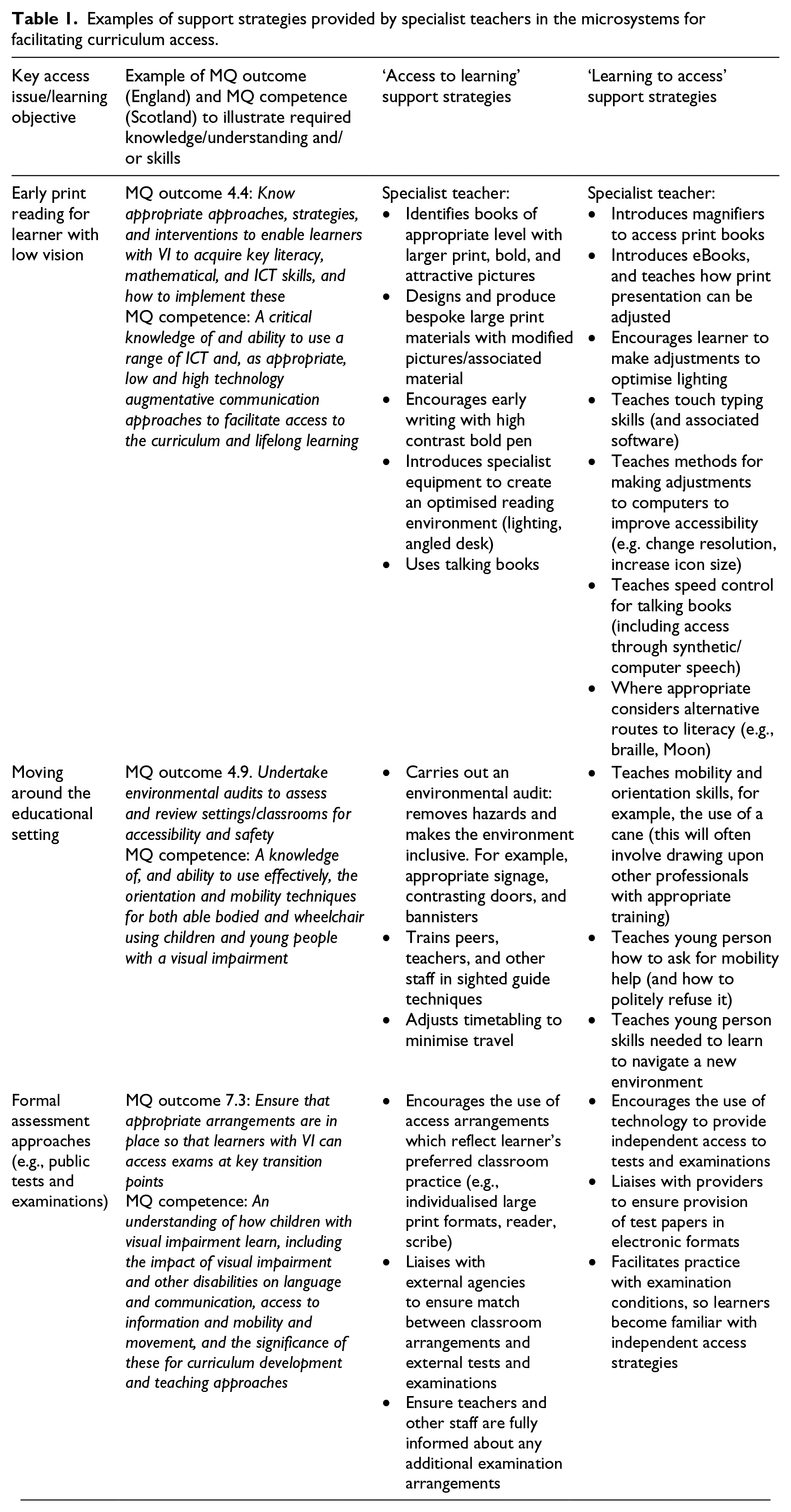
For children and young people with vision impairments, this would include, for example, the curriculum resources, the people, as well as learning activities with which the learner has direct contact. It also includes teachers and their respective attributes; other learners; physical and virtual learning spaces; access to curriculum resources; the teaching activities learners engage with; the nature of the support the children and young people receive; and the relationships they develop with their peers, tutors, and other staff. Although Bronfenbrenner (2005) makes explicit reference to ‘face-to-face settings’ in describing the microsystem, given the increasing importance of learning technologies to the learner experience within this ecology, the virtual learning environment can be included as a separate ‘setting’ in which learning (formal and informal) could take place. Table 1 provides examples of support strategies provided by specialist teachers in the microsystems for facilitating curriculum access that reflect the ‘access to learning’ and ‘learning to access’ approaches.
Examples of support strategies provided by specialist teachers in the microsystems for facilitating curriculum access.
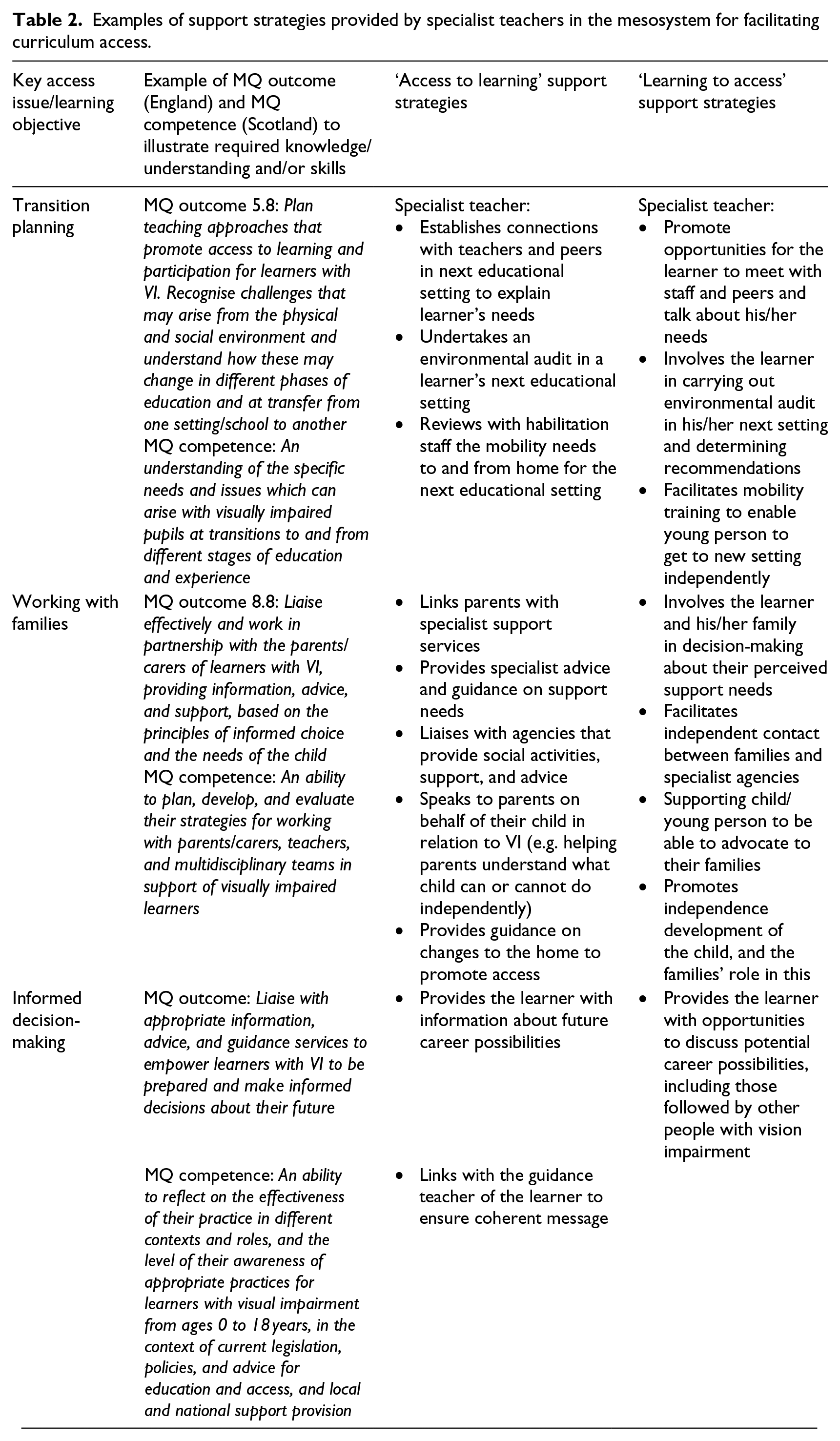
Surrounding the microsystem are the activities taking place within the mesosystem. These include the relationships that are developed and nurtured between a given home, school, or community setting, and working with an employer, sponsor, or work placements. It is reported by Anderson et al. (2014) that within the ‘ecology of inclusive education’, relationships and connections between them within this mesosystem are ‘continuously occurring, changing and evolving; they are never static but rather dynamic influences on the learner sitting at the centre of the framework’ (p. 29). Within the mesosystem, the specialist teacher has a central role in developing and promoting connections between structures within the child’s microsystems (e.g., facilitating support networks within school, linking parents with services, working with the child and his/her teachers in the school environment) as well as making connections with agencies in the exosystem (e.g., social services, mobility instruction). Table 2 provides examples of support strategies provided by visiting teachers in the mesosystem for facilitating curriculum access that reflect the ‘access to learning’ and ‘learning to access’ approaches.
Examples of support strategies provided by specialist teachers in the mesosystem for facilitating curriculum access.
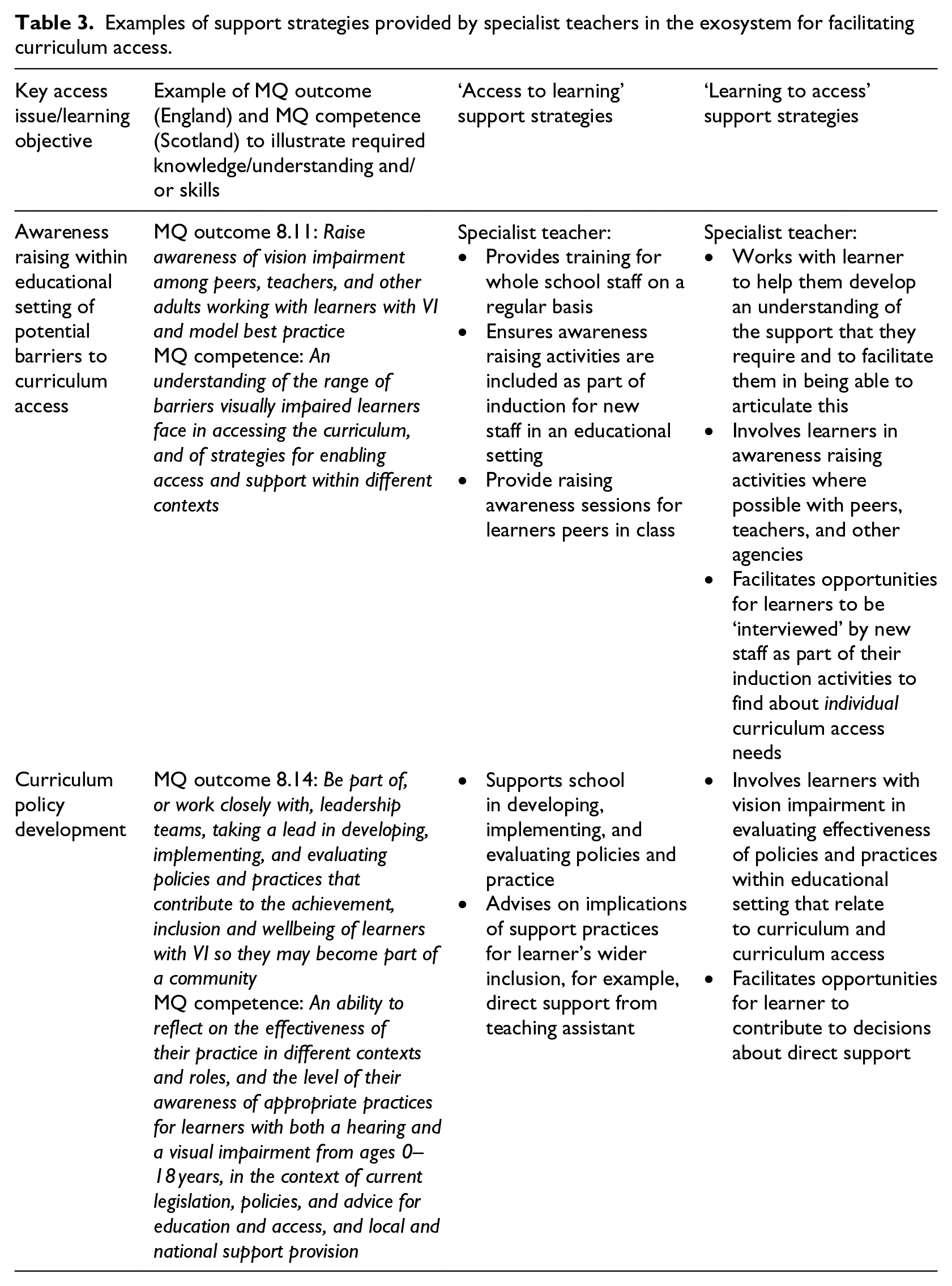
While the exosystem is conceptualised as being outside of the learner’s direct agency, it has implications in the context of an ecology of IE given it includes aspects such as the curriculum policies of the educational setting, budget allocations in a given year to support children and young people with particular types of needs. With reference to the ‘ecology of inclusive education’, Anderson et al. (2014) report that this system includes ‘school leadership structures, teaching and non-teaching staff, school culture, values and ideology, authority and collaborative patterns (leaders, staff, students, parents, community), support structures, resource allocation, school rituals, school policies and procedures and the student cohort’. Table 3 provides examples of support strategies provided by specialist teachers in the exosystem for facilitating curriculum access that reflect the ‘access to learning’ and ‘learning to access’ approaches.
Examples of support strategies provided by specialist teachers in the exosystem for facilitating curriculum access.
The macrosystem captures the current key drivers for change in IE at national and international levels and includes, for example, the prominence given to inclusion as part of an international broader ‘rights’ agenda, a focus on learners with special educational needs in national contexts being actively engaged in decisions about their future. As such, it provides scope for examining and comparing different national as well as international agendas and policy developments. As Anderson et al. (2014) note in relation to an ‘ecology of IE’, this system,
encompasses the varying contexts in which the school exists – social, political, historical and global – as well as other factors such as the education system or systems, current agendas (standardisation of student achievement and professional performance; increased accountability), and, if applicable, a mandated curriculum. (p. 30)
Specialist teachers will not normally not engage directly within this ‘system’ on a regular basis. They may, however, have opportunities to do so through feeding in on behalf of, as well as providing opportunities for, children and young people to input to, for example regional and/or national consultations on provision for children and young people with particular types of educational need (e.g., McCracken & McLinden, 2014).
The chronosystem is of particular relevance to this analysis given the role of the specialist teacher in potentially supporting a young person with vision impairment throughout their compulsory and post-compulsory educational pathway. Anderson et al. (2014) report that within the ‘ecology of IE’ ‘the timeframe for this system is that of the learner’s enrolment within formal school education – the years of primary and secondary schooling’ (p. 30). For the purpose of this analysis, it also includes post-compulsory education given that in some countries specialist teachers are required to support learners into early adulthood. As an example, the SEND Code of Practice in England (DfE, 2015) provides specialist teachers with opportunities to provide input to Education, Health and Care (EHC) plans for children and young people in line with the principles outlined in Box 1, and ensure due consideration is given to developing and promoting longer-term knowledge, understanding, and skills (i.e., as illustrated through the ‘learning to access’ strategies presented in Tables 1–3) to afford successful preparation for adulthood, including independent living and employment.
In relation to Scotland, a prime example of this approach in practice is the Scottish implementation of ‘Getting It Right for Every Child’ (GIRFEC), whereby teachers including specialist teachers, draw upon the ‘My world triangle’ when working with children or young people at every stage to inform themselves of the whole world of the child or young person (Figure 4). As guidance within the GIRFEC model states ‘it is still important to keep the child or young person’s whole world in mind and provide immediate help where necessary’ (Scottish Government, 2012).

The My world assessment triangle.
Conclusion
Within the spectrum of need created by visual impairment, a key barrier faced by children is reduced ‘access’ to information in order to develop their knowledge, understanding, and skills (McLinden & Douglas, 2014). As reported by Douglas, McLinden, McCall, et al. (2011), ‘access’ is a complex and multi-levelled term. In the context of education, an important role of the educator therefore is to find appropriate ways of reducing potential barriers to access through the deployment of appropriate strategies. McLinden and Douglas (2014) argue that the role of the specialist teacher can be viewed as being a complex blend of ensuring the child is able to access the curriculum (although not necessarily requiring direct input from themselves) and ‘equipping’ the child with the necessary competencies and confidence to be able to independently access curriculum areas. The array of activities specialist teachers of children with vision impairments are required to carry out in directly and indirectly supporting the development of the children can appear disconnected. Individually, all these activities are important; nevertheless, it is when they are considered together that the broader picture can be conceptualised. In strongly promoting the importance of the additional curriculum/ECC in preparing young people for employment beyond school, Douglas and Hewett (2014) offer the following cautionary note to illustrate how the additional curriculum should be considered to be only part of a more balanced solution:
[…] the skills-based approach to independence as encapsulated by the ECC must not be confused with promoting an individualised approach to preparing young people for life after school. In line with the discussion, the responsibilities of employers and society as a whole are part of a balanced solution to improve people with visual impairments’ participation in employment (and clear legislation and its enforcement is part of that). Ideally young people’s educational experience should reflect such a balanced approach. (p. 97)
Within this article, we have conceptualised this holistic and balanced approach by combining the educational vocabulary associated with curriculum access (i.e., through drawing on the terms ‘access to learning’ and ‘learning to access’) with the broader ecological systems theory as conceptualised by Bronfenbrenner (2005). While we are aware of limitations in drawing on an ecological systems theory (e.g., Hill, 2005), our analysis suggests it provides a helpful framework for examining the role of the specialist teacher within an IE system. Indeed, a particular strength of the ecological systems theory is that it includes a focus on the characteristics of the individual learner as well as acknowledging the complexity and multi-dimensional nature of the influences on development. The notion of ‘progressive, mutual accommodation’ (Bronfenbrenner, 2005, p. 107) is of particular relevance to this analysis as it highlights a need to focus not just on the learner, the environment or indeed each in isolation, but rather the changing relationships between these over a given period of time and across different settings including further and higher education.
We have applied this framework to the role of the specialist teacher in England and Scotland as an illustration of how such an analysis can be utilised, not only as a practical way of navigating a complex job role, but also one which has a theoretical underpinning. Although the article has been illustrated by outcomes that reflect the role of specialist teachers with a particular focus on select national contexts and illustrated with reference mainly to school settings, the theoretical model and related vocabulary we present should be useful for practitioners in other countries to draw on. Further articles are planned to develop the model further, and consider for example, its relevance to the role of the specialist teacher in supporting children and young people with more complex needs.
The analysis presented in this article has resonance with the children and youth version of the International Classification of Function and Disability (ICF-CY) (World Health Organization [WHO], 2007) in recognising that a central issue in child development is that the nature and complexity of children’s environments change dramatically with transitions across the stages of infancy, early childhood, middle childhood and adolescence. Changes in the environments of children and youth are associated with their increasing competence and independence. The environments of children and youth can be viewed in terms of a series of successive systems surrounding them from the most immediate to the most distant, each differing in its influence as a function of the age or stage of the developing child. (p. xvi)
Whatever the context and setting, and in line with the ethos of the ICF-CY, our central concern as practitioners, educators, and researchers should be to identify and remove barriers to access in all their forms to enable children and young people with vision impairments to participate effectively in education and society more generally.
Footnotes
Acknowledgements
Reference is made to ‘children and young people with vision impairments’ in this article to reflect the 2014 SEND Code of Practice in England (DfE, 2015) and the new specification for Mandatory Qualifications for specialist teachers (NCTL, 2015).
Declaration of Conflicting Interests
The author(s) declared no potential conflicts of interest with respect to the research, authorship, and/or publication of this article.
Funding
The author(s) received no financial support for the research, authorship, and/or publication of this article.