




Abstract
In the French braille code, becoming an efficient contracted braille user requires a considerable investment in time and effort. Students must learn 1217 abbreviations to allow time- and space-saving, but practitioners are questioning whether this investment is worthwhile. The purpose of this study was to examine the frequency of contracted braille use by adults and their perceptions about the importance of this code. A total of 23 Quebec braille users (aged 18–40 years) completed a telephone interview with quantitative questions about the frequency of their braille use, and their use of technologies as well as qualitative items regarding their perceptions of braille now and in the future, 12 of whom completed a brief braille reading test.In all, 85% of participants used uncontracted braille for reading, 59% used contracted braille, and 95% used text-to-speech. Contracted braille was used mostly for tasks that require continuous reading (e.g. novels). All except one recognized the need to learn uncontracted braille and 78% considered contracted braille useful. In all, 11 participants indicated that they “can read faster” with contracted braille, a finding that was not replicated by our reading test, whereby reading speeds were not statistically significantly different between the two conditions . The portrait that emerges from the current use of contracted French braille in Quebec indicates that it is not often used in the life of blind individuals. However, the faith of our participants in the relevance of the contracted code is still very strong. This may be explained by the fact that braille is part of their identity. The potential increase in reading speed with contracted braille may not justify the time, effort, and cognitive resources required to learn/teach this code in French. The educational challenge remains to find the proper balance between the uses of French braille versus other technologies such as text-to-speech.
Keywords
Braille is the principal means of written communication used by persons living with functional blindness. This communication system is used throughout the world, though its codes vary depending on the language of its users. The French braille notation system, also used in Quebec, Canada, has several codes that allow the user to access literature, mathematics, science, and music (Braille, 1837). Braille text can be presented in its basic uncontracted format, but it can also be written in its abbreviated contracted version. In the braille system currently used within Quebec schools, 1217 abbreviations exist. A blind student will learn Grade 1 or uncontracted braille during his or her first school year, while contracted braille is taught throughout the subsequent 4 years, concurrently with the rest of the school curriculum. Recent technological developments have challenged the necessity of French contracted braille, given its complexity, as it used to be required to access higher learning and the workforce. Several of the authors have observed a resistance toward the use of contracted braille among their student braille users who favor voice synthesis.
Educators are keen to teach high-quality braille and to ensure that young blind students are better equipped for higher learning and the job market. In order to better adapt teaching to the reality of contemporary young adults with blindness, it is necessary to understand how they use contracted and uncontracted braille in their everyday lives. Their opinions regarding the importance of learning each of these written codes is of interest as these students enter the school system. Moreover, a comparison of their reading speed for both contracted and uncontracted braille is needed. The study was motivated by a need to evaluate the resources required to teach such a complex contracted braille code in light of its actual use once training has been completed. Therefore, the concerns are related to the logistics of braille education, the cognitive efforts required for learning contracted braille and, finally, its actual use considering the alternative technological support tools now available.
Although few studies exist on the use of French braille in Quebec, our approach focused first on those studies and complemented them with research examining French braille in France as well as English braille in the United States. This body of research revealed that the benefits and disadvantages of contracted braille remain controversial and disputed. A key advantage usually attributed to contracted braille is space saving. For French braille, Lewi-Dumont (1997) estimated this space reduction at around 40%, whereas Fontaine (2000) judged it to be in the order of 25%–30%. As for the English language, space saving was generally thought to be around 30%; however, the more accurate value may be around 20% (Durre, 1996). What remains unclear is whether space saving alone is a sufficient reason to justify the learning of contracted braille without considering the advantages of uncontracted braille (Hong & Erin, 2004).
Another reason used to promote the teaching of contracted braille is reading speed. Lewi-Dumont (1997) cites Pierre Villey, who indicated that an individual capable of reading 125 words per minute (wpm) using uncontracted French braille can read, on average, 189 wpm using contracted braille, resulting in a speed gain of 15%. Mousty (1986), however, believed that this gain was only around 10% for experienced readers. He also added that this difference was lower or, at times, even negative for individuals with less training and/or experience. Furthermore, Lewi-Dumont (1997) stipulated that, at least in French, space saving was not accompanied by an equivalent saving of time because contracted braille is so complex and, therefore, quite difficult to learn, while Hong and Erin (2004) stated that uncontracted English braille did not decrease the reading speed.
A further consideration is the cognitive load caused by the learning of an additional code. Fontaine (2000) stipulated that for contracted French braille, the 4-year time span required for learning a simple literacy code was too long. Lewi-Dumont (1997) suggested that students learning contracted braille shortly after having acquired the ability to read using uncontracted braille were then overloaded by having to learn a new code, resulting in problems with memorization caused by the complexity of the abbreviated code and the fact that these abbreviations affect almost every word to some degree. This opinion was supported by Fontaine (2000), who found that the time span in school allocated to the memorization of these abbreviations was too short. She also added that contracted French braille was too heterogeneous and too difficult to assimilate under the current teaching conditions. This further increased the cognitive load for the young learner, causing problems with the orthographic understanding of the language (Hatwell, 2003). It should be noted that abbreviations in French braille do not always follow the natural segmentation of syllables (Fontaine, 2000; Hatwell, 2003).
In turn, Hong and Erin (2004) added that young readers may benefit from investing the time into learning the uncontracted English code properly, as opposed to acquiring a complex code too fast too soon for the benefit of space gain. Tobin and Hill (2015) noted that mastering braille reading required more time than printed reading. The existence of new technological support tools required us to consider the low use of contracted braille in favor of new ways to save space, such as text-to-speech. Indeed, more and more documents are stored electronically rather than on paper (Hong & Erin, 2004; Lewi-Dumont, 1997). In addition, new technologies enhance access and information sharing among blind and sighted people (Tobin & Hill, 2015).
In Quebec postsecondary education institutions, services for students with disabilities in colleges and universities offer the production of materials in alternative formats such as braille or electronic texts; however, they produce mostly electronic texts which have the advantage of being able to satisfy the needs of more users while being faster and more economical to produce. In primary and secondary schools, the Ministry guidelines mention the use of technological support tools, whereby documents can be given to students in e-text format. “This format will thus enable students to use technological support tools when administering examinations to complement the braille version” (Ministère de l’Éducation, du Loisir et du Sport, 2014). The variety and availability of technological tools bring about changes to the way in which blind people access written information, but little is known about the use of contracted braille after high school. Therefore, it was decided to investigate the frequency and types of use of both contracted and uncontracted braille by adults that completed their braille training in Quebec. In addition, our participants were asked to read texts aloud in contracted and uncontracted braille to measure their reading speed.
Method
The Board of Directors of the École Jacques-Ouellette, a school specialized in the teaching of visually impaired students at the elementary and high school levels, approved the project. Participation in the study was proposed to braille users who graduated from either regular or specialized schools throughout the Province of Quebec, according to the selection criteria described below.
Participants
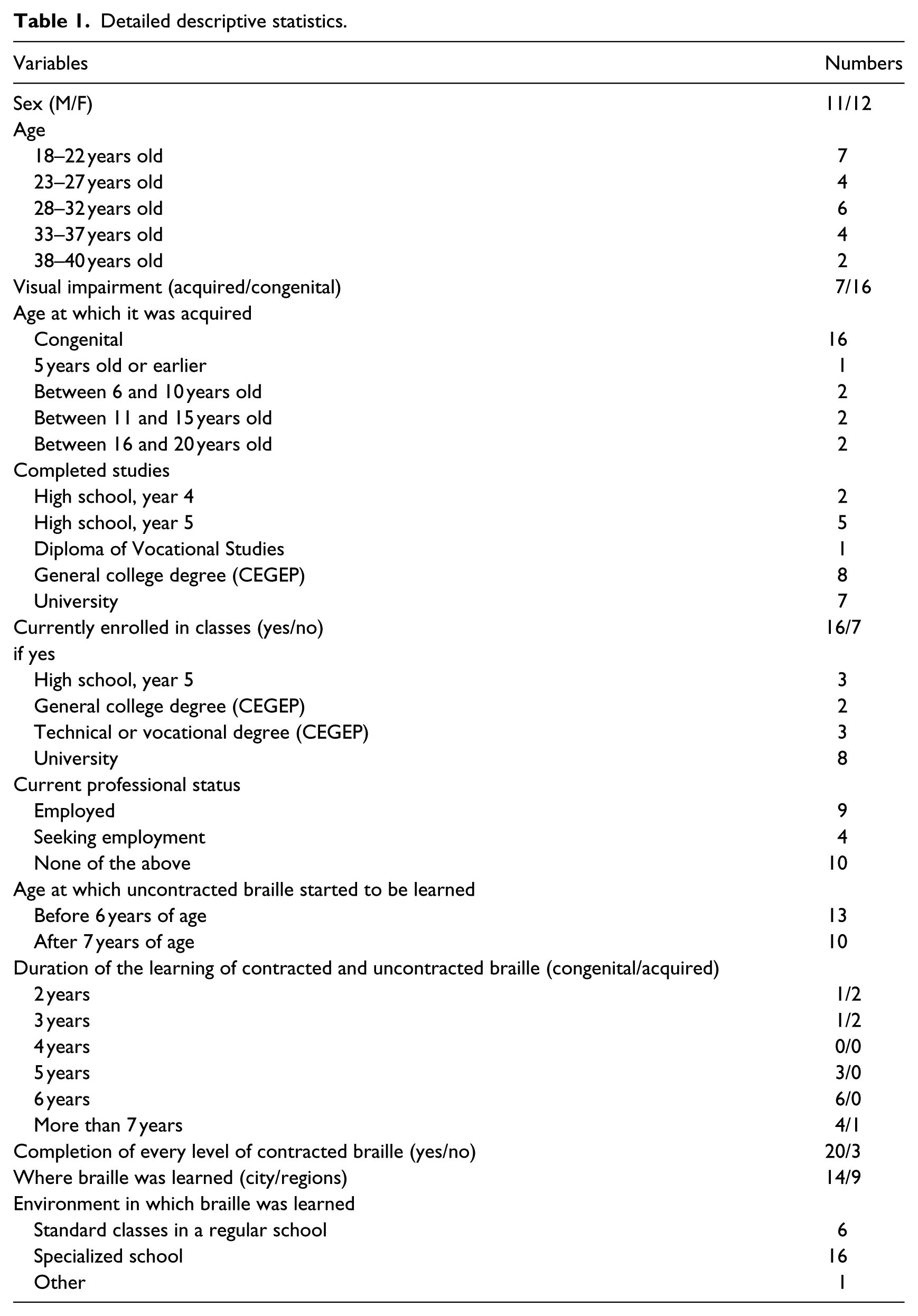
Potential participants had to use braille as their primary access to print, they had to have learned contracted braille in Quebec, and had to have successfully completed the third year of secondary school and be aged between 18 and 40 years. Staff within the education system identified 39 potential participants, of which 23 individuals could be reached by phone or social media, fit our criteria, and were available for the study. The sample included 12 women and 11 men, 16 of whom were blind from birth, whereas the remaining individuals had developed their visual impairment between the ages of 5 and 20 years. The majority of participants (15/23) had completed college or university. The remainder had finished the 4th or 5th year of secondary school; 16 participants were still in school and 9 were employed. All reported that they used a computer as well as a refreshable braille display and JAWS screen reading software. In addition, 20 participants were using a scanner and 20 used a type of digital player, Victor Reader. One participant used a Perkins brailler and another used a slate and stylus. For 13 of the 23 participants, braille was the medium in which they learned to read and write. The 10 remaining participants previously learned to read and write with printed material, but subsequently learned braille following a significant drop in vision. A total of 20 participants completed all four levels of the 1217 French braille abbreviations taught in the Quebec school system. Slightly more than half (13/23) learned braille in a specialized school while others attended a regular school. Finally, 18 participants rated the experience of learning contracted braille as easy or very easy. In addition, 19 considered themselves as good contracted braille readers. Detailed descriptive statistics are available in Table 1.
Detailed descriptive statistics.
Material
The research team consisted of three educational consultants for visual impairment, based at the École Jacques-Ouellette, who specialized in braille teaching. This team created a 37-item questionnaire that asked participants in what ways and in what contexts of their lives they were using contracted and/or uncontracted French braille (Appendix 1). This questionnaire was piloted with three braille users on staff and their feedback was incorporated into the final version. For questions about frequency of use, the response options were never, rarely, often, and very often, whereas questions about preference and personal opinions were open-ended.
Procedure
The questionnaire was administered via telephone, responses were entered into a response sheet by the interviewer, and participants had to rate their learning experience of both contracted and uncontracted braille and describe their reading and writing habits. Finally, they were asked to make a judgment on the importance and future use of contracted and uncontracted braille. The telephone interview lasted approximately 1 hr and was conducted by a naive research assistant without prior knowledge of braille or visual impairment. The choice to engage an assistant without previous experience in braille was partially made because the team wanted to allow the participants to speak freely and explain themselves in their own words and to avoid the potential to lead the answers with professional jargon or technical terms during probing questions. In addition, the members of the team were potentially involved in the teaching of braille at some point during the past; therefore, an interviewer unknown to the participants would avoid response bias.
Braille reading speed test
Following the phone interview, participants were offered the possibility of taking part in a segment of the study that involved reading two excerpts of a young adult novel (third-year high school level) in braille. Time and travel constraints resulted in only 12 participants being available for this segment. French-speaking braille users are relatively rare in the Canadian linguistic landscape, and given the vast distances across Quebec and the time limitations of our participants, it was not possible for all to present themselves in person. For those who were able to complete the reading test, each excerpt was embossed in contracted and uncontracted braille. The first excerpt contained 400 words; the second, 405. The contracted braille versions had 80.5% and 76.8%, respectively, of their words contracted for each excerpt. Participants were asked to read both excerpts, in randomized order. Before each participant started to read, the examiner provided a context to the excerpt. Reading speed was calculated on the basis of the number of words read in a 3-min period, while reading errors were recorded by the examiner.
Results and discussion
The percentages of responses below refer to the proportion of individuals that answered each question with often or very often. The sum of percentages frequently exceeds 100% as multiple responses were permitted. For questions pertaining to reading, 85% of participants answered that they used uncontracted braille, 59% used contracted braille, and 95% used text-to-speech. This proportional distribution reflected the perceptions of the teachers on the research team that work with our clientele. As for writing and re-reading written materials, 59% used uncontracted braille, 30% used contracted braille, and 56% relied on text-to-speech. Interestingly, these percentages were generally lower when compared to those of reading activities.
Figure 1 displays the proportion of responses to the question: “For which tasks do you utilize contracted braille?” There was no pattern of braille use across age groups, or education versus work environment. However, it appeared that tasks that require substantial and continuous amounts of reading or writing (reading textbooks, novels, work-related materials, lecture notes, journals, and newspaper) were those where contracted braille was used more often, both in work and education as well as in family life and leisure. Seven of the nine participants who were employed indicated that they used contracted braille for work-related reading; however, this may have been related to the fact that six of them worked in the field of visual impairment rehabilitation. Among leisure tasks, reading novels stood out with 65% of respondents engaging often or daily in this activity using contracted braille. It should be noted, however, that most novels are not available in uncontracted embossed braille. Therefore, knowledge of contracted braille is necessary if the person wants to read novels that are produced in French braille. Not surprisingly, contracted braille was not used much in tasks where there was little text to read or write, such as in e-mail.
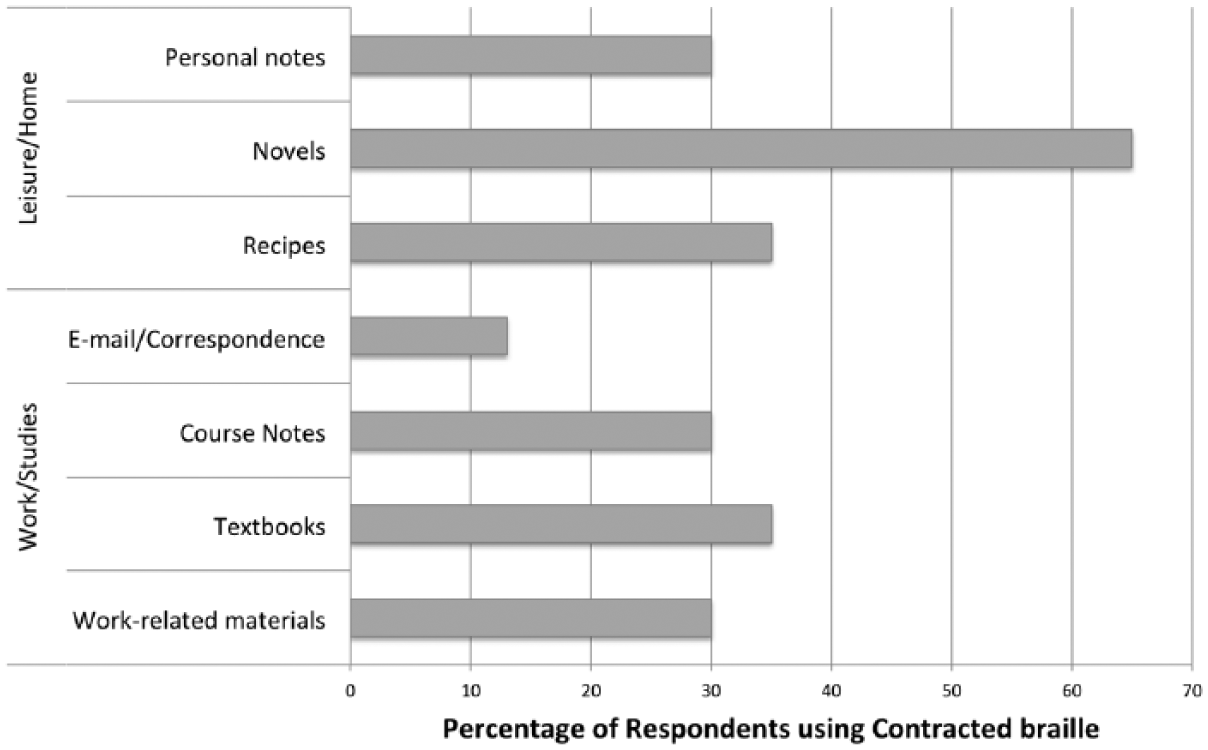
Proportion of participants that reported using contracted braille for each activity of daily living, either often or daily (n = 23).
Uncontracted braille use
The last part of the questionnaire investigated the participants’ perceptions regarding the usefulness of braille today and their recommendation as to whether it should continue to be taught. The participants could give multiple responses and justify them should they choose to do so. Therefore, the qualitative aspect of some of the answers allowed us to describe a more complete picture that may be more informative about life as a braille user. Please note that phrases in quotation marks are direct translations of participant responses. All except one participant (95%) recognized the need to learn uncontracted braille in today’s environment. The benefits that individuals saw concerned school life, work, and social participation. Several participants stated that uncontracted braille “is my main working tool” and allowed them to have “a job like people who can see.” Access to computers was the most frequently cited reason (n = 14) for the use of uncontracted braille. “This is the basis for using the computer, it allows me to use the refreshable braille display.” Participants also indicated uncontracted braille as their preferred means for learning how to spell (n = 8) and “it is essential for the correction of texts.” Eight respondents indicated that uncontracted braille was useful for reading and two stated “it is necessary to know in order to learn contracted braille.”
Participants were unanimous in recognizing the importance of uncontracted braille and recommended that blind children learn it. They perceived it as the basis for literacy, “otherwise the children will be illiterate.” The reason given most often was learning and maintaining spelling (n = 14). “Without uncontracted braille, any sense of spelling is lost.” Participants stated its ability to provide access to written material (n = 9). Furthermore, uncontracted braille was mentioned as helping integration into society, provision of access to education and better employment (n = 6), and facilitation of data access (n = 4) as “it is most prevalent with existing computer aids.” The same questions were asked about the perception on the usefulness of contracted braille today and whether participants recommended its teaching today.
Contracted braille use
Of our respondents, 78% considered it useful or very useful to know contracted braille today. The main reason mentioned was linked to employment and the benefit of increased reading speed. Several participants indicated that they “can read faster” (n = 11). However, the results of our reading test conducted with 12 participants contradicted this assertion. Their reading speed of contracted braille in wpm (M = 91, standard deviation (SD) = 45) did not statistically significantly differ from that of reading uncontracted braille (M = 84, SD = 36), t(11) = 1.46, p = .17, η2 = .16; however, given previous results (Laroche, Boulé, & Wittich, 2012), the present analysis lacked power. Therefore, the results need to be considered with caution, even though they are relatively comparable to previous data, where we noted an average speed of 99 wpm in contracted braille for French braille users in Quebec (Laroche et al., 2012). Similarly, there was no significant difference between the number of errors committed between the two reading conditions. Contrary to what was anticipated, the low use of contracted braille did not lead to more reading errors. Fluidity was only increased by 8.33%, similar to the 10% benefit reported elsewhere (Mousty, 1986).
The second reason for the use of contracted braille was related to the accessibility of documents (n = 4) that “allows for a greater choice of books.” Contracted braille is an additional tool for accessing knowledge. The third reason mentioned was practical: contracted volumes take less space (n = 4), “the books are smaller.” It was originally the primary function of the establishment of an abbreviation code, but it seemed to our respondents that this was not sufficient reason for the learning of such a code, and participants did not attach great importance to this reason. On the other hand, 22% considered that knowing contracted braille today was only somewhat or not at all useful because “the situations where we encounter contracted braille are almost zero” (n = 4). The other reasons given were the preference for text-to-speech (n = 2) and difficulties related to learning the contracted code (n = 1).
Although only 78% of the participants considered that knowing contracted braille was useful or very useful, it was noted that 92% would recommend to parents that their blind child should learn contracted braille. The reasons for this recommendation were faster reading speed (n = 11), accessibility to all documents written in braille (n = 4), and space saving (n = 3). The desire to give all possible tools available to children “so that they have the choice to read what they want and above all to work like everyone else” was mentioned by five participants. Despite their positive opinion, some respondents nuanced their thinking about the future of braille, “with new technology, it is less essential” and “in 20 years there will be almost none.” In addition, two participants would leave the choice to the child when or whether to start learning contracted braille. The two participants who did not recommend the learning of contracted braille justified their opinion by the low frequency of its use and the difficulty of learning the French abbreviations. Even though the participants largely recommended the acquisition of contracted braille, their perception of its usefulness in their current lives was less assertive, especially when considering that only 21% of respondents utilized contracted braille often in their activities of daily living. We hypothesize that part of these seemingly contradicting opinions are linked to the fact that these participants partially still support the perspectives of their own past teachers who instilled a sense of importance for braille in the context of higher learning, mixed with the participants’ own experiences and perspectives on novel text-to-speech technologies and the realities of their own current braille use.
Limitations
Braille remains a sensitive and emotionally charged topic for many users: being questioned about its use may have embarrassed some participants and led them to modulate their answers. Once participant responses were compiled, it became apparent that certain questions could have been added that would have clarified or nuanced the interpretation of results, even though the questionnaire itself had been piloted with three braille users prior to testing. This includes the consideration of participants’ perception of braille in the context of literacy acquisition, a comparison of braille use during versus after high school, or differences in the use of braille in the literary versus non-literary context (e.g. technical manuals), all topics that warrant further investigation. Finally, future research should ascertain the frequency of use while also considering the duration of use, which was neglected in our study.
Conclusion
The portrait that emerges from the current use of contracted French braille in Quebec indicates that it is not dominant in the life of our participants. Despite the importance they attach to the learning of contracted braille, its use is very low in the workplace, postsecondary education, recreation, and activities of daily living, except when reading novels. However, the faith of our participants in the relevance of the contracted code is still very strong. This may be explained by the fact that braille is part of their identity. The arrival of new technologies has revolutionized print access, and braille is no exception. These technologies have the same benefits that have been attributed to contracted braille by our participants: work efficiency and space savings. Moreover, contrary to popular belief, our data indicated that the reading speed of contracted braille was not a real benefit compared to uncontracted braille. For individuals who lost their sight early in life, the potential minimal increase in reading speed of contracted French braille may not justify the time, effort, and cognitive resources required to learn this code.
For all interviewees, uncontracted braille remained the gateway to print. It was not only the preferred reading medium, but it remained the preferred means to learn and maintain spelling. The participants considered it essential for the education of blind children, and one interpretation is that priority should be given to the teaching of reading strategies rather than learning a complex code. Although braille is an effective access to print, it is relatively slow. It should be noted that technological aids (e.g. refreshable tactile displays) allow the user to choose to read a text in contracted or uncontracted configuration. The learning and use of contracted braille thus become a personal choice instead of a mandatory part of a student’s curriculum. At present, text-to-speech in combination with uncontracted braille allows blind individuals prompt access to all information. The educational challenge remains to find the proper balance between the uses of braille versus other technologies such as text-to-speech. Future research should evaluate the effect of different language access modalities on text comprehension as well as spelling and grammatical skills.
Footnotes
Appendix 1
Acknowledgements
The authors thank Jacinthe Boulé and Geneviève Blondin for their contribution to the questionnaire development.
Funding
W.W. is funded by a Junior 1 Career award, provided by the Fond de recherche du Québec – Santé (# 28881).