




Abstract
Research suggests that adults with visual impairments tend to participate in inadequate amounts of physical activity and are at high risk for developing health-related conditions. The most likely environment for youth with visual impairments to learn about physical activity is school-based physical education (PE) classes. However, little research exists examining the influence of PE on lifelong physical activity for those with visual impairments. Therefore, the purpose of this study was to explore the perspectives of adults with visual impairments toward the impact of PE on their current physical activity participation. Sixteen participants (7 males and 9 females) with visual impairments who attended integrated public schools and private schools participated in this study. Data were collected through semi-structured, audio-taped telephone interviews and reflective field notes. A semi-structured interview guide was used to ensure that the same lines of inquiry were pursued across participants. Member checking, peer debriefing, and communicative validity were utilized to support trustworthiness. An inductive analysis was used to interpret the data. Two key themes were revealed. The first theme, ineffectual PE experiences, described participants’ beliefs that PE experiences had little impact on their current physical activity. The second theme, retrospective needs, revealed modifications the participants believed would have improved their PE experiences. One of the primary objectives of PE is to provide the tools needed for lifelong physical activity. Upon completion of the study, most participants indicated that they considered themselves to be physically active in adulthood. However, this was attributed to meaningful experiences outside of their respective school-based PE classes.
It has been established that regular engagement in physical activity can help improve overall health and fitness, and reduce the risk for many chronic diseases (Centers for Disease Control and Prevention [CDC], 2014; Sallis, Prochaska, & Taylor, 2000). According to the CDC (2014), those who engage in regular physical activity tend to live longer and have a lower risk for diseases such as heart disease, stroke, depression, and obesity. Unfortunately, however, research suggests that adults with visual impairments tend to participate in insufficient amounts of physical activity (Haegele & Porretta, 2015; Marmeleira, Laranjo, Marques, & Pereira, 2014; Sadowska & Krzepota, 2015). Rather than engaging in physical activity, these individuals tend to spend the majority of their leisure-time in sedentary activities, such as watching television or playing computer games (Holbrook, Caputo, Perry, Fuller, & Morgan, 2009; Marmeleira et al., 2014). Due to inadequate physical activity participation and a preference for sedentary behaviors, individuals with visual impairments are at higher risk for developing lifestyle-mediated and health-related conditions (Holbrook et al., 2009; Ray, Horvat, Williams, & Blasch, 2007) as well as having a lower quality of life regarding health (Haegele, Famelia, & Lee, 2017).
Research consistently suggests that physical activity behaviors track from childhood to adulthood (Telama et al., 2005). Hence, it is important to understand youth physical activity behaviors to improve physical activity among individuals with visual impairments in adulthood. For youth with visual impairments, the most likely environment to learn about and participate in physical activity is well-designed, school-based physical education (PE) classes (Haegele, Zhu, & Davis, 2017). According to the current United States national PE standards for the Society of Health and Physical Educators (SHAPE America, 2014), “the goal of PE is to develop physically literate individuals who have the knowledge, skills and confidence to enjoy a lifetime of healthful physical activity.” Physical literacy is the ability to move with competence and confidence in a wide variety of physical activities in multiple environments that benefit the healthy development of the whole person (SHAPE America, 2014). Through PE, youth have the opportunity to develop the skills needed to engage in sports and activities of daily living, acquire the knowledge needed to make healthy choices throughout their lives, and be physically active (National Association for Sport and Physical Education [NASPE], 2012).
It is clear that PE is an important site for youth with visual impairments to learn about physical activity. However, previous literature exploring students with disabilities’ experiences in integrated PE has found participants, including those with visual impairments, to describe challenging and exclusionary instances (Bredahl, 2013; Fitzgerald, 2005; Haegele & Sutherland, 2015). For example, in a study examining the PE experiences of 16 individuals with visual impairments, Haegele and Zhu (2017) reported that participants expressed feeling “frustrated” and “awkward” when being compared to their peers without disabilities in PE. Within non-longitudinal studies, students with visual impairments have also described the importance of their interactions with their PE teachers, and how teachers’ attitudes can shape their experiences (Bredahl, 2013; Haegele, Sato, Zhu, & Avery, 2017; Haegele & Zhu, 2017; Haegele, Zhu, & Davis, 2017; Lieberman, Robinson, & Rollheiser, 2006). Thus, it is clear that teachers play a crucial role in creating meaningful PE experiences for their students with disabilities, including those with visual impairments (Block & Obrusnikova, 2007; Bredahl, 2013; Haegele & Zhu, 2017; Lieberman et al., 2006). Collectively, this area of inquiry has found that peer comparisons and teachers’ attitudes are among main factors that contribute to positive or challenging PE experiences for the students with visual impairments.
Previous literature suggests that positive PE experiences contribute to physical activity as adults (Telama, Yang, Laakso, & Viikari, 1997). Thus, it is logical to suggest that challenging experiences, like those typically described in the literature examining experiences of those with visual impairments, may contribute to inadequate physical activity participation in adulthood. Unfortunately, to the knowledge of the authors of this article, no previous research exists which examines the influence of school-based PE on physical activity for those with visual impairments in adulthood. Therefore, the purpose of this study was to explore the perspectives of adults with visual impairments toward the impact of PE on their current physical activity participation.
Methods
Research approach
This study utilized a descriptive-qualitative methodology using an exploratory case study design (Yin, 2003) with retrospective data collected from the participants. The purpose of this study method is to gain an understanding of complex social phenomena while retaining meaningful particularities of the participants’ real-life circumstances (Yin, 2003). Therefore, an exploratory case study was considered appropriate for exploring the impact PE experiences had on physical activity engagement in adulthood. The current study is unique in that it focuses on the influence of the participants’ school-based PE experiences and the meaning they ascribed to those experiences regarding their physical activity as adults.
Participants
Sixteen participants (nine females, seven male) with visual impairments were purposely selected for this study (Fraenkel, Wallen, & Hyun, 2012). Purposeful Scottpling focuses on selecting information-rich cases, based on pre-specified eligibility criteria that highlight the questions under review (Patton, 2002). Eligibility criteria included individuals (a) being 18–50 years of age, (b) having a visual impairment (including blindness) during their educational experiences, (c) being willing to complete a telephone interview for 60–90 min, and (d) having been educated in an integrated setting (e.g., public school, private school). The age range criteria were selected to ensure inclusion of participants in a variety of phases of life (Bredahl, 2013). A call for participants was distributed through an online registry for individuals with visual impairments, and potential participants were asked to email the research team to express interest in participating. Those who emailed the research team and met each of the eligibility criteria were invited to participate in this study. Table 1 highlights detailed demographic information about each participant. Pseudonyms were assigned to each participant to protect identity.
Participant demographics.
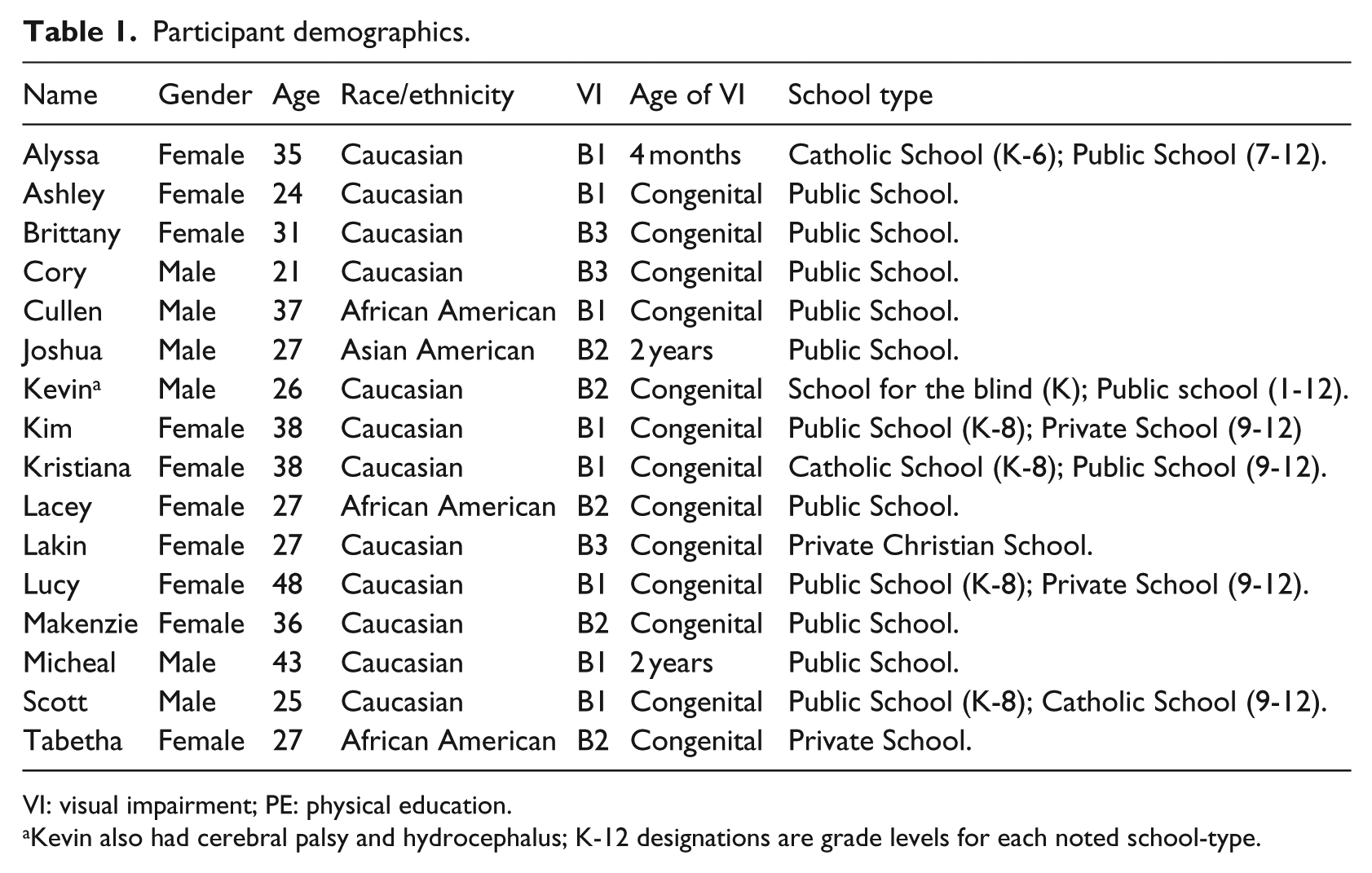
VI: visual impairment; PE: physical education.
Kevin also had cerebral palsy and hydrocephalus; K-12 designations are grade levels for each noted school-type.
Data collection
Data were collected in two ways: semi-structured telephone interviews and reflective field notes. The second author completed the telephone interviews, which were used in place of face-to-face interviews due to the participants’ geographical locations. A semi-structured interview guide including open-ended questions was used to ensure that the same lines of inquiry were pursued across participants (Patton, 2002). Open-ended questions were used to generate in-depth responses about the participants’ experiences, perceptions, opinions, feelings, and knowledge (Patton, 2002). Sample questions included the following: (a) Can you describe how your PE experiences impacted your current physical activity participation? (b) What could have been done differently that could have had a better impact on your current physical activity? and (c) How do you think your PE experiences influenced your understanding of your capabilities? Completed interviews ranged from 60 to 90 min in duration.
Because qualitative research requires ongoing evaluation and judgment (Fraenkel et al., 2012), reflective field notes were taken during and after each interview regarding the interviewer’s thoughts and observations. Reflective field notes allowed the interviewer to interpret the information beyond the participants’ answers by making their own perceptions part of the data (Patton, 2002). Reflective thoughts were noted to ensure reflexivity and control for the danger of interviewer effects (Fraenkel et al., 2012). Furthermore, the reflective field notes assisted in the comprehension of the data during data analysis, which was completed by the primary author.
Data analysis
The audio-taped interviews were transcribed verbatim by the research team upon completion of the data collection process. The objective of the transcription process was to obtain a semantic record of the interview, which included all words that were spoken by the participants and interviewer. The exact length of pauses and non-verbal utterances were not transcribed, as the content of the participants’ experiences were the focus of this analysis (O’Connell & Kowal, 1995).
A constant comparative method (Boeije, 2010) was used to interpret the data, and this allowed themes to be constructed from the transcriptions and reflective field notes. The basic strategy of this analytical process was to constantly compare pieces of data, as the name implies. By continually evaluating each interview, the primary author was able to revisit information that appeared to echo throughout several different responses. The themes were constructed by the primary author during data analysis based on the recurring concepts provided by the participants in their individual interviews. Constructed themes were shared with the secondary author, who checked for alignment with the purpose and research approach of this study. Those that were agreed upon were presented as themes.
Trustworthiness
Member checking, peer debriefing, and communicative validity were utilized to ensure trustworthiness. Member checking was used to minimize the influence of subjective bias (Patton, 2002). Prior to data analysis, the transcribed interviews were distributed to participants for review to ensure accuracy and relevancy. The participants’ acknowledgment of the accuracy of the data ensured that trustworthiness was supported (Merriam, 1998). Peer debriefing is a “process of exposing oneself to a disinterested peer in a manner paralleling an analytical session and for the purpose of exploring aspects of the inquiry that might otherwise remain only implicit within the inquirer’s mind” (Lincoln & Guba, 1985, p. 308). For this study, an impartial peer who was familiar with this line of inquiry examined the researcher’s transcripts and finalized themes. Afterwards, feedback was provided to enhance credibility and ensure validity. Communicative validity was used to ensure the focus of the interviews remained consistent and relevant to the participants’ expectations. In this study, each interview began with the interviewer explaining the purpose of the study and providing a brief explanation of the types of questions that were to follow. In addition, communicative validity was applied throughout the interview process by the interviewer stopping, rephrasing, summing up, and asking for clarification.
Results and discussion
The purpose of this study was to explore the perspectives of adults with visual impairments toward the impact of PE on their current physical activity participation. The descriptive-qualitative methodology used for this study enabled the authors to gain a better understanding of the participants’ PE experiences and how these experiences influenced their physical activity as adults. Two interrelated themes were constructed from the participants’ responses: ineffectual PE experiences and retrospective needs. The first theme, ineffectual PE experiences, described how the participants believed their respective PE experiences were unsuccessful in helping them realize their full potential in physical activity contexts. The second theme, retrospective needs revealed alternative approaches and modifications the participants believed would have improved their PE experiences. Notably, the participants’ level of visual impairment was shown to have little no difference on their respective experiences.
Ineffectual PE experiences
It has been noted that students with disabilities, including those with visual impairments, often do not have positive PE experiences (Bredahl, 2013; Fitzgerald, 2005; Haegele, Sato et al., 2017; Haegele & Sutherland, 2015; Haegele & Zhu, 2017; Lieberman et al., 2006). Similar sentiments were expressed among participants in this study (reflective field notes). For many of the participants, challenging PE experiences influenced their physical activity engagement well into adulthood. For example, Lakin revealed that I think maybe if I had a more successful experience in PE, I may have been active earlier and sooner. And, if I had the access to more accessible sports, maybe I would have played that and maybe it would be part of my life today. I could have been on a rowing team if that had been an option at a younger age. It’s too bad.
Unfortunately, Lakin wasn’t physically active earlier in her adult life and related that to her lack of participation during her school-based PE experiences. Similarly, Micheal elaborated that I wish my experiences would have been different. I think that if it would have been positive then I probably would have had more opportunities for activities, more opportunities for seeing what I was capable of instead of waiting until I was 25. I was a bit behind on that sort of thing.
Lakin and Micheal both describe how PE may have negatively impacted their current physical activity and point toward the quality of their programs as a contributing factor. More specifically, they suggest that if they had more success with different activities during PE, those experiences could have had a more positive impact on their physical activity as adults. Since research has demonstrated that individuals with visual impairments tend to report challenging experiences in PE (Haegele & Zhu, 2017; Haegele, Zhu, & Davis, 2017), it may be logical to suggest that participants from other previous studies may have had similar feelings about their previous PE programs.
Overwhelmingly, the participants of this study reported that they were not able to take advantage of potential benefits related to successful PE engagement. For example, Makenzie explained that her integrated PE classes: Made me think that there were things that I couldn’t do, physical wise, activity wise, because I never got much of a chance to participate. I never got to find out what my real potential was. I felt like I couldn’t do the same activities as other kids. If I had a little better experience, I might be more into feeling better about my physical health today.
Had Makenzie been given more encouragement and opportunity to participate and discover her capabilities, she explained that physical activity may have been more enjoyable and rewarding for her as an adult. This sentiment was consistently shared among participants in this study. Unfortunately, this finding is in alignment with current literature that asserts that negative PE experiences for individuals with visual impairments can result in a lack of self-confidence and self-esteem (Haegele & Zhu, 2017). For example, Micheal explained that he currently “prefers” to do things on his own due to the lack of team sport experiences: I think that’s one of the big things that I missed, was the fact that playing team sports builds a lot of skills that are useful later on in life. Having missed out on that, I don’t like working in a team setting.
Previous research has revealed that many students with disabilities, including those with visual impairments, have negative perceptions of team sport that can be rooted in a lack of successful engagement in these types of activities during PE (Bredahl, 2013; Haegele & Sutherland, 2015; Haegele & Zhu, 2017).
Research suggests that physical activity behaviors during childhood can track into adulthood (Telama et al., 2005). The qualitative methodology used in this study allowed each participant to share personal insights into how they believed their PE experiences as youth influenced their physical activity as adults. Participants described challenging experiences that were hard to describe, at times (reflective field notes). For example, when asked how she thought her PE experiences influenced her understanding of her own capabilities engaging in physical activity, Tabetha stated, Just hearing that question brings up feelings, for me, of missed opportunities. I’d like to know that I could do more than just basically sit around doing nothing or homework or holding things for people or other people’s errands during PE, than what I did. I knew that outside of that situation, my capabilities were great. I know what it’s like being a physical person but also meet those physical achievements. I know how that feels so it would be nice to successfully make that connection between a baseball bat and a baseball or actually catch a ball that someone threw at me with intent or try. That would have felt good.
Tabetha’s response was unique in that instead of not knowing her capabilities and wishing she had opportunities to discover them, she had a developed understanding of her abilities were and what being successful in physical activities felt like. She wanted to be able to experience that success with her peers. Existing literature describes the importance of positive peer interactions during PE, and how those interactions can have a significant impact on how individuals with disabilities, including those with visual impairments, experience PE and understand their abilities (Haegele & Sutherland, 2015; Seymour, Reid, & Bloom, 2009; Spencer-Cavaliere & Watkinson, 2010).
Retrospective needs
Teachers’ attitudes and actions have been a focal point in recent literature as playing a critical role in the students with disabilities, including those with visual impairments, experiences in PE (Bredahl, 2013; Haegele & Zhu, 2017; Lieberman et al., 2006). Throughout the interviews in this study, the participants revealed alternative approaches and modifications they believed would have improved the meaningfulness of their PE experiences. This is in alignment with current literature that suggests that individuals with disabilities, including those with visual impairments, may have a more successful PE experience had they been provided proper adaptations and modifications (Bredahl, 2013; Haegele & Sutherland, 2015). A few participants gave specific suggestions that they felt would have been more beneficial in their respective PE classes, which included communication, feedback, and tactile modeling. For example, Scott believed that his PE experience was not impactful, and attributed this lack of impact to a late start in meaningful activities. He stated that Trying the weight room in high school was a nice start because then I knew what I was doing. The only problem with that is that it was too late. If I had started earlier and had more equal physical activity where everybody was doing the same thing, like from day one, occasionally I think it would have been a more positive impact. (Interview: Scott)
Like Scott, Lakin and Micheal, recognized that physical activity was important and suggested that although they did not see their experiences in PE as meaningful, they believed that PE had the capability of being meaningful. They believed that a quality PE program could have offered a number of benefits for students with visual impairments including discovering physical capabilities, developing teamwork skills, and finding enjoyment in being physically active (Haegele, Brian, & Goodway, 2015; Haegele, Zhu, & Davis, 2017).
The participants revealed several reasons why they believed their PE programs were not more effective. Among participants, the lack of opportunities to participate and to discover their capabilities was the most problematic factor contributing to the ineffectiveness of PE. Lakin explains, “I think it negatively influenced my perception of my own abilities, or my perception of my ability to develop physical abilities.” She elaborates on her experiences by saying, “I am active today because I have chosen to be active at an older age, but I don’t think my PE experiences influenced that.” Similarly, Kristiana stated that she “didn’t have the most positive PE experiences.” She went on to say that it “just had to do with not having opportunities.” The lack of opportunity was not only expressed as not being able to experience different activities but, also, not being able to participate or be included at all. The feeling of not being allowed to participate was ubiquitous among participants. For example, Kim explained that her PE teachers decided “well, it’s going to be too hard to teach you how to dribble the basketball so we are going to make you sit out.” Unfortunately, this is in alignment with existing literature stating that many individuals with disabilities are excluded in their PE settings (Bredahl, 2013; Haegele & Zhu, 2017).
In addition, Kristiana advised, “What they [PE teachers] could do is try to include them [students with visual impairments] as much as possible and make the experiences enjoyable rather than something that you dread.” Kevin explains that PE could have had a better impact on his physical activity as an adult by “letting me have more of an opportunity to experiment with things.” In a similar vein, Kim suggested, There are other things I know I can do. Saying, “Yes, you have to run the mile-long cross-country track with everybody else.” That says to me, if they can do it, you can do it. And if they can go on a walk, you can go on a walk. That is something I really appreciate because now I know I can do those things as an adult and I won’t let somebody say to me: ‘well, you know you can’t do this.’ Who says I can’t do it? (Interview: Kim)
Block and Obrusnikova (2007) stated that positive attitudes of PE teachers might be the most important factor in enhancing the experiences of students with disabilities. This supports findings from Bredahl (2013), which suggested that students with disabilities’ experiences in PE are significantly influenced by their teacher and how understanding and accommodating they are. Kevin and Kim reported that they believed that if their teachers would have shown more interest and awareness in their abilities, they could have developed better self-confidence and a better understanding of their own capabilities. For example, Kevin adds, “It really has impacted me negatively because I don’t feel motivated to do anything.” He explains it is “because the way I know how to do it people won’t let me do it.” Likewise, Cullen stated that “they (PE teachers) could have included me more.” He goes on to say, “I could have definitely earned my A instead of having it given to me. And I was definitely willing to do that.” Equally, Makenzie explained, “I think having me participate in other things so I could learn different things that I could do.” She continued, “If I would have had more participation, maybe I’d be into physical activities.”
A teacher’s active involvement in individuals with disabilities’ physical activity participation can contribute to a more successful experience (Block & Obrusnikova, 2007; Bredahl, 2013; Haegele & Sutherland, 2015). For example, Tabetha drew from her extracurricular physical activity experiences, and described that tactile modeling and physical guidance were important for her success. She recounted, When I danced, there was a constant discussion, constant dialogue: “What do you need?”; “What can I do?”; “What do you not understand?” I tell them [dance instructors] it’s ok for them to touch me. If showing me is not making it work, help me get in the position that you need me to be in. Or, I would even have dance instructors that allowed me to touch them to show me how I was supposed to be.
Tabetha also recalled the “neon coloured paper markers” used by her dance instructor, “if I had things like that present in PE, surely I would have participated more.” Kim also suggested tactile modeling in regard to her experience in a basketball lesson in which she was forced to sit out. “I think instead saying, ‘this is how you dribble’, have my mobility instructor say, ‘you put your hand on top of the ball and go like this.” The participants agreed that if these types of accommodations or modifications were utilized in PE, they likely would have translated to more meaningful experiences.
Limitations
Various limitations exist in this study. First, this study collected retrospective data where participants were asked to reflect on their PE experiences as youth. It may be argued that the integrity of the data might be jeopardized due to the loss in accuracy when recalling past experiences (Bredahl, 2013). In addition, the descriptions in this study should not be viewed as a representation of the current status of integrated PE in schools, as PE practices are likely to have changed over time. Instead, the responses represent the meaning that these participants placed on their personal PE experiences (Haegele & Zhu, 2017). Second, data were collected through telephone interview. While advantages are present, authors noted the substitution of face-to-face interviews can result in limited intimacy and unobserved facial expressions and body language during the interviews (Goodwin & Staples, 2005). Finally, individuals who exclusively received PE in integrated settings were included in this study, therefore the findings may not be transferable to those who received PE services in self-contained settings.
Conclusion
The purpose of this study was to explore the perspectives of adults with visual impairments toward the impact of PE on their current physical activity participation. Several studies have examined the experiences of youth with disabilities, including those with visual impairments, in PE (Bredahl, 2013; Haegele & Sutherland, 2015; Haegele & Zhu, 2017). However, little is known about how PE impacts individuals with visual impairments’ physical activity in adulthood. Gaining an understanding of how these experiences impact physical activity participation as adults can help inform PE teachers with unique perspectives for teaching this population. Using a descriptive-qualitative methodological approach, two themes were constructed which describe participants’ experiences in PE. These themes provide insight into how PE has impacted adults with visual impairments’ physical activity engagement. Generally, participants reported limited participation in PE activities and discussed how their teachers’ attitudes, accommodations, and opportunities influenced their participation. These themes contribute to our understanding of how PE impacts physical activity participation for adults with visual impairments.
