



Abstract
Social inclusion involves the dynamics that link the development of capacities with access to opportunities, well-being, relationship networks, and the exercise of citizenship. This study sought to understand the meanings on social inclusion of people with visual impairment from four cities in Colombia, as well as the family dynamics that favor or hinder inclusion processes. A qualitative exploratory study was conducted, by applying 26 semi-structured interviews via telephone. The interviews were transcribed and the themes extracted by the authors. The three emerging categories were the following: (1) My disability does not measure me: it is a way of living and being in the world; (2) deconstructing imaginaries: a wager on inclusion; and (3) from the family, the most important is letting be. Our results indicate that social inclusion is mediated by the meanings they assign to their own condition of visual impairment, by the existing social imaginaries on the theme, and by the family dynamics or the nearby environment. The work recognized the following as facilitators: acceptance of the disability by those who have the condition and by their close environment; recognition of the disability as part of human diversity; the family as actor that recognizes, respects individuality, and promotes their development; and the individual skills to cope with the situation and find a support network. Barriers were the negative imaginaries and the biomedical view that persist in society, which interact with the daily lives of the people, thus generating situations of exclusion.
Introduction
According to the global disability report by the World Health Organization (WHO), 15% of the global population has a disability, that is, nearly 1 billion people, of which close to 200 million experience considerable difficulties in their daily lives (Gómez-Aristizábal et al., 2015; WHO, 2011). It was estimated that by 2020, 43 million people live with blindness and 295 million people experience moderate to severe vision impairment, which is 3.74% of the global population, with 37.4 cases per every 1000 people. For this same year, the Central American region reported 34 million people with loss of vision; of these, 1.3 million were blind (Bourne et al., 2021). In Colombia, preliminary reports by the 2018 population census register a national disability prevalence of 7.1% (3,065,361 people, of which 1,784,372 report difficulties with levels of greater severity: severe or total disability), and difficulties of the type of not seeing up close, far, or around constitute 18.7%. According to these figures, visual impairment could occupy the second place in frequency within the population with disability in the country (Instituto Nacional para Ciegos, 2020).
Social inclusion has multiple meanings, but certainly goes through the dynamics that link the development of capacities with access to opportunities throughout the vital cycle and, with such, access to well-being, relationship networks, and exercise of citizenship; this implies access to minimum of well-being and protection according to the society’s level of development. Social inclusion does not always mean joining an educational or work context because participation in these scenarios depends on the individual’s interest. For many, social inclusion is simply feeling well and being part of being included; it is being happy (Ruiz & Moreno, 2005). However, people with disability face moderately lower participation in significant activities and higher rates of social isolation and are marginalized from the social, economic, cultural, and political aspects of community life (Bulk et al., 2020).
In Colombia, it is reported that close to 82% of the people with disability is deprived of access to basic and essential services, such as health, environmental sanitation, education, employment, security, and justice, among others, but, above all, deprived of their identity as integral human beings with rights and responsibilities (Velandia & Jaramillo, 2008). According to the analysis of the data provided by the Register of People with Disability, it is identified that they are concentrated in the least favored socioeconomic levels, which evidences their reduced opportunity of mobility in the social structure and, in turn, only 5% of the people in condition of disability reached the secondary level of education (Hernández-Jaramillo & Hernández-Umaña, 2005).
Although it is recognized that in social inclusion the different actors and sectors of development play a fundamental role (given that disability is more contextual than individual), it is necessary to delve into comprehending the meanings assigned by individuals with visual impairment on social inclusion and the repercussions that visual impairment acquires on the daily and subjective existence of the people (Venturiello & Venturiello, 2014). Our research group understands social inclusion as the installation of opportunities and conditions to guarantee the exercise of human rights. This work stems from the conviction that people with visual impairment, by the fact of being the ones who have the condition, have useful and valuable knowledge that we cannot arrive at through other means (Palomer et al., 2010); hence, this study sought to comprehend the meanings on social inclusion of people with visual impairment in four cities of Colombia: Bogotá, Bucaramanga, Piedecuesta, and Arauca, identifying proposals to advance, as well as the family dynamics that favor or – on the contrary – hinder inclusion processes.
Method
An exploratory-type qualitative, descriptive study was conducted (Creswell, 2014). Participants were selected intentionally, using the special interviewee criteria (Martínez-Salgado, 2012), defined as those located in a unique position in the community. To be considered in the research, the participants needed to be of legal age and have low vision or blindness and reside in these geographic zones of the country, places prioritized by the Colombian National Institute for the Blind for processes of accompaniment to organizations of people with visual impairment. The study used the WHO categories to classify the severity of the visual impairments given in ICD-10R and ICD-11 (International Classification of Diseases version 10R and 11), from ranges of visual acuity (VA): Blindness is a VA worse than 3/60 (<20/400), and low vision is grouped under two categories, namely, moderate and severe visual impairment [VA worse than 6/18 or 20/60 up to 3/60 or 20/400, respectively]; R. R. A. Bourne et al., 2017; Vision Impairment and Blindness, n.d.; WHO – ICD-10 Online Versions, n.d.).
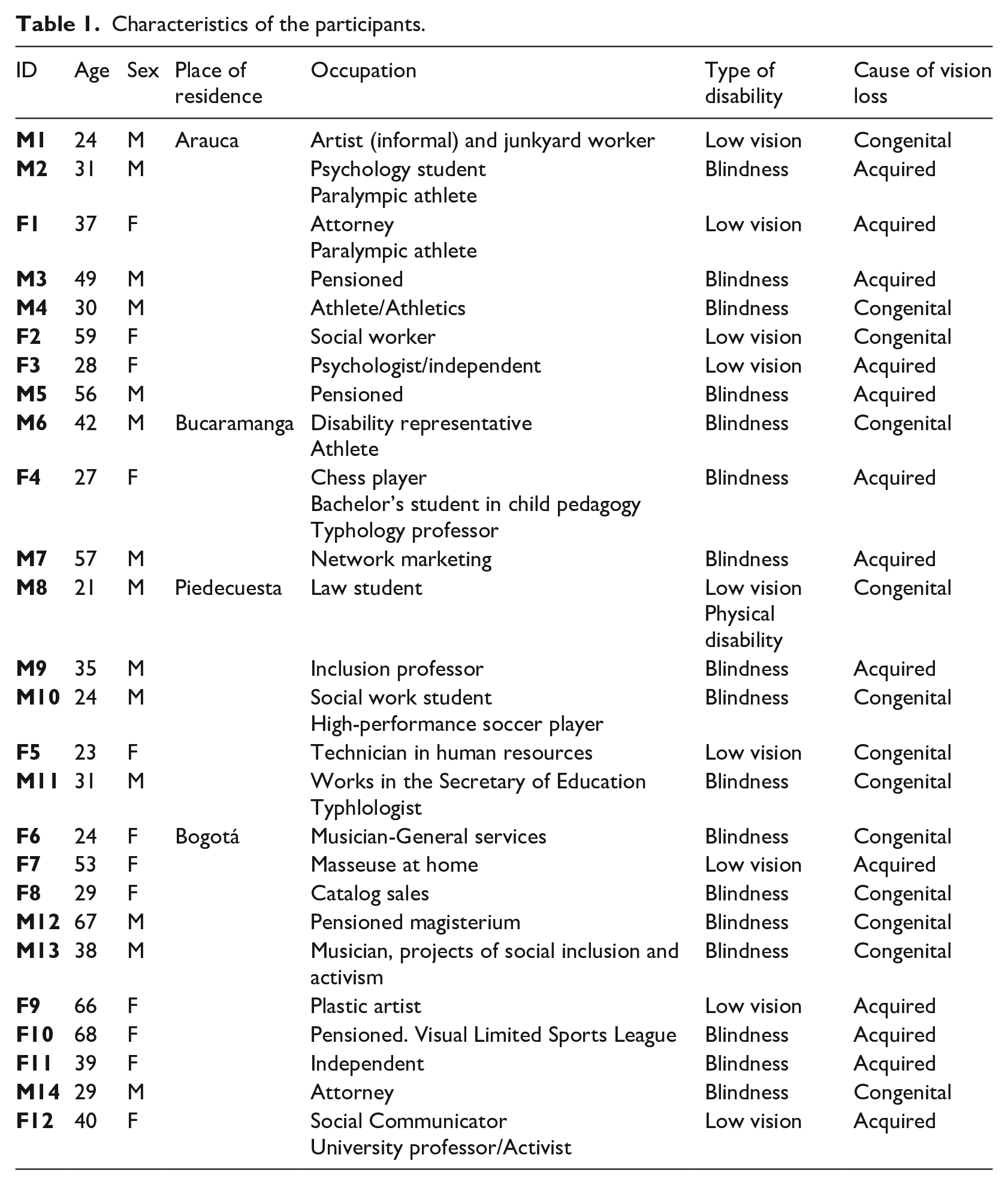
Data saturation was used as a criterion to define the number of participants. It is understood as the moment when the interviews and the qualitative material stops providing new important data as it begins to be repetitive. The research had 26 participants, 10 from the city of Bogotá, 3 from Bucaramanga, 5 from Piedecuesta, and 8 from Arauca. The mean age of the participants was 40 years. The minimum age was 21 years and the maximum age was 68 years. Of all the participants, 53.9% are males (14 people). Table 1 shows the characteristics of the participants.
Characteristics of the participants.
Given the condition of isolation due to the COVID-19 pandemic, the telephone semi-structured interview was used as a tool to gather information, which permitted addressing the experiences of people with visual impairment. Those participating were contacted in person by the researchers from the National Institute for the Blind, with prior authorization from the institutions. Each participant was informed about the objectives of the research, the methodology used, and the results expected from the study. Before conducting the interviews, three telematic group meetings were held to socialize with the participants the intention of the research and the process proposed; this permitted clearing their doubts and concerns.
Thereafter, the researchers (M.d.P.O.-C., K.N.A.-P., M.d.R.Y.-C., and P.M.F.) with experience in qualitative research and working with people with visual impairment interviewed each participant. Each interview lasted an average of 1 hr; during the interviews, two researchers were always present; while one directed the interview, the other one took notes and included key aspects for the analysis. All the interviews were recorded in magnetic media through a telephone application and then these were identified, bearing in mind the city by assigning each of them an identification code. The interviews were posed to obtain information regarding three dimensions, such as perceptions and experiences of the individual with disability in relation to social inclusion, proposals to advance in social inclusion, and family dynamics. The following questions were used to guide the interviews: “What is social inclusion?” “What are the barriers that you have experienced to achieve social inclusion?” and “What are the practices that can facilitate social inclusion?”
The research team has expertise in public health, psychology, disability, and visual impairment. M.d.P.O.-C. is a PhD candidate in public health and has wide research experience in low vision and blindness. K.N.A.-P. is a Social Communicator, has a master’s degree in social change, and experience working with visually impaired people. M.d.R.Y.-C. is an occupational therapist, with research experience in visual impairment and social inclusion. P.M.F. is a psychologist with research experience in visual impairment and social inclusion. L.G.V. has PhD in biomedical sciences and has experience in the analysis of social inequalities in visual health.
The analysis process used the methodological design from Taylor and Bogdan approach, who proposed a method to analyze the information from the findings given in the interviews, so the work followed the process of discovery, coding, and relativization of data (Taylor, 1987). Data analysis was performed concurrently with data collection, with emerging findings informing subsequent data collection. The researchers independently coded the transcripts; the resulting codes and categories were refined through ongoing team meetings to engage in collective reflection, expanding the possibilities for coding. To support the analysis of the reports from the participants, the atlas.ti software (v. 6.2) was used.
All the people invited accepted to participate and then were requested their verbal informed consent to conduct the semi-structured interviews. The study guaranteed ethical, anonymous, and confidential management of the information and names of the participants. This research was supported by the ethics committee at Universidad Santo Tomás, Bucaramanga.
Findings
Three central categories emerged from the information analysis with their respective subcategories, which are shown in Figure 1. For those interviewed, social inclusion is mediated by the meanings they assign to their own condition of visual impairment, by existing social imaginaries on the theme, and by the family dynamics or the nearby environment.

The three central categories with their respective subcategories.
My disability does not measure me: it is a way of living and being in the world
The significance of visual impairment is an individual, personal issue that is in process of permanent construction; hence, it is not static or single dimensional and interacts with the social, economic, and family conditions of an individual. This significance is mediated by matters of age, gender, and moment in which the disability appears, among others, and which is transformed in the interaction with others and with themselves: “The disability is an opportunity that allows me to find paths to fulfill purposes and dreams, but of course before it had to have been a burden, a disgrace, but today I have given it new meaning” (M7).
For some of those interviewed, the concept of disability is only a political category that permits joining, in the Colombian case, more than 1 million people with different vision conditions, but which – in turn – enter into tension with the individuality and peculiarity of the experience, given that the subject is homogenized and blurred. Likewise, from the perspective of the people interviewed, the significance assigned to their condition transcends the biomedical vision and, in that sense, it is not understood as a clinical diagnosis, but which is assumed as a condition of human diversity, which has facilitated their inclusion processes:
Feeling that it is not one’s problem, or a diagnosis; the defect is not what is relevant, but that barriers exist because the disability is not in the person as such, the disability is in the surroundings and if you start from that premise, well, things are different. (F12)
For those interviewed, their condition of disability has not impeded their personal development, given that it is understood as a condition, a way of acting and being in the world, as many others – even as an opportunity. It is identified that, for some of those interviewed, the meanings of disability are framed within the model of functional diversity (Palacios & Romañach, 2006), being that it is understood that all human beings carry out their activities in different manner:
The word disability is more a political term than truly medical, if some people are born – as in my case – with difficulty to walk, it does not mean I can’t get to certain places, it is that I need support to get there. A conventional person climbs stairs perfectly by moving one foot and then the other, not me, even if I have to do it sitting down, with support from another person, but I try to reach that part if there is no elevator. (M8)
Furthermore, it is recognized that there are those who assume a posture of self-exclusion that does not permit advancing in processes that promote their participation as subjects with rights in society; even for some people interviewed, the barriers for inclusion start from the very subjects with disability. These postures are related to the negative imaginary society has in relation with disability: “When you are in situation of disability, the first thing they tell you in the street is poor you and if you are not prepared you believe that story and start to fight with the entire world” (M6).
Social inclusion starts with acceptance
Social inclusion for those interviewed is a matter that starts with the process of accepting the condition of disability. There are those who manifest that for a society to assume a posture of inclusion toward diversity, it is necessary for women and men with disability to first recognize their capacities and potentialities and, thus, they can advance in their self-perception as part of society: “Truth starts by one’s acceptance; when you feel you are an active part and with contribution to society, I think many doors will open. The problem is that we do not accept ourselves” (M7).
This acceptance process is mediated by each person’s individual characteristics that can sometimes become facilitators and/or barriers. Facilitators for inclusion identify the individual characteristics together with the social, spiritual, and emotional skills of each person to face the challenges implied by living with visual impairment:
Everything in life is the result with what one has inside the mind, if the conception one has with respect to one’s life and it turns out that when one does not accept oneself, when one does not accept one’s reality, then it is very difficult to start any process. (F3)
Some of those interviewed mention that to the extent that they are empowered of their own condition and of their situation, those who are in their close environment start to interact differently; hence, for the participants, it is important to advance in the visibility of the difference through social activism, participation in different social settings that permit having their voices heard, which contributes to the transformation of the negative imaginaries existing about people with disability. “When they see you are empowered, owner of your situation, all that pitiful feeling begins to change; when you gain that space, people learn to respect you” (F4).
For those who participated in this study, it is important to strengthen individual skills to have the possibility of requesting support in cases required, without this implying an issue of invisibility of their capacities and potentialities.
Accepting the disability leads individuals to assume using the walking stick as a tool that contributes in their security, wandering, autonomy, and independence and which becomes an extension of touch. However, the people interviewed recognize that accepting to use the walking stick is a gradual process, given that at the beginning there is resistance, given that society has assigned a symbolic weight to this object, associating it directly with feelings of pity and handicap:
As you start assuming your disability, you start having a better relationship with your walking stick. Only after leaving school, did I manage to free myself from the pressure of my classmates and use the walking stick every day, before that I would be embarrassed. (F4)
Moreover, barriers to accepting the disability issues are mentioned related to the imaginaries they have about their own condition, given that for some it is a negative condition that generates disadvantages in the interaction with society. Some participants have in their imaginary the perspective of being a burden or of requiring permanent support from their families or from the state: “You feel you are a burden to society, you feel that now the state and others have a commitment with you” (M13). This path of acceptance is not simple and each individual experiences it differently; however, the experience of episodes of depression, anger, and sadness is recognized as a common aspect among a number of those interviewed.
Deconstructing the imaginaries: a wager for inclusion
For those interviewed, one of the principal barriers for inclusion has to do with the imaginaries that exist in societies in relation to those in condition of disability. These imaginaries affect their daily lives, in the interaction with other people, translated into difficulties for the experience, construction and performance of their life projects, and, hence, the achievement of a dignified and happy life: “Well, the first barrier one finds sometimes is people’s attitudes, perhaps their lack of knowledge, the intransigence to be receptive to what one may ask or tell them or to see the situation” (F7).
It is identified that society still has deeply rooted in the social imaginary the biomedical model of disability in which the subject is made invisible and blurred and the health condition is placed first, thus promoting a direct relation among disability, disease, and handicap, which hinders overcoming schemes linked to a history of beneficence and charity:
We would go give some conferences in a company and, suddenly, there would be an employee who would take out some coins and tell us to take them to help us with transportation or something and we were the ones giving the talks . . . it was absurd. (F12)
These issues increase further due to gender differentiation, given that from the perspective of those interviewed, women with visual impairment are denied the roles traditionally considered feminine; they are infantilized and limited: “Women with disability cannot care of themselves, they are denied many activities, so there comes a point in which the woman with disability isn’t even a woman” (F12).
From the normalization, and retaking Foucault, the fact is highlighted that norms that regulate existence are inscribed on the bodies; these are normative prescriptions in which the “normal” complies the double function of indicating a statistical regularity (the majority case) and a moral prescription (the good and adequate; the desirable); this obligates to homogeneity, canceling all that which escapes the norm (Foucault, 1998); these matters are recognized by the study participants:
People with disability are a risk, they must be normalized, they are not productive, so they are a risk to capitalism, they do not think. Regarding sexuality, infantilization is also seen, nobody can have desires, so let’s sterilize it. In society there is the imaginary of normality, so they are abnormal and, thus they see us and treat us all the time; let’s say they are imaginaries that are always contributing precisely to this social exclusion. (F3)
In this sense, lack of knowledge is identified in the population in general about the disability and the specific experiences of those with this condition of diversity. Thus, they recognize the importance of undertaking informative, educational, and communicative processes that contribute to establishing relations from respect, which – in turn – aid in transforming stereotypes or negative imaginaries, which contribute in the mid and long terms to generating joint changes and not from the view of vertical intervention that has been traditional with those having the condition of disability:
It is that people sometimes see us with pity or as gods, so it is because they really do not know that a person with disability is a person. It’s that simple, it is neither less, nor more, it is the same. So, it is not to seeing the disability, it is about seeing the person. (M9)
The imaginaries of disability play an important role in social inclusion in that social relations are regulated by the beliefs, values, and symbolic systems made tangible in the culture. These go beyond collective thought, since it is that from which they are constituted, represented, stated, and done in a given society (Santacruz, 2013):
Well, I consider that sometimes they are cultural formations that are being transmitted, the poor thing, we must pity him . . . So, I think they are participation jobs, to demonstrate capacities and potentialities that contribute to the development of this country. I consider them stereotypes we have to break from with education, with projects where they are supported and can show life experiences. (M2)
Although the imaginaries the participants identify are complex, we retake that proposed by Cornelius Castoriadis, who indicates that the imaginary does not refer to the purely structural, to immovable representations in societies, but that it is a creative capacity related to imagination, which reveals the creative power of the human being, inasmuch as an imaginary is a real and complex set of images (of what we are and desire) that appear to provoke different senses, senses that occur, are instituted, and open the world (Agudelo, 2011). This wager for the deconstruction of imaginaries is given from the need to recognize the difference, recognize human diversity and the values it has in the construction of societies, transcending the principles of normalization applied by the medical science to people with disability: “Inclusion is recognizing that we are all different and that there is diversity that in accordance with it, there are specific needs” (F7).
“When we are capable of looking at others in their essence, we will be capable of undertaking inclusion processes”
Those interviewed manifest the need to transcend those biomedical and medicalized visions to approach the theme from the diversity, thus recognizing the potentialities of each being in the construction of more inclusive societies. These aspects may be read from these wagers of Hegelian philosophy in which recognition designates an ideal reciprocal relation among subjects, in which each one sees the other as his equal and also as separate from itself:
I say we are magicians, we see the arm of the person who is missing it. . . we are always looking at the defects and that brings us to cancelling all the potential the person has, and that is a bit of not recognizing others in their essence. (M10)
From the paradigms of recognizing the solution to situations of injustice experienced by certain population groups, there is the cultural or symbolic change and, hence, the positive valuation of diversity. Lack of recognition or inadequate recognition can constitute forms of oppression, confining someone to a false, distorted, or diminished way of being. Beyond the simple lack of respect, this can inflict severe damage, by typecasting people into an overwhelming feeling of self-loathing. Granting recognition is not a mere act of courtesy, but a vital human need (Fraser, 2000). These matters are recognized in the accounts of those interviewed:
To open that door of inclusion, it is necessary to have education, a change of culture, for people to not have those beliefs of pity, we do not want to be given things for free, just recognize our capacities and potentialities. (F7)
According to Nancy Fraser, transforming solutions are currently associated with the deconstruction, which blurs the group differentiation – in this case, the terms in which difference is elaborated by a visual condition, given that this permits counteracting the existing lack of respect, transforming the underlying structure of cultural evaluation (Fraser, 2000, 2008): “A world that accepts the difference, I say that when the person is capable of looking at another, in their expression, as a person, inclusion processes begin” (M13).
For the participants, more than talking about social inclusion, what is required is a wager on empathy, on that possibility of recognizing others, in their peculiarities, specificities, potentialities; thus, we can progress in the construction of a society that is more respectful of differences. “We must work from empathy because if it is a stranger, if there is no interest on the theme, no inclusion processes will be produced effectively” (M13).
Social inclusion goes beyond a normative issue
Although the importance of normative initiatives for social inclusion is recognized, for the study participants this is an issue lived daily, which is evidenced in each action and scenario in which they live, and due to this, greater importance is given to those individual and collective attitudes and practices from the nearby environment that construct social fabric, which, in this sense, contributes to their inclusion. Public policies are recognized as important tools for the enforceability of rights, but – also – critical aspects are identified in them, given that they homogenize the population with disability, make the people invisible, and standardize some forms of acting upon a collective with specific identities and, in some cases, what it promotes is exclusion: “Social inclusion is a utopia, it is a search, it is not a theme solved in a classroom, in a class, in a norm. It is something constructed at each instant, in the street, in the day to day” (F9). For those participating in the interviews, social inclusion is a way of relating to another; however, it is recognized that it is a long way to cover, even a utopia and which requires time, will, desire, and empathy.
From the family, the most important is letting be
The dynamics taking place within the families play an important role in social inclusion, which become tangible in specific actions that can be facilitators or, on the contrary, barriers to develop autonomy, independence, and self-determination of the people with visual impairment. “My mother teaches me, guides me; she does not see my vision as a limitation, rather, she sees it as a strength. They help me to continue forward and not get depressed by not doing things” (M14).
From this work, it is understood that families are nonhomogeneous realities; hence, they have diverse behavior logics, such as change in its structure and onset of disabilities, among others (Barboza et al., 2019). The family, as group organization that is part of a greater social network, is a scenario in which become tangible the imaginaries of disability, which relate to the historical reality and social context in which they have lived. In this sense, the significance the family members have about the disability relates to the way relations are established among its members. On one hand, if there is a biomedical or care view, the practices carried out are overprotective or medicalized. “This was very hard; a very difficult situation, my family rejected me. My father still does not accept it” (F11).
On the contrary, in those with a broader vision on the theme, or a system of beliefs or positive perceptions about the disability (Knestrict & Kuchey, 2009), practices are identified that recognize the person with disability as a subject of rights, with possibilities of constructing their own life project and achieving their personal performance: “Fortunately, I have a family that respects the disability, respects decisions, respects autonomy” (F12).
Those who make up the family have an important participation, given that they have created conditions that permitted the first social inclusion to take place within the family’s private setting, to then achieve it in the public scenario or from society. It must be mentioned that most of those interviewed mention the mother figure as one of the most important referents. Experiences are identified in which the families assumed positive practices and which today are recognized by people with visual impairment as one of the key aspects for what they have achieved today in the different dimensions of their personal, academic, and professional lives.
From the personal, it is identified that the family exerts an important function of motivating, guiding, and supporting people with visual impairment against the daily challenges that arise, thus permitting each person to take control over their own lives, their desires, feelings, and expectations. From the academic, the families were recognized as support to achieve the educational objectives proposed, to overcome barriers generated within the educational context, and for the constant updating of topics of interests.
Those interviewed state the importance of undertaking educational actions within their homes in which basic aspects of disability and of mobility, among others, are socialized with each member, given that these types of actions have permitted their empowerment and to position themselves differently in their family relations: “You have to start by teaching the family, starting from themes of terminology or themes of concepts regarding us. From what one is learning, from what one investigates to implement it in one’s closest environment” (M6).
Thus, the families become – in turn – multipliers in the nearby settings, which favors the interrelation and conformation of social fabric beyond the family nucleus. In this sense, families construct and consolidate social support networks, fundamental to open a range of possibilities for social inclusion (Abad-Salgado, 2016): “Well, my family does everything possible for me to feel accepted with my disability, so they look for a thousand ways for people to understand my situation of visual impairment” (F11).
The participants interviewed recognize the importance of the accompaniment received from those who make up the family nucleus in the active search for rehabilitation processes, particularly during the initial phases of the condition, which has been evaluated as positive, given that due to these services, today they have greater autonomy:
When I acquired the disability, I had my mother’s support; she never limited me, on the contrary, she would tell me to go ahead, to go out on my own, to use the walking stick; even if I cracked my head, she cried if I were not to listen, she would say try not to go through where you went yesterday. (F11)
Moreover, the participants recognize the description as an easily implemented practice that favors their participation, socialization, and integration in daily activities:
My mother is the one who has the theme of inclusion most ingrained, when we are on the street and are talking about something, she tries to describe it, my sister too. If we are in a park or something attracts their attention, they say look, it’s like that; they try to describe it. (M11)
In spite of the aforementioned, it is necessary to strengthen these processes not only within the family nucleus but also with the surrounding environment to apprehend this practice and do it routinely:
Not everyone describes things, so they are talking and sometimes talk about visual things and they do not have that in mind and it is a situation that bothers. There are other moments in which they make gestures or signals and one as a person with disability perceives them, however, they continue with the same plan. (M10)
Although most of those interviewed recognize diverse positive aspects in their families, they also report barriers for the visions the members have about the disability, about what is expected in terms of the social functioning of a person with visual impairment, which is reflected in overprotective and caring practices that have a negative impact: “Since my birth until 22 years of age, my mother limited me too much, she overprotected me a lot, she did not teach me to face life, I did not know about doing household chores” (F8). Regarding these types of circumstances, those interviewed undertook actions, sometimes individually, through the support from other family members or due to special situations that permitted their breaking away from that caring circle, thus achieving substantial progress in their social inclusion.
Likewise, the study participants recognize the importance of engaging in processes of psychological intervention with the families to favor practices that permit empowering the people with visual impairment. The participating group reports some difficulties in establishing their sentimental relationships and acceptance from the family of their partners with disability, which again accounts for the imaginary that exists in society in relation to the condition of disability:
At first, it is quite complicated – the issue of the family accepting one’s partner due to ignorance, we should say, lack of knowledge. The fact that they say, with so many people that can see in the world, you hook up with a person that can’t see? But later, when they get to know you, acceptance is normal; they treat you like any other person. (F6)
Although most of the participants have had positive experiences in relation to their families, cases were identified of people who due to their condition of disability have been abandoned or discriminated by individuals from their close environment, which accounts for the coexistence of different social factors that come into dispute in disability:
My family abandoned me and that has been the most difficult thing, not having family support has been the hardest and the most difficult to face. They said that now what were they going to do with me, that now they had to carry me forever, that I was not going to be able to do anything. (F7)
Discussion
Social inclusion of people with disability, according to Nussbaum (2012), requires a new conception of society in which altruism and solidarity prevail, in which development is not evaluated by economic production and in which it is recognized that justice is not about providing the same to everyone equally, but about ensuring a social base that, bearing in mind the differences, offers more to those who need more to construct a dignified life – aspects that are coherent with the perceptions manifested by those interviewed, given that these repeatedly identified the need to value and recognize differences, to deconstruct the imaginaries society has regarding people with disability, and to weave other forms of relating that permit a true inclusion in settings of daily life.
Social inclusion is a complex, multidimensional social category that is constructed from the culture and the imaginaries societies have with respect to the theme. Without a doubt, there is a long way to go in recognizing the diversity, the capacities, and potentialities of people with visual impairment. The following are identified as facilitators to social inclusion: acceptance of the disability by those with the condition and by their close environment; recognition of the disability as part of human diversity; the family as a player that identifies, respects the individuality of each subject and, in that sense, promotes and accompanies their development; and the individual skills to cope with the situation and find a support network during the different life stages. The importance of the family and social, emotional, and financial support, among others, has been reported by Bassey and Ellison (2020), who mention that these aspects permit people with disability to adapt to new circumstances and reconstruct their life project.
In addition, the negative imaginaries and the biomedical view that persist in society were found as barriers; these constantly interact with the daily lives of people with disability, generating situations of exclusion and vulnerability reflected specifically in educational, work, and city scenarios on issues like mobility. These aspects have been indicated by those who mention how the need to normalize blindness or of legitimizing that they are still capable of doing things, perhaps more than other people, reflect their negative experiences of being discredited because of their deviation from the norm (Bulk et al., 2020).
Although this research recognizes the normative actions and, specifically, public policies as important aspects in official terms to take steps in social inclusion, greater importance is identified of actions that are carried out from day to day, in the exercise of citizenship, to contribute to the construction of inclusive, fair, and less inequitable societies. Public policies must be made tangible in daily life, given that no norm will be able to guarantee that which society does not grant, like human rights, to people with disability. Hence, it is necessary to accompany the implementation of public policies with strategies that contribute to modifying informal rules or the codes of conduct that negatively impact social inclusion (Molina, 2017).
It necessary to address that proposed from these theories of recognition, which propose as solution to the situations of injustice experienced by population groups, cultural or symbolic change, and, hence, the positive assessment of diversity. The lack of recognition or inadequate recognition may constitute forms of oppression, confining someone in a way of being false, distorted, or diminished (Fraser, 2000).
Conclusion
The primary aim of this study was to understand the meanings of social inclusion for people with visual impairment from four cities in Colombia, as well as the family dynamics that favor or hinder inclusion processes. The following categories emerged: (1) My disability does not measure me: it is a way of living and being in the world; (2) deconstructing imaginaries: a wager on inclusion; and (3) from the family, the most important is letting be. Our results indicate that social inclusion is mediated by the meanings people assign to their own condition of visual impairment, by the existing social imaginaries on this topic, and by the family dynamics or the nearby environment. The following facilitators were identified: acceptance of the disability by those who have the condition and by their close environment; recognition of the disability as part of human diversity; the family as an actor that recognizes, respects individuality, and promotes their development; the individual skills to cope with the situation and find a support network. Barriers were the negative imaginaries and the biomedical perspective that persists in society, which interact with the daily lives of the people, generating situations of exclusion.
The research findings have diverse implications. From the community setting, it is necessary to propose information, education, and communication actions that contribute to diminish the negative imaginaries society has regarding disability. Although the importance of normative actions is recognized, we need to advance toward recognizing people with visual impairment as subjects of rights, to guarantee equal opportunities for them and, hence, their social inclusion. It is key for processes of rehabilitation and health care to include psychological accompaniment for the person and the family nucleus because it permits advancing on accepting the condition as a fundamental aspect to achieve social inclusion. It is important to resist the dominant narratives of disability as an issue located within the individual and challenge the social and cultural factors that create and perpetuate the inequalities lived by people with visual impairment.
Limitations
The condition of isolation due to the COVID-19 outbreak implied conducting interviews through virtual media, which did not permit close interaction with the people interviewed. It is important to broaden comprehension on the phenomenon, and participation from relatives in future research to obtain their perspective and their role in the social inclusion of people with visual impairment. Future studies could be proposed from an ethnographic vision to delve into the daily dynamics and practices assumed that can favor and/or hinder social inclusion.
Footnotes
Declaration of conflicting interests
The author(s) declared no potential conflicts of interest with respect to the research, authorship, and/or publication of this article.
Funding
The author(s) disclosed receipt of the following financial support for the research, authorship, and/or publication of this article: The Project was co-funded by Colombia’s National Institute for the Blind and Universidad Santo Tomás-Bucaramanga. Research project: Configuration of daily practices undertaken by people with visual impairment, their families, and/or the nearby environment that permit identifying barriers and facilitators for social inclusion.
