



Abstract
Public transport plays an important role in improving mobility for persons with visual impairment. Commercial drivers are major stakeholders in ensuring that there are efficient and accessible public transport systems on university campuses that have a relatively high number of persons with visual impairment. We conducted a cross-sectional survey among 90 taxi drivers who operate their services on the campus of a tertiary inclusion school. The drivers were surveyed on their knowledge and practices in providing services to persons with visual impairment. The findings show that 55 (61.1%) drivers knew how to identify a pedestrian with a visual disability by looking out for the white cane. A total of 77 (85.6%) drivers have also adopted the practice of stopping for pedestrians to cross the road. However, only 20 (22.5%) respondents agreed to reserve the front seat for the passenger with visual impairment. Participants were not knowledgeable on the sections of the disability act relating to the provision of transport services to persons with visual impairment nor the kind of punishment associated with breaching the rules. The study provides recommendations on how to bridge the gap between the demands of the disability act and the practices of commercial drivers.
Introduction
Approximately 1 billion people worldwide have some form of disability (World Health Organization [WHO], 2017a) and 80% of them live in developing countries like Ghana. An estimated 3% (740,000) of the population in Ghana have some form of disability out of which 40.1% (296,000) are visual or sight-related (Ghana Statistical Service, 2014).
Persons with disability (PWDs) are known to potentially experience higher levels of unemployment and poverty (Mitra et al., 2011). Formal education remains a means by which PWDs obtain the needed skills to become employable and economically independent. The current paradigm in providing formal education is to ensure that persons with and without a disability are educated within the same setting and the exclusive institutionalization of PWDs is phased out. This ideology is strongly enshrined in the inclusive education (IE) policy by the Ministry of Education of Ghana. This policy provides an opportunity for all stakeholders in the education sector to address the diverse learning needs of various categories of students in the Ghanaian education system (Ministry of Education, 2015).
Visual impairment (VI) is a form of disability with reduced visual performance that cannot be remedied by refractive correction; either by spectacles or contact lenses, surgery, or other medical methods (WHO, 2017b). Consequently, it results in functional limitations of the visual system that may be characterized by restricted visual field, decreased contrast sensitivity, increased sensitivity to glare, as well as decreased ability to perform activities of daily living, such as reading or writing (Haymes et al., 2002; Jones et al., 2019; Naipal & Rampersad, 2018). The most common nonacademic challenge faced by persons with visual disabilities in inclusive schools is mobility (Ackah-Jnr & Danso, 2019; Temesgen, 2018). Persons with VI in most public schools in Ghana do not always have the luxury of paved walkways and safeguarded routes (Ackah-Jnr & Danso, 2019; Morley & Croft, 2011). Therefore, public transportation plays a major role in the safe movement of persons especially in tertiary education institutions, which have huge campuses. The University of Cape Coast (UCC) is an inclusion education institution of higher learning which hosts the second largest population of students with visual disability in Ghanaian tertiary institutions. There are approximately 60,000 students in UCC and 30 (0.05%) of them have visual disability (severe VI and blindness; Kwafoa & Imoro, 2020). Students have two main means of public transportation: the first one is the shuttle system. There are a limited number of buses that transport students from their halls of residence to the lecture halls. These shuttles have very limited routes and can only be boarded directly from the halls of residence to the lecture theaters on campus. Privately owned taxis is the second option available to students. The taxis are registered and given special authorization to operate within the confines of the university. They are the first point of contact for most students including persons with visual disability and provide regular mobility support throughout their stay. The taxies are the only mode of transportation to most parts of the campus as well as the rest of the city. They play a very important role in the daily lives of students. A previous study has assessed the transportation systems from the perspective of students with VI (Odame et al., 2020).
The findings showed a lot of discontent among the students on the use of the transport services. One way to find a lasting solution to this problem is to find viewpoints of all the stakeholders, including the drivers or transport operators. This study, therefore, focuses on the drivers by investigating the knowledge and practices of public transport operators in providing service to PWDs on the campus of the UCC.
Methods
A qualitative cross-sectional survey design approach was used in this study. The study was conducted among 90 taxi drivers from the two main taxi stations on the UCC. The study participants were sampled based on their availability and willingness to participate in the survey at the time of data collection. All taxi drivers were members of the private vehicle owner’s cooperative on campus.
Data collection tool
Data were collected through a questionnaire survey which consisted of a series of questions. There were a total of 17 questions in addition to 3 questions that elicited information on the demographics of the participants. Five of the 17 questions were aimed at finding out the driving experience of the drivers and how they will identify a visually impaired pedestrian. The questions also examined how the drivers will approach the pedestrian with VI to offer their services to them. Eleven questions solicited to investigate the study participants’ knowledge and practice of the disability act. The last question aimed at inquiring whether there were any regulations or protocols on how to deal with the visually impaired in the study participants’ membership association(s). The ages of the study participants were noted to investigate whether it had any impact on the kind of responses.
Data collection procedure
The research was explained to all the drivers and those who gave consent to participate in the study were recruited. Due to the language barrier, the questions were translated into the local dialect of Fante for 99% (89) of the study participants. The responses received were then recorded and transcribed into English. Participants were given ample time to understand the questions and provide their responses. All concerns of participants about the research were duly addressed.
Data analysis
The data were screened and entered into the Statistical Package for the Social Sciences for Windows (Version 22.0; SPSS, Inc., Chicago, IL, USA) software. Descriptive statistics were used to present the demographic profile of participants. Responses to the questions were summarized and presented in tables using frequencies and percentages. Analysis of variance was computed to explore the relationship between the responses and the age and duration of driving as a commercial driver. Spearman’s correlation was used to assess the association between the age of participants and the duration of driving. Alpha level was set at less than .05.
Ethical considerations
Approval to conduct the survey was obtained from the leadership of the transport unions at the UCC campus. The leadership informed the members and introduced the research team to them. During this meeting, the study was explained to all the drivers in the local language (Fante). After the meeting, drivers who showed willingness to participate had to acknowledge that they fully understand the study and its implications. Participants were made aware they had full right to withdraw from the research at any point in time without providing any reason. After this, an informed consent was signed/thumb printed as proof. To ensure data anonymity, the names of the study participants were not documented.
Results
All 90 participants of the study were males with a mean age of 40.7 (±12.2) years. Table 1 shows that the mean period within which participants had been drivers (16.0 ± 9.6 years) was marginally higher when compared with when they ventured into commercial driving (15.1 ± 9.8 years). The observed difference was found to be statistically significant (T = 3.58, p = .010). The age of participants was highly correlated with duration of driving (r = .780, p < .001) and years spent as a commercial driver (r = .771, p < .001); therefore, years spent as a commercial driver was used for all further analysis.
Age and driving history of campus commercial drivers.

SD: standard deviation.
Allocation for dedicated places for parking and accessibility of taxi stations for people with visual disability
An observational tour around the whole campus did show that no spaces have been allocated for parking for persons with visual disability or any other forms of disability. There were no visible signs around the campus commercial vehicle stations. All the stations were not tared and there were potholes and mounds in the roads leading to the vehicle stations. There were no designated areas for the crossing of persons with VI or any form of disability.
Most of the walkways (Figure 1(a) and (b)) leading to the taxi station were unpaved with gulleys due to erosion and not accessible to persons with VI. The only paved pathway has a rail only on one side, while the other side has a gully after the pavement. Apart from the uneven nature of the walkway, there is a disruption in the walkway due to construction work and has not been repaired.
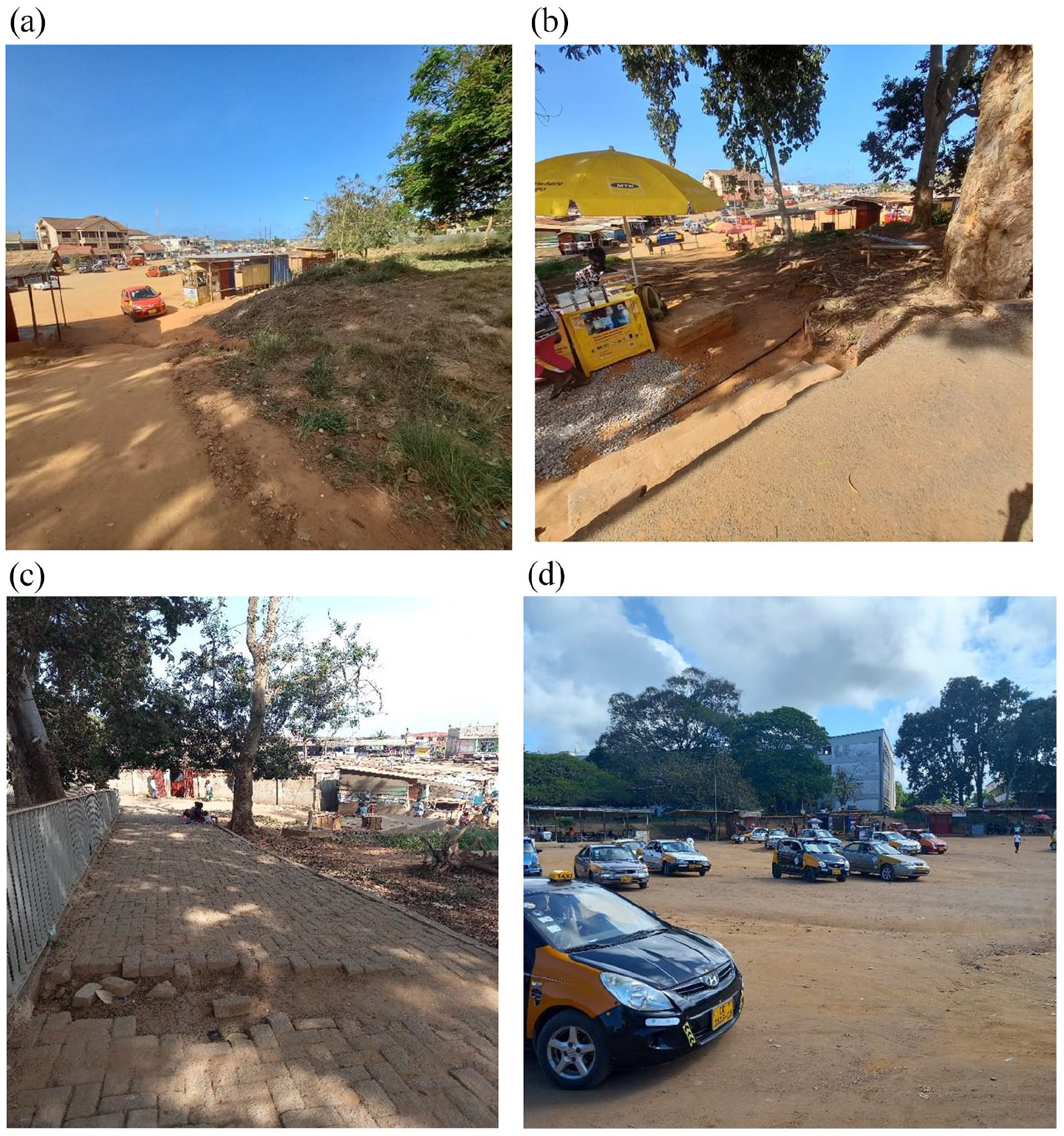
The taxi station and footpaths leading to it: (a, b) Common footpath used by students, (c) the only paved walkway has a rail with a gap, and (d) the nature of the taxi station.
Knowledge and practice of drivers on identifying pedestrians and seating options for passengers with VI
The responses of participants to items assessing their ability to recognize pedestrians with a visual disability, the actions they take, and recommended punishment for drivers who may refuse to provide them with the needed support are shown in Table 2. More than half of the respondents (61.1%) indicated they identify the visually impaired by the possession of the white cane/walking stick. One-third of the study participants (33.3%) indicated they could identify the intention of the visually impaired to cross the road; however, 2.2% could not tell whether an individual standing by the roadside intends to cross the road. Almost one-third (32.2%) of the drivers specified that the individuals would show some kind of body movements or positioned in a way that tells the intention of crossing the road (10.0%). Only 4.4% of responses required that the individual would be standing at the zebra crossing.
Knowledge and practice of drivers on identifying pedestrians and seating options for passengers with visual impairment.

SD: standard deviation.
The majority (85.6%) of participants would stop when they come across a visually impaired pedestrian crossing the road, whereas 13.3% of participants prefer to slow down their driving speed rather than stopping their respective vehicles. More than two-thirds (74.2%) of responses indicated that the front seat(s) was suitable for persons with VI, 23.6% preferred the back seat, while 2.2% had no preference. The age of participants did not influence their responses. However, participants with a shorter duration of being commercial drivers (14.1 ± 8.2 years) were more likely to offer their front seat to persons with VI, F(2, 86) = 4.129, p = .019.
Opinions of drivers on sections of the disability act relating to pedestrians and seating options for passengers with VI
The responses of participants on their knowledge of how to care for passengers and pedestrians with VI and associated penalties enshrined in the Ghana Disability Act are reported in Table 3. More than half of the respondents (79.8%) were of the view that not reserving a vehicle’s front seat(s) should not be considered a crime. This view was influenced by the duration of driving, M = 10.6 ± 6.3 years, F(2, 86) = 4.883, p = .030. Table 3 further shows that 91.0% and 85.4% of the participants did not know that failure to reserve a vehicle’s seat for the visually disabled could lead to imprisonment up to 3 months or be fined, respectively.
Opinions of drivers on sections of the disability act relating to pedestrians and seating options for passengers with visual impairment.

SD: standard deviation.
Table 3 shows that about one-third of the number of participants (36%) agreed that a driver who refuses to stop for a visually disabled pedestrian crossing the road deserves to be fined. The others suggested that the driver should be reported and arrested (15 [15.7%]) while almost an equal number (13 [14.6%]) indicated that such a driver does not deserve to face any charges.
Of the 90 participants, 65 (72.2%) of them agreed that a driver who refuses to stop for a visually disabled pedestrian wanting to cross the road does deserve some form of punishment. One-third (36%) proposed a fine; 13 (14.6%) participants were of the view that no punishment should be metered out. The age of participants and the duration of being a commercial driver did not influence the responses of the participants on all questions answered.
Regulation and training needs of operators of commercial vehicles
Responses of participants with regard to the need for training and regulations in relation to providing services to persons who are visually disabled are shown in Table 4. Most of the respondents (85.4%) indicated that the respective associations to which they belong have no regulations on how to deal with people with VI. Thirteen (14.6%) of the drivers have had some form of training on how to deal with visually impaired passengers. However, a majority of 96.6% of participants are receptive to having training on how to deal with passengers who are visually disabled.
Regulatory and training needs of drivers in providing services to passengers with visual impairment.

Discussion
This study explored the knowledge and practice of drivers on the provision of service to pedestrians and passengers with visual disability. The findings show that about two-thirds of drivers know how to identify a pedestrian with a visual disability and have also adopted the practice of stopping for pedestrians to cross the road. Persons with VI often observe the movement of oncoming vehicles before they proceed to cross the street. They exercise a lot of caution and often miss opportunities to cross roads compared to sighted pedestrians (Ashmead et al., 2005; Geruschat et al., 2006). Drivers that just slow down may not be deemed safe by the person with VI. Therefore, the drivers’ intention of providing a safe crossing for the pedestrian will not be achieved (Ashmead et al., 2005). It will be ideal for all drivers to adopt the option of stopping for pedestrians with VI at road crossings or when they show intentions of crossing as stated in Section 25 of the Persons With Disability Act (Government of Ghana, 2006). The rest of the drivers use nonspecific cues like gestures, body movement, or walking with someone. This may be due to the low usage of white canes by pedestrians with VI or the possible lack of knowledge by the drivers on the essence of the white cane in cases where the pedestrian may be holding it (Attia & Asamoah, 2020). Attia and Asamoah (2020) in their study in another inclusion school in Ghana identified the disregard of the white canes by drivers and other road users. Based on their findings, they proposed that road users should be educated on the relevance of the white cane and the government should institute stiffer punishment for motorists who ignore it.
It is important to note that more than one-third of the respondents in this study would offer the front seat to the visually disabled. However, almost 80% of respondents were not ready to reserve the front seat for a person with VI. This practically means that whoever comes first to board the vehicle can take any seat at all. This is at variance with the recommended practice of reserving a seat for a person with a disability and only give it up when there is no passenger with a disability. Some drivers provided explanation on why the back seat(s) would be preferred for visually impaired passengers and a front seat(s) for sighted passengers. They believed the sighted passengers will be able to identify and prompt the driver of oncoming danger and may also notice if the driver is falling asleep. This explanation did not correspond with their earlier overwhelming willingness to offer the front seat to passengers with VI. It is recommended that priority seats offered to PWDs in vehicles should be close to both the driver or the entrance/exit to ease communication with the driver and to minimize the distance walked into the public transport (Fast, 2018; Malhotra, 2010). This is especially true for the location of the study where taxis are mostly shared, and the taxi stations load up to a maximum of four passengers before it can embark on its journey. Therefore, there could be instances the passenger with VI is either too far from the driver or from the exit. Passengers could also be sandwiched between other passengers at the back seat which may make it difficulty alighting at their preferred destination.
Participants were not knowledgeable on the sections of the disability act relating to the provision of transport services to persons with VI. Most of the drivers did not know that not stopping for a pedestrian with a disability who intends to cross a road and not providing priority seats in public transport were punishable under the law. This is stated in Sections 25 and 29 of the Disability Act 715 of Ghana with the associated penalty stated in Section 30.
Section 25: A motorist shall stop for a person with a disability who shows an intention to cross the road either at the pedestrian crossing or at an appropriately designated point for crossing by persons with a disability. Section 29: A person responsible for the booking of passengers on a commercial bus is supposed to reserve at least two seats for persons with disability and failure to do so, he/she shall be dealt with by the law for contravening Section 29. Section 30: A person who contravenes Sections 25 and 29 commits an offence and is liable on summary conviction to a fine not exceeding fifty penalty units or to a term of imprisonment not exceeding three months or to both.
However, Section 29 refers to only commercial buses to the neglect of all other means of transportation. A possible amendment of this article may be needed to ensure that all public transport vehicles that are shared or need to be fully booked like most taxis in Ghana must have dedicated priority seats.
The study participants generally had no previous training on providing transport services to visually impaired persons. The lack of training of drivers to provide services to pedestrians and passengers with VI has been noted in some studies, and sometimes particular reference has been made to taxi drivers (Fast, 2018; Gallagher et al., 2011). The drivers’ code which is used for training new drivers may need to be revised to include laws stipulated in the disability act. This will help improve the safety of pedestrians with VI on the roads and improve the accessibility of public transport to students with severe VI and blindness not just in inclusion schools but in the wider society. Most of the drivers in this study indicated their willingness to participate in a training on providing services to visually impaired passengers.
Conclusion
The knowledge on the provision of transport services to persons with VI was low among our study population due to their poor knowledge of the provisions in the disability act. The lack of willingness to provide appropriate seats for persons with VI was evident. However, most of them could identify a pedestrian with VI and were willing to stop for them to cross the road. The drivers did not know the legal punishment for flouting any of the regulations stipulated in the disability act. There is the need to provide some level of institutionalized training to drivers and transport operators to help improve the experience of persons with VI on public transport.
