




Abstract
Mobile phones/devices are an important part of our daily lives for sighted people and those with visual impairment (VI) in India. This study explores how Indian university students use and perceive mobile apps and identify the challenges in their usage. A paper-based survey was administered for 124 college students who were legally blind. The survey had items relating to sociodemographic information, use of mobile devices and apps, and the use of apps specifically designed for persons with VI. Results show that, on average, the participants with VI have been using a mobile device for more than 5 years. Many participants used Android devices and free apps. In addition, they found that the mobile apps were user-friendly and accessible. Results also found that Facebook and WhatsApp are more frequently used. Participants had a high level of self-efficacy and positive attitudes toward special apps for VI. Android devices are popular in India because of lower cost compared to iOS devices. Results are discussed, and implications for practice are provided.
Individuals with visual impairment (VI) in India are estimated at 40 million (Garewal, 2019). Mobile phones/devices are an important part of our daily lives for sighted people and those with VI. However, access to mobile phones for people who are VI presents challenges because most mobile phones have touch-enabled screens and lack of accessibility software (Chakraborty & Samanta, 2013).
Raja (2016) stressed the importance of digital technologies for people with disabilities, including those with VI. Specifically, these technologies, when made accessible, allow for full participation in society by leveling “the playing field across life domains (i.e., education, employment, e-governance, civic participation, financial inclusion, and disaster management)” (p. 3). Like Raja’s viewpoint, Siu and Presley (2020) stated “Technology is often the ultimate mediator to ensure everyone in the community, whether blind or sighted, has equitable access to information” (p. 328). It also can help students with VI achieve their goals for a certain lifestyle, employment, and recreation interests.
Research indicates that there have been several studies conducted on the use of mobile devices/apps with individuals with VI. For example, an online survey of 132 individuals with VI was conducted to explore the types of mobile devices they used, accessibility features, types of apps, and their usability (Crossland et al., 2014). Results show that most of the participants used smart phones for texting, making telephone calls, reading, browsing the internet, and identification of objects. In addition, Morris and Mueller (2014) surveyed 1,348 people with disabilities including 85 participants who were blind and found that the participants mostly used iOS devices were satisfied with their devices and ease of use. However, this study did not investigate the use of mobile apps.
In another study, Griffin-Shirley et al. (2017) explored the use of mobile apps among 259 individuals with VI. The participants indicated that the apps were useful, accessible, practical, and they would like to see improvement in new or existing apps. The most reported apps used were for visual identification, reading/writing, GPS, and news. With the same dataset, another analysis of participants was conducted and reported results concerning the parameters for the development of mobile apps for individuals with VI (Moon et al., 2020). For persons with VI to accept and use mobile apps, the functionality and accessibility of mobile apps was important.
Recently, Martiniello et al. (2019) surveyed 466 adults with VI about their use of smart phones and tablets for certain tasks and the decisions they made concerning which device to use. The results showed that most of the participants replaced traditional devices with smart phones or tablets for object identification, navigation, sighted help, listening to audiobooks, eBooks, and optical character recognition. The participants also reported that the use of mainstream devices enhanced social acceptance among the public.
Studies in India
Few studies have been conducted in India concerning the use of smart phones and/or mobile apps. Pal and Lakshmanan (2015) conducted a mixed-methods study using a survey and a semi-structured interview (52 surveys and 21 interviews) with persons with VI focusing on social inclusion and access to their workplaces in Bangalore, India. All participants used a Nokia phone except for one who used an Apple iPhone. In addition, they reported using JAWS and Eloquence (screen reading software), music player, Bluetooth, GPS, and voice recording or note-taking. Participants also reported that mobile devices increased their ability to establish and maintain their social networks, allowed greater access to transportation in public spaces, and control of their personal information which fostered independence. In this study, the participants did not mention or report the use of mobile apps.
In another study, Vashistha et al. (2015) explored the use and non-use of social media among 53 low-income mobile phone users with VI in rural and semi-urban areas. Researchers analyzed call logs, interviews, and phone surveys to identify the strengths, weaknesses, and benefits of the social media platforms. The participants expressed challenges with social media, such as lack of English proficiency, accessibility features, and navigational challenges, and difficult to follow terminology (e.g., tweet, follow). Some participants expressed that it increased their social interactions with others, but they also gained social acceptance and entertainment. Many non-users abandoned the devices due to the cost of the device and the internet.
Pal et al. (2017) conducted a similar mixed-methods survey with 81 people with VI who rated six constructs concerning mobile use: independence, safety, economic participation, income, productivity, social circle, and mobility. Participants reported mostly using smart phones for email, browsing, and social media. Results also indicated that the highest rated constructs were physical mobility, social circle, safety, and independence. Many participants expressed that the cost of the phones was more than 70% of their family’s household income.
The literature indicates a need for more research among persons with VI and their use of mobile apps. Furthermore, there is a lack of research concerning Indian university students with VI on mobile apps. Such research can identify the status and use of mobile apps among students with VI attending an Indian university. In addition, such a study can inform best practices and provide recommendations for instructors and administrators to provide better accessibility in higher education. The following research questions were answered in this study: How do Indian university students with VI use and perceive mobile apps? What are some frequently used devices and apps and how students with VI use them? What challenges do Indian university students with VI face when using mobile apps?
Methods
Recruitment of participants
The study was approved by Texas Tech University Human Research Protection Program. This approval allowed the Banaras Hindu University to waive their approval process for Human Subjects Research. The participants were recruited from an India university and its affiliated colleges who were pursuing their education (i.e., undergraduate, graduate). Consent was obtained prior to the administration of the survey.
Survey
The survey items were adapted from Griffin-Shirley et al. (2017), which examined the use of mobile devices and apps among individuals with VI and their perceptions concerning the apps. The survey items included sociodemographic information, use of mobile devices and apps, and apps specifically designed for persons with VI. In addition, a five-point Likert-type scale was used to rate app usability, frequency, self-efficacy, ease of use, usefulness, and so on. Specific items on the current survey that were modified from Griffin-Shirley et al. (2017) were level of education and income to match with India’s standards. To make the survey accessible to potential Indian participants, a double translation method was used: English to Hindi (Indian language), Hindi to English, and back to Hindi.
The paper-based survey was distributed from February 2019 to July 2019 by individuals with vision who read and recorded the participants’ responses to survey items. Initially, the primary author compiled a list of students who are visually impaired (e.g., name and phone number) and residing in the university housing (hostels). In total, 10 volunteers who were sighted were recruited to contact the potential participants. Orientation to the paper-based survey and list of potential participants with VIs were provided to the volunteers. The volunteers contacted 150 potential participants and obtained informed consent from 124 (82.7%) who agreed to participate in the survey. After the consent, the survey was read to the participants by the volunteers. All 124 participants completed the survey. Data were then entered by a doctoral student into an Excel spreadsheet. The first author confirmed the accuracy of the data and it was transferred to SAS®9.4 for statistical analysis.
Participants
A total of 124 participants completed the survey. They were all legally blind, as per the Person with Disability Act 1995 of India, who had (1) total absence of sight, or (2) visual acuity not exceeding 6/60 or 20/200 (Snellen) in the better eye with correcting lenses, or (3) limitation of the field of vision subtending an angle of 20° or worse (Ministry of Law, Justice & Company Affairs, 1996). VI was the only disability for all participants except for one who chose not to disclose.
The sociodemographic characteristics of the study participants are presented in Table 1. The participants were Indian university/college students aging from 20 to 28 years, male (83.1%), and living in an urban or semi-urban area (53.2%). All participants, except for one who declined to disclose, had a bachelor’s or master’s degree. Most participants (91.9%) reported their annual income less than 25,000 rupees (₹) or less than US$350.
Sample demographics (N = 124).

SD: standard deviation.
Data analysis
Descriptive statistics were utilized to summarize the participants’ experiences and perceptions about mobile devices and apps. In addition, bivariate tests were conducted to identify sociodemographic factors related to mobile device and app use. Specifically, the participants were divided by gender (male vs female), geographical location (urban vs nonurban), or education (bachelor’s degree vs master’s degree); and then the subgroups were compared using t-test (for continuous variables, with Satterthwaite approximation if appropriate) or chi-square test (for categorical variables). An effect size (Cohen’s d or Cramér’s V) was calculated for each comparison.
Results
Mobile device and app use
The participants’ experiences with mobile devices and apps are reported separately for different genders (Table 2), geographical locations (Table 3), and education levels (Table 4). On average, the participants have used a mobile device more than 5 years (M = 64.88, SD = 20.68 months). The length of mobile device use did not significantly differ between males versus females (p = .43, d = .19) and between urban versus nonurban areas (p = .06, d = .35). The participants who earned a master’s degree have used a device significantly longer than those who had a bachelor’s degree (p < .001, d = 1.25), but this may simply reflect the fact that the former group was slightly older than the latter group (i.e., average age of 26.55 vs 23.21 years), respectively (p < .001).
Use of mobile devices and apps and perceptions about special apps, by gender.

SD: standard deviation; GPS: global positioning system.
Use of mobile devices and apps and perceptions about special apps, by geographical location.

SD: standard deviation; GPS: global positioning system.
Use of mobile devices and apps and perceptions about special apps, by education.

SD: standard deviation; GPS: global positioning system.
As depicted in Figure 1, most participants were currently using an Android device(s) (96.8%) and only 3.2% using an iOS device(s). It was also found that a greater proportion of the participants with a master’s degree was using an Android tablet (35%) compared to the bachelor’s degree group (7.8%; p < .001, V = .31). However, there was no significant difference between the gender groups (p = .11, V = .19) and between the location groups (p = .20, V = .16).
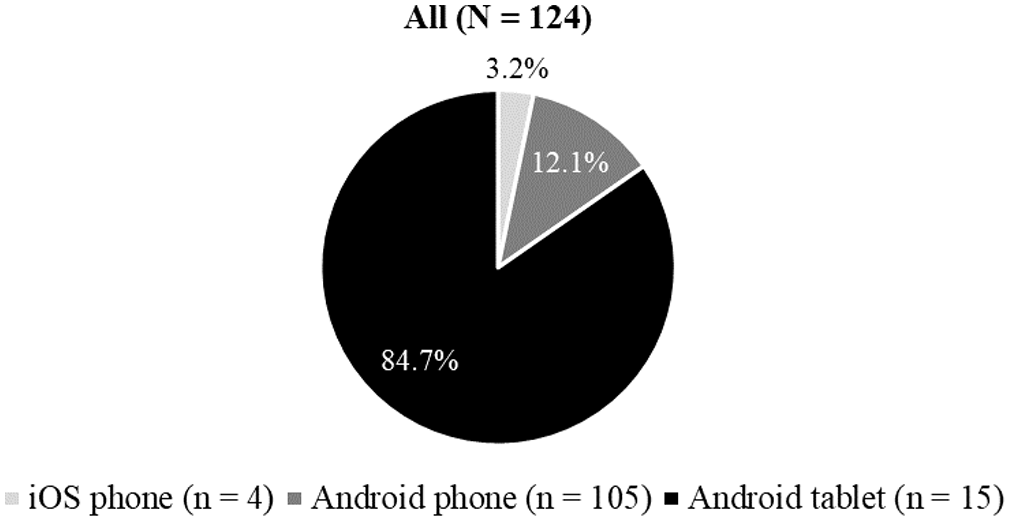
Current use of mobile devices.
About three-fourths of the participants utilized only free apps (72.6%) and 66.1% downloaded one to two apps in a month (see Figure 2). Similar percentages were observed among males and females (p = .80, V = .02; p = .34, V = .13). The participants residing in an urban area were more likely to use free apps only than those in a nonurban areas (80% vs 63.8%, p < .05, V = .18), but the urban and nonurban groups did not differ in the number of app downloads (p = .06, V = .21). As compared to the participants with a bachelor’s degree, the master’s degree group had a higher tendency of purchasing paid apps (75% vs 18.4%, p < .001, V = .47) and downloaded significantly more apps (p < .001, V = .60).
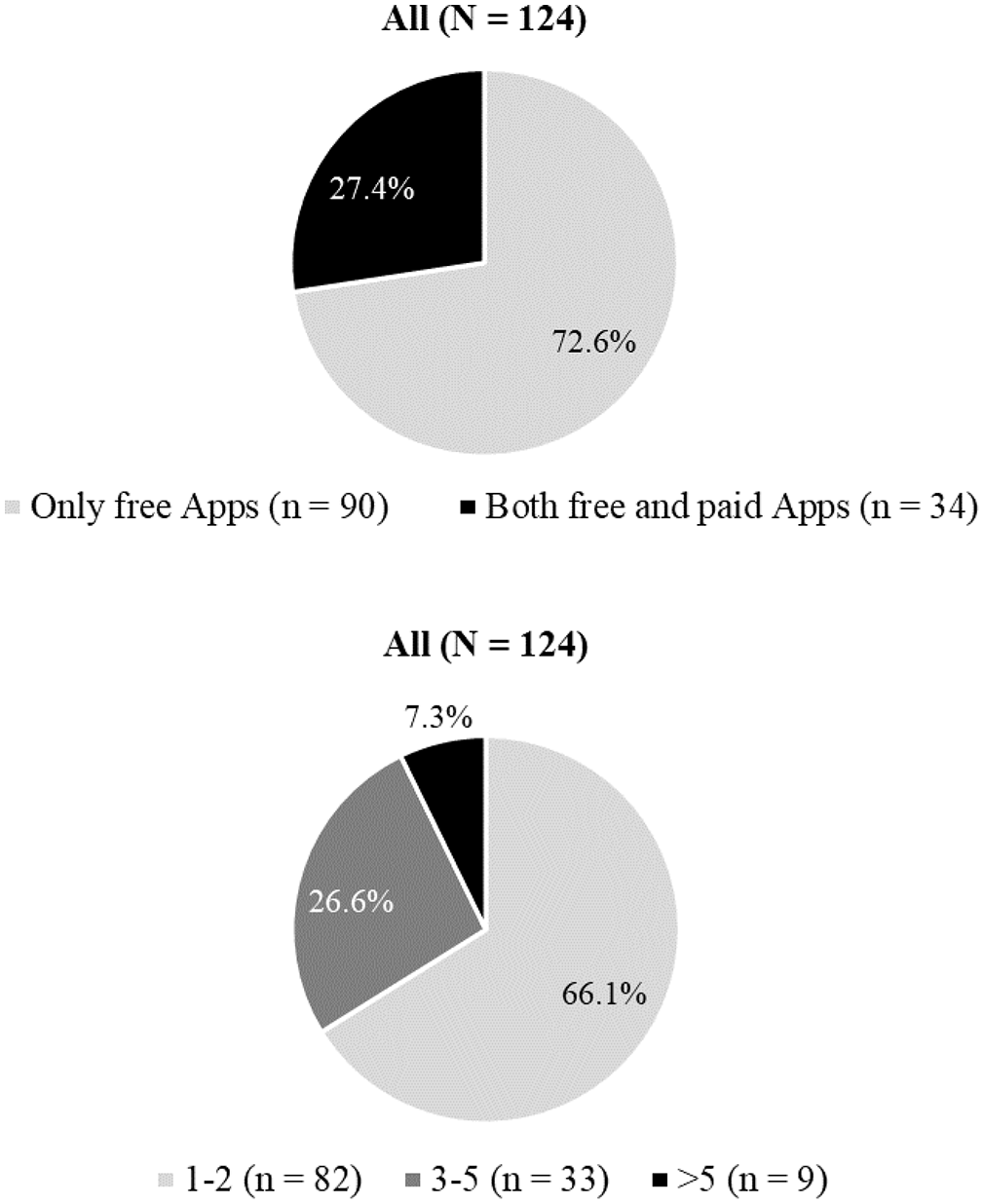
Current use of mobile apps and number of app downloads.
The participants were asked to list up to five apps that they utilize most frequently. Of a total list of 600 apps given by the participants, the most reported apps were Google Search (20.2%) followed by WhatsApp (18.8%), Facebook (14.3%), YouTube (10.3%), and Telegram (7.7%). The participants also reported that they use apps for a variety of different services, most commonly for education (98.4%), shopping, GPS navigation, news, and dictionary/thesaurus (see Figure 3). These five services were also reported most frequently in each of the gender, location, and education subgroups. Interestingly, a greater proportion of the participants living in a nonurban area was using app tools for news service compared to the urban group (53.4% vs 33.8%, p < .05, V = .20). In general, mobile apps were perceived user-friendly (96.8%) and accessible (96.8%).
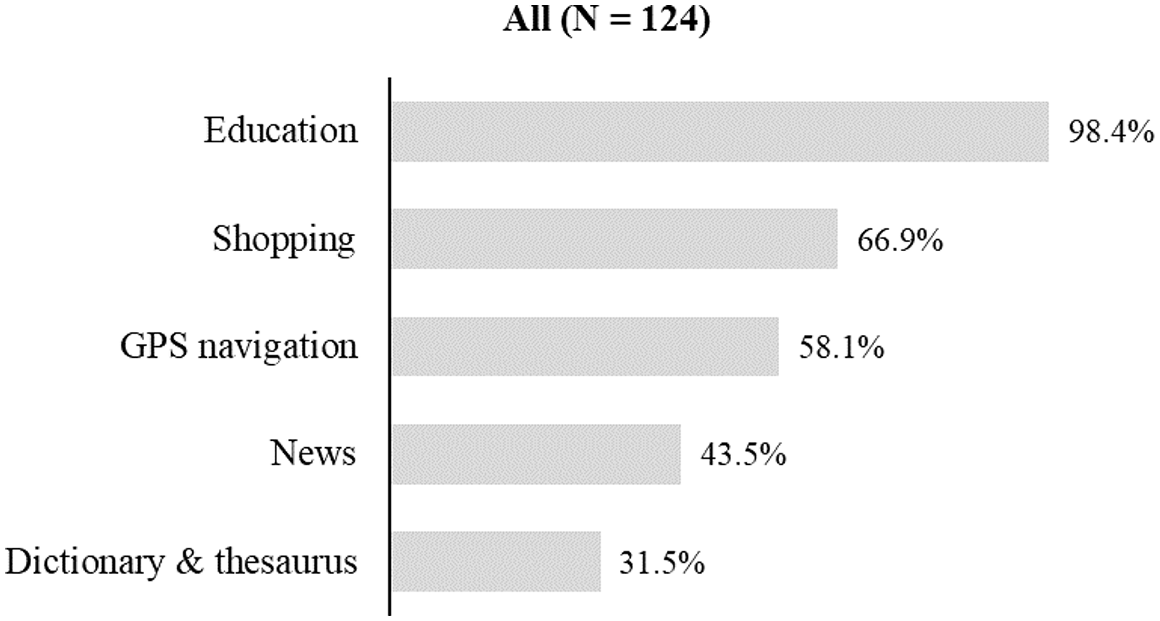
Top five services of using mobile apps.
Special apps for individuals with VI
All participants had apps on their device that were specially designed for individuals who are blind. The participants used special apps, such as TalkBack (built-in screen reader with Android; 38.7%), screen reader (32.3%), and hearing enhancer (device amplifies sound; 29%). The most popular apps they purchased were Tally (data entry app; 37.9%), Microsoft Office (33.9%), and KNFB Reader (converts text to speech or braille; 25%). Mobile apps less apt to be purchased by the participants include Audible (Amazon Audible books; 18.5%), Digital Eyes (screen reader; 18.5%), Kindle (Amazon app; 16.9%), Prizmo (scanner app; 16.1%), and Be My Eyes (virtual assistance through a live call; 6.5%).
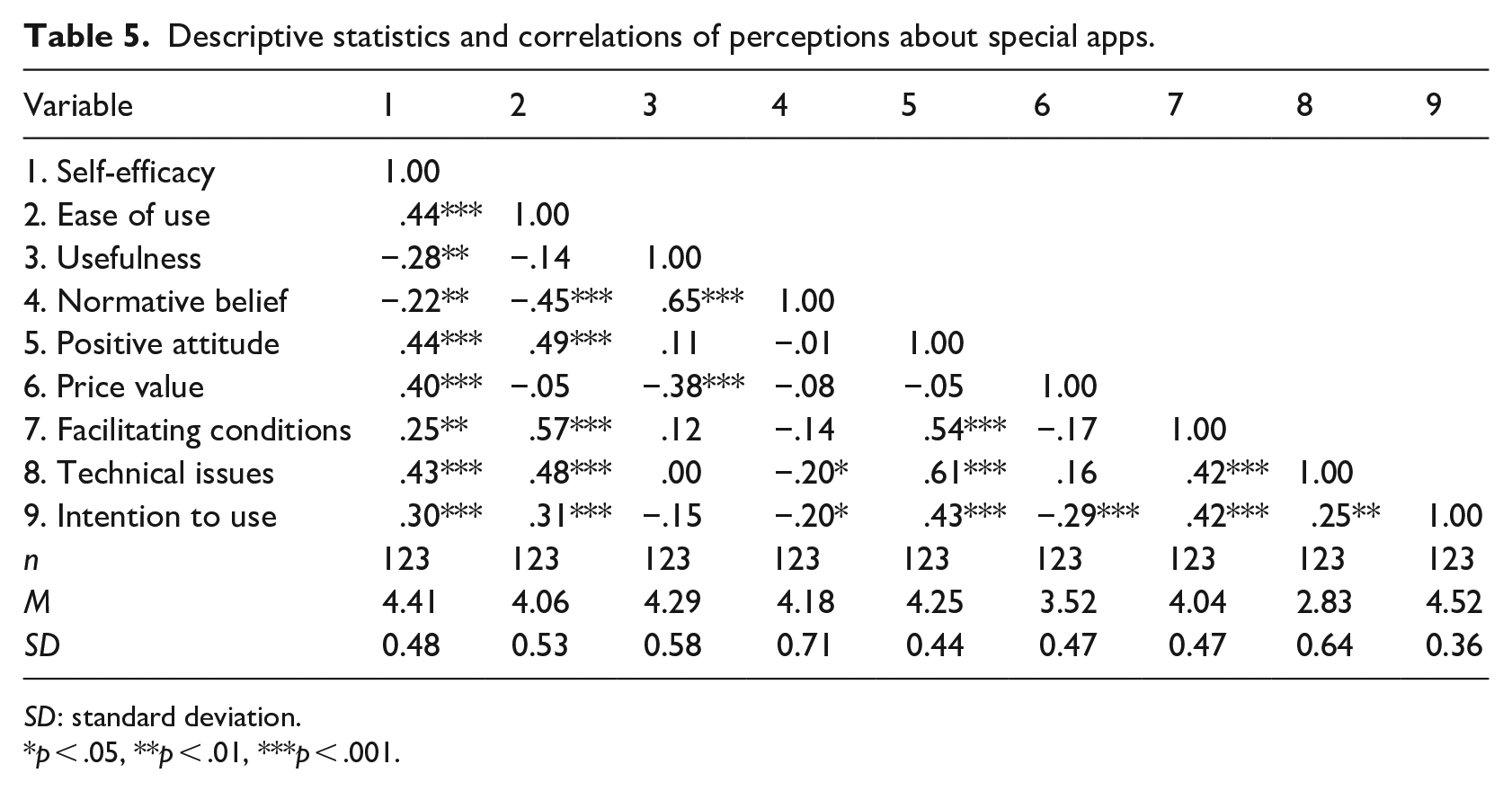
Table 5 presents the descriptive statistics and (Pearson) correlations for the participants’ perceptions regarding apps specially designed for people with VI. Overall, the participants considered special apps as a practical tool for individuals who are visually impaired: useful (M = 4.29, SD = 0.58), easy to use (M = 4.06, SD = 0.53), and in good facilitating conditions (M = 4.04, SD = 0.47). The participants indicated a high level of self-efficacy (M = 4.41, SD = 0.48) and positive attitudes toward special apps (M = 4.25, SD = 0.44), but they also made moderate ratings about price value (M = 3.52, SD = 0.47) and technical issues (M = 2.83, SD = 0.64). The participants reported that they intend to use special apps (M = 4.52, SD = 0.36).
Descriptive statistics and correlations of perceptions about special apps.
SD: standard deviation.
p < .05, **p < .01, ***p < .001.
The participants who have a higher level of self-efficacy reported that they have a lower level of normative belief (i.e., apps typically used/recommended by friends and family members; r = −.22, p < .01), and that special apps are less useful (r = −.28, p < .01). In fact, the participants who had high normative belief were significantly more likely to have difficulties (r = −.45, p < .001) and struggle with technical issues (r = −.20, p < .05) and thus avoid using special apps (r = −.20, p < .05). We also found positive and significant correlations between different domains of their perceptions about special apps (see Table 5).
The participants’ perceptions were comparable between the gender subgroups (all p’s > .05, d = .03–.32) and between the location subgroups (all p’s > .05, d = .00–.26). However, the participants with a master’s degree had less positive perceptions on the price value of special apps (p < .05, d = .50) and were less likely to encounter technical issues (p < .05, d = .56) than those with a bachelor’s degree. No significant difference was found in other domains between these two groups.
Discussion
This study investigated the status of mobile devices and app usage among college students with VI in India. Overall, results show that the participants have been using a mobile device for more than 5 years. In addition, many of the participants with VI were using Android devices and three-fourths of participants utilized only free apps. Some of the commonly used apps were Google, WhatsApp, Facebook, YouTube, and Telegram. These results are consistent with Vashistha et al. (2015) who found that social networks, such as Facebook and WhatsApp, are more frequently used social media platforms in India compared to other platforms (i.e., Twitter). In addition, they found that the mobile apps were user-friendly and accessible.
In India, most of the participants used Android devices because of cost. In general, the cost of the phones is high (Chakraborty & Samanta, 2013; Pal et al., 2017), particularly for the student population who has a limited income from scholarships or dependent on parental income. In addition, Vashistha et al. (2015) found that some participants in their study ceased using the device due to the cost of the device and the internet. Therefore, lack of funds may have necessitated the use of free apps by the participants with VI. This is also observed in students with master’s degree who purchased more paid apps compared to those with a bachelor’s degree. A possible reason could be that students with a masters’ degree may have a higher income (e.g., scholarships, work as paid tutors) to afford the paid apps.
The participants with VI used the mobile apps for education, shopping, GPS navigation, news, and dictionary thesaurus. These findings are similar to the other studies conducted with persons with VI on the use of mobile apps (Griffin-Shirley et al., 2017; Pal et al., 2017). In contrast, Vashistha et al. (2015) report that their study participants faced challenges, such as a lack of English proficiency, accessibility features, and navigational challenges, and found it difficult to follow terminology on social media (e.g., tweet, follow).
The participants who earned a master’s degree were less likely to encounter technical issues with mobile apps than those who had a bachelor’s or lower degree. This could be due to the amount of time they have been using the apps compared to those with a bachelor’s degree.
Many times, apps with accessibility features for people with VI contribute to social inclusion, education, and independence, thus upgrading their quality of life (Theodorou & Meliones, 2020). Regarding social media, Siu and Presley (2020) discuss the role technology plays in breaking down the environmental and attitudinal barriers toward individuals with VI. Little research has been done in this area, specifically concerning the training of people with VI in the use of mobile apps.
Results indicated that the participants had a high level of self-efficacy and positive attitudes toward special apps. Moon et al. (2020) reported similar findings in their study. Specifically, the participants had a high level of self-efficacy, a positive attitude, and intended to continue the usage of special apps by persons with VI. Results further showed that the participants rated the price value and technical issues with mobile apps/devices as moderate. Chakraborty and Samanta (2013) and Vashistha et al. (2015) discuss the high cost of phones and the internet.
Implications for practitioners
The implications for practice include that the faculty and peers (sighted and VI) could provide a list of free apps that could improve their performance of daily and academic tasks. To ensure success of students with VI, training and technical support are recommended on a continual basis. In addition, many students with VI cannot afford to purchase smart phones; administrators at Indian universities and non-governmental agencies can seek funding to aid students with VI in purchasing smart phones/tablets, mobile apps, and internet access (e.g., free Wi-Fi locations across campus). University students with VI should be encouraged to utilize mobile devices/apps so that it improves their academic performance, independence with daily tasks, access to information, social interaction, and social standing among their peers (peers with and without VI).
Limitations and future research
The limitations include the use of convenient sampling in a small geographic area, which restricts the generalization of results to a similar population across other colleges in India. In addition, most of the participants with VI were male in this study. Future researchers should strive to use a random sampling in a larger geographic area. Doctoral students read survey items and recorded the participants’ responses; this may have influenced the accuracy of some of the written responses. Focus groups or interviews can provide a more accurate picture of mobile app usage. Another limitation is that data were based on self-reports of the usage of mobile apps, not the actual usage by the participants with VI. Future research should focus on tracking the actual use of mobile apps of persons with VI. The survey did not include items that would provide information about the correlation between students’ academic performance and their usage of mobile apps, another potential area for future research.
Conclusion
This study investigated the status of mobile app usage among college students with VI in India. Results indicated that most of the participants with VI used Android devices and only free mobile apps. In addition, the participants found that the mobile apps were user-friendly and accessible. However, cost of devices/apps and internet was obstacles to usage. Future researchers should expand the study to other universities for generalization of results across similar population.
Footnotes
Declaration of conflicting interests
The author(s) declared no potential conflicts of interest with respect to the research, authorship, and/or publication of this article.
Funding
The author(s) received no financial support for the research, authorship, and/or publication of this article.
