




Abstract
Students with visual impairments (VI) and multiple disabilities (MD) often exhibit challenging behavior, yet school staff’s use of evidence-based practices in behavior management is reportedly low. In this article, we share the results of a collaborative professional development (PD) aimed at increasing school staff buy-in and use of individualized positive behavior interventions and supports (I-PBIS) with students with VI and MD. Ten staff, including teachers, paraeducators, and related services, working in a self-contained school for students with VI participated in four weekly, collaborative small group modules on research-based I-PBIS strategies. The Covid-19 pandemic occurred mid-study, which affected implementation of the program and collection of outcome data; however, pre- to post-PD participants’ supportive beliefs regarding I-PBIS increased significantly. Participant-reported knowledge and use of I-PBIS also increased but did not reach significance. In addition, participants found the PD highly acceptable and useful in their work with students with VI and MD who engage in challenging behavior. Implications for increasing school staff support for and use of I-PBIS with students with VI and MD are discussed.
Keywords
School-age students with visual impairments (VI) and multiple disabilities (MD), including intellectual and physical disabilities, can present a variety of unique challenges to teaching teams. Compared to both typical students and students with VI who do not have additional disabilities, students with VI and MD are more likely to (a) engage in challenging behavior such as aggression and self-injury (Alimovic, 2013) and (b) possess fewer adaptive (Bathelt et al., 2019) and communicative (Bathelt et al., 2017) skills. Teachers of students with visual impairments have reported that 64% of their students with VI and 95% of their students with deafblindness engage in challenging behavior (Westling, 2010), and many educators describe managing challenging behavior as one of the most difficult aspects of their work (Scott, 2017).
Behavior support for students with VI and MD
Research-supported frameworks can assist teachers and other school staff in assessing, preventing, and reducing challenging behavior while increasing adaptive and communicative behavior. One such approach is individualized positive behavior interventions and supports (I-PBIS; Bambara & Kern, 2021), based on applied behavior analysis (Clarke-Bishke & Crowley, 2011). I-PBIS strategies aim to decrease challenging behavior by first gaining an understanding of the purpose challenging behavior serves for an individual student. That knowledge is then used to reduce triggers for challenging behavior and teach communicative and adaptive behaviors that serve the same function as challenging behavior. Strategies based on an I-PBIS approach have been found to be effective for students with VI and MD (Nannemann et al., 2017). For example, Bruce et al. (2018) found that avoiding triggers to challenging behavior by creating a structured, sensory-friendly, and predictable environment while reinforcing adaptive and communicative behavior was helpful in reducing challenging behavior in their participants who were deafblind with CHARGE (coloboma, heart defects, atresia choanae [also known as choanal atresia], growth retardation, genital abnormalities, and ear abnormalities) syndrome. In addition, students with VI, MD, and challenging behavior can be taught to use adapted versions of the Picture Exchange Communication System (PECS; Ivy et al., 2014) and other augmentative and alternative communication methods (Parker & Ivy, 2014) to increase functionally equivalent communication and decrease challenging behavior.
Special educator preparation in I-PBIS
Unfortunately, special education teachers frequently report entering the field with insufficient pre-service preparation in behavior management and use of I-PBIS strategies (Flower et al., 2017). Instead, teachers often learn these concepts and skills through on-the-job-learning or in-service professional development (PD; Moore et al., 2017). These methods of learning I-PBIS strategies have potential advantages of being more closely tied to the work context and needs of in-service special education teachers and their students (Darling-Hammond et al., 2017), yet research indicates typical PD in special education is often ineffective in developing new beliefs, knowledge, and skills in teachers (Kennedy, 2016). Traditional PD is frequently provided through on-site workshops, delivered by individuals considered experts in content. These models of PD tend to center the knowledge of the expert or leader of the workshop and marginalize the knowledge of the attendees. In addition, traditional PD is brief, with workshops often being presented one time with little to no follow-up support in implementing the ideas discussed in the presentation. Furthermore, traditional PD tends to be delivered in homogeneous groups, such that teachers may receive one training while related services and paraeducators receive their own PD. As a result, the teaching teams that support students with VI and MD may struggle to integrate the variety of concepts they learn into their separate PD trainings (Lewis & McKenzie, 2010).
In contrast to PD activities described above, Darling-Hammond et al. (2017) found that effective PD for school staff (a) teaches specific strategies, (b) incorporates active learning, (c) is collaborative, (d) presents models of effective practice, (e) includes coaching or expert support, (f) provides space for feedback and reflection, and (g) is of sustained duration. Unfortunately, in both research and practice, teacher PD in I-PBIS and other behavior management tends to be prescriptive, in that educators are informed by experts, through coaching, workshops, or combinations of these methods, which practices they should be using with their students and how best to implement them. While such a prescriptive approach may seem appropriate, research in teacher learning indicates that this model may actually be counterproductive and result in lowered adoption and use of content by teachers. For example, Kennedy (2016) found that prescriptive models of teacher PD had the least effect on teacher practice, whereas PD models that emphasized collaboration, reflection, and teacher insights had the greatest effects on teacher practice. These findings may be partly because prescriptive approaches dismiss the practice-based evidence (Smith et al., 2013) possessed by teachers about their unique populations. The space in which evidence-based practice and practice-based evidence overlap may be exactly where collaboration, active learning, and reflection are useful in educator PD.
Communities of Research and Practice
Project CoRP (Communities of Research and Practice) was developed to include the components of active learning, collaboration, and reflection into teacher PD in behavior management. In its first pilot test, participation in the 4-week program was associated with significant increases in special educators’ reported use of I-PBIS that were maintained 6 months after program completion (Robertson et al., 2021). Project CoRP was then revised for further pilot testing based on participant feedback and adapted for teachers of students with higher support needs. The purpose of the present study was to pilot this version, aimed at increasing supportive beliefs, knowledge, and use of I-PBIS in school-based personnel working with students with VI and MD. Project CoRP sought to integrate evidence-based practices into I-PBIS with participants’ practice-based evidence (Smith et al., 2013) by incorporating collaboration, active learning, and reflection into teacher PD in behavior management. Our research questions were, is Project CoRP associated with increases in participants’ (1) supportive beliefs regarding I-PBIS, (2) knowledge of I-PBIS strategies, and (3) use of I-PBIS strategies? In addition, we sought to learn whether Project CoRP was feasible, acceptable, and useful to participants.
Method
Participants and setting
Following institutional review board (IRB) approval from both the first author’s research institution and the partner school, school staff participants were recruited from a private state-chartered school serving students with VI and MD ages 3–21 years. All full-time classroom staff who currently or previously worked closely with students with challenging behavior were eligible to participate. After completing the project, participants received a US$75 honorarium and continuing education credits.
Twelve school staff initially consented to participate in PD. After the first of four planned meetings, the Covid-19 pandemic occurred. Two staff were unable to participate after the start of the pandemic, resulting in 10 participants who completed the program. These staff included four certified teachers of students with visual impairments (TVIs), three paraeducators, two speech-language pathologists, and one behavior specialist (see Table 1 for full participant demographics). Students taught by participating school staff were 3- to 21-year-old students with VI and MD, including cortical visual impairment, intellectual, and physical disabilities. In addition, many students across the school showed significant challenging behavior, such as aggression and self-injury. The 10 staff were put in two groups of five based on their availability. PD meetings occurred after school in the staff conference room.
Participant demographics.
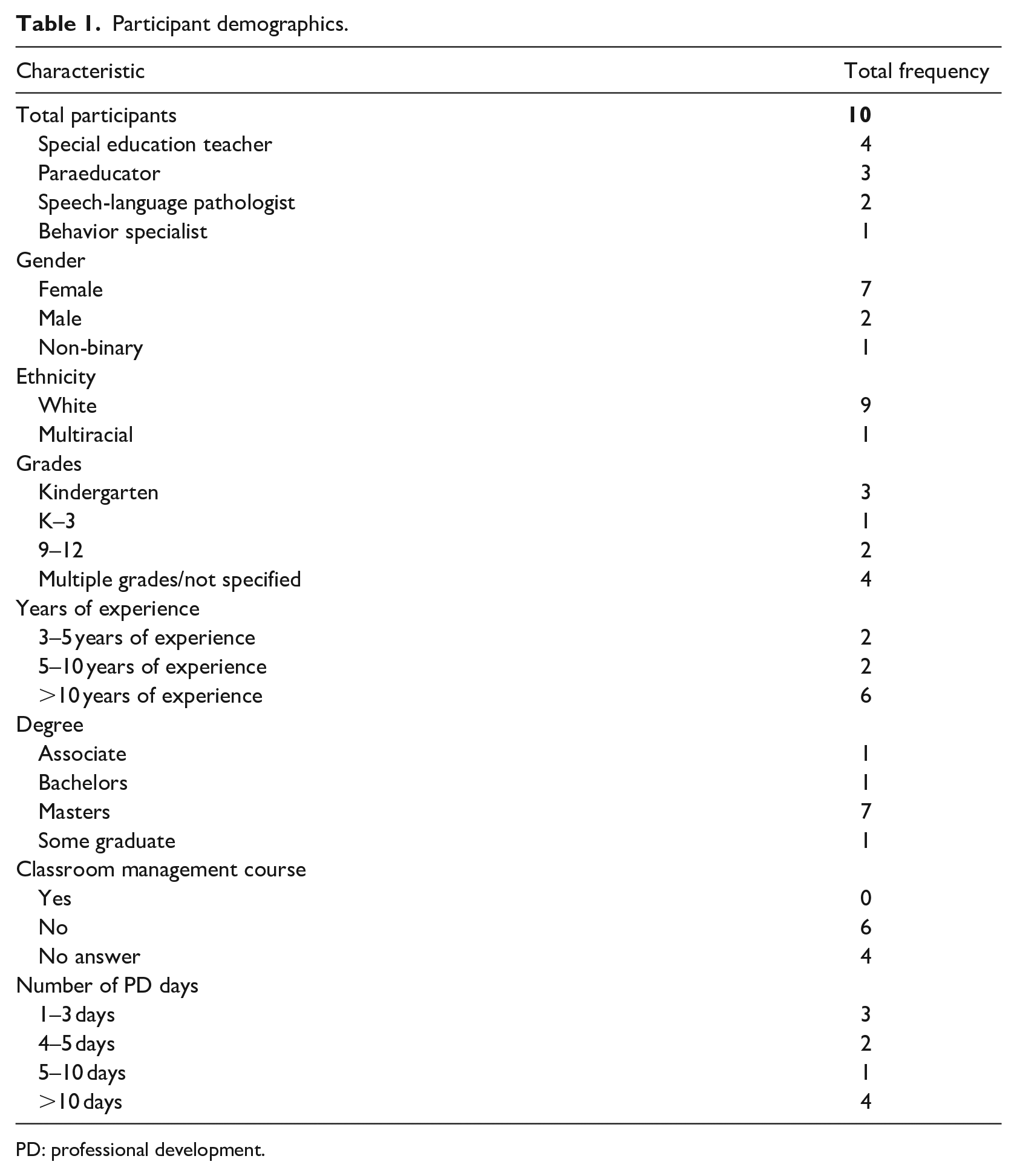
PD: professional development.
Research design
The research design for this study was a one-group pre-test post-test design (N = 10). Specifically, measures were administered to participants first at pre-test, after which the PD was implemented over 1.5 months, and then measures were administered again at post-test to capture whether the PD was associated with any changes in how participants thought about and used behavior management strategies. As a one-group nonexperimental design, this study cannot show that any changes in participant outcomes were caused by PD (Campbell & Stanley, 2015); however, significant changes indicate potential for this approach and support further investigations using experimental designs.
Measures
Multiple measures were used to assess participants’ beliefs, knowledge, and use of I-PBIS pre- and post-PD. In addition, participants rated each module and provided a summative evaluation of the PD. Procedural integrity and participation were assessed by an independent observer.
Measures of participants’ beliefs about behavior
The Beliefs about Behavior Scale (BABS; Browning-Wright & Cook, 2012) measures teacher beliefs that facilitate or present barriers to the use of I-PBIS and has evidence of construct validity as well as test–retest reliability of r = .88 (Cook et al., 2015). The School Record Analysis (SRA) was adapted from Okonofua and Eberhardt (2015). In the SRA, participants read two student vignettes and rate their perceptions of the student, their behavior, and how the teacher should respond. The SRA has adequate evidence of reliability and validity (Okonofua & Eberhardt, 2015). The Teachers’ Sense of Efficacy Scale–Short Form (TSES; Tschannen-Moran & Hoy, 2001) was used to assess changes in the degree to which participants believed they were capable of impacting student challenging behavior. Finally, participants were asked in the summative evaluation whether participating in the PD changed anything about how they think about student behavior. If participants indicated “yes,” they were directed to explain how their thinking had changed.
Measures of knowledge and use of I-PBIS
Participant knowledge and use of I-PBIS was assessed using the Survey of Classroom and Behavior Management (SCBM; Moore et al., 2017) before and after participation in Project CoRP. On the SCBM, participants self-report their perceived use and knowledge of 10 research-based positive behavior management strategies. The SCBM has demonstrated internal consistency at .88 and test–retest reliability of .82, as well as construct validity.
Participant response to the PD
After completing each module, participants rated how interesting each component of the module was on a 1 (not at all interesting) to 5 (extremely interesting) scale and how helpful each component might be for another school staff on a 1 (not at all helpful) to 5 (extremely helpful) scale. Participants were also given open feedback opportunities to describe their favorite and least favorite features of the module and suggest ways to improve the module for future participants. After completion of post-test assessments, participants received a summative evaluation of the project. In this evaluation, they were asked to give feedback on their favorite and least favorite features of Project CoRP overall, their level of satisfaction with the program on a 1 (very dissatisfied) to 4 (very satisfied) scale, and the likelihood that they would recommend the program to a friend or colleague on a 1 (very unlikely) to 4 (very likely) scale.
Procedural fidelity and participation
Transcripts from in-person meetings were reviewed by an independent coder for facilitator procedural integrity using a fidelity checklist. In the fidelity checklist, the coder recorded whether the facilitator delivered each component of the day’s session, as well as whether the facilitator asked for participant feedback at least three times and gave at least three validating responses to participants’ comments. Facilitator fidelity was 100% across all sessions. Data were also collected on participants’ completion of PD modules. After the pandemic was declared, 2 of the original 12 participants were no longer able to participate, producing a 17% attrition rate. The 10 continuing participants completed 100% of online module activities.
Procedures
Project CoRP format
Project CoRP was planned to be delivered in four weekly 1 hour meetings within two small groups over a 1-month timeframe; however, the Covid-19 global pandemic was declared after the first week of meetings reviewing Module 1. As a result, each group met face-to-face one time in the first week and completed the remaining Modules 2 through 4 individually. Participants completed pre- and post-PD measures before and after completion of these four modules. After post-PD measures, each group met with the first author via Zoom for discussion and feedback on the program.
Groups were mixed by grade level, years of teaching experience, and professional role. The first author facilitated all synchronous meetings, during which the group reviewed and responded to the Project CoRP online modules in a focus group fashion. Group members were given access to the online module 1 week prior to the synchronous meeting and asked to preview the module. During synchronous meetings, the facilitator read the module script out loud and frequently paused for participant feedback. All synchronous meetings were recorded for fidelity checks.
Project CoRP content
Project CoRP included four online modules, each with a similar organizational format. The focus of the first module was on the message that students’ challenging behavior is changeable and influenced by the environment, which is considered a necessary belief for using I-PBIS (Robertson, 2020). Modules 2 through 4 focused on specific I-PBIS strategies, specifically functional communication (Ivy et al., 2014), choice-making (Clark & McDonnell, 2008), and effective reinforcement (Paclawskyj & Vollmer, 1995).
Each module began with a slide thanking members for their participation and restating that that their written contributions during the session may be used in future versions of the PD to help other teachers of students with complex instructional needs with managing challenging behavior. Modules 2 through 4 then shared operational definitions of the focus I-PBIS strategy and school-based examples of its use. Next, each module presented a summary of a research study demonstrating the effects of the focus strategy for teachers and students. Each module included one or more published single subject graphs of the effects of the focus strategy (available from first author). When possible, these studies included students with VI and MD.
School staff and parent testimonials were presented next. Testimonials can influence beliefs and behavior by increasing staff interest in the focus strategy (Okonofua et al., 2016). Each CoRP module contained one staff and one parent testimonial. Staff testimonials were written accounts from school staff describing how and why they use that module’s focus practice. In parent testimonials, parents described a school staff member’s use of that module’s strategy as helping their child in school and at home.
Last, participants were asked to engage in two reflective writing prompts. Reflective writings are forms of active learning (Darling-Hammond et al., 2017) and have been shown to help the writer make connections between a concept and their own experiences and increase buy-in to that concept (Okonofua et al., 2016). Specifically, participants wrote their own example of ways they use the focus practice to address student behavior. Finally, participants wrote a supportive note to another staff member dealing with challenging behavior describing how they could use the strategy in that module to support positive student behavior.
Data analysis
To analyze changes in the primary quantitative measures from pre- to post-PD, we used paired t-tests. To examine the acceptability and usefulness of the PD, we conducted a descriptive analysis of mean participant ratings of the modules. We reviewed participant comments to assess staff perceptions of the PD and identify areas for improvement.
Results
Participant beliefs about behavior management
A primary aim of the PD was to increase participants’ supportive beliefs regarding the use of I-PBIS. Indeed, participant scores on the BABS increased significantly from pre- to post-PD, t(9) = −2.18, p = .057, indicating a significant increase in beliefs that support a positive approach to managing student behavior (see Table 2). In addition, 50% of participants reported that the PD had changed how they think about challenging behavior. When asked what about their thinking had changed, participants primarily (80%) described participating in the PD as reaffirming or refocusing them on the importance of consistently using research-supported I-PBIS described in the program. One participant also reported that it helped them realize they were not the only one dealing with challenging behavior and that proven solutions exist and can be used. Other standardized measures of beliefs, including the SRA and TSES, did not change significantly.
Paired t-test results.

SD: standard deviation.
Statistically significant findings at the p = .05 level.
Participant knowledge and use of I-PBIS
A further aim of the PD was to increase knowledge and use of I-PBIS. There were pre- to post-test increases in both participant-reported use, t(9) = −1.57, p = .15, and knowledge, t(9) = −1.82, p = .10, of strategies as measured by the SCBM (Moore et al., 2017), with knowledge approaching significance. Due to the pandemic, participants were not in school during the post-test, and therefore opportunities to use I-PBIS strategies were limited; however, results suggest a potential positive effect on knowledge and use of I-PBIS from pre- to post-PD.
Participant response to the PD
On a 5-point scale, in which a score of 5 indicated “extremely interesting” and “extremely helpful,” the average participant rating across all modules was 4.0. By module, participants’ highest average ratings went to the introductory module (M = 4.1). By module component, discussion with colleagues was rated most favorably (M = 4.6); however, discussion only occurred during the first module as the pandemic was declared in the following week. Other highly rated components were teacher and parent testimonials (M = 4.1).
In the summative evaluation, participants were asked to describe their favorite and least favorite aspects of the PD overall. Across participants, 90% described aspects of the group discussion as their favorite part of the PD, although discussion could only happen in the first week. One participant described reading the parent and teacher stories as their favorite aspect. Least favorite aspects included disruptions caused by the pandemic (30%), reading graphs (20%), lack of detail and examples regarding how to implement and adapt focus strategies for different students (30%), and challenging nature of reading research (10%). Participants averaged 3.8 out of 4 (4 = very satisfied) on satisfaction with the PD and 3.7 out of 4 (4 = very likely) on likelihood of recommending the PD to a friend or colleague.
Discussion
The purpose of this project was to test the potential effectiveness and acceptability of a collaborative approach to PD (Project CoRP) in increasing supportive beliefs, knowledge, and use of I-PBIS strategies in school staff working with students with VI, MD, and challenging behavior. Our theory of change (TOC) was that engaging in Project CoRP would foster beliefs and knowledge supportive of I-PBIS, which would increase use of I-PBIS. Based on our findings, participating in Project CoRP was indeed associated with significant increases in participant beliefs that facilitate a positive approach to behavior management as measured by the BABS; however, significant belief change was not found using SRA or TSES measures. Second, participants reported pre- to post-PD increases in knowledge and use of I-PBIS that did not reach statistical significance. Overall, significant increases in supportive beliefs on the BABS and non-significant increases in knowledge and use of I-PBIS may serve as preliminary evidence supporting the TOC and the potential for this model of PD, particularly considering the small and underpowered sample size.
Previous research on the importance of supportive beliefs, or buy-in, regarding a positive approach to addressing student behavior is especially relevant to the findings of the present study. This body of research has identified buy-in as a primary factor affecting school staff use of positive behavior support (Kittelman et al., 2020; Pinkelman et al., 2015), specifically noting that a lack of supportive beliefs is a primary reason for staff and schools to resist a positive approach to behavior management. Although this issue has been identified as a major barrier, methods of fostering buy-in to positive approaches are not yet clear. The results of the present study suggest that a collaborative approach to PD in I-PBIS may be one method of fostering such buy-in and may be effective with school staff working with students with significant disabilities, such as VI and MD. Furthermore, most research regarding supportive beliefs and buy-in to PBIS has examined these issues as related to the implementation of schoolwide PBIS (e.g., Cook et al., 2015). Few studies have examined the role of, or approaches to fostering, buy-in regarding implementation of I-PBIS (Robertson, 2020). Our findings suggest that supportive beliefs about I-PBIS may be (a) increased through collaborative PD and (b) related to use of I-PBIS strategies. Finally, participants found this approach to PD enjoyable and useful, particularly the aspect of discussing strategies and experiences with their colleagues.
Limitations
As this study was a one-group pre-test post-test design, we cannot conclude that participating in the PD caused any changes in measures as opposed to some other variable. In addition, this study included a small, underpowered sample size, resulting in only large effects reaching significance. Furthermore, the Covid-19 pandemic occurred mid-study, and therefore, post-PD measures on participants’ reported use of I-PBIS strategies were collected when participants were not actually in the classroom. We were unable to collect follow-up measures on the maintenance of participants’ belief and behavior change over time. Finally, participants taught a wide variety of student ages adding heterogeneity to the sample; however, the fact that significant belief change occurred within a small and heterogeneous sample may speak to the potential for this model of PD in fostering teacher belief change.
Implications for research and practice
Research into the effects of collaborative PD on teachers’ use of I-PBIS with students with complex instructional needs should use experimental designs to examine whether this approach causes changes to teachers’ beliefs and use of I-PBIS. In addition, more work is needed to understand the types of belief changes that may be produced by collaborative PD and how changes in beliefs may affect practice. Furthermore, observational measures should be used to confirm self-reported changes in teacher practice.
The present study’s findings suggest that this collaborative approach to PD may support I-PBIS buy-in among some school staff and that participants may find this PD model particularly helpful and interesting. Staff with prior I-PBIS training may find this PD model more beneficial than staff who are very new to I-PBIS, due to the focus on implementation and adaptation of strategies for use with students with varying characteristics. Therefore, a collaborative approach to PD may be especially useful when staff have basic knowledge of I-PBIS strategies but may not be using these strategies effectively due in part to lack of buy-in. Collaborative PD may also be effective as an implementation support when used with skills-based PD approaches, such as coaching. In these cases, a collaborative approach to PD may help foster buy-in to using I-PBIS.
