



Abstract
Non-Western Christian missionaries from a variety of backgrounds represent Europe as being in decline in terms of its religiosity and morals. Such evaluations are set against a backdrop of Christian demographic shift from the global North to the global South and secularization theory.
The shift in demographics is, however, unfinished, as is the inversion of relations implied by the vocal, critical presence of Southern Christians in Europe. There is great religious variety within Europe, the West and the global South. Hence scholars are developing fresh theoretical lenses to take better account of contexts and connections in analyses, and further research into the relationship between rhetoric and reality is called for.
Introduction
Christian migrants, ministers and missionaries from the Two Thirds World arriving in Europe are providing their own critiques of the religious and spiritual situation on the continent, frequently contrasting it negatively with that in their home context. 1 This article presents such critiques offered by intentional missionaries from Asia, Latin America and Oceania, as well as Africa, who have recently worked in Europe.
Respondents have worked in a range of mainline, as well as Pentecostal/Charismatic, churches and not only as ministers to diaspora congregations. 2 They indicate the variety of non-European Christians missionizing Europe today. There are similarities in missionaries’ narratives about the current health of European Christianity, despite their diversity of backgrounds and contexts. These narratives resonate not only with other non-Western Christians in Europe’s views, but also academic analyses of global Christianity, including macro statistical trends and some sociological explanations of Christianity’s ‘Northern’ decline and ‘Southern’ growth in terms of socio-economic difference and modernity. Yet, I conclude that despite the resonances between practitioner and (some) academic analysis of observed macro changes, the more nuanced theorizing being developed is necessary and more in depth research required in order to better understand shifting global religious and power geometries. 3
Europe, Christianity, the Global North and the Global South
Europe is historically Christian, yet characterized now by greater diversity and loosening connections between church and nation. 4 Davie places European religion in its global context, highlighting how it is internally varied, yet sufficiently similar to be contrasted with the rest of the world. Within Europe there are ‘variations on a discernible theme – namely relatively low levels of religious practice and credal assent, alongside higher levels of both residual attachment and nominal belief’. 5 The European observer is forced to admit that the familiar is not necessarily the norm in global terms. Christianity is thriving in other regions.
Jenkins observes the same trends of declining Christian practice in the West and religious persistence and growth elsewhere in the world, but takes the argument in a different direction. He focuses on contemporary clashes between Christianity and Islam in countries such as Nigeria, and, following the clash of civilizations thesis, 6 argues that ‘the global South’ will become ‘The Next Christendom’. 7 This provocative argument has been challenged. 8 Nonetheless, the contrast drawn between Christianity in ‘the global North’ and ‘the global South’ has become something of a convention in the contemporary study of world Christianity, with the focus mainly upon the continent of Africa. 9
Given such trends in Christianity, alongside the persisting economic and structural inequalities between North and South, it is unsurprising that, from the 1950s onwards, there have been flows of Christian migrants moving from South to North. 10 Blanes and Sarró write: ‘today we observe how (1) contemporary mobility and migration have overcome traditional frontiers, and (2) [Christian] proselytism and mission no longer see Europe as the place of origin, but often as a place of arrival.’ 11
Since ter Haar’s 1998 landmark study, the experiences of non-Western Christians in Europe have attracted increasing academic interest, though attention has largely remained upon African Initiated Churches (AICs) and Pentecostal/Charismatic churches (PCCs). 12 Ter Haar and others address how such churches consider themselves on a mission to Europe, noting that this is generally unsuccessful beyond diaspora communities. 13 There is much less available on the perceptions and experiences of intentional missionaries, as well as ministers of religion and economic migrants, and within mainline churches. 14
According to Barrett, Johnson and Crossing’s numbers, there is a larger number of Christians in Europe, but the regions with the next highest numbers are Africa, Asia and Latin America and the rate of Christian demographic growth is faster in these regions than in Europe or North America. 15 This is a process of demographic change underway rather than fully realized. Similarly, it is the Northern regions which are still sending the highest number of Christian missionaries overseas, though the numbers being sent from Southern regions are increasing rapidly: ‘we cannot say there are more non-Western missionaries than Western missionaries. At least not yet.’ 16 This serves as an early warning against over-generalizations.
Locating Missionaries
The full study from which this article is drawn was designed as the first in-depth, qualitative investigation of ‘reverse mission’. This is the contested concept of missionaries from former mission fields now evangelizing Western countries. 17 Christians from the South, working in the UK, were recruited via mission societies and historic mission churches. A combination of interviewing, participant observation and review of primary sources was chosen as the approach, given the developing and diffuse form of the phenomenon. The in-depth interview was judged to be the most suitable form for gaining insight into the experiences, thoughts and feelings of participants. I devised an interview guide in order to generate relevant data and to allow comparison between interviews. These interviews were conducted between 2005 and 2007 at times and places convenient to interviewees – often in their home or place of work; the majority were recorded and transcribed. For details of the interviewees whose words and experiences are drawn upon in the present article, see Table 1. Respondents represent a quite diverse group in terms of country of origin, denomination and British location. 18 They are unified by having travelled from a non-Western country to undertake Christian missionary work in Britain.
Interviewees referenced
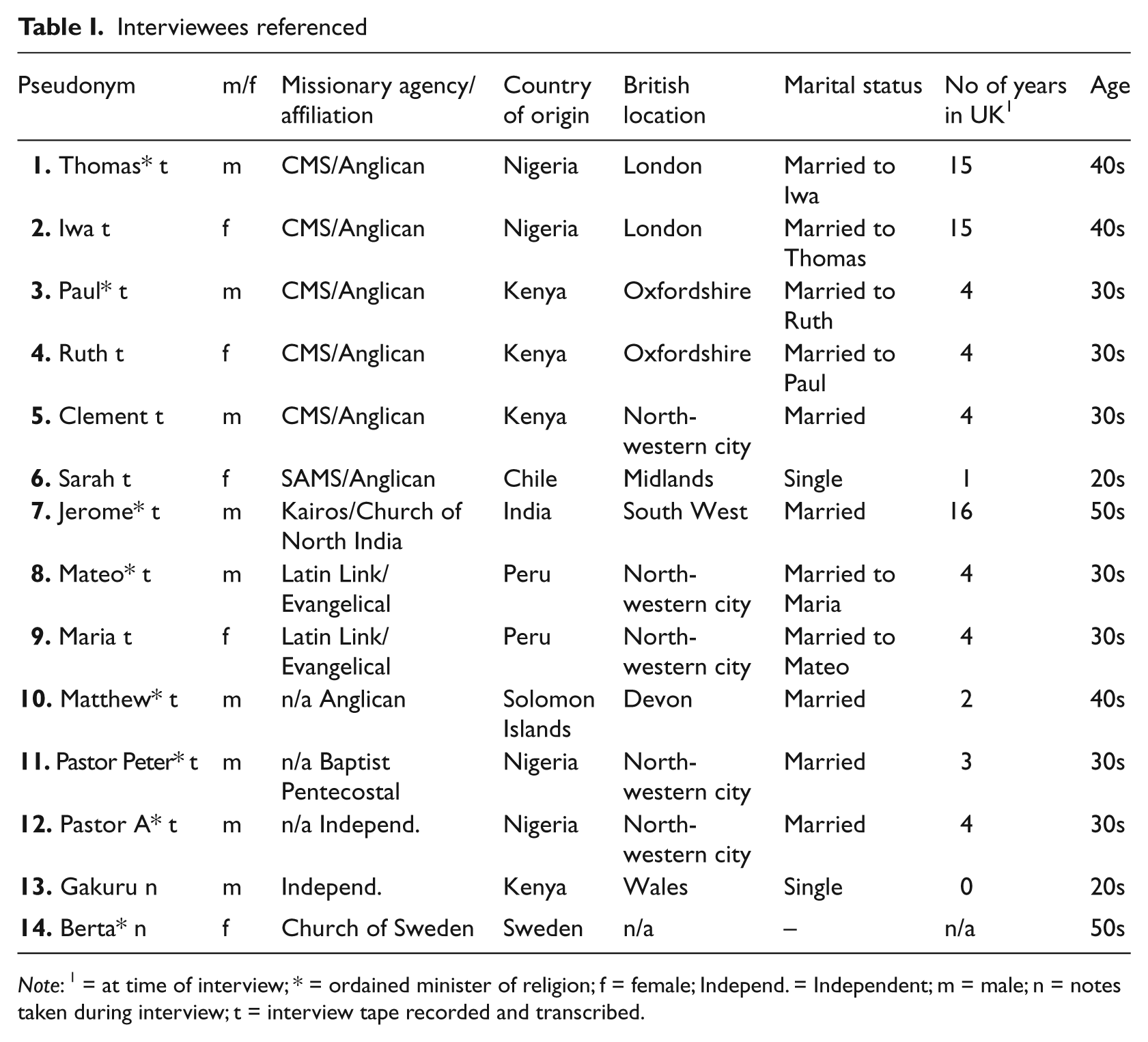
Note: 1 = at time of interview; * = ordained minister of religion; f = female; Independ. = Independent; m = male; n = notes taken during interview; t = interview tape recorded and transcribed.
Approaching respondents via mission agencies helped to locate self-ascribed missionaries. The Church Mission Society (CMS) is a historic Anglican mission society founded in the second half of the 19th century to send missionaries primarily to Africa. From the 1980s onwards, it has also welcomed Southern missionaries to work in Britain. 19 Similarly, the South American Mission Society (SAMS) was established in the (early) 19th century for the development of Anglican churches in South America, particularly in Chile, and began inviting missionaries to the UK in the late 20th century, though it has subsequently become integrated as part of CMS. 20 Kairos is a new, ecumenical mission agency set up by research participant Jerome ‘to promote and facilitate a new evangelisation of the affluent Christian nations of the North by the Church of the poor’ (according to a promotional handout), and is staffed exclusively by people from the global South. Latin Link is an interdenominational, evangelical mission agency specializing in Latin America. It was formed in 1991 through the merger of two pre-existing mission organizations. Respondents Mateo and Maria are supported directly by its recent offshoot Latin Partners, which was set up to permit Latin Americans to experience mission in Europe. 21
The methodological limitations of one-off interviews with a self-selecting sample are acknowledged. The interviews were supported by extra visits for participant observation wherever possible, discourse analysis of missionary materials and use of secondary data. The project’s focus on ‘reverse mission’ was made explicit and comparison between respondents’ countries of origin and Britain was an item on the interview schedule. Assessments of European Christianity were also offered unprompted and in informal discussions during fieldwork. Salient themes were developed through thorough review and analysis of interview transcripts and field notes. Relative Christian and moral decline in Europe emerged as one such theme. Consequently (and due to the limitations of space), this article focuses upon this theme in respondents’ discourse rather than daily work and encounters in Europe or reverse mission. 22
Europe in Darkness
Migration and settlement are always challenging. In her study of migrant PCCs in the Rhine-Ruhr area of Germany, Währisch-Oblau notes that: missionaries aim at transformation, and therefore their understanding of their own role and task is inevitably bound up with their imagination of their target country . . . The imagination of the host country is always bound up with the imagination of the home country the missionary has left . . . The ‘mission field’ is always deficient, problematic, negatively associated, so that the Gospel message the missionary brings can be projected as meeting needs, solving problems . . .
23
In our interview, Church of North India minister Jerome (see Table I), now principal of an ecumenical training college in South West England, assessed British weather, food and friendliness negatively. He depicted settling in as a struggle. Others similarly complained about the weather and relative difficulty of getting to know people in Britain. Jerome went on to give a negative assessment of European Christianity, stating that: the truth of the matter is that Christian demography has shifted. Today when you see the face of a Christian you’re looking at an African face, or an Asian face, that’s where the world’s Christians are now located so we call it the majority world now as far as the Church is concerned, and people like me are quite convinced that Europe is a major mission field.
Mateo and Maria, a Peruvian couple placed by Latin Link in a city in North West England, said that churches at home are not interested in funding missions to Britain, because they perceive it as a Christian country. However, since being in Britain, Mateo and Maria see that it is in need of mission. They reported seeing churches converted into mosques and Hindu temples. Such sentiments are echoed by Thomas, an Anglican priest from Nigeria ministering to the Nigerian diaspora community in London in partnership with CMS: So you’re coming to a place which you think that is a Christian nation and all of a sudden you arrived and it’s a different thing entirely and so there’s the shock of the number of people attending church, there’s the shock on the age group of the people coming to church and there’s a shock on the proclamation of that Gospel that it’s not real proclaimed as you would expect, and so also with the commitment of the people I see is quite different so those are the contrasts that and you discover that people are not very passionate for what they believe . . .
The macro portrayal of European Christianity as in decline is played out in these on the ground observations. Clement, a Kenyan Anglican placed as a CMS mission partner in a deprived community in North West England, told me how when he had first arrived he had begun an initiative to clean up his parish church as he had done successfully for the cathedral in Nairobi. However, after half a year in his British parish nothing had been done, so Clement stopped pushing. Local people get annoyed when the church is closed and they cannot use it for baptisms or weddings due to its state of disrepair, but they do not invest in it with either their time or money. He also spoke of having to readjust his ‘Kenyan expectations’ of missionary success once settled in the UK, as did others.
In 2005, a group of young men and women from Anglican and Catholic orders in Melanesia conducted a mission, visiting the British Anglican dioceses of Exeter, Chester and London. In a sermon, a priest accompanying them retold the anecdote of one of the Melanesian Brothers being shown around a church in Chester and commenting ‘it’s nice, but where are the young people?’ Brothers and British organizers of the mission who had also visited the Solomon Islands related stories of large, youthful congregations there.
Like Clement, Ruth and Paul are mission partners with CMS placed in an area of urban deprivation, but in South East England. Ruth told me that in Kenya, people tend to be quite public about their faith. Paul added that people do not want to talk about faith or church going in Britain, which has made their job difficult. It seems evangelism is more of an everyday occurrence in their country of origin: ‘Muslims can be also quite mission minded. They are quite mission minded in Kenya, and they would try and convert us to Muslims as we’re trying to convert them to Christianity [chuckles] . . .’ Thomas made a similar point: ‘there is emphasis on evangelism and mission in Africa, and, that is not that emphasized in UK or in the West . . .’ Sarah is an Anglican mission partner from Chile who worked with young people in the Midlands through SAMS. She described Christians expressing their faith vocally in Chile proclaiming ‘yes, I’m a Christian, I’m a Christian, I’m saved’, and acting upon what God tells them to do in the Bible rather than just saying ‘I am good’, as in Britain.
The state of Christianity in Britain is certainly seen as a barrier to evangelism. Pastor A, a Nigerian pastor who set up his own independent congregation in North West England, said: ‘Now, if you look around, especially churches where you’ve got in the United Kingdom now. It’s not news that churches are closing down. It’s not news that people don’t go to church anymore. God is out of the curriculum. People don’t really wanna know about God.’ In a discussion of their youth work, Ruth and Paul reported finding residual Christian knowledge amongst local young people, but an overwhelming reluctance to go to church (Paul’s words are underlined and mine are in italics): Paul doesn’t mention that he gave quizzes . . . during the time of the hot cross buns, and also the Pentecost, and most of the children seemed to do very well in those quizzes. It gave some indication that still, you know, the religious knowledge isn’t lacking among these children, so I don’t know where they get it, whether at home, or in school, but they know about the resurrection. They know about, you know, Christ and salvation, so why don’t they go to church and why aren’t they Christians? That’s what we are left wondering.
Have you got any ideas?
Like Pastor A, Pastor Peter moved from Nigeria to study and ended up founding his own church in England. He told me that people ‘may be happy after the taking lager [. . .] they may be happy after going to nightclub, but inside themselves something’s missing.’ Jerome criticized the breakdown of relationships and family in Europe and contrasted this with the joy of people in ‘poor countries’: ‘In our society here we have everything, and we all look so wretchedly miserable and frustrated.’
In response to a question about religious differences between Britain and Chile, Sarah said that she had been shocked by encountering Christians in Britain who have sexual relations with their boyfriends or girlfriends and consume alcohol. Paul and Ruth commented upon the serial relationships and drug taking they observe amongst young people in their local British community, as did Clement: getting here and starting to engage with youth we, it was really difficult, really difficult to know what kind of homes the kids were coming from, very different from Kenya, from our situation there, and I had done youth ministry for 16, for 18 years, and so I should have known [laughs] you know, I should have known everything that comes with youth ministry. I’d read up stuff even about the West and so on, but also done youth ministry in different situations, thought I had a handle on it, but coming here, it was a totally different ball game, because the young person is coming from a very broken down background. Their family is broken.
Similar Stories
For respondents, secularity in Europe appears to mean not only separation of church and state, but decline in church attendance and Christian commitment, a problem associated with a decline in happiness and morality. Similar narratives can be found in other research with non-Western Christians in Europe. For example, in an article about West African Pentecostal churches in Britain, Hunt quotes from an interview with a member of the Redeemed Christian Church of God (RCCG), a Pentecostal mega church from Nigeria: ‘In societies like Britain morals are getting worse – we will provide an example to people.’ He documents RCCG’s missionary activities in London and writes: ‘This marks a deliberate strategy of evangelizing the perceived “dark continent” of Europe and an attempt to win over white converts.’ 24 Währisch-Oblau documents PCC church leaders from the global South commonly describing Germany’s Christianity having been neglected and laying dormant, ready to be restored through their missionary endeavours. 25
In the first decade of the new millennium, the Church of Sweden ran the ‘Mission in Return’ project which brought people from the Swedish church’s sister churches in the global South to be placed in Swedish parishes. A co-organizer of this mission reported to me the shock of some of the missionaries involved regarding the secularity encountered in Sweden. An ordained minister of the Evangelical Lutheran Church in Tanzania, who I met in Germany in 2011, discussed how being part of the project in Sweden, along with his present work in Germany, had shown him how European churches are increasingly accepting their need to receive missionaries.
Pasura finds Christian Zimbabweans living in England depicting it biblically as Babylon or Egypt, implying that it is a foreign and hostile land in terms of religion as well as violence and racism. 26 Along similar lines, Jenkins writes: ‘In terms of deliberate missionary work, Great Britain today plays host to some 1500 missionaries from 50 nations. Many come from African countries, and these are shocked at the spiritual desert they encounter in this “green and pagan land”’. 27
An exception to the trend for looking at AICs and PCCs in Europe is Koning’s doctoral thesis Importing God. It is innovative in its focus upon a Ghanaian Seventh Day Adventist (SDA) church and inclusion of comparative fieldwork conducted with Evangelical churches from Indonesia and Ethiopia, Serbian and Russian Orthodox churches, an Iraqi Chaldean Catholic church, a Protestant Japanese church, the Urdu Church in Holland, the Korean Reformed Church, and Iranian Jehovah’s Witnesses, amongst others, operating in the Netherlands. Koning reports leaders and members from these churches encountering disinterest and aggression from Dutch people when attempting to evangelize. Ghanaian Adventists elided being Dutch, white and European in their discourse. Leaders of churches from across the world depicted the Dutch as secularized, having lost Christian beliefs practices and morals. 28
Thus we see Christians from across non-Western backgrounds working across Western Europe offering similar narratives of Christian decline on the continent, associated with spiritual and moral loss.
Explaining the Decline and Contrast
Christian ministers and missionaries from other continents also provide similar explanations for this observed contrast with their homeland, which can confound prior expectations of ‘Christian Europe’. They explain this in terms of modernization, encompassing processes of secularization, individualization, economic development and Enlightenment. Thomas summed up the view as follows: there is a tendency for people when they become very affluent and to become worldly, to begin to think that ‘because I have money’, you know? ‘I’m ok and so, I don’t need God’ [. . .] my hunch is to think that perhaps the experience of modernity and Enlightenment has to some extent affected the psyche of the West and that rebellion, or reaction against authority, or authority figure and the notion that man has come of an age where we cannot need any tutelage anymore, and so that has given room to, dispels any notion of submitting to God’s own authority and we now have the sense of independence, we are independent, we don’t need God, we can do without God, we can be passionate on things that can improve our humanity, we can go into scientific discovery [. . .] without thinking about God [. . .] and I said to myself ‘I wouldn’t want us to experience Enlightenment in that context’ you see, because our set beliefs within the African continent, I mean, within the African context, is very traditional and you tend to see Africans to be very conservative in their thinking and in their perception and in their worldview, and so perhaps that is why the church is growing: because it’s very easy for an African person to link with his or her own religion, as if religion is in the centre of their being of their life and so put God within that context, you know, it thrives. . .
Jerome said: ‘materialism has been a major challenge. Secularism has been a major challenge. The Enlightenment project has been a major challenge to historical development of Christianity in the West.’
Paul and Ruth, Clement and Pastor Peter also share this view of the relative material wealth of the West being to blame for its relative secularity. Paul said: ‘from the few conferences I have attended here, there seems to be a great need for a lot of work to be done in Europe [. . .] what happens is that the West tends to have quite a bit of in terms of material things, finances, and things like that.’ In conversation during their 2005 Mission to the UK, various members of the Melanesian Brotherhood spoke of the contrast between Britons having everything and Melanesians having to depend on God. Clement and Jerome added that the state churches in Europe have become complacent and noted increased religious pluralism. Mateo and Maria also cited increased plurality as a reason for the current state of European Christianity.
The Revd Ronald Nathan, formerly director of the African Caribbean Evangelical Alliance in London, describes Europe as ‘post-Christian’, citing the ‘advent of postmodern thinking’, pluralism and modernization as causes.
29
In Koning’s study, leaders of the Ethiopian evangelical church and Urdu Church Holland observed ‘fellow ethnics’ secularizing in Holland because of their increased material wealth. The Ghanaian SDA ministry director attributed the Dutch Christian decline he observed to post-World War II economic growth, with another member citing development and modern technologies causing the Dutch to believe in themselves more than in Christianity.
30
Olofinjana, himself a Baptist minister from South-western Nigeria, quotes Kalu: Africans are leading the largest and fastest growing churches in Europe. This becomes more significant when we consider the fact that the secularisation of European states is causing Christianity to be on the decline. It is because of this decline and coldness towards religion that commentators and African ministers have labelled Europe ‘the dark continent’.
31
Academic Resonance and Dissonance
The citations from Nathan and Olofinjana, both Christian ministers, above illustrate the relationship between practice and scholarship in this field. 32 Eight of my respondents were also ordained ministers of religion (see Table I) and most had engaged in tertiary education in their country of origin. Pastor Peter was working on a PhD about Christianity in Nigeria at the time of our interview and Paul towards a postgraduate qualification in Christian ministry, which involved his own study of British Christian youth work. Mateo was also studying religion at a local university and two of the Melanesian Brothers involved in the 2005 mission had been studying Theology in Chester, because the Anglican diocese funds Brothers to take a Bachelor degree in Theology at the Centre for Christian Ministry, University of Chester. Hence, overlaps between these practitioners’ discourses and academic theories of religious change (Christian decline) in post-war Western Europe and beyond are understandable and perhaps to be anticipated.
From the late 1950s, sociologists set about ‘the task of developing a comprehensive all-encompassing theory of all the process and structural changes required to transform non-industrial into industrial societies.”
33
The particular political, social and cultural norms present in advanced industrial societies were converted into logical requirements for development. This included the decline of religion, and the following quote typifies such a view: Secularization is inherently linked with Modernization . . . [in] advanced industrial societies in North America, Western Europe, and East Asia, traditional forms of religion have been, and still are, declining, as we will demonstrate. During the past 40 years, church attendance rates have been falling and adherence to traditional norms concerning divorce, abortion, suicide, single parenthood, and homosexuality have been eroding – and continue to erode. . . . Islamic fundamentalism, on the other hand, does have a growing mass constituency. But it is growing in societies that have not modernized: though some of these societies are rich, they have not become rich by moving along the modernization trajectory of industrialization, occupational specialization, rising educational levels, and so on . . .
34
The negative and necessary correlation missionaries draw between modernity and religiosity is repeated. This is secularization theory. 35 The reason respondents’ home societies are more religious is because they are less modern.
Christian missionaries may have been influenced by such academic ideas, but they are appropriated for a different purpose. In theories of modernization and secularization Christianity becomes an impediment to non-Western societies’ progress rather than a requirement for it (as it was in the Colonial Era). However, for practitioners this loss of religion with modernization is no resounding improvement. They evaluate it as an impediment to the West’s spiritual and moral development.
The broad-level language employed throughout this article in reference to ‘Europe’, ‘the West’, ‘non-Westerners’, ‘the global South’ and ‘the global North’ has been justified by regional similarities and the use of the terms in both practitioner and scholarly discourse. 36 However, the United States and South Korea are awkward outliers, with high levels of religious practice and development. 37 The US is quite different from Europe. Southern and Eastern Europe is quite different from Northern and Western Europe, and there is even greater religious variation across the global South. 38
The risk with identifying general patterns is that they may mask differences and variety to too great an extent, and missionaries qualify their negative evaluations. Pastor Peter spoke of ‘hope’ and ‘remnants in the land’ in terms of Western Christianity, as have others. 39 A Melanesian Anglican bishop working as a parish priest in South West England sounded a warning note in our interview against generalizations, pointing out that church statistics are very unreliable in the Solomon Islands and that his British parishioners are highly dedicated. Gakuru, who I interviewed just before he left Nairobi for a placement in a church in Wales, highlighted the continued need for mission also within Kenya.
Similarly, the academic grand narrative about modernization and secularization has been extensively critiqued as an oversimplification. Martin asserted the importance of context and regional variability within secularization theory. 40 The obvious persistence of religion across the world has subsequently led to revisions. 41 As seen above, Davie draws upon global data to argue that Western Europe is the exception rather than destination in terms of international religious trends. In keeping with the multiple modernities’ paradigm, 42 there is no one right way of being modern. One can be both modern and religious, a point developed by Davie in a recent book with Berger and Fokas analyzing the differing form and impact of the Enlightenment within the West. 43
This perspective undermines the Western hegemony implicit (and sometimes explicit) in modernization theory. 44 The missionary narratives presented here, if only taken at face value, might be interpreted as a form of Occidentalism. Yet, the power of non-Western Christians in contemporary Europe is not comparable to that of Western colonialists, and the discourse does not fully reflect reality, not least because there is also ‘novel, plural and revived Christianity in Europe.” 45 Thus, qualifications are offered. Genuine religious changes may be observed, but evaluation of such changes depends upon where one stands, and for this reason, if no other, macro diagnoses require contextualizing.
Conclusion
This article finds that Christian missionaries and ministers from Asia, Latin America and Oceania, as well as Africa, working in Northern and Western Europe elaborate a form of secularization theory in their assessments of contemporary European society. Europe is now far less confident in its Christianity and global mission and Christianity is growing at a faster rate beyond the West. The similarities between non-Western missionaries’ observations across contexts and with academic accounts and international statistics imply that their imagination of the host region reflects reality to an extent. However, global data on religiosity and development do not bear out such macro interpretations unequivocally. Religious and socio-economic variation and persisting inequalities within and between nation states and regions can be masked, as can global interdependence. Europe’s current and varied religious circumstances cannot be assumed to be the fate of the rest of the world moving through a linear process of modernization. As the missionaries themselves and social theorists appreciate, nuance and qualification are necessary.
Schreiter identifies the need for better models for analyzing global Christianity. 46 Knibbe outlines different approaches to conceptualizing the encounter between Nigerian missionaries and European contexts. Whilst I would challenge the view that Davie’s work on Europe as an exceptional case represents yet another evolutionary framework, the effort to undermine European scholars and Nigerian leaders of the RCCG’s assumptions about modernity and tradition is welcome. 47 This plus Knibbe’s further work and that of Koning employing notions of space and place to analyze migrant churches in the Netherlands are all an indication of the intellectual appetite for rethinking grand narratives of religious change and decentring the West, as is application of globalization theory by scholars such as Adogame and Olupona. 48
Self-perceptions and self-reporting and master narratives must be taken seriously but not unquestioningly. Pastor Peter concludes: ‘God used the white people [. . .] to open the eyes of the Africans, to bring forth the light. For God is now using the same people that he has used the forefathers of to come back to bless this generation.’ The world is changing both religiously and geopolitically, and the voices of non-Western missionaries evangelizing Europe are a testament to this. Positive or negative evaluations of these changes depend on one’s perspective. What is clear is that new tools are required for the proper analysis of this new situation, and to consider where we are going.
Footnotes
Acknowledgements
I would like to thank the respondents who volunteered to participate in the research. Thank you to Judith Becker and Brian Stanley for the invitation to the September 2011 conference ‘Europe as Other’ in Mainz and Marat Shterin for the invitation to give the Religion and Society seminar at King’s College London in October 2011 (the papers for which formed the basis for this article) and for the helpful feedback. I am also grateful to Grace Davie, Metin Eren, Linda Woodhead and the anonymous reviewers for their comments and suggestions.
Funding
This research was funded by a doctoral scholarship from the University of Exeter, UK.