



Abstract
This article discusses the concept of spiritual assets or spiritual capital in community development and social transformation. It argues that much of the existing discourse on the subject tends to be reductionist in its approach, often limiting discussion of spiritual assets to the social and cultural capital of religious organizations. The study proposes an understanding of spiritual assets which acknowledges the creative and sustaining work of the Spirit in enabling and motivating communities to envision, and discern paths of renewal and social transformation.
Introduction
I recently watched a documentary on the impact of micro credit organizations in developing countries. It explained of how different groups of women in Bangladesh, the Philippines, and Kenya had been able to move out of poverty through gaining access to small amounts of capital. The ‘experts’ in the documentary included representatives of the United Nations as well as senior figures in national and international micro-credit organizations. However, much of the program was taken up by the stories from the women of how access to credit had enabled them to support their families and find dignity and respect in their communities. What was noticeable was that for many of the women, although access to credit was the factor which changed their situation, they frequently referred to this change in their lives as something which God had done. While the women made constant references to God and to answered prayer, the ‘experts’, whatever their personal religious convictions, presented the changes in the women’s lives from a world view which made no reference to prayer, spirituality or God.
The documentary seemed to reinforce an observation that could be made about development programs in many parts of the global South. While many organizations work as if faith is a matter of private conviction, distinct from the operations of a development program, many of the communities which they work with operate within a very different world view where such distinctions do not apply and could even seem nonsensical. This difference in world views perhaps illustrates both the need to articulate the role of spirituality in development and the challenges involved in achieving that end. Key to that discussion is the concept of spiritual capital or spiritual assets 1 as an attempt to articulate a generally unacknowledged or ill-defined resource which communities often refer to using words such as God, faith, and prayer.
Spiritual Assets as an Emerging Concept
From the perspective of Christian theology, there is nothing new about the concept of spiritual assets even if they are not described in precisely those terms. The scriptures remind us that we are to be filled with the Spirit, walk in the Spirit, exercise the gifts of the Spirit, and bear the fruit of the Spirit. All of these could be said to refer to spiritual assets. What appears to be changing is the perception of the role of religion in the understanding and practice of international development even if, as suggested above, the role of faith and spirituality are largely ignored. In this respect, Shah and Shah note that the use of the term spiritual capital to articulate the idea that religion can effect pro-developmental change is new. 2 This interest in the role of religion can possibly be seen to be a consequence of a number of factors.
Firstly, it has become apparent that secularization theory has proved to be incorrect or inadequate in its projection of changes in society. Secularization theory anticipated the growth of secularization as being intrinsically linked to the growth of modern societies. As a society becomes more modern, so the theory goes, there will be a decline in religion at the societal and individual level. 3 The confidence with which this was proclaimed in the 1950s and 1960s seemed to have evaporated in the 1990s in the face of a rampant growth in religion globally, and the rise of counter-secularization movements of religious orthodoxy and fundamentalism. Harvey Cox, author of The Secular City, wrote almost three decades later that ‘Today it is secularity not spirituality that may be headed for extinction’. 4 The resilience of religion as a social phenomenon, its continued and growing social influence, has meant that development theory and practice have had to take into account the instrumental role of religion in social and economic development.
Secondly, we have witnessed a massive growth of faith-based initiatives which have created greater space for faith-based groups to be involved in development. This is not only evidenced in the emergence of faith-based international relief and development agencies but also, perhaps equally significantly, in the recent development of faith-based desks and policies within international NGOs. There is a growing recognition within these organizations of the distinct contribution that faith-based bodies bring to development. Lipsky notes that faith-based networks are different from any other network because they can stretch from the most hard-to-reach communities to the largest international organizations, such as the Vatican. 5 Yet the result has been an at times uneasy alliance where Western ‘secular’ governments have sometimes found themselves funding non-Western religious bodies engaged in relief and development programs. Equally, we can observe a growing dependence by international faith-based organizations on funding from government aid. Gifford, for instance, notes that the $55 million given to Ethiopia in 2005 by Catholic Relief Services came almost exclusively from USAID. 6
Thirdly, there has been a growth in thinking and reflection on the interaction and integration of theology and development. While this thinking has covered a wide range of development issues, this article will particularly focus here on the Sustainable Livelihoods Framework because of its particular focus on the concept of household capital or assets.
Spiritual Assets and the Sustainable Livelihoods Framework
Within a livelihoods framework, livelihoods are defined as what poor people do day by day to survive and flourish in the face of what comes their way, given the resources and relationships that are available to them, and the wider social arrangements that define their place and role in society. 7 The framework looks at the nature of vulnerability in a given context, the social structures which affect the way the poor can use their assets, and the strategies people adopt in order to survive and prosper. At the heart of the livelihood framework are the asset portfolios which households have access to. These assets have been understood to consist of human, natural, financial, physical, and social capital. 8
In his discussion of the framework, the late Steve de Gruchy noted the way that the role of religion in poor communities is not properly accounted for and perhaps, more significantly, noted that the models of development owe too much to a Western sociological tradition and give insufficient attention to the role of religion in shaping life choices in Africa. 9 His argument at this point however remained rooted in the significance of the role of religion rather than in any discussion of spirituality or the Spirit as an asset.
The introduction of the concept of spiritual capital or spiritual assets poses the question of whether spiritual capital exists as a further asset in enabling communities to flourish. Can we account for the spiritual assets which the women in the documentary seemed to suggest were instrumental in their own flourishing? Does faith and spirituality provide another dimension of assets and if so, how can that dimension be identified and quantified as a contributory factor in the task of development?
There are at least three possible ways of locating spiritual capital within an asset portfolio.
Spiritual capital adds incrementally to capital which is already present. In other words, it increases access to other forms or sources of capital rather than providing a distinct or additional asset.
Spiritual capital adds a further distinct asset – spiritual capital (see Figure 1).
Spiritual capital shapes the way existing assets are used – for instance, providing vision and motivation.
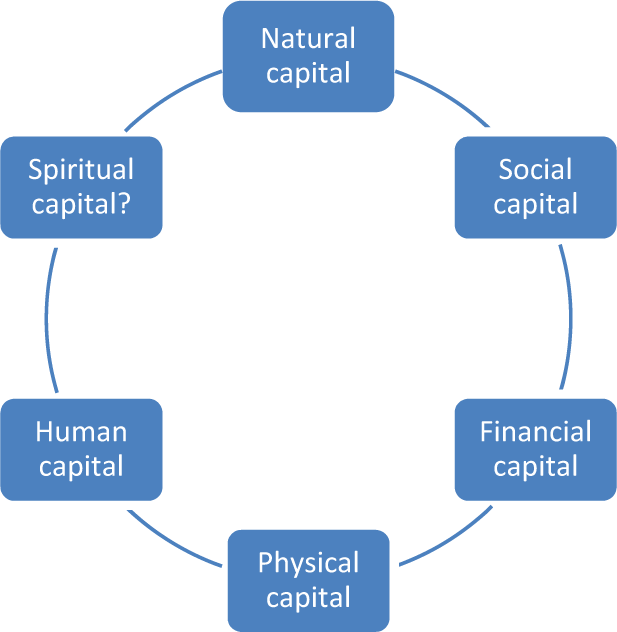
Spiritual capital as a distinct asset.
Examples of each of these perspectives are not difficult to observe. The idea that spiritual capital provides access to other forms of capital is readily witnessed in prosperity theology where the gifting of the Spirit is understood to result in increased access to material wealth or health or even greater social capital by the provision of a partner or children. From a different perspective, many commentators and non-governmental organizations also see spiritual capital as something which provides access to other forms of capital through the social capital and volunteerism of religious organizations. 10
The idea of spiritual capital as a distinct asset is generally the least well-articulated in the literature, and yet perhaps most corresponds to existential expressions of spiritual capital in grassroots communities. Working with churches in urban slums, I frequently encountered people who sensed that the presence of the Spirit in their lives provided a distinct dimension which enabled them to overcome challenges, deal with difficulties and provided an additional qualitative dimension to life, which material assets alone would be incapable of providing.
The third understanding of spiritual capital, as that which provides motivation and vision for the way in which resources are used, is the one given most attention to in this study. As will be seen later, it is this understanding which I think offers the most helpful way of assessing what it is that faith communities bring to the positive transformation of society. It will come from convictions of faith. The very statement that ‘The earth is the Lords and all that is in it’ 11 changes the way we look at the creation and distribution of resources. Similarly, an understanding of the presence and working of the Spirit in the world, and within and through the community of faith, is fundamental to a Christian understanding of development.
Spiritual Assets and the Faith-based Agenda
As indicated earlier, the growing interest in spiritual assets can be understood partly in relation to the growing emphasis in the development world on acknowledging and working with faith-based organizations (FBOs). 12 In sectors such as health, such involvement is almost unavoidable given the history and significant role of churches and faith-based organizations (FBOs) in healthcare provision. Today, church and faith-based groups provide anywhere from 40% to 70% of healthcare services in sub-Saharan Africa. 13 Similarly, in Kenya it is estimated that as much as 64% of the nation’s educational institutions are church-based. 14 I was recently in conversation with staff in a UN program where a major funding application had been turned down precisely because, in developing the proposal, they had failed to identify the role of FBOs.
The raised profile of faith-based groups and the implications of a rise in funding for faith-based initiatives, administered through otherwise secular organizations, is something the church cannot ignore, and the increase in faith-based initiatives has not been neutral in its impact on the mission of the church. Positively, they can help resource churches and other redemptive communities to engage in ministries in which love of God is demonstrated through love of neighbor. Equally however, where the terms of involvement require a clear separation between the broader mission of the church and the particular aid or development project, then they may turn out to be detrimental to Christian mission. Those of us committed to an integral understanding of mission have to be concerned about such developments. If we are to pursue an integral or holistic understanding of mission then it is incumbent upon us to demonstrate that churches and faith-based organizations provide more than just the institutional vehicle for increased access to the only livelihood assets that are deemed to count.
Spiritual Assets and Dominant World Views
One of the challenges facing those who advocate for the concept of spiritual assets is to be able to define their content within a wider development discourse. In discussion of livelihood assets, there is a temptation for the church to engage with the five assets which can be defined from within a modern world view, while slipping in spiritual assets as part of an internal discourse for fear that it will otherwise be perceived as ‘Emperor’s new clothes’. In other words, we have not articulated the concept of spiritual assets in ways which the development world can engage with, even if to reject it.
The difficulty of including spiritual capital within asset portfolios is reflected in the way in which the development world at times seems to be captivated by a particularly secular world view. Peter Berger makes the important point that, although globally the trend is towards de-secularization there is a significant exception to this process which he describes as follows:
There exists an international subculture composed of people with western-type higher education, especially in the humanities and social sciences, that is indeed secularized. This subculture is the principal carrier of progressive, Enlightenment beliefs and values. While its members are relatively thin on the ground they are very influential, as they control the institutions that provide the official definition of reality.
15
Berger’s observation is critical for this discussion. Development theories and the practices of international development agencies have a profound impact on nations around the world, particularly in the global South. Defining assets without including the spiritual is a way of defining reality, confining it to the material, which is then imposed on societies and communities which for generations have openly acknowledged other resources and forces which they understand to have shaped and sustained life as individuals and communities. The exclusion of that understanding, confining resources to the material, social and psychological, becomes little short of neocolonialism, a redefining of reality from a position of power which fails to accommodate the wisdom and insight of the ‘other’.
Defining Spiritual Assets within the Discourse of Modernity
In any discussion of spiritual assets, we are confronted with the challenge of finding a common understanding. Berger and Hefner offer this definition, ‘Spiritual capital might be thought of as a sub-species of social capital, referring to the power, influence, knowledge, and dispositions created by participation in a particular religious tradition’. 16 What is telling here is that spiritual capital is subsumed within the more identifiable social capital. The result is a reductionist understanding of spiritual which seems to exclude any sense of the transcendent, so that we can speak of spiritual in much the same way that we can speak of Weber’s spirit of capitalism. Spiritual here is reduced to something that people of faith, of many religious persuasions, would find less than adequate.
Roger Finke has argued that spiritual capital must be understood in relation to the emotional attachment an individual has to his or her Religion. ‘Religious capital consists of the degree of mastery of and attachment to a particular religious culture.’ 17 Again we see that the language used here is religion, rather than faith and spirituality, and is explained in psychological and anthropological categories of emotional and cultural attachment.
Other attempts at defining spiritual capital have equated it with the ethical principles found within a religion which work for the betterment of society. Malloch notes that:
There may be no one set of religious principles regulating any given economic polity but all religious peoples, regardless of their faith community, make individual and collective choices in which personal faith, coloured by longstanding and deeply rooted historical religious traditions, are highly relevant and important factors.
18
What many of the approaches to spiritual assets share in common is a reductionist approach to religion, recognizing its ethical, social and psychological benefits but omitting reference to the transcendent within the term spiritual. Essentially, reference to spiritual assets is conducted in a way that neither questions nor undermines a modern, largely Western, world view. Such positions also have the significant advantage of offering no preference for any religious persuasion. Religion, whatever the precise nature of faith, may potentially be a positive factor in human development, particularly in the way it promotes social capital and volunteerism. In this vein, Lipsky notes,
Not only does faith affect an FBO’s policies, programs, and strategies, it is also key to recruiting volunteers, saving money on staff salaries, developing trust with communities at the local and national level, and promoting behavioural changes deemed essential to improving health outcomes.
19
What such approaches offer to us is an idea of spiritual assets which does not manifest exclusivism. Spiritual capital is articulated in terms which retain space for one of the core values of modern Western society, religious pluralism. Spiritual capital can be observed in people, Malloch informs us, ‘regardless of their faith community’. 20
Spiritual Capital as an Uncertain Good
Berger and Hefner note that spiritual capital, understood in this way, can be positive or negative. The spiritual capital of any religion, they argue, can contribute to economic prosperity and to a more democratic society or it can have negative effects in say promoting anti-democratic, totalitarian movements or being anti-market. 21 If we illustrate this from economic life, RH Tawney’s, Religion and the Rise of Capitalism and Max Weber’s The Protestant Ethic and the Spirit of Capitalism both demonstrate the role of protestant Christianity in shaping economic behavior. In a similar vein, David Martin 22 has pointed to the significance of the global Pentecostal movement in promoting a more entrepreneurial culture that is a harbinger to economic growth. Conversely, Gifford 23 and others have pointed to what are perceived as counter development influences of prosperity theology in Africa.
One problem with these arguments is that they fail to provide any scope for interrogation of what constitutes the ‘good life’. The good of religion is measured only in as much as it conforms to the ideals of Western society. There is little consideration of the role of spiritual capital in the envisioning of a different society built on different values and challenging the reigning ideologies. In this respect, Woodberry helpfully reminds us that religion is not simply about enabling people to achieve certain ends, but is also concerned about shaping which ends people seek. 24
Faith, Spirituality, and Spiritual Assets
Woodberry notes that people invest in religion because they seek something uniquely spiritual, something that cannot be reduced to money or sex or power. He makes the important observation that the concept of spiritual capital can offer some challenges to purely materialistic interpretations of reality. He notes,
Introducing the concept of ‘spiritual capital’ may challenge scholars to analyse whether there are any uniquely religious resources or whether religious groups are merely repositories of material resources and networks of people that happen to be in religious organizations.
25
The Church of England, in its Faithful Cities report, perhaps provides a pointer towards these unique resources by opting to use the term faithful capital to describe the sources of energy and hope which religious faith brings to the sustaining and transforming of communities. In discussing this form of capital, it notes that,
Religious faith is still one of the richest, most enduring and most dynamic sources of energy and hope for cities. Faith is a vital – and often essential – resource in the building of relationships, and communities.
26
As we have already observed, there appears to be a profound reluctance to discuss the notion of spirit, in a transcendent sense, in spiritual capital. Some commentators moved swiftly to the term religious capital as if spirit and religion were synonymous, 27 while others have preferred the term ‘cultural capital’. 28 The reasoning for this is perhaps obvious. Modernity appears to offer no language or categories within which to discuss the Spirit. The person of the Spirit or the inspiration or life-giving presence of the Spirit cannot find a place within a discourse entirely formed by modernity. Confronting this problem in their discussion on the social impact of Pentecostalism, Miller and Yamamori resort to referring to the ‘S’ factor in an attempt to ‘cast a modicum of doubt on the sometimes arrogant ways in which social scientist define reality’. 29
For this reason, it is essential that we re-define spiritual assets in ways which give space for the spiritual – not in a dualistic sense as something entirely distinct from our material existence – but in ways which give expression to spiritual realities which form an intrinsic part of that very existence. It would, for instance, be bizarre to discuss spiritual capital in the African context in terms which deny the very idea of Spirit or spirits.
However, in doing this, we face a clear dilemma. The strength of the definitions offered by Berger and others is that they provide the possibility of recognizing and affirming the contribution that different faiths make to a given community. It means that mosque, temple, synagogue, and church may be equally considered as potential sources of spiritual assets in a community. It also gives scope for atheistic religions such as Buddhism to be recognized as having spiritual capital. From this perspective, the spiritual can be addressed in the public domain, and evaluating spiritual capital becomes a process of measuring the positive or negative impact adherence to a religion has on the welfare and development of a household, community or nation. However, from the perspective of Christian theology, can we discuss spiritual assets using language that makes no reference to the uniqueness of the Holy Spirit, and which reduces spirit to ethos and spirituality to ethical, behavioral and psychological influences? I believe we cannot. We must develop definitions which articulate our understanding of the work and purpose of the Spirit in the world. If we want to throw spiritual assets into the public ring of livelihoods assets then we will have to articulate that understanding in a way that engages with, but is not defined by, the prevailing discourses of our age.
Discerning the Spirit in Spiritual Capital
‘In Africa Christianity changes people’s hearts. It brings spiritual transformation. The rebirth is real. The change is good.’ 30 It seems odd to look to a self-confessed atheist for a definition of spiritual assets, but Matthew Parris’ 2008 article in The Times provides some important insights for an understanding of spiritual assets. He suggests that Christian evangelism in Africa provides a whole change in belief systems which are transformational, liberating individuals and communities and providing a form of development which goes beyond Western materialism. The article raises important questions, both for Christians and atheists alike, and it is perhaps significant that he would not make the same claims for the role of Christianity in the United Kingdom. However, what is helpful in the article is that his argument is largely on based on what he observes as the impact of Christianity within society and his conviction that the development and transformation of societies requires (at least for Africa) a spiritual dimension that goes beyond purely material resources.
How then can we define spiritual assets from a faith perspective, in a manner which does not reduce the concept to little more than the social capital of religious communities? In exploring that question, what follows might be described as four hallmarks of spiritual capital which highlight the importance of the agency of the Spirit in the transformation of communities. These four hallmarks are:
As we consider these four dimensions of spiritual capital, we can see that the first three might equally be said of religions generally. Within most religions, there is a vision for or a yearning towards a society built on different values to those manifest in wider society. Such visions will share some elements in common with a Christian understanding of the Kingdom of God and some which will be significantly different. Nevertheless, vision, motivation and discernment are aspects which diverse faith communities might all bring to processes of community transformation. We can also acknowledge that the presence and agency of the Spirit may be found to be to be at work in individuals and communities of diverse faiths and none, provoking vision and motivating change. The fourth definition, however, is exclusively Christian. It presupposes that true transformation is only possible through a life restored in relationship to God through Jesus Christ. It also presumes that that which is authentically spiritual has as its source the Holy Spirit who will ultimately point people towards Christ.
Locating Spiritual Assets
The immediate danger of the above argument is that we over-identify spiritual capital with the presence of the church and potentially confuse the Kingdom of God with the Church. While the Church is called to be a visible sign of the Kingdom, it points beyond itself. Secondly, the church remains an institution bound by sin and human frailty. Equating the church with spiritual assets would require a wholesale amnesia regarding the church’s failure in various times and contexts to stand against sin and injustice both within herself and in wider society. At times, it has been the church which has provided the obstacle rather than the initiative to redemptive and liberating movements. Donovan’s assertion, that at times the church must be evangelized by the world, is a reflection of those realities. 37 However, to deny the reality of spiritual capital within the life of the church is to assume that the prophetic and liberating role of the church in various times and contexts has ultimately been nothing more than human endeavor driven by religious conviction. It also ignores the true calling of the church to be the body of Christ, a fellowship bound together by the Spirit of God.
Spiritual assets will be visible when communities of faith have a vision for a society which reflects God’s shalom, where peace and justice embrace each other and individuals, and communities are reconciled to one another and to God. They will be manifest where people encounter new sources of love and courage which inspire them and empower them to love their neighbor sacrificially and joyfully. They will be manifest where people and individuals are alert to what God is doing in the world. Spiritual assets will be evident where people sense the movement of the Spirit who constantly broods over the face of the earth, making all things new and restoring order out of chaos, justice out of oppression, hope out of despair, resurrection of life out of death. When this takes place Christ is glorified in the world.
In Mary’s Song, 38 Luke provides us with an insight which is central to the task of locating spiritual assets. Within the song, we see that worship and doxology lie at the very heart of the pursuit of justice. Mary magnifies the God who fills the hungry and lifts up the down-trodden. Praise and the pursuit of justice intersect like threads in a cloth. Mary’s Spirit inspired vision of God’s future, for society emerges both from her overflowing sense of praise for God and from her conviction, through scripture, of what God has been doing from generation to generation. Word and worship become the foundations for a vision for what the God of History will do and Christ is at the center of that vision. It is this knowledge of what God has done in her own life, and her conviction of what God has done through history that inspires her to sing of a future where the political and economic order is overturned, and God’s new Shalom is inaugurated in Jesus Christ. Mary’s song is a profound manifestation of spiritual capital; vision, motivation and discernment of the activity of God which directs us to the person of Christ.
Application to a Sustainable Livelihoods Framework
How then do we present spiritual capital within the asset portfolio of a Sustainable Livelihoods Framework? Here we return to the possibilities. It could be argued that spiritual capital forms a distinct asset as indicated in the earlier diagram. However, this leaves us with significant difficulties particularly in terms of measuring it as a distinct entity. The other problem of identifying spiritual capital as a separate asset is that it may lead us unwittingly towards a form of dualism where the life of the Spirit is identified in a way that is separate from the social, material, and physical life of a household or community. It may be better therefore not to think of spiritual capital as a separate asset but as that which shapes and determines how assets are used.
If we consider a livelihood framework we can see that there are external factors which influence people’s capacity to realize their assets. Shocks such as conflict or natural disasters, and trends such as changing markets and seasonality with periods of drought or flood, can all conspire to create contexts of vulnerability even where a community might otherwise appear to have adequate assets. 39 Similarly, structures within society, its policies, institutions, and processes can positively or adversely affect the ability of a household or community to fully harness its assets. 40 It is in this arena of the forces which shape the way assets are perceived, valued, and utilized, that I think we can locate spiritual assets. They are not, I would suggest, a separate, sixth, asset base but a fundamental factor in shaping the motivations, actions, and the impact of interaction with those assets.
From this position, we can argue that spiritual assets consist of the manifestation of the Spirit in the life of a faith community which enable it to
Secondly, when a church exercises spiritual assets it will be
Thirdly, spiritual assets enable communities to rightly
Conclusion
We have seen that there are a number of ways of understanding the concept of spiritual assets but that much of the discussion tends to be framed within a discourse defined by the narrow parameters of modernity. Such definitions, when applied in contexts of international development programs, fail to engage with the world views of many communities in which transformation and development is pursued. Discussion of the spiritual tends to preclude an understanding of the transcendent, reducing spiritual assets or capital to the social and cultural capital of religious bodies.
It is argued here that we need an understanding of spiritual assets which acknowledges the work of the Spirit in envisioning and motivating communities of faith to discern paths of social transformation. In all of this we seek an understanding of spiritual assets which can find their roots in the work of the Spirit, through whom all creation is sustained, and will be transformed and renewed.
However, within any discussion of spiritual assets we will discover an inherent contradiction. Spiritual assets motivate and envision the right use human, physical, natural, social, and financial capital, and yet, in their very use, they declare their insufficiency. While spiritual assets may promote the right use of all forms of capital they will at the same time declare that ‘Man does not live by bread alone’. Here we must part company with all secular theories of development. It is good to be full but it is not enough. It is good to have rights observed and protected, but it is not enough. It is good that rivers flow clean and communities embrace one another and welcome the stranger, but it is not enough. All the resources of a livelihood framework present us with an insufficient good. Spiritual assets will always insist that there is more and will highlight the poverty of wealth when a life is not reconciled to God. Spiritual assets will cause us to weep for the one who is full but walks away empty having not discovered the meaning of true riches. Spiritual assets challenge the boundaries of what we understand to be the ‘good life’ until we discern that such a life is incomplete apart for Christ.
Footnotes
Funding
This research received no specific grant from any funding agency in the public, commercial, or not-for-profit sectors.