



Abstract
Editorial for ‘One Christ—Many Witnesses: Marking the Completion of the Regnum Edinburgh Centenary Series’, a special issue to celebrate the Regnum Edinburgh Centenary Issue.
The focus of this issue of Transformation is the celebration of the completion of the Regnum Edinburgh Centenary Series. Thirty-one volumes have so far been published in the most wide-ranging series on mission and world Christianity in our century. The series has grown out of the celebration of the Edinburgh 1910 World Missionary Conference. The foundational resources and a major legacy of that conference were the findings of eight think tanks or ‘commissions’, which can be found on the shelves of mission libraries around the world today. The centennial project in 2010 therefore used a similar model and set in motion international and cross-confessional study groups on nine themes identified as key to mission in the 21st century. Reports from these study groups were compiled in one of the first volumes in the Regnum Edinburgh Centenary Series under the title Edinburgh 2010: Witnessing to Christ Today. The reports were then discussed at the major centennial event in Edinburgh 2010 that brought people together from all corners of the universal church. The report from this event has been published under the title Edinburgh 2010: Mission Today and Tomorrow.
Twenty-eight other volumes in the series are also available (see: www.ocms.ac.uk/regnum), and another five are in preparation. The publications reflect the ethos of Edinburgh 2010 and are intended to make a significant contribution to ongoing studies in mission and world Christianity. The material published in this series uniquely reflects a diverse range of views and positions which bridge regions, churches and other differences. The series editors hope in this way to have encouraged conversation between Christians in many countries and collaboration in mission. The volumes are intended for study and reflection in both church and academy. To make access as wide as possible, most are available for download from the website and copies of the series are being placed free of charge in 24 major libraries of mission and theology around the world.
Most of the titles relate to the nine study themes (including foundations for mission, Christian mission among other faiths, mission spirituality and authentic discipleship and mission and postmodernities), while other titles explore missiological thinking within the major confessions (Roman Catholic, Orthodox, Anglican, Pentecostal, Evangelical, Lutheran, etc.). In addition, there are volumes on key issues in mission, such as mission and the next generation, mission at and from the margins, mission and diaspora, the Bible in mission, mission and reconciliation, evangelism and diakonia in context and perspectives on mission from different regions of the world (such as Latin America, Eastern Europe, Africa and Korea). The series also includes volumes reflecting on major 2010 events in Tokyo and Cape Town. The series will be brought to completion in the middle of 2016. A list of the volumes already published and still to come is found below.
To celebrate the series and mark its upcoming completion a symposium was arranged at the Oxford Centre for Mission Studies (OCMS) on 4 September 2015. Eighty mission thinkers joined the series editors – Dr Wonsuk Ma of OCMS, Prof. Knud Jørgensen of the MF Norwegian School of Theology, Prof. Kirsteen Kim of Leeds Trinity University and Tony Gray of Words by Design – to celebrate this remarkable endeavour. The event also celebrated the enormous diversity of the churches, mission agencies and academic institutions involved in the project. The keynote speaker at the event was Dr Dana Robert of Boston University. In her address she reviewed the relationship between mission and Christian unity from the Edinburgh 1910 conference to the present, with a particular focus on the following themes in contemporary missiological reflection: global networking as an expression of common witness, the power of testimony in building unity, the centrality of the Holy Spirit in church growth and the ecumenism of blood experienced in the crisis situation of Christians around the world, especially in the Middle East, North Africa and South Asia. Responses to her address were given by Prof. Petros Vassiliadis of the University of Thessaloniki, Bishop Hwa Yung of the Methodist Church in Malaysia and Revd Dr Hielke Wolters, representing the World Council of Churches. In addition, responses have been invited from Dr Marina Ngursangzeli Behera from the Presbyterian Church of India, Mizoram Synod and presently teaching at the Ecumenical Institute at the Chateau de Bossey, which is part of the World Council of Churches, and from Dr Mireya Alvarez, Director of Women Ministries with the Church of God in the State of Virginia, USA.
At the September symposium, reviews of the Regnum Edinburgh Centenary Series were offered by Dr Rose Dowsett of the World Evangelical Alliance; Revd Jacques Matthey, formerly Programme Director at the World Council of Churches; Revd Dr Kenneth Ross of the Church of Scotland; and Prof. Steve Bevans SVD of the Catholic Theological Union, Chicago. Revd Andrew Anderson, Chair of the Edinburgh 2010 General Council and now Chaplain at OCMS, led the worship. Bishop Graham Kings, Mission Theologian in the Anglican Communion, gave the closing address in which he quoted the Archbishop of Canterbury on new forms of mission for the digital age, and Revd Canon John O’Toole, representing the Roman Catholic Church, closed the event with prayer.
The understanding of mission undergirding the series reflects the Common Call from Edinburgh 2010 (see below).
Large established publishers are used to committing themselves to long series of books – in the theological world, it is fairly commonplace for a publisher to commit itself to a Bible commentary series, for example, which may span most or all of the canon. However, when a small independent publisher, used to putting out four or five titles per year, agreed to take on the Edinburgh 2010 series (as it was then known), they perhaps did not have a complete picture of what was involved, or what it would become.
The first volume was commissioned and appeared in 2009. Six years later, celebrating the achievement and impending completion of the series, as a publisher we managed to bring together some significant statistics. At the time of the analysis, 28 volumes in the Edinburgh Centenary Series had been published, with another eight in the pipeline. The statistics reproduced here relate to those 28 volumes … so the final numbers will be even higher!
The series comprises:
9582 pages
3,388,465 words
17,921,768 characters
21,269,199 characters (including spaces)
62,846 paragraphs
333,141 lines
This data can be shown graphically in Figure 1 (below). But what does this data actually mean? Well, firstly, if we were to lay all the pages end-to-end from one full set of books that would total over 2 km of paper. With an initial print run of 300 copies of each title, that is 600 km of paper, or the distance from London to Edinburgh … plus a bit more! Perhaps the theological issues raised by this use of resources may be addressed in the Care in Creation volume (planned for publication after this analysis).
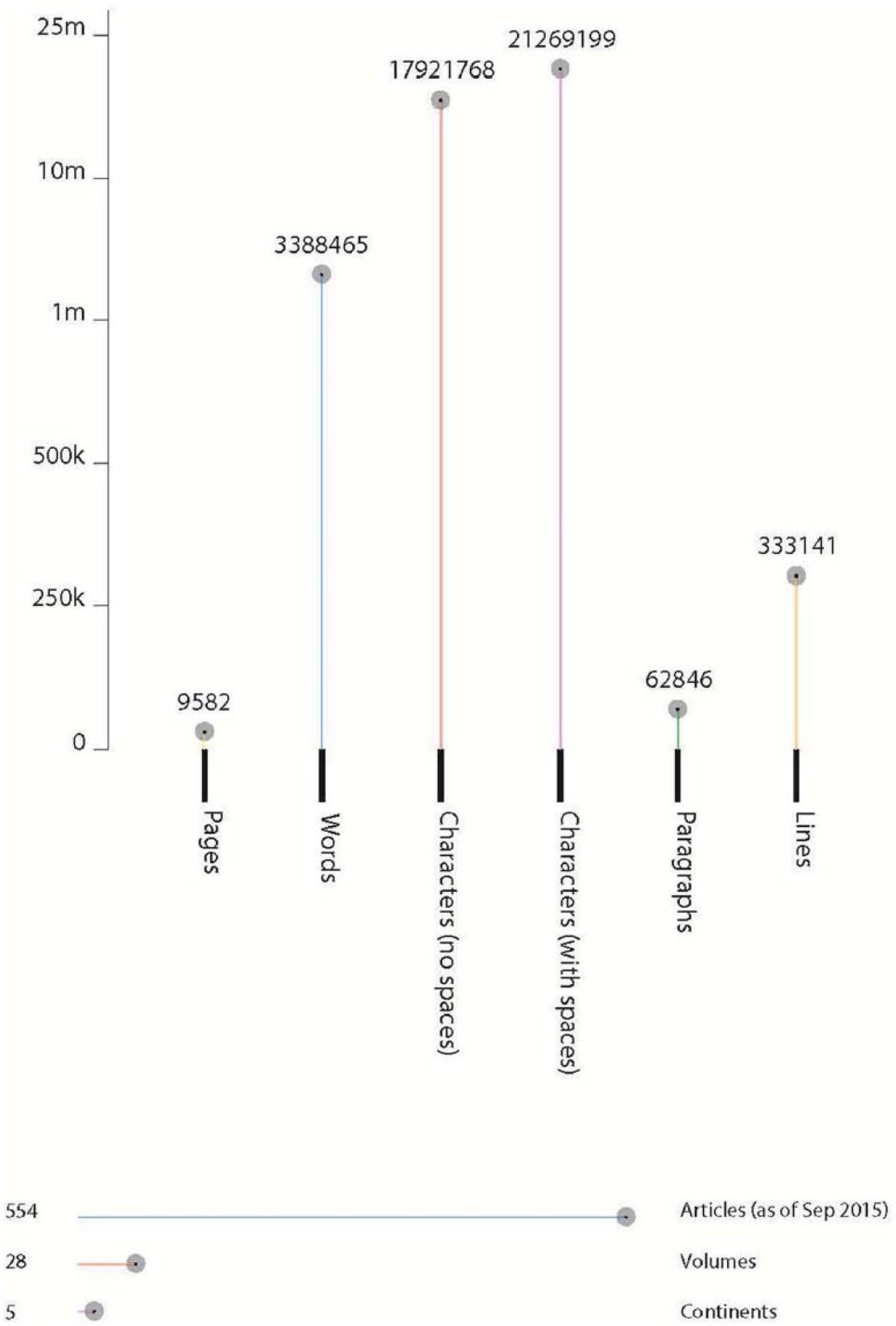
Statistics for word count etc.
Furthermore, if the whole Bible translated in English is approximately 800,000 words in length, the Regnum Edinburgh series has produced more than four times the length of the entire Bible! Again, perhaps this raises a theological question regarding interpretation – the right place of hermeneutics and applied theology!
The two longest volumes were, firstly, The Lausanne Movement (with over 185,000 words), and secondly the volume on Freedom of Belief (just over 180,000). Of course length and size are not necessarily a measurement of merit. Yet with over 550 separate articles to read, edit, proof and typeset, producing the series has not only been a task of mammoth proportions, but often a challenge for a small publisher with limited resources. These were articles written for all corners of the globe, and from a variety of ecclesiastical and theological backgrounds – and from those used to writing academic papers with all the required footnotes and citations, to those with less experience and more used to preaching and delivering a good argument.
For a series that is looking specifically at world mission, some statistics regarding international and geographic spread may be interesting. An analysis of the geographical spread of articles according to continent provides the following figures (the division of continents is always quite arbitrary, and a matter of debate amongst cartographers, not just missiologists!):
Africa: 62
Asia: 104
North America: 121
South America: 24
Europe: 220
Australasia: 22
These numbers represent the articles written by country, using the location of the author at the time of the publication of the article (as could best be determined). This is not necessarily the same as the nationality of the author, nor does it represent the other countries that a specific author may be known for working in. Note that an author may appear more than once, and may even appear in different locations.
The relevant breakdown of countries per continent can be seen in Table 1.
Articles per country and continent.

A graphical representation of this data can be seen in Figure 2.

Articles per country and continent.
Regnum Edinburgh Centenary Series
Titles published by March 2016:
Mission Then and Now
Witnessing to Christ Today
Mission Continues
Holistic Mission
Mission Today and Tomorrow
The Church Going Glocal
Interfaith Relations after One Hundred Years
Witnessing to Christ in a Pluralistic Age
Mission and Postmodernities
Evangelical and Frontier Mission
LifeWidening Mission
A Learning Missional Church
Foundations for Mission
Mission Spirituality and Authentic Discipleship
Mission as Ministry of Reconciliation
Catholic Perspectives on Mission
Orthodox Perspective
Bible in Mission
Christian Communities in Contemporary Contexts
Pentecostal Perspectives on Mission
The Lausanne Movement. A Range of Perspectives
Mission at and from the Margins
Global Diasporas and Mission
Mission and the Next Generation
Called to Unity for the Sake of Mission
Freedom of Belief and Christian Mission
Mission and Theological Education
Korean Perspectives on Mission
Christian Mission and Caring for God’s Creation
North East Indian Perspectives
Latin American Perspectives
Coming titles:
Mission and Power
East European Perspectives on Mission
Evangelism and Diakonia in Context
Ecumenical Perspectives
Edinburgh 2010 Common Call
As we gather for the centenary of the World Missionary Conference of Edinburgh 1910, we believe the church, as a sign and symbol of the reign of God, is called to witness to Christ today by sharing in God’s mission of love through the transforming power of the Holy Spirit.
Trusting in the Triune God and with a renewed sense of urgency, we are called to incarnate and proclaim the good news of salvation, of forgiveness of sin, of life in abundance and of liberation for all poor and oppressed. We are challenged to witness and evangelism in such a way that we are a living demonstration of the love, righteousness and justice that God intends for the whole world.
Remembering Christ’s sacrifice on the Cross and his resurrection for the world’s salvation, and empowered by the Holy Spirit, we are called to authentic dialogue, respectful engagement and humble witness among people of other faiths – and no faith – to the uniqueness of Christ. Our approach is marked with bold confidence in the gospel message; it builds friendship, seeks reconciliation and practices hospitality.
Knowing the Holy Spirit who blows over the world at will, reconnecting creation and bringing authentic life, we are called to become communities of compassion and healing, where young people are actively participating in mission, and women and men share power and responsibilities fairly, where there is a new zeal for justice, peace and the protection of the environment, and renewed liturgy reflecting the beauties of the Creator and creation.
Disturbed by the asymmetries and imbalances of power that divide and trouble us in the church and the world, we are called to repentance, to critical reflection on systems of power and to accountable use of power structures. We are called to find practical ways to live as members of One Body in full awareness that God resists the proud, Christ welcomes and empowers the poor and afflicted and the power of the Holy Spirit is manifested in our vulnerability.
Affirming the importance of the biblical foundations of our missional engagement and valuing the witness of the Apostles and martyrs, we are called to rejoice in the expressions of the gospel in many nations all over the world. We celebrate the renewal experienced through movements of migration and mission in all directions, the way all are equipped for mission by the gifts of the Holy Spirit and God’s continual calling of children and young people to further the gospel.
Recognising the need to shape a new generation of leaders with authenticity for mission in a world of diversities in the 21st century, we are called to work together in new forms of theological education. Because we are all made in the image of God, these will draw on one another’s unique charisms, challenge each other to grow in faith and understanding, share resources equitably worldwide, involve the entire human being and the whole family of God and respect the wisdom of our elders while also fostering the participation of children.
Hearing the call of Jesus to make disciples of all people – poor, wealthy, marginalised, ignored, powerful, living with disability, young and old – we are called as communities of faith to mission from everywhere to everywhere. In joy we hear the call to receive from one another in our witness by word and action, in streets, fields, offices, homes and schools, offering reconciliation, showing love, demonstrating grace and speaking out truth.
Recalling Christ, the host at the banquet, and committed to that unity for which he lived and prayed, we are called to ongoing cooperation, to deal with controversial issues and to work towards a common vision. We are challenged to welcome one another in our diversity, affirm our membership through baptism in the One Body of Christ, and recognise our need for mutuality, partnership, collaboration and networking in mission, so that the world might believe.
Remembering Jesus’ way of witness and service, we believe we are called by God to follow this way joyfully, inspired, anointed, sent and empowered by the Holy Spirit, and nurtured by Christian disciplines in community. As we look to Christ’s coming in glory and judgment, we experience his presence with us in the Holy Spirit, and we invite all to join with us as we participate in God’s transforming and reconciling mission of love to the whole creation.
The Edinburgh 2010 Common Call emerged from the Edinburgh 2010 study process and conference to mark the centenary of the World Missionary Conference, Edinburgh 1910. The Common Call was affirmed in the Church of Scotland Assembly Hall in Edinburgh on 6 June 2010 by representatives of world Christianity, including Catholic, Evangelical, Orthodox, Pentecostal, and Protestant churches. For further information, see: www.edinburgh2010.org.
Footnotes
Funding
This research received no specific grant from any funding agency in the public, commercial, or not-for-profit sectors.