



Abstract
Short-Term Mission (STM) is a reality that is intertwined and integrated into the fabric of world mission and Christian experience. Many discussions revolving around short-term mission have been descriptive and about best practices. This article moves beyond an appraisal of short-term mission as a phenomenon and instead looks at why and how OMF International, a long-term mission agency, aligned STM with long-term mission, vision and strategy by focusing on the mentorship and discipleship of its STM volunteers. It also looks at with-ness and consociation as a model for mentorship, and discipleship as a means of addressing the opportunities and challenges that STM presents to long-term mission agencies.
Introduction
There used to be a time in the history of the church and mission that missionary service was seen as a lifetime commitment. Stories of missionaries embarking on their mission journey with an expectation that they would die in service mark the annals of Christian history. Contemporary mission reflects very little of this mindset and long-term service is now frequently preceded by a short-term mission (STM) trip to test and see. The short-term mission phenomenon, compounded by paradigm shifts in contemporary mission, has contributed much to the change in mission commitments and long-term involvement. The reality also exists that the STM phenomenon is no longer confined to movement from the west to the rest of the world. Global Christianity has shifted its centre of gravity, 1 and with globalization and international travel 2 breaking down geographical and cultural distances, short-term mission becomes an even better option financially and logistically for majority world churches. As Robert Priest shares, ‘From Peru to El Salvador, Paraguay, Singapore, Thailand, South Korea or Kenya, one finds Christians not only partnering with visiting short-term missionaries, but also sending out short-term mission teams themselves, either abroad or to destinations within their country’. 3 In East Asia, churches are turning to short-term missions as a means of providing opportunities for their congregants to serve communities, support long-term missionaries and raise awareness about mission.
This article looks at how OMF International (OMF), an organization that has served East Asia’s peoples for more than 150 years, has integrated short-term mission and aligned it with its mission and vision by focusing on mentorship and discipleship. STM within OMF refers to cross-cultural mission placements that are up to a year in length. With-ness and consociation are concepts introduced by Günter Krallman in Mentoring for Mission and are the model for mission discipleship encouraged in this article. 4 Mission discipleship refers to discipleship that focuses on an individual’s understanding of mission as part of their own transformation as followers of Jesus Christ. Most of the conclusions that follow are a result of research and study conducted working towards an MA in Leadership with Mission at All Nations Christian College in the UK.
Short-Term Mission and the ‘Long-term’ Mission
OMF’s Serve Asia programme was loosely developed beginning around 1990 as a way of responding to the growing interest in short-term placements and opportunities. 5 In 2004, the first Serve Asia (Short-Term) Coordinators Consultation resulted in the adoption of a mission, vision and values statement which would guide all STM work within OMF. 6 Serve Asia was defined as a ‘mission discipleship program which encourages each participant towards purposeful involvement in one or more of the six practices of mission: going, learning, welcoming, sending, praying and mobilizing’. 7 The goal in running the programme since then was not just about sending short-term volunteers but walking alongside them as they discover ‘where God wants them to be involved in the Great Commission’. 8 Participants serve from two weeks to 11 months and are given the opportunity to experience cross-cultural ministry in East Asia and to strategically contribute to OMF’s field strategies. It cuts across all OMF centres and ministries, has more than 50 coordinators around the world and receives hundreds of short-term volunteers a year from across the globe.
Long-term 9 mission agencies and long-term missionaries continue to grapple with the strategic place of STM and the short-term volunteer in the midst of the tension between research focused on the uncertain benefits of short-term mission and the increasing demand for short-term opportunities to serve. A growing body of literature pointing to STM’s weaknesses and challenges includes research showing that STM reinforces stereotypes and deepens misconceptions about the poor, 10 equally increases ethnocentrism, 11 has little impact on financial giving to long-term missions 12 and has been viewed as ‘spiritualized vacation trips’ 13 that are no different from tourism. 14 Challenges also exist in terms of STM’s impact on the STM volunteers as well as on the recipients. Though STM has been generally accepted to have some level of impact on the lives of its participants, research undertaken has also shown no lasting positive change in the life of participants 15 and little lasting fruit in its recipient communities or ministries, 16 and has had no more positive impact on those they serve than local groups providing the same services. 17 STM and STM volunteers have also been observed to be more of a burden to long-term missionaries than a help, 18 with research showing that STM serves participants better than its recipients 19 and that programmes focus more on pleasing volunteers and giving them an experience to remember. 20
To address the tension between short-term and long-term as well as the challenges and criticisms of STM, the OMF Serve Asia programme began working on centring its approach to short-term mission on the discipleship and mentorship of short-term mission volunteers. By focusing on ‘mission discipleship’ and placing it at the core of its mandate, Serve Asia found a way to integrate itself as a strategic ministry to OMF and long-term mission in that it helps (1) mobilization efforts, especially in the area of longer term commitments and involvement in mission, and (2) evangelization efforts, not just through its provision of personnel for immediate and specific ministry needs but also through the opportunity for it to be used to catalyze mission movements.
Short-Term Mission and Long-Term Commitments
From the late 1940s, long-term mission agencies introduced STM programmes with great hope that they would complement life-time missionary service by providing missionary personnel to fulfil specific needs. 21 For a long time within OMF, the primary value of STM was seen to be how it mobilized new long-term missionaries. In 1996, for example, the International Director for Personnel highlighted only one encouragement to OMF’s STM programme, that 24% of those who participated from 1989 to 1995 were either in full-time Christian service or training for the same. 22
Very little research exists, however, showing the co-relation between the number of those who join an STM trip and those who return long-term. Scott Moreau concluded, for example, that in both Canada and the US, though increased time and resources have been given towards STM recruitment, support and sending, ‘to date, no direct correlation can be drawn between the massive increase in STM and long-term sending’. 23 In the context of East Asian churches, Philip Nicholson shared that STM has become a substitute for long-term mission for Chinese youth whose parents would never permit them to serve long-term and hence investment in them ‘would produce little fruit in long-term mission workers’. 24 A missionary who served as an STM coordinator in Thailand also shared that she has seen very few of the alumni return as long-term missionaries. 25
In 2014, I sent out a survey as part of research focusing on developing Serve Asia as a strategic ministry within OMF. 26 Of 383 missionaries who joined OMF between 2010 and 2014, approximately 23% responded and a number of significant findings surfaced. The first finding is that a majority of OMF long-term missionaries have had some form of STM experience prior to serving long-term (See Figure 1). Of the survey respondents, 90% participated in a STM trip prior to joining OMF, and of the 79 with STM experience, 42 or 48% of respondents specifically served with Serve Asia. 27
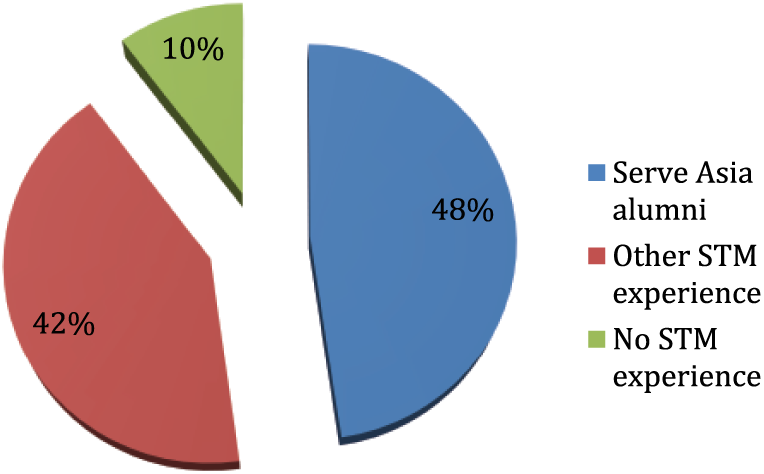
Previous involvement in STM of new OMF personnel from 2010 to 2014.
Neither the number of times respondents went on STM prior to joining long-term nor the length of each placement were significant to long-term commitment. More than 50% of respondents served at least twice prior to joining OMF and at least 39% were involved in trips that were no longer than two weeks.
28
Descriptively, 61% of those who had some form of STM experience prior to serving long-term said it was contact with long-term workers or missionaries that was most helpful to them personally. One shared that her STM trip was helpful in ‘dispelling myths about what “REAL” missionaries do each day’.
29
Other aspects described as helpful were training or orientation before and during their STM placement, mentoring from mobilizers or long-term missionaries, followed equally by the ministry placement itself and debriefing. Respondents were also asked to share about other aspects of their STM placements which they found helpful. Two respondents shared that team interactions were helpful. One respondent, between 36 and 40 years of age, who had only been on only one STM trip for 10 days in Brazil to help with building projects, shared: I went on the STM when I was in high school, and I have to admit, I don’t remember a lot from the experience, except that our leader did a really good job of instilling a sense of purpose, as well as teaching about serving and not being a burden to those who we were going to.
30
Another respondent, a millennial 31 now serving in China, shared that during her STM placement they had a really good system of morning team meetings during which they would do a Bible study followed by a short culture lesson. They would then visit local sites and contextualize the things they had discussed in the morning and then in the afternoons they would use their learnings with their students. What was taught and learned was put into practice. Her STM placement was ‘really hands on and accessible’ but also ‘made everything relevant’. 32
One way in which short-term mission leads to long-term mission commitment is that the through the STM trip a sense of calling to mission for the long term is confirmed. What happens during the STM trip thus become critical to the confirmation of a participants’ sense of calling. One respondent shared that God spoke to him through his STM experience and confirmed what he thought God wanted him to do.
33
Another respondent stated: I already knew what I wanted to do long-term, but I think it was good I went on a STM because it did bring validation to go long-term. I think just watching long term missionaries interact with the local people really confirmed that that is what I wanted to do some day.
34
Journeying with Short-Term Volunteers
Reconciling the role that STM plays in longer term mission commitments, the Serve Asia programme has sought to find ways to develop ways to journey with its volunteers. Contemporary understandings of discipleship have mostly been formed by an over-reliance on programmes; and by focusing on curriculum implementation rather than ‘journey’, discipleship has become more about ‘cognisance and the attainment of knowledge, and less about transformation’. 35 Discipleship is not a programme or a production line, and nor is it just for new believers, leaders, those highly literate or those who like structure. 36 In terms of long-term calling, Jesus also demonstrated that the long-term call to ministry was preceded not by an immediate commitment to be his witness but by a commitment to ‘follow him’, to ‘come and see’ (John 1:39) and ‘be with’ him (Mark 3:14). Rather than create a fixed curriculum to be implemented across the STM programme, Serve Asia instead seeks to develop a community and environment that serves as fertile ground for a disciple of Christ to follow after, see and be with. 37
From the onset, the Serve Asia programme sees each inquirer and volunteer as ‘following after’ Christ and at each stage of the journey are opportunities not just for their discipleship and mentorship but also for OMF to journey with their sending communities like their church, seminary, student fellowship or small group.

Within the inquiry and application stages, forms and processes have been designed to help aid coordinators and mobilizers to discern where the potential volunteer is at in terms of their discipleship. The goal is therefore not so much to ‘screen out’ volunteers from placement but to disciple, mentor and help them discern how God is leading them and their sending communities. Through consultation and collaboration, resources are shared and developed whilst keeping policies and processes as light and flexible as possible so that short-term coordinators, mission mobilizers and field hosts can focus on investing in the lives entrusted to them. Because mentorship and discipleship is also very much context-specific and will be shaped by culture, each OMF centre running the Serve Asia programme will have different ways of journeying with their Serve Asia inquirers or volunteers at different stages. Keeping the programme centred on ‘mission discipleship’, shared values and leaving flexibility for helps give a centre ownership of the Serve Asia programme in their context as well as keeping mentorship and discipleship relevant and culture-sensitive.
Young Adults and the Serve Asia STM Experience
One area that Serve Asia has found specifically strategic to mission mobilization is its investment in participants between the ages of 21 and 30. From 2011 to 2017, OMF Serve Asia received at least 4390 short-term mission volunteers, 36 percent (36%) of whom were between the ages of 21 to 30 (see Figure 2).
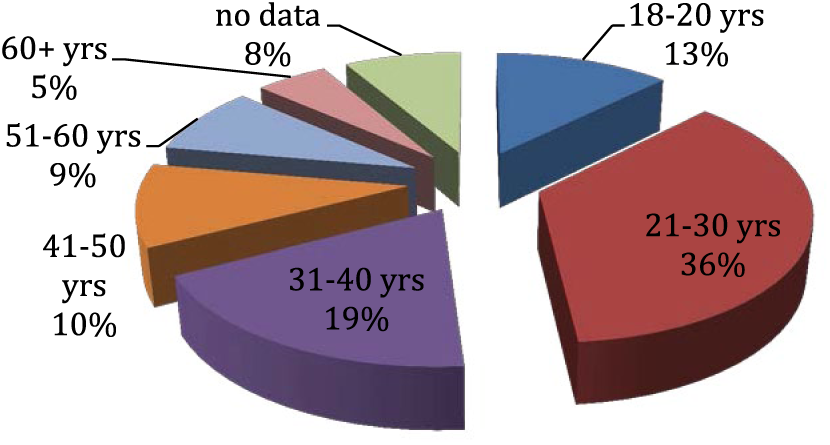
Age distribution of Serve Asia participants 2011–2017.
The STM experience and engagement with the realities of cross-cultural mission provide an excellent venue for ‘big questions’ which Sharon Daloz Parks sees as critical to the development of emerging adults. Purpose, meaning and faith serve as overarching themes, and questions such as ‘who am I?’ and ‘does my life have place and purpose?’ are asked. 38 In the midst of meaning and vocation formation, the role of a mentor in the life of an emerging adult is quite significant. Parks states that at the right time mentors provide five key gifts: ‘recognition, support, challenge, and inspiration – in ways that are accountable to the life of the emerging adult’ 39 and it is in a mentoring relationship that transformative questions and dialogue can spur formation of commitment as well as ‘yield the gift of a worthy dream’. 40 This worthy dream finds its fullest and most profound form in a sense of vocation which in turn conveys ‘calling’. 41 By focusing on mentorship and discipleship of its STM volunteers, the OMF Serve Asia programme has sought to create mentoring relationships and communities for young adults who are at that stage of vocation and calling formation.
Responses from new OMF missionaries between 2010 and 2013 reinforce Parks’ theories about the importance of mentoring in that the most helpful aspect of their STM experiences was contact with long-term missionaries. One respondent shared that through contact with long-term missionaries during their Serve Asia placement they ‘were able to see long term missionaries as they worked, which gave an idea of what a missionary actually does from day to day’. 42 Another missionary shared that meeting long-term workers as well as talking with others considering long-term service during his STM placement was helpful to making a commitment towards long-term. 43
The need for a long-term missionary’s influence on and investment in an STM volunteer is not antithetical to OMF culture. Historically, J Hudson Taylor himself invested in the lives of others who needed to come, see and experience. In 1876, Taylor travelled with Robert Landale, a young Oxford graduate and son of a lawyer of the Supreme Court in Edinburgh. 44 Landale was encouraged by his father to first go as a ‘traveller’ to see China for himself before committing himself to long-term service. 45 Landale’s trip lasted less than a year. He was able to pay for all his own expenses and there was no obligation on either his or Taylor’s side when he accompanied the latter. Broomhall narrates that Landale was ‘impressed’ by the quality of Taylor and the CIM. In 1880, two years after his time of testing to see what missionary life would be like, he came back to China as a full member. 46
Another story is that of William Borden. At the age of 16 in 1904, he embarked on a round the world trip that lasted a year. Though short, Borden’s trip left life-changing impressions. He shared: … I have never thought very seriously about being a missionary until lately … I can’t explain what my views were but I met such pleasant young people who were going out as missionaries, and meeting them influenced me … While talking with them we learn of the work and the opportunities, etc. so that I realise things as I never did before. When I look ahead a few years it seems as though the only thing to do is prepare for the foreign field.
47
Whether it be 1876, 1910, or 2011, the fact remains that the role that long-term missionaries play in the life of an emerging adult, specifically those in their twenties, cannot be underestimated. The length or depth of investment varies. In Borden’s case, the influence of missionaries came in the form of stories shared. In the case of many of OMF respondents to the survey it was merely their observance of what a missionary did every day that left an impact on them. Investment in the life of a short-term volunteer need not be seen as contrary to long-term ministry, primarily because a vision for the long-term necessitates a vision for those who will carry on long-term ministries and provide further depth and breadth to what has been started.
As an organization that has existed for more than 150 years, OMF seeks to provide that mentoring environment that helps each short-term volunteer envision what long-term mission service looks like. Parks argues not only for a one-to-one mentoring relationship but for a mentoring community, and one of OMF’s strengths as an organization is the sense of fellowship that is shared not just on a team level but on an international level. By building on this organizational strength, OMF’s Serve Asia programme seeks to provide and offer a mentoring community that will shape another generation of cross-cultural missionaries and mission partners.
Although a sense of purpose or calling is formed during the delicate stage of emerging adulthood, 48 it doesn’t always translate into long-term mission commitment. Some may feel called to serve long-term but will not have the opportunities to see this through or obstacles emerge. When a dream developed during young adulthood is unrealized, it has, however, a way of re-emerging throughout adulthood and especially during mid-life. 49 Over the past six years, at least 14% of short-termers have been above the age of 50 and at least 18% of new long-term missionaries who joined from 2010 to 2013 were 50 years old and above. 50 A case can be built that even if an STM volunteer does not commit to long-term service, any sense of purpose, call, or ‘worthy dream’ developed during their STM placement will inform the rest of their adult life. Some may even decide to follow this call later on in life. Indeed, many may not end up as long-term missionaries, but a sense of purpose and call caught during emerging adulthood through STM may result in significant involvement in mission through prayer, giving, partnership, mobilization and more.
‘With-ness’and ‘Consociation’ in Mission Discipleship
Given the importance of the long-term missionary in the life of STM volunteers and especially young adults, the challenge nevertheless faced is that many missionaries feel that they just do not have the time to invest in it. Many missionaries serving in ministries across OMF feel stretched and are finding it difficult to juggle their different roles. Mentoring a young adult and journeying with a short-term volunteer feels like an additional load to an already busy life.
For Serve Asia, the model of discipleship encouraged is with-ness and consociation. Closely looking at biblical texts and rabbinic traditions. Krallman argues that it was through close association with the disciples, through with-ness and consociation, that Jesus was able to prepare the disciples to carry forth in mission as well as in witness. Consociation expresses a close relationship and union between people and Krallman considers that Jesus saw this as fertile ground for the disciples’ own growth in terms of ‘character, understanding, and skill’.
51
Krallman adds that Jesus also made the experience of ‘his with-ness the pivot of their training’. He notes: On the basis of such with-ness, [Jesus] generated a dynamic process of life-transference which was meant to foster wholistic maturity in his friends and to facilitate them toward effective leadership at the same time. While being trained to follow, they were actually groomed to lead. In fact Jesus Christ never saw reason to draw a clear distinction between discipling and leadership development.
52
This model of mentorship and discipleship was not new, for in Jesus’ time apprenticeship was the model used for training. Rabbinic tradition was such that it was through a talmid’s time with his rabbi that he learned. Krallman expounds that a keen Jewish student during Jesus’ time would seek intimate association with a rabbi beyond formal instruction and that the rabbi was not just an intellectual and theological authority but also a living example. 53 As Friedeman articulated, ‘the words of the rabbi were precious, his example precious still’. 54 The process of imitation was facilitated through life-sharing, and a disciple of a rabbi would accompany him to the synagogue, the law-court, celebrations and the market place. Disciples were expected to assume the role of serving the rabbi and take on menial tasks. Imitation qualified a disciple to be their teacher’s reliable witness.
Jesus’ method for mentoring was ‘relational, informal, oral and mobile’. 55 He also ‘modelled, taught, enabled practical application, encouraged, corrected, and stressed the indispensability of divine empowering’. 56 He shunned the tendency to formalize, structuralize or institutionalize, and his methods were life-related, concrete and dynamic. 57 Through with-ness and consociation Jesus dynamically discipled so that his disciples’ mindset and lifestyle would be shaped by his own. Discipling was a process of life-transference through relationship. 58 As Coleman also concludes, truth was ‘not taught in abstract doctrines and regulations’, but instead ‘caught in the experience of their shared life’. 59
According to Krallman, Jesus mentored for mission and it was in the context of ministry that Jesus discipled. Krallman states, ‘with-ness for information and with-ness for formation – converged into one powerful impact moulding the disciple into an authentic replica of his master’s prototype’. 60 Through constant exposure to who he was as well as what he did and said, Jesus intended his disciples to ‘discern and absorb his vision, mindset, and mode of operation’. 61 He instilled in his disciples a global vision, commissioned them to represent him to the entire world and promised them the Holy Spirit who would enable them in their task.
Krallman’s theories on how Jesus discipled and mentored for mission have served as a strong case for rooting OMF’s short-term mission opportunities as mission discipleship in that it is by embracing the whole concept of life-transference that a vision for ministry will be formed. Moreover, training for how ministry should be done and conducted will be passed on. Mentorship and discipleship of STM volunteers is being developed to be a key aspect of mission strategy because through it vision, dedication, character qualities and skills possessed by missionaries and mission leaders are passed on to others. 62 Training and transformation of short-term mission volunteers is, therefore, integrated into long-term mission life and ministry as opposed to being run as a separate ministry programme.
Short-Term Mission for Long-Term Vision
Although a number of mission agencies have either reduced or ceased their short-term mission opportunities, OMF has been able to develop STM as a ministry strategic to long-term vision in a number of ways. One way is in the area of investment in the lives of short-term volunteers who are emerging adults. Responses from new OMF missionaries underscored that contact with long-term missionaries served to be the most helpful aspect of their STM experience, rather than necessarily what they actually did. Parks states that it is a mentoring relationship and a mentoring community that informs the life decisions that an emerging adult will make. Therefore, whilst the intention of OMF STM placements is for each short-term volunteer to catch a vision for the long-term, efforts are also being made to help OMF long-term missionaries nurture a long-term vision for short-term volunteers they come in contact with. How they invest in the lives of short-term volunteers will have Kingdom repercussions. The sense of burden that a short-term volunteer places on a long-term missionary can be addressed by Krallman’s model of discipleship as with-ness and consociation. Discipling and mentoring can come in the form of just being with the short-term volunteer, demonstrating what ‘real’ missionary life is like and asking big questions that might spur them to develop a sense of purpose and call.
As an STM programme, Serve Asia has also found alignment with wider organizational values and directions by continuing to strengthen itself as a mission discipleship programme. The screening of short-term volunteers includes an inquiry into where volunteers are at in their discipleship journey in order to determine the level of investment that a long-term missionary should give as well as to screen out short-term applicants who are not genuinely interested in growing in obedience as a disciple. This has meant developing different STM tracks and processes to better facilitate placements as well as developing courses to better train and equip those who will be further advanced in their discipleship journey. Recently, a one-month cross-cultural mission course was introduced to help equip volunteers planning to serve more than six months. This ‘Launch Course’ was facilitated in partnership with the Asian Cross Cultural Training Institute, and during the first course held in 2018 more than half of the participants shared that time with the mentors at the course had helped them through the next steps towards longer term service.
One final area in which Serve Asia has been able to encourage long-term vision is in the way it has helped OMF serve East Asian churches and East Asian mission movements. The increasing number of East Asians coming through the Serve Asia programme has been an opportunity to be involved in discipling for mission and partnering with East Asian churches, including those in diaspora. A younger leader in East Asia shared with me her church’s desire to serve and send short-term mission teams, but that they want to do it properly. Through the Serve Asia programme, OMF is finding ways to help indigenous mission movements like this younger leader’s church. STM also serves as an opportunity for OMF to look into models of discipleship in an East Asian context that one can hope will catalyze both mission movements and deeper reflection on matters of discipleship and transformation. To the glory of God, it is OMF’s hope that East Asia continues to be transformed by the reality and knowledge of Jesus Christ and that through the Serve Asia programme and short-term mission, radical disciples of Christ emerge amongst East Asians and beyond.
Conclusion
By focusing on the mentorship and discipleship of its short-term mission volunteers, OMF International has been able to align STM with long-term mission, vision, and strategy. With-ness and consociation is encouraged as the model for mentorship and discipleship in response to research that points to the critical role that long-term missionaries play in the life of STM volunteers as well as the identified additional burden that STM places on long-term ministries. Short-term mission and short-term volunteers are, for good or bad, woven into contemporary mission and global realities. Short-term mission is no longer a phenomenon that is confined to the west and a movement from the west to the rest of the world. It colours the tapestry of global mission, the life of communities, churches, and individuals. It leaves marks in the lives of today’s followers of Jesus Christ as if through a rite of passage and place of liminality. Long-term mission agencies and missionaries play a special role in mission discipleship and the hope is for more partnerships between long-term mission agencies, missionaries and local churches to develop in such a way that it focuses on the opportunities that mentorship and discipleship of STM volunteers presents.
Footnotes
Funding
This research received no specific grant from any funding agency in the public, commercial, or not-for-profit sectors.