



Abstract
The United States has dealt with issues on immigration for over a century. The largest wave of immigration before the late 20th century began in the 1870s and peaked in 1910 (Foley & Hoge, 2007). In the past few decades, the United States has dealt overwhelmingly with the issue of undocumented immigrants. This challenge has led to different approaches to immigration reform and to help regulate the influx of immigrants across its borders. Generally, however, there have been two major sets of voices indicative of the opinion of the American populace. One group has called for tighter immigration rules to prevent the easy entry of undocumented immigrants who have been branded as criminals. The other group has taken a moral and ethical stance to permit the entry of immigrants and to formulate a process for their legal residency. These two opposing views have triggered an ongoing discussion on undocumented immigrants.
Introduction
Immigration issues in the United States of America have transcended political barriers and seeped into religious and ethical arenas. On the religious front, many churches and parachurch organizations have spoken out in favor of immigrants and their well-being. According to Ehrkamp and Nagel (2014), the Catholic Archdiocese of Atlanta has advocated on behalf of undocumented immigrants by calling for comprehensive immigration reform (p. 320). Ethically, many people, citizens, and non-citizens alike, see the restriction on immigrants from entering the United States or making life unbearable for them within the United States as injustice. Caplan (2012) surmises that the injustice and harm that immigration restrictions prevent have to be at least comparable to the injustice and harm that immigration restrictions impose.
Many arguments have been raised as to the need for immigration restrictions. According to President Trump, many undocumented immigrants from Mexico are a threat to the safety and security of US citizens because they are criminals, drug dealers, and rapists (Heyer, 2018: 147). Others argue that American workers need to be protected from poverty due to the drastic increase in the supply of labor that would plummet American wages to Third World levels (Caplan, 2012: 7). Yet others argue that the proponent of immigration restrictions must show that there is no cheaper or more humane way to mitigate the evils of immigration.
Objective of the Article
The objective of this article is to paint an ethical picture of how undocumented immigrants are viewed from various perspectives by the American populace. It will further discuss the ethical and moral arguments put forward to support the residential privileges of undocumented immigrants, as well as legislation passed to prevent the continuous stay of undocumented immigrants in the United States. The involvement of churches and other religious organizations in the ongoing debate will be assessed in the light of biblical mandates. Should the United States government promulgate legislation to assimilate undocumented immigrants on ethical and moral grounds, or should it be purely legal? Is there a compromise between these two perspectives?
This article, moreover, seeks to address migration perspectives, ethical theories, jurisdiction arguments, and other related approaches. The impact of social action taken by various organizations, including Christian and parachurch organizations will be explored. This article will also serve as a sequel to this author’s study on African Christian Immigrants (Sackey-Ansah, 2020), with a general focus on the ethical, biblical, socioeconomic, political, and religious perspectives of the American populace on undocumented immigrants. Further discussions will center on the impact of individual state legislation on the plight of undocumented immigrants. Finally, the theme of human dignity will be examined in light of human rights violations.
Controversy on Terminology Use
Political correctness has prompted the use of several terminologies to describe foreigners who are unlawfully present in the United States or without proper documentation. The appropriate use of terminology is to avoid the application of offensive, abusive, dehumanizing, or demeaning identification to such a group of people. The term illegal immigrants has long been done with. According to Nowrasteh (2019), those who are particularly supportive of deporting illegal immigrants tend to call them illegal aliens while those who prefer legalization tend to use the term undocumented immigrants. The term alien is defined in 8 U.S.C. §1101 (a) (3) as “any person not a citizen or national of the United States.” Von Spakovsky (2018) speculates that the Supreme Court and federal immigration law use the term, illegal alien. He argues that undocumented immigrant is a politically correct, made-up term adopted by pro-illegal alien advocacy groups and liberal media.
The United Nations High Commission on Refugees (UNHCR) and other immigration advocacy groups argue that the term illegal gives a negative connotation. Undocumented tends to be a fair description of the documentary status of immigrants who are either in the process of legalizing their stay or have overstayed their legal status in the United States for a reason. The New York City Council on May 29, 2020, voted to promulgate a law that will make officials and law enforcement unable to use the terms alien and illegal immigrants to refer to undocumented immigrants. The new term will be noncitizen (NYC Council, 2020).
To strike a political balance devoid of any conjecture or preference of one opinion or the other, the author chooses to use undocumented immigrants throughout this article to identify individuals who are classified by the US immigration law as out of residential status.
US Immigration
The United States is one of the greatest countries in the world and a preferred destination for immigrants. Most people would, therefore, want to either migrate or associate with the United States (Foley and Hoge, 2007; Thomas, 2011). Generally, according to Torres and Pelham (2008), about a quarter of the world’s population would like to permanently move to another country. Schuck (2018) estimates that approximately 10 million immigrants were legally admitted into the United States between 1987 and 1996, besides millions more that came in or remained illegally within the same period. He further postulated that only in the mid-1980s did the problem of illegal immigration receive sustained legislative attention, and particularly since 1986, immigration policy has been roiled by fierce political storms and incessant flux (p. 1). The United Nations’ 2017 annual report revealed that two-thirds of all international migrants were living in just twenty countries. The largest number of international migrants, that is, 50 million resided in the United States (United Nations International Migration Report, 2017).
The 2017 statistical report of the United Nations High Commission on Refugees (UNHCR) estimated that 65.6 million people were displaced globally. Of this, 22.5 million were refugees, which constitutes a significant percentage of immigrants. Mossaad (2016) hypothesized that between 2013 and 2015, close to 70,000 refugees arrived in the United States (United Nations International Migration Report, 2017).
Migration Perspectives
The general perspective of people on migration may be derived from their personal experiences, close relationship with immigrants, observance of migration incidences and events, or through the media, to mention some. Areas of specific impact may include socioeconomic, political, biblical, ethical, and religious.
Socioeconomic Perspective on Immigration
Passel and Cohn (2017) suggest that from 1965 to 2017, the majority of unauthorized immigrants in the United States were of Mexican origin due to social, economic, and political processes. According to Massey et al. (2015), migration between Mexico and the United States has historically been a circular affair, with migrants coming and going in response to economic fluctuations on both sides of the border (p. 1016). Some of them had “well-established socioeconomic networks” and “engaged in circular immigration” (Massey et al., 2015). Circular immigration is when migrants find work in the United States, remit families back home, establish financial stability, visit their original countries seasonally, and then return to the United States.
Proponents of immigration restrictions use many-sided arguments, including the propensity of the increase of labor in the United States. However, Caplan (2012) disputes this notion by arguing that American workers do not owe their standard of living to immigration restrictions. He affirms that low-skilled wages are indeed likely to fall but most Americans are not low-skilled (p. 7).
Others dwell on the use of taxpayers’ money for the enforcement of immigration policies. Meissner et al. (2013) explain that the US government spends more on federal immigration enforcement than all other principal federal criminal law enforcement agencies combined. Schuck (2008) argues that, on average, immigration is beneficial to the United States as a whole, yet it makes some individual Americans—and immigrants—worse off, particularly at the lower socioeconomic levels (p. 870). Ahn et al. (2013) also allude to the fact that undocumented workers contribute positively to US society by undertaking dangerous or unpopular jobs. These jobs pay the minimum wage which most Americans would not want to take (p. 306).
The stance of Americans on immigration differs across the board, covering a wide spectrum. Schuck (1998) observed that most Americans are in support of legal immigrants like refugees and asylees but oppose illegal immigration. They favor immigrants’ access to education and health benefits but not to welfare or social security; cultures from other countries contribute positively to American life and that diversity continues to strengthen American society (pp. 8–9). O’Neill and William (2014) emphasized that the various views of Americans regarding immigration policy typically betray differing “moral squints”—rival liberal or communitarian rhetoric that shape our prevailing “common sense” on migration policies (p. 89). Schuck (2018) posits that virtually all Americans want stronger enforcement of existing restrictions and most favor reducing legal immigration below current levels (p. 4).
Other Americans vehemently oppose the influx of immigrants because they claim there is not enough land to accommodate foreigners. Risse (2008) did a comparative analysis of most developed countries. He used population density, that is, the number of people per square mile to prove that America has more land to shelter immigrants. He elaborated that Germany has a population density of about 600 per square mile, as does the United Kingdom; Japan has 830, the Netherlands 1,200, and Bangladesh 2,600. On average, the United States has a population density of 80 per square mile (p. 8). Admittedly, certain cities like New York, Chicago, and Los Angeles may rank above the national average, yet there is enough land in the United States to welcome immigrants.
Political Perspective on Immigration
Although the United States as a nation has political regulations to deal with undocumented immigration, different states, cities, and municipalities can enact their laws and enforce these to their advantage. Walker (2010) explains that local responses to new immigrants have varied across the United States as hundreds of localities have considered or enacted local policies to address immigration issues in their communities (p. 27).
A Stance against Immigration
As much as some states in the United States are open and welcoming to immigrants, others also oppose them and demand tougher measures to secure borders to regulate their entry. One state that openly made its intentions clear to enforce migration policy was Arizona. For eight straight years, Arizona lawmakers enacted laws directed against undocumented immigrants. In 2002, the Identity Theft law was passed. This law was intended to criminalize the use of “fake” identities. Then in 2004, the Arizona Taxpayer and Citizen Protection Act, popularly called Proposition 200, was passed. This act was meant to deny public benefits to undocumented migrants (Androff and Tavassoli, 2012: 166). The Arizona Smuggling Law was passed in 2005 which made smuggling, hiding, or aiding migrants a felony.
With the then-governor Jan Brewer at the helm of affairs, Arizona passed the Arizona Senate Bill 1070 under the Support Our Law Enforcement and Safe Neighborhoods Act. Erhkamp and Nagel (2014) affirmed that details of Arizona 1070 made it a crime to be in the state without proper documentation, gave the police broad authority to check individuals’ immigration status during unrelated traffic stops, and criminalized the “harboring” and transportation of undocumented immigrants (p. 320).
A Stance for Immigration
In a positive attitude to welcome and protect immigrants, documented and undocumented alike, some city and state governments have taken steps in this direction. These places include Minnesota communities (Immigrant Law Center of Minnesota, 2018) and Takoma Park, Maryland (Walker, 2010). Minnesota communities, for instance, provide legal representation for residents facing deportation hearings, city separation ordinances, and other related issues. According to Walker (2010), the twin cities of Minneapolis and St. Paul have responded in inclusive ways to immigrants by granting local rights to immigrant populations or by limiting the role of local officials in immigration enforcement (p. 27). In yet another inclusive immigration policy spanning over two decades (from 1985 to 2007), the city of Takoma Park, Maryland, enacted sanctuary policies to protect immigrants. These policies ranged from the protection of undocumented immigrants who could not obtain official refugee status from the US government to city officials being unable to inquire into or discriminate against immigrants based upon their legal status (Walker, 2010: 27).
Taking a middle stance, Beltran (2020) argues that, based on priority assumption, it is morally permissible for states to limit immigration using exclusionary immigration policies and borders, to favor certain interests of residents and citizens (p. 10).
Biblical Perspective on Immigration
The tradition in historical Christianity to host migrants, based on biblical principles, whether legal or illegal is very strong. The “ethic of hospitality” as described by Arias (1982) was a distinctive mark of Christianity from the earliest days of the faith. The stories in Acts 2:42–47 & Acts 4:32–37 exemplify one of the highest forms of hospitality as distinctive marks of “family” and “fellowship” in the early church. For the common good of the greater part of the populace, the early church cooperated so well together that no one was known to be poor or lack anything. Everyone’s need was met. The fundamental goal of immigration is to make a better living, and the basic need of immigrants is possibly to get out of poverty and become a source of financial and economic help for families and relatives from their countries of origin.
God’s mandate to the Israelites was to treat strangers hospitably (Leviticus 19:35 & Numbers 35:9–15). It was an ethical injunction to treat aliens with love, respect, and mercy. The cities of refuge, according to Beck (2018), are revealed to be a situational application of those ethical injunctions (p. 133). Foreigners in that epoch are the same as immigrants in our time. Scott (2007) paints an incredible picture through a relatable analogy and a real comparison of the experiences of biblical characters like Abraham and Sarah to our present-day immigrants. He postulates that just as immigrants of today, Abraham and Sarah “could not obtain a visa or study the language and culture of the people they would meet because they did not know where they were going.” During Abraham’s time, there was a distinction between the lifestyle of farmers, who were considered privileged, and the shepherds, who were underprivileged. The former could be classified as the First World of our day, and the latter categorized under Third world status. Abraham and Sarah, whose traditional occupation was shepherds, “were relegated to the land on the margins, the land that could not be farmed because it was too dry or too rocky” (p. 37).
God mandated the Israelites to leave extra food during the time of harvest for the sake of the need of foreigners (Leviticus 23:22). The unnerving story of the Moabitess, Ruth, in the biblical historic book of Ruth, gives the two-faced coin parallel of struggle and hospitality. Scott (2007) remarked that the two women, Naomi and Ruth, struggled to survive in Bethlehem. Ruth, particularly, experienced a long and painful adjustment (p. 40). However, the gesture of hospitality is exemplified when Boaz (the wealthy icon) instructed his workers to be kind toward Ruth (the foreigner/migrant). He stressed, “Let her gather among the sheaves and don’t reprimand her. Even pull out the stalks for her from the bundles and leave them for her to pick up, and don’t rebuke her” (Ruth 2: 15–16).
God enforces his sovereignty in hospitality. The scripture referenced in Leviticus 23:22 ends with, “For I am the Lord your God!” He is over all and in charge. He watches over both the rich and poor and makes an avenue for the provision of everyone. Prophet Daniel inferred “that the living may know that the Most High is sovereign over all kingdoms on earth and gives to anyone he wishes and sets over them the lowliest of people” (Daniel 4:17). In the New Testament era, Apostle Paul admonished Christians to do good to all people, especially those in the household of faith (Galatians 6:10). There is a special blessing that God showers on a group of people or nation that is hospitable.
Ethical Perspective on Immigration
The approach of Ehrkamp and Nagel (2014) from a religious point of view suggests that Christian ethics of welcome as practiced in the US South become enmeshed in a politics of hospitality that straddles sacred and secular spaces and blurs the line between divine and secular law (p. 321). Hagues and Patterson Roe (2018) challenge social workers of Christian faith to stand up for the principles of Christianity in the face of immigration policies. They acknowledge that social workers of Christian faith may have a variety of perspectives on immigration issues based on their work structure and policies. However, regardless of their opinions, they must live faithfully to their calling as Christians, ethically as professional social workers, and have evidence to support their opinions and actions (p. 3). Rajendra (2014) argues that “Christian ethics must respond to the reality of migration” (p. 290). It can, therefore, be inferred that Christians have both moral and religious obligations to support and help sojourners and foreigners (immigrants).
Hagues and Patterson Roe (2018) push the boundaries further to indicate that to support immigrants is not only a religious obligation but an ethical one too. They reiterate that the National Association of Social Workers (NASW) Code of Ethics obligates social workers to promote the general welfare of society, from local to global levels, and the development of people, their communities, and their environments. Additionally, they are mandated to speak against injustice (p. 4). Schuck (2018) addresses how the principal public debates center on the questions of how much immigration should be permitted, the appropriate criteria and mix for whatever immigration is permitted, and the moral and policy justifications for these criteria (p. 4). In summary, God’s standard of hospitality for all human beings is the decisive theological basis for the hospitality towards the alien (Beck, 2018: 135).
Meyers (2000) argues from a more legalistic perspective, eliminating undocumented immigrants from the pool of migrants. He surmises that immigration control policy deals with the admission and selection of permanent immigrants, temporary migrant workers, and refugees, as well as attempts to restrict illegal immigration (p. 1246).
Hammar (1985) explains that immigration policy consists of two parts:
Immigration control policy or immigration regulation. This polity deals with the rules and procedures governing the selection and admission of foreign citizens; and
Immigrant policy. This approach addresses the conditions provided to resident immigrants, including but not limited to work and housing conditions, welfare provisions, and educational opportunities (pp. 7–9)
Religious Perspective on Immigration
Knoll (2009) writes extensively on how religion and politics affect immigration. He categorizes three sections under determinants of immigration attitudes: ethno-religiosity, re-structuralism, and religious marginalization. According to Green (2007), an ethnoreligious perspective is a lens through which the influence of religion on individual attitudes can be understood. Kellstedt and Green (1993) stress that there are intrinsic differences in belief, practice, and commitment, even for individuals with minimal religiosity (p. 55). It is believed that one’s religious affiliation, more so one’s denominational commitment, greatly influences political and immigration perspectives.
Religious re-structuralism focuses more on individual religious commitment and behavior rather than the religious tradition. Welch and Leege (1998) buttress the point that devotional styles of praise, worship, and consistent church attendance is a significant predictor of attitudes on politics and immigration policies. Religious marginalization is a terminology used to describe religious minority groups. Allport (1979) and Betz (1994) hypothesize that religious minority groups have empathy for other minority groups and are thus more supportive of minority policies. Fetzer (1998) argues that members of minority religions are more likely to support pro-immigrant governmental policies.
With the involvement of religious elites in the public debate, immigration may very well be classified as another socio-justice morality issue, subject to individual religious influences (Knoll, 2009: 315). He asserts that among denominations, the Catholic Church has taken perhaps the strongest stance on immigration reform measures. The United States Conference of Catholic Bishops issued an official statement at their November 2000 general meeting. They stated, in part, that “We bishops commit ourselves and all the members of our church communities to continue the work of advocacy for laws that respect the human rights of immigrants and preserve the unity of the immigrant family. We join others of goodwill in a call for legalization opportunities for the maximum number of undocumented persons, particularly those who have built equities and otherwise contributed to their communities” (Schnurr, U.S. Conference of Catholic Bishops 2000, Unity in diversity, p. 4).
Land (2006) posits that Evangelical Protestants have a divine mandate to act redemptively and compassionately toward those who are in need. A majority of the leaders of the major religious traditions in the United States, according to Knoll (2009), have publicly supported liberal immigration reform in one form or another. They often cite biblical admonitions to care for those in need and to welcome the “stranger among us” (p. 315).
Knoll (2009) further stresses the role of the American Jewish Committee (AJC) in the immigration reform battle. He stresses that AJC “has routinely and consistently taken public stands in support of liberal immigration reform measures” (p. 317). A quote on their website gives a reflective recollection of their own experience of hardship and unfair treatment in the sojourn of Egypt as “strangers,” and in this context, “undocumented immigrants.” “Strangers are to be welcomed and valued, as were once strangers in the land of Egypt” (ajc.org/whoweare).
Ethical Theories of Immigration
Several categories of voices push both legal and illegal immigration issues to the limit. Generally, there are those in favor of legalized immigration and others who kick against any attempt at immigration reform. Terminologies like xenophobia, nativism, principled restrictionism, and pragmatic restrictionism, are used to categorize those who hold a restrictionist view of immigration. Regarding restrictionism, for instance, Blake (2013) endorses the right of states to restrict immigration, without necessarily suggesting that any or all restrictions are permissible. He views states as political communities with jurisdictional rights to protect both citizens and foreigners under the law. He posits, “The state is a territorial and a legal community, where that territory marks out a jurisdiction within which that state’s laws are effective” (Blake, 2013: 104).
For the scope and intent of this article, these categories will be grouped into two: morality and jurisdictionism.
Morality
Ethics and morality seem to always go hand in hand. Morality is the concern to do the right thing, to be ethically scrupulous, to avoid doing wrong, or to act justly (Schuck, 2008: 867). Holmes (2009) defines ethics as being about the good and the right (p. 12). Risse (2008) proposes that immigration should be thought of as a moral problem that must be considered in the context of global justice (p. 1). Ethics can be viewed as judgments about whether human behavior is right or wrong (Johnson, 2015).
Theoretical Approach
Asamoah-Gyadu (2014) focuses on “situation ethics.” He admits that there are inevitable tensions created between Christian morality and illegal means of survival abroad. Situation ethics theory postulates that there is no predefinition of good or bad. Judgments are based on the situation. Situationists are familiar with existing rules and regulations but they refuse to be bound by any in absolute terms (p. 69).
From an immigration perspective, however, two distinct words put things in a better perspective: deontology and consequentialism. Deontology deals with duty, moral obligation, and the right action (Schuck, 2008). It defines moral conduct as an action that is right in itself; while rightness, in turn, is defined in terms of certain antecedent and abstract principles or values—for example, human dignity, equality, and flourishing. Consequentialism defines the morality or rightness of a policy in terms of its actual, real-world effects—for example, wealth creation or production of other forms of well-being (Schuck, 2008: 867). Deontology, therefore, basically deals with human rights and related social issues while consequentialism deals with policy or the letter of the law.
Bedard (2008) discusses the approach of Catholic bishops to the issue of undocumented immigrants in the United States based on their pastoral letter, “Stranger no Longer: Together on a Journey of Hope.” She summarizes the content of the letter as a notion for the common good but emphasizes the ethical categories of human rights and justice for immigrants (p. 117). How should we think about illegal immigrants? Are they doing something wrong? Risse (2008) admits that they are breaking the law, but, arguably from a moral standpoint, not all ways of breaking the law are to be condemned (p. 4). This perspective and that of “situation ethics” bring into focus Kohlberg’s theory of moral reasoning at the post-conventional stage, which is also the post-formal operation. Under the social contract and individual rights orientation, social conventions are only good to a point (Kohlberg, 1984). People have rights and must not be violated if even the rules of the culture make such abuse possible. In other words, according to Kohlberg’s reasoning, though immigrant laws can be rightly enforced, they should not infringe on the rights of immigrants.
The story of the survivors at Le Chambon-sur-Lignon during the Jewish holocaust paints an excellent picture of Kohlberg’s reasoning. There was a combination of the social contract (legal) and universal (ethical) principles that undergirded the story. The Christians in Le Chambon had no relationship with the Jews. They may never have set eyes on those Jews before but they believed they were human beings that needed to be treated equally as any other group of people. They did all they could to support them. If calling them by their names would expose them, they chose to call them “Old Testament people.” They resorted to creating “false identifications” for them. They hid and fed them. As Christians, they felt they were performing their godly obligation even if it was against the law. Daniel Trocme (d. 1942) who ran an American-funded home for young children surmised, “I have chosen Le Chambon because I will thus be able not to be ashamed of myself” (Le Chambon-sur-Lignon Survivors, 2020). He belonged to a group of people who believed in universal (ethical) principles. Being human and treating other human beings equally is the right thing to do no matter the social system. If even the Nazi government had decreed that its citizens should be inhumane towards Jews, the right thing was to place human dignity above social laws. The Christian French citizens in Le Chambon responded similarly, even when the Nazi police pitched their headquarters across the street from their quarters. So also was the approach of some social service agencies like the Quakers, Swiss Red-Cross, and OSE. In as much as the Holocaust was an outrageously inhumane act, we still see God at work as he preserved the lives of the Jews through the post-formal reasoning of the Christians in Le Chambon.
As a nation, the United States, even with its rigorous immigration measures, still shows a level of ethical nuance toward immigrants. According to Fabi and Taylor (2019), undocumented immigrants in the United States are largely ineligible for public-funded health care, with few notable exceptions. These include the federal Emergency Medical Treatment and Active Labor Act (EMTALA) and the Children’s Health Insurance Program (CHIP) (p. 398). The former uses Medicare funding to cater to all patients who visit the emergency room in critical condition. The latter provides undocumented pregnant patients with insurance coverage for prenatal care, as well as other services relevant to pregnancy in the name of an unborn beneficiary.
Practical Approach
Some authors (Kurthen, 1995; Leitner, 1995; Meyers, 2000; Zolberg, 1981) note that ethnically homogenous countries are less likely to accept ethnically dissimilar permanent immigration than heterogeneous ones. For instance, the United States is known as the hub of immigrants from its constitutional inception and is, therefore, more likely to accept immigrants. This mode of acceptance is demonstrated by programs to assimilate immigrants. These include amnesties (for example, The Immigration Reform and Control Act of 1986 signed into law by US President Reagan on November 6, 1986), Diversity Visa (DV) lottery (The Immigration Act of 1990 signed into law by President Bush which provided 55,000 immigrant visas annually), and the adoption of the principle of jus soli, which is citizenship by place of birth. In contrast, however, countries like Germany, Japan, and Switzerland adopt the principle of jus sanguinis, that is citizenship by parentage, which tends to preserve ethnic homogeneity and influences migration decision “to favor temporary migrant workers over permanent immigrants of dissimilar ethnic origin” (Kurthen, 1995: 929).
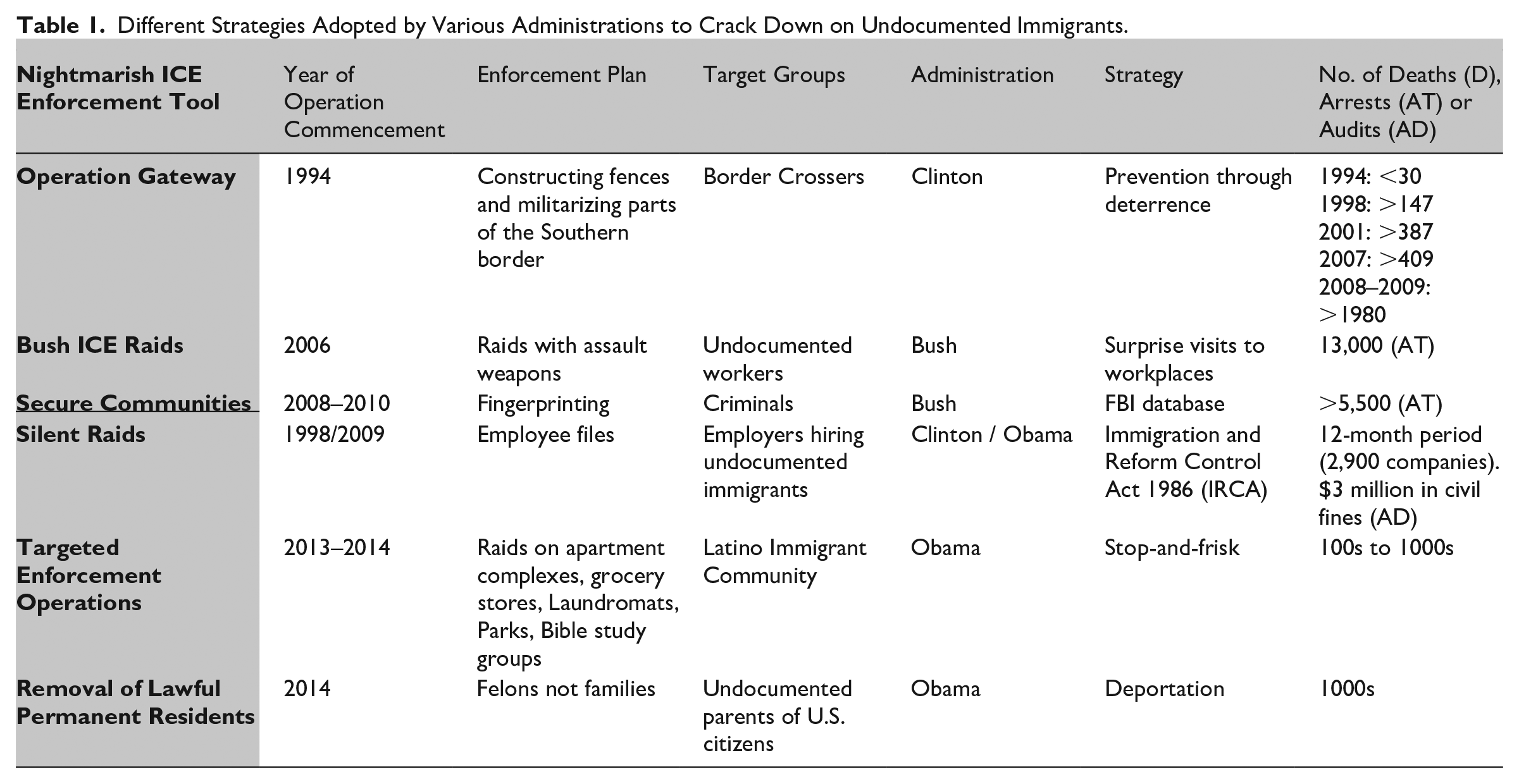
In Ethics, Morality, and Disruption of U.S. Immigration Laws, Hing (2015) traces the unfair treatment of undocumented immigrants, and even to an extent, resident aliens. He has compiled heart-wrenching stories of Immigration and Customs Enforcement (ICE) officials raiding stores, restaurants, and auto shops (pp. 955, 992). Holslin (2014) confirms that hardworking immigrants were victimized by Bush-era ICE raids. During the Obama administration’s silent raids, thousands more lost their jobs. Hing (2015) categorizes “nightmarish ICE enforcement tools” into six areas: operational gatekeeper, Bush ICE raids, secure communities, silent raids, targeted enforcement operations, and removal of lawful permanent residents (without a fair hearing).
Table 1 presents a breakdown of the details of operations carried out by the Clinton, Bush, and Obama administrations over a period of about two decades. It includes the enforcement plan, target group, strategies employed, number of deaths, arrests made, and audits conducted on employers (companies and organizations). Analyses of the data prove that various administrations adopted different strategies to curtail the influx of immigrants. In a bid to accomplish this goal, however, these measures resulted in the death and wrongful characterization of immigrants in significant numbers (Hing, 2015).
Different Strategies Adopted by Various Administrations to Crack Down on Undocumented Immigrants.
Jurisdictionism
Jurisdictionism potentially seems like a new terminology in the field of immigration research. The literature on the topic “jurisdictionism” is limited. Lamey’s The Jurisdiction Argument for Immigration Control: A Critique seems to be one of the few, if not the only article that had a comprehensive and detailed approach to the topic. Strangely, no other literature researched to this point uses jurisdictionism. The author will, therefore, draw on Lamey’s literature and relate this to other authors who come close to the subject matter.
Jurisdictionism, according to Lamey (2016) is the brainchild of Blake (2013). In his article Immigration, Jurisdiction, and Exclusion, Blake (2013) proposed three features that a state should possess:
A government able to exercise control through coercion;
A portion of the globe’s surface over which that control is exerted;
A local population that is the subject of that control.
Jurisdictionism, which is the jurisdiction argument for immigration control, maintains that states are justified in restricting the number of immigrants (Lamey, 2016: 582). The jurisdictionism perspective, which falls between open borders and restrictive borders, only permits the entry of immigrants on justifiable grounds. Lamey (2016) explains that jurisdictionism’s original twist is to harness its liberal features to a significant and extensive form of border control. This strategy may be less restrictive than current state practice, but that, nonetheless, falls well short of the open borders advanced by global liberals (pp. 582–583).
Every country is governed by laws and regulations to keep order, sanity, and security within its borders. Every country has the right to secure its borders and protect its citizens. Others are of the “open border” viewpoint. Gibney (2004) observes that the link between liberalism and open borders is so strong that the latter view is sometimes termed “global liberalism.” This view contrasts with the proponents of border control. Blake’s (2013) Immigration, Jurisdiction, and Exclusion, and Kates and Pevnick’s (2014) Immigration, Jurisdiction, and History systematically converge on some thoughts but invariably diverge on others. For example, Kates and Pevnick (2014) find Blake’s (2013) argument for the right of liberal states to forcibly exclude potential immigrants “attractive.” Their stance is based on Blake’s balanced perspective on most immigration issues (2013).
Jurisdictionism is predominantly an insidious theory. It postulates that the current entry policies of democratic states or nations like the United States, United Kingdom, France, Canada, and Germany, to name a few, commit an injustice against would-be immigrants from poor countries. Lamey (2016) purports that a widespread feature of contemporary immigration policy is to prioritize the entry of well-off, economically skilled immigrants over their unskilled, impoverished counterparts (p. 582).
Foley and Hoge (2007) traced a trend in the admission of immigrants into the United States over different epochs. They surmised that during the Great Depression and World War II, immigrants from Europe were admitted into the United States under the quota system of the Immigration Act of 1924. The story was different for Africans, Asians, Latin Americans, and the Middle Easterners who “were shut out by the severe limits on the quotas for those regions” (p. 57). In the 1960s, the hospital industry focused attention on hiring immigrants from the Philippines and India, where nurses with specialties were trained. Then in the 1980s, due to the emerging information technology industry, skilled engineers from Taiwan, Hong Kong, India, and Korea were recruited (p. 58). One of the salient categories of the DV lottery introduced by President Bush was that one should be a skilled worker. The foregoing arguments buttress the point that when it comes to admitting immigrants, the United States prefers skilled workers to unskilled workers.
However, another aspect of jurisdictionism argues for the admission of people who may be unskilled and poor. Lamey (2016) states that jurisdictionism is refreshing in reversing this priority and viewing poverty as a reason for admission (p. 582). The ethical dilemmas of taxation of undocumented immigrants, military service as a means to expedited citizenship, repatriation of immigrants to high-risk environments, and immigration profiling for purposes of risk management (Strait, 2011: 218), possibly constitute taking undue advantage of undocumented immigrants. In other words, admit them when it is convenient and works to the advantage of the nation, and reject them when they have nothing to offer the host country. Applying the Marxist approach of migration, which assesses the short-term correlation between the economic cycle and immigration policies, Bovenkerk et al. (1991) suggest that migrants constitute an industrial reserve of an army of labor.
Ethical Religiosity
Besides the strong arguments of human rights, historical continuity, family history, fairness, and sovereignty in favor of “legalized” immigration, there is yet another area for great consideration, which this researcher calls “ethical religiosity.” Ethical religiosity is the legal, compassionate involvement of churches, parachurch, and religious organizations in immigration issues. These groups fundamentally use biblical principles to host, support, and help immigrants find solace in the United States. This viewpoint, to a great extent, edges on the borders of both legislative and religious limits. Ehrkamp and Nagel (2012) posit that amid such anti-immigrant legislation, places of worship serve as important spaces of integration and welcome for recent immigrants (p. 627). The effort of churches and religious groups to help immigrants varies. Wells (2004) observed that beyond the provision of services and advocacy work, many churches have also sought to integrate immigrants into congregational life. The effort put into the process of integration is particularly significant, given the South’s history of racial segregation and the role of white churches that endeavor to maintain their status quo. Asamoah-Gyadu (2014) argued that the mission of churches includes the provision of “protection” for their vulnerable members who need to survive a physically precarious diaspora (p. 68).
Though not legally backed, some churches have served as immigration sanctuaries for undocumented immigrants. Churches are deemed “sensitive locations” along with schools and hospitals by the Department of Homeland Security and most likely Immigration and Customs Enforcement (ICE) will refrain from conducting raids in these areas (Winston, 2017: 13). Borter (2017) surmises that during the Trump Administration’s immigration enforcement against sanctuary cities, many religious leaders and communities opened their churches to shelter undocumented immigrants who were facing removal orders from ICE. Statistically, there was a 200% increase, approximately 400–800 churches that offered places of safety to immigrants facing deportation threats (p. 1210).
Sanctuary Cities
The concept of Cities of Refuge in the Pentateuch books of Numbers and Deuteronomy, and the historical book of Joshua, bear many similarities to that of Sanctuary Cities in our time. There were six Cities of Refuge designated as Levitical towns—Bezer, Golan, Hebron, Kedesh, Ramoth, and Shechem. These cities were on either side of the River Jordan, where “a person who commits an accidental homicide was to flee to escape the avenger and thus live to stand trial” (Walvoord and Zuck, 2000: 256). They were, therefore, locations and places of refuge. Although the definition for Sanctuary Cities is still evolving, Houston (2019) surmises that it is a designation for places that adopt sub-federal policies that regulate cooperation with and participate in federal immigration enforcement (p. 562). Sanctuary cities are therefore refuge centers where undocumented immigrants who feel threatened for their lives and/or security can safely abide for a considerable period without any foreseeable legal immigration repercussions.
On another level, some authors also strike distinctions between Cities of Refuge and Sanctuary Cities. Walker (2010), for instance, argues that Sanctuary Cities are more focused on “sanctuary policies” than on location or space as depicted by Cities of Refuge. He hypothesizes that local policies can be enacted at the city, state, and country levels and may be called sanctuary policies, “separation ordinances,” “integration policies,” or simply policies that limit the role of local officials in immigration enforcement (p. 29). Yet on another level, Houston (2019) propounds that sanctuary cities are not strictly a policy or place, but a process. He observes that the amalgamation of the two schools of thought on sanctuary cities being “proposed or passed policy” and “labeled place or jurisdiction” diminishes analytical and political purchase and reinscribes a simple binary interpretation of sanctuary (p. 563).
During the first year of his presidency and to fulfill “campaign promises,” President Trump signed Executive Order 13768, “Enhancing Public Safety in the Interior of the United States” to cancel all federal funding to sanctuary cities. It stated, “Sanctuary jurisdictions across the United States willfully violate Federal law in an attempt to shield aliens from removal from the United States” (Trump, 2017: 8799). This Executive Order was vigorously enforced and started a legislative battle between the federal government on one hand, and state, city, and local governments on the other, at times leading to legal consequences. To date, the battle rages on.
Human Rights
As mentioned in the Ethical Religiosity section of this article, Catholics have taken to the forefront in negotiating for immigration reforms. Cruz (2011) elaborates that Catholics have social teachings on immigration reforms. He groups human rights and the common good into three:
Human dignity, which maintains that nothing or no accidental matter such as place of birth or nationality of parents diminishes the moral worth of all people and that justice requires an open border policy.
Human rights, which affirm that human beings are to be regarded and treated as subjects entitled to a decent and human life.
The common good, which is an ethical framework essential for the elaboration of humane immigration policies (p. 299). Hill (2008) emphasizes that human rights are fundamental to human dignity (pp. 262–263).
Koch (2005) offers the standard tripartite distinction obligations under human rights. She classifies these as “to respect,” “to protect,” and “to fulfill,” in a bid to handle different situations in different ways. To respect is not to violate the human rights of others within or without jurisdictional territories (global); to protect is to defend the human rights of those within a jurisdictional territory (local), and to fulfill is to have the mindset to obligate and promote human rights within a jurisdiction (local). Ikuenobe (2018) holds an entirely different view on human rights comparing the conceptions of Western to non-Western worlds. He argues that the overemphasis on rights, upheld by Western culture, as entitlements, without a corresponding emphasis on duty, is not an adequate way of maintaining rights and dignity for all, especially for the vulnerable. However, the African, non-Western conception of dignity as a basis for human rights dependent on individuals’ innate metaphysical capacities, which are nurtured and actualized in a community for individuals’ well-being, provides a better approach (p. 589).
Ikuenobe (2018) further surmises that a plausible African conception unpacks the communal material conditions, which include social relationships that make a person’s natural metaphysical, rational autonomy, and rights possible and substantive. He posits that “A right is substantive only because others have a duty to respect it, and the community has the power and rules to protect rights and enforce the duty of non-violation” (p. 593). Gleaning from Ashcroft’s (2005) explanation of dignity as a combination of descriptive and normative elements, Fitzpatrick (2013) indicates that the normative element implies a correlative duty of respect by others, which involves the material condition of goods and rules that make dignity and rights possible. Mattson and Clark (2011), however, argued that the inherent worth and absolute view of dignity as a basis for rights make sense only in individualistic cultures. This concept tends to be problematic and has no relevance in communitarian cultures. They avouched, “Communitarian cultures tend to emphasize people’s duties and obligations rather than their rights. Dignity arises from fulfilling these obligations, typically involving acknowledgment by others” (p. 306).
Most of the literature reviewed for this article challenged human rights violations on many fronts, especially concerning undocumented immigrants. These include but are not limited to racial discrimination, racial profiling, denial of wages (wholly or partly), sexual harassment, and high-risk jobs, to name a few. These acts are founded on discrimination. Ahn et al. (2013) stress that the culture of discrimination becomes the ideological backdrop for abuse (p. 309).
Human rights violation, including criminalization of undocumented immigrants, has contributed to a climate of discrimination that negatively affects immigrant communities in the United States for both documented and undocumented immigrants (Androff and Tavassoli, 2012: 166). Illegal immigration has become one of “the most pressing ethical issues” in America today. It has grown beyond bounds to become a human rights issue because of the widespread violations and dehumanization of undocumented migrant people.
Undocumented Immigrants
According to Warren and Kerwin (2018), there are two categories of undocumented immigrants. Some entered the United States with valid temporary visas and subsequently established residency without authorization. Others entered the country without proper immigration documents across the southern border (p. 125). Medina (2017) observes that President Trump’s executive order on immigration gives wider latitude to enforcement officials, expanding those targeted for deportation to include anyone whom immigration officers judge to pose a risk to public safety or national security. The continuous targeting of undocumented migrants as criminals or bad people is rather tragic. Heyer (2018) surmised that the Trump administration’s ongoing betrayal of undocumented immigrants and asylum seekers reflects false assumptions and facile analyses of complex challenges (p. 150).
To oppress the alien, Ahn et al. (2013) observed, is nothing less than apostasy. In Exodus 23:9, Israel was mandated by God to ever cherish “the heart of an alien, for you were aliens in the land of Egypt.” Cultivating the virtue of hospitality to the stranger, or alien, Pohl (1999) indicated, is thus no mere supererogatory act of “charity” as hospitality is often seen today. For the Christian, it is a God-given responsibility, a mandate from the Creator. As Cruz (2016) noted, more than 200 million people live outside their country of origin and millions more are on the move as refugees and internationally displaced persons (IDPs) (p. 245). He further argued that the gifts, challenges, and humanitarian crisis embedded in contemporary human dignity put the spotlight on the Christian churches’ missionary activities. Christians are therefore mandated to care for foreigners and strangers (immigrants) to the best of their abilities.
Violation of Human Rights
The attempt of the United States to cut back on the influx of immigrants through its borders, on one hand, and the impact on human rights, on the other hand, has resulted in some inhumane activities. Simply put, the human rights of immigrants, especially those crossing the Mexico–US border have been violated. Androff and Tavassoli (2012) explained that despite the efforts to prevent immigration into the United States, the dangerous journey north, for immigrants, has dire consequences resulting in human rights violations. These violations result in “deaths, tremendous health risks, separation from family members, and the risk of inhumane treatment if apprehended or detained” (p. 165). The violations of immigrant human rights can be grouped into three:
Loss of lives due to harsh conditions of weather and maltreatment of migrants by law enforcement;
Unfair prosecution of arrested immigrants;
Abuse of immigrants in law enforcement custody.
Androff and Tavassoli (2012) report that since 1994 an estimated 5000 immigrants have died in the Sonoran desert. The United Nations (UN) plays a major role in protecting human rights. In 1948, the United Nations promulgated Article 13 of the Universal Declaration of Human Rights law, which stipulated that every human has the right to freedom of movement (UN, 1949). Over 50 years later, the UN reinforced its stance more clearly by adopting the International Convention on the Protection of the Rights of All Migrant Workers and Members of Their Families. This law states in part that migrants are not only workers but also human beings with families, drawing attention to the dehumanization and human rights violations of migrant workers and their families (p. 166).
Ignatieff (2017) broadened the scope of human rights research by visiting areas that had had human rights issues. He and his team visited Los Angeles, Brazil, South Africa, former-Yugoslavia, and others. In his research, he asserts that the appreciation of human rights is not about changing the geography of states “but changing the moral dispensation in which we think of human life” (p. 4). Surprisingly, he openly admitted that in the 1940s white people “like me” believed in the right to rule non-white people based on the disreputable justification that was foundational to the understanding between races then (p. 4).
Violent Behavior of Undocumented Immigrants
Objectively, the United States has the right to monitor and control the influx of undocumented immigrants through its borders. Many catastrophic events that have led to the loss of lives at the hands of undocumented immigrants raise much more concern than empathy for immigrants. On March 12, 2019, an illegal immigrant with a criminal record, Carlos Eduardo Arevalo Carranza, 24, was arrested for the murder of 59-year-old Bambi Larson. Sources say he stalked her before stabbing her to death (Dedaj, 2019). In December 2018, a day after Christmas, an illegal immigrant fatally shot a Newman Police Department Corporal, Ronil Singh, during a normal traffic stop. Cpl. Singh was survived by his wife and a then five-month-old son (Associated Press, 2018). Although these stories may be two in several hundred, it still buttresses the point of the Trump administration that harsher measures should be taken to curtail the entry and residency of undocumented immigrants.
Immigrants crossing the US border, who are unchecked and unscreened for security detail, pose a danger to the populace in various ways. Immigrants who elude these security checks become a great threat to the country because it possibly opens the door to people with criminal backgrounds including drug dealers, terrorists, and sex traffickers, to mention a few. On the other side of the coin, however, some immigrants contribute to the economy of the United States by their hard work and even perform menial jobs that normally American citizens may not necessarily accept. Other undocumented immigrants have been employed by companies that deal with sensitive information and have worked with great integrity and maintained confidentiality. These are the two extremes: criminals versus good people.
The moral and ethical approach to immigration is therefore justified in several ways. To maltreat an immigrant just because the person is not a citizen or has entered illegally into the United States is a basic violation of human rights. To recognize that human rights are fundamental to basic human dignity is to admit that immigrants are normal human beings who need to be treated with respect, regardless of the suspicions surrounding them. Ethics demand the right things to be done. Morals demand that we exhibit good nature towards others. Even more sensitive is the divine responsibility to treat strangers and foreigners with love.
A combination of ethical, moral, and legislative approaches can bring about immigration reform that will satisfy both ends of the argument spectrum. In other words, an immigration resolution that will uphold human rights and dignity on one part and the laws of the land, on the other part, can be promulgated. This reform will admit those who genuinely qualify and reject those who do not use the right means of entry.
Conclusion
Illegal immigration is an issue that the world in general and the United States, in particular, will continue to address. As this situation intensifies year after year, it behooves governments and other religious entities to seek ways to resolve this predicament. Christian leaders and lawmakers need to sit around the table for talks. For instance, the Catholic Bishops who have taken the initiative for immigration reform should have constructive discussions with Congressional lawmakers and bring about a form of resolution, particularly in the United States. In this manner, families that are being separated, people who are being criminalized and put in detention without just cause, and the misuse of human resources by predators, will cease or be reduced to a minimum, while unity and respect among humans are promoted.
In applauding the work of the United States Conference of Catholic Bishops (USCCB), the National Council of the Churches of Christ in the USA (NCCC), and other church organizations in their statements on immigration reform, Shadle (2020) brings out a critical caution. He posits, “Although these documents offer a compelling Christian witness on the issue of immigration and have guided Christian engagement on the issue, they also fail to address adequately how the legal/illegal frame operates in American political discourse.” (p. 92). There should, therefore, be a comprehensive approach to the issue of immigration and not rate legal over illegal immigration carefully noting that an unguided immigration sweep can be “aimed at restricting and delegitimizing both illegal and legal migration” (Shadle, 2020).
The scriptural element of hospitality as presented by Jesus in Matthew 25 should not be overlooked. Jesus portrayed himself as the invisible stranger that benefited from the goodness of a neighbor. He posited, “Truly I tell you, whatever you did for one of the least of these brothers and sisters of mine, you did for me” (vs. 40).
In conclusion, many authors have sought to initiate and continue talks on immigration. Others have made thought-provoking statements that give a clear picture of the challenges of immigration in general and steps that can be taken to resolve them. There is something in all humans, Schuck (2018) observes, that likes to moralize about immigration, to view it as an activity for which strong normative views, including feelings of right or wrong, not merely prudence or wisdom, are both natural and appropriate (p. 867).
Footnotes
Funding
The author(s) received no financial support for the research, authorship, and/or publication of this article.
