



Abstract
Joseph's story in Genesis 37–50 is well-known among Christians. It is similar to the Torah's account of Yōsef's life. The Islamic version celebrates the triumph of the virtuous. In contrast, the biblical narrative highlights the unwavering loyalty of Joseph to his family and forgiveness; an account that could serve as a model for coexistence and fostering harmonious interfaith relations. In this article, the Qurʾānic story of al-Yῡsuf, as well as the Jewish and Christian interpretations of the same story, are used for an intertextual interpretation. Drawing from the idea of ‘from the foreign to the familiar,’ the author describes Joseph's story in Islamic, Jewish and Christian traditions in that sequence. Joseph's story, she suggests, has valuable lessons for the Jews, Christians and Muslims who are connected with each other in a sense through this common narrative; she argues that an intertextual reading of similar narratives in their traditional sources has promise for building bridges between them.
Introduction
In order to gain a better understanding of Islam as a Christian or a Jew, it is essential among others to examine the Qur’an in relation to the Old Testament or the Torah. 1
One of the promising texts involves the story of Joseph. The question to ask is, ‘what does it mean to read Joseph's narration of forgiveness in the Muslim, Jewish, and Christian context for trilateral talks?’ This study examines the Joseph narrative from two perspectives: one, Analyze Sῡrah Yῡsuf inter-textually because, similar narratives exist in the Book of Jubilees, the Torah and the Old Testament. In the Bible, Joseph is seen broadly as one who forgives. Two, Apply the inter-textual meaning to our contemporary context of interfaith relations where forgiveness can lead to reconciliation.
Yῡsuf in the Qurʾānic
The Joseph narrative is found in the 12th chapter of the Qurʾān, Sῡrah al-Yῡsuf. It is one of the most beautiful common narratives. 2 The chapter, consisting of 111 verses, was revealed in Mecca. Muslims believe that Allāh provides people with a model to imitate through the life stories of the prophets. Unlike the stories of other characters and the prophets, which are spread throughout the Qurʾān, Yῡsuf's narrative is contained in a single chapter. It is a unique story in that it is the longest and most descriptive account in the Qurʾān and has a unified structure and content. Yῡsuf is the only individual in the Qurʾān whose personal life is described in length in a separate chapter and he is regarded as the most righteous prophet. 3
The story begins with the following note: ‘We will recount to you the best of narratives in what We have revealed to you of this Qurʾān, and indeed you were among those who were ignorant of it before We revealed it to you’(v. 3). 4 The storyteller addresses Yῡsuf's dream in vs 4–6 where the eleven stars, the sun and the moon prostrate themselves before him. The older brothers of Yῡsuf are unhappy with their father favouring Yῡsuf over the others; and so, they scheme to eliminate him. However, Yῡsuf reaches Egypt and gains power and prestige. He plots to bring his brother Benjamin to Egypt. He reunites with his father, and declares that his boyhood wishes have come true. 5 This narration concludes with a lesson and guidance for people who have faith (3, 111). 6
The Yῡsuf narrative contains a traditional heroic saga of a young man with aspirations but isolated from his family. The story describes the stages of affliction and suffering inflicted by the evildoers, culminating in the protagonist's reconciliation with his family. When Yῡsuf discovers that the shaiṭān's (Satan) schemes were to divert Allāh's great plan for his life through his brothers, he embraces his destiny and is overjoyed to see his dream of family reunion come true.
The Qurʾān divides the parts into the following verses: Yῡsuf's dream (4–7) and the brothers’ conspiracy (8–18), rescued but sold to merchants (19–22), the temptation of an Egyptian high-ranking wife and imprisonment (23–35), interpretation and appointment to the management position (36–57), and the reunion with family (58–101). 7 The circular structure of this chapter begins with Yῡsuf's dream and concludes with the confirmation that it comes true.
First, Joseph is a character mentioned in all three Abrahamic religions, but Islam highlights Yῡsuf's narrative in order to elevate Muḥammad. Yῡsuf is described as the embodiment of victory over the unjust and wicked. Muḥammad appears to have had a special affection for Yῡsuf. In the same way that Yῡsuf overcame his brothers’ jealousy, lying, and conspiracy and ultimately defeated them, it is thought that Muḥammad himself, by Allāh's will, persuaded that he would eventually overcome the persecution of his Meccan relatives and prevail. Later, upon reentering Mecca, Muḥammad delivered the message, ‘I will not blame you today’ (Qurʾān 12:92), to the Meccans who had tormented him in the past but were now begging for life. Likewise, after his brothers recognize him, Yῡsuf forgives them of their past transgressions.
Through its introduction and conclusion, Sῡrah al-Yῡsuf recounts the nature and narrative context of the biography of Yῡsuf who would have been a role model for Muḥammad's life. Muḥammad had struggled with his tribe's rejection. The story of Yῡsuf would have provided solace to Muḥammad, who endured the loss of his blood ties and mounting pressures. 8 In Qurʾān 12:3 Muḥammad praises the narrative of Yῡsuf as the most beautiful story. Yῡsuf is also mentioned in other parts of the Qurʾān such as 6:12 and 40:34.
While every sacred scripture in ‘the Abrahamic tradition’ commonly appraises the character of Joseph, the Islamic tradition approaches the story from two different focal points. The first is to establish strong ties to Muḥammad's prophethood, and the second is to convey Allāh's qualities through Muḥammad's biography. In addition to Muḥammad's narration, the function and purpose of the narrative form are disclosed through Allāh's character. Yῡsuf's story was used to illustrate Allāh's victory against the persecutors during Muḥammad's time. The message of Allāh emphasizes that humans have limitations and that nothing can be accomplished without Allāh. Though, the brothers are unable to recognize Allāh's purposes, Yῡsuf does.
In Islamic doctrine, each prophet's story seems to be connected to Allāh's attributes. Yῡsuf's story mainly focuses on Allāh's forgiveness, as He is al-ḡafūr (53) 9 . According to Islam, Yῡsuf, his great-grandfather Ibrahim, his grandfather Ishaq, and his father, Yaqub, were all prophets, as was he. Allāh oversees the schemes of Yaqub's sons and subverts them, and accomplishes his own will. Allāh is described as the sovereign in all events (34, 50) and Yaqub puts his trust in him and believes that Allāh is the dependable one al-wakīl (67). Allāh is also portrayed as omniscient, all-knowing, and all-hearing, al-samīʿ (34). 10 Even though the intervention of Satan to make those slaves of the king forget what Yῡsuf interpreted for them in the prison, Allāh knows everything (42). This narrative also demonstrates God's generous and forgiving character through Joseph's declaration of forgiveness.
In the Qurʾānic account of Yῡsuf, his brothers discovered money in their saddlebag and decided to return to Egypt; nevertheless, neither Judah nor Benjamin is mentioned by name in this chapter. Regarding this occurrence, Yaqub mistrusted his sons, but he acknowledged ‘Allāh is the best protector (al-ḥafīẓ) and the merciful one (al-raḥīm)’ (64). Yaqub then allowed them to take his young son for the lengthy journey back to Egypt in order to determine the exact amount of food needed during the famine. In the story of Yῡsuf, for instance, Allāh is revealed as the one and the conquering one, al-ʾaḥad and al-qāhir (39) 11 , and the gracious one, al-laṭīf (100). 12 In a later scene, the victims became the brothers guiled by Joseph's scheme, and the stealing sin of Yῡsuf ‘s brothers was disclosed. In the aftermath of their recollections of the previous transgressions and accusations, they eventually admit that Allāh is the most just judge, al-ḥakīm.
The Jewish Reading of Yōsef's Story
The story of Yōsef is most prevalently depicted as the story of atonement among Jews because it is written in the Book of Jubilee, which laid the groundwork for the Day of Atonement, when Yōsef's blood is replaced by the scapegoat. 13 The message of forgiveness in the story of Yōsef is widely embraced by the diverse spectrums of Judaism, from the secular to the traditional and from the modern conservative to the radical. This ritual of proclaiming forgiveness can be interpreted as the proclamation of good news through the sacrifice of animals, resulting in the offering of reconciliation and forgiveness on our behalf. The proclamation that the Year of Jubilee has begun signals a change in Israel's relationship with the pagan nations.
It is not a declaration that Israel will triumph over the pagan empires, but rather that they are liberated from the cycle of retaliation in relation to their enemies. They no longer exist as enemies. In this instance, the proclamation of the Year of Jubilee implies that Israel's status might well soon be restored, which refers to the achievement of eschatological salvation, which necessitates a new exodus. The animosity between stepbrothers and the rivalry between different mothers led to the exile of Yōsef to Egypt. If only emancipation was given to the nation that embodies the forgiveness and the grace of God, thus, Israelites’ independence in the Jubilee year was not merely Israel's political liberation but the emancipation of other nations as well by the grace of God, Adonai of Israel.
In addition to the Jubilee year, Yom Kippur corresponds with atonement, as the story of Yōsef is written in the Book of Jubilees. Chapter 34 of Jubilees explains ‘the establishment of Yom Kippur as a punishment for Yaʿaqov's son's actions against Yōsef’, referring to how Yōsef was sold to Egyptian traders. For this reason, it was decreed that on the tenth day of the seventh month, the children of Israel should make atonement for their sins with a young goat, making this the annual day of cleansing. In the Book of the Temple Scroll, this is the Day of Atonement-the day of affliction, remembrance, and fasting. On this Jewish fasting day, the Israelites recall Yaʿaqov's affection for his son, Yōsef. Christianity's Joseph story in Genesis 37 also relates to the Jewish atonement ceremony. The brothers slaughtered a goat and dipped Yōsef's coat in its blood (37:31), creating the association of this narrative with Yom Kippur 14 .
The far more important aspect of Yom Kippur is te-shuvah, or repentance. Yom Kippur is the Jewish day of repentance that requires individuals to acknowledge their sins and humbly seek forgiveness. Secular Jews also observe this day and attend synagogue, fasting on Yom Kippur and hearing the kol nidre sounded on the shofar (ram's horn) at the conclusion of the Yom Kippur service. 15 The Israelites would seek God's and other people's pardon for all the wrongdoings they had committed during the prior year. Yom Kippur atones for crimes perpetrated against both God and humans. Therefore, Jews are obligated to perform teshuvah and seek forgiveness from their neighbours and friends. By soliciting forgiveness for their sins, they begin Yom Kippur with a focus on penitence before God.
According to the Jewish Rabbi, the central significance of Yom Kippur is also ‘selected from Yahweh's identical offerings’. 16 Even if a sacrifice were meticulously prepared, Adonai, the Lord, could reject it, just as he had rejected Cain's and Saul's. 17 In light of the imagery of the two herds of goats, the significance of this Yom Kippur ritual to the Jewish people is revealed in a clear manner. The high priest placed two male goats alongside the altar of God. One goat was selected as a sacrifice for Azazel, while the other was selected for Adonai. Abraham's story too has a connection with Yōsef’s story through the sacrifice. As a substitute for his son's sacrifice, God provided a lamb, which Abraham offered to God, who had already prepared everything. This ram caught by its horns also signifies the Lamb of God, the suffering Messiah's servant in Christianity. The sacrifice of Abraham's son, Isacc's Aqedah, meaning to “binding,” had been deferred until the time of the suffering servant.
In the Old Testament, the book of Torah also describes the Day of Atonement in Leviticus 16, 23:26–32, and Numbers 29:7–11. In Leviticus, each Israelite had to observe the sacred occasion by practicing self-denial and bringing their sacrificial offerings for atonement. The Jewish year of Jubilee is the year of liberation when the oppressed are released and their freedom is restored. After 50 years, household slaves are to be liberated from all oppression.
The Christian Text of Joseph's Story and Reconciliation of his Household
In Christian understanding, the declaration of Nazareth in Luke's Gospel (Luke 4:18–30), the Jubilee is fulfilled through the promised Messiah who is Jesus. In the Old Testament, Joseph is also depicted as a prototype of the promised messiah. Isaiah 61:1-2 is a typical jubilee text that reinterprets Leviticus 25. Through the servant of the Lord, the Messiah, the joyous news can give comfort and liberation to all people across ethnic, cultural, social and economic boundaries. On the basis of Joseph's later interpretation of the events and his proclamation of forgiveness and acceptance, scholars believe that the biblical account and the Qurʾān differ significantly in the degree of forgiveness within the family.
In Genesis 45 and 50, readers can find Joseph's confession and a summary of his life in God's eyes; he put his trust in God, who had led his life with integrity. According to Joseph's interpretation of his life (45:3–10; 50:12), his acquisition of provisions during the famine enabled his entire family to endure and survive the famine. Joseph's seventy-member household, including his parents and 11 brothers, was saved from the dreadful famine due to God's providence and his impeccable plan, which preceded Joseph's life of conundrums by more than a decade. Joseph overcame his bitterness and resentment so that he could finally gain a comprehensive understanding of God's plan of redemption. 18
In Islam, Yῡsuf's other evil brothers, including Judah, the ancestor of Jesus’ lineage, are merely insignificant cameos and nameless background figures. They are not deserving of forgiveness since they betrayed father and his brother. 19 The biblical text, however, emphasizes the repentance of these wrongdoers. In Genesis 44, for instance, Judah was transformed into a virtuous man, and his honest response to Joseph's test contributed to the final reconciliation of Jacob's household.
The dysfunctional members of Jacob's family had the opportunity to reflect on their past and grow as a result of Joseph's sacrifice. Judah, who had sold Joseph to the Ishmaelites and profited from the transaction, later offered himself as Joseph's servant on behalf of his youngest brother Benjamin and refrained from causing his aging father Jacob and his brothers, who were already responsible for Joseph's death, any additional suffering. God foresaw the process and devised the optimal means to break the cycle of retaliation. Judah, who had sold Joseph to the Ishmaelites and profited from the transaction, later offered himself as Joseph's servant on behalf of his youngest brother Benjamin and refrained from causing his aging father Jacob and his brothers, who were already responsible for Joseph's death, any additional suffering.
The animosity and deceit between Joseph and his brothers resulted in the separation and division of the family for more than a decade, causing Joseph unending pain. Benjamin was unable to alleviate his father Jacob's grief over Joseph's loss. According to Jacob's confession before Pharaoh, he endured his separation from his brother Esau, the betrayal of his sons, and the loss of his cherished wife Rachel and son Joseph. Joseph provided his brothers with a number of opportunities to demonstrate remorse so that he could forgive them by devising means for them to reflect on their past transgressions. In addition, Joseph's maturity was the result of his afflicted life and the hardships of his servanthood, which he endured while living apart from his brothers. He finally admitted that during the time he was able to settle in Egypt, God was making his plan for the redemption of his people; thus, his life testimony reveals how well he understood God's plan and its promise of the salvation of the community.
According to the Qurʾānic interpretation, Joseph's forgiveness and generosity imply a meaning of the hierarchical forgiveness. The winner of the final stage can be kind to those who failed and were weak. There is no love for the enemy, but rather Muḥammad's condescending generosity toward those losers. The Christian community, on the other hand, interprets Joseph's story as implying that forgiveness is not about using superior power to execute revenge, but rather about continuing to care for one's family members despite their harsh behaviour. Joseph forgave his brothers despite their irresponsible behaviour and consoled them with gentle words. This narrative teaches Christians that love conquers even evils. ‘You love your enemies and forgive your enemies 20 ’ This teaching can release those captivated by hatred and they can be freed from the cycle of revenge, anger and murder.
In addition, Christians learn that God is in control of Joseph's innocent sacrifice, just as he symbolizes the promised Messiah, Jesus, the Lamb of God, as the atoning and reconciling sacrifice for the household of God. In the Bible, the plot of Joseph's story is analogous to Jesus’ passion, agony and sacrifice on behalf of his brothers as an innocent offering.
Joseph was condemned and sold by his brother Judah; this evil scene was fuelled by his brothers’ jealousy, as well as God's provision and faithful guidance of Joseph's life. Joseph's sale to merchants and his destiny in Egypt were the result of his coloured coat, Joseph like the beloved son of God held a prominent place among his brothers. He became a trusted house servant to a wealthy, high-ranking Egyptian named Potiphar by divine intervention, but his life was soon threatened again by Potiphar's wife, who strove to seduce him. Despite his resistance, he was incarcerated for several years. In spite of his noble character, he suffered humiliation in the Pharaoh's prison, but he was elevated again after interpreting the Pharaoh's dreams.
The favoured son of his father became a symbol of sacrifice. He was exiled to the position of homo sacer, 21 just as Jesus was ostracized and served as a scapegoat while being separated from his beloved family. God's promise of redemption of Jacob's family was fulfilled by Joseph, so he became a precursor to Jesus, the descendant of Abraham and the Saviour.
Inter-Textual Reading of Joseph's Story in Light of Variances
Although all three religions affirm that God's plans are always impeccable, more theoretical discourse is possible for the figures whose characters are delineated as flawless in the Qurʾān but not in the Torah. The Judeo-Christian scripture gives no indication that Jacob was ever knowledgeable of his sons’ deception about Joseph's death. Jacob in the Bible is as blemished and imperfect as any ordinary person. In Islamic scholars’ commentaries on the Qurʾān, it is asserted that the sinless prophet Ya’qῡb already knew the reckless scheme of Yῡsuf's brothers through the revelation of the all-knowing Allāh, but pretended ignorance of the forged evidence of the perpetrators based on the verses, ayats, (12: 86, 96) 22 . In the Qurʾān 12:15–18, Ya’qῡb already recognizes that his son's account that Joseph was devoured by a wolf is false, but he has no choice but to accept it. However, the Bible overturns the claim since Jacob and the patriarchs in the Bible are merely sinful humans; Jacob, unaware of his son's lies about Joseph, had a vision about the end of his life with his beloved son Joseph right before being transported to Egypt, and he obeyed God. 23
In the Qur'an, there are additional details not found in the Bible. One is the admiration people have for Yῡsuf's beauty. There is an extended anecdote in which women compete to peel apples without getting distracted by Yῡsuf's physical attraction. Also, Zulaikhah, who is mentioned in the Bible as Potiphar's wife, Al-Azῑz's in the Qur'an, was compelled to succumb to Yῡsuf's alluring appearance. Commentaries on Sῡrah Yῡsuf add acclamations on Yῡsuf's admirable characteristics, and the story is verbally transmitted among Muslims 24 . The scene in which it is determined whether the front or back of Yῡsuf's clothing was torn off 25 , which provided evidence of Yῡsuf's innocence and determined whether Zulaikah or Yῡsuf's statements were accurate, was also added. 26 These narratives are entirely absent in the Bible.
In addition to the victorious ending, Muslims are taught that Yῡsuf was a prophet descended from the patriarchs, and that his dream to save his household and his tribe finally came true. Joseph in the Judeo-Christian scriptures and Yῡsuf in the Qurʾān may appear to be very similar, but there are differences in the details that bring different rites to each faith community. Yῡsuf's outstanding moral quality as a prophet is overemphasized in the Islamic tradition's account of his life, in contrast to his evil brothers, who are of no consequence to the happy ending of the family. In the last chapter of the Genesis in the Bible, Jacob's corpse was buried in the Promised Land (Genesis 50:7–13) and Joseph's coffin was brought to the Promised Land as Joshua's army re-entered their spiritual heritage. In the Qurʾān, there is no journey back to Canaan, nor is Ya’qῡb's body transported to the Promised Land, as in the biblical narrative (Joshua 24:32). Thus, the story presented in this structure concludes with Yῡsuf's personal victory over his enemies, and the righteous Yῡsuf, who triumphed over adversity, was being used analogically to praise Muḥammad's ultimate victory in the same way that Muslims applauded Yῡsuf as their heroic figure. 27
According to asbāb al-nuzūl, an Islamic commentary, in terms of the Qurʾānic Khatam an-nabiyyin, the seal of the prophets, Yῡsuf's narrative is the best of the statements given to the bored audience in need of a refreshing message and narrations from Allāh. Yῡsuf's story was delivered by Muḥammad, the prophet of Islam, at a time when Muḥammad's followers requested a new message prior to emigrating Medina (Al-Rahim El-Sharif and Ahmad El-Sharif, 2020), so that they could relate to the context of Yῡsuf and overcome difficult circumstances as a religious minority group persecuted by the Quraish tribe 28 . The lives of Muḥammad and other prophets have a significant impact on Muslims’ faith and interpretation of the Qurʾānic text. By describing the lives of the prophets, Muḥammad intended to account for Allāh's attributes and introduce himself as the seal of prophethood. Elements are selected from the various Sῡrahs in order to extol the enumerated attributes of Allāh in the story of Yῡsuf, in which Muḥammad found his personal hope for victory over his enemies. Therefore, reading the Bible from a Muslim perspective can be challenging for people of non-Islamic backgrounds. 29
Above all, it is significant for comparing other religious texts with the Qurʾānic evaluation and interpretation of Yῡsuf, because in the Jewish and Christian traditions, Yῡsuf is not a spotless prophet but became a member of twelve tribes of Israel. Yῡsuf's story in Islam, on the other hand, has emerged as a revelation to Muḥammad more than any other story revealed in Muḥammad's life, thereby confirming Muḥammad as the true prophet. Yῡsuf's triumphant conclusion serves primarily to present Muḥammad as the final prophet who completes the stories of earlier prophets. Muḥammad narrates the account of Yῡsuf while enduring the most difficult times in his own life, so it is regarded as the most compelling account.
In contrast to the Yῡsuf story, which bolstered Muḥammad's prophethood and helped Muslims overcome adversity, this story teaches Christians about Joseph's character and connects it to Jesus’ sacrifice. Based on Judah's initiative in standing up for Benjamin, the younger brother, Christians interpret the story in terms of sacrifice and atonement. Muḥammad desired to persuade his people, through the story of Joseph, that in the end, Allāh's plan was superior to man's evil scheme, thereby proving his prophethood. Muḥammad enabled his followers to strengthen and convince the monotheistic worldview, as well as strengthen the bonds of the Muslim community, by presenting Allāh as on their side. The subjective voice of the narrators, which considers the attributes of Allāh and the prophethood of Muḥammad in the Qurʾān, highlights the prophets in the Qurʾān.
In the Qurʾān, the progression of events and the main characters differ from the Bible's literal description. Therefore, it is true that Joseph's narration is of great importance to a parallel study. The subjective voice of the Qur’an's narrators, which considers the attributes of God and the prophethood of Muḥammad, emphasizes the prophets in the Qur’an. Joseph's narration is significant because it gives a comparative perspective for trilateral dialogues to seek complex and multifaceted lessons from the same religious narrative (Hinze and Omar, 2013, pp. 1–6). The prophets in the Qurʾān also appear in the Christian Bible, especially in the Old Testament, and among them Joseph is highly significant in the paralleled studies. Joseph's narrative does not necessarily demonstrate clear correlation in content; however, their parallel placement facilitates the identification of differences and similarities between the texts (Figure 1).
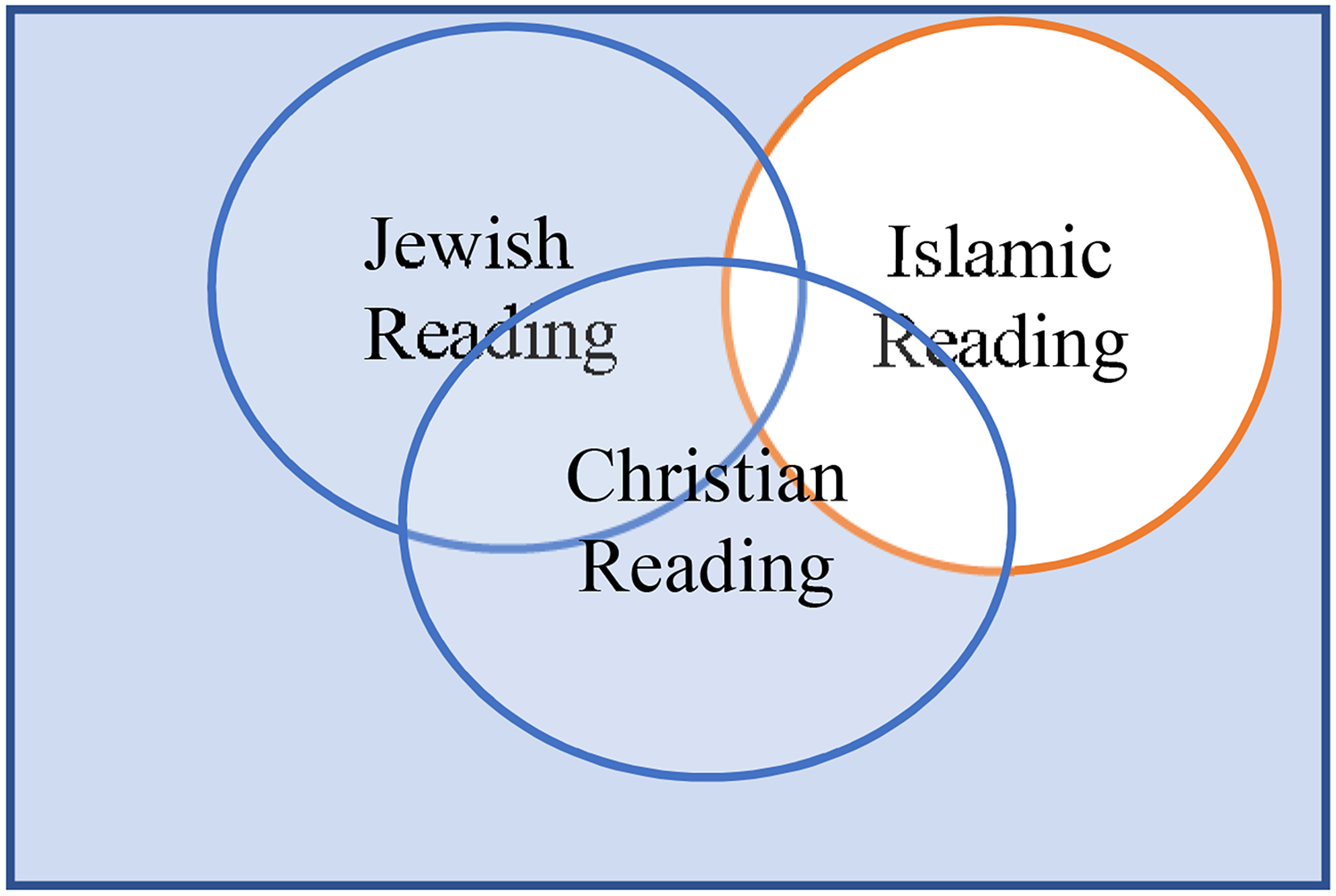
Threefold understanding of interreligious text-reading – theme of forgiveness.
Integrating Three-fold Inter-religious Text Reading
In the Book of Jubilee, Yōsef's blood-stained coat was forged by his brothers and his death was reported to his father Yaʿaqov. This sorrowful story of a victim became the origin of the Day of Atonement 30 as we find the narrative in the book of Genesis 37. Joseph was a victim and a scapegoat cast out from his own family and exiled to a foreign country, Egypt. Joseph's brothers replaced his death by killing a goat, and that became the tradition of the scapegoat and its biblical rite as written in Leviticus. Joseph's narrative and the repetition of the tradition had settled as the scapegoat ritual. The atonement tradition in Christianity can be attributed to this Levitical institution.
Regarding the Day of Atonement, despite the discontinuities and continuities found among the three ‘Abrahamic traditions,’ the perpetrators’ misgivings and violations were paid for by killing a goat as their replacement. From the Christian perspective, Jesus is the perfectly anointed Lamb of God who through his passion brought peace and reconciled humanity with God and each other. Joseph who became a slave of Potiphar and prisoner under the Pharaoh was the symbol of the redeemer of humanity as the servant of the Lord shared sufferings with his people. The evil brothers who were fearful of Joseph's retribution sought forgiveness by reminding him of their deceased father's words and forgiven by Joseph's generosity.
In the Qurʾān, unlike the story found in the Torah or the Bible, the purpose of revealing the character of Allāh through this account is crucial. Considering the context of this Sῡrah, Muḥammad's leadership was insecure and his followers were bored in the process of pilgrimage to the divine city of Medina that became the background of Yusuf’ story given to his newly converts to Islam. 31 By announcing this long historical anecdote as if it were a special revelation shown to Muḥammad, he overcame his life crisis and was able to regain the trust of his followers. Therefore, Muslims believe Joseph's story is one of the greatest revelations given to Muḥammad as it assured them of their faith and Allāh's qualities during the most difficult time in Muḥammad's life. Muslims strengthen their religious community, Ummah, and more firmly integrated through Joseph's story and the character of God, as the all-knowing and forgiving one.
Reflecting on Christian history, it has become apparent that the interpretation of Joseph's text and its central message of forgiveness should be tailored to our cultural and social contexts. Recognizing others’ interpretations can lead us to be respectful and as we pay heed to others’ historical and cultural stances with high sensitivity. 32 Despite the differences in interpretations across the three religions, the common theme of forgiveness can serve to heal this fractured world; it can also lead to reconciliation with God's creation.
Affirming the spiritual roots of Joseph's role and its significance can mend our fractured relationships. As we examined the meaning of forgiveness through the lens of the Jewish tradition, we came to realize that we will only embrace the value of forgiving our brothers and sisters in God's creation if we comprehend the ramifications of the perspectives of believers from other faiths. Then, the Creator will restore our joy and lead us to begin celebrating the Jubilee year. If Jacob's household represents God's people, Israel, then the regeneration of his people can be applied to the hostile histories of Palestine and Israel, Non-Arabs (pejoratively called, ‘ajam) and Arabs, Muslims and the People of the Book (ahl al-Kitab), and Jews and Christians in the Qurʾān.
Jesus, from the perspective of Christians, became the healer and the forgiver for the broken vessels. Blood had to be shed to heal the intense conflicts and animosities among people groups. 33 After Covid-19, the world is in a state of disrepair and the human population is in need of healing. Now, neighbouring nations have closed their borders, anti-immigration sentiment is praised by domestic citizens and refugee brothers and sisters and family members have become dispersed and cut off from the mainland. It may also shed light on the religious and political conflicts that are going on in Russia and Ukraine. The citizens who opposed Russia's occupation and war crimes have collectively yearned for liberation from war and violence. We have lost our brotherhood within the divisions and have become enemies for a variety of reasons. There are still numerous nations and ethnic groups suffering from the effects of genocide and post-war trauma. The Joseph's narrative can inspire us all with hope in the power of forgiveness and reconciliation.
Conclusion
Reconciliation can be accomplished by the Lamb of God. Christians can take the lead in serving as mediators and by extending their arms of friendship to both Muslims and Jews. “It is a threefold call of reconciliation” (Schreiter and Jørgensen, 2013), between Muslims and Jews, Jews and Christians, and Muslims and Christians. In order to overcome decades of animosity between these religious groups, the sacrifice comparable to Joseph's can serve as a redemptive analogy.
As a result of Joseph's act of forgiveness and commitment, his estranged family was eventually reunited and brought back together. Christians should broaden their ideas, discover how Muslims read the narrative from their standpoint. Fear of the other must give way to hope for a fresh start with readings of similar narratives in their respective scriptures. When Christians and Jews are more sensitive to the interpretation and traditional exegesis of Muslims, misperceptions about the Islamic faith may diminish, resulting in the practice of forgiveness in the background of their contentious history.
The bitterness from the collective memories of the Yom Kippur War, also known as the Arab–Israeli War of 1973, may give way to greater acceptance if the original meanings of forgiveness and atonement are communicated and received in the intertextual readings. A new hymn of praise may be sung as in the year of the Jubilee, praising God for delivering us all from our bondages. Joseph's narrative and its lessons need to be revisited and discussed in order to begin a new journey towards reconciliation.
Footnotes
Funding
The author disclosed receipt of the following financial support for the research, authorship, and/or publication of this article: This article is supported by the Research Fund of the Presbyterian University and Theological Seminary in 2022.

Notes
Author biography
Hanna Hyun is an assistant professor at PUTS (Presbyterian University and Theological Seminary). Her dissertation focuses on comparative religious studies and migrant Ahmadiyyat Muslims in the U.S. She has served as the director of the Centre for Islamic Studies in Sydney since 2016. She worked with BMB (Believers from Muslim Backgrounds) and Messianic Jews in Sydney, in addition to serving the Arabic church (kanīsatu rajāʾi alaủmami). She taught at Kosin University between 2013 and 2015, Sydney College of Divinity between 2016 and 2019, and Juan International University between 2020 and 2021. Her primary research interests are Islamic Studies, Migration, Refugee, and Home theology, Multicultural church planting, and Platform churches.