




Abstract
Guilt is an emotion commonly experienced in divorce. Although guilt has been shown to increase cooperative negotiation behavior in organizational contexts, this is the first investigation of the role of guilt in divorce negotiations. Using survey data of 457 divorcing individuals, the authors examined how guilt was related to the most relevant negotiation styles, while controlling for the guilt-overlapping emotions shame and regret. Guilt was related to cooperative negotiation behavior (i.e., more yielding and problem-solving behavior, and less forcing behavior). Shame was related to uncooperative negotiation behavior (i.e., more forcing, more avoiding, less problem-solving behavior), whereas regret had no additional explanatory value.
Guilt is an emotion commonly experienced in divorce. It can, for instance, arise in the partner who initiated the breakup (Sbarra & Emery, 2005) or engaged in an extramarital affair (Spanier & Margolis, 1983; Walters-Chapman, Price, & Serovich, 1995). In fact, for a long time, a divorce was legally granted only if one party could be proven “guilty” (i.e., at-fault divorce). This is no longer the case in most Western societies. Nevertheless, it is very likely that at least one of the divorcing partners feels guilty (Baum, 2007).
As a consequence of high divorce rates, the lives of numerous men, women, and children are affected by divorce arrangements. It has been assumed that feelings of guilt might lead to inequitable distributions of money or visiting rights (Walters-Chapman et al., 1995). In other words, guilt might influence the divorce negotiations that determine these arrangements. However, no systematic investigation has been conducted on how divorcing couples negotiate their arrangements and the role of guilt therein.
Negotiation has been investigated predominantly in the fields of communication, organizational psychology, and economics (cf., Thompson, 2005). Although this research reveals interesting insights and describes parallels between work-related and marital conflicts (Putnam & Folger, 1988), negotiations investigated in these fields are not entirely comparable to divorce negotiations. Studies in these fields are usually carried out in laboratory settings, using, for example, social bargaining paradigms. Intra- and interpersonal processes in such settings are experimentally manipulated and controlled. In addition, the negotiating parties in experimental settings are often students who are not familiar with each other (Barry, 2008). Divorcing couples, however, once had a relationship and share a common history. Unlike many other populations, they negotiate about things that can have existential meaning for them (e.g., their children or their home). Therefore, in the present study, we investigated to what extent divorcing persons’ feelings of guilt toward their former partner are related to their negotiation behavior.
Theoretical background
Feelings of guilt have negative valence. They occur when people think they have made a (moral) transgression and feel responsible for their actions (Baumeister, Stillwell, & Heatherton, 1994). This can be related to real acts and “mental acts” (Landman, 1993). In other words, individuals can feel guilty not only about things they really did but also about things they imagined having done. Guilt often involves (the belief of) having harmed another person (Baumeister et al., 1994; Berndsen, van der Pligt, Doosje, & Manstead, 2004). The focus is on the other, and the own deed is assessed as being negative. Guilt requires the competence of self-evaluation and is therefore regarded as a self-conscious emotion. Its central action tendency is reparation (Lindsay-Hartz, 1984). Reparation can involve actions such as apologizing or making amends, or counterfactual thoughts such as mentally undoing what one did wrong (Tangney, 1995). Because reparative actions serve to maintain social relationships, guilt is considered a moral emotion (Haidt, 2003).
Guilt is often treated as interchangeable with shame (Tangney, 1991), given that shame is also regarded as a self-conscious and moral emotion (Haidt, 2003). Like guilt, shame has negative valence and occurs when a transgression has been made. Yet, despite their similarities, guilt and shame have important differences. In contrast to guilt, shame is elicited by the feeling of exposure; the focus is on the self (Lindsay-Hartz, 1984), which is assessed as being negative (Tangney, 1995). Shame is associated with feeling small, worthless, and incompetent. Individuals experiencing shame do not feel in control of the situation. They want to retreat from the situation, hide, disappear, mentally undo the negative aspect of the self, or attack themselves or the other (Roseman, Wiest, & Swartz, 1994; Tangney, 1991, 1995).
Guilt also needs to be differentiated from regret (Zeelenberg & Breugelmans, 2008). Like guilt, regret has negative valence. It occurs when a person realizes that the outcome of a decision is worse than it could have been, had the person decided differently. Similarly, regret can be elicited by real or mental acts; the person experiencing regret feels in control of the situation and responsible. However, regret can also occur when the person has no control over the situation. In contrast to guilt, regret arises from intra- rather than interpersonal harm (Berndsen et al., 2004). Moreover, one can regret not only one’s own, but also other people’s deeds (Landman, 1993). Characteristics of regret are thinking of a lost opportunity, the desire for a second chance, and a feeling of sinking (Roseman et al., 1994). Regret elicits the action tendencies to (mentally) undo what one has done, to want to make up for what one did wrong, and to be angry at oneself (Roseman et al., 1994; Zeelenberg & Pieters, 2006).
Negotiation styles
Four negotiation styles have been repeatedly highlighted in the negotiation literature. Based on the dual concerns model (Pruitt, 1983), they can be classified along two dimensions: concern for own outcomes and concern for the other’s outcomes (also respectively referred to as assertiveness and cooperativeness (Walters, Stuhlmacher, & Meyer, 1998). A cooperative orientation can be “cooperative-assertive or cooperative-unassertive” (Walters et al., 1998, p. 3). When both self-concern and concern for the other party are high, the negotiator will use a problem-solving approach with the goal of finding a solution that is highly agreeable to both parties (cooperative-assertive). When self-concern is low but other-concern is high, the negotiation strategy will be yielding (also referred to as obliging or accommodation) behavior. The negotiator who uses this strategy will relent and meet the expectations of the counterpart (cooperative-unassertive). When self-concern is high but other-concern is low, the negotiator will adopt a competitive approach, showing forcing (also referred to as dominating or coercing) behavior, such as making threats. When both self- and other-concern are low, the negotiator will tend to avoid the conflict. Some of the literature (e.g., De Dreu, Evers, Beersma, Kluwer, & Nauta, 2001) describes compromising as a fifth strategy. This strategy is used when both self- and other-concern are moderate.
Other work differentiates three negotiation strategies only (e.g., Putnam and Wilson, 1982: nonconfrontation, solution-oriented, and control). Organizational psychologists and economists, however, often differentiate solely between cooperative and uncooperative or competitive behavior (or between other-concern and self-concern). In these studies, cooperativeness is operationalized as “making small demands, large concessions, and the cooperative choice in the Prisoner’s Dilemma” (Walters et al., 1998, p. 4), whereas competitiveness is operationalized as the negotiators making “large demands of their opponents or [using] distributive, win-lose tactics like making threats, insults and firm positional commitments” (Walters et al., 1998, p. 3). However, treating cooperation and competition as two ends of a continuum is inaccurate. For one, it ignores the fact that problem-solving behaviors are characterized by both high self- and high other-concern, whereas avoiding is characterized by both low self- and low other-concern.
Guilt, shame, regret, and negotiation
Several studies have investigated the influence of guilt, shame, and regret on negotiations in organizational settings. Based on the assumption that the three emotions are similar, they are sometimes regarded as one construct. For instance, Butt and Choi (2006) found that an emotion compound of emotion items such as “guilty”, “ashamed”, and “regretful” increased forcing behavior and decreased participants’ collaborative motives in a simulated employment contract negotiation. Bell and Song (2005) found that a similar compound (comprising the self-conscious emotions shame, humiliation, guilt, and embarrassment) was not related to a yielding negotiation style in a work-related conflict. Of course, it is difficult to draw conclusions about the impact of a single emotion when multiple emotions are combined in one construct.
Other studies have focused on the specific emotions. For example, guilt has been shown to increase cooperative behavior in social bargaining games (de Hooge, Zeelenberg, & Breugelmans, 2007; Ketelaar & Au, 2003; Nelissen Dijker, & De Vries, 2007). However, studies on shame and regret in negotiations are sparse. De Hooge and colleagues (2007) found a near-significant negative effect of shame on cooperative behavior. Cohen (2010) demonstrated that shame-prone individuals approved of false promises and purposeful misrepresentations in negotiations. Finally, Crotty and Thompson (2009) found that feeling “regret of the heart” (not having followed the heart in a decision, as compared to not having followed the head) made their participants yield more, demand less, and also gain less in different bargaining experiments.
Hypotheses
Our research focus was the relation between guilt and divorce negotiation styles. Negotiation offers the possibility of reparation (e.g., by yielding the object of negotiation to the counterpart). As mentioned earlier, reparation is the typical action tendency of guilt. Moreover, feeling guilty is associated with a high level of concern for the other, and low concern for the self (Lindsay-Hartz, 1984), which, according to the dual concerns model, is associated in turn with yielding behavior (Pruitt, 1983). Indeed, guilt has been shown to increase cooperative behavior (i.e., yielding actions) in social bargaining games (e.g., de Hooge et al., 2007). As a result, we hypothesized that in divorce negotiations, (above and beyond shame and regret) feeling guilty would be positively related to yielding behavior (H1). The theoretical framework of the dual concerns model also suggests that a high other- and low self-concern are at variance with forcing behavior. Therefore, guilt should be negatively related to forcing behavior – above and beyond shame and regret (H2).
Although our focus was on guilt, we formulated some exploratory hypotheses on shame and regret. Unequivocal findings on shame in negotiations are sparse. Although shame seems to be related to uncooperative behavior (Cohen, 2010; de Hooge et al., 2007), from emotion theory it is known that the most typical action tendency of shame is retreat (e.g., Tangney, 1991). In negotiation settings, retreat therefore likely translates to conflict avoidance. As such, we hypothesized that shame (above and beyond guilt and regret) would be positively related to avoiding behavior in divorce negotiations (H3).
Findings on regret in negotiations are sparse as well. Regret is elicited by a negative outcome for a person. An action tendency typical of regret is to undo what one did, with the aim of changing the negative outcome into a positive one (Landman, 1993). In divorce situations, people who regret the loss of the relationship or the fact that they did not manage to maintain it might demonstrate yielding or non-forcing behavior in a negotiation to propitiate their partner, in the hopes of winning the other back. Crotty and Thompson (2009) have shown that regret leads to giving more and demanding less. We therefore predicted that regret would play a role in explaining yielding and forcing behavior above and beyond guilt and shame, and that it should be positively related to yielding behavior (H4), and negatively related to forcing behavior (H5).
Method
Participants and procedure
The 457 participants were a subsample of the Interdisciplinary Project on the Optimization of Separation Trajectories. Sixty percent were women. Among the sample were 36 former couples. Participants’ mean age was 43.5 years (SD = 9.25, ranging from 22 to 71 years). Their relationship with their former partner had lasted on average 17.8 years (SD = 9.47, ranging from five months to 54 years), of which they had been married for 15.5 years on average (SD = 9.63, ranging from three months to 49 years). The majority (73.3%) had children with their former partner, ranging from one to five in number (M = 2.17, SD = 0.88). Most were moderately (41.5%) or highly (44.1%) educated. The majority (97.6%) were Belgian citizens.
Participants were recruited at four Flemish courts. Over a period of one year, project staff addressed every person who was summoned to a divorce court hearing. Persons willing to participate left their address and were contacted several days later. They could choose to complete the electronic questionnaire at the university computer lab, online at home, or to have a staff member visit them with a laptop. All surveys included extensive sociodemographic information about the participant and the former partner, as well as questions related to family background, divorce trajectory, and financial situation. In addition, participants were randomly assigned to one out of three questionnaire versions (measuring [a] emotions, [b] parent-child relationships, or [c] ex-partner relationships). This procedure was chosen in order to prevent fatiguing participants with overly long surveys. It resulted in three subsamples, one of which was used in the present study.
Measures
Guilt, shame, and regret
Guilt (ten items), shame (nine items), and regret (four items) were assessed with items compiled by the authors in the process of developing the Guilt in Separation Scale (GiSS) (Wietzker & Buysse, 2011). The wording stems directly from focus groups and an open-ended questionnaire. In both, we asked divorced people and divorce experts to reflect on different aspects of guilt, shame, and regret toward a partner whom one is divorcing. Content validity of the items was achieved by expert ratings. The analyses revealed strong psychometric properties, including good discriminating ability across the three emotions (cf., Wietzker & Buysse, 2012; more detailed information about the development of the items and selection procedures can be obtained on request from the first author).
The participants were instructed to think of their ex-partner while answering the questions. The answering format was a seven-point Likert scale with the scale points never (1) to always (7). Scores were attained by computing subscale means. In the present study Cronbach’s alphas were .91 (guilt), .88 (shame), and .85 (regret). The items and their factor structure as obtained in the current study are displayed in Appendix A.
Negotiation behavior
Negotiation behavior was assessed with the Dutch Test for Conflict Handling (DUTCH) (De Dreu et al., 2001). The DUTCH consists of five four-item subscales that measure the following behaviors: yielding (e.g., “I try to accommodate the other party”), forcing (e.g., “I fight for a good outcome for myself”), avoiding (e.g., “I try to avoid a confrontation with the other”), problem-solving (e.g., “I examine ideas from both sides to find a mutually optimal solution”), and compromising (e.g., “I try to realize a middle-of-the-road solution”).
The items could be answered on a five-point Likert scale from totally disagree (1) to totally agree (5). The DUTCH is usually applied in organizational contexts; here, instructions were adjusted to the context of divorce. Post-hoc EFA revealed that two of the items (one from the avoiding subscale, the other from the compromising subscale) did not load on the factors that represented the respective subscales. These items were discarded from further analyses. The means of the remaining subscale items were used as scores. In the present study Cronbach’s alphas of the subscales were: avoiding (.72), problem-solving (.75), yielding (.75), forcing (.77), and compromising (.79).
Results
Table 1 presents descriptive information and correlations of the negotiation styles and emotions. The most frequently reported negotiation style was compromising behavior, whereas forcing behavior was reported the least often.
Negotiation styles and emotions: Descriptive information and Pearson correlations1
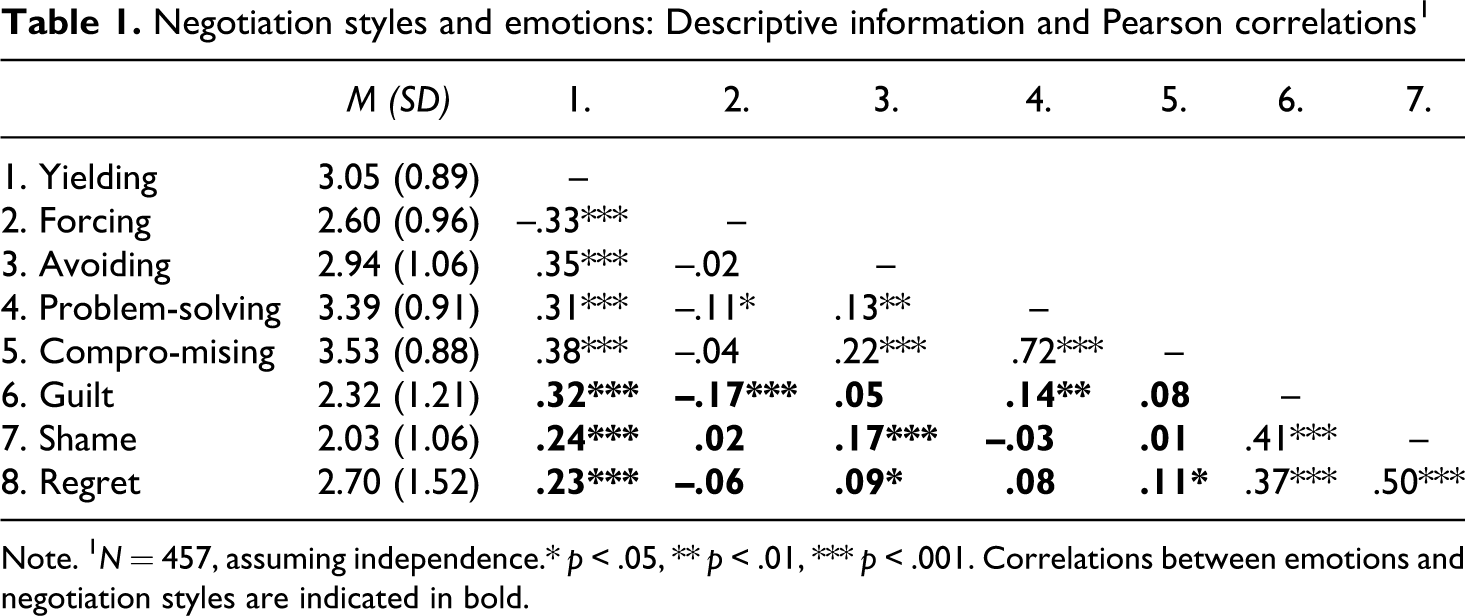
Note. 1 N = 457, assuming independence.
* p < .05,
** p < .01,
*** p < .001. Correlations between emotions and negotiation styles are indicated in bold.
To measure nonindependence within the 36 ex-couples who were included in the sample, we performed Pearson correlations between former husbands’ and wives’ negotiation styles. The correlations were as follows: avoiding r = .00 (p = .99), compromising r = -.23 (p = .17), forcing r = -.27 (p = .11), problem-solving r = .10 (p = .57), and yielding r = -.27 (p = .11). Kenny, Kashy, and Cook (2006) recommend an alpha level (p value) of .20 as the threshold to determine nonindependence. Given that the p-values for compromising, forcing, and yielding were smaller than .20, it seemed prudent to account for dependence within couples in our analyses.
We hypothesized that guilt, shame, and regret would (above and beyond each other) have effects on yielding, forcing, and avoiding negotiation behavior (H1-5 ). In addition we wanted to explore whether the three emotions had effects on problem-solving and compromising negotiation behavior. Because the observations formed a mix of independent individuals and dependent former couples, we used mixed regression models (SPSS 17) to test our hypotheses (Kenny et al., 2006). Although guilt, shame, and regret were correlated, the variance-inflation factor (1.27 for guilt, 1.43 for shame, and 1.40 for regret), did not suggest any multicollinearity problem (Kutner, Nachtsheim, Neter, & Li, 2004), so that multiple regression analysis was considered appropriate.
Given that mixed-model regressions do not allow for hierarchical entry (Norusis, 2009), we pursued an equivalent analytic strategy – testing a regression model with only the covariates as predictors against a regression model with the covariates and the single independent variable. A test of significance between those two models reveals the impact of the independent variable beyond any effects of the covariates. More specifically, for each of the five negotiation styles as dependent variable, we first fitted a separate regression model in which the two covariates that we wanted to control for were entered. Next we fitted a model where the predictor of interest was added (cf., Table 2 , which shows the models resulting from this step). An F-test comparing these two models (labeled as F change in Table 2) was performed to assess the significance of the added predictor (Kutner et al., 2004). For example, to test hypothesis H1, we first fitted a mixed regression model with yielding behavior as dependent variable and shame and regret as covariates. We then fitted a model with guilt as additional predictor.
Guilt, shame, and regret as joint predictors of negotiation styles (mixed regressions, five separate models)
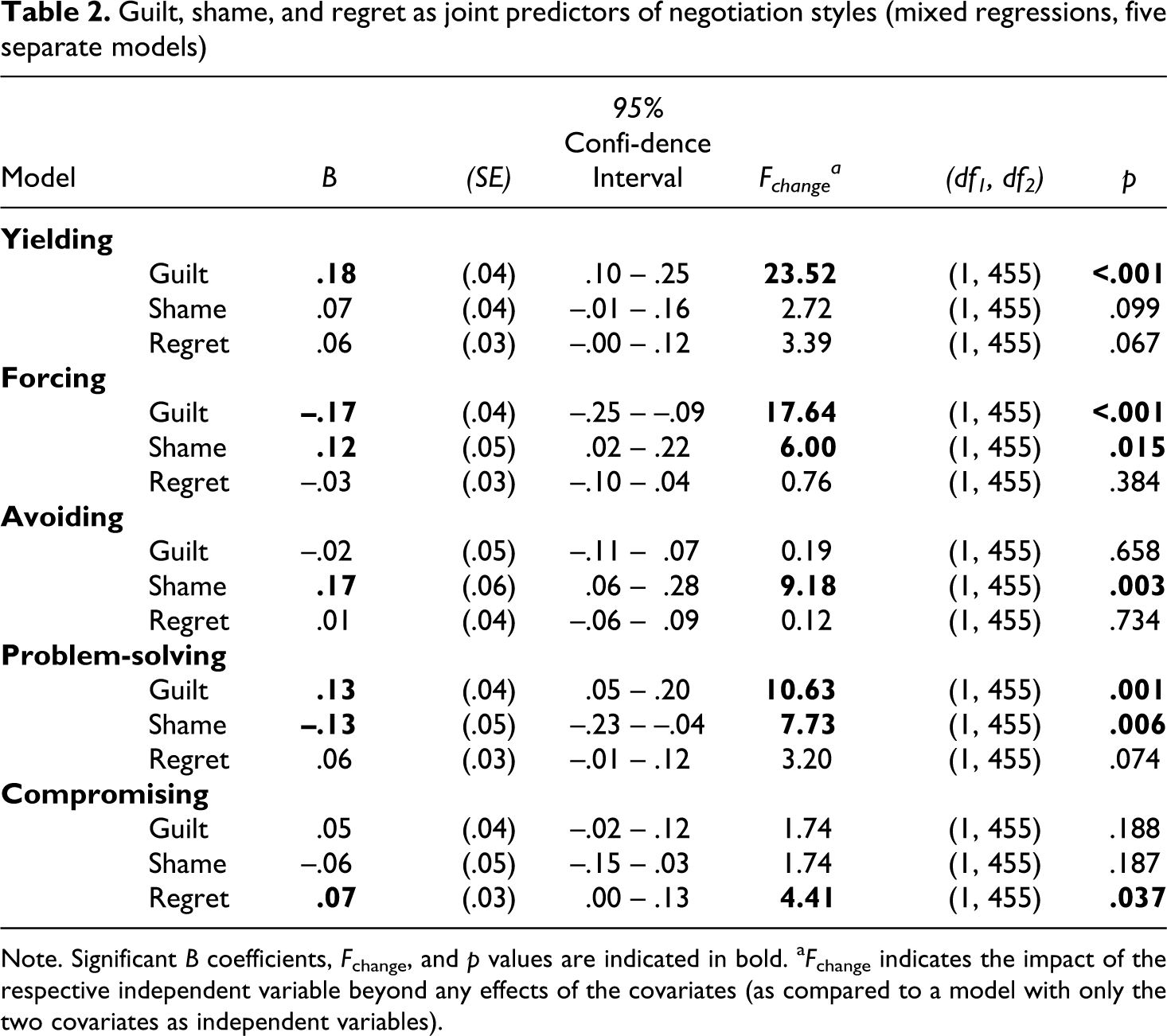
Note. Significant B coefficients, F change, and p values are indicated in bold. a F change indicates the impact of the respective independent variable beyond any effects of the covariates (as compared to a model with only the two covariates as independent variables).
We assumed fixed main effects for the covariates and predictors and an unstructured variance-covariance matrix, which allows for correlated errors within former couples. Random effects were not included. In contrast to a random intercept mixed-effect model, which allows for only positive correlations within couples, this modeling approach has the advantage that it allows for negative nonindependence (that is, the outcome variables are correlated negatively) within couples. (For more details on multilevel modeling to study dyads, see Kenny et al., 2006, Chapter 4).
Confirming our hypotheses, guilt was positively related to yielding behavior (H1) and negatively related to forcing behavior (H2), above and beyond shame and regret. Further exploratory analyses revealed that guilt was also positively related to problem-solving. The guiltier participants felt, the more yielding and problem-solving behavior and the less forcing behavior they reported. As hypothesized, shame was positively related to avoiding behavior (H3), above and beyond guilt and regret. In addition to the predicted effect, shame was negatively related to problem-solving and had a weak positive effect on forcing behavior. The more ashamed participants felt, the more avoiding and the less problem-solving behavior they reported. Moreover, they reported slightly more forcing behavior. Because we did not correct for multiple testing (cf. O’Keefe, 2007), the latter effect should, however, be interpreted with care.
Contrary to our prediction, regret was not associated with yielding (H4) or forcing behavior (H5), above and beyond guilt and shame. It had a small significant effect on compromising alone. Given the small effect size and the absence of multiplicity correction, this effect could be considered negligible.
Discussion
The present study extends the research on the role of emotions in negotiation. Our aim was to investigate the extent to which guilt is related to the negotiation styles of divorcing persons and, in doing so, to disentangle the effects of guilt from those of the related emotions shame and regret. The present findings show that guilt as an emotion is an important factor in divorce negotiations. Feeling guilty was related to overall cooperative behavior, shame was related to overall uncooperative behavior, and regret had no explanatory value over and above guilt and shame.
Guilt, shame, and regret have sometimes been treated as one construct (e.g., Bell & Song, 2005; Butt & Choi, 2006). At first glance, this conflation appears reasonable, given the conceptual overlap. Both guilt and shame are considered moral emotions, which serve to maintain social relations. This implies that people who feel guilty or ashamed should negotiate in a way that does not jeopardize the relationship with the counterpart. Our results, however, show that although guilt, shame, and regret overlap conceptually, they affect negotiation behavior in very different ways. When controlling for shame and regret, guilt was positively related to yielding and problem-solving behavior and negatively related to forcing behavior, which indeed indicated prosocial negotiation behavior. However, when controlling for guilt and regret, shame tended toward forcing behavior and was not related to yielding patterns, which indicated uncooperative negotiation behavior. This might be explained by the fact that shame-proneness has been shown to be related to anger and hostility (Tangney, Wagner, Fletcher, & Gramzow, 1992). Our findings are in accordance with de Hooge et al. (2007), whose results (in an economic context) corroborated the moral functions of guilt while questioning the moral functions of shame. Regret, in contrast, did not play a strong role in negotiation behavior in the present study.
The results not only indicate the importance of distinguishing different emotions in efforts to understand negotiation behavior but also show the importance of operationalizing negotiation behavior more comprehensively than is often done in the economic literature. There, negotiation is often studied within social bargaining games, in which cooperative behavior is usually operationalized by the amount of tokens players yield to other parties (e.g. de Hooge et al., 2007). Uncooperative behavior is operationalized by making large demands or threatening the other (cf. Walters et al., 1998). This distinction – which is in fact a distinction between yielding and forcing behavior – does not capture the range of behavior in divorce negotiations. Keeping in mind the four negotiation styles described in the dual concerns model, cooperative behavior would encompass not only yielding but also problem-solving. Moreover, when describing behavior patterns in negotiation, the nonuse of forcing and avoiding behavior might be seen as cooperative behavior as well. Uncooperative behavior would encompass not only forcing but also avoiding, as well as the nonuse of yielding and problem-solving behavior. This perspective is supported by our data. Feeling guilty was related to overall cooperative behavior, which was reflected in more yielding, less forcing, and more problem-solving behavior. In contrast, feeling ashamed was related to overall uncooperative behavior – that is, more avoiding, less problem-solving, and even slightly more forcing behavior. The results also corroborate Pruitt’s (1983, p. 167) argument that although the negotiation styles are “somewhat incompatible” and “are usually adopted one at a time … combinations are possible, especially when two strategies can be insulated from one another”.
Practical implications
Individuals involved in a divorce negotiation do not always employ negotiation tactics deliberately, but sometimes out of emotion. For instance, a negotiator who feels ashamed might endanger the negotiation process by avoiding the conflict or attacking the other party. Such uncooperative behavior is not socially desirable. In contrast, a negotiator who feels guilty might facilitate the negotiation process by being willing to make settlements. Herein lies a pitfall for divorce professionals such as mediators or attorneys. The cooperativeness of the guilty negotiator may make her/him seem more reasonable (and even more likeable). Hence, the guilty negotiator may be better for the negotiation process. However, one needs to ask whether that person is also the better negotiator, that is, the negotiator who reaches the best possible outcome.
From an economic point of view, an answer to this question might be that cooperating is not considered a good bargaining tactic because it runs the risk of being exploited by the counterpart (Walters et al., 1998). In contrast, a competitive negotiation style (i.e., forcing behavior or getting angry) has been observed to be related to material gain (Sinaceur & Tiedens, 2006). However, divorce negotiations differ from organizational negotiations. Divorcing couples share a common history. If they have children, especially younger ones, they will inevitably remain connected, whether contact is desired or not. This makes it necessary to negotiate in a way that makes future interactions possible.
In the current study, guilt and shame were related to yielding, forcing, avoiding, and problem-solving behavior. Yielding behavior, which can lead to unfavorable outcomes, can be useful when the negotiators’ relationship has a high priority (Walters et al., 1998). This may be more the case in divorce negotiations than, for instance, in economic negotiations. Forcing behavior, which might lead to high material gains under different circumstances, has clear disadvantages in divorce negotiations, including destructive effects on the relationship (Walters et al., 1998). Moreover, it increases the possibility of long-term lawsuits. Avoiding behavior leads to a prolongation of the conflict as well, which may lead to a third party (i.e., a judge) deciding the outcome. Hence, in the context of divorce, the most reasonable negotiation behavior that promises the best outcome for both parties appears to be problem-solving behavior.
Being positively related to problem-solving as well as yielding behavior, feeling guilty in a divorce negotiation bears the risk of being exploited but also the chance of reaching a mutually beneficial solution. As long as yielding out of feelings of guilt does not end up as “a self-sacrificial deference to the other party’s needs” (Walters et al., 1998, p. 3), guilt may even have the side effect of easing the conscience. Hence in divorce negotiations, a certain amount of guilt may be functional. In contrast, our research suggests that the related emotion of shame can be viewed as dysfunctional, whereas regret has a weak impact on divorce negotiations.
Limitations and future directions
Although we tried to recruit a representative sample, a certain self-selection bias was inevitable. For example, the overall low mean of guilt suggests that persons who perceived themselves as victims of the divorce process may have been overrepresented in our sample. Nonetheless, by surveying divorcing persons about their divorce negotiations with their ex-partner, the present study might provide a higher ecological validity than many studies on negotiation (Barry, 2008).
Future research should not only clearly differentiate between seemingly similar emotions but also clearly conceptualize different negotiation behaviors. Ideally, divorce negotiations should be studied in a situation that is as natural as possible. A future avenue could be to investigate the emotional dynamics within negotiating ex-couples. Given the rising numbers of divorces, it is worth increasing efforts to better understand how divorce negotiations function.
Footnotes
Appendix A
Factor structure of guilt, shame, and regret items
Acknowledgements
We would like to thank William L. Cook, Joop J. Hox, and Agnes Moors for their valuable comments on earlier drafts of this manuscript.
Parts of this research have been funded by the Instituut voor de aanmoediging van Innovatie door Wetenschap en Technologie (IWT) in Flanders, Belgium.