



Abstract
Despite extensive research on regret, relatively little is known about the underlying mechanisms of regret within close relationships. Attachment theory provides a theoretical framework to study regret within close relationships. Specifically, anxiously attached people tend to have negative views of themselves and their past acts, which is likely to result in a higher tendency to experience regret. Attachment security is likely to attenuate this tendency. Two studies provide support for these claims. Study 1 used a correlational design and showed that attachment anxiety is positively associated with the tendency to feel regret within close relationships but not with regrets in other domains. Study 2 used an experimental design and showed that reducing attachment anxiety via attachment security enhancement reduces the tendency to feel regret mainly for participants high in attachment anxiety.
Close relationships serve as the substrate for a plethora of decisions people have to make. As people negotiate their day-to-day lives or cope with life transitions they tackle questions such as: Should I continue to date this person or move on? Is it a good idea to have sex with that person or not? Is it a good time to have children? Inevitably some outcomes of these decisions are likely to be perceived negatively, leading to feelings of regret (Kahneman & Tversky, 1982). People may have different inclinations to feel regret based on the ways in which they perceive themselves, their relationship partner(s), the events that led to the decision they made, and the world in general. These perceptions or mental representations of self, other, and close relationships are thought to be the building blocks of individuals’ attachment styles (Bowlby, 1969). Hence, the tendency to feel regret is likely to be associated with one’s attachment style. In the current work we investigated the suggested associations between attachment and regret. Specifically, in Study 1 we examined whether dispositional attachment anxiety and avoidance are associated with a higher tendency to feel regret, while in Study 2 we examined whether reducing attachment insecurity via security priming results in a decreased tendency to feel regret.
Regret theory and research
Regret is a frequent experience (Shimanoff, 1984) often conceptualized as a negative emotion (unless it leads to reflection, a sense of growth, and behavioral change; e.g., Landman, 1993; Roese & Summerville, 2005). It usually follows the recognition that a personal action (or inaction) could have made the past or present better (Landman, 1993; Zeelenberg, 1999), and often involves self-blame and rumination regarding adverse events and their consequences (Connolly & Zeelenberg, 2002). People who engage more in regret and ruminate over their regrets tend to report decreased life satisfaction and experience more difficulty negotiating negative life events as compared with those who do not engage in regret (e.g., Lecci, Okun, & Karoly, 1994; Schwartz et al., 2002).
In an attempt to understand this emotional experience or state, researchers have investigated the causes and mitigations of regret (e.g., Chua, Gonzalez, Taylor, Welsh, & Liberzon, 2009; Kahneman & Tversky, 1982; Zeelenberg, van Dijk, Manstead, & van der Pligt, 1998). While focusing on different factors leading to regret, most regret theories (Decision Justification Theory; Connolly & Zeelenberg, 2002; Consistency Fit Theory; Seta, McElroy, & Seta, 2001; Seta, Seta, McElroy, & Hatz, 2008) agree on the antecedent – an outcome of an event is perceived negatively. Without the perception of a negative outcome, regret is unlikely to occur.
Despite being conceptualized as an emotion related to negative outcomes, regret is also distinguishable from other emotional states related to negative outcomes. For example, the antecedents of regret differ from those of disappointment, particularly the perception of the self as agentic or having control over the situation. More specifically, an antecedent of regret is a negative perception of actions performed by the self – which requires some form or perception of the self as agentic. However, an antecedent of disappointment is a negative perception of actions performed by others that impact the self, which does not require agency or perceptions of the self as having control (Frijda, Kuipers, & ter Schure, 1989; Zeelenberg, van der Pligt, & Manstead, 1998). Thus, when faced with a negative outcome, a person who feels personally responsible for (or a sense of agency or control over) this outcome is more likely to experience regret and less likely to experience disappointment than a person who does not feel responsible for the outcome.
A recent meta-analysis focusing on regret found that the third most frequent topic people feel regret about is events within romantic and other close relationships (Roese & Summerville, 2005). Despite these findings and the broad body of research on regret, especially in the domains of finance and sports (e.g., Kahneman & Tversky, 1982; Zeelenberg et al., 1998), relatively less research has been conducted on relationship-related regret, and most of it has concentrated on sexual experiences (Dickson, Paul, Herbison, & Silva, 1998; Oswalt, Cameron, & Koob, 2005). This suggests a strong need for more research on relationship-related regret.
In line with this suggestion, recently more attention has been given to regret within various close relationships, such as romantic relationships and friendships. Concentrating on gender differences within close relationships, Roese and colleagues (2006) compared men’s and women’s regrets with regard to action and inaction within romantic relationships, friendships, and family (parental and sibling) interactions. They found that men and women differed on the regrets they experienced in romantic relationships but not in other domains. Although focused on gender, these findings suggest that regret is a common experience within close relationships and, more importantly, that the experience of regret within romantic relationships may differ from regret in other domains.
While the abovementioned findings provide an initial understanding of regret within close relationships, they have little to say regarding the effects of partners’ personality dimensions or relationship styles on relationship-related regret. Personality dimensions were already shown to affect feelings of general regret both directly (e.g., Pierro et al., 2008) and indirectly through the consistency between the decisions a person makes and his or her personality (Seta et al., 2001). However, most of these studies have been conducted outside the domain of close relationships, thus it is unclear what role personality plays with regard to regret felt within close relationships. The current work is set to fill this gap in the literature – exploring how personality affects relationship-related regret. Specifically, we investigated whether attachment style, a personality dimension known to be highly relevant to close relationships, might explain the tendency to feel regret in close relationships.
Attachment and regret
According to attachment theory (see reviews by Cassidy & Shaver, 2008, and Gillath, Canterberry, & Collins, 2012), responsive, sensitive support from caregivers early in life leads a child to develop a sense of attachment security (or a secure attachment style). Conversely, unresponsive, insensitive caregiving leads to the development of an insecure attachment style. Insecure attachment is represented by two broad and largely orthogonal dimensions: attachment anxiety and avoidance. Parenting that is characterized by inconsistent or intrusive caring is thought to result in an anxious attachment style, whereas cold and rejecting parenting is thought to result in an avoidant style.
Individuals high on attachment anxiety tend to have a negative view of themselves (named negative model of the self by Bartholomew & Horowitz, 1991) and report lower levels of relationship satisfaction as compared with non-anxiously attached individuals (e.g., Mikulincer & Florian, 1995; Shaver, Schachner, & Mikulincer, 2005). Anxiously attached individuals often feel overwhelmed by their own emotions, being unable to regulate their negative emotions and control their relationship-related thoughts and worries. This leads them to be preoccupied with – and to frequently ruminate about – negative emotions and events in the past (e.g., McWilliams & Holmberg, 2010; Mikulincer, Shaver, & Pereg, 2003; Sbarra & Hazan, 2008). Attachment anxiety is also positively correlated with a higher tendency for self-reproach and self-blame for events in the past (e.g., Bradley & Cafferty, 2001; Muris, Meesters, van Melick, & Zwambag, 2001), which are both known to correlate with the tendency to feel regret (e.g., Connolly & Zeelenberg, 2002; Inman, 2007). These characteristics make anxiously attached people more likely to view past outcomes negatively, which, in turn, may make them more likely to feel regret than individuals low on attachment anxiety.
Although individuals high on attachment avoidance tend to hold positive views of themselves, they hold negative views of others (Bartholomew & Horowitz, 1991). These perceptions are likely to increase the chances that avoidant individuals would view relationship-related events negatively, but also make them less likely to view these negative outcomes as their own fault (reduce agency). Like anxiously attached individuals, avoidants are less likely to be satisfied with their relationships and relationship partners; however unlike anxious individuals, they are not likely to ruminate or be preoccupied with their close relationships or the way they feel about them. Instead, individuals high on avoidance deactivate their attachment system and downplay the importance of (relationship) threats and emotions (e.g., Fraley & Shaver, 1997; Klohnen & Bera, 1998; Mikulincer & Florian, 1995). These tendencies suggest that avoidant individuals should be less likely to feel regret as compared with non-avoidant individuals.
Finally, people who are low on both attachment anxiety and avoidance – securely attached individuals – tend to hold positive views of themselves, others, and their relationships. Consequently they report being more satisfied with their relationships, and are less likely to view past relationship outcomes negatively (compared to their less secure counterparts; e.g., Mikulincer et al., 2003). A heightened sense of attachment security is also associated with an optimistic perception of life, higher self-esteem, and lower tendencies to ruminate and procrastinate, all of which were found to be associated with a lower tendency to feel regret (e.g., Ferrari et al., 2009; Kasimatis & Wells, 1995; Sanna, 1998). This suggests that attachment security may be associated with a lower tendency to feel regret about close relationships, and that enhancing attachment security would reduce the tendency to feel regret about close relationships.
Further support for the idea that enhancement of attachment security reduces the tendency to feel regret comes from the ample work on attachment dynamics and enhancement of the sense of attachment security (e.g., Baldwin, Fehr, Keedian, Seidel, & Thompson, 1993; for reviews see Gillath, Selcuk, & Shaver, 2008; Mikulincer & Shaver 2007b). This work suggests people have various mental models stored in their memory (related to attachment anxiety, avoidance, and security), and each of these models can become more cognitively accessible and more influential in information processing at different times. For example, Baldwin et al. (1993) and others have shown that, when asked, people can recall a relationship where they felt anxiously, avoidantly, or securely attached; these memories, in turn, affect people’s expectations about their interaction with relationship partners and their perceptions of these interactions and interaction partners.
Furthermore, it was shown that using simple priming procedures, one can enhance the sense of attachment security and reduce or even reverse effects associated with attachment insecurity. For example, Mikulincer, Shaver, Gillath, and Nitzberg (2005) demonstrated that security priming increases the tendency to help a person in distress, even among insecurely attached people. Gillath and Shaver (2007) showed that security priming resulted in people overcoming their dispositional insecurity and endorsing more secure behaviors, and Gillath, Hart, Noftle, and Stockdale (2009) found that security priming reduced levels of attachment insecurity, at least temporarily. Based on the reviews by Gillath et al. (2008) and Mikulincer and Shaver (2007b) regarding the far reaching effects of security priming, and especially its ability to reduce attachment insecurity, one would predict that a security priming procedure would also affect participants’ feelings of regret – reducing the tendency to feel regret.
Initial support for the suggested associations between attachment anxiety and regret and security and the lack of regret comes from Saffery and Ehrenberg’s (2007) work. They studied the association between attachment anxiety and regret in post-relationship situations and found a positive correlation. Although providing support for the suggested association between regret and attachment anxiety, Saffery and Ehrenberg did not investigate the combined effects of attachment anxiety and avoidance, considered regret in only one domain (dissolved relationships), and focused purely on correlations. The goals of the current paper are therefore to investigate: (1) how both attachment avoidance and anxiety are related to regret in a variety of relationship contexts; and (2) whether the enhancement of attachment security will decrease the tendency to experience regret.
Study 1
The goal of Study 1 was to map the associations between attachment avoidance and anxiety and feelings of regret in both general and relationship-specific domains. In line with the findings of Saffery and Ehrenberg (2007), anxiously attached people – who have a negative model of the self, tend to view past events as more negative, and ruminate more – were predicted to feel and report more regret than their non-anxious counterparts, especially with regard to close relationships. The association between regret and attachment avoidance was less clear. The positive view of the self and negative perception of others that defines attachment avoidance, as well as avoidant individuals’ deactivating emotion regulation strategies and their tendency not to reflect on the past, are likely to be associated with less regret. However, the association between attachment avoidance and regret has not been tested previously and these hypotheses are speculative. To test these hypotheses participants were asked to complete a battery of questionnaires assessing attachment style in general (not limited to romantic relationships) and the tendency to feel regret both in general and in a variety of contexts involving close relationships. Participants also completed several other personality and mood variables that were used as controls to verify that the proposed associations we found were not due to the associations between attachment style and the general experience of negative emotions or broad personality facets and regret (rather than specifically attachment style and regret).
Methods
Participants
Participants were 99 young and middle-aged adults (56 women, two did not report gender), mostly Caucasian (83%), with an age range from 18 to 58 (Mdn = 21). A majority of the participants were in or had recently been in a romantic relationship (n = 83). Participants were students at a large Midwestern university or residents of a small Midwestern city. Participants were not compensated in any way and completed the measures on a voluntary basis.
Materials
The questionnaire packets consisted of an attachment measure, questionnaires relating to regret (general and relationship-related), a personality dimensions measure, a mood measure, and a questionnaire pertaining to demographics and history of relationships. Three orders were used to control for potential order effects. The first scale was always the attachment measure and the last was always the series of demographic questions.
Attachment
To assess attachment style, the Experiences in Close Relationships (ECR; Brennan, Clark, & Shaver, 1998) inventory was used. The measure consists of 36 items assessing two attachment dimensions: anxiety (18 items; e.g., “I worry about being rejected or abandoned”) and avoidance (18 items; e.g., “I try to avoid getting close to others”), all rated on a 1 (disagree strongly) to 7 (agree strongly) scale. Participants were asked to think about how they generally feel in close relationships (e.g., with romantic partners, close friends, and family members) and respond to each statement by indicating how much they agree or disagree with it. As both subscales showed high internal consistency (α anxiety = .89; α avoidance = .91), two scores were computed for each person – one for attachment anxiety and another for avoidance – by averaging the items in each subscale. The two scores were moderately positively correlated (see Table 1).
Study 1: Correlations among attachment and dependent variables

*p < .05
+ p < .06
Regret
Two measures of regret were included, one assessing regret regarding decisions in general and another assessing regret specifically with regard to relationships (romantic as well as other close relationships). To assess general decisional regret, the regret subscale of the Regret and Maximization Scale (Schwartz et al., 2002) was used. The subscale includes five items, such as “Whenever I make a choice, I’m curious about what would have happened if I had chosen differently” and “Once I make a decision, I don’t look back” (reversed scored)”. Participants were instructed to use a 1 (completely disagree) to 7 (completely agree) response scale. The Cronbach’s alpha for the five items in the current study was adequate (α = .73). Higher score represents higher tendency to feel general regret.
To measure regret with regard to close relationships, participants were asked to complete an 18-item scale developed by Roese and colleagues (2006). Participants were first asked to indicate if a (potentially negative) event presented to them was applicable to them or not (yes/no). For events to which they answered yes, they were asked to indicate the extent of regret they felt about the event using a 1 (regret very little or not at all) to 7 (regret very much) response scale. Events were taken from sexual, romantic, and friendship interactions. Example items include, “(I) should have tried harder to sleep with _____”, “(I) avoid going out with people I know I won’t like”, and “(I) wish I had tried harder to make friends”. If participants responded “yes” to any of these items they then rated how much regret they felt about that item. Participants reported having experienced an average of 7.92 events (SD = 5.57). A composite of all the rated items was computed to measure regret pertaining to close relationships in general (α = .89). Higher score represents a higher tendency to feel relationship-related regret in a variety of relationships.
Control measures
To control for the alternative explanation that the association between attachment style and regret is due to negative affectivity or a general trait/personality dimension, participants completed measures of mood and personality. Attachment insecurity is often associated with negative affect (e.g., Mikulincer et al., 2003). To control for the alternative that negative affect rather than attachment style generated the correlation with regret, mood was assessed using the PANAS (Positive Affect Negative Affect Schedule; Watson, Clark, & Tellegen, 1988). The PANAS allowed us to investigate regret as a unique emotion by controlling for general negative affect. The PANAS has two subscales, positive affect (which includes items such as “proud”, “active”, “strong”) and negative affect (with items such as “ashamed”, “nervous”, “afraid”). Participants were asked to indicate to what extent each of the 20 emotion-related items describes the way they generally feel, using a 1 (very slightly) to 5 (extremely) response scale. Only negative affect (α = .78) was used in the current study; higher score represents more negative mood.
The Big Five Inventory (BFI; Benet-Martinez & John, 1998) was used to control for the alternative explanation that rather than attachment style, a more general personality dimension is responsible for the variance in regret. The BFI consists of 44 items divided into five subscales: extraversion, agreeableness, conscientiousness, neuroticism, and openness to experience. Only neuroticism (α = .77) was used as a control variable. Participants were asked to rate the extent to which each item is a good descriptor of them using a 1 (disagree strongly) to 5 (agree strongly) response scale; higher scores represent higher neuroticism.
Procedure
Participants were approached at different locations such as libraries, the Campus Union, campus eating areas, sorority or fraternity houses, as well as apartment complexes. Research assistants approached potential participants, introduced themselves, and asked people if they would be willing to participate in a study. If individuals agreed to participate, they were handed a consent form. After signing the consent form, they were handed a questionnaire packet and an envelope and were assured their answers would be confidential. Participants were instructed to take their time and place the packet in the provided envelope once completed. The envelope was then collected by the research assistant. Finally participants were thanked for their time and debriefed.
Results
We first examined the correlations between general and relationship regret, attachment avoidance and anxiety, neuroticism, and negative affect (see Table 1). The correlation analysis revealed that, as expected, attachment anxiety was positively related to both general regret and relationship regret. The analysis also revealed that attachment avoidance was positively related to relationship regret and marginally positively related to general regret.
Because several of the measures were correlated with neuroticism and negative affect, and because the two attachment insecurity scores were correlated with each other, we conducted regression analyses predicting each regret score from the full set of variables: one predicting general regret and another predicting relationship regret. In the first step of each regression, regret (general or relationship) was regressed on neuroticism and negative affect. In the second step, attachment anxiety and avoidance were entered as predictors. Finally, in the third step, the interaction between attachment anxiety and avoidance was entered. 1 Attachment avoidance and anxiety were mean centered before entering them or their interaction term into the model.
The regression analysis predicting general regret revealed main effects for neuroticism and negative affect. Attachment anxiety, avoidance, and their interaction did not predict general regret (see Table 2). The regression analysis predicting relationship regret, however, revealed that attachment anxiety was the only significant predictor (see Table 2), such that the more anxious a person was, the more relationship regret he or she reported. No other effects (main effects or the interaction) were significant.
Study 1: Regression analyses predicting general and relationship regret

Discussion
In line with our predictions, higher levels of attachment anxiety were associated with higher levels of relationship-related regret. This was the case even when controlling for the effects of mood and neuroticism. Surprisingly, attachment anxiety was not related to general regret when controlling for the effects of mood and neuroticism. Anxiously attached individuals are known to have trouble regulating negative emotions in general, and specifically with regard to their relationships (Mikulincer et al., 2003). Our findings suggest the same pattern is true for regret in relationships, even when controlling for negative mood. However, regret in other domains is unrelated to attachment anxiety, perhaps because anxiously attached individuals can more easily regulate emotions that are not related to their relationships.
Both regret and negative mood were correlated with attachment anxiety, which corresponds to previous research on attachment anxiety and emotion regulation (e.g., Cooper, Shaver, & Collins, 1998; Mikulincer et al., 2003). However, when controlling for negative mood, attachment anxiety was still related to relationship regret, implying that attachment anxiety is related to regret in close relationships above and beyond the association between attachment anxiety and other negative emotions. Attachment avoidance, on the other hand, had no effect on either general-or relationship-related regret when controlling for mood and personality dimensions.
While providing important information on the contributors to regret and the associations between attachment insecurity and regret, Study 1 used purely correlational methods and did not provide information on causality or the directionality of the association between attachment insecurity and regret. For example, it might be the case that feeling more regret increases a person’s attachment insecurity rather than the other way around. In Study 2, we used an experimental design to further examine the associations between attachment anxiety and avoidance and regret. Specifically, we used a security priming procedure to investigate whether increasing participants’ sense of attachment security might reduce the tendency to feel relationship-related regret.
Study 2
Recent work on the sense of attachment security (e.g., Gillath & Shaver, 2007; for reviews see Gillath et al., 2008; Mikulincer & Shaver 2007b) suggests that enhancing the sense of attachment security via simple priming procedures can reduce or reverse effects associated with attachment insecurity. Based on these reviews and the correlations found in Study 1 between attachment anxiety and regret, one would predict that being exposed to a security prime would reduce the tendency to feel relationship regret among anxiously attached people.
Negative events in the past are generally associated with negative emotions, such as regret, and negative cognitive processes, such as rumination. However, it is possible to reframe negative events in a positive light. Thus, while a negative event in the past can be viewed as a mistake to be regretted, it can also be viewed as an opportunity to learn and grow, or as a way to avoid similar mistakes in the future. An additional goal of Study 2 is therefore to investigate how attachment dimensions (anxiety and avoidance) and attachment security priming are related to the framing of past events. Specifically, in Study 2 we directly ask participants if they learned from the experiences that caused them to feel regret.
A third goal of Study 2 was to further our investigation into the unique association between attachment anxiety and relationship-related regret. People who are high on attachment anxiety tend to have a negative view of the self. This, in turn, is likely to lead them to believe that negative relationship outcomes are their fault. Such a belief, as mentioned in the introduction, is an antecedent of regret. It should not, however, affect other negative emotions such as sadness or disappointment. To verify the unique association between attachment anxiety and regret, in Study 2 participants rated their feelings not only of regret, but also of disappointment and sadness after recalling a negative event from their past. This allowed us to compare attachment anxiety’s associations with each of the three different emotions.
To test our predictions, participants in Study 2 were asked to recall an event from their own past that resulted in relationship regret. Then they completed a priming procedure, through which they were exposed to either a security prime or a control prime (positive or neutral). Immediately following the priming procedure, participants were asked about the event and their sense of regret about it (as well as their sense of disappointment and sadness). Following these questions, participants were asked whether they viewed the regret as a learning experience, to allow us to test the effects of the priming on learning from regret. 2
Based on the results of Study 1, we predicted that: (1) attachment anxiety would be positively correlated with feelings of relationship-related regret; (2) this would hold only in the two control conditions (positive and neutral) and not in the security priming condition. That is, attachment security enhancement will eliminate the association between attachment anxiety and regret; (3) the association between attachment anxiety and regret would not generalize to disappointment and sadness due to the agentic nature associated with the antecedents of regret; (4) based on past findings related to the ways in which anxious people cope with negative events (i.e., focusing on the emotion rather than on the problem; e.g., Mikulincer & Florian, 1995), attachment anxiety would also be negatively related to a sense of learning from negative past events (participants high on attachment anxiety would maintain their focus on the negative affect rather than on what can be learned); (5) finally, as attachment security is known to be associated with a sense of growth (Mikulincer & Shaver, 2007a), we also predicted that enhanced security would increase the sense that one learned from the event he or she regretted.
Method
Participants
Participants were 85 undergraduate students (54 women), predominantly Caucasian (89%), from a Midwestern university who participated for course credit. Ages ranged from 18 to 40. All participants were either currently in a relationship or had recently (past year) been in a romantic relationship. Participants completed the study in a classroom setting.
Materials and procedure
After consenting, participants completed the attachment measure used in Study 1 (ECR; Brennan et al., 1998). The two attachment subscales were not correlated (see Table 3), and both showed high internal consistency (αanxiety = .90; αavoidance = .88).
Participants were then asked to recall a relationship-related event which they regretted. We used the if/then technique as suggested by Roese et al. (2006) to help participants recall such an event. Participants were instructed to: Think for a moment about an interaction with a very close person that you either have been romantically attached to or a good friend of. Try to pick one particular person that you have interacted with recently. Write the initials of this person here: _____, and his or her role (i.e., friend, boyfriend, etc.) here: ________. As you look back across your experiences with this person, is there anything in particular that stands out as a regret? In other words, is there something that you wish you had done differently, or some actions you wish you had taken or not taken?
3
In the security priming condition, participants were asked to “try to remember a time when you felt loved and cared for by a close other (e.g., a good friend, a spouse, or a close relative). A time you spent with someone who is very close to you, and when you felt supported and secure”. In the positive priming condition participants were asked to “try to remember a time in which you felt happy, like after hearing a good joke, seeing a funny movie, or getting a good grade in class. A time when what you did or what you’ve seen or heard made you laugh, or feel joy and delight”. In the neutral priming condition, participants were asked to “try to remember time when you did some mundane task with an acquaintance of yours, like buying products in the store, or studying in the library with a class mate”. After reading the priming instructions participants were asked to describe the event in detail, referring to external events, such as behaviors of the parties involved, as well as internal feelings, thoughts, and desires. Participants were provided a full page and five minutes to write their description.
Participants were then instructed to think about the regret they described in the first part of the study and answer the following questions: “How much
Results
Manipulation checks
Participants’ responses to the different prime conditions were coded by two raters to verify that participants followed the instructions for each priming condition. Thirteen participants were excluded from the following analyses for failing to respond to the prime appropriately. For example, in the security prime condition, not describing a time they felt loved and cared for, or in the positive or neutral prime describing a relationship partner or close other that might have evoked a sense of attachment security. The excluded participants were equally spread across all three conditions: Security prime n excluded = 5, Positive prime n excluded = 3, Neutral prime n excluded = 5.
Participant regrets
Initial analysis
One concern with this design is that participants may have recalled different topics of regret based on their levels of attachment anxiety and avoidance; in turn, different topics of regret might have influenced feelings of regret or learning from mistakes. To test this possibility, and specifically the possibility that separation-related regret (known to be associated with attachment insecurity; Mikulincer, Gillath, & Shaver, 2002) resulted with different effects, participants’ regrets were first coded based on whether the regret resulted in the end of a relationship or not (0 = relationship ended, 1 = relationship did not end). An event that led to the end of their relationship was reported by 24 participants; 61 participants reported on a regret that did not end their relationship. Logistic regression assessed if attachment avoidance, anxiety, or their interaction predicted regrets about the end of a relationship. Attachment avoidance predicted the topic of the regret (end of a relationship or not), b = .76, SE = .31, p = .013, OR = 2.14. Thus, for every one unit increase in avoidance, the odds of reporting regret related to the end of a relationship increased by 2.14. Topic of regret, however did not predict level of regret or learning from mistakes, ps > .05. These results suggest that the type of event participants recalled does not account for differences in level of regret or learning from mistakes.
Effects of attachment security priming
We first examined the correlations among attachment anxiety, attachment avoidance, regret, disappointment, sadness, and learning from mistakes (see Table 3). Attachment anxiety was positively correlated with regret but was uncorrelated with learning from mistakes, disappointment, and sadness. Attachment avoidance was uncorrelated with regret, disappointment, and sadness but was negatively correlated with learning from mistakes. Regret, disappointment, sadness, and learning from mistakes were all moderately positively correlated. Unlike Study 1, and as is usually the case when one uses the ECR within a student sample, attachment anxiety and attachment avoidance were uncorrelated (see Table 1; Mikulincer & Shaver, 2007a).
Study 2: Correlations among attachment and dependent variables

p < .05
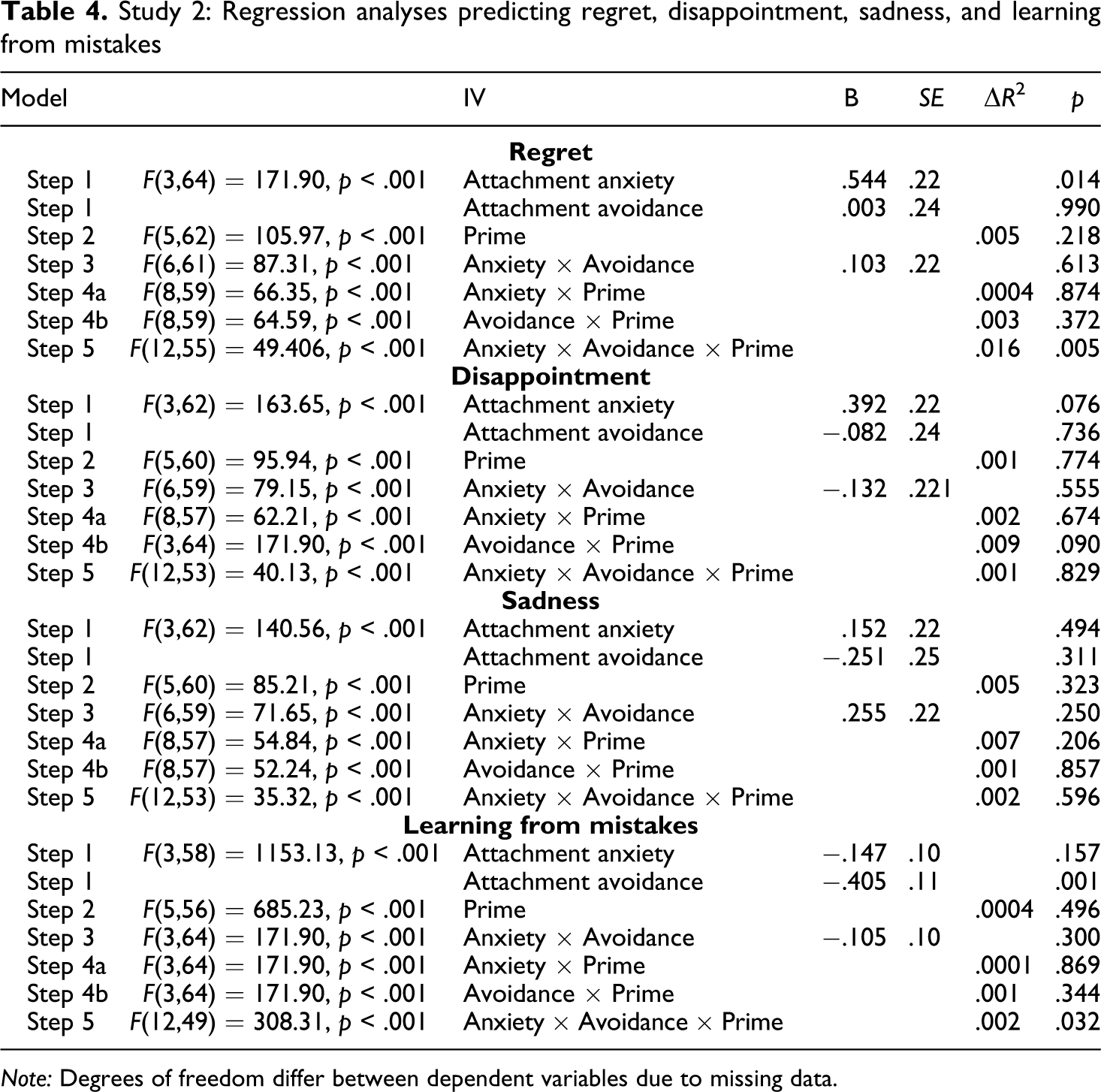
To test the combined effects of the attachment dimensions and security priming on level of regret, disappointment, sadness, and learning from mistakes we conducted four multiple regression analyses – one per each dependent variable. In the first step of each regression analysis, attachment anxiety and avoidance were mean centered and entered (step 1, Table 4). In the second step of each regression, we entered the priming condition, coded as two dummy variables (one representing security, coded as (1), with the positive and the neutral prime coded as (0), and another representing the positive prime, coded as (1), with the security and the neutral prime coded as (0)). The product terms representing the two-way interaction between avoidance and anxiety were entered in the third step (step 3). The product terms for interactions between anxiety and the prime were entered in the next step (step 4a). The product terms for the interaction between anxiety and the prime were then removed and the product terms for the interaction between avoidance and the prime were then entered (to assess the interaction of avoidance and the prime separately from the interaction of attachment anxiety and the prime, step 4b). The product terms for all two-way interactions were entered (step 5a) and then all product terms for the three-way interaction were entered in the final step (step 5b).
Study 2: Regression analyses predicting regret, disappointment, sadness, and learning from mistakes
Note: Degrees of freedom differ between dependent variables due to missing data.
Because interactions involving priming conditions consisted of two regression terms (one with each dummy variable), all interactions involving priming conditions were tested using a model comparison strategy based on the change in r2 (Δr2 ). We examined the change from the model without the interaction terms to the model consisting of the interaction terms. If the Δr2 was significantly different from zero, the model with the interaction terms explains more variance than the model without the interaction terms, and the interaction between priming (as two dummy variables), anxiety, and/or avoidance is significant (Cohen, Cohen, West & Aiken, 2003).
Regret
The regression analysis predicting regret revealed a three-way interaction between the priming condition, attachment avoidance, and attachment anxiety (see Table 4). To probe the interaction we used an online simple slopes calculator (Preacher, Curran, & Bauer, 2006) to calculate the effects of priming at high and low levels of avoidance and anxiety. We probed each interaction twice (the priming condition and all interaction terms were represented by two dummy coded variables, thus there were two three-way interaction variables to probe), once with an effects coded variable comparing the influence of the security priming (2) to positive (-1) and neutral primes (-1), and one in which the effects coded variable compared positive (1) and neutral primes (-1). Security priming reduced feelings of regret for participants high in anxiety and low in avoidance, but did not affect feelings of regret for other participants (Figure 1). There were no effects of condition when comparing the positive and neutral primes (all ps > .1).

Study 2: Three-way interaction between security prime, attachment anxiety, and attachment avoidance on regret.
Disappointment
The regression analysis predicting disappointment had no significant effects of attachment anxiety, avoidance, or priming condition, nor any interactions between attachment anxiety, avoidance, and condition (see Table 4).
Sadness
The regression analysis predicting sadness had no significant effects of attachment anxiety, avoidance, or priming condition, nor any interactions between attachment anxiety, avoidance, and condition (see Table 4).
Learning from mistakes
The regression analysis predicting learning from mistakes also revealed a three-way interaction between priming condition, attachment avoidance, and anxiety (see Table 4). We repeated the analytical procedure previously described. Security priming increased learning from regret for participants high in anxiety and high in avoidance, 4 and decreased feelings of learning from regret for participants high in avoidance but low in anxiety. Security priming did not affect learning from regret for other participants (Figure 2). There were no effects of condition when comparing the positive and neutral primes (all ps > .1).

Study 2: Three-way interaction between security prime, attachment anxiety, and attachment avoidance on learning from mistakes.
Discussion
Using examples of regret from participants’ own lives allowed us to investigate the associations between attachment style and relationship-related regret with greater realism. In addition to replicating Study 1 results showing a positive correlation between attachment anxiety and regret, Study 2 demonstrated that exposure to a security prime lessened feelings of relationship regret compared to exposure to a positive or neutral prime, especially among people who scored high on attachment anxiety and low on attachment avoidance (preoccupied individuals; Bartholomew & Horowitz, 1991). In addition, neither attachment avoidance, anxiety, security prime, nor any interactions predicted other negative emotions (sadness and disappointment) about past events.
Unlike Study 1, however, both attachment anxiety and avoidance influenced feelings of regret. In Study 2, we found no main effects of attachment avoidance. Furthermore, we found no evidence of an interaction between attachment anxiety and attachment avoidance by itself. Only when the security prime was introduced did attachment avoidance play a role. Thus, we are left to hypothesize that perhaps the security prime we used only affected individuals who were high on attachment anxiety and low on attachment avoidance, and perhaps a different method of security priming (e.g., subliminal) known to affect avoidant individuals would have resulted with similar main effects regardless of people’s levels of anxiety and avoidance.
Despite positive correlations between regret, disappointment, and sadness, neither measured nor manipulated attachment security had an effect on feelings of disappointment or sadness. In other words, when recalling past negative events, attachment security plays a specific role in feelings of regret but does not affect other negative emotions related to the event. Previous research has found that in general domains, regret and disappointment are two distinct emotions with different experiences and different behavioral tendencies (Zeelenberg et al., 1998). Regret is an emotion that is more focused on the role of the self; thus individuals high on attachment anxiety, who have a negative view of the self, were expected and indeed reported feeling more regret when recalling a past event. Likewise, increasing security, which presumably increases the accessibility of a positive model of the self, was expected and indeed decreased the tendency to feel regret, especially among anxiously attached people.
Exposure to the security prime had an additional beneficial effect. Not only did it lower the tendency for participants to feel regret about past events, but it was also associated with reporting negative events as an opportunity for learning for some participants. Specifically, exposure to a security prime led participants high on both attachment anxiety and avoidance (fearful avoidants; Bartholomew & Horowitz, 1991) to view mistakes as a greater opportunity for learning. Interestingly, exposure to a security prime led participants high on avoidance and low on attachment anxiety (dismissing avoidants; Bartholomew & Horowitz, 1991) to view mistakes less as an opportunity to learn. The effect of security priming on learning from regret for participants high on avoidance and low on attachment anxiety may be due to individuals high on avoidance and low on attachment anxiety having a different reaction to the security prime as compared with their nonavoidant counterparts. Previous studies have shown that security primes may actually cause avoidant individuals to feel worse (e.g., showing more hurt feelings; Cassidy, Shaver, Mikulincer, & Lavy, 2009), potentially disarming their defenses. Perhaps a similar effect occurred in this study, and while feeling worse, individuals high on avoidance and low on attachment anxiety were less likely to have positive growth experiences or view events as a potential for such an experience.
General discussion
Two studies investigated the associations between regret and dispositional, as well as manipulated, attachment security. Overall we found that individuals high on attachment anxiety were more likely to report feeling regret about past events. However, this was the case only when considering close relationships. Attachment anxiety (or avoidance) was not directly related to feelings of regret in non-relationship domains when the effects of general personality dimensions and mood were controlled for.
When exposed to a security prime, attachment anxiety and attachment avoidance interacted to predict feelings of regret. For people low on attachment avoidance and high on attachment anxiety, attachment security priming decreased the tendency to feel regret when considering current or past close relationships. Additionally, boosting the sense of attachment security eliminated the association between insecure attachment and decreased tendency to learn and grow from past mistakes for participants high on both attachment avoidance and anxiety (fearful avoidants; Bartholomew & Horowitz, 1991).
One explanation for the associations between attachment style and regret concerns emotion regulation and perceptions of outcomes of past events. Anxiously attached individuals are known to have a biased tendency to recall more negative memories than positive ones and to ruminate and be preoccupied with them (e.g., Mikulincer et al., 2003; Mikulincer & Orbach, 1995; Sutin & Gillath, 2009). This bias toward negative memories is likely to increase the tendency to perceive past events as negative and in turn increase feelings of regret. Although we were unable to test this hypothesis directly in the current study, our findings provide preliminary evidence for this claim.
General regret
The current research provides further insight into the understanding of general regret and the effects of personality on its occurrence and experience. Most previous studies on regret have focused on the effects of the situation or the content of regret on feelings of regret. There has been less work on the way personality influences regret, especially within close relationships (e.g., Pierro et al., 2008). Across both current studies, we found consistent evidence for the impact of personality variables. General personality traits (neuroticism) and mood (negative affect) were found to affect the tendency to feel general regret (Study 1), whereas attachment anxiety had an effect on regret in a domain related to attachment style – close relationships. This suggests that the specific effects of personality on regret may depend on the domain of the event that led to feelings of regret.
Relationship regret
Research on regret in close relationships has been rather limited and lacks a guiding unifying theoretical framework. The current studies provide such a framework, leading the way for others to explore the issue further. Future research should further investigate the associations found in the current study between regret and attachment style, incorporating aspects of existing regret theories. For example, the finding that attachment anxiety is positively related to relationship regret can be interpreted based on Consistency Fit Theory (Seta, McElroy, & Seta, 2001) as the result of anxiously attached individuals viewing their past decisions as inconsistent with their personalities and relationship schemas. Such inconsistencies are in line with recent findings showing anxiously attached people to be more ambivalent about their decisions and behavior (Mikulincer, Shaver, Bar-On, & Ein-Dor, 2010). A different interpretation based on Decision Justification Theory (Connolly & Zeelenberg, 2002) may suggest that anxiously attached individuals view their past decisions as poorly made and this, in turn, makes them more likely to feel regret. Conversely, securely attached individuals view past decisions as correct or positive and thus are likely to feel less regret. Future studies should further disentangle the intersection of attachment theory and regret theories. Are the associations between attachment style and regret best explained by the inconsistency between the past and present, or perception of past decisions as good or bad?
Learning from mistakes
One of the proposed functions of regret is to help people learn from their mistakes (Epstude & Roese, 2008). In Study 2, we attempted to investigate the association between attachment style and learning from past mistakes. Consistent with previous theorizing, learning from mistakes was positively correlated with feelings of regret. However, attachment anxiety, avoidance, and security priming had different effects on learning from mistakes and feelings of regret. For participants high on attachment anxiety and avoidance, the security prime increased feelings of learning from regret. Conversely, feelings of security decreased learning from regret for participants high on attachment avoidance and low on attachment anxiety (dismissing avoidants; Bartholomew & Horowitz, 1991). One explanation for the different results concerning regret (effects mainly for preoccupied) and those concerning learning from mistakes (dismissing and fearful) has to do with differences in question wording. The regret item asked about a specific regret (relevant mainly for preoccupied people), whereas the learning from regret item asked about a general tendency to learn from mistakes. This generalized format had potentially greater relevance for avoidantly attached people – leading to the findings among fearful avoidants and dismissing avoidants (both high on avoidance).
An alternative explanation for this difference comes from the lost opportunity principle of regret (Beike, Markman, & Karadogan, 2009). The lost opportunity principle of regret states that people regret past events that they cannot change in the future. In accordance with this principle, participants high in avoidance and low in anxiety may have recalled regrets that cannot be changed in the future. If this was the case they could not learn from these regrets, and a sense of security may have encouraged these participants to stop trying to learn from the past and “move on”. The positive association between attachment avoidance and the tendency to recall regrets about the end of a relationship found in Study 2 provides some evidence for the first part of this hypothesis (attachment avoidance predicts regrets related to events that are perceived to be unchangeable, such as relationship termination).
The second part of this hypothesis, however, was not supported by our data (the topic of regret influences ratings of regret). However, using relationship termination as an unchangeable event is not a perfect test of the lost opportunity principle of regret. Even if a relationship has ended, there remains a chance that the partners would get back together (as is often the case with anxiously attached people; e.g., Davis et al., 2003; Dutton, Winstead, & Mongeau, 2006). Thus, future research should more closely investigate how the topics of regret differs as a function of attachment style and how the topic of relationship regret affects feelings of regret and learning from mistakes. Furthermore, most studies of regret have not investigated how the factors that predict regret (e.g., consistency of past behaviors) impact learning from past mistakes. Future research should consider the interplay between predictors of regret, the experience of regret, and learning from past mistakes.
Limitations
There are a few limitations to our studies. The participants in the current studies were predominantly college undergraduates, especially in Study 2 (all undergraduates); this may have influenced the relationship-related regrets they could recall. As people age, they have more opportunities to encounter unfavorable relationship outcomes and are more likely to have to deal with the consequences of these outcomes. We did not find an effect of age in Study 1; however, the majority of participants in this study were undergraduate students and we might have lacked sufficient variability to detect an effect of age on regret. Furthermore, as people age, the topics of their regrets may change (e.g., Gilovich & Medvec, 1994). Younger people are more likely to regret past actions whereas older people are more likely to regret past inactions. Future studies should look at the effects of age on the associations between attachment style and regret.
Another limitation had to do with our reliance on self-report measures to operationalize all of the key constructs under investigation. This made our findings more vulnerable to response bias distortions as well as to mono-method bias. In addition, in Study 2 we used a single item to measure regret. Although multiple-item measures may have better reliability, other researchers have used single-item measures successfully (e.g., Seta et al., 2001). Another limitation has to do with our measure of learning from regret, which, unlike other measures in Study 2, was not focused on a relationship context.
Lastly, the effect sizes associated with the significant interactions of prime and adult attachment orientations on regret were small, although typical in psychology (Frazier, Tix, & Barron, 2004). For these reasons, future studies exploring the interface of regret and adult attachment orientations would do well to gather larger (and more gender-balanced) samples, use prospective designs capable of tracking regret across multiple time points, use multiple items to assess regret, include relationship focused measures of learning from regret, and include both self-report and independent assessments of participants’ regret (e.g., reports from parents, roommate, and/or intimate partners).
Conclusion
Despite the abovementioned limitations, the current studies provide a coherent picture of the associations between attachment style and regret within close relationships. Furthermore, our studies suggest ways to minimize the negative feelings of regret (especially if one is preoccupied) and enhance the ability to learn from past mistakes and encourage growth – by enhancing the sense of security (as long as one is not dismissive). This adds to the “broaden and build” model of security (positive emotions, such as security, broaden an individual’s momentary thought–action repertoire) suggested by Fredrickson (2004) and Mikulincer and Shaver (2007b) and advances the regret literature by shedding light on regret’s underlying mechanisms.
Footnotes
Acknowledgements
Both first and second authors contributed equally to the preparation of the manuscript. We would like to thank Jeff Friedrich and Stephanie Wallio for their comments on an earlier draft of this article.
Funding
This research received no specific grant from any funding agency in the public, commercial, or not-for-profit sectors.