



Abstract
The present study examined friendship rules on the online social networking site Facebook. Study 1 used focus group data to inductively create a list of 36 Facebook friendship rules. Study 2 utilized survey data to examine college students’ endorsement of the various rules in close, casual, and acquaintance friendships. Results indicated five categories of Facebook friendship rules, which included rules regarding communication channels, deception and control, relational maintenance, negative consequences for the self, and negative consequences for a friend. Additionally, close friends, casual friends, and acquaintances significantly differed in their endorsement of four of the five rules categories. Results suggested that interaction rules provide a useful framework for the study of online social networking sites.
Interaction rules guide social encounters by dictating tacit yet salient behavioral norms (Argyle & Henderson, 1984; Harre & Secord, 1972). The existence of interaction rules is commonly accepted by relationship researchers, yet receives relatively little focused attention. Indeed, the majority of research utilizing an interaction rules approach was conducted by a single group of researchers (i.e., Argyle, Henderson, and colleagues) during the 1980s. Existing research has examined the presence of interaction rules in 22 different contexts (Argyle, Henderson, & Furnham, 1985), with specific studies focusing on friendship (Argyle & Henderson, 1984), virtual work groups (Walther & Bunz, 2005), and teacher-student relationships (Henderson & Argyle, 1984). Additionally, Kline and Stafford (2004) examined marital relationships and found that compared to quantity of interaction, interaction rules were a more salient predictor of trust, liking, and satisfaction. In fact, interaction rules accounted for 51% of the variance in their composite marital satisfaction index. Interaction rules might, therefore, be an important aspect of communication in numerous relational contexts.
Friendships are the most common social relationship (Blieszner & Adams, 1992), and are likely governed by a specific set of interaction rules (i.e., friendship rules). Argyle and Henderson (1984) established the existence and prevalence of various offline friendship rules; however, the topic deserves to be reconsidered within the context of computer-mediated communication. Tools such as social networking sites are used to perform important relational tasks (e.g., initiation, maintenance, and identity management), but might alter the ways in which individuals enact said tasks (Bryant, Marmo, & Ramirez, 2011). As such, friends might expect different behaviors during online interactions than during offline interactions.
The present study explores the topic of friendship rules as they occur on the social networking site known as Facebook. As of May 2011, Facebook is the world’s most popular social networking site, with more than 800 million active users (Facebook.com), who primarily employ the site for social purposes such as maintaining a network of offline relationships (Bryant & Marmo, 2010; Tong & Walther, 2011). Although Facebook interactions typically occur between partners with an offline relationship (Ellison, Steinfield, & Lampe, 2007), the site’s mediated and semi-public nature might lead users to follow a unique set of interaction rules. The present manuscript examines Facebook interaction rules via two studies that explore and empirically test Facebook friendship rules in close, casual, and acquaintance friendships.
Review of literature
Social interaction rules
Patterns in social behavior can be partially explained by the presence of interaction rules (Argyle & Henderson, 1984). Interaction rules prescribe the implicit behavioral norms that allow individuals to engage in efficient and cooperative social interaction. Specifically, interaction rules dictate standards of behavior, reward exchange, and cooperation within dyads and groups. Hence, interaction rules represent the set of behaviors that society members agree should be performed or avoided in order to optimize social efficiency (Henderson & Argyle, 1986).
Interaction rules also serve a relational maintenance function by helping individuals identify social obligations and perform behaviors consistent with their relationship type. According to Henderson and Argyle (1986), “rules provide the framework in which the relationship is given stability, by regulating potential sources of conflict that might disrupt the relationship” (p. 266). The violation of interaction rules is associated with the dissolution of friendships (Argyle & Henderson, 1984) and dissatisfaction in workplace relationships (Henderson & Argyle, 1986). Conversely, marital relationship quality is linked with adherence to relational rules (Kline & Stafford, 2004). Hence, interaction rules hold great potential as predictors of relational outcomes in numerous contexts, such as friendship.
Friendships are one of the few relationship forms to receive focused examination using an interaction rules approach. Argyle and Henderson (1984) suggest that friendship rules help individuals identify the behavioral expectations that enable them to avoid conflict and sustain their friendships. The authors conclude that friendship rules exist in four categories: rules about sustaining or signaling intimacy (e.g., self-disclosure, discussion of personal topics, expression of anger/anxiety, and trust), rules about the proper exchange of rewards (e.g., repaying debts, emotional support, and volunteering help), rules regulating potential dyadic conflict (e.g., teasing and respecting privacy), and rules regulating potential sources of third party conflict (e.g., jealousy and tolerance of each other’s friends). In the same study, six particular friendship rules were labeled as most salient: standing up for a friend in his/her absence, sharing news of success, showing emotional support, trusting and confiding in each other, volunteering to help in a time of need, and striving to be pleasurable company. Enacting behaviors consistent with these rules should help individuals sustain their friendships, increase their access to tangible aid, deepen their information networks, and enhance their sense of social integration.
In sum, interaction rules guide proper behavior between relational partners. Each relationship form, however, possesses properties that distinguish it from other types of relationships. Friends, for example, might be expected to adhere to different rules than coworkers or romantic partners. Moreover, the quality and the nature of a friendship might be inferred based on the extent to which partners are willing to exert effort to follow friendship rules (Argyle & Henderson, 1984). It is, therefore, important to consider not only how friends differ from other forms of relationships, but also how interaction rules might function differently within various types of friendship.
Friendship
Friendship is “a relationship involving voluntary or unconstrained interaction in which the participants respond to one another personalistically” (Lea, 1989, p. 278). Friendships are the most prevalent type of social relationship (Blieszner & Adams, 1992), and fulfill important personal needs such as inclusion (Baumeister & Leary, 1995), affection (Floyd et al., 2005), and identity affirmation (Wright, 1984). Additionally, friends are expected to engage in joint activities (Argyle & Furnham, 1983) and are sources of consideration (e.g., showing concern and providing assistance), communication (e.g., self-disclosure and discussion), and affection (e.g., expressing sentiment and emotional bonds) (Hays, 1984).
Friendships are also voluntary and lack the genetic and institutional ties that may exist in many romantic and family relationships. As such, many researchers assert that friendships experience less interdependence (Berscheid, Snyder, & Omoto, 1989) and are somewhat fragile (Wiseman, 1986). Other researchers, however, suggest that the voluntary nature of friendships enables flexibility in which friends can adapt to life events by increasing or decreasing closeness in ways that sustain the relationship (Becker et al., 2009). Although these conceptualizations of friendship differ, both imply that friendships are dynamic and must be managed over time. Friendship rules provide a guide for friends to manage and sustain their relationship, yet the exact pattern of rules likely varies depending on the nature of the friendship.
Types of friendship
Friendships can be negotiated and sustained at various levels. Indeed, Hays (1988) notes that the term “friend” might actually represent a number of different friendship types that vary in regard to relationship strength and quality. Interpersonal interaction quality is associated with the type of relationship shared by two individuals (Baym, Zhang, & Lin, 2004), so it is useful to conceptualize friendship as occurring in close, casual, and acquaintance forms.
Close friendships involve high levels of interaction, self-disclosure, intimacy, involvement, and interdependence (Kelley et al., 1983; Sillars & Scott, 1983). Close friendships require positive mutual perceptions (Rawlins, 1984) and are often associated with phrases such as “love, trust, commitment, caring, stability, attachment, one-ness, meaningful, and significant” (Berscheid & Peplau, 1983, p. 12). Close friends cannot be easily replaced because they experience more shared benefits and interdependence Boase, Horrigan, Wellman, & Rainie, 2006; Hays, 1989, and provide intense emotional support (Wellman & Wortly, 1990). As with many strong social ties, close friends often adopt a communal focus by prioritizing long-term affect exchange over the direct exchange of tangible benefits (Mills & Clark, 1982). Hence, close friends are deeply invested in each other’s individual happiness, value their relationship, and work towards achieving joint goals (Wright, 1984). The presence of intimacy and interdependence appears to make close friendship more resilient to relational transgressions (Hays, 1989), such as rule breaking.
Casual friendships exist between people who are in the early stages of relationship development and have not yet achieved the intimacy, closeness, and communal bonds present in close friendships. Casual friends engage in joint activities and possess low to moderate levels of closeness, yet typically avoid disclosing extremely intimate information (Berger & Roloff, 1982). Casual friendships are governed by rules of exchange in which partners expect a direct and immediate reciprocation of social support and other relational benefits (Mills & Clark, 1982), and tend to be less forgiving of relational transgressions than close friends (Hays, 1989). Despite their more superficial nature, casual friendships serve an important role in the accumulation of social capital and are therefore beneficial to maintain.
Casual friendships might be further separated from acquaintance relationships. These relationships are often treated as synonymous; however, important distinctions exist. As noted by Jehn and Shah (1997), “relationships exist on a continuum of intimacy” (p. 776). Close friendships fall on one end of the spectrum and involve high levels of interaction and intimacy. Casual friendships lie in the middle of the spectrum because they involve personal interaction and social support, yet lack the extreme intimacy present in close friendships. Acquaintance relationships fall on the opposite end of the spectrum and involve individuals who vaguely know each other, yet rarely interact and experience little or no sense of intimacy. Indeed, acquaintances know each other from casual social encounters, yet lack a sense of personal connection and shared relational history (Jehn & Shah, 1997). Additionally, acquaintance relationships involve low levels of intimacy and relational quality (Baym, Zhang, Kunkel, Ledbetter, & Lin, 2007), because partners know very little about each other and exchange little or no social support.
Some people might be hesitant to label acquaintances as friends; however, weak ties such as acquaintances help individuals broaden their social networks (Fischer, 1982; Wuthnow, 1998) and accumulate social capital (Hays, 1989; Kavanagh, Rees, Carroll, & Rosson, 2003). Moreover, social networking sites such as Facebook prominently display the many acquaintances in users’ offline social networks and label these individuals as “friends” (Ellison et al., 2007). Hence, an analysis of Facebook friendship should include acquaintance relationships as a distinct form of friendship that is becoming increasingly prevalent now that individuals possess an easy venue in which to articulate and interact with these weak relational ties.
Social networking sites such as Facebook have become extremely popular venues for relational communication, particularly amongst friends (Lampe, Ellison, & Steinfield, 2006; Ellison et al, 2007). As defined by boyd and Ellison (2007), SNSs are web-based services that allow individuals to (1) construct a public or semi-public profile within a bounded system, (2) articulate a list of other users with whom they share a connection, and (3) view and traverse their list of connections and those made by others within the system.
Facebook currently reigns as the world’s most popular SNS and is the world’s second most trafficked Internet site (Alexa.com, December 2011). A growing body of research has examined Facebook in relation to social capital (Ellison et al., 2007), profile components (Lampe et al., 2007), the warranting value of photos (Walther, Van Der Heide, Hamel, & Shulman, 2009), uncertainty reduction (Sanders, 2008), relational maintenance (Bryant & Marmo, 2010), and impressions (Tong, Van Der Heide, Langwell, & Walther, 2008). These studies provide great insight regarding the reasons and ways that Facebook users employ the site, but do not aim to interrogate the presence of rule-driven behavioral norms on Facebook. Friendship rules provide a guide for Facebook friends to manage and sustain their relationship, yet the exact pattern of Facebook rules is likely to vary depending on the nature of the friendship.
Facebook interaction represents an offline to online communication trend (Ross et al., 2009) in which users form Facebook networks to interact with members of their existing offline social network (Gross & Acquisti, 2005, Lampe et al., 2006). Indeed, users report using the site to look up people they had lost touch with and maintain contact with members of their social network (Joinson, 2008). Focus group participants in Bryant and Marmo’s (2010) study described the nature of their relationship with various Facebook friends. Participants acknowledged that their networks included a small number of family members, romantic partners, coworkers, and teachers; however, they claimed that most of their Facebook network consisted of various forms of friendships. Indeed, participants labeled close friends as the small number of individuals whom they considered very close or best friends, and interact with using numerous channels of communication (e.g., face-to-face, telephone, email, Facebook). Casual friends were labeled as real friends with whom participants interact with outside of Facebook, yet without intimacy or extreme closeness. Finally, acquaintances were described as the extremely large number of people whom participants had met once or twice offline but whose interaction was primarily limited to passive Facebook use such as monitoring each other’s profile updates.
The present study will employ these definitions of close, casual, and acquaintance Facebook friendships, and attempt to decipher whether the type of Facebook friendship affects the degree to which individuals endorse various interaction rules. Traditional definitions state that friendship requires unconstrained interaction between partners (Lea, 1989). Interestingly, Facebook enables various forms of friendship that may or may not meet this requirement. For example, close and casual friends might be labeled as legitimate friends whose relationship transcends various channels of communication, whereas acquaintances might be a more tenuous and constrained relationship in which partners interact primarily through Facebook unless their offline activities produce a chance encounter.
In sum, Facebook users must attempt to negotiate friendships of varying levels of closeness using mediated interaction, and might therefore come to understand a distinct set of Facebook friendship rules. Focused attention is necessary to identify the rules of Facebook friendship because said rules might diverge from existing research in key ways. Notably, Argyle and Henderson’s (1984) rules of friendship were created to describe good offline friendships, or friendships of an entirely lapsed nature (i.e. formerly good but currently out of touch). Facebook users might come to hold a different set of behavioral expectations because they simultaneously use the site to manage friendships of a close, casual, and acquaintance nature. The diversity of relationships present on the venue therefore suggests a more complex structure of rules.
Additionally, Facebook interaction is a form of mediated communication that provides users with an array of asynchronous and nearly synchronous communication options. Asynchronous Facebook components (e.g., wall posts and private messages) allow users to interact free of time constraints, whereas nearly synchronous components (e.g., chat) provide a way for users to hold a real-time conversation. The use of synchronous communication may afford close friends a sense of immediacy, yet could also be viewed as inappropriate given the lack of intimacy in acquaintance relationships. Moreover, Facebook users can choose to use components of a public (e.g., wall posts and photo comments) or private (e.g., private messages and chat) nature. The use of public communication can help solidify a friendship, yet also can raise many problems if a friend communicates in a potentially risky manner with which others would not wish to be associated. As such, Facebook users likely possess unspoken behavioral codes regarding the appropriate use of synchronous/asynchronous and public/private Facebook communication tools in various types of friendships.
In sum, friendship rules serve as a guide for proper behavior (Argyle & Henderson, 1984), so an understanding of these rules should provide important insight regarding the shared set of behavioral expectations for various types of Facebook friends. Hence, Study 1 explores the existence of a set of Facebook friendship rules by asking the following question: RQ1: What rules of Facebook friendship are salient among college students?
Study 1
Rather than applying Argyle and Henderson’s (1984) friendship rules to Facebook, the present study mimicked their methodology to inductively develop and then empirically test a list of Facebook specific friendship rules. Argyle and Henderson (1984) explain that when examining interaction rules, “an important part of the procedure is the construction of a list of potential rules, like hypotheses to be tested” (p. 212). These authors conducted six pilot interviews to construct their list of friendship rules, and then used a series of surveys to test hypotheses and determine endorsement of each rule. They claimed that the inductive development and deductive examination of rules are both essential methodological steps to ensure that researchers do not create a set of rules that possess little practical importance.
The present study follows suit by first developing and then testing a list of Facebook friendship rules. Although Argyle and Henderson used pilot interviews to develop their list of friendship rules, the present study utilized focus groups. Friendship rules represent a set of shared beliefs regarding norms of proper behavior, so use of focus groups allowed the researchers to explore the beliefs of a larger number of Facebook users while also determining whether group members agreed upon a suggested rule.
Methods
Participants
Participants were recruited from lower division communication courses at a large Southwest university. The sample consisted of 44 students (23 men and 21 women) ranging from 19 to 24 years of age (M = 20.2 years). Participants described themselves as Caucasian (n = 34), Asian/Pacific Islander (n = 3), Hispanic (n = 1), Native American (n = 1), and “other” (n = 5). Using open-ended questions, participants reported possessing an average of 200 Facebook friends and spending 38.4 minutes per day on Facebook.
Procedures
A total of six focus groups (two all-male, two all-female, and two mixed-sex) were conducted at an on-campus location. The biological sex composition of groups was manipulated to ensure relatively equal representation of male and female viewpoints, and provide a variety of contexts in which participants might be more or less willing to discuss particular rules. Focus groups lasted 45–60 minutes and were audio-recorded and transcribed to produce 83 pages of single-spaced data. All study procedures received approval from the university’s Office of Research Integrity and Assurance.
A semi-structured protocol was used to ensure that all groups remained focused on a similar set of questions, yet allow flexibility to reflect group synergy and individual participant experiences (Tracy, Lutgen-Sandvik, & Alberts, 2006). The researchers began by explaining that rules are prescriptions for social behavior that dictate what people should or should not do. Participants were then asked to brainstorm a list of rules that might govern Facebook interaction. Other prompts included “How did you come to know these rules?” “Do you think everyone understands these rules?” and “Which rules do you think are most important?” Focus groups tend to produce a cascading effect in which each comment stimulates further ideas and directs group discussion (Lindlof & Taylor, 2002). As a result, impromptu follow-up prompts were used as necessary to probe interesting discussion points that surfaced in each focus group and encourage participants to signal whether they agreed with each other’s rules. At the conclusion of the session, participants were asked to individually complete a short demographic questionnaire assessing their biological sex, age, ethnicity, number of Facebook friends, and time spent on Facebook on an average day.
Data analysis and results
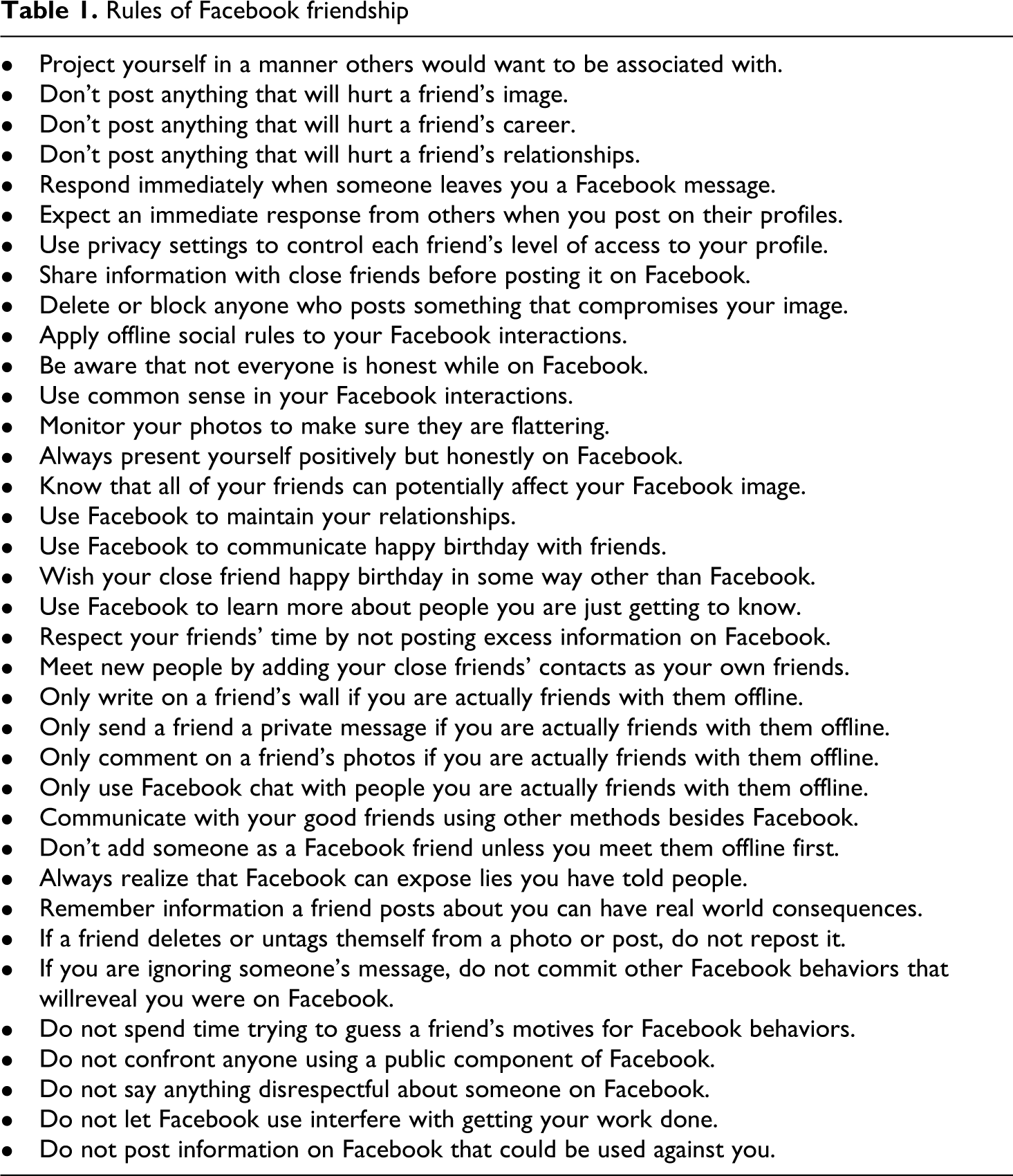
The data were concurrently analyzed and coded to reveal 138 Facebook rules. Similar rules were then condensed (e.g., “don’t post unflattering photos of a friend”, “don’t post photos where a friend looks ugly”, and “don’t post obnoxious photos of people” were condensed into “don’t post unflattering photos”). Finally, rules that did not receive relative agreement in at least two focus groups were removed to ensure that the list of rules represents potentially normative behavioral prescriptions. The resulting list of 36 rules (see Table 1) represents a comprehensive understanding of the Facebook friendship rules that surfaced in Study 1.
Rules of Facebook friendship
Study 2
Study 1 provided a list of Facebook friendship rules; however, the use of focus group data made it difficult to quantify participants’ endorsement of each rule. For example, the researchers were able to note that participants generally nodded or offered agreement when a rule was mentioned; however, individuals were not required to verbalize or quantify their thoughts on each rule. A second study was conducted to address this limitation and empirically examine: RQ2: Which rules of Facebook friendship are the most important?
Additionally, the list of Facebook friendship rules presented in Study 1 did not address the possibility that certain rules group together. For example, Argyle and Henderson (1984) found that many friendship rules exist, yet they can be accurately classified into categories such as rules regarding intimacy, the exchange of rewards, dyadic conflict, and third party conflict. Hence, Study 2 examined the factor structure of Facebook friendship rules by asking: RQ3: Are there distinct categories of Facebook friendship rules?
Finally, Argyle and Henderson (1984) found that friendship rules function differently in good friendships as opposed to lapsed friendships (i.e., a formally good friendship that deteriorated). Participants, however, only reported on a same-sex individual that was at some point considered a good or close friend. As previously suggested, Facebook users are likely to maintain large networks composed of primarily weaker social ties. Hence, the present study expands on the notion of intimacy by examining Facebook rules in close, casual, and acquaintance friendships.
The endorsement of Facebook friendship rules likely varies within specific forms of friendship. However, conflicting predictions might be made regarding the nature of these differences. For example, acquaintances and casual friends might realize their relationship is not durable enough to survive a transgression (Hays, 1989), and therefore be more cognizant of Facebook friendship rules. Conversely, users might be more willing to ignore friendship rules when they lack any investment towards a communal relationship. Indeed, the intimacy present within close friendships might lead partners to hold each other to higher standards regarding the Facebook rule adherence. Still, close friends likely interact outside of Facebook, and might therefore place more importance in offline friendship rules (see Argyle & Henderson, 1984) and care very little about their Facebook interactions (Bryant & Marmo, 2010). Given the potentially contradictory predictions, the present study proposed the following question: RQ4: How do acquaintances, casual friends, and close friends differ in their endorsement of Facebook friendship rules?
Methods
Participants and procedures
Initial sample
Participants were recruited from undergraduate classes at a large Southwestern university and received extra credit for their participation in an online survey. Individuals who did not complete the entire questionnaire or who took less than five minutes to complete the questionnaire were dropped from the sample in order to maintain the integrity of the data set. A total of 801 participants (321 men and 477 women) were retained in the sample after applying this inclusion rule. Ages ranged from 18 to 52 years (M = 20.3 years, SD = 2.48), and participants described themselves as Caucasian (n = 627), Hispanic (n = 96), Asian/Pacific Islander (n = 53), African American (n = 27), Native American (n = 7), and “other” (n = 30).
A quasi-experimental design was used to randomly assign participants to one of three groups (acquaintance, casual friendship, or close friendship) based on participants’ birth month. Participants were provided with a definition of their assigned friendship type and were then directed to think of a Facebook friend who fit that definition (e.g., “please think of a Facebook friend who is an acquaintance.”) An acquaintance was defined as “a person whom you have met before, yet do not regularly interact with.” A casual friend was described as “a member of your offline social circle; in other words, someone who you hang out with but is not one of your best friends.” Finally, a close friend was defined as “someone you consider one of your best friends.” Using this design, 34.21% of the sample (n = 274) reported on an acquaintance relationship, 32.46% (n = 260) reported on a casual friendship, and 33.33% (n = 267) reported on a close friendship that exists on Facebook.
Manipulation check
A manipulation check was conducted to ensure that the assignment of friendship type led participants to identify a relationship with an appropriate level of closeness. Aron, Aron, and Smolan’s (1992) Inclusion of Other in the Self (IOS) measure was used as an indicator of relational closeness. The IOS measure consists of seven Venn diagrams in which two overarching circles (one circle labeled “self” and a second circle labeled “other”) are changed to display an increasing amount of overlap. Participants were asked to indicate which diagram best reflects their relationship, with a lower score signaling less relational closeness and a higher score reflecting greater relational closeness. Respondents were expected to display less relational closeness with acquaintances than with casual friends, and less relational closeness with casual friends than with close friends.
The manipulation was examined through a one-way ANOVA with friendship type (acquaintance, casual, and close friendship) as the between-subjects factor and relational closeness as the dependent variable. Levene’s test showed that the assumption of homoscedasticity was tenable, F(2, 798) = 1.5, p = .22. The ANOVA revealed a significant main effect, F(2, 798) = 259.85 p < .001, partial η2 = .39; in which acquaintances (M = 2.63, SD = 1.51) reported less closeness than casual friends (M = 3.55, SD = 1.39), who reported less closeness than close friends (M = 5.37, SD = 1.82).
Although the ANOVA was significant, the effect size was smaller than expected. Hence, the sample was filtered to remove participants who did not indicate a level of relational closeness consistent with conceptual expectations for each relationship type (acquaintances = closeness score between 1 and 3, casual friend = closeness score between 3 and 5, close friend = closeness score between 5 and 7). A small degree of category overlap was allowed because people might naturally possess slightly different conceptualizations of closeness within close, casual and acquaintance relationships. A total of 208 participants were removed (64 acquaintances, 80 casual friends, and 64 close friends), leaving a final sample of 593 participants.
The manipulation check was repeated with the filtered sample and the one-way ANOVA revealed a significant main effect for friendship type, F(2, 590) = 1431.77, p < .001, partial η2 = .83. Levene’s test was F(2, 590) = .45, p = .64; indicating that the assumption of homogeneity was tenable. A planned contrast (contrast coefficients: −3, 1, and 2) was run and revealed a significant linear relationship, t(590) = 50.60, p < .001. Close friends (M = 5.95, SD = .79) reported more closeness than casual friends (M = 3.87, SD = .75), who reported more closeness than acquaintances (M = 1.92, SD = .76). The increased effect size indicated that the filtered sample should be used to remove potential error from the study and ensure that the three friendship categories reflect empirically distinguishable levels of relational closeness.
Final sample
The final sample consisted of 593 participants (264 men and 329 women) ranging from 18 to 52 years of age (M = 20.34, SD = 2.65). There were 114 freshmen, 164 sophomores, 146 juniors, and 166 seniors, with three participants omitting the question. The sample was 80.6% Caucasian (n = 478), 11% Hispanic (n = 65), 5.7% Asian/Pacific Islander (n = 34), 2.9% African American (n = 17), 1% Native American (n = 6), and 3.7% other (n = 22); however, these numbers reveal that numerous participants selected multiple categories as applicable. Participants were also asked to reveal basic information about their Facebook activity using a set of categorical measures. The mode scores reveal that on average, participants reported being Facebook members for two to three years and possessing 201-300 Facebook friends. Additionally, participants log onto Facebook three to four times per day and spend 21-30 minutes per day on the site.
Participants were asked to respond to the questionnaire based on their relationship with a specific Facebook friend. Of the final sample, 35.1% (n = 208) reported on an acquaintance, 30% (n = 178) reported on a casual friend, and 34.9% (n =207) reported on a close friend. Participants reported on 263 male friends and 329 female friends, and had known their friend for an average of four years and three months.
Measures
Dependent measures
The questionnaire asked participants to signal their level of agreement that each of the 36 rules developed in Study 1 should be followed during Facebook behavior with their designated close friend, casual friend, or acquaintance. Rules were rephrased so that they applied to interactions with a single Facebook friend in mind. For example, “I should project myself in a manner others would want to associate with” became “I should project myself in a manner with which this person would want to be associated.” Responses were measured using a seven-point Likert-type scale (1 = strongly disagree, 7 = strongly agree).
Covariate
Individuals might gain a different sense of Facebook friendship rules depending on the intensity of their Facebook use. Hence, the Facebook Intensity Scale (Bryant & Brody, 2010) was used as a covariate in analysis of the research questions. The Facebook Intensity Scale was originally adapted from Ellison et al. (2007) and consisted of six items measured on a five-point Likert scale (1 = disagree, 5 = agree): “Facebook is part of my daily routine,” “I would be sorry if Facebook shut down,” “I feel out of touch when I haven’t logged on to Facebook in a while,” “Most of my friends are on Facebook,” “Facebook is important in how I manage my social life,” “Facebook is important in how I gain information about campus activities,” “Facebook is important in how I stay in touch with my friends,” and “Facebook is an important communication tool for me and my friends.” A reliability analysis was conducted and revealed a Cronbach’s alpha of .89.
Results
Research question 2
RQ2 asked which Facebook friendship rules are most important. To examine this question mean scores were calculated for each of the 36 rules, with a higher mean score indicating greater rule endorsement (see Table 2). Analysis did not distinguish between friendship types and therefore reflects the overall salience of individual rules.
Summary statistics for Facebook friendship rules
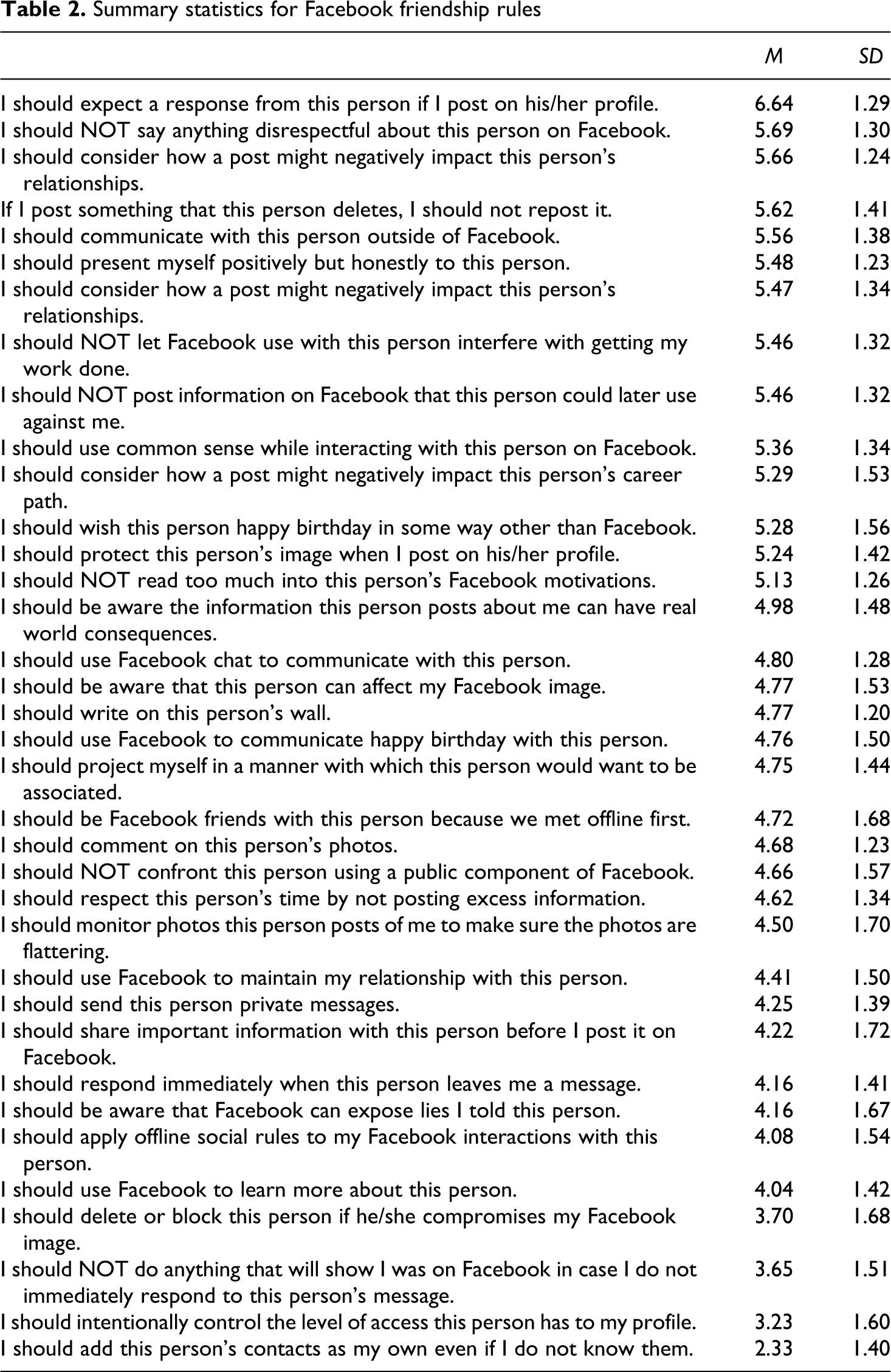
Fourteen rules received mean scores of five or greater, indicating that the average participant agreed that the rule should be followed in their friendship. The five most important rules were “I should expect a response from this person if I post on his/her profile”, “I should not say anything disrespectful about this person on Facebook”, “I should consider how a post might negatively impact this person’s relationships”, “If I post something that this person deletes, I should not repost it”, and “I should communicate with this person outside of Facebook”. A total of four rules received mean scores of three or less, indicating that the average participant disagreed that the rule should be followed in their friendship: “I should delete or block this person if he/she compromises my Facebook image”, “I should not do anything that will show I was on Facebook in case I do not immediately respond to this person’s message”, “I should intentionally control the level of access this person has to my profile”, and “I should add this person’s contacts as my own even if I do not know them”.
Research question 3
RQ3 asked whether distinct categories of Facebook rules exist. A principle components exploratory factor analysis with Oblimin rotation was used to explore the underlying empirical factor structure of the 36 Facebook rules. The Kaiser–Meyer–Olkin (KMO) test and Bartlett’s test of sphericity were significant, KMO = .80, χ2(171) = 3866.12, p < .001; indicating enough multicollinearity existed to conduct the factor analysis. The initial analysis suggested an eight-factor solution with eigenvalues of one or greater, yet Cattell’s scree test revealed a significant “drop-off” of eigenvalues after five factors. Hence, the analysis was rerun with a forced five-factor solution. A 60/40 selection criterion was used to retain items with primary loadings of .60 or above, and secondary loadings of .40 or less. Items that did not fit this criterion were dropped and the analysis was rerun to reveal the final five-factor solution, which was both empirically and conceptually sound (see Table 3). Standardized factor scores were calculated for each of the five factors to be used in subsequent analyses.
Factor loading for Facebook rules
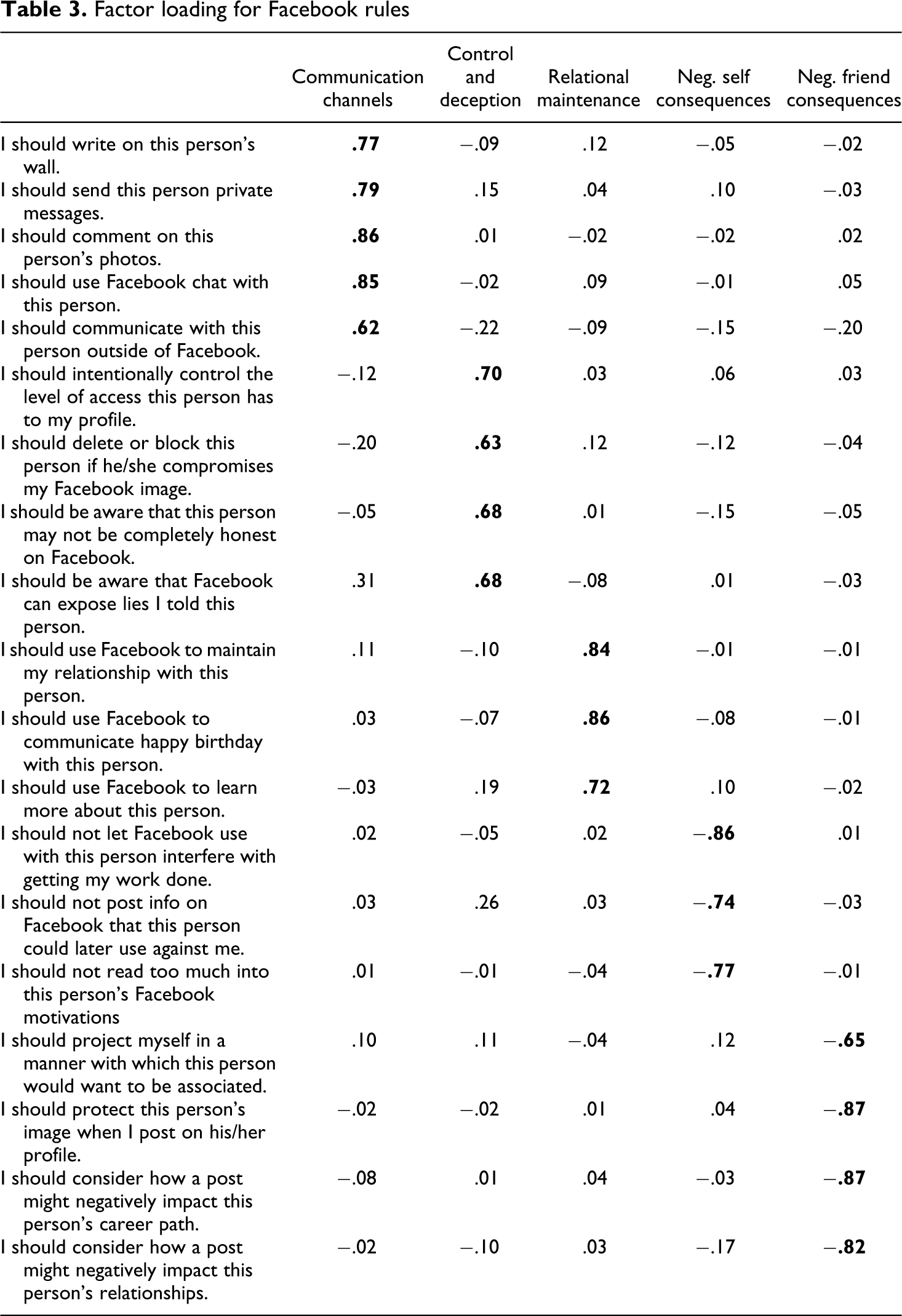
In response to RQ3, the five factors were indicative of different categories of Facebook rules: rules regarding communication channels, rules regarding deception and control, rules regarding relational maintenance, rules regarding negative consequences for self, and rules regarding negative consequences for the friend. The first factor, Rules Regarding Communication Channels, consisted of five items concerning whether a specific Facebook component should be used to communicate with a friend. The second factor, Rules Regarding Deception and Control, consisted of four items – two involved controlling the friend’s profile access, and the remaining two items involved awareness of deception on Facebook. The third factor, Rules Regarding Relational Maintenance, consisted of three items indicating whether basic relational tasks should be performed on Facebook. The fourth factor, Rules Regarding Negative Self-Consequences, contained three items concerning awareness of the way that interacting with a Facebook friend might adversely affect one’s own life or image. The fifth factor, Rules Regarding Negative Friend Consequences, consisted of three items regarding awareness of the ways Facebook behavior might adversely affect a friend’s life or image. The fourth and fifth factors were negative in nature, likely indicative of the fact that rules loading onto these factors suggest greater awareness of the potentially negative consequences of Facebook use.
Research question 4
RQ4 asked whether acquaintances, casual friends, and close friends differ in their endorsement of specific Facebook rules. This question was examined using a MANCOVA with friendship type (close, casual, or acquaintance) serving as the between-subjects factor. Facebook Intensity was anticipated to impact participants’ awareness of Facebook rules and was therefore included as a potential covariate. Rule categories developed in response to RQ3 (rules regarding communication channels, rules regarding deception and control, rules regarding relational maintenance, rules regarding negative self-consequences, and rules regarding negative friend consequences) served as dependent variables which share conceptual linkage as Facebook friendship rules. The dependent variables were significantly correlated, Bartlett’s test of sphericity,: χ2 (14) = 129.54, p < .001, average r = .12; signaling the assumption of multicollinearity was tenable and a MANCOVA could be appropriately used.
The MANCOVA produced a significant multivariate effect for friendship type, Wilks’ λ = .63, F (10, 1072) = 27.68, p < .001, partial η2 = 0.21. Facebook Intensity was retained as a significant covariate, Wilks’ L = .82, F(5, 536) = 22.97, p < .001, partial η2 = 0.18. However, multivariate results should be read with caution because a significant Box’s M test indicated that homoscedasticity could not be assumed, F(30, 895281.17) = 4.02, p < .001.
At the univariate level, significant main effects were found for friendship type on four of the five rules: communication channel rules, F(2, 540) = 88.59, p < .001, partial η2 = 0.24; negative friend consequence rules, F(2, 540) = 27.04, p < .001, partial η2 = 0.09; deception and control rules, F(2, 540) = 19.52, p < .001, partial η2 = 0.07; and relational maintenance rules, F(2, 540) = 13.75, p < .001, partial η2 = 0.05. Levene’s test statistics revealed homoscedasticity could be assumed for all significant main effects. Only negative self-consequence rules failed to reach statistical significance, F(2, 540) = 0.13, p = .88, observed power = .07.
Follow-up post hoc Student-Newman-Keuls (SNK) tests were conducted to determine the nature of each main effect. 1 Significant differences were found across all levels of communication channel rules; close friends reported the most endorsement of rules (M = 5.38), followed by casual friends (M = 4.82), then acquaintances (M = 4.22). All friendship types significantly differed for rules regarding negative friend consequences, with close friends reporting the most endorsement (M = 5.39), followed by casual friends (M = 4.82), then acquaintances (M = 4.21). Conversely, acquaintances reported significantly more endorsement of deception and control rules (M = 4.17) than did casual friends (M = 3.75) and close friends (M = 3.56), who did not significantly differ from each other. Concerning the endorsement of relational maintenance rules, acquaintances (M = 4.63) and casual friends (M = 4.47) did not significantly differ from each other, yet both reported significantly greater endorsement of relational maintenance rules than did close friends (M = 4.11). Finally, the lack of a significant main effect for rules regarding negative self-consequences indicated that close friends (M = 5.43), casual friends (M = 5.40), and acquaintances (M = 5.42) did not significantly differ in this study. In sum, results of RQ4 suggest that rule endorsement generally differs across the forms of Facebook friendship.
Interpretation and discussion
The present study explored Facebook friendship rules in close, casual, and acquaintance friendships amongst college students. As part of Study 1, RQ1 resulted in an inductively derived list of 36 potential Facebook friendship rules. Study 2 empirically tested the Facebook friendship rules that surfaced in Study 1. Analysis of RQ2 provided a list of individual Facebook friendship rules in order of their endorsement across all friendship types. Mean scores indicated that 14 rules received relative agreement; the top five rules were: “I should expect a response from this person if I post on his/her profile,” “I should not say anything disrespectful about this person on Facebook,” “I should consider how a post might negatively impact this person’s relationships,” “If I post something that this person deletes, I should not repost it,” and “I should communicate with this person outside of Facebook.” The presence of distinct rules with different average levels of endorsement supports the notion that certain friendship rules are more salient than others (Argyle & Henderson, 1984). The most salient rules likely play a larger prescriptive role regarding behaviors in Facebook friendship than do the rules that received lower agreement or even disagreement.
Moreover, these rules may represent Facebook friendship rules that are universal within the context of friends with whom one shares an offline relationship of any nature. Indeed, Argyle and Henderson (1984) found that 26 rules received high endorsement as applicable within all friendships. Although Argyle and Henderson’s rules differed from our own, many represent similar sentiments, such as avoiding public criticism, sharing good news, and providing social support. Interestingly, Argyle and Henderson discussed many rules regarding proper face-to-face behaviors that did not surface in the present study. For example, the authors found that friends should make eye contact, care for each other during illness, and avoid sexual activity with each other. Conversely, the present study suggests that Facebook friends are highly concerned about the appropriateness of various communication channels as well as the importance of facework and impression management. Facework is not a new concept, but is likely a huge concern for web 2.0 users (e.g, social networking sites, blogs, and microblogs) who create content and interact with their relational partners in very public settings. Indeed, participants were cognizant that Facebook interactions could produce negative consequences, and therefore endorsed rules that could prevent Facebook friends from hurting each other’s public image.
Analysis of RQ3 established five empirically and conceptually distinct categories of Facebook friendship rules: rules regarding communication channels, rules regarding deception and control, rules regarding relational maintenance, rules regarding negative self-consequences, and rules regarding negative friend consequences. This result is consistent with Argyle and Henderson’s (1984) finding that friendship rules have an underlying categorical structure. Although the exact categories of Facebook friendship rules differed from Argyle and Henderson’s rules (i.e., rules concerning intimacy, reward exchange, dyadic conflict, and third party conflict), the rules appear to function similarly by facilitating relationship stability and mitigating conflict that might arise due to Facebook behaviors. Facebook users who consider how their posts will affect their friends and adhere to rules (e.g., being positive, protecting each other’s image, and reciprocating communication) can sustain their relationship by avoiding the relational stress that would occur if these rules were broken.
RQ4 tested how close friends, casual friends, and acquaintances differ in their endorsement of each of the five categories of Facebook friendship rules. Analyses revealed many insights. For example, close friends, casual friends, and acquaintances did not significantly differ in their endorsement of rules regarding self-consequences. Interestingly, rules regarding self-consequences possessed a high mean score among all participants, suggesting they might be universal rules of Facebook behavior in all friendships. This finding could have important implications within a growing body of research (e.g., Dwyer, Hiltz & Passerini, 2007) and popular press coverage regarding privacy and safety on SNSs. Schools and employers have begun to monitor SNS activities and it appears that participants in this study were aware of the potential negative online and offline consequences that could arise through Facebook use.
The remaining Facebook friendship rule categories displayed some degree of difference between close, casual, and acquaintance friends; however, the direction of the differences varied by rule. Endorsement of communication channel rules significantly differed in all friendship types, with close friends reporting the most endorsement, followed by casual friends and acquaintances. Hence, closer friends found it more acceptable to use multiple forms of Facebook communication. This finding is consistent with Bryant et al.’s (2011) claim that acquaintances lack the necessary intimacy to use many Facebook components. Perhaps acquaintances become Facebook friends not to directly communicate, but rather to passively maintain the relationship to a point where social capital benefits might accrue (Ellison et al., 2007).
Endorsement of rules regarding negative friend consequences also significantly differed in all friendship types, with close friends reporting the most endorsement, followed by casual friends and acquaintances. Rules regarding negative friend consequences stressed consideration of how a user’s Facebook behaviors might negatively impact their friend. In this study, Facebook users were more concerned with protecting the image of closer friends, which supports the claim that close friends develop a communal relationship and value each other’s well-being (Mills & Clark, 1982). Hence, offline norms of protecting close friends appear to have translated to Facebook friendship rules in this study.
Significant differences were also found for deception and control rules; acquaintances reported the most endorsement, followed by casual friends and close friends, who did not significantly differ from each other. This is not surprising because deception and control rules involve potentially dishonest behaviors that people might not expect their closer friends to perform. Interestingly, close friends did not differ from casual friends, suggesting that moderate levels of intimacy and closeness were adequate to reduce the importance of deception and control rules. Conversely, participants’ greater endorsement of deception and control rules for acquaintances suggests that befriending an offline acquaintance on Facebook requires increased suspicion. This finding also suggests that Facebook users are more willing to delete an acquaintance that compromises their image, supporting Hays’ (1989) claim that friends develop survival mechanisms as they grow closer.
Concerning the endorsement of relational maintenance rules, acquaintances and casual friends did not significantly differ from each other, yet both reported significantly greater endorsement of relational maintenance rules than did close friends. This finding contradicts research concluding that close friends use more Facebook relational maintenance behaviors than do casual friends and acquaintances (Marmo & Bryant, 2010), as well as research suggesting the closer relationships involve higher levels of relational maintenance (Hess, Fannin, & Pollom, 2007). This discrepancy might be explained in different ways. First, the present study only tested rule endorsement and did not inquire about enacted behaviors. It is, therefore, possible that Facebook users display more Facebook relational maintenance behaviors with closer friends, yet do not consider it a rule to do so. Indeed, close friends might primarily interact outside of Facebook, whereas casual friends and acquaintances might rely on Facebook as a primary venue for relational maintenance and therefore be more cognizant of Facebook friendship rules (Bryant & Marmo, 2010). A second possible explanation is that although the present study found three items that approximated relational maintenance tasks performed on Facebook, the factor labeled as relational maintenance may not accurately tap into the same constructs used by research examining multiple relational maintenance strategies (e.g., Marmo & Bryant, 2010). Additional research is necessary to further explore this conundrum.
Limitations and directions for future research
The present study provided insight regarding the rules of Facebook friendship, but still possesses certain limitations. For example, as previously mentioned a convenience sample was used and homescadasiticy assumptions were not tenable. Additionally, the measures were limited to perceptions regarding the appropriateness of Facebook rules in close, casual, and acquaintance friendships, yet did not address actual behaviors or adherence to rules. This decision was made because pre-tests suggested that participants found it easier to identify agreement with rules as opposed to accurately recalling past behaviors. Nonetheless, future research should address this limitation by asking how frequently participants actually perform the friendship rules.
Similarly, research might examine the consequences of breaking Facebook friendship rules. Argyle and Henderson (1984) suggest that friendships can dissolve when partners break friendship rules, yet this might not occur in a mediated venue such a Facebook. The largely asynchronous nature of Facebook allows users to interact and maintain friendships with little effort at their own convenience (Bryant & Marmo, 2010). Additionally, terminating a friendship by “defriending” someone is a potentially face threatening act should the friend discover that they were removed (Brody and Pena, 2010). Hence, Facebook users might find it easier and more polite to maintain Facebook connections with friends who break Facebook friendship rules. Conversely, most Facebook behavior is public to the extent that users broadcast their messages in ways that can be seen not only by their targeted friend but also by their entire network (e.g., wall posts and status posts). As a result, users might choose to terminate their Facebook relationship with someone who violates rules in a way that compromises the user’s image (e.g., negative self-consequence rules). Given these potentially divergent outcomes, future research should examine the relational consequences of breaking Facebook friendship rules.
Additionally, a dyadic approach could be fruitfully utilized by collecting data from both partners in a friendship and asking them to report on their own adherence to Facebook friendship rules, as well as their partner’s adherence. Future research might also extend the notion of Facebook interaction rules beyond the constraints of friendship. Family members, coworkers, romantic partners, and friends could demonstrate intriguing differences regarding their endorsement of Facebook interaction rules.
Finally, researchers should strive to consider the numerous variables that might affect the use of friendship rules both on and off of Facebook. The present study was exploratory in nature, so it is necessary to examine the concept of Facebook friendship rules within the larger context of relational variables such as biological sex (same-sex or opposite sex), length of relationship, long-distance or proximal relational nature, intimacy, commitment, trust, liking, and satisfaction. Kline and Stafford (2004) found that interaction rules were a salient predictor of trust, liking, and satisfaction in marriages, so similar efforts are necessary to determine if the Facebook rules developed in the present study can actually predict established relational outcomes. Connecting rules with specific outcomes would enable a greater understanding of the larger relational functions of Facebook friendship rules.
Conclusion
Friendship rules guide social behavior and help friends to identify and enact the behavioral obligations necessary to maintain their relationship. The present study suggests that social networking sites such as Facebook provide an intriguing venue in which relational behaviors are performed with the aid of a salient set of Facebook friendship rules. Although many rules appear to be salient for all friends, results suggest that users might possess different sets of Facebook rules for different types of Facebook friends. Although exploratory, the results of this study can serve as a starting point for future research regarding the subject of interaction rules as they manifest in the digital age.
Footnotes
Acknowledgements
The authors would like to thank Dr. Artemio Ramirez Jr. and numerous anonymous reviewers for their helpful feedback.
Funding
This research received no specific grant from any funding agency in the public, commercial, or not-for-profit sectors.