




Abstract
Franiuk and colleagues (2002) distinguished between two implicit theories of relationships (ITRs)—a soulmate theory and a work-it-out theory. The soulmate theory reflects beliefs that finding the right person is important for relationship success while the work-it-out theory reflects beliefs that relationships take effort to be successful. The current research explores the association between the ITRs and relationship violence. Surveying an older sample than a traditional college sample (N = 143), the ITRs interacted with partner fit and relationship length to predict relationship violence. As predicted, for those with poor partner fit, the soulmate theory was associated with low violence early in relationships, but the soulmate theory lost some of its protective benefits in longer relationships.
Scholars across various disciplines have long investigated the factors that lead individuals into or keep them in violent relationships. Researchers have studied situational predictors of entering or remaining in a violent relationship (e.g., low education, low income, children) and psychological states that make it more difficult to leave a violent relationship (e.g., low self-esteem, low self-efficacy) (see Bornstein, 2006, for a review). Other researchers have investigated how people’s beliefs about romantic relationships might lead them into or keep them in violent relationships. For example, a well-established predictor of being in a violent relationship as an adult is exposure to violence as a child (e.g., Gelles & Cornell, 1990; Straus, Gelles, & Steinmetz, 1980). Although there are many reasons a child who witnessed or experienced violence in the home may enter a violent relationship as an adult, one mechanism is through the problematic modeling of the child’s beliefs about conflict in intimate relationships (Straus et al., 1980). Other beliefs that researchers have highlighted in the study of intimate partner violence are those related to gendered expectations about how men and women are supposed to act in relationships (e.g., Wood, 2001). A relatively new area of relationship research centered around beliefs about relationships, the study of implicit theories of relationships, may offer additional information about who is going to remain in a violent relationship and why.
Implicit theories are beliefs that people have about the nature of certain constructs. Implicit theories of relationships (ITRs) distinguish between people who believe that relationships are meant to be and those who believe that relationships develop over time with hard work. Prior research on ITRs has shown that these relationship beliefs are related to the way the individuals think about their relationships and their relationship partners and affect their decisions to remain in the relationship (e.g., Franiuk, Cohen, & Pomerantz, 2002; Knee, 1998), but none has investigated the association between ITRs and relationship violence. Therefore, the goal of the current research is to investigate the association between people’s ITRs and their experiences with relationship violence in a current romantic relationship.
Implicit theories of relationships
Implicit theories of relationships are loosely based on the distinction that Dweck and Leggett (1988) made between people’s implicit theories about their personality characteristics. Dweck and Leggett (1988) distinguished between people who believed that their personality characteristics were stable (entity theorists) and those who believed that their characteristics could change over time (incremental theorists). More recently, several researchers have noted that individuals make these distinctions about romantic relationships as well (Franiuk et al., 2002; Knee, 1998; Ruvolo & Rotondo, 1998). Generally, these researchers distinguish people who believe that relationships are meant to be and that relationship success depends on finding that one “right” person from people who believe that relationship success depends more on work and effort than finding that one right person. Franiuk and colleagues (2002) refer to these theories as the “soulmate theory” and “work-it-out” theory, respectively.
Although different nomenclature is used among the various researchers in this area, their findings are remarkably consistent. For example, these researchers have shown that ITRs are associated with relationship satisfaction and relationship longevity (e.g., Franiuk et al., 2002; Knee, 1998). Moreover, these researchers have found that partner fit is an important moderator of the association between ITRs and relationship variables. The concept of partner fit has generally been used in this research to reflect the extent to which people believe that their current relationship partner is their ideal relationship partner. Partner fit moderates the ITR interaction such that people with a strong soulmate theory and weak work-it-out theory who have found the right person (good partner fit) are the most satisfied in their relationships, while people with a strong soulmate theory and weak work-it-out theory who have not found the right person (poor partner fit) are the least satisfied in their relationships (Franiuk et al., 2002). Those with a strong soulmate theory and weak work-it-out theory (we label these people “pure soulmate theorists”) who have poor partner fit also end their relationships more quickly than those who report good partner fit (Franiuk et al., 2002). Pure work-it-out theorists’ (strong work-it-out theory and weak soulmate theory) relationship satisfaction and longevity have been shown to be less dependent on their beliefs about their relationship partner than pure soulmate theorists’ (Franiuk et al., 2002). Finally, Franiuk, Pomerantz, and Cohen (2004) showed that the ITRs were causally related to relationship satisfaction, such that holding a soulmate theory and having good partner fit leads to high relationship satisfaction and not the other way around.
Further, pure soulmate theorists and pure work-it-out theorists have been shown to respond differently to conflict. Knee and colleagues (Knee, 1998; Knee, Patrick, Vietor, & Neighbors, 2004) showed that growth theorists (similar to work-it-out theorists) respond more proactively (e.g., less denial about and more problem-focused solutions) to relationship conflict than destiny theorists (similar to soulmate theorists). Franiuk and colleagues (2004) showed that soulmate theorists’ response to conflict depends on their beliefs about partner fit. Those experimentally induced to hold the soulmate theory who had good partner fit responded to relationship threats with positive distortions about their relationship partner (e.g., downplaying their partner’s faults) while those who did not have good partner fit responded with negative distortions (e.g., downplaying a partner’s good qualities). Again, participants’ responses to relationship threat were less dependent on their beliefs about partner fit when they were induced to hold the work-it-out theory. Similarly, Burnette and Franiuk (2010) found that, early in a relationship, those with a strong soulmate theory were more forgiving of a partner’s transgressions if they had good partner fit relative to those who did not report good partner fit. Once again, response to relationship conflict was not affected by reported partner fit for those with a strong work-it-out theory. In all, past research suggests that pure soulmate and work-it-out theorists handle relationship conflict differently. Work-it-out theorists tie conflict less to their beliefs about partner fit than soulmate theorists; and soulmate theorists, with good partner fit, engage in cognitive distortions and forgiveness to maintain their beliefs that they are with the right person, especially early in the relationship.
ITRs and intimate partner violence
In the United States, lifetime prevalence for a woman to be a victim of intimate partner violence is estimated between 1 in 3 and 1 in 2 (e.g., Centers for Disease Control and Prevention, 2010; Thompson et al., 2006; Tjaden & Thoennes, 2000). For men, the lifetime prevalence for being a victim of intimate partner violence is estimated between 1 in 4 and 1 in 3 (Centers for Disease Control and Prevention, 2010). Although men are victims of intimate partner violence, intimate partner violence is considered a gendered crime rooted in patriarchy and most research has studied factors that keep women in abusive relationships while very little research has focused on men in this regard. A thorough review of factors that serve to keep women in violent relationships is beyond the scope of this paper, but a brief review of past research showing that beliefs about one’s relationship and one’s relationship partner play a role in the decision to remain in a violent relationship is pertinent. In a review of the literature, Holtzworth-Munroe (1988) found that women were more likely to make unstable than stable attributions for abuse, indicating that they believed a partner’s abuse was unlikely to happen again. Similarly, Herbert, Silver, and Ellard (1991) found that women in abusive relationships were more likely to make positive appraisals of their situation (e.g., think their relationship is not as bad as others’ relationships, put a positive spin on their abuser’s manipulative behaviors) than women who had left abusive relationships. Finally, Wood (2001) identified “fairy tale narratives” from interviews with women in abusive relationships that are consistent with the research noted previously. Fairy tale narratives involve beliefs that a partner is going to change back to the good man they fell in love with, that the abuse is not that bad, that they can control the abuse, and that the good in their relationship outweighs the bad. Researchers believe that these positive appraisals of a violent relationship are effective methods for coping with the abuse but also serve to keep women in violent relationships.
Research on ITRs suggests that people may enter relationships with the propensity to make these relationship appraisals (or not). The ITRs are relatively stable beliefs about relationships that hold steady even as people go in and out of different relationships (Franiuk et al., 2002). Therefore, the ITRs may add to the intimate partner violence literature by recognizing the role of relationship beliefs that people bring to the relationship with them. In other words, the response that people have to relationship abuse may be related to deep-seated beliefs that individuals have about the nature of individuals and romantic relationships. For example, the work-it-out theory suggests that relationships take work and effort and is based on the idea that relationships and relationship partners can change (an incremental theory). One might speculate that people who have a strong work-it-out theory may engage in some of the positive appraisals and fairy tale narratives noted previously, namely that their relationship partner will change and that they can control the abuse with effort and work. However, research by Franiuk and colleagues (2004) showed that those induced to hold the work-it-out theory were not as likely to distort their views of their partner as those induced to hold the soulmate theory. This tendency away from cognitive distortion may lead pure work-it-out theorists to deal with relationship problems more proactively than pure soulmate theorists. In general, Knee and colleagues have found that a cultivation orientation (analogous to those strong in the work-it-out theory and weak in the soulmate theory) acts as a buffer for negative relationship events (Knee, Nanayakkara, Vietor, Neighbors, & Patrick, 2001; Knee, Patrick, & Lonsbary, 2003).
The soulmate theory, on the other hand, may be more clearly associated with intimate partner violence than the work-it-out theory, especially when considering beliefs about partner fit. Central to the soulmate theory is one’s view of his or her partner as the “right” person (i.e., good partner fit). Franiuk and colleagues (2002) showed that pure soulmate theorists who did not have good partner fit ended their relationships sooner than those who had good partner fit and sooner than pure work-it-out theorists who did not have good partner fit. Therefore, pure soulmate theorists may be more likely to end relationships when warning signs of abuse appear early in a relationship. However, once a pure soulmate theorist has decided that he or she is with the right person, warning signs of abuse (or the abuse itself) may be distorted to maintain one’s positive view of one’s partner. In fact, Franiuk and colleagues (2004) speculated that the soulmate theory may be detrimental for people who were in an abusive relationship, given soulmate theorists’ tendency to downplay a partner’s faults when they believed they were with the right person. Although it is reasonable to believe that downplaying minor faults would be a relationship advantage, dismissing major relationship problems or partner faults could be detrimental to the individual and/or the relationship. Therefore, it is possible that the protective function that the soulmate theory serves to keep a person out of a violent relationship is dependent on when the relationship violence begins. Recent research by Burnette and Franiuk (2010) suggested that people with a strong soulmate theory are engaged in constant partner evaluation early in the relationship, but, once they are committed to the relationship, they may use strategies to maintain their beliefs about their partner as their soulmate. Therefore, if relationship violence begins after one has decided that he/she is with the right person, people with a strong soulmate theory might be more likely to remain in a violent relationship than people with a weak soulmate theory.
Overview
The goal of the present study was to assess adults’ ITRs and experiences with intimate partner violence, focusing on partner fit and relationship length as moderators. Unlike implicit theories in other domains that are measured as opposing poles of a continuum, past research has supported that the ITRs are best understood as independent dimensions. Although the independence of the ITRs allows for each to have unique effects, past research suggests that studying the ITRs together is important for understanding people’s lay theories of romantic relationships (see Knee et al., 2003, for a review). Therefore, our predictions are focused on the interaction between the soulmate and the work-it-out theories. Moreover, studying the extremes of each theory is the most conceptually sound approach, and “the interactive effects of ITRs are often most clear when the effect of one belief is particularly strong (or weak) depending on the level of the other belief” (Knee et al., 2003, p. 44). As noted previously, for ease of discussion, we label those who are strong on the soulmate theory and weak on the work-it-out theory to be “pure” soulmate theorists; we label those who are strong on the work-it-out theory and weak on the soulmate theory to be “pure” work-it-out theorists.
Hypotheses
We expected relationship length and partner fit to moderate the interaction between the soulmate theory and the work-it-out theory. We also expected the soulmate theory to be associated with intimate partner violence (IPV) for those with a weak belief in the work-it-out theory (pure soulmate theorists) but not for those with a strong belief in the work-it-out theory. More specifically, for participants in longer relationships and for participants who have poor partner fit, we expected that a soulmate theory would have a positive association with relationship violence for those who endorse a weak belief in the work-it-out theory (pure soulmate theorists) but not for those who endorse a strong belief in the work-it-out theory. For participants in shorter relationships and with poor partner fit, we expected that a soulmate theory would have a negative association with relationship violence for those who endorse a weak belief in the work-it-out theory (pure soulmate theorists) but not for those who endorse a strong belief in the work-it-out theory.
Methods
Participants
The participants were 143 adults (108 female, 34 male, 1 missing) in a romantic relationship who responded to an online request to fill out a survey. The majority of participants were White/Caucasian (84.6%), followed by Latino/a (7.7%), Asian/Asian-American (3.5%), Black/African-American (1.4%), and Bi-racial (0.7%). The majority of participants were heterosexual (89.5%), followed by homosexual (4.9%), bisexual (2.8%), “not sure” (0.7%), “prefer not to answer” (0.7%), and missing (1.4%). Participants ranged in age from 18 to 83 (M = 30.1, SD = 10.1). Relationship length ranged from 0 to 52 years (M = 6.2 years, SD = 7.4).
Procedure
Participants were solicited using the social networking website Facebook. We chose this forum because we specifically wanted a more varied sample (older, with more relationship experience) than the traditional college sample. The researchers posted a request on their “friends”’ walls that read as follows: “If you are over 18, please help me collect data for a research project I’m working on by clicking the link below and filling out the survey. This study has been approved by our Institutional Review Board, and it only takes 5–10 minutes!” 1 A link to an online survey created using Google Docs was provided at the end of this request. The researchers posted this request daily for one month on Facebook. Facebook users were encouraged to share this request with their “friends” as well.
When an individual clicked on the provided link, he or she was taken to an informed consent. The study and the participant’s rights were described. Participants were then asked to verify that they were 18 years of age and consent to participate by selecting an “I agree, continue to survey” option and then clicking on a “submit” button at the bottom of the page. Once clicking on this button, participants were taken to the first page of the survey. Participants were asked to fill out the Relationship Theories Questionnaire, a questionnaire asking them about the relationship violence they experienced in their current relationship, a partner fit measure, and then a demographics form. After finishing the final page of the survey, participants hit a “submit” button and were taken to a debriefing page that fully informed them about the purpose of the study and provided national resources for victims of relationship violence.
Materials
Relationship theories
Participants filled out the 20-item Relationship Theories Questionnaire (Franiuk et al., 2002). This measure consisted of 11 items assessing participants’ beliefs in the soulmate theory (e.g., “Success in a romantic relationship is based mostly on whether the people are ‘right’ for each other”) and nine items assessing participants’ beliefs in the work-it-out theory (e.g., “Success in a romantic relationship is based mostly on how much people try to make the relationship work”.). All items were answered on a 1–7 Likert scale with 1 = strongly disagree and 7 = strongly agree. The scales were internally reliable (α = .80, M = 4.6, Median = 4.55, SD = 0.93 for the soulmate scale; and α = .69, M = 4.27, Median = 4.22, SD = .84 for the work-it-out scale). Conducting a median split, 26% of the sample was categorized as holding a “pure” soulmate theory (strong in soulmate theory, weak in work-it-out theory), 29% of the sample was categorized as holding a “pure” work-it-out theory (strong in work-it-out theory, weak in soulmate theory), 20% were categorized as weak in both theories, and 25% were 4 categorized as strong in both theories.
Relationship violence
Participants answered 20 questions about the relationship violence they experienced from a romantic partner in their current relationship. The 20 items were derived from Straus’ (1979) Conflict Tactics Scale. The CTS contains eight items assessing emotional/psychological violence (e.g., “Has your relationship partner ever insulted or swore at you?”) and 12 items assessing physical violence (e.g., “Has your relationship partner ever slapped you?”) answered as “yes” or “no”. Each participant’s score was calculated by summing the total number of “yes” responses. Range = 0–18 acts of violence experienced, M = 2.50, SD = 2.72.
Partner fit
Participants filled out a seven-item partner fit measure (Franiuk et al., 2004), assessing the extent to which participants believed their relationship partner was the “right” person for them (e.g., “I can’t imagine finding a partner who is a better match for me than my current partner”). Participants answered these seven questions on a 1 = strongly disagree to 7 = strongly agree scale. The partner fit measure had high internal reliability, α = .93, M = 5.39, SD = 1.42.
Demographics
Participants answered questions about their gender, sexual orientation, ethnicity, age, and number of violent relationships.
Results
The order of the questionnaires was varied for participants, and there were no order effects for the ITRs, reported relationship violence, or partner fit. There were no gender differences for the ITRs. Age was negatively correlated with the soulmate theory (r = −.36, p < .05) but not correlated with the work-it-out theory (r = −.12, ns). Controlling for age, relationship length was correlated with the work-it-out theory (r = .27, p < .05) but not correlated with the soulmate theory (r = .14, ns). Zero-order correlations are presented in Table 1.
Zero-order correlations between Soulmate Theory, Work-it-out Theory, Partner Fit, Relationship Length, and IPV

Notes: IPV: Intimate Partner Violence; PF: Partner Fit; RL: Relationship Length; ST: Soulmate Theory; WT: Work-it-out Theory.
Correlations that have a * are significant at p < .05. Ns = 142 for correlations between ST, WT, PF, and IPV. Ns = 137 for correlations with RL. Ns = 141 for correlations with Age.
ITRs and intimate partner violence
The data were analyzed looking at participants’ total experienced current intimate partner violence (IPV). The IPV scale was also divided into emotional and physical violence experienced, although we did not make specific predictions about emotional and physical violence. There were no gender differences in reported IPV experienced, so findings are reported across the entire sample. Although 70% of participants reported that they had never dated or married a violent relationship partner, 72.5% of participants reported experiencing at least one violent event in their relationship. Participants also reported experiencing more emotional violence than physical violence in their relationships (t(141) = 12.3, p < .05) (Table 2).
Reported intimate partner violence in current relationships

Note: The values reported are mean number of items endorsed on the 8-item emotional DV scale and the 12-item physical DV scale of the CTS. t-values that have an * are significant at p < .05.
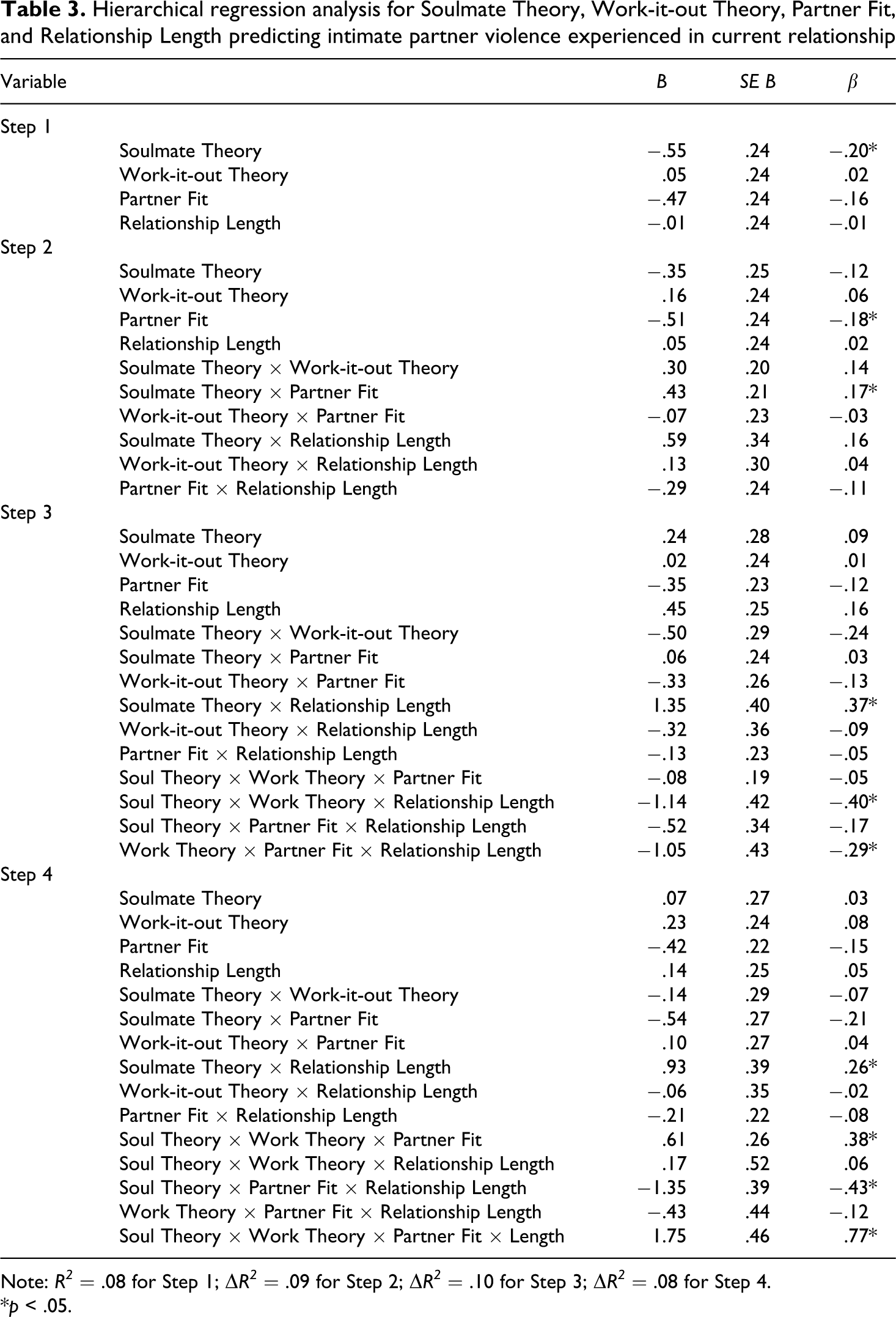
To address our hypotheses, a hierarchical multiple regression predicting relationship violence experienced in one’s current relationship was conducted (see Table 3). First, the four predictor variables were standardized. At Step 1, the centered Soulmate Theory, Work-it-out Theory, Partner Fit, and Relationship Length terms were entered. The Soulmate Theory was significant (β = −.20, t(136) = −2.24, p < .05). At Step 2, the two-way interactions were entered. The two-way Soulmate Theory × Partner Fit interaction term predicting overall IPV was significant (β = .17, t(136) = 2.04, p < .05). At Step 3, the three-way interactions were entered. The Soulmate Theory × Work-it-out Theory × Length interaction term was significant in predicting IPV (β = −.40, t(136) = −2.74, p < .05) . The Work-it-out Theory × Partner Fit × Length term was also significant in predicting IPV (β = −.29, t(136) = −2.44, p < .05).
Hierarchical regression analysis for Soulmate Theory, Work-it-out Theory, Partner Fit, and Relationship Length predicting intimate partner violence experienced in current relationship
Note: R2 = .08 for Step 1; ΔR2 = .09 for Step 2; ΔR2 = .10 for Step 3; ΔR2 = .08 for Step 4.
*p < .05.
At Step 4, the four-way interaction between Soulmate Theory, Work-it-out Theory, Partner Fit, and Relationship Length was entered. Consistent with our main hypothesis, the four-way interaction predicting overall relationship violence was significant (β = .76, t(136) = 3.80, p < .05). Decomposing the four-way interaction, we tested the simple slopes of the four two-way interactions for significance following Aiken and West (1991). Consistent with predictions, for those in longer relationships (+1SD) and with poor partner fit (-1SD), the soulmate theory interacted with the work-it-out theory such that the soulmate theory was positively associated with IPV for those weak in the work-it-out theory (β = 1.76, t(136) = 3.80, p <. 05) but not for those strong in the work-it-out theory (β = .09, t(136) = .54, ns). Further, for those in shorter relationships (−1SD) and with poor partner fit (-1SD), the soulmate theory interacted with the work-it-out theory such that the soulmate theory was negatively associated with IPV for those weak in the work-it-out theory (β = −.89, t(136) = −5.88, p < .05) but not for those strong in the work-it-out theory (β = −.16, t(136) = −.84, ns) (Figure 1). Although no specific predictions were made for those with good partner fit, for those in longer relationships (+1SD) and with good partner fit (+1SD), the soulmate theory interacted with the work-it-out theory such that the soulmate theory was negatively associated with IPV for those weak in the work-it-out theory (β = −1.24, t(136) = −2.17, p < .05) but not for those strong in the work-it-out theory (β = .45, t(136) = 1.35, ns). For those in shorter relationships (−1SD) and with good partner fit (+1SD), the soulmate theory was not associated with IPV for those with a strong or weak belief in the work-it-out theory (t’s < 1.88, ns). The findings from the four-way interaction are consistent with our prediction that the association between ITRs and IPV depends on relationship length and perceptions of partner fit. Further, the findings are consistent with our prediction that the soulmate theory would be associated with IPV when participants held weak beliefs in the work-it-out theory but not when participants held strong beliefs in a work-it-out theory. As predicted, for those in longer relationships and with poor partner fit, IPV was highest for those with strong beliefs in the soulmate theory and weak beliefs in the work-it-out theory (pure soulmate theorists); for those in shorter relationships and with poor partner fit, IPV was lowest for pure soulmate theorists.
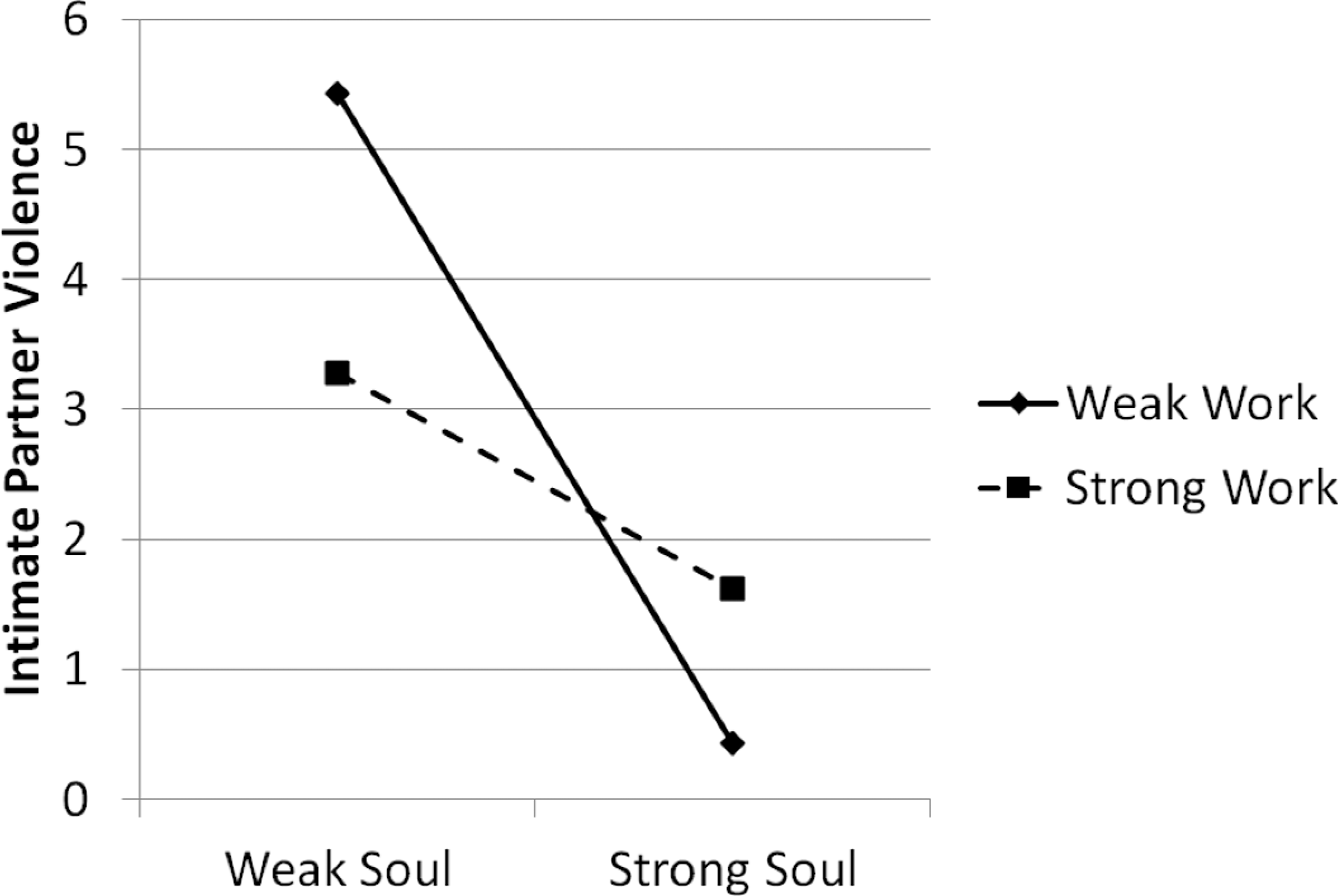
Participants in short relationships with poor partner fit. Soulmate theory × Work-it-out Theory predicting total IPV experienced in current relationship.
Regressions involving the four-way interaction predicting emotional and physical violence separately were also conducted (although no specific hypotheses were made about different types of IPV). The four-way interaction predicting emotional violence was significant (β = .49, t(136) = 2.18, p < .05). Testing the simple slopes of the four two-way interactions, for those in longer relationships and with poor partner fit, the soulmate theory was positively associated with emotional IPV for those with a weak belief in the work-it-out theory (β = 1.12, t(136) = 2.16, p < .05) but not for those with a strong belief in the work-it-out theory (β = .11, t(136) = .61, ns). For those in shorter relationships and with poor partner fit, the soulmate theory was negatively associated with emotional IPV for those with a weak belief in the work-it-out theory (β = −.51, t(136) = −2.97, p < .05) but not for those with a strong belief in the work-it-out theory (β = −.28, t(136) = −1.29, ns). None of the remaining simple slopes was significant.
The four-way interaction predicting physical violence was significant (β = .83, t(136) = 4.67, p < .05). Decomposing the interaction, we tested the simple slopes from the four two-way interactions for significance. Results followed a similar pattern to those for total IPV reported above. For those in longer relationships and with poor partner fit, the soulmate theory was positively associated with physical IPV for those with a weak belief in the work-it-out theory (β = 1.91, t(136) = 4.67, p < .05) but not for those with a strong belief in the work-it-out theory (β = .03, t(136) = .20, ns). For those in shorter relationships and with poor partner fit, the soulmate theory was negatively associated with physical IPV for those with a weak belief in the work-it-out theory (β = −1.04, t(136) = −7.76, p < .05) but not for those with a strong belief in the work-it-out theory (β = .05, t(136) = .27, ns). For those in longer relationships and with good partner fit, the soulmate theory was negatively associated with physical IPV for those with a weak belief in the work-it-out theory (β = −1.24, t(136) = −2.43, p < .05) but not for those with a strong belief in the work-it-out theory (β = .46, t(136) = 1.55, ns). For those in shorter relationships and with good partner fit, the soulmate theory was positively associated with physical IPV for those with a weak belief in the work-it-out theory (β = .53, t(136) = 2.00, p < .05) but not for those with a strong belief in the work-it-out theory (β = −.41, t(136) = −1.72, ns).
Discussion
Overall, our hypotheses were supported. The soulmate theory and work-it-out theory interacted to predict IPV experienced in a current romantic relationship. Again, we were most interested in the interactive extremes of the ITRs—pure soulmate theorists and pure work-it-out theorists—as past research has suggested that studying the ITRs jointly is particularly relevant to predicting behavioral outcomes in relationships. As predicted, the interaction between the soulmate theory and work-it-out theory was moderated by partner fit and relationship length such that for those in short relationships and with poor partner fit, the soulmate theory was negatively correlated with IPV for those weak in the work-it-out theory (pure soulmate theorists) but not correlated with IPV for those strong in the work-it-out theory. However, for those in long relationships and with poor partner fit, the soulmate theory was positively associated with IPV for those weak in the work-it-out theory but not correlated with IPV for those strong in the work-it-out theory. These findings support past research that suggests that beliefs about one’s partner are more relevant to determining relationship outcomes for pure soulmate theorists than pure work-it-out theorists. Further, these findings support that relationship length (e.g., when one determines that his/her partner is a good fit) is relevant to relationship outcomes when investigating the interaction between the ITRs.
Consistent with past research and expectations for the current research, partner fit moderated the association between the soulmate theory and relationship violence for those weak in the work-it-out theory but not [for those] strong in the work-it-out theory. Past research consistently showed that beliefs about partner fit were not as tied to relationship outcomes for pure work-it-out theorists as they were for pure soulmate theorists. Central to the soulmate theory is the idea that one is with the “right” relationship partner. Once those with a strong soulmate theory decide that they are with the right relationship partner, it may be more difficult for them to leave violent relationships (especially if they also have a weak work-it-out theory). Therefore, we also included relationship length as a moderator of the ITR and partner fit interaction predicting relationship violence because of the importance of when a person decides if he or she has good partner fit and when relationship violence begins. Early in relationships, people are quickly deciding whether or not their partner is someone with whom they want to be with long-term; however, this early evaluation process is much more critical for those who hold a strong soulmate theory than it is for those who hold a strong work-it-out theory (who are more open to relationships developing slowly and partners potentially changing over time). For pure soulmate theorists, early warning signs about a partner usually lead to unhappiness and relationship termination whereas this is less likely to happen for pure work-it-out theorists (e.g., Franiuk et al., 2002; Knee, 1998). Therefore, if relationship violence starts early in a relationship, the soulmate theory may offer some protection against continuing a relationship with a violent partner.
However, if relationship violence starts later in a relationship (or there are few warning signs or warning signs are not recognized), a pure soulmate theorist may downplay this relationship violence to convince him or herself that he or she should stay with this person. Although it may seem ironic that a soulmate theorist would stay in a relationship with an abusive partner given that a part of the soulmate theory is the belief that a partner cannot change, this belief also solidifies one’s partner as his or her “soulmate”. In other words, once a soulmate theorist believes that he or she has found the right person, it is difficult for the soulmate theorist to change his or her beliefs about his or her partner (e.g., Franiuk et al., 2002; Knee, 1998). Therefore, in the current study, we expected relationship length to moderate the interaction between the ITRs and partner fit. Simply, we expected the soulmate theory to have protective value against IPV early in relationships. As predicted, we found that pure soulmate theorists in longer relationships reported more IPV than pure soulmate theorists in shorter relationships. More importantly, for those in shorter relationships, a pure soulmate theory was protective only for those who had poor partner fit (and not for those who had already decided that they were with the right person). Again, at least early in the relationship, the longer a relationship goes on, the more likely pure soulmate theorists are to believe that they are with the right person (because they would have ended the relationship had they believed they were not with the right person (Franiuk et al., 2002)).
Although we expected the soulmate theory to be more protective for those early in relationships who had not yet decided if they were with the right person, we did not assess the mechanisms through which this might happen. It is possible that a pure soulmate theory delays the start of relationship violence because the soulmate theory leads to constant evaluation of one’s partner. Although likely not explicitly aware of his or her partner’s relationship theory, a potentially violent partner may notice a partner’s scrutiny and may hide the relationship violence, thus explaining why pure soulmate theorists seem to be protected from relationship violence early in relationships. Similarly, for some soulmate theorists, poor partner fit, at least early in relationships, may signal that one is still deciding whether or not a person is a good fit. Again, this scrutiny may delay warning signals of violence for pure soulmate theorists (relative to those who are not pure soulmate theorists). Additionally, poor partner fit may trigger low investment or low commitment from those with a strong soulmate theory. This is consistent with research that shows people who are dating typically report less violence than those in more committed relationships (cohabiting or married) (e.g., Brown & Bulanda, 2008). Of course, this explanation assumes that those with poor partner fit, and therefore low commitment, are in new relationships where they have not yet committed to a relationship partner. Otherwise, admittedly, changes in relationship commitment or low commitment in long-term relationships where greater commitment is expected can trigger increased relationship violence (Mize, Shackelford, & Shackelford, 2009; Walker, Logan, Jordan, & Campbell, 2004).
As noted above, the soulmate theory may offer some protection early in the relationship to allow soulmate theorists to end relationships quickly when there are signs of relationship violence. Further, we would expect that the protective benefit that the soulmate theory serves early in relationships to get people to leave violent relationships also keeps people in good relationships with non-abusive partners. Not surprisingly, for pure soulmate theorists who have found the right person, we found that low rates of IPV were reported in longer relationships. However, when early warning signs of relationship violence are missed, consistent with the interpretation above, soulmate theorists who have quickly decided that their relationship partner is right for them may experience more IPV because they likely (and ironically) work very hard to maintain their positive beliefs about their partner. However, as the relationship continues, there are likely more complex processes occurring related to the ITRs and partner fit than can be determined by the present research. For pure soulmate theorists who remain in a relationship long-term with an abuser, their beliefs about their relationship partner may change as indicated by the interactions showing that the pure soulmate theory was positively associated with IPV for those with poor partner fit in longer relationships (but negatively associated with IPV for those with good partner fit in longer relationships). While soulmate beliefs may lead a person to downplay IPV early in a relationship when one believes that he or she is with the right person, as the relationship abuse continues long-term a soulmate theorist may slowly recognize that his or her partner is not a good fit while their soulmate theory and other factors serve to keep the person in the relationship. Finally, whether soulmate theorists remain in relationships long-term with an abuser may depend on the type of abuse, as emotional abuse may be easier to downplay than physical abuse. Future research should longitudinally investigate whether or not partner fit moderates the association between the ITRs, type of abuse, and distortions related to partner abuse.
Although the current research identifies partner fit as a key variable in associating the soulmate theory with IPV, it is possible that additional beliefs associated with the theory make some soulmate theorists particularly vulnerable to IPV. First, one aspect of the soulmate theory is a belief that passion is important in relationships (Franiuk et al., 2002). Although passion can certainly have positive associations in relationships (e.g., greater sexual attraction), high passion in relationships has also been associated with jealousy and intimate partner violence (e.g., Bookwala, Frieze, Smith, & Ryan, 1992; Vandello & Cohen, 2008). Therefore, people who have a strong soulmate theory may be more prone to committing relationship violence and/or seeking out partners who are more prone to committing relationship violence than people with a weak soulmate theory. Second, Knee and colleagues (2001, 2004) have shown that destiny theorists’ responses to relationship conflict may heighten that conflict. For example, destiny theorists are more likely to make stable and dispositional attributions for negative relationship events, thus heightening relationship conflict. Further, as noted previously, pure soulmate theorists have more negative reactions to conflict (e.g., avoidance-coping, feeling less committed to one’s partner). Although this characteristic may lead pure soulmate theorists to end relationships when early warning signs are present, later in the relationship when a soulmate theorist has decided that he or she is with the right person, negative reactions to conflict may heighten one’s own or one’s partner’s proclivity to violence. In fact, Robertson and Murachver (2009) found that lacking skills to deal with relationship conflict was associated with IPV. Therefore, it is important to consider aspects of the soulmate theory, other than the importance of partner fit, that also may be associated with IPV.
Finally, we did not make specific predictions about how the work-it-out theory would interact with relationship length and partner fit given that past research has shown that partner fit is less predictive of behavior for work-it-out theorists than soulmate theorists. None of the simple slopes for the work-it-out theory in the four two-way interactions was significant, but some of the trends were similar to those for the soulmate theory. We are hesitant to interpret marginally significant findings, but it is possible that, at least early in a relationship, holding a work-it-out theory may help to buffer negative relationship events by encouraging more constructive solutions to relationship problems. However, the current research does not necessarily predict that the buffer offered by the work-it-out theory holds in longer relationships. It is possible that the work-it-out theory may keep people in relationships that may turn violent in the long term (by encouraging “working through” relationship problems that may turn abusive). It is important for future research to follow the ITRs longitudinally.
While most past research has highlighted positive relationship outcomes associated with the work-it-out theory, this is the first research to address ITRs and IPV. Partner fit may not hold as much meaning for pure work-it-out theorists, so it is possible that there are other variables that moderate the association between the work-it-out theory and IPV. It is reasonable to believe that there may be certain person variables, when paired with a work-it-out theory, that would lead the work-it-out theory to encourage a person to “work through” relationship violence or believe that a partner will change his/her abusive ways. Admittedly, the current investigation focused on known moderators of the soulmate theory and relationship outcomes. For example, one variable that might be associated with the work-it-out theory and IPV is a history of family violence. Children who witnessed their parents’ violence may be more likely to develop a work-it-out theory because their parents’ relationship led them away from beliefs that there is a “right” person out there or because they learned that conflict was normal and relationships take work. Therefore, work-it-out theorists with a history of family violence may have a different notion of or threshold for which relationship problems should be worked through than those without a history of family violence.
Limitations and future research
First, although researchers have noted the advantages of using online samples for data collection—namely greater variety in age and education than a college sample (e.g., Birnbaum, 2004)—it is important to acknowledge that this data collection method has limitations as well. As Birnbaum (2004) notes, web samples rarely yield random samples of one’s population of interest. The present research was typical of web research that generated a self-selected sample, limited to those who were exposed to the initial request for participation. Although our sample was more diverse with respect to age and relationship experience than a college sample, our sample was more likely to be female and White than the U.S. population (US Census Bureau, 2011a, 2011b). These limitations notwithstanding, it is important to note that researchers have also found that web participants might be more honest and more motivated to respond seriously than college students who often participate due to course requirements (Birnbaum, 2004; Reips, 2000).
Second, our research cannot determine whether ITRs cause one’s relationship violence (or reactions to relationship violence) or whether relationship violence shapes one’s ITRs. Our correlational design merely establishes an association between the ITRs and IPV. For example, our research cannot determine whether one’s soulmate theory, once determining good partner fit, keeps a person in a violent relationship or whether one bolsters his or her soulmate beliefs to justify remaining with an abusive partner. In other words, people in abusive relationships who initially, at the start of a relationship, have weak soulmate beliefs may feel that they have to convince themselves that their partner is the right person for them and, therefore, they have a good reason to stay in the relationship. This may bolster their soulmate theory throughout the relationship. Our research is an important first step in investigating ITRs and IPV, but future research should investigate the causal association between the ITRs and IPV.
Third, we were not able to sufficiently investigate gender effects because of our relatively small sample of men. As noted previously, the social meaning of male-to-female violence compared to female-to-male violence is very different considering that men hold the social, economic, and political power in our society (Holtzman-Munroe, 2005). Therefore, it is important to interpret the data presented here accordingly. For example, a woman may be more motivated to put work into an abusive relationship because of social and economic constraints that pressure her to remain in that relationship. Although past research has shown that men and women do not differ in the extent to which they endorse each ITR, this does not mean that the ITRs do not interact differently with partner fit and other variables in predicting IPV for men relative to women.
Finally, although we supported our hypothesis related to relationship length and partner fit, we do not know exactly how or when a person decides whether or not he or she is with the right person. We do not know which relationship events or partner information holds the most weight in deciding if a relationship partner is a good fit; and, although it is thought that soulmate theorists make these decisions quickly (e.g., Burnette & Franiuk, 2010; Franiuk et al., 2002), we do not know how quickly these decisions are made. We also have yet to investigate how variable this timetable is and how relationship events may impact this decision differently for soulmate theorists and work-it-out theorists. Additionally, in the present study, we did not ask participants when the violent event occurred. Although it is unlikely that people, retrospectively, would be able to identify when relationship abuse started relative to when they decided that they were with the right person, this is likely an important variable in determining whether or not pure soulmate theorists will remain in abusive relationships. A pure soulmate theorist is not explicitly aware of his or her relationship theory, but the cognitions and behaviors that are influenced by holding a soulmate theory may be used to weed out a potential abusive partner. More specifically, holding a soulmate theory may lead a person to hold certain expectations about partner behavior and to react negatively to behaviors that signal future abuse. However, if a soulmate theorist is unable to recognize warning signs of abuse or if relationship abuse begins after one has decided that he or she is with the right person, the beliefs associated with a soulmate theory may make it difficult for one to leave a violent relationship. Investigating when relationship abuse begins relative to when a person makes decisions about partner fit are vital questions for future research in this area. Further, this longitudinal research should investigate warning signs of relationship violence (e.g., jealousy, public possessiveness) in addition to emotionally and physically abusive acts. Finally, future research should include an assessment of frequency of violent events within the relationship. Although the current research makes some distinctions between more and less violent relationships, assessing frequency of violent events allows for a clearer picture of abuse in a particular relationship.
This paper is not meant to suggest that ITRs are the best explanation for why people remain in abusive relationships. There are many factors that explain why people remain in abusive relationships. As numerous scholars have pointed out, a lack of economic freedom is an undeniable cause of women becoming trapped in an abusive relationship (e.g., Bornstein, 2006) as is fear that their partner will kill them or their children if they leave (e.g., Anderson, et al, 2003; Harding & Helwig-Larsen, 2009). Undeniably, as Wood’s (2001) dark narrative describes, people stay in abusive relationships because they feel they have no options. However, as Wood (2001) also points out, some people use fairy tale narratives to keep them in relationships—beliefs that trivialize or positively distort the relationship abuse. Therefore, with this research, we hope to add ITRs to the discussion involving views of one’s partner, beliefs about relationships, and intimate partner violence.
Footnotes
Funding
This research received no specific grant from any funding agency in the public, commercial, or not-for-profit sectors.