



Abstract
Demand–withdraw patterns of spousal response to family conflict were examined among 83 couples living in a stepfamily context. Using daily process methods, husbands and wives were each asked to report separately on incidents of relationship conflict, responses to this conflict, and subsequent negative affect for a period of seven consecutive days. Data were analyzed using multilevel modeling and interpreted from a dyadic coping perspective. Findings indicated that when husbands engaged in demand or withdraw responses both members of the dyad subsequently reported declines in mood. Wives demanding and withdrawing had no significant cross-spousal impact. Of particular interest was the finding that husbands’ use of confrontive demanding exacerbated the negative impact of wives’ withdrawal on wives’ mood.
The demand–withdraw pattern of spousal interaction has been referred to as one of the “central, and most intractable, destructive patterns of marital interaction” (Heavey, Layne, & Christensen, 1993, p. 16). In this pattern, one spouse makes demands, complains, or confronts while the other withdraws from the relationship in an effort to avoid the partner’s demands. The reciprocal nature of this negative interaction sequence is a perpetuating factor that can cause couples to grow more and more polarized in their positions, increasing their risk of marital dissolution (Christensen & Heavey, 1990).
Although research has documented distress and dissatisfaction arising from this pattern of spousal interaction, the differential impact on husbands and wives over time has been a source of confusion in the literature. At the very least, the impact on the couple appears to be complex. For example, despite associations between marital decline and wife-demand/husband-withdraw interactions (Christensen & Heavey, 1990), there is evidence that wives become more satisfied over time if they withdraw and their husbands demand (Gottman & Krokoff, 1989; Heavey et al., 1995). However, there is also evidence that wife-withdraw/husband-demand patterns of interaction result in concurrent and long-term marital dissatisfaction (Heavey et al., 1995). These findings speak to the complexities of the demand–withdraw pattern and highlight the need to better understand how these behaviors interact to impact individual members of the dyad.
Wives have consistently been found to more often fill the demanding role, whereas husbands appear to more often fill the withdrawing role (Christensen, 1988; Christensen & Heavey, 1993; Heavey et al., 1993). Two broad theoretical frameworks have been put forth to account for these gender differences. The first relates these differences in demand–withdraw to characteristics of the individual (i.e., to inherent differences in women and men). Alternatively, this gender pattern has also been attributed to contextual factors; that is, it has been suggested that this pattern is a product of the different contexts in which men and women typically find themselves. The purpose of the current study was to examine the differential impact of demand–withdraw patterns of interaction on husbands and wives in stepfamilies. The population of couples living in stepfamilies is particularly germane to the study of these interactions because maintaining the couple relationship as well as parent–child and stepparent–stepchild relationships are key challenges faced by these couples. Although approximately half of all North American couples divorce during their lifetime, the rate of dissolution in remarriages is higher than in first marriages. Approximately 25 to 40% of children will spend some time in a stepfamily following the remarriage of a parent (see Preece & DeLongis, 2005). We are aware of no previous work on demand–withdraw interactions in couples in stepfamilies.
Given the particularly salient nature of interpersonal conflict (Bolger, Stadler, Paprocki, & DeLongis, 2009), as well as the potential for such conflict to give rise to demand–withdraw patterns of interaction (Zwicker & DeLongis, 2010), husbands’ and wives’ responses to family tension were assessed. Interactions between these demand–withdraw responses were calculated in an effort to examine patterns of interaction at the dyadic level. In order to capture the impact of these events over time, a daily process approach to data collection was utilized, in which couples were followed for a period of one week.
First, it was hypothesized that one spouse’s use of demand and withdrawal responses to family stressors would be associated with subsequent increases in negative affect in the other spouse. Additionally, it was hypothesized that demand–withdraw responses from husbands and wives would interact to exacerbate their negative impact on individual members of the dyad. Although previous research has indicated that each spouse’s response to family stress plays a role in the partner’s coping effectiveness (Marin, Holtzman, DeLongis, & Robinson, 2007), little is known about how demand and withdrawal behaviors interact in this regard. The pattern of one spouse withdrawing and the other confronting was expected to be associated with increases in negative affect for both members of the couple.
Method
Participants and Procedures
Our sample consisted of 83 married or cohabiting heterosexual couples, in which at least one of the two spouses had a child from a previous union living in the home for more than three months of the year. Participants were recruited through community newspaper and radio advertisements and were entered into a random $500 draw. The mean age of participants was 40.8 years (standard deviation, SD = 6.4, range = 21 to 60; women: M = 39, SD = 5.8, range = 21 to 50; men: M = 40.4, SD = 6.6, range = 28 to 60). The majority of participants were Canadian-born (76.1%; women: 79.7%; men: 72.5%), with the remainder largely from other English-speaking countries such as Great Britain (7.5%; women: 3.8%; men: 11.2%) and the United States (8.2%; women: 11.4%; men: 5%). At the time of the interview, participants had spent an average of 4.6 years living with their current spouse (SD = 3.2), with a range from less than one year to 11 years. The majority of participants (83.2%) had been married at least once previously (range = 1 to 4 marriages). The mean number of children in the stepfamily was 3.5, with a range of 1 to 8 children. The children spent, on average, 8.2 months of the year (SD = 3.2) in the stepfamily home.
Data were collected as part of a larger research project (see DeLongis, Capreol, Holtzman, O'Brien, & Campbell, 2004) that included telephone interviews, questionnaires, and daily diaries. Only the sections of the project that are relevant to the present study are indicated here. Each spouse completed a week-long twice-daily diary measuring affect and coping with interpersonal stressors. The diaries were completed around lunchtime and before bedtime. Negative affect was assessed twice daily, whereas coping was included only in the evening diary and referred to family stressors that occurred throughout the day. On average, participants reported family stressors on 5.12 days (SD = 1.97) over the period of one week.
Measures
Coping responses
Demand–withdraw responses to interpersonal conflict were assessed once a day (before bedtime) with the Brief Ways of Coping (BWOC; Lee-Baggley, Preece, & DeLongis, 2005). Participants were asked to describe their most bothersome family stressor that day and then report the extent to which they used each of the coping responses on a three-point scale (1 = does not apply or not at all, 3 = a lot). Responses were grouped according to demand (i.e., confrontive) and withdraw characteristics and labeled as angry demanding (e.g., “Expressed anger to the person(s) who caused the problem”) and interpersonal withdrawal (e.g., “I gave the other person(s) involved the silent treatment”), respectively. Lee-Baggley et al. (2005) have previously presented the psychometric properties of the coping subscales for this sample.
Daily affect
Negative affect was measured twice daily with a short form of the Positive and Negative Affect Schedule (PANAS; Watson, Clark, & Tellegen, 1988). Participants reported the extent to which they experienced six feelings since their last diary entry on a three-point scale (1 = not at all, 3 = a lot). Negative affect included six items from the PANAS (i.e., feeling guilty, nervous, upset, irritable, and afraid) and an additional item representing sadness derived from the Affects Balance Scale (Derogatis, 1975). Alphas for morning negative affect averaged across the seven days were .68 for women and .80 for men.
Results
Overview of data analyses
The data conform to a multilevel structure, with days nested within couples. We used multilevel random coefficient modeling (MRCM), which allowed us to model both within- and between-subject variation. Hypotheses were tested using Hierarchical Linear Modeling, Version 6 (HLM; Raudenbush, Bryk, Cheong, Congdon, & du Toit, 2004). A two-intercept approach incorporating actor and partner effects was utilized, in order to better control for the non-independence of the data (Cook & Kenny, 2005). Level 1 variables were grand-mean centered across all participants according to recommendations by Kenny, Kashy, and Cook (2006) for data involving couples. The daily ratings of each spouse for coping and evening negative affect were entered at Level 1, controlling for earlier reports of negative affect and perceived stressor seriousness. Coping interaction variables between husbands and wives were also entered at Level 1. Within-person aggregate means were calculated for each Level 1 variable and entered at Level 2. This ensured that treatment of the intercepts as random factors did not bias the coefficients of the within-person factors (Schwartz & Stone, 1998). Level 2 data for wives and husbands were standardized over the grand mean that included both wives and husbands.
Descriptive statistics
The means and standard deviations for wives and husbands are presented in Table 1. Here Level 1 data were aggregated for each spouse over all time points. Wives had higher levels of morning (t = 3.16, p ≤ .01) and evening negative affect (t = −2.58, p ≤ .05) than did their husbands, but otherwise no significant differences were found on study variables.
Means (M) and standard deviations (SD) for wives and husbands.

Multilevel analyses
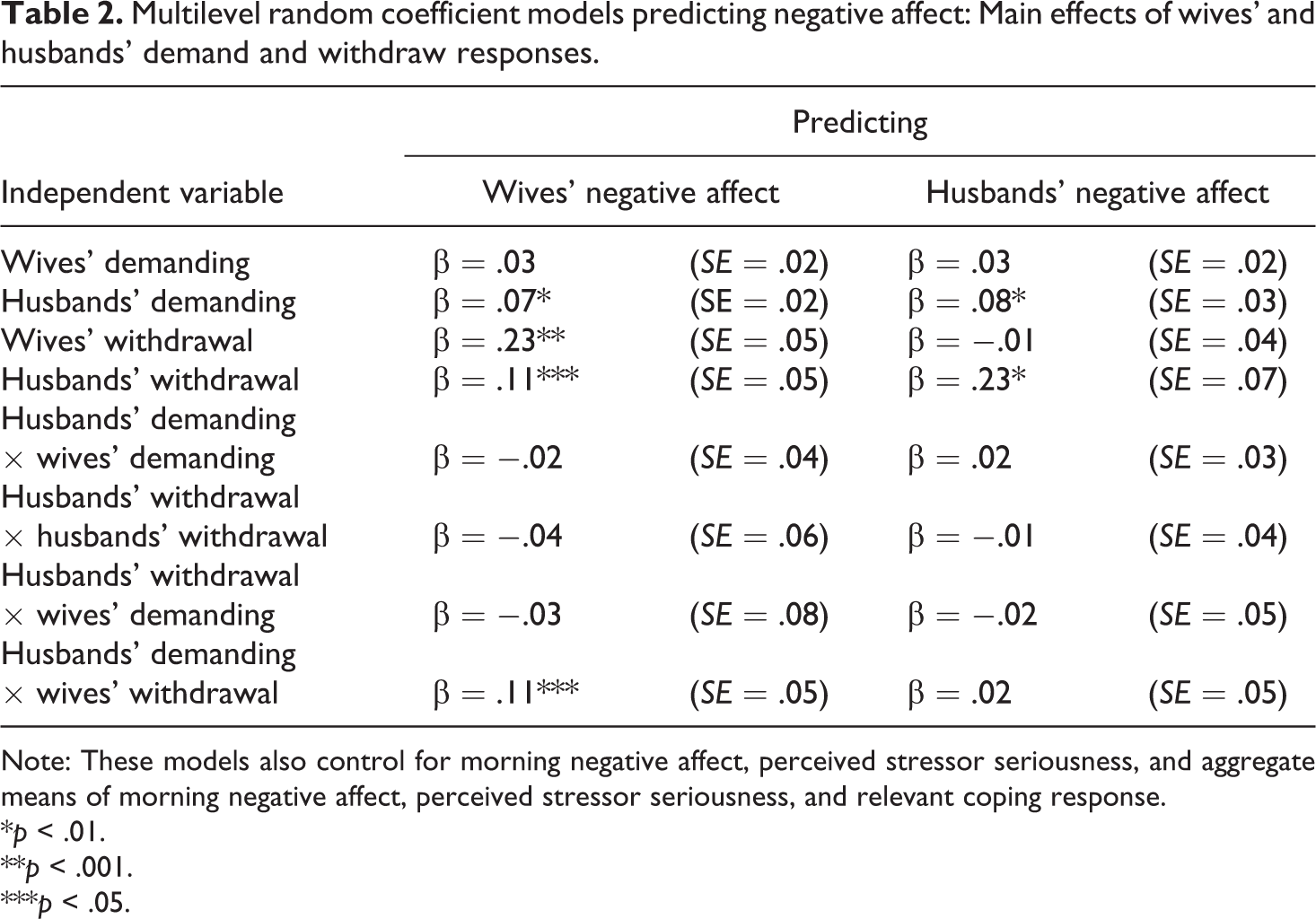
We first hypothesized that the spouse’s level of demand and withdraw behaviors in response to interpersonal stressors would negatively impact the alternate spouse, even controlling for the target spouse’s own previous mood. In order to examine this hypothesis, we formulated the following model separately for husbands and wives and for demand and withdraw responses:
evening negative affect ti = wife [β1iw] + husband [β2ih] + β3iw (morning negative affect wife) ti + β4iw (stressor seriousness wife) ti + β5iw (coping wife) ti + β6iw (coping husband_wife) ti + rti
where evening negative affect ti is evening negative affect at time point t for couple i; wife is a dummy indicator which is 1 for all wives and 0 for all husbands; husband is a dummy indicator which is 1 for all husbands and 0 for all wives; β1iw is the intercept for wives and β2ih the intercept for husbands; (morning negative affect wife) ti is the wives’ level of morning negative affect at time point t for couple i; (stressor seriousness wife) ti is the wives’ perceived seriousness of stressor at time point t for couple SD; (coping wife) ti is a demand or withdraw response for wives at time point t for couple i; (coping husband) ti is a demand or withdraw response for husbands at time point t for couple i; (coping husband_wife) ti is a demand or withdraw response for husbands (aligned for wives) at time point t for couple i; β3iw through β6iw are regression coefficients for the relationships between the independent variables and evening negative affect; and rti is the within-couple error. A similar model was formulated for husbands and both were subsequently tested with the inclusion of multiplicative interaction terms between confrontive demanding and withdrawing responses. See Table 2 for main effects of interest.
Multilevel random coefficient models predicting negative affect: Main effects of wives’ and husbands’ demand and withdraw responses.
Note: These models also control for morning negative affect, perceived stressor seriousness, and aggregate means of morning negative affect, perceived stressor seriousness, and relevant coping response.
*p < .01.
**p < .001.
***p < .05.
Husbands’ reports of both demand and withdraw responses were associated with significant increases in negative mood for their wives, as was wives’ own use of withdrawal following incidents of conflict. Wives’ report of confrontive demanding was not found to be significantly associated with their own mood at the end of the day. Husbands’ mood was significantly (and negatively) impacted by their own use of both maladaptive responses, with wives having no additional significant impact on husbands in this regard. Interactions between demand and withdraw responses indicated that wives’ withdrawal was significantly moderated by husbands’ use of confrontive demanding in predicting negative affect in wives. No other significant interactions between demand and withdrawal responses of husbands and wives were found to be significant. Tests for simple slopes revealed that when husbands responded to conflict by confronting and demanding, the negative impact of wives’ withdrawal was exacerbated; when husbands engaged in less demanding responses, the role of wives’ withdrawal in their own mood was less severe but still significant (see Figure 1 for a plot of the interaction).
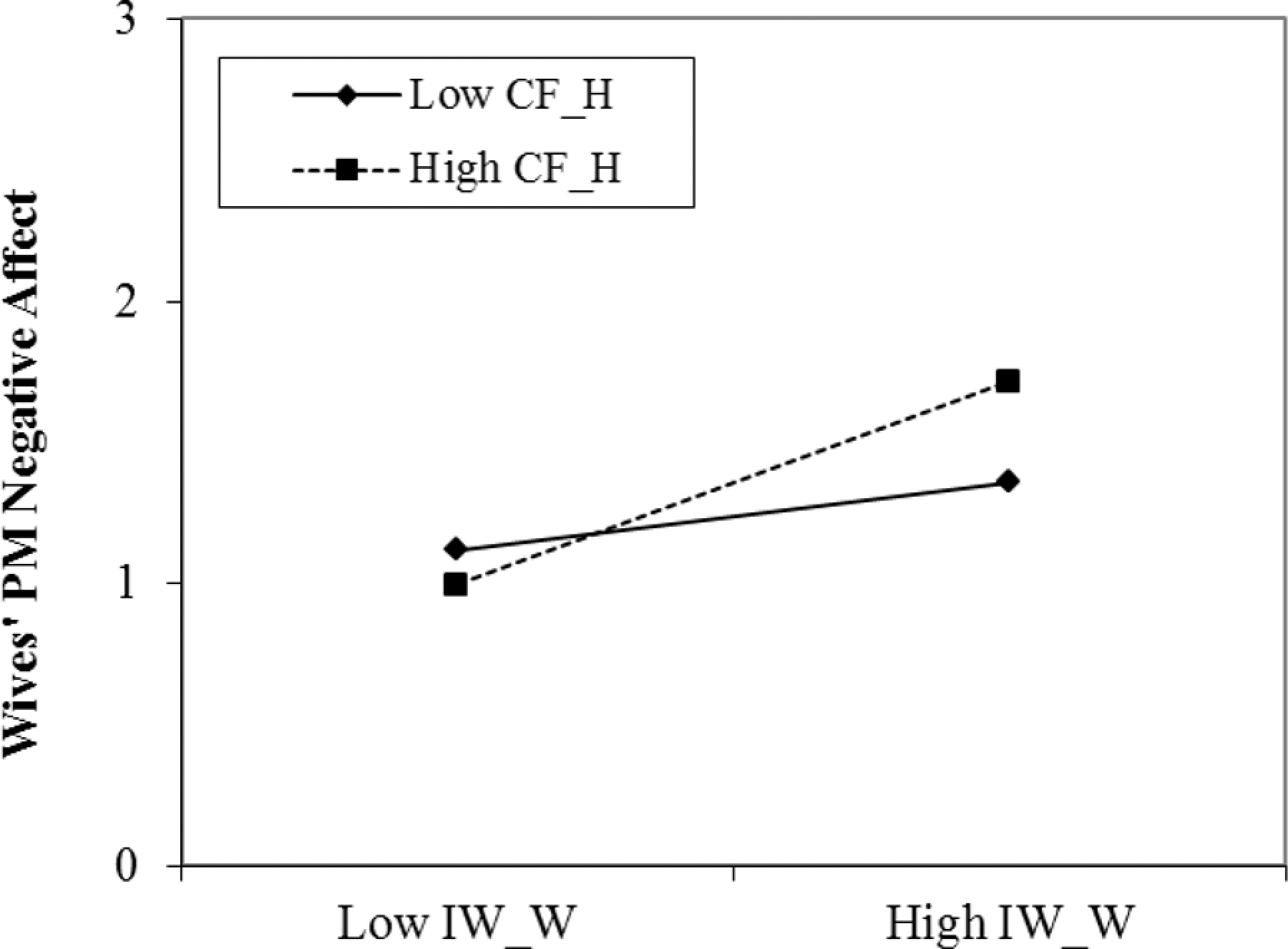
Interaction between husbands’ confrontive demanding (CF_H) and wives’ interpersonal withdrawal (IW_W), predicting wives’ evening negative affect.
Discussion
The current findings offer new insight into the complexities of the demand–withdraw pattern of marital interaction. In particular, they reveal gender differences in the cross-spousal impact of withdrawal and confrontive demanding, in so far that husbands appear to have a greater influence on the psychological adjustment of wives following interpersonal conflict than vice versa. Interestingly, when wives responded by demanding or withdrawing, their own withdrawal responses were associated with increases in negative affect for them. This is in contrast to husbands, who experienced greater declines in mood in the face of their own demanding and withdrawing responses. Indeed, husbands’ demand–withdraw responses appeared to be associated with increases in negative affect for both themselves and their wives, significantly impacting the subsequent mood of their partners. Wives, on the other hand, appeared to have no such significant effect on the mood of their husbands. Although there is limited evidence from previous studies suggesting that wives may become more satisfied over time if they withdraw and their husbands demand (Gottman & Krakoff, 1989), our findings did not support this. Rather, the husbands in the current sample appeared to yield particularly harmful effects on both members of the dyad when they engaged in either demand or withdraw responses. Indeed, the current analyses support a large body of research that has documented a destructive influence of these forms of spousal interaction (Heavey et al., 1995). More notably, they offer further insight into the specific pathways through which such behaviors might affect long-term marital satisfaction and/or dissolution.
The interaction between husbands’ demanding and wives’ withdrawal predicted significant and negative outcomes for wives. This finding is consistent with previous research on dyadic coping indicating a significant influence of spousal response on coping effectiveness in dealing with family stressors (DeLongis, Holtzman, Puterman & Lam, 2010; Hagedoorn et al., 2011; Marin et al., 2007). Our findings suggest that compared with their wives, husbands, at least in stepfamilies, are relatively impervious to spouse engagement in demand or withdrawal responses to family stress. This is consistent with other findings here demonstrating a greater spousal influence on the part of husbands.
The husband-demand/wife-withdraw pattern of interaction was found to have an impact on spousal well-being, whereas the more typically cited wife-demand/husband-withdraw pattern did not have a significant synergistic effect (Christensen & Heavey, 1990). This may be a product of the stepfamily context, or it may be that couples in which at least one member has been previously divorced respond differently to the demand–withdraw pattern of interaction. For example, women who remarry have been found, on average, to have greater financial resources (Glick & Lin, 1987) and higher levels of education (Chiswick & Lehrer, 1990), and it may be that such women respond differently to the demand–withdraw pattern of marital interaction. Additional research is needed to clarify this.
While our findings shed light on the effects of demand and withdraw responses to family stress on both husbands and wives, they suggest complexity in the gendered nature of these patterns. It is difficult to draw conclusions regarding the generalizability of these findings given the unique characteristics of the current sample, all of whom were living in a stepfamily setting at the time of participation. Current findings may not be extendable to non-stepfamily units or to first marriages, given the unique challenges and stressors faced by stepfamilies, and the potential differences of those who divorce and remarry from those who do not. Nevertheless, implications exist for developing intervention strategies for couples in stepfamilies. Our findings suggest that efforts aimed at cultivating more effective responses to marital stress should take into account the spouse’s response and the dynamic interplay of both spouses’ demanding and withdrawing behaviors.
Footnotes
Funding
This work was supported by the Social Science and Humanities Research Council of Canada (grant to the second author and fellowship to the first author).
Conflict of interest statement
The authors declared no conflicts of interest.