



Abstract
We test theoretical arguments developed by Hazan and Diamond (2000) suggesting that attachment theory presents a more parsimonious theory of mate selection than Buss’ sexual strategies theory. We hypothesized that physical attractiveness and indicators of attachment anxiety and avoidance would be related to mate choice variables (e.g., number of first dates, and the probability of entering into an exclusive relationship in a 32-week period). We used a sample (N = 242) of Latter-day Saint (LDS) young single adults. In general, our results support the idea that both physical attractiveness and attachment dimensions are important for understanding romantic relationship formation and dating processes. Physical attractiveness is generally the strongest predictor, and is more meaningful for females. Implications for theory are discussed.
Ground-breaking research by Buss (1985, 1989, 1995) suggested the fundamental importance of physical attractiveness and sex differences in human mate selection. His model has been generally accepted as the definitive view on human mate selection from an evolutionary perspective. More recently, Hazan and Diamond (2000) have suggested an alternative evolutionary explanation of human mate selection. However, there has been no empirical test of the alternative explanation proposed by Hazan and Diamond. The purpose of this study was to test this alternative evolutionary explanation in the early stages of romantic relationship formation.
Sexual strategies theory
Sexual strategies theory (Buss & Schmitt, 1993) has two tenets which Hazan and Diamond critique and offer an alternative to, and which are of interest to us in this study. First, sexual strategies theory emphasizes the sex differences in mating behavior. Indeed, this assumption is the essential starting point of the theory. These sex differences are based on the idea that males and females are looking for different qualities in a heterosexual mate because of differences in “parental investment” that is present even at the mate selection stage. That is, males are inclined to want to inseminate as many fertile females as possible to insure the continuation of their genes. Females, however, have evolved a preference for men who are willing to invest in them and their offspring. While Buss and his co-authors allow that the mating behaviors of men and women can be similar under certain ecological conditions, “the inescapable conclusion from their writings is that differences between the sexes represent the hallmark of human mating” (Hazan & Diamond, 2000; p. 187).
Second, the theory posits that because of these sex differences, physical attractiveness is more important in men’s mate selection choices than in females’ choices. This is because physical attractiveness is an indicator of fertility. Buss’ (1989) study of mate preferences in 33 countries provided support for the idea that males valued reproductive capacity more than females. The theory does not deny that males may continue to invest in an impregnated female; rather it argues that the partner with greater “reproductive costs” will invest more as there is more to lose. This partner is the female, as the overall investment necessary for producing the next generation (e.g., egg production, childbearing, breastfeeding, etc.) is substantially higher than for the male.
Hazan and diamond’s attachment theory of mate selection: An alternative evolutionary perspective
Hazan and Diamond critique sexual strategies theory on several fronts. For one, they note that many of the studies used to support the sex difference in mate selection deal only with preferences and not with what criteria are used by men and women in actual mate choices. They also critique Buss’ research and show methodological problems that bring his findings into question as well as alternative explanations for some of his findings concerning sex differences. Ultimately, they suggest that neither the theory nor the research that has been used to support it has yet been able to “predict real-world mate selection behaviors” (p. 187).
Given these critiques, they offer an alternative evolutionary account that integrates a diverse set of ideas and research findings and “provide[s] a more grounded account of human mating” (p. 186). This account is based on attachment theory. Their critique of sexual strategies theory and their explication of an alternative attachment theory of human mating is extensive and meticulous. But at its core are two primary issues. First, that human mate selection is basically and fundamentally an issue of an attachment bond, the “pair bond”, rather than simply a matter of sexual reproduction. Second, from an attachment perspective there should be little or no differences between the sexes.
Human mating as an attachment pair bond
While sexual strategies theory allows that men “may” invest minimally in long-term pair bonding, the clear emphasis is that men naturally prefer short-term mating. However, survival of infants requires a long-term commitment (as compared to other mammals) from the male and, indeed, long-term mating has apparently evolved in humans. Research demonstrates that the majority of reproductive partnerships remain together for several years (Fisher, 1989). How did this happen if males prefer to quickly inseminate and then move on? Hazan and Diamond suggest that a mechanism evolved to solve this problem of keeping males involved and this mechanism was attachment. The infant-parent attachment mechanism—namely attachment theory—that had evolved to secure the survival of highly dependent infants “was exploited for the (new) purpose of cementing a bond between reproductive partners” (Hazan & Diamond, 2000, p. 189).
Attachment theory, as proposed by Bowlby (1973) theorized the attachment system as a behavioral system innate in all humans that motivates individuals to seek what has been called “felt security.” While attachment theory was initially applied almost exclusively to parent-infant relationships, Bowlby, and eventually other scholars (e.g., Hazan & Shaver, 1987), suggested that the defining features of attachment relationships manifest themselves in long-term romantic relationships as well. These defining features that are seen in the overt behaviors of individuals toward their attachment figures are proximity maintenance (seeking physical closeness), safe haven (seeking comfort or aid when needed), separation distress (when there are unexpected or prolonged separations), and secure base (knowing you can rely on the attachment figure as you engage in exploratory and nonattachment activities). Furthermore, they note that these defining features—proximity maintenance, separation distress, safe haven, and secure base—are almost exclusively formed, in the adult case, with romantic partners. Thus, “mate relationships are attachments in the technical sense of the term” (p. 189).
Attachment in early relationship formation
Although Hazan and Diamond (2000) propose that attachment is central to mate selection, they make no specific suggestion as to its validity in early relationship development. Thus we turn to other sources to build a case for attachment as a viable predictor in the earliest stages of relationship formation. In the attachment literature focused on romantic relationship formation Mikulincer and Shaver (2003) have suggested that the four overt attachment behaviors described above are manifest as either hyperactivating or deactivating strategies. When the attachment system is activated and if the individual perceives that their romantic partner is inconsistent or seldom available as a safe haven or secure base then hyperactivation or deactivation may occur. Hyperactivation is characterized by demanding, coercion, clinging, and controlling actions. Deactivation is characterized by detachment, compulsive self-reliance, and avoidance of intimacy. Those individuals prone to a hyperactivating strategy are seen as having an anxious attachment orientation, whereas those prone to a deactivating strategy are seen as having an avoidant attachment orientation. Theory suggests that too much of either of these strategies may be detrimental to relationship formation and that secure attachment—which is seen as being low on both of these dimensions—is considered the preferable attachment orientation one seeks in a partner (Hazan & Ziefmann, 1994; Mikulincer & Shaver, 2003).
Although, empirical research (Klohnen & Luo, 2003; Chappell & Davis, 1998; Pietromonaco & Carnelley, 1994) has sought to confirm the theoretical argument that attachment has a role in the mate selection process, these studies are for the most part hypothetical, in that they do not test whether or not an individual’s attachment behavior actually predicts how they form relationships. Rather, most of these studies have typically asked study participants to make judgments about what they would do when presented with a specific scenario involving individuals who display specific attachment behaviors (Creasey & Jarvis, 2008). Additionally, because attachment bonds typically take years to form (Hazan & Ziefmann, 1999), it may be considered an exercise in futility to test the relationship between attachment and early relationship initiation stages. Still, some have argued, and have shown empirically, that attachment behaviors can be observed in the earliest stages of relationship formation. Perhaps the most notable of these is Eastwick and Finkel’s (2008a) work showing that activation of the attachment system, and attachment anxiety in particular, was observable in a speed dating scenario. Other studies of note are Sanford (1997), which showed that after controlling for dating status (whether or not they were dating steadily), being either attachment avoidant or anxious was related to less frequent dating compared to being secure, and Schindler, Fagundes and Murdock (2010), which revealed no association between attachment anxiety and a greater likelihood to date or to commit to a romantic partner. This latter study further showed that attachment avoidance had no association with a decreased likelihood to go on dates, but that it was associated with a decreased likelihood to enter a committed relationship.
When we combine the evolutionary perspective of Hazan and Diamond with the shortage of empirical findings, we are left with a lot of unanswered questions regarding the association of attachment to real-world relationship initiation. Still, what little evidence we have seems to suggest that early romantic relationship formation may be an attachment process and that individuals who manifest more avoidant and/or anxious attachment behaviors may have more difficulty forming romantic relationships. Furthermore, although Hazan and Diamond (2000) present an alternative view of mate selection, they do not propose that physical attractiveness is irrelevant in the mate selection process, only that it is not the primary motive. Thus, we hypothesize that attachment and physical attractiveness will simultaneously predict human mate selection.
Sex differences in human mate selection
Hazan and Diamond’s second major point is that there should be little or no differences between the sexes in the mate selection process. Their argument in essence is that mate selection is an attachment process, and if attachment pair bonding is the same for males and females, then there should be no sex differences. They note that there is no theoretical reason why males and females should differ in their need and desire for felt security. From an attachment perspective, males and females all seek attachment figures who are “kind, warm, responsive, and competent.” As one piece of evidence for their argument, they note that the Buss research showing that males assign greater weight to physical attractiveness and women to social status actually shows that neither physical attractiveness nor social status is most important for either sex. Rather, the top qualities for both sexes are kindness, understanding, and intelligence, and these are the same qualities that all infants and adults look for in their attachment figures. Thus, we hypothesize that there will be no sex differences in how attachment predicts mate selection as measured in the current study.
Given the two arguments put forward by Hazan and Diamond in support of their attachment theory of mate selection, and the small bit of empirical work that actually tests the relationship of attachment with real-world relationship formation, this research was designed to investigate whether indicators of attachment viability have an impact on mate selection and whether there were differences by sex. Is there evidence that attachment pair bonding behaviors are manifest in the relationship initiation phases of young adult romantic relationships? If Hazan and Diamond are correct in their theoretical speculations, then we should find that those individuals who are seen as candidates for a good attachment pair bond—that is, they are capable of being kind, warm, responsive, and competent—will prove more likely to be successful in the initial development of romantic relationships. This thinking led to the following hypothesis:
H1: When entered simultaneously, both physical attractiveness and attachment dimensions should be related to romantic relationships’ initial dating phases.
If Hazan and Diamond’s attachment theory of mate selection is correct we expect physical attractiveness to be no more potent a predictor of relationship initiation dating phases for males than it is for females. Furthermore we also expect no sex differences in the importance of physical attractiveness and of attachment pair bonding viability. That leads to our second hypothesis.
H2: There are no sex differences in the predictions of relationship initiation dating phases.
Second, we chose a sample of young single adults (YSAs) from among a population of members of the Church of Jesus Christ of Latter-day Saints (aka, Latter-day Saints, LDS, or Mormons) because among practicing Latter-day Saints marriage is highly valued (Chadwick, Top, McClendon, Judd, & Smith, 2007), and consequently, Latter-day Saint YSAs tend to move quickly from acquaintance to dating, to exclusivity, to engagement, and ultimately to marriage (Holman, 1996; Holman & Harding, 1996; Schaalje & Holman, 2007). Therefore, this sampling group gave us an opportunity to see a great deal of movement from first acquaintance to the development of an exclusive relationship in a short amount of time and to have a sample that actually “dates”, unlike most of their American peers (Glenn & Marquart, 2001; Regnerus & Uecker, 2011).
Method
Sample and procedures
The data were gathered in 2010 and 2011. Participants were recruited by 10 researchers who went door to door within a pre-selected geographic area in the fall of 2010. This area had a high concentration of apartment complexes and houses generally rented by students and working young adults. Participants were incentivized by entering them in a draw for one of three $300.00 gift cards, and one of three big screen TVs. The draw was held again at the beginning of each semester, with new prizes, so that participants had multiple chances to win, and were incentivized to continue for the full 32 weeks. Participants completed the READY online assessment, a 200-plus item questionnaire. This questionnaire is based on the extensive empirical and theoretical work completed on the RELATE instrument (Busby, Holman, & Taniguchi, 2001) which is used to evaluate the individual, family of origin, social, and relational contexts of couples and inform them of their relational strengths and weaknesses. READY is an adapted version of RELATE designed for individuals not in a relationship, for the purpose of informing the participants about their readiness for committed relationships. 1 The validity and reliability of the measurement scales have been established in previous studies (for details see Busby et al., 2001). Participants also responded to a weekly text message for 32 weeks beginning in the fall of 2010 and continuing until spring 2011, asking them to indicate any relationship transitions (e.g., first date, second date or more with same person, became exclusive, etc.) in the last week and the name of the individual with whom that transition occurred.
Lastly, a profile was set up on Facebook and participants were invited as friends of the study. This allowed access to their wall, information page, and pictures. A picture of each individual was then selected and edited so that they would uniformly show the shoulders and face of all participants.
The sample was limited to include only individuals who were not in a committed relationship at the time of the first data collection, those who responded to at least 75 percent of the weekly texts, and those for whom a picture was available to measure physical attractiveness. The final sample consisted of 242 individuals, 57 percent of whom were female. Ninety-five percent of participants were Caucasian and between 18 and 28 years of age with a mean age of 22 for males and 20 for females. All but six individuals were members of the Church of Jesus Christ of Latter-day Saints.
Measures
Dating phases
Dating phases were measured using responses from the weekly text messages. As text messaging only allows 160 characters per message, participants were instructed at the outset of the study to respond to the following cue. “Relationship transitions in the last week. Respond with Letter and Person’s Name.” Response options were: (a) No date; (b) First date; (c) second or more date with the same person; (d) In an exclusive relationship; (e) Engaged; (f) Broke-up; (g) Other specify. Respondents were asked to include all dates they may have been on in the previous week (i.e., multiple dates with the same partner, and/or multiple dates with different partners). They were also instructed to give the name(s) of the individual(s) with whom they went on a date. This allowed us to construct several variables measuring how often and how long participants dated certain individuals. Using the data collected through text messaging the following variables were created.
The first measure, Number of Dateless Weeks, represents the number of weeks an individual reported not having a date of any kind. As respondents were followed for 32 weeks, higher numbers reflect a pattern of less dating. This variable was measured by counting the total number of weeks that the participant responded with the letter “a”, signifying they did not go on a date that week.
The second dating stage isolated from the text data was Number of First Dates. This variable reflected how many first dates an individual participated in during the week preceding the text. This variable was measured by counting the total number of “b’s” (1st dates) respondents indicated they had been on each week. Higher numbers reflected a pattern of consistent dating but not necessarily dating that progressed toward commitment.
The Number of 2nd or More Dates with the Same Individual an individual participated in was measured by counting how many “c’s” (indicating second or more dates with same individual) respondents said they had during the week. Higher numbers of second or more dates reflected a pattern of consistently dating the same person. Although these are not committed relationships, they likely reflect a degree of attractiveness and liking by one or both of the partners.
Relationship measured whether or not the individual entered into a relationship during the time period. This variable was constructed by observing whether respondents ever responded with the letter “d” indicating they had entered an exclusive relationship. Individuals who at any time during the 32-week period responded with a “d” were given a value of one; all other participants were assigned a value of zero indicating no relationship was formed.
Attachment dimensions
Attachment is generally seen as consisting of two dimensions: attachment anxiety and attachment avoidance. A person is securely attached by having low scores on both scales. Attachment dimensions of avoidance and anxious were measured using items from READY that were derived from the Adult Attachment Questionnaire (AAQ) (Simpson, Rholes, & Phillips, 1996). Avoidance was measured on an eight-item scale that gauges the degree to which respondents (1) see themselves as comfortable having others depend on them, (2) find it difficult to trust others completely, (3) find it relatively easy to get close to others (reverse coded), (4) are comfortable having to depend on other people (reverse coded), (5) like people getting close to them, (6) are uncomfortable being close to others, (7) are nervous whenever anyone gets too close to them, and (8) see that others want them to be more intimate than they feel comfortable being. Cronbach’s α was .85.
Anxious attachment was measured using nine items that asked the extent to which respondents (1) worry about being abandoned by others (reverse coded), (2) view others as reluctant to get as close as they would like, (3) worry that their partners do not really love them, (4) worry about their partners leaving them (reverse coded), (5) want to merge completely with others, which sometimes scares people, (6) are confident that others would never hurt them by suddenly ending the relationship (reverse coded), (7) want more closeness and intimacy than others do, (8) rarely think about others leaving them (reverse coded), and (9) are confident that their partner loves them just as much as they love their partner (reverse coded). Cronbach’s α was .81. Response options for both anxious and avoidant measures were on a seven-point Likert-type scale ranging from (1) Strongly Disagree to (7) Strongly Agree.
Physical attractiveness
Finally, Physical Attractiveness was measured using the pictures gleaned from participants’ Facebook pages. Physical Attractiveness reflects the extent to which raters perceive a target as having physical features that are appealing to them. While this is subjective, research has shown that individuals are fairly consistent in their judgment of physical attractiveness (Sugiyama, 2005). In the present study, physical attractiveness was measured by having six research assistants (three male, three female) rate participants’ pictures. The pictures were selected from Facebook based on two criteria. The first was that the picture appeared to be a representation of the respondent’s most attractive self. Second, pictures were selected that showed the upper torsos and faces of respondents. The scale was 1−7 with one indicating very unattractive and seven indicating very attractive. The intra-class correlation coefficient representing the average reliability of coders was .84.
Gender
Gender was measured using an item from the READY assessment that simply asked respondents to indicate their biological sex. Response options were male (coded as 0), and female (coded as 1).
Analysis strategy
In order to test our hypotheses in an efficient manner, we chose a hierarchical approach. Using the statistical program STATA, (StataCorp, 2009) we first computed four separate models with physical attractiveness and gender as predictors of Dateless Weeks, Number of First Dates, Number of 2nd or More Dates with the Same Individual, and Relationship. We then tested models wherein anxious and avoidant attachment and gender were entered as predictors of Dateless Weeks, Number of First Dates, Number of 2nd or More Dates with the Same Individual, and Relationship. After computing these models and observing that both physical attractiveness and attachment dimensions were significantly related to the dating phases variables, we computed all models simultaneously, and tested the contribution of each independent variable using a Wald test. Specific coefficients are only interpreted for the combined model. Lastly, we created interaction terms between gender and all the independent variables and re-tested these models in order see if gender acted as a moderator to either physical attractiveness and or attachment. These interaction terms were then interpreted.
The models testing the relationships between the independent variables and Dateless Weeks, First Dates, and 2nd or More Dates with the same Individual required the computation of a Poisson distribution model. This is because the distribution of events that have been counted (e.g., number of dates) are left censored by zero (you cannot have negative dates), and thus do not follow a true normal distribution. Distributions of counts are also often zero-inflated (i.e., a disproportionate number of those sampled report zero values), which skews the distribution. Thus, a Poisson distribution model is used to predict the probability of a given number of events occurring in a specific time interval. For an in-depth discussion of Poisson distribution models please refer to Hoffman (2004). The last model testing the relationship between the independent variables and Relationship was fitted using logistic regression.
Poisson coefficients are typically reported as incidence rate ratios (IRRs) which represent the expected average rate of change in the outcome given a one-unit change in the predictor. Like odds ratios in logistic regression, IRRs can easily be transformed into a percentage change. In Table 1, we present IRRs but only the expected percentage change is included in the text.
Dating process variables predicted by physical attractiveness and attachment anxiety and avoidance.

Note. * indicates significance at p < .05; ** indicates significance at p < .01; IRR stands for incidence rate ratio;
OR stands for odds ratio.
Results
Descriptive statistics
Descriptive information for each of the dating phases variables reveals interesting patterns, as well as possible gender differences. For example, males on average experienced two fewer dateless weeks (M = 15.5) than females (M = 13.1). This difference across gender was significantly different (t(240) = 2.496, p = .001). Furthermore, although the mean number of first dates for males (M = 5.4) and females (M = 4.69) appears very similar, 8 percent of females reported zero first dates in the measured period while there were no males who reported zero first dates. For the variable 2nd or More Dates with the Same Individual about 12 percent of males in the sample reported having zero in the 32 weeks whereas 26 percent of females reported zero 2nd or More Dates with the Same Individual. The above variables show that although on average males and females seem to experience similar dating patterns, on the margins females clearly are disproportionately dateless; however, in terms of relationships, the proportion of males and females who actually had a relationship in the period was not different (t(240) = −.995, p = .097).
Just over half (54 percent, N = 130) of the sample entered an exclusive relationship in the 32 weeks and of these about 94 percent (N = 122) reported having engaged in each of the dating phases at least once; that is, they reported at least one dateless week, one first date, and one second or more dates with the same individual. Of the individuals who reported having a relationship, 35 percent (N = 46) were still with their partner at the end of the 32-week period. The remaining 65 percent (N = 84) had broken up.
Lastly, it is interesting to note some differences in the independent variables. In this sample males and females differed in levels of attachment avoidance (t(239) = 2.475, p = .014 359) but not attachment anxiety (t(239) = .004, p = .997) or physical attractiveness (t(239) = 1.622, p = .106). Within gender, males were significantly more anxious than they were avoidant (t(102) = 3.768, p < .001). No difference existed in levels of anxiety and avoidance among females (t(102) = 1.431, p = .1.55).
Predictors of dating phases
Zero-order correlations are presented in Table 2, as a reference. By themselves they cannot answer the research questions, but the correlations show that physical attractiveness and the specific measures of attachment anxiety and attachment avoidance were related to all the dating/relationship outcomes to a greater of lesser degree. This indicates the advisability of our more in-depth analyses.
Correlations for all study variables by gender.
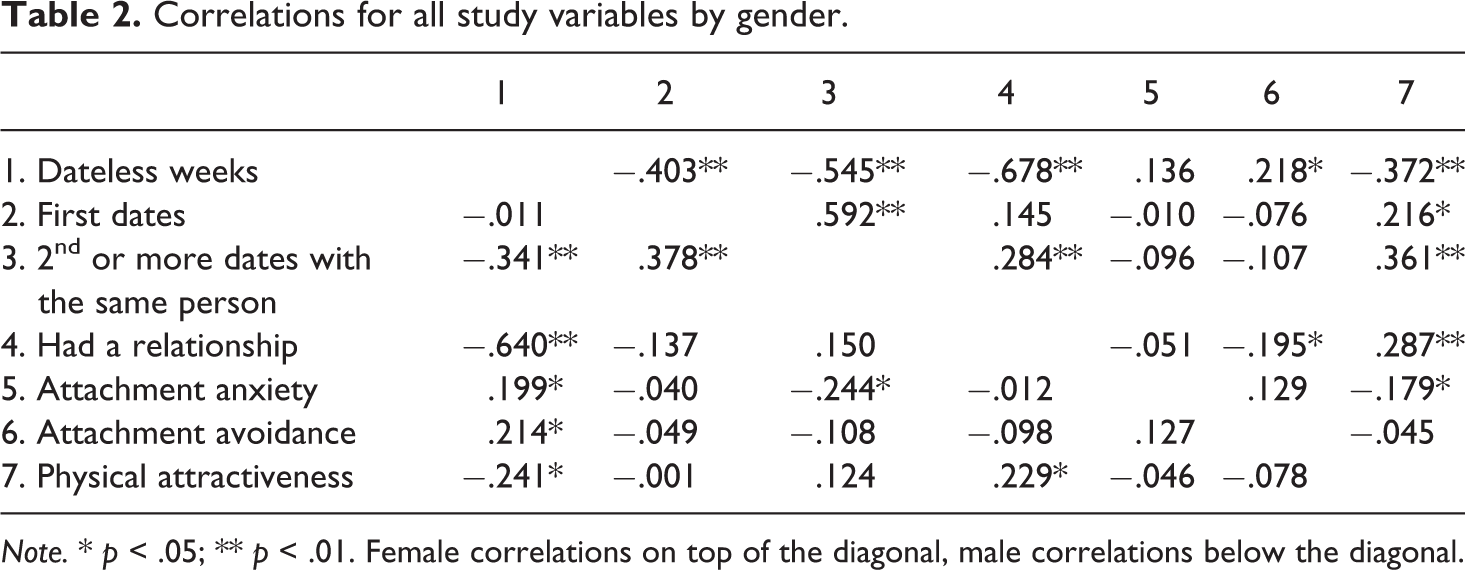
Note. * p < .05; ** p < .01. Female correlations on top of the diagonal, male correlations below the diagonal.
The first and second hypotheses called for testing physical attractiveness and the two attachment variables simultaneously with gender as a moderator (controlling for age). The results are seen in the top half of Table 1. Individual Wald tests were conducted to test the hypotheses that the variance contributed by physical attractiveness, anxious, and avoidant attachment was equal to zero. Results indicated that both anxious and avoidant attachment predicted unique variance for the outcomes Number of Dateless Weeks (χ2 = 45.83, p < .001) and Number of 2nd or More Dates with the Same Individual (χ2 = 16.96, p < .001), that avoidant attachment predicted unique variance for the outcome Relationship (χ2 = 5.01, p < .05), and that physical attractiveness predicted unique variance for all the outcomes. Furthermore, gender was a significant predictor of all the outcomes except Relationship.
Specific findings revealed that for every one-unit increase in physical attractiveness we would expect the average rate of dateless weeks to decrease by 14 percent. For every one-unit increase in attachment avoidance we would expect the average rate of dateless weeks to increase by about 9 percent, and for every one-unit increase in attachment anxiety we would expect the average rate of dateless weeks to increase by about 6 percent. Lastly, the average rate of dateless weeks is expected to be about 20 percent higher for females as compared to males.
For the outcome Number of First Dates we would expect every one-unit increase in physical attractiveness to result in an increase of 10 percent in the number of first dates. Furthermore, based on this model the average rate of first dates for females is expected to be 16 percent lower for females as compared to males.
For the outcome Number of 2nd or More Dates with the Same Individual every one-unit increase in physical attractiveness was related to an expected 33 percent increase in the average rate of second or more dates with the same individual. A one-unit increase in attachment anxiety was related to an 11 percent decrease in second or more dates with the same individual, and a one-unit increase in attachment avoidance was related to a 7 percent decrease in second or more dates with the same individual. The average rate of second or more dates with the same individual was expected to be 18 percent lower for females as compared to males.
Lastly, a one-unit increase in physical attractiveness was related to a 72 percent increase in the odds of being in a Relationship. And a one-unit increase in attachment avoidance was related to a 25 percent decrease in the odds of being in a Relationship.
Interaction effects
The second set of models tested included the interaction terms between gender and the other independent variables. The results for these models are presented as the marginal effect on the dependent variable at specific values of the independent variable. Following convention we chose to set the value of the independent variables at one standard deviation above and below the mean to signify high and low values on the continuous independent variable while holding all other covariates at their means. To test these models the independent variables physical attractiveness, attachment avoidance, and anxiety, gender, and the interactions between gender and physical attractiveness, attachment avoidance, and anxiety, as well as the covariate age were used to predict Number of Dateless Weeks, Number of First Dates, Number of 2nd or More Dates with the Same Individual, and Relationship. For results see the lower half of Table 1.
In the models, significant relationships existed between the gender x physical attractiveness interaction and number of First Dates, the gender x physical attractiveness interaction and Number of 2nd or More Dates with the Same Individual and the gender x attachment anxiety interaction and Number of 2nd or More Dates with the Same Individual. The marginal effects (displayed in Table 3), accompanied by a test of simple slopes indicated that while setting all other variables at their means, highly attractive females participated in more first dates than less attractive females β = 1.47, z = 4.35, p < .001. Highly attractive females also participated in more second or more dates with the same person than less attractive females β = 2.43, z = 9.89, p < .001. For males, however, the test of simple slopes indicated no difference in first dates β = .04, z = .08, p = .935, or second or more dates with the same person β = .78, z = 1.81, p = .07 at high and low levels of physical attractiveness. Furthermore, a test of simple slopes showed that highly physically attractive males participated in more first dates β = 1.50, z = 3.36, p < .001, and second or more dates with the same person β = 2.23, z = 6.14, p < .001 than less attractive females. Additionally, low physically attractive males participated in more first dates β = 1.50, z = 3.36, p < .001, and second or more dates with the same person β = 1.44, z = 4.88, p < .001 than low physically attractive females. Highly attractive females, and males generally seemed to have very similar dating experiences when it came to first dates and second or more dates with the same person.
Marginal effects highlighting the moderating effect of gender and the independent variables physical attractiveness, and attachment anxiety, on the dating outcomes.

Note. Columns labeled L are the marginal effects of the independent variable at on standard deviation below the mean. Columns labeled H are the marginal effects of the independent variable at on standard deviation above the mean. For each dependent variable, means in the same row differ from other means at p < .05 as specified by superscripts a,b,c,d.
The marginal effects for the gender x attachment anxiety interaction with Number of 2nd or More Dates with the Same Person (see Table 3), accompanied by a test of simple slopes indicated that while setting all other variables at their means, low anxious males participated in more second or more dates with the same person than high anxious males β = 1.39, z = 3.70, p < .001, high anxious females β = 1.36, z = 3.67, p < .001, and low anxious females β = 1.24, z = 3.45, p < .001. There was no difference in the slopes of high and low anxious females β = .113, z = .38, p = .702.
Summary and discussion
Hazan and Diamond theorize that attachment needs are as fundamental to being human as is the need to sexually propagate the human species. They critique the most widely accepted view of human mate selection as articulated in Buss’ sexual strategies theory and then put forward their own view that mate selection is more accurately seen as a process of pair bonding. They build their theory by carefully reviewing, critiquing, and disputing Buss’ research, and demonstrating the theoretical feasibility of an attachment perspective of mate selection. However, they do not perform empirical tests of their theoretical ideas. Therefore, we chose to conduct a test of their ideas, as well as follow up on some empirical studies that support the case they make for attachment as a theory of mate selection, but apply it to early relationship formation.
Based on their attachment theory of mate selection, we hypothesized that physical attractiveness and two indicators of attachment viability (attachment anxiety and attachment avoidance) would be related to our indicators of romantic relationship initiation, which consisted of four dating phases. The most fundamental conclusion we reach is that both physical attractiveness and attachment dimensions play a role in the early phases of romantic relationship initiation. More specifically, and consistent with both Buss’ sexual selectivity theory and Hazan and Diamond’s attachment theory of mate selection, physical attractiveness was related to all four dating phases variables, and at least one measure of attachment was related to three out of the four dating phases variables such that the more physically attractive and more securely attached one is, the more likely one is to have fewer dateless weeks, have more second or more dates with the same person, and to establish an exclusive relationship within the 32-week sampling period.
Hazan and Diamond suggest that attachment theory does not stipulate any sex differences. All humans need and seek attachment figures who provide them with felt security, a sense of reassurance that one is of worth and has others upon whom one can depend in times of emotional and physical need. Sexual strategies theory, on the other hand, has sexual differences as the fundamental premise of the theory. Therefore we tested the idea that there are no sex differences in the prediction of relationship initiation dating phases. Our fundamental conclusion in this instance is that there are sex differences and these differences are important for understanding mate selection.
With our statement of the hypotheses, we noted that the theories were not robust enough to suggest how the variables of physical attractiveness, attachment anxiety, attachment avoidance, and gender should singularly and interactively predict each phase of relationship initiation. Our findings allow us to make several observations and offer some insight that may refine the theory of human mate selection.
We suggest that Hazan and Diamond’s attachment theory of mate selection finds its best support in three of our findings. First, one or both components of attachment security/insecurity are predictors of three out of the four dating phases. This supports their idea that the attachment mechanism is operative in pair bonding. Attachment dimensions are indicative of people’s expectations or working model of how worthy they are to be cared for, loved, and respected by a potential attachment figure and how likely they think the potential attachment figure is to be available, responsive, and competent in responding to needs. Our measures were self-report measures which suggests that the more strongly young adults feel they are worthy of attention and care and the more they anticipate others will respond kindly, the more likely they are to progress in dating. Behaviorally they will act more secure in themselves and portray themselves as secure, and will therefore be of more interest to others. Moreover, the people they ask out or who ask them out are more likely to see them as someone who will be kind and responsive toward them (the dating partner).
Second, it is informative that all four predictors make simultaneous, statistically significant, and unique contributions to two of the dating phases—number of dateless weeks and number of second or more dates with the same individual. These two outcomes are the ones that are the best indicators of prolonged relationships. Young adults with insecure images of themselves and others, and behavioral manifestations of these images, clearly have less success in getting dates or getting beyond an initial date. To be secure from an attachment perspective is to be low in both anxiety and avoidance and this only occurred with those two outcomes. Thus, secure attachment helps above and beyond physical attractiveness to maintain dating relationships beyond a first date. Interestingly, attachment dimensions had no effect on number of first dates while being physically attractive did, which is likely because attachment representations are difficult to detect previous to a first date experience. Thus, physical attractiveness by itself may get one into dates, especially females, but staying power comes from physical attractiveness and expressions of attachment security. Attachment security helps the young single adults feel confident about allowing a relationship to develop and grow and also allows their partners to feel safe about the development of the relationships.
Third, at the multivariate level, physical attractiveness and attachment avoidance take on an increasingly important role in whether individuals cross over into a qualitatively different place in their relationships. For every one-unit increase in physical attractiveness the average number of second or more dates with the same person increases by 33 percent. Yet a one-unit increase in physical attractiveness accounted for a 72 percent increase in the odds of being in an exclusive relationship. This is more than double. Furthermore, a one-unit increase in attachment avoidance resulted in a 7 percent decrease in second or more dates with the same person and a 25 percent decrease in the odds of being in a relationship – 3.5 times as high. These findings may suggest that as relationships progress, individuals naturally begin to be weeded out as prospective mates based on their physical characteristics as well as their perceived ability to provide a secure pair bond.
Can this increased importance of physical attractiveness and avoidant attachment be explained by either attachment theory or sexual strategies theory? Numerous previous studies demonstrate that avoidant attachment is associated with dysfunctional beliefs like believing that love really doesn’t exist or will disappear over time, with lower commitment to and investment in romantic relationships, and with greater likelihood of being dissatisfied with a romantic relationship and of addressing that dissatisfaction by leaving (Mikulincer & Shaver, 2007). But none of this research addresses why attachment avoidance should increase in importance at this phase as compared to earlier phases. We believe that what we are seeing is that as couples approach this important turning point (Are we going on dates or are we progressing toward a committed relationship?), either the attachment avoidant persons find an excuse to exit before it becomes more serious than they can handle or the partners tire of trying to move relationships “to the next level” with someone who does not seem to be “kind, warm, responsive, and competent”.
Explaining the increase in importance of physical attractiveness is more difficult. Eastwick and Finkel (2008b) found that physical attractiveness was rated highly as a stated preference of an ideal partner. However, they found that stated preference and participants’ actual preferences did not correlate in the case of physical attractiveness in a speed dating scenario. As speed dating is a first date, our findings are consistent with theirs, suggesting that physical attractiveness is less meaningful in this initial stage. Why then does it become more important in later stages? Attachment theory provides some further insight. Zeifman and Hazan (2000) developed a theoretical model of the process of attachment formation. This process starts with the “preattachment” stage, with sexual attraction or romantic interest. As couples begin to fall in love, they move to the “attachment-in-the-making” phase. Physical contact is at its highest here and partners begin to display safe haven behavior such as increased proximity and comfort seeking. Since LDS young adults tend to move faster through relationships, we suggest that couples in the second or more dates with the same individual stage and those in a relationship are transitioning from the preattachment phase to the attachment-in-the-making stage. As such they are seeing each other with different eyes. That is, when in the preattachment stage they looked at physical attractiveness as a starting point for evaluating sexual maturity and attachment possibilities. Now that they have been together for a while and tested out the relationship enough to know that it may have possibilities, they use physical attractiveness to filter out those they do not perceive as having the potential to meet their attachment needs. From a sexual strategies perspective, as relationships progress, physical attractiveness may become more salient as individuals evaluate whether they are attracted enough to their partner to form a more serious relationship with them. Not because physical attractiveness is more important per se than other qualities, but because at this point of decision, sexual reproductive capacity must be given serious consideration.
Contrary to Hazan and Diamond’s theory, the process of attachment pair bonding does seem to differ by gender to some degree. Our findings suggest that lower attachment anxiety among males increases their ability to get multiple dates with the same females. However, females seem to experience the same number of multiple dates regardless of their anxiety level. Two possible explanations exist. The first is that females are seeing something they don’t like in the highly anxious males on the first or subsequent date and are not accepting second, third or fourth dates. Given what we know about anxiously attached individuals and interpersonal relationships (e.g., Mikulincer & Shaver, 2003), it may be that after a few dates, females begin to perceive these young men as clinging, and controlling, or submissive and overly accommodating, and thus break off the relationship. Buss’ arguments would also support this possibility as he suggests that females have more to lose in a relationship, and would therefore be likely to exert more control as they recognize characteristics (e.g., hyperactivating behavior) in the male that may suggest poor long-term viability as a suitable mate.
The other explanation is that more anxious males may worry about rejection (Mikulincer & Shaver, 2003) as the relationship moves forward, and thus are apprehensive about taking the next step. Why this occurs as a male but not a female phenomenon is difficult to explain, however it may be due to the fact that our sample represents a more traditional dating system. Bogle (2008) suggests that in such a system, at least early on, males have the prerogative when it comes to asking girls on a date, and progressing the relationship. Thus, females are often obliged to accept first date invitations and the males know this. After the first date, however, males may begin to experience some pressure associated with this prerogative, and those who are highly anxious refrain from pursuing multiple dates. Using this explanation it would seem that avoidance as well as anxious attachment would lead to this gender difference, which is not the case in our sample. However, it should be noted that in our sample of males, mean levels of anxiety were significantly higher than levels of avoidance, thus we would assume anxious behavior was more apparent than avoidant behavior.
Overall, our findings support the proposition that attachment dimensions are important components of mate selection as suggested by Hazan and Diamond in their attachment theory of mate selection. Furthermore, they are important at even the earliest stages of relationship development. On the other hand, their contention that there should be no sex differences was not supported by our findings, which also suggest that physical attractiveness—while an indicator of attachment viability—operates to some extent as posited by Buss in his sexual strategies theory. In sum, our findings provide empirical support for Hazan and Diamond’s attachment theory of mate selection, but not necessarily as an alternative explanation to Buss’ sexual strategies theory. Rather, our findings suggest that both may be viable explanations and can work in concert to more effectively explain why humans make decisions about with whom they will form a relationship.
Limitations and implication
One of the limitations of this study is the generalizability of the findings outside of an LDS population. Although this population allowed for investigation of dating patterns in a collapsed timeframe, it also limits the external validity of the results. On the other hand, LDS samples are generally more different in attitudes than in how they enact roles from those not of the LDS faith (e.g., Heaton, Goodman, and Holman, 1994). Furthermore, while LDS young single adults are different in their timing and pacing of relationship formation, there is little to suggest that the influence of attractiveness or attachment would be different.
Another limitation to the research is the short timeframe of the data collected. Even in this unique population, 32 weeks did not allow us to collect data on other variables (e.g., relationship length, how much time from first date to becoming exclusive, and number of relationships) that might have more fully tested the effects of physical attractiveness, attachment orientation, and gender on relationship development. We also recognize that there are many other factors that may predict these dating patterns. Evolutionary theory is not the only perspective social scientists use to predict mate selection (Cere, 2000).
Lastly, we note that because we used self-report measures there may be some inconsistencies in how different individuals report on these measures and particularly the dating outcomes. For example, our findings suggest males experience more dates in general than females do; however, this may simply be because males tend to define a date more loosely than do females.
In spite of these limitations, our research offers support for the dual importance of physical attractiveness and attachment behaviors at the earliest stages of romantic relationship development. Furthermore, this study and our findings have important implications for the field in several ways. For example, this represents the only study of which we are aware that actually follows the day-to-day dating experiences of young adults in a real-time fashion (weekly), rather than asking individuals to think back over an extended period of time. Thus, in its measurement framework this study is likely more valid and reliable. Relatedly, our study also represents the first to explicitly test attachment as a viable explanation of actual mate selection processes. We hope our test of some of the important theoretical ideas put forward in particular by Hazan and Diamond will stimulate further theorizing and research in this area. Lastly, from a practical perspective our findings suggest that an anxious or avoidant attachment orientation may indeed act as a stumbling block for relationship formation. Thus, individuals concerned with the current state of their dating lives may consider ways of overcoming attachment issues as an important step to becoming a more acceptable mate.
Footnotes
Funding
This research received no specific grant from any funding agency in the public, commercial, or not-for-profit sectors.