



Abstract
Relationships are strongly influenced by the perceptions of how one’s partner feels about oneself, yet little is known about the nature of these perceptions or how they relate to outcomes. This study introduces a construct: perceived inclusion of the other in the self (IOS-perceived). IOS-perceived extends the “inclusion of the other in the self” (IOS) model to incorporate one’s perception of the extent to which the partner includes one in his or her self-concept. This article proposes a mediational model in which perceptions of partner satisfaction lead to IOS-perceived, which in turn leads to IOS. Two studies, one including an implicit measure of IOS, provide strong support for the proposed model.
Keywords
Feeling close to another person is a wonderful experience, but one that assumes the risk of experiencing loss or rejection. Accordingly, before growing closer to a partner, one would like to be sure that the partner also desires closeness. We propose a model in which perceived partner satisfaction leads to perceived partner closeness, which (because it reassures the self that it is safe from rejection) leads to the feeling of closeness to the partner. We offer a new direct measure of perceived partner closeness that we believe will become a valuable tool.
We conceptualize closeness as a process by which individuals include the resources, identities, and perspectives of another in the self-concept or “inclusion of the other in the self” (IOS; Aron, Aron, Tudor, & Nelson, 1991). Studies using multiple methodologies show that people process information about close others like information about themselves (see Aron, Lewandowski, Mashek, & Aron, in press). Mental representations of self include “cognitive elements” of close others. For example, Aron et al. (1991) asked participants to rate the extent to which they and a nonclose other possessed trait pairs (e.g., “carefree-serious”). Participants were given the option to report that only one trait, both traits, or neither trait applied to themselves and a nonclose other. People reported both traits applied more when rating the self versus a nonclose other, an effect due to being less likely to make strong dispositional attributions to the self (Sande, Goethals, & Radloff, 1988). Aron et al. showed that individuals chose more “both apply” options when rating close others (similar to when rating the self) than when rating nonclose others. These results suggest that people include close others in the self.
Perceptions of partner
Reis, Clark, and Holmes (2004) make a compelling case that perceptions of relationship partners’ feelings have important effects. It matters a great deal to feel that a partner cares for oneself, understands one’s needs, and responds to them. Extensive research demonstrates that one’s own feelings about the partner have implications for relationship quality. There are measures of these constructs and much is known about underlying mechanisms. However, researchers know very little about people’s perceptions of how close others feel. Reis et al. (2004) argue that perceived partner responsiveness is an essential, understudied aspect of relationships.
Perceptions of the partner (bias effects) are more closely linked to relationship outcomes than the partner’s actual feelings (accuracy effects; Kenny & Acitelli, 2001). Meta-perceptions of how partners view oneself are largely based on self-views (e.g., Kenny & DePaulo, 1993). Indeed, people project their own levels of responsiveness onto the perceptions of the partner (Lemay, Clark, & Feeney, 2007). However, attachment theory (e.g., Bowlby, 1969) suggests distinct mental models of self and the other. We propose that specific cues are important for establishing general perceived partner responsiveness. We focus on perceptions that the partner (a) is satisfied, because this seems likely to be particularly visible and (b) feels close to oneself (as an important intervening variable).
The risk regulation system
IOS is thought to benefit the self by expanding the self-concept, but it can be risky because one takes into oneself aspects of the other, including the other’s outcomes (giving up pure self-interest) and also including the other’s view and acceptance of the self. Hence, we propose that before including the other in the self, one looks for cues that the partner includes one in his or her self-concept. Murray, Holmes, and Collins (2006) suggest that one’s confidence in perceived regard impacts relationship goals. One activates connectedness goals when one is confident in the partner’s perceived regard. One activates self-protection goals when one has doubts about the partner’s perceived regard. The risk regulation system gauges when to increase closeness with a partner or not based on perceived regard. In a potentially risky interpersonal situation, perceived regard is a cue that helps one decide whether to risk increased dependence or to protect the self from potential harm (Murray et al., 2006). However, this work aggregates indicators of perceived regard. We propose that one actively searches for specific cues that the partner returns one’s feelings before risking vulnerability.
Importance of measuring specific partner perceptions
Initial research is focused on larger, overarching constructs of perceived regard not specific aspects of such perceptions. Now it is valuable to move onto more specific distinctions among aspects of perceived regard to understand the roles each play. We focus on two relevant perceptions when deciding whether or not to increase closeness: perceptions of partner’s relationship satisfaction and perceptions of partner’s closeness.
Perceived partner satisfaction
It is one’s perception of partner’s positive affect about the relationship, which is likely relevant to deciding how a partner feels about the relationship. Research on interdependence theory (e.g., Rusbult, Martz, & Agnew, 1998) supports the notion that satisfaction plays a major role in predicting commitment to a relationship. It is reasonable to presume that people are aware of this link and believe they can evaluate this aspect of partner regard accurately.
Perceived partner closeness
It is one’s perception that the other includes the self (IOS-perceived), which is another cue to assess a partner’s feelings. IOS-perceived is likely less obvious (except as inferred from perceived partner satisfaction), but particularly important in deciding whether to risk increasing closeness. This construct extends the IOS model to incorporate perceptions of the extent to which the partner includes one in his or her self. If one assumes that the partner includes one in his or her self, one expects the partner to value and care for one’s welfare. We propose one can observe perceived partner satisfaction more easily than IOS-perceived, but that IOS-perceived is the most important indicator. Thus, one would use perceived partner satisfaction to determine whether the partner includes one in his or her self, and then as a result may increase or decrease one’s own level of closeness.
Distinguishing IOS-perceived from related constructs
As with IOS, we expect that although IOS-perceived undoubtedly shares variance with other relationship variables, it also accounts for important unique variance. Previous work finds that IOS is distinct from similarity to a partner (Mashek, Aron, & Boncimino, 2003). It is likely one’s own feelings about the partner influence perceptions of the partner’s feelings about the self (Lemay et al., 2007), but we argue (and test) that there is important variance not shared by IOS-perceived and IOS. Differences may occur, for example, due to relationship stage (early in a relationship, one may be less confident in IOS-perceived) or due to individual differences (e.g., anxiously attached individuals may perceive the partner as desiring less closeness than one feels to the partner).
In sum, it is important to understand specific perceptions of the partner because impressions of a partner’s satisfaction and closeness are likely to shape one’s feelings about a relationship (in terms of one’s own closeness as measured in this study) as well as decisions to pursue or end the relationship. Perceptions of partner feelings, because they are more immediately accessible, likely play a bigger role in one’s own experience than even the partner’s actual feelings.
The proposed model
The logic above implies a mediation model (Figure 1) in which (a) perceived partner satisfaction leads to (b) perceived partner closeness, which leads to (c) one’s own feelings of closeness in the relationship. The focal research questions of the two studies described below represent each of these steps in the mediation process, plus the overall test of mediation.

Proposed model.
Study 1
Method
Participants
Participants were 77 undergraduates (51 women) in romantic relationships: mean age = 19.71 years (SD = 3.78); mean relationship length = 1.58 years (SD = 1.51). 1
Measures
In a mass testing, we assessed perceived partner satisfaction with two items from the satisfaction subscale of the Investment Model Scale (Rusbult et al., 1998), modified to represent perceptions of the partner’s satisfaction: “My partner thinks our relationship is close to ideal,” “My partner feels satisfied with our relationship” (α = .69). We assessed closeness with the IOS Scale (Aron, Aron, & Smollan, 1992), containing seven pairs of overlapping circles labeled with self and partner, ranging from no overlap to almost complete overlap. Participants chose the circle pair that best represents their relationship. To assess IOS-perceived, we used the same overlapping circles, except participants received additional instructions designed to draw attention to the new, different perspective: “Please answer the next question as if you were your partner. That is, please tell me the answer that you think she or he would give if asked.”
Results and discussion
Predicted model
Descriptive statistics and correlations are shown in Table 1. Figure 2 shows mediation results. Following current recommendations (e.g., Preacher & Hayes, 2004), we used bootstrapping to assess indirect effects with 5000 resamples and 95% confidence intervals (CIs); in every case, results were also significant with Sobel tests. As proposed, there was a strong overall effect of perceived partner satisfaction on IOS; a strong effect of perceived partner satisfaction on IOS-perceived; a strong effect of IOS-perceived on IOS even after controlling perceived satisfaction; and a significant reduction in the direct effect when the mediator was included (indirect effect; ab = .30, 95% CI: [.14, .52]). The direct path remained significant (p < .05), suggesting “partial mediation.” Results were not moderated by gender or relationship length (although there were some main effects for these variables in expected directions).
Descriptive statistics.

*p < .05; **p < .01 (all two-tailed test).
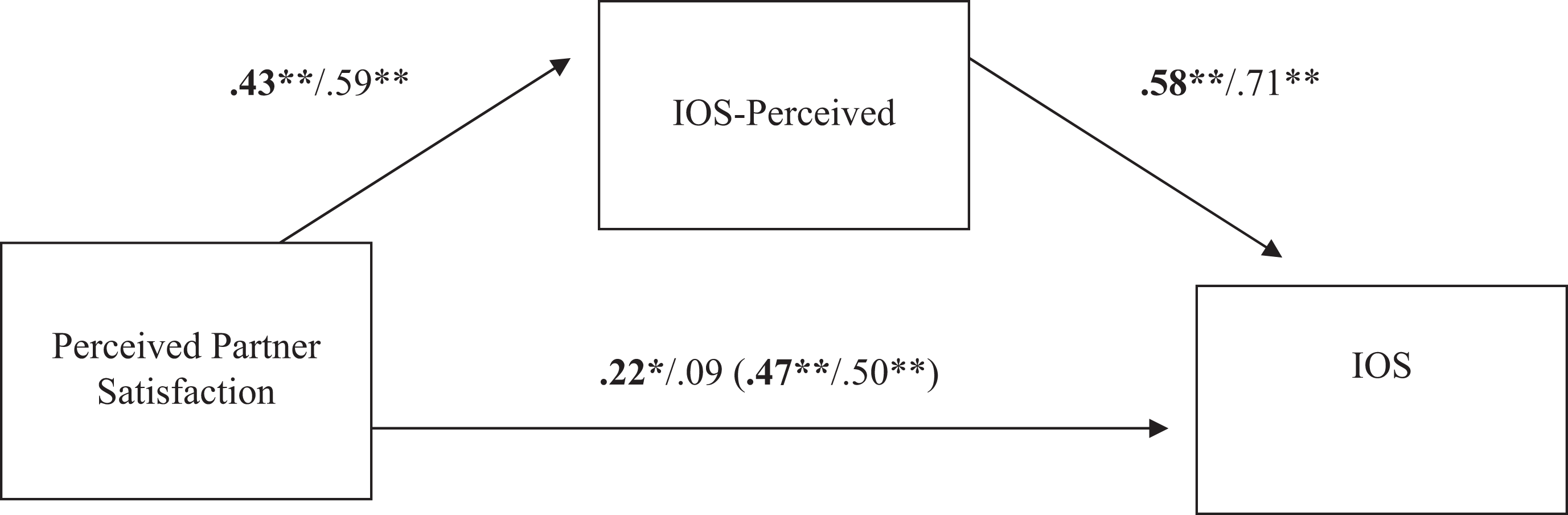
Explicit IOS β values. Study 1: bolded; study 2: plain text. *p < .05 and **p < .001. IOS: inclusion of the other in the self.
Reverse causal model
We tested a reverse mediation model (IOS to IOS-perceived to perceived partner satisfaction), which showed a smaller reduction with the addition of the mediator (from β = .48 to β = .34) and a nonsignificant indirect effect (ab = .12, 95% CI: [−.08, .31]). Thus, the proposed model better fits the data.
Study 2
Study 2 attempted to replicate study 1 with a larger sample, a longer measure of satisfaction, and an implicit measure of closeness. In addition, we counterbalanced the order of measures to assess the possibility that study 1 results were due to order effects, as might result from participants anchoring their view of others in their view of the self (e.g., Krueger, 2000).
Method
Participants
Participants constituted 260 undergraduates (124 women) who reported on either a current relationship (n = 112) or their most recent past relationship; mean length = 1.54 years (SD = 2.20), mean age = 20.16 years (SD = 1.83).
Measures
The measures presented were part of a larger study. We assessed perceived partner satisfaction with the study 1 items, plus two more items modified from Rusbult et al. (1998): “Our relationship makes my partner very happy,” “My partner thinks our relationship is much better than others’ relationships” (α = .89). IOS and IOS-perceived were identical to study 1 with order counterbalanced. The Sande et al. (1988) attribution questionnaire provided an implicit measure of IOS (α = .67). This measure contains 11 bipolar adjective pairs (described in the introduction). Following Aron et al. (1991), more “both” options chosen to describe the partner indicated greater closeness (i.e., the tendency to treat the partner like the self).
Results and discussion
Predicted model
Paralleling study 1, there was strong support for the model, including each of the individual paths and the overall test of the mediation (ab = .56, SE = .07, 95% CI: [.43, .70]). The mediated path from perceived partner satisfaction to IOS became nonsignificant, suggesting “full mediation.” Although there were some main effects, none of the results changed by controlling for gender, relationship status, or relationship length nor did they moderate any effects.
Implicit IOS model
In addition, IOS-perceived mediated the effect of perceived partner satisfaction on implicit IOS (ab = .26, SE = .12, 95% CI: [.03, .50]; see Figure 3).
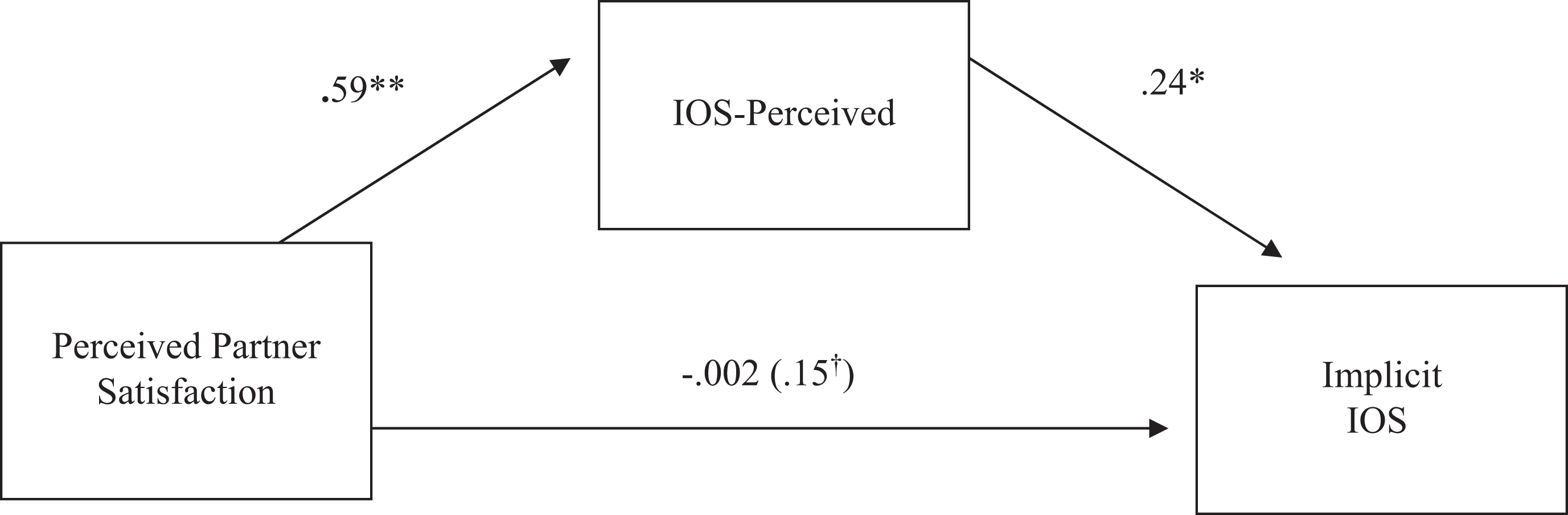
Implicit IOS β values. † p = .06; *p < .05; **p < .001. IOS: inclusion of the other in the self.
Reverse causal models
As in study 1, the reverse models showed a smaller reduction (from β = .50 to β = .14 for explicit; β = .09 to β = −.001 for implicit) than the proposed models; but indirect effects were significant (ab = .27, SE = .05, 95% CI: [.18, .37] for explicit; ab = .09, SE = .03, 95% CI: [.03, .16] for implicit).
General discussion
Two studies, using explicit and implicit measures, support the proposed model that perceived partner satisfaction leads to perceptions of partner closeness, which impacts one’s own closeness to the partner. These findings extend the risk regulation model by uncovering specific processes that mediate closeness with a partner. Our model emphasizes the importance of specific perceptions of the partner, focusing on two relevant constructs likely to be salient on the path to developing closeness.
This study is the first to introduce the construct of perceived inclusion of the other in the self (IOS-perceived). IOS-perceived is distinct from IOS and taps into a mental model of specific perceptions of the partner’s feelings. Although the correlations between IOS-perceived and IOS are large (r’s = .68 and .77), they are not perfect, suggesting each accounts for unique variance. Furthermore, a key part of the pattern supported in each study relies on unique variance in IOS-perceived after controlling for IOS. In addition, Aron et al. (1992) found that retest reliability for IOS was significantly higher than IOS-perceived (α = .95; difference between reliability and correlation: study 1, Z = −6.45; study 2, Z = −6.73; both ps < .001). The one-item pictorial measure answers Reis et al.’s (2004) call for attention to perceptions of the partner, providing an easy and intuitive way to measure such perceptions. Another practical benefit is only one member of the couple is necessary to measure perceptions of the partner. One possible limitation is participants may find it awkward to respond “as if you were your partner.” Future work could simplify instructions to read, “Choose the pair of circles that best represents how your partner views your relationship.”
Future research should use longitudinal and experimental methods to test the causal direction. Our data were partially consistent with a reverse model suggesting that the pathway could move the opposite way. Theoretically, it seems likely that the perceptions of the partner’s feelings would guide one’s own feelings of closeness to a partner; but the reverse or a bidirectional relationship is certainly possible. Future research might identify individuals with discrepancies between own and perceived partner closeness and study resulting processes. It is also important to examine the generalizability of the model to other kinds of relationships, as well as other cultural and social class contexts.
This work advances knowledge, suggesting how perceptions of the partner guide one’s own feelings about the partner. These studies support the importance of a new construct, IOS-perceived, as a key predictor of relationship closeness and make available an efficient measure that could be applied in a wide variety of domains.
Footnotes
Acknowledgments
We would like to thank Janice Rodden, Meredith Van Vleet, and Jennifer Zogg for their helpful comments on this manuscript.
Funding
This work was financially supported by a grant from the National Institute on Aging (F32-AG037262).
Note
References
Supplementary Material
Please find the following supplemental material available below.
For Open Access articles published under a Creative Commons License, all supplemental material carries the same license as the article it is associated with.
For non-Open Access articles published, all supplemental material carries a non-exclusive license, and permission requests for re-use of supplemental material or any part of supplemental material shall be sent directly to the copyright owner as specified in the copyright notice associated with the article.
