



Abstract
The current study explored how family characteristics (i.e., family cohesiveness and marital adjustment) and child characteristics (i.e., temperament) assessed when the child was 13 months old predicted child behavior with mothers and fathers at 36 months. Mother–father–child interaction was observed to assess family cohesiveness at 13 months. Mothers and fathers also completed questionnaires assessing their perceptions of marital adjustment and their child’s temperament at 13 months. Based on dyadic parent–child interactions at 36 months, under-controlled behavior and positive engagement were examined as outcome variables. Results indicated that observed family cohesiveness predicted positive engagement with both parents. Moreover, in families with high cohesiveness at 13 months, child behavior was significantly consistent across mother–child and father–child interactions, whereas in families with low cohesiveness, consistency of child behavior was not observed. Results also revealed that fathers’ perceptions of marital adjustment directly predicted child behavior with fathers, while the combination of low family cohesiveness/low marital adjustment and difficult temperament predicted child behavior with mothers.
Keywords
Family systems theory suggests that children experience overlapping yet distinct interaction patterns across different family contexts (Minuchin, 1985, 1988). Mother–child and father–child interactions provide particularly salient socialization contexts for young children (e.g., Clarke-Stewart, 1987; Parke & Buriel, 2006), yet systematic differences in child behavior across these two interaction contexts have been noted. Indeed, several studies have shown that children behave differently when interacting with each parent. For example, Power, McGrath, Hughes, and Manire (1994) found that preschool boys tend to be more compliant with fathers than mothers, while girls show no difference in compliance across the two contexts. Similarly, Feldman and Klein (2003) observed that toddlers were higher on compliance when interacting with their fathers than with their mothers. Other studies have shown that children engage in more physical play with fathers than with mothers (e.g., Bright & Stockdale, 1984; Carson & Parke, 1996). Differences in affect have also been demonstrated such as higher levels of positive affect with mothers than fathers (Feldman & Klein, 2003; Field, Vega-Lahr, Goldstein, & Scafidi, 1987; Forbes, Cohn, Allen, & Lewinsohn, 2004). What is lacking in this line of work, however, is an explanation for how children develop different interaction patterns with mothers and fathers. Therefore, the current study examined factors that might predict child behavior in these two different dyadic contexts. Specifically, we examined family cohesiveness, marital adjustment, and child temperament at 13 months and explored whether these family variables predicted child behavior with mothers and fathers 2 years later.
Family cohesiveness
According to family systems theory (Cox & Paley, 1997; Minuchin, 1985, 1988), the family operates as a whole, which cannot be captured by the simple sum or extension of individuals’ and dyads’ characteristics. Family cohesiveness, for example, represents the sense of togetherness and closeness in a family, and it has been identified as one of the most central dimensions of family functioning (e.g., Bloom, 1985; Olson, Sprenkle, & Russell, 1979). Past research also showed that family cohesiveness emerges early on and remains fairly stable over the first few years of life (e.g., Feldman & Masalha, 2010; Fivaz-Depeursinge, Corboz-Warnery, & Keren, 2004; McHale, 1995). In addition, because highly cohesive families show emotional closeness across multiple family subsystems including mother–child and father–child relationships during the triadic family interaction, it is very possible that early family cohesiveness may help children develop similar interaction patterns with mothers and fathers.
Numerous studies have found a concurrent and longitudinal linear relationship between cohesiveness and child adjustment, demonstrating that children in families that show high levels of cohesiveness during a triadic family interaction are less likely to have emotional and behavioral adjustment problems (e.g., Barber & Buehler, 1996; Cooper, Holman, & Braithwaite, 1983; Feldman & Masalha, 2010; Kerig, 1995; Lindahl, 1998; Lucia & Breslau, 2006; Richmond & Stocker, 2006; Schoppe, Mangelsdorf, & Frosch, 2001). It has also been found that in highly cohesive families, children experience less emotional insecurity when exposed to marital conflict, suggesting family cohesiveness as a protective factor in the context of marital conflict or maladjustment (Davies, Harold, Goeke-Morey, & Cummings, 2002; Lindahl & Malik, 2001).
Increasing numbers of studies have examined triadic family interaction either as a correlate of family and child functioning or as a context of parenting/co-parenting behavior. However, studies that focus on a triadic level of family functioning (as observed through family cohesiveness) are still relatively lacking compared to studies on dyadic relationships, especially among families with infants. In addition, although family cohesiveness often reflects other aspects of family functioning such as valuing and practicing family rituals (Crespo, Kielpikowski, Pryor, & Jose, 2011), which may create more family time together and thus contribute to greater consistency in child behavior across mother–child and father–child interactions, no study to date has investigated whether family cohesiveness in infancy contributes to cross-situational consistency of child behavior. Given that highly cohesive families exhibit a strong sense of unity and togetherness, it is very possible that children in highly cohesive families may develop more similar interactional styles with both parents than children in less cohesive families. Taken together, the current study examined family cohesiveness observed in infancy in order to better understand the role of early triadic family functioning in predicting children’s behavior at the age of 3 with each parent and its consistency across the mother–child and father–child interaction contexts.
Marital adjustment
In addition to wholeness, interdependence is another key principle of family systems theory: Subsystems of the family (e.g., individual family members, dyadic relationships, and the triadic relationships) influence one another, not in a top-down fashion, but rather in a continuous, reciprocal fashion (Cox & Paley, 1997; Minuchin, 1985, 1988). One of the most widely studied family subsystems is a marital relationship. It is well-documented that how the marital relationship functions (e.g., marital conflict, marital satisfaction) is closely tied to how children function at later years (see Cummings & Davies, 1994; Davies & Cummings, 1994; Grych & Fincham, 1990, for reviews). The link between marital quality and parent–child relationship quality has also been demonstrated concurrently (Goldberg & Easterbrooks, 1984) and longitudinally from infancy to early childhood (Frosch, Mangelsdorf, & McHale, 2000; Owen & Cox, 1997), suggesting that martial relationship quality at earlier years has a long-term implication for later child functioning.
However, we know very little about whether marital adjustment predicts later child behavior with mothers and fathers and if so whether the predictive validity of marital adjustment differs for child behavior with mothers versus fathers. Moreover, despite a significant increase in fathers’ involvement in childrearing over the past few decades (Pleck & Masciadrelli, 2004), very little research has been conducted to investigate how fathers contribute to the development of children’s interactive patterns with fathers. Therefore, the current study examined not only mothers’ but also fathers’ perceptions of marital adjustment and how they predicted child behavior with mothers and fathers, respectively.
Child temperament
Temperament is defined as “constitutionally based individual differences in reactivity and self-regulation” (Rothbart & Bates, 2006). Temperament researchers have documented modest stability in temperamental characteristics across time and situations. Thus, an association between temperamental characteristics and child behavior exhibited during a parent–child interaction is expected. To assess child temperament, numerous studies have utilized parental reports of temperament (e.g., Belsky & Rovine, 1990; Pauli-Pott, Mertesacker, Bade, Haverkock, & Beckmann, 2003; Schoppe-Sullivan, Mangelsdorf, Brown, & Szewczyk Sokolowski, 2007). Although parental reports have been criticized for lack of agreement with observers and high subjectivity (Kagan, 1998; Kagan & Fox, 2006), convergent and predictive validity of parental reports of temperament have been well established (Mangelsdorf, Schoppe-Sullivan, & Buur, 2000; Parade & Leerkes, 2008; Rothbart & Bates, 2006).
In fact, past research provides support for the relevance of parental perceptions of temperament for children’s observed behavior during a parent–child interaction. Lee and Bates (1985) found that 2-year-old children who were perceived by their mothers as difficult at earlier ages showed more resistance to the mothers’ attempts to control their disruptive behavior (e.g., breaking house rules, causing damage to object/person). Harris, Robinson, Chang, and Burns (2007) also found that when 3- to 7-year-old children were concurrently rated by their mothers as low on effortful control (e.g., short attention span, lack of inhibitory control), they showed difficulty voluntarily sustaining their attention to the task during a mother–child interaction. However, we still know little about fathers’ perceptions of temperament and their associations with observed child behaviors (see e.g. Schoppe-Sullivan et al., 2007; Goldsmith, 1996 for exceptions). If mothers and fathers have different perceptions about their child’s temperament (e.g., Mangelsdorf et al., 2000; Rothbart, Ahadi, Hershey, & Fisher, 2001), they each may elicit different patterns of behavioral and emotional reactions from their child during dyadic parent–child interaction. Therefore, the current study utilized both mothers’ and fathers’ perceptions of temperament at 13 months and examined how they similarly or differentially predicted child behavior with mothers and fathers at 36 months, respectively.
The dual-risk model
In addition to direct associations between family and child characteristics at 13 months and child behavior 2 years later, the current study tested the dual-risk model (or diathesis-stress model) with difficult temperament (typically characterized by lack of adaptability and predictability, intense behavioral and emotional reactions) as a vulnerability factor (or a diathesis) (Belsky, Bakermans-Kranenburg, & van IJzendoorn, 2007; Roisman et al., 2012). Specifically, we investigated how observed family cohesiveness and parents’ perceptions of marital adjustment interacted with child temperament to predict child behavior. There is cumulating evidence suggesting that children with more difficult temperament, which serves as a vulnerability, are at higher risk of maladjustment when their parents’ marital relationship is unsatisfying or conflictual (Easterbrooks, Cummings, & Emde, 1994; Grych & Fincham, 1990; Hetherington, 1989; Zimet & Jacob, 2001). Relatedly, Tschann, Kaiser, Chesney, Alkon, and Boyce (1996) found that children with more difficult temperament who were exposed to high levels of family conflict showed the highest risk of internalizing and externalizing behavior problems, whereas children with less difficult temperament had much fewer behavior problems regardless of levels of family conflict. In this line of research, however, the primary focus has been on children’s overall adjustment; thus, we do not yet know whether the dual-risk model could be equally applicable to explain children’s behavior with mothers versus fathers. Therefore, the current study examined low family cohesiveness and low marital adjustment as cumulative risk factors for children with difficult temperament in the prediction of child behavior with each parent.
The current study
In summary, the current study addressed three questions: (1) How do family cohesiveness, marital adjustment, and child temperament at 13 months similarly or differentially predict child behavior with mothers and fathers at 36 months? (2) Does greater family cohesiveness contribute to greater cross-situational consistency in child behavior?, and (3) How do family cohesiveness and marital adjustment interact with child temperament to predict child behavior with mothers and fathers at 36 months?
Based on past research described above, we hypothesized that children would behave differently with mothers and fathers, such that they would show higher levels of compliance (e.g., Feldman & Klein, 2003) with fathers than with mothers, or higher levels of positive affect with mothers than with fathers (e.g., Feldman & Klein, 2003). We also predicted that children in highly cohesive families would exhibit greater consistency in their behavior across interactions with mothers and fathers. However, we should note that this hypothesis is largely exploratory due to lack of previous research examining this issue.
In addition, we expected that low family cohesiveness (e.g., Kerig, 1995; Lindahl, 1998), parental perceptions of low marital adjustment (e.g., Cummings & Davies, 1994), and parental perceptions of difficult temperament (e.g., Lee & Bates, 1985) would predict less optimal child behavior (e.g., low compliance, high distractibility, and low positive affect). Finally, in the dual-risk models, child’s difficult temperament was expected to moderate the link between family cohesiveness/marital adjustment and child behavior, such that children with more difficult temperament would exhibit less optimal behavior with both parents only when faced with other risk factors such as low family cohesiveness and low marital adjustment.
Method
Participants
A total of 65 mother–child dyads (31 girls, 34 boys) and 59 father–child dyads (27 girls, 32 boys) participated in this investigation as part of a larger longitudinal study of family relationships. All the participants were from a medium-sized city and surrounding areas in the Midwestern US and recruited through posted notices in the communities, online newsletter at the university, or subject files maintained in the Psychology department. The numbers of mothers and fathers are not equal because some fathers did not complete the questionnaires, although their interactions with their children were all videotaped during the home visit. Therefore, 59 pairs of mothers and fathers were from the same families.
At the time of the 13-month assessment, the mean of parental age was 31.89 years (SD = 5.12 years) for mothers and 34.30 years (SD = 7.40 years) for fathers. The mean of child’s age was 12.53 months for both mother–child dyads (SD = 21 days) and father–child dyads (SD = 22 days). Both mothers and fathers were relatively well educated: 1.7% of fathers had only a high school degree; 7.7% of mothers and 11.9% of fathers had some college education; 47.7% of mothers and 37.7% of fathers had a college degree; 29.2% of mothers and 28.8% of fathers had a master’s degree; and 15.4% of mothers and 20.3% of fathers had a PhD. Both parents were predominantly European American: 86.2% of mothers and 83.1% of fathers were European American; 6.2% of mothers and 8.5% of fathers were Latino; 0% of mothers and 3.4% of fathers were African-American; 6.2% of mothers and 1.7% of fathers were Asian or Asian-American; and 1.5% of mothers and 3.4% of fathers were mixed ethnicity. The average family income was between $51,000 and $60,000 at 13 months for both mother–child and father–child dyads.
Procedure
When the target child was 1 year of age, families were contacted to schedule a laboratory visit. Approximately 2 weeks prior to the actual laboratory visit, families received a packet of questionnaires to complete before the laboratory visit (primarily given the limited amount of time available for the laboratory visit), including the ones asking about child temperament and marital adjustment. The mother and the father were each instructed to complete the questionnaires independently of each other to ensure that their responses were not influenced by their spouses. During the laboratory visit at 13 months, the whole family (mother, father, and child) was given a set of stacking rings, a shape sorter, and blocks and instructed to play with them in that order for 10 min. The family was then given a box of new toys (e.g., toy telephones and puppets) to play for 5 min and finally cleaned them up as a family.
Approximately 2 years later, families were contacted again to schedule a home visit during which mother–child and father–child interactions were videotaped. Each parent–child dyad was provided with three different 24-piece puzzles to complete in 15 min. Given difficulty of the task for 3-year-old children, parental interventions were necessary for completion of the task. To avoid any order effects, the order of mother–child and father–child interactions was counterbalanced across families.
Observations and parental reports at 13 months
Family cohesiveness
Triadic family interaction videotaped during the lab visit was later coded by two trained coders using the System for Coding Interactions and Family Functioning (SCIFF; Lindahl & Malik, 2001). Although the SCIFF yields multiple scales of family functioning, we focused on a scale called Cohesiveness in order to capture how families interact as a whole and how it contributes to the development of child behavior with each parent. Cohesiveness was rated on a 5-point scale (1 = very low, 2 = low, 3 = moderate, 4 = high, and 5 = very high). Families with high levels of cohesiveness demonstrate the sense of togetherness, closeness, and mutual respect and emotional bonding among all the family members. The coders overlapped on 38.5% of the observations that were randomly chosen. Percentage agreement within one scale point was 97.6%. γ value was also used as a measure of inter-rater reliability because it is more appropriate for ordinal data than kappa (Liebetrau, 1983), but it too controls for chance agreement. γ coefficient was .88. All disagreements were resolved by conferencing.
Marital adjustment
Each parent filled out a 32-item questionnaire, the Dyadic Adjustment Scale (DAS; Spanier, 1976), yielding a total marital adjustment score. A lower total score indicates a lower level of marital adjustment, and a relationship with a total score of 107 or below is considered distressed (Crane, Allgood, Larson, & Griffin, 1990). In our sample, 10.8% of mothers and 20.3% of fathers had scores indicative of marital distress. Cronbach’s αs for the DAS total scores were .88 for mothers and .91 for fathers. The correlation between mothers’ and fathers’ scores was r = .57, p < .001.
Child temperament
Each parent completed the Infant Characteristics Questionnaire (Bates, Freeland, & Lounsbury, 1979). This 7-point scale, 28-item questionnaire measures four different aspects of infant temperament: fussiness/difficulty (nine items), unadaptability (five items), unpredictability (six items), and dullness (four items). Fussiness/difficulty reflects how frequently and vigorously the infant cries and how hard it is to soothe him or her when upset. Unadaptability reflects how negatively the infant responds to novelty and change. Unpredictability corresponds to how difficult it is to predict the infant’s sleep/feeding cycles and to interpret his or her cries or fusses. Finally, dullness represents how inactive and unresponsive the infant usually is.
In order to create a broader construct of difficult temperament, all the items that captured fussiness/difficulty, unadaptability, and unpredictability were summed for mothers and fathers separately. Dullness was excluded because it does not conceptually fit the construct of difficult temperament originally proposed by Thomas and Chess (1977), which is often characterized by high emotional and behavioral reactivity, unsoothability, and unpredictability. In addition, internal consistency of the dullness scale was relatively low (.56 for mothers and .45 for fathers). Cronbach’s αs for difficult temperament were .76 for mothers and .84 for fathers. The correlation between mothers’ and fathers’ ratings was r = .66, p < .001.
Although mothers’ and fathers’ reports of marital adjustment and difficult temperament were moderately correlated, past research suggested that each parent’s perception of marriage and child temperament plays different roles in a parent–child relationship (e.g., Belsky, Youngblade, Rovine, & Volling, 1991; Mangelsdorf et al., 2000; Rothbart et al., 2001). Therefore, each parent’s perceptions were examined separately in the current investigation.
Child behavior at 36 months
Two independent coders completed global ratings of child behavior during a puzzle task with each parent using the coding system adapted from Egeland, Sroufe, and Erickson (1983). The global scales, rated on a 5-point scale (1 = very low, 2 = low, 3 = moderate, 4 = high, and 5 = very high), included persistence (active engagement in face of difficulty and regardless of amount of parental guidance), enthusiasm (active efforts and initiatives with vigor and excitement), positive affect (frequent and/or intense expressions of smiling, laughing, and a positive tone of voice), negative affect (frequent and/or intense expressions of fussing, whining, and refusals), activity level (the amount and duration of physical activity), distractibility (frequent attention shifts due to external distractions), avoidance of parent (clear and explicit attempts to avoid interactions with the parent), affection toward parent (affective and behavioral sharing of positive feeling with the parent), and compliance (willingness to listen to the parent and comply with the parent’s suggestions and requests).
The two coders were assigned randomly chosen parent–child interaction episodes to code. They overlapped on 75.9% of the mother–child interactions and 72.7% of the father–child interactions. Percentage agreement within one scale point ranged from 93.3% to 100% (M = 96.9%) for the nine scales of child behavior with mothers, and from 94.6% to 100% (M = 96.2%) for the nine scales of child behavior with fathers. γ coefficients ranged from .86 to .97 (M = .93) for child behavior with mothers and from .83 to .97 (M = .90) for child behavior with fathers. All disagreements were resolved by conferencing.
In order to reduce the number of child behavior scales for subsequent analyses, principal component analysis was conducted using the Varimax rotation method. Results revealed the same two components for child behavior with both parents. For one component, persistence (reversed), activity level, distractibility, and compliance (reversed) had loadings higher than .65 in absolute values (ranging from .76 to .97 for mothers and from .77 to .93 for fathers). Therefore, a new composite variable, called Under-controlled Behavior, was created by summing activity level and distractibility and subtracting persistence and compliance (α = .95 for both mothers and fathers).
For the other component, enthusiasm, positive affect, and affection toward parent showed loadings higher than .65 (ranging from .77 to .87 for mothers and from .69 to .92 for fathers). Based on this pattern of positive loadings, a new composite variable, called Positive Engagement, was created by summing enthusiasm, positive affect, and affection toward parent (α = .88 for both mothers and fathers). Negative affect and avoidance of parent loaded on both components, thus they were not included in either composite and were excluded from subsequent analyses.
Children who received high ratings on under-controlled behavior were constantly physically active (e.g., fidgeting, standing up, moving around the room), easily distracted by the surroundings, not actively engaged in the task, and not very compliant with parents. On the other hand, children high on positive engagement demonstrated a fair amount of enthusiasm and joy toward the task and showed a lot of positive emotions and frequently shared them with parents. Under-controlled behavior and positive engagement were significantly correlated, r(65) = −.65, p < .001 for mothers, and r(59) = −.60, p < .001 for fathers. Based on prior research (Rothbart, Ahadi, & Evans, 2000), the two components were treated as overlapping yet distinct constructs of child behavior in the current study.
Results
Several different sets of analyses were conducted. First, correlations between demographic variables and child behavior were examined. Child gender differences in child behavior were also examined. Second, direct associations between predictor variables and child behavior with each parent were explored. Third, to explore general consistency in child behavior across the two dyads, child behavior with one parent was compared to the same behavior with the other parent. Given our particular interest in the role of family cohesiveness in the development of child behavior, we also examined levels of cross-situational consistency in child behavior as a function of levels of family cohesiveness. Finally, a series of hierarchical regression analyses were conducted to test the dual-risk model by examining difficult temperament as a vulnerability factor (or a diathesis) and low family cohesiveness and low marital adjustment as cumulative risk factors to predict child behavior in each dyad. The means and SDs for all the variables are reported in Table 1.
Intercorrelations and descriptive statistics for predictor variables and child behavior.

⁁p < .10; *p < .05; ***p < .001.
Preliminary analyses
Mothers’ and fathers’ age and education were not significantly related to child behavior with mothers and fathers, respectively. Family income at 13 months was not related to children’s behavior with either parent. When child gender differences in child behavior were explored, one difference emerged. When interacting with mothers, girls showed higher levels of positive engagement than boys did (Ms = 10.35 for girls vs. 8.35 for boys), t(63) = 2.70, p < .01. As a result of these preliminary analyses, the only demographic variable included in subsequent analyses was child gender.
Correlational analyses: Family variables and child behavior with each parent
As Table 1 reveals, family cohesiveness was related to positive engagement with both mothers, r = .25, p < .05, and fathers, r = .29, p < .05. Mothers’ perceptions of marital adjustment were not associated with either under-controlled behavior (r = −.06, p = .66) or positive engagement (r = −.06, p = .64) with mothers, but fathers’ perceptions of marital adjustment were associated with children’s observed under-controlled behavior, r = −.45, p < .001, and positive engagement with fathers, r = .30, p < .05. The Fisher r-to-z transformation revealed that these correlations for fathers were significantly different from the corresponding correlations for mothers at a .05 level of significance (−.45 vs. −.06 for under-controlled behavior and .30 vs. −.06 for positive engagement). Neither parent’s perceptions of difficult temperament were directly associated with observed child behavior. In sum, the results suggested that when families showed high levels of togetherness and closeness during the triadic family interaction at 13 months, children were more positively engaged with both mothers and fathers 2 years later. In addition, 3-year-old children were behaviorally better regulated and more affectively positive when interacting with fathers who reported higher marital adjustment 2 years earlier.
Consistency of child behavior across contexts
When consistency of child behavior across mother–child and father–child interactions was explored, results indicated lack of significant consistency for under-controlled behavior, r = .24, p = .07, but moderate consistency for positive engagement, r = .45, p < .001. There were no significant mean-level differences in under-controlled behavior or positive engagement with mothers and fathers. In order to explore whether consistency in child behavior across the dyadic contexts would vary as a function of family cohesiveness at 13 months, a median split was performed with family cohesiveness. Results revealed that in the 21 families with low cohesiveness (ratings ranged from 2 to 3), neither under-controlled behavior nor positive engagement was significantly consistent across the dyadic interactions (r = .06, p = .80; r = .33, p = .15, respectively). By contrast, in 38 families with high cohesiveness (ratings ranged from 4 to 5), both under-controlled behavior and positive engagement were moderately consistent across the contexts (r = .35, p < .05; r = .54, p < .001, respectively). We performed Fisher r-to-z transformation on .06 and .35 for under-controlled behavior and .33 and .54 for positive engagement across low and high cohesive families. Not surprisingly, given the relatively small sample size for each group, neither pair of correlations was significantly different from one another.
Regression analyses testing the dual-risk model
In order to explore whether low family cohesiveness and low marital adjustment would serve as cumulative risk factors for children perceived by their parents as difficult, four separate sets of hierarchical multiple regression analyses were conducted (i.e., predicting under-controlled behavior or positive engagement with mothers or fathers). First, child gender was entered as a covariate in the models predicting positive engagement with mothers. Next, all the predictor variables (i.e., family cohesiveness and parental perceptions of marital adjustment and difficult temperament), all of which were centered, were entered. Finally, the two interaction terms (i.e., family cohesiveness × difficult temperament, marital adjustment × difficult temperament) (computed using centered variables) were entered. Mothers’ self-reports were used to predict child behavior with mothers, and fathers’ self-reports were used to predict child behavior with fathers. A significant interaction was interpreted through a graph constructed as suggested by Aiken and West (1991).
When predicting child behavior with fathers, neither the interactions terms nor the overall models were significant. However, when predicting under-controlled behavior with mothers, the marital adjustment × difficult temperament interaction (Figure 1) was significant, β = −.36, p < .01. The overall model was also significant, F(5, 58) = 2.57, p < .05, R 2 = .18 (Table 2). When predicting positive engagement with mothers, both the family cohesiveness × difficult temperament interaction (Figure 2), β = .26, p <.05, and the marital adjustment × difficult temperament interaction (Figure 3), β = .27, p < .05, were significant, with a significant overall model, F(6, 57) = 3.29, p < .01, R 2 = .26 (Table 3).
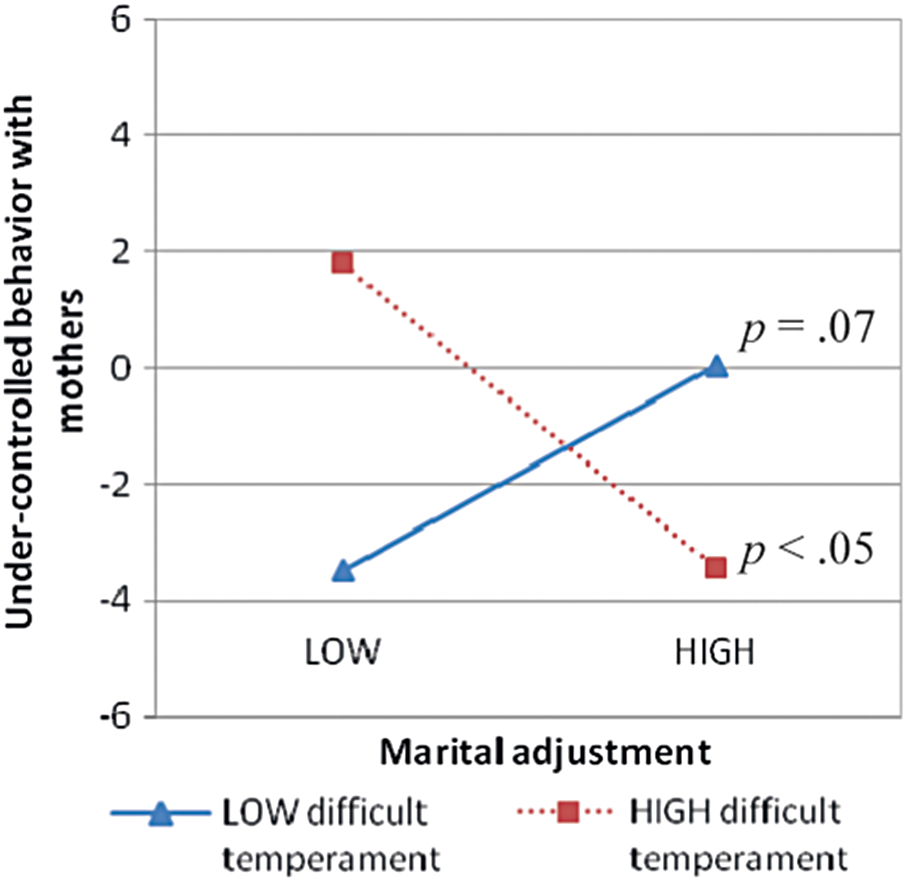
Mothers’ perceptions of difficult temperament moderating the association between mothers’ perceptions of marital adjustment and children’s under-controlled behavior with mothers.

Mothers' perceptions of difficult temperament moderating the association between family cohesiveness and children's positive engagement with mothers.
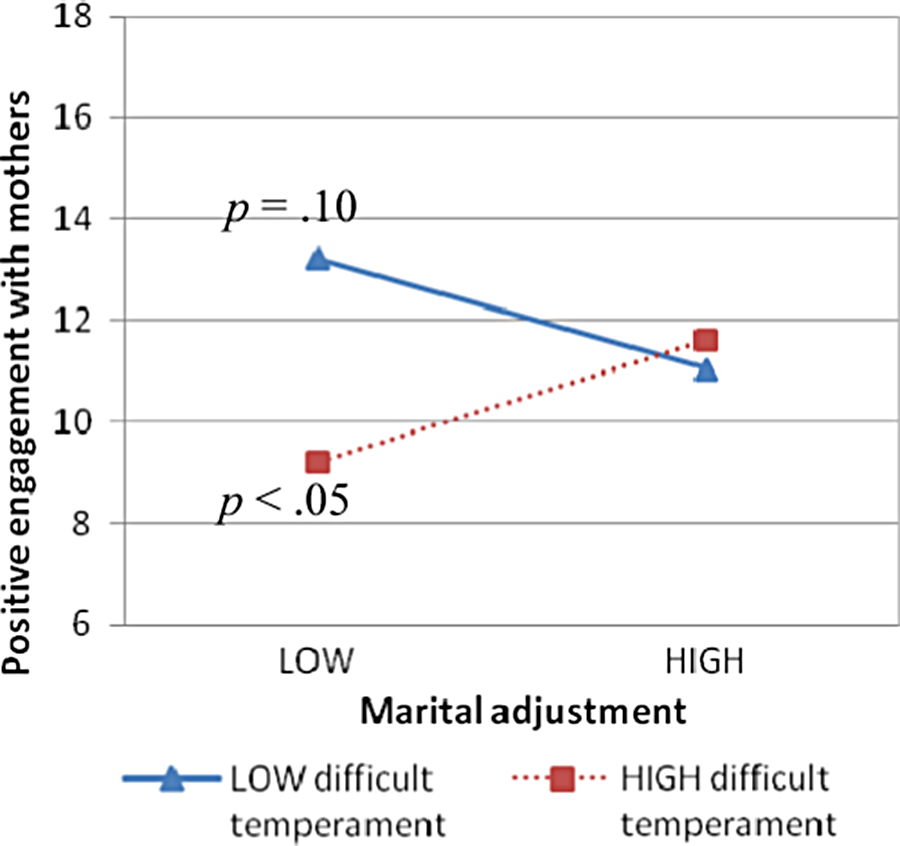
Mothers' perceptions of difficult temperament moderating the association between mothers' perceptions of marital adjustment and children's positive engagement with mothers.
Regression predicting under-controlled behavior with mothers.

Note. Total R2 = .18.
*p < .05; **p < .01.
Regression predicting positive engagement with mothers.

Note. Total R2 = .26.
*p < .05; **p < .01.
All three graphed interactions indicate that when families were less cohesive during the triadic family interaction or when mothers reported lower levels of marital adjustment at 13 months, 3-year-old children who were perceived by their mothers as difficult at 1 year of age displayed less optimal behavior with mothers, including higher levels of under-controlled behavior and lower levels of positive engagement. However, for children with lower levels of difficult temperament, the relationship between family cohesiveness/marital adjustment and child behavior was not significant.
Discussion
The current study investigated whether family (i.e., family cohesiveness, marital adjustment) and child characteristics (temperament) would independently and/or jointly predict child behavior during the mother–child and the father–child interactions. In addition, the extent to which family cohesiveness contributes to cross-situational consistency in child behavior was examined.
Results showed that family cohesiveness at 13 months predicted children’s higher positive engagement with both mothers and fathers at 36 months. In other words, when the family showed a strong sense of closeness and emotional connection with each other during the infancy period, children appeared to be highly enthusiastic, positive, and affectionate toward both parents at the age of 3. Similarly, in families with high levels of cohesiveness, moderate consistency of both under-controlled behavior and positive engagement across the mother–child and the father–child interactions was observed. It is possible that more cohesive families may interact together more often through family rituals such as dinnertime (e.g., Crespo et al., 2011), thus the child is more likely to develop similar interaction patterns with each parent. Future studies should use diaries of daily activities within families to explore whether highly cohesive families actually do spend more time together.
We expected that parental perceptions of marital adjustment would predict child behavior with both parents given past research showing the link between marital quality and child functioning (e.g., Davies & Cummings, 1994). Results, however, revealed strong main effects of marital adjustment on both under-controlled behavior and positive engagement only with fathers, but not with mothers. By contrast, the dual-risk model was only useful for predicting child behavior in the mother–child interaction context. More specifically, when mothers reported low marital adjustment or when families lacked the sense of unity and togetherness during the triadic family interaction at 13 months, children with difficult temperament showed less affectively positive and more under-controlled behavior with mothers. By contrast, in families in which the marital relationship was well-adjusted or the triadic family interaction was highly cohesive, children’s difficult temperament did not play a role in predicting their behavior with mothers.
These findings provide additional support for difficult temperament as a vulnerability factor or a diathesis (Belsky et al., 2007; Roisman et al., 2012) such that temperamentally difficult children are at risk of adjustment problems when faced with other risk factors such as low marital adjustment (Zimet & Jacob, 2001) or family conflict (Tschann et al., 1996). Inversely, it also suggests that high marital adjustment and high family cohesiveness can serve as protective factors for children with difficult temperament, providing them with a buffer against the risk of developing behavior problems. Interestingly, this dual-risk model appears to hold only when considering children’s behavior with mothers.
In contrast, only main effects (especially of marital adjustment) were found when predicting child behavior with fathers. Some have suggested that fathers’ roles are less “scripted” and more discretionary than mothers’ roles in the social and family contexts (Lamb, 2002; Parke, 2002). Because fathers’ parental roles and spousal roles are less distinct, fathers may not be able to successfully “compartmentalize” their stress within the marriage (Cummings, Merrilees, & Ward George, 2010). Consequently, fathering becomes more vulnerable to marital discord (Belsky et al., 1991; Brody, Pellegrini, & Sigel, 1986; Goldberg & Easterbrooks, 1984) or a lack of spousal support (Cummings, Goeke-Morey, & Raymond, 2004) and adopt less optimal (e.g., controlling) parenting behaviors or withdraw from interactions with their child as a coping strategy to recuperate from marital stress. On the other hand, although some studies showed that women are likely to show more intense physiological and emotional reactions to marital conflict (e.g., Kiecolt-Glaser & Newton, 2001; Mayne, O’Leary, McCrady, & Contrada, 1997), other studies suggest that women are more willing than men to actively seek social support in times of stress (Reevy & Maslach, 2001), implying the presence of more buffering systems for mothers than for fathers. Therefore, one risk factor may not have been sufficient to have a direct impact on mothering and in turn child behavior with mothers.
Limitations and future research
Although the current study advanced our understanding of how family cohesiveness, marital adjustment, and child temperament play roles in shaping child behavior with each parent during the first few years of life, there are still some limitations, which can be addressed in future research. First, because families in the current study were relatively well educated, middle class, and mostly European American, the findings in the current study may not be generalizable to families with different demographic characteristics. Moreover, as Markus and Kitayama (1991) demonstrated, different behavioral patterns among adults and children have been observed across cultures. Therefore, it would be interesting to investigate whether or not family variables influence children’s behavior with mothers and fathers differently across different ethnic, sociocultural, and cultural groups.
The current study was based on the longitudinal data that may tempt us to make causal connections between the variables across the two time points. However, it is possible that the associations we found in the current study may be the result of stability among the variables at earlier time points (Kiesner, Dishion, Poulin, & Pastore, 2009). Therefore, investigations that employ the transactional model by examining both concurrent and longitudinal associations at multiple time points would be imperative in order to definitely answer questions about the directions of the effect.
In addition, the current study used a puzzle task, which may be more consistent with the type of activities that mothers typically do with their children than what fathers typically do (e.g., MacDonald & Parke, 1984, 1986). In future research, a free-play session or a more physically oriented activity should be included in addition to a cognitively or verbally oriented activity in order to elicit different parenting behaviors and thus different child behavior.
The current study utilized parental reports of temperament based on empirical evidence for predictive validity and meaningful roles of such measurements for children’s development (Mangelsdorf et al., 2000). However, studies that assessed temperament through laboratory or home observations have generally indicated that parental reports and observational assessment of temperament are only modestly correlated (Rothbart & Bates, 2006), suggesting that each measurement provides different types of information about child temperament (e.g., Roisman & Fraley, 2006). Therefore, it would be interesting to investigate predictive validity of observational assessments of temperament for child behavior with mothers and fathers during dyadic interactions.
Conclusion
The current study highlights the importance of family and child characteristics for the development of children’s interactions with both of their parents in the first few years of life. The results also suggest that there are relationship-specific developmental processes at work. Children do not behave identically with mothers and fathers, and the correlates of their behavior differ across these two important relationships. In sum, the results of the current investigation shed light on the importance of taking into account the various contexts in which children are embedded in order to more fully understand young children’s social–emotional development.
Footnotes
Authors’ note
Portions of these data were presented at the biennial meeting of the Society for Research in Child Development, Denver, Colorado, USA, in 2009.
Acknowledgments
We are grateful to Glenn Roisman, Larry Hubert, Kelly Bost, Maria Wong, Dan Laxman, Allison Jessee, Cynthia Neff, and Stevie Schein for providing helpful comments on this article and to all the families who participated in the study.
Funding
This research received no specific grant from any funding agency in the public, commercial, or not-for-profit sectors.