



Abstract
Regulating emotions in interpersonal contexts requires managing one’s own emotion, a partner’s emotion, and the emotional tone of the relationship (e.g., conflict and intimacy). This multifaceted regulatory challenge, often referred to as “relationship-focused coping,” has been associated with health outcomes, but the real-time emotional processes involved are understudied. We use state-space grids (a recently developed graphical method) to investigate dynamic sequences of emotional experience (positive vs. negative) and relationship-focused coping intentions (to protect vs. engage one’s partner) taken from 26 couples in which one or both partners were smokers, while they discussed a health-related disagreement during a nonsmoking baseline and then while smoking. State-space indicators of contingent emotion-coping sequences showed evidence of both successful regulation (associated with improving emotional state) and unsuccessful regulation (associated with worsening emotional state). The pattern of results suggests that interpersonal emotion regulation may interfere with smoking cessation differently depending upon whether one or both partners smoke.
Keywords
Regulating emotions in interpersonal contexts requires people to accomplish multiple regulatory tasks simultaneously: they must manage not only their own emotional experience but also the partner’s emotion and the emergent moment-to-moment quality of their shared relationship, such as minimizing conflict or enhancing intimacy (Coyne & Smith, 1991, 1994). The stress and coping literature, and particularly the literature on couples coping with chronic illness, variously refers to this process as relationship-focused coping (Coyne & Smith, 1991, 1994), “ways of giving support” (Kuijer et al., 2000), or dyadic coping (Bodenmann, 1997, 2005; Kayser, Watson, & Andrade, 2007). In general, this work links relationship-focused coping to patient psychological and physical well-being (Coyne & Smith, 1994; De Ridder, Schreurs, & Kuijer, 2005; Hagedoorn et al., 2000; Hinnen, Hagedoorn, Ranchor, & Sanderman, 2008; Kayser, Sormanti, & Strainchamps, 1999; Kuijer et al., 2000; Vilchinsky et al., 2011) as well as to relationship satisfaction and distress for both partners (Coyne & Smith, 1991; Hagedoorn et al., 2011; Manne et al., 2007; Suls, Green, Rose, Lounsbury, & Gordon, 1997), but specific findings are inconsistent and often difficult to interpret. Much of this research has taken a static rather than dynamic view of coping processes and has not incorporated the rich tradition of research on emotion regulation. From the latter perspective, relationship-focused coping represents an ongoing process of interpersonal emotion regulation, thereby connecting it to dynamic theories of emotion and self-regulation with the potential for promoting a deeper understanding of underlying mechanisms.
The present research investigates two widely studied forms of relationship-focused coping: protective buffering, which involves hiding negative emotions and yielding to one’s partner to avoid distress or disagreement (Coyne & Smith, 1991; Kuijer et al., 2000), and active engagement, which entails open discussion and problem solving as well as talking about feelings (Coyne & Smith, 1991; Kuijer et al., 2000). Protective buffering is akin to emotional suppression, but with the explicit goal of avoiding partner distress and conflict (Coyne & Smith, 1991; Kuijer et al., 2000). Engagement is often posed as the opposite and involves open emotional expression and the willingness to engage with upsetting topics or emotions (Coyne & Smith, 1991; Kuijer et al., 2000).
A central limitation of prior research on relationship-focused coping is that it has used aggregate measures across days, weeks, or years, whereas the emotional and interpersonal processes underlying the regulation of emotions occur across minutes (Gross, 1998). As a result, although protective buffering and active engagement presumably reflect an intention or desire to manage the emotions of oneself and one’s partner, real-time contingencies between either partner’s emotional experiences and their intentions to protect or engage remain essentially uninvestigated. Similarly, if one hypothesizes that relationship-focused coping influences longer term health outcomes through mediating effects of reducing negative emotions or enhancing positive ones (Manne et al., 2007; Suls et al., 1997), this too implies that momentary changes in protective buffering or engagement should precede momentary changes in emotion. Again, due to aggregating across relatively large time periods, traditional cross-sectional and even panel designs do not permit investigators to test this idea.
A key distinction in the present research is that moment-to-moment effects of relationship-focused coping on emotional experience can be either intended or unintended (Shoham & Rohrbaugh, 1997). Intended sequences are those in which intentional efforts to protect or engage are followed by either increased positive emotion or decreased negative emotion. In contrast, unintended sequences (sometimes referred to as ironic 1 ; Shoham & Rohrbaugh, 1997) are those in which the immediate emotional consequence of a coping effort is a worsening mood state (i.e., less positive or more negative). For example, despite intending to protect self, partner, or relationship, someone who employs protective buffering could undermine intimacy and thereby contribute to a less positive affective state for both partners (Manne et al., 2007; Suls et al., 1997). Similarly, engagement could result in conflict, with accompanying negative emotions.
A second, related distinction is that intended and unintended sequences can involve the coping intentions and/or emotional experience of either the reporting person or his/her partner. In other words, one person’s coping efforts could lead to change in his or her own emotions resembling what the dyadic data analysis literature calls an actor effect (Kenny, Kashy, & Cook, 2006) – or it could lead to changed emotional experience reported by the other person – resembling a partner effect (Kenny et al., 2006). Any given couple might experience intended and unintended actor or partner effects under different circumstances, but because prior research has only assessed global reports of relationship-focused coping, it has been difficult to study the relative frequency of these sequences or the conditions that moderate their occurrence.
Dynamic sequences of interpersonal emotion regulation
Contemporary theories of emotion regulation frame it as a dynamic ongoing process of interconnected moment-to-moment contextual demands, emotional responses, and regulatory behaviors that modulate the emotional response (Cole, Martin, & Dennis, 2004; Manian & Bornstein, 2009). This implies that emotion regulation can only be detected through change and, more specifically, contingent changes between emotion and regulation (Cole et al., 2004; Hoeksma, Oosterlaan, & Schipper, 2004; Manian & Bornstein, 2009). In other words, strong evidence that emotion regulation is occurring requires changes in emotional state, followed by changes in regulatory behavior, followed by further changes in emotion. A similar point has been made in the literature on interpersonal processes. The best evidence that one person is influencing another is the observation of contingent changes in some relevant aspect of both partners (Howe, Dagne, & Brown, 2005). In the present study, we adopt this framework and investigate the sequences of changes in emotional experience, regulatory intentions, and subsequent emotional experience.
To assess within-person and between-partner processes, as well as intended and unintended correlates of protective buffering and engagement, we investigate six types of sequences. The first two suggest an emotion regulatory attempt has occurred, since they involve an undesirable change in emotional state followed by a change in either own regulatory intention (intrapersonal regulation) or partner’s regulatory intention (interpersonal regulation). Thus, the first two are (1) increasing negative emotion followed by increasing own or partner intention to protect and (2) decreasing positive emotion followed by increasing own or partner intention to engage. The next two types of sequence suggest unintended contingencies between regulatory intentions and emotion, since they involve increasing regulatory intentions but worsening emotional state: (3) increasing intentions to protect followed by increasing own or partner negative emotion and (4) increasing intentions to engage followed by decreasing own or partner positive emotion. Finally, two types of sequences suggest intended contingencies, since they involve increasing regulatory intentions and improving emotional state: (5) increasing intentions to protect followed by decreasing own or partner negative emotion and (6) increasing intentions to engage followed by increasing own or partner positive emotion.
State-space grids
A recently developed graphical method, state-space grids (SSGs), and accompanying free software (GridWare) (Lamey, Hollenstein, Lewis, & Granic, 2004), has made the assessment of interpersonal dynamic sequences tractable (Granic & Hollenstein, 2003, 2006; Hollenstein, 2007, 2013; Hollenstein & Lewis, 2006; Hollenstein, Granic, Stoolmiller, & Snyder, 2004; Lewis, Lamey, & Douglas, 1999). SSGs were inspired by a dynamic systems approach to studying development and social interaction and have been used mostly in the study of parent–child interactions (Granic, O’Hara, Peplar, & Lewis, 2007; Hollenstein & Lewis, 2006; Hollenstein et al., 2004). SSGs are appropriate for bivariate time series data arising from any context, either experimental or naturally occurring, and can be applied either to single bivariate pairs (e.g., one parent and child) or to many pairs. One central assumption is that any social unit from individuals to couples to groups can be seen as an open, dynamic, self-regulating system. These systems will typically have many possible states but can only be in one state at a given moment. The dynamics of the system are reflected in changes from state to state over time (Hollenstein, 2007). The range of all possible states constitutes the state space and any two measures of the system can be represented by a two-dimensional grid. For example, one partner’s protective buffering could be represented on the x-axis and the other partner’s emotional experience on the y-axis (Figure 1(a)). The temporal sequence of emotion and protective buffering are plotted on the grid, with each cell representing the bivariate combination of one person’s protective buffering and the other person’s emotional experience for a given time unit. As an extension of the simultaneous states (i.e., cells), ordinal data also allow derivatives or change scores to form the axes (Hollenstein, 2013). That is, the cells can represent a change in x that occurred prior to a change in y. For example, Figure 1(a) depicts a male participant’s protection–engagement on the x-axis and his partner’s concurrent emotion on the y-axis. Figure 1(b) is the same dyad but the axes are comprised of the change score from t − 2 to t − 1 on the x-axis but the change score from t − 1 to t for the y-axis dimension. Here the cells capture a two-step change sequence: change in x followed by a change in y.
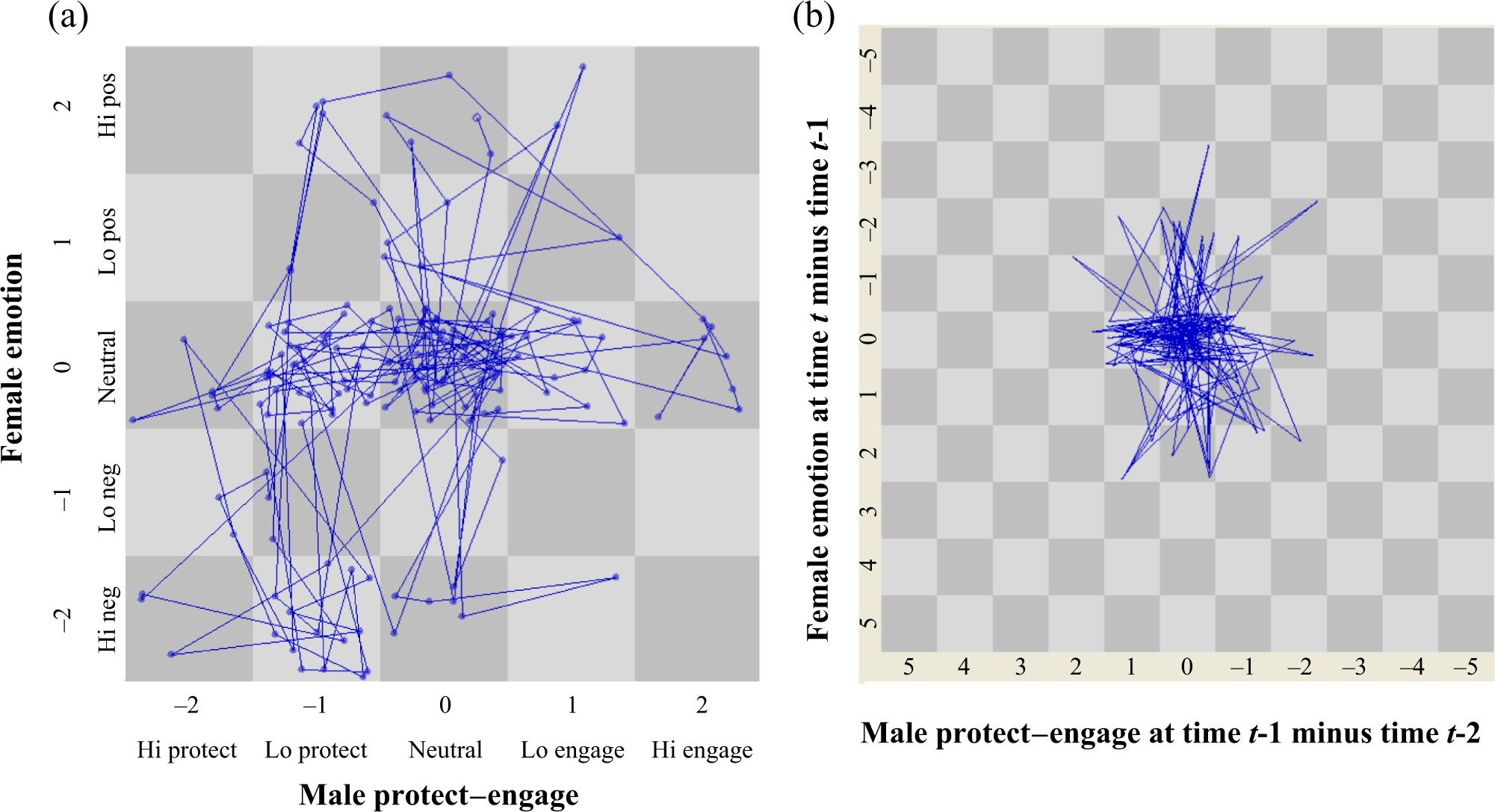
State-space grids for one dyad. (a) On the left are the dyadic states for the male partner’s degree of protective buffering or engagement on the x-axis and the female partner’s simultaneous emotional experience. (b) The same data are displayed for lag-2 change scores for the protect–engage of the male partner and the lag-1 change scores for emotion of the female partner. Thus, cells represent a three-step change pattern of protect–engage changes followed by emotion changes. Columns on the right indicate an increase in protective buffering, and columns on the left indicate an increase in engagement of the male partner. Rows on the top indicate an increase in negativity and rows on the bottom indicate an increase in positivity of the female partner.
Several measures indexing the tendency to engage in a particular sequence are provided by GridWare and allow hypothesis testing. The three we focus on are (1) frequency, or the number of times a couple engages in a specific sequence (Granic & Dishion, 2003; Granic et al., 2007; Hollenstein et al., 2004), (2) immediacy, or how quickly a couple enters a specific type of sequence at the beginning of the conversation (Hollenstein, 2013), and (3) recurrence, or how long it takes a couple to return to a specific type of sequence once they have left it (Lewis et al., 1999). These indicators are the most commonly used in prior research and each provides unique information about the dynamics of the system. For example, one couple may be slow to enter a given sequence, but once they do, there is a pull for them to remain there and repeat the sequence (low immediacy, but high frequency and fast recurrence). Another couple may enter immediately and remain there awhile, but once they disengage from it, they may be slow to return (high immediacy and frequency, but slow recurrence). Both patterns would suggest a tendency to be drawn to the sequence, but the three indicators would not necessarily be correlated with each other, and so we investigate each separately.
Interpersonal emotion regulation and smoking
Relationship variables predict smoking cessation, but relevant socioemotional mechanisms are understudied (Bottorff et al., 2006; Dollar, Homish, Kozlowski, & Leonard, 2009; Homish & Leonard, 2005; Rohrbaugh et al., 2001). For example, smokers are more likely to achieve cessation, if their partners are nonsmokers (Dollar et al., 2009; McBride et al., 1998); and nonsmoking wives who previously smoked are more likely to start again, if their husbands smoke (Homish & Leonard, 2005). Less is known, however, about the emotional and relational processes involved. In our prior work, we investigated relatively automatic interpersonal emotion regulation and smoking in the same sample of couples that we report on here (Rohrbaugh, Shoham, Butler, Hasler, & Berman, 2009; Shoham, Butler, Rohrbaugh, & Trost, 2007). In those investigations, we focused on a process called symptom-system fit, which refers to an unhealthy behavior, such as smoking, helping to preserve relationship well-being by increasing positive emotion or couple closeness. Results showed that the act of smoking increased positive experience and emotional synchrony in couples with two smokers. In contrast, when only one partner was a smoker, the act of smoking decreased positive emotions and synchrony. In addition, the single-smoker couples showed less evidence of communal coping, as indicated by the use of the pronoun “we” during their discussions (Rohrbaugh, Shoham, Skoyen, Jensen, & Mehl, 2012). These findings are in accord with other research suggesting that smoking is a source of conflict for single-smoker couples. For example, a longitudinal study found that discrepancies between partners’ smoking behavior predicted declining marital satisfaction (Homish, Leonard, Kozlowski, & Cornelius, 2009) and a qualitative study found that single-smoker couples experienced more conflict, ridicule, and criticism associated with smoking than other couples (Bottorff et al., 2005).
Present study and hypotheses
In the present study, we extend our prior work to investigate contingent sequences of emotional experience and conscious regulatory intentions in the context of couples discussing a health-relevant disagreement, first during a nonsmoking baseline, then while smoking (either one or both partners smoked, depending upon whether one or both were habitual smokers). Based on prior evidence that smoking appears to be bonding for double-smoker couples (Rohrbaugh et al., 2009, 2012; Shoham et al., 2007), but generates conflict for single-smoker couples (Bottorff et al., 2005; Homish et al., 2009), we hypothesized that double-smoker couples would be more likely than single-smoker couples to regulate emotions by engaging with them, especially when actively smoking. In contrast, we expected single-smoker couples to be more likely to use protective buffering to avoid mutual distress, especially when the smoking partner was actively smoking. Following similar logic, we expected double-smoker couples to be more successful at using engagement than single-smoker couples (i.e., they would have more intended, and fewer unintended, correlates of engagement), due to their lower risk of conflict arising from engagement. In contrast, we expected single-smoker couples to be more successful at using protection than double-smoker couples, due to their greater need to avoid conflict even at the expense of reduced engagement.
Finally, given widespread sex differences in emotional processes (Flynn, Hollenstein, & Mackey, 2010; Gross & John, 2003; Grossman & Wood, 1993; Kring & Gordon, 1998), we also investigated the possibility of sex differences in the occurrence of the emotion-regulation sequences. First, women have been shown to suppress less (Gross & John, 2003), express emotion more (Kring & Gordon, 1998), and be more willing to openly engage in relational conflict (Carstensen, Gottman, & Levenson, 1995) than men. In addition, women tend to do more of the “emotional work” in relationships (Carstensen et al., 1995) and score higher on performance measures of emotional intelligence (Joseph & Newman, 2010). This led us to expect that women would be less likely than men to use protective buffering and more likely to use engagement. Similarly, we expected that men’s protective buffering would be more likely to have unintended associations with their female partners’ emotions, due to thwarting the women’s preference for emotional engagement. Further, we expected women to be more successful in general at interpersonal emotion regulation (i.e., their regulatory intentions would have more intended, and fewer unintended, associations with their partners’ emotions).
Methods
Participants
Participants were 26 couples recruited to receive a couple-level smoking-cessation intervention (Rohrbaugh & Shoham, 2001; Rohrbaugh et al., 2001). One partner in each couple had either a diagnosed heart or lung problem aggravated by smoking or at least two other documented risk factors for coronary artery disease. In 10 (dual-smoker) couples, the second partner also smoked. In 10 of the single-smoker couples, the male partner was the smoker, while in the other 6, it was the female partner. All of the couples were heterosexual except for one gay couple with two smokers and one lesbian couple with one smoker. The couples were either married (n = 23) or living together in a committed relationship (n = 3). The mean age of participants was 55 years (range: 35–72); 23% had graduated from college and 54% were at least partially retired. Three of the participants were Mexican American, one was Native American, and the rest were Caucasian. At the time of initial screening, smokers reported averaging 24.3 (SD = 10.2) cigarettes a day. On the Fagerstrom test of Nicotine Dependence, where scores in the 6–7 range indicate “high dependence,” smokers had scores of 6.1 (SD = 2.1). Additional sample details are provided in Rohrbaugh et al. (2009) and Shoham et al. (2007).
Procedures and measures
After enrolling in the study, but before participating in any treatment, each couple attended a 2-h laboratory session during which they provided informed consent and completed a series of assessments. The present report focuses on measures taken from one of these tasks in which smoking was manipulated during a conversation about a disagreement. In preparation for the conversation, each couple completed a modified areas of change questionnaire (Weiss & Birchler, 1975) to help identify at least three health-related disagreements they could discuss during the videotaped conversation. We instructed couples to choose topics that were important to both partners and concerned desired changes in at least one partner’s behavior. Typical topics included disagreements in regard to the management of smoking, diet, and exercise; financial management of health care costs; relationships with health care providers; and involvement of family members in health-related issues. Disagreements also concerned divisions of labor and shared couple activities, particularly when health problems interfered with those activities.
During the videotaped conversation, partners sat at a 90° angle, partially facing each other as well as the camera. When the research assistant left the room, the couple began discussing the first disagreement on their list. After 5 min, a light came on signaling smokers to light up and the conversation continued for another 5 min. Participants did not know in advance how long they would talk before the signal. Subsequent coding of video recordings revealed that couples on average devoted 51.7% of their discussions to smoking-related topics.
Immediately following the conversation, we rearranged the room so that the partners could recall their emotional experience and regulatory intentions while watching their own interaction on videotape. They did this by watching the video twice, first reporting on their emotional experience (negative to positive) and on the second watching reporting on their regulatory intentions (protection to engagement). Each partner did this with an electronic joystick that moved from left to right and bottom to top, with clearly marked anchors of “most negative” (−) and “most positive” (+) on its left and right sides, respectively, for emotional experience, and “protect” and “engage” on the bottom and top for regulatory intentions (e.g., pulling toward the self for protection and opening away from the self for engagement). A research assistant demonstrated how to move the joystick from side to side, normalized using the full range of the scale, and explained that the participants should report on how they felt and what their regulatory intentions were during the conversation on a continuous, second-to-second basis, regardless of whether he or she was talking at the time. A barrier between the partners prevented them from seeing each other’s hands or facial expressions as they made their ratings. The calibrated joysticks recorded scores of −100 at the far left position, +100 at the far right position, and 0 at the neutral (resting) position with continuous gradations in between.
Derivation of measures using GridWare
For the present analyses, the second-to-second joystick ratings were averaged into 10-second units because visual inspection of the raw data suggested substantial random noise at shorter time frames. Next, GridWare requires ordinal variables and so the −100 to +100 joystick values were reduced into five equal ordinal categories coded as integer values −2 through +2 (we also explored using seven categories and this did not alter results). For protect–engage variables, these categories were high protect, low protect, neutral, low engage, and high engage. For the emotion variables, these were high negative, low negative, neutral, low positive, and high positive. From these state variables, we captured the change from one 10-second period to the next by creating new lagged difference variables. The lag-1 change variables were obtained via subtracting each variable’s value at time t − 1 from the value at time t; the lag-2 change variables were obtained by subtracting each variable’s value at time t − 2 from time t − 1 (Figure 1(b)). Thus, we obtained eight dynamic change variables, four for each partner: protect–engage lag-1 change, emotion lag-1 change, protect–engage lag-2 change, and emotion lag-2 change. GridWare was used to derive measures from the two-dimensional pairings of these variables (Figure 1(b)). Specifically, we plotted the lag-1 change in one variable with the lag-2 change in another so that the values in each cell of the grid represented a three-step sequence (t-2, t-1, and t) of change in the x-axis variable followed by change in the y-axis variable. Three indices were obtained for each region of these grids: Frequency was the number of visits to that region; Immediacy was the time from the beginning of the interaction to the first entry into that region; and Recurrence was the average time between visits to that region.
Lag-1 and lag-2 change variables were paired both within and across partners to obtain frequency, immediacy, and recurrence indices in three superordinate categories: (1) Evidence that regulation occurred: increasing negativity followed by increasing protective buffering or decreasing positivity followed by increasing engagement; (2) Unintended consequences: increasing protective buffering followed by increasing negativity or increasing engagement followed by decreasing positivity; and (3) Intended consequences: increasing protective buffering followed by decreasing negativity or increasing engagement followed by increasing positivity.
Data analysis
Repeated measures data taken from interacting couples are likely to have multiple sources of interdependence, including individuals nested within couples and the two experimental conditions (baseline and smoking) nested within person. This lack of independence makes standard analytic tools such as analysis of variance or regression inappropriate (Kenny, 2006). In addition, inspection of histograms and skew/kurtosis statistics showed that the GridWare indices were not normally distributed and therefore could not be appropriately analyzed using a standard linear model. To address these issues, we used a dyadic version of a generalized linear mixed model with a log link function and negative binomial distribution (all models were implemented using SAS PROC GLIMMIX). The nonlinear model accommodates the non-normally distributed outcome variables. To accommodate the nesting of individuals within couples, we explored several dyadic models, including a two-intercept model that included separate male and female random intercepts and a model that allowed for correlated partner residuals, but these models would not converge and so we adopted a simpler random intercept model, in which each dyad was specified to have its own random intercept. This approach treats the dyad as the unit of analysis and accounts for partner’s potentially correlated residuals, so long as the correlation is positive (Kenny et al., 2006). Finally, the use of the negative binomial distribution addresses the potential for overdispersion of the residuals arising from two time points nested within individuals (Littell, Milliken, Stroup, & Wolfinger, 1996).
We tested a series of models in which the GridWare indices of the sequences (frequency, immediacy, and recurrence) were predicted from the experimental manipulation (baseline vs. smoking), the couples’ smoking status (a two-level categorical variable indicating whether one or both partners were smokers), participant sex, all two-way interactions, and the three-way interaction. Significant interactions were decomposed following Aiken and West (1991). All predictors were treated as fixed effects because allowing them to be random led to convergence problems.
Results
Effects of the smoking manipulation and smoking status on levels of emotion and regulation
Model estimated means and standard errors for emotional experience and regulatory intentions, as a function of the smoking manipulation and smoking status, are provided in Table 1. Although these mean levels are not the focus of the present study, we provide them as a context for our primary analyses of emotion-regulation sequences. For emotional experience, as reported in prior work (Shoham et al., 2007), a significant interaction of the manipulation by smoking status, F(1, 23) = 113.51, p < .001, indicated that emotional experience became more positive from baseline to smoking for double-smoker couples, t(23) = 6.78, p < .001, but less positive for single-smoker couples, t(23) = − 8.74, p < .001. Similarly, for regulatory intentions, a significant interaction of the manipulation by smoking status, F(1, 24) = 98.66, p < .001, indicated that regulatory intentions became more engagement oriented from baseline to smoking for double-smoker couples, t(24) = 3.00, p < .007, and less engagement oriented for single-smoker couples, t(25) = −12.28, p <.001.
Means and standard errors for emotional experience and regulatory intentions
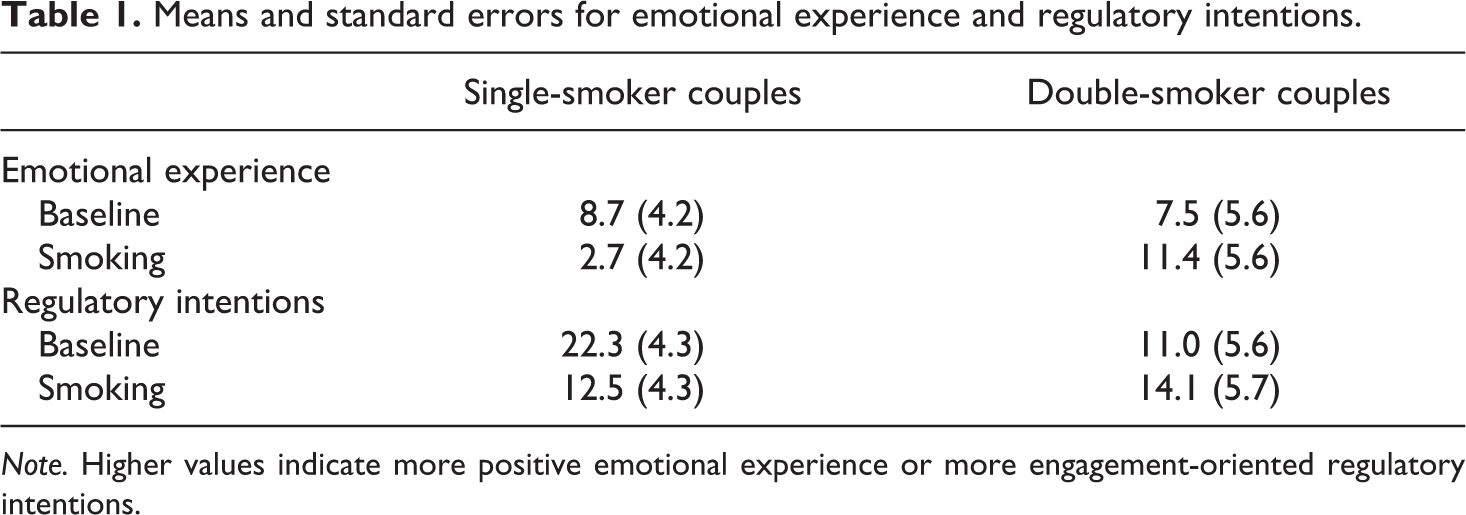
Note. Higher values indicate more positive emotional experience or more engagement-oriented regulatory intentions.
Another fact evident in Table 1 is that, on average, participants experienced more positive than negative emotion and reported more intention to engage rather than protect their partner. Nevertheless, intraclass correlations (ICCs) show that the majority of variability in emotional experience and regulatory intentions was within person, rather than between person, making an analysis of time-varying sequences relevant. Specifically, the ICC for emotion was .13, meaning that about 87% of the variance was due to within-person fluctuations, and for regulatory intentions, it was .10, showing that about 90% of the variability was within person. In addition, the range for both variables covered the entire spectrum of possible values, from −100 to +100, and was fairly normally distributed from −2 to +2 in the transformed ordinal space used for analyses. Thus, although on average the participants felt positively and intended to engage their partners, they also fluctuated over time in both their experience and their intentions, making a dynamic analysis appropriate.
Regulation attempts
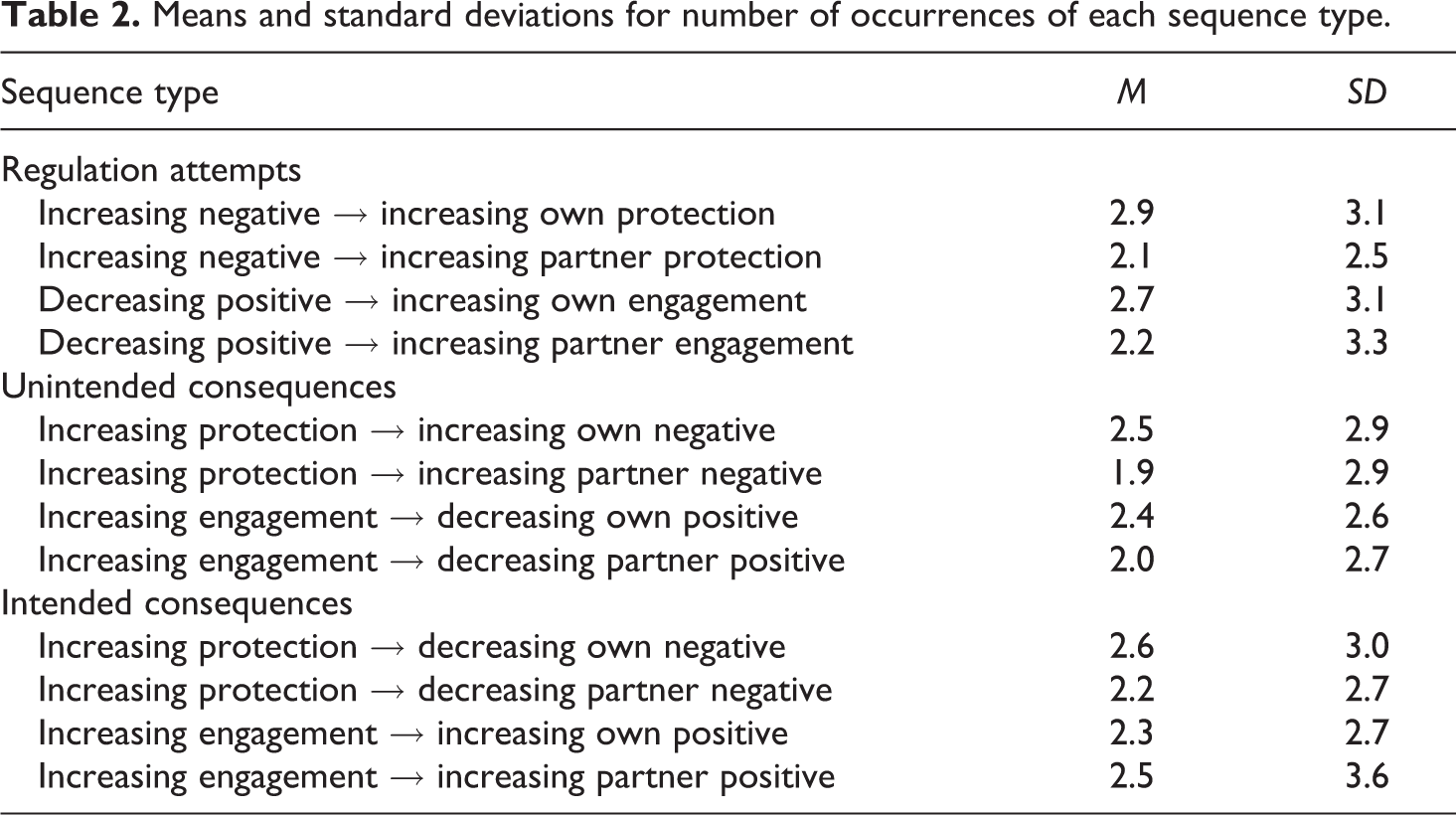
Our first analysis addressed emotion-regulation attempts during the conversations, as indicated by sequences in which either (1) negative emotion increased and was followed by increasing own or partner intentions to protect or (2) positive emotion decreased and was followed by increasing own or partner intentions to engage. Table 2 shows that these sequences occurred approximately 2 to 3 times on average per couple over the duration of the 10-min conversations, suggesting that both within-person and between-partner regulatory attempts occurred.
Means and standard deviations for number of occurrences of each sequence type
We next asked whether these sequences were influenced by the manipulation, smoking status, or sex. Here and in subsequent sections, we first report significant effects for each sequence type and then provide a summary of findings as they relate to the three moderators (smoking manipulation, smoking status, and sex). For the sequence increasing negative emotion → increasing own protection, we found main effects of the manipulation on frequency, t(25) = −2.48, p < .03, and recurrence, t(11) = 2.51, p < .03, with this sequence occurring more frequently (1.4 sequences) and with faster recurrence (0.6 min) during smoking than during the baseline (0.9 sequences; 0.7 min). For the sequence increasing negative emotion → increasing partner protection, we found a main effect of sex on recurrence, t(16) = 3.30, p < .01, such that women’s increasing negative emotion followed by their male partners’ increasing protection showed faster recurrence (0.5 min) than the reverse (i.e., men’s increasing negative followed by female partner’s increasing protection: 0.6 min). No significant effects were found for the sequence decreasing positive emotion → increasing own engagement, but for the sequence decreasing positive emotion → increasing partner engagement, we found a significant interaction of sex by smoking status for immediacy, F(1, 22) = 7.34, p < .02, whereby women’s decreasing positive emotion followed by their male partners’ increasing engagement showed greater immediacy (0.7 min) in double-smoker couples as compared to single-smoker couples (0.8 min; b = −0.86, p < .01) and compared to the reverse sequence (i.e., men’s decreasing positive followed by female partner’s increasing engagement: 0.8 min; b = −0.65, p < .01).
Summary
These results suggest that the participants attempted to regulate their own negative emotion by protecting their partner more during smoking than baseline. In terms of smoking status, men in double-smoker couples showed the most evidence of trying to engage their partners when their partners began to feel less positive. Finally, women were less likely than men to try to protect their partners when their partners began to feel more negative.
Unintended emotional correlates
Our second analysis addressed whether emotion-regulation attempts during the conversations had unintended correlates, as indicated by sequences in which either (1) intentions to protect increased and were followed by increasing own or partner negative emotion or (2) intentions to engage increased and were followed by decreasing own or partner positive emotion. Table 2 shows that on average, these sequences occurred approximately 2 to 2.5 times per couple over the duration of the conversations, suggesting that at least some regulation attempts had unintended emotional sequela.
Models testing the effects of the manipulation, smoking status, and sex showed that for the sequence increasing protection → increasing own negative emotion, there was a significant three-way interaction for frequency, F(1, 22) = 4.64, p < .05, such that men in single-smoker couples experienced fewer sequences during smoking (0.6 sequences) than baseline (1.4 sequences; b = −0.88, p < .02). For the sequence increasing protection → increasing partner negative emotion, there was a significant interaction of sex by smoking status for immediacy, F(1, 22) = 7.90, p < .01), such that men’s increasing protection followed by increases in their female partner’s negative emotions showed greater immediacy in double-smoker couples (1.7 min) as compared to single-smoker couples (2.7 min; b = −1.1, p < .01) as well as compared to the reverse sequence (i.e., women’s increasing protection followed by men’s increasing negative emotion: 2.5 min; b = −0.8, p < .01). There was also a main effect of sex on recurrence, t(9) = 4.63, p < .01, with men’s increasing protection followed by increases in their female partner’s negative emotions showing faster recurrence (5.5 min) than the reverse sequence (7.5 min). There were no significant effects for the sequence increasing engagement → decreasing own positive emotion, but for the sequence increasing engagement → decreasing partner positive emotion, results showed a significant interaction of sex by the manipulation for frequency, F(1, 23) = 4.24, p < .05, such that there were fewer sequences in which women’s increased engagement was followed by their partner’s decreased positive emotion during smoking (0.2 sequences) than baseline (0.8 sequences; b = −0.30, p < .04). Finally, there was also a main effect of sex for immediacy, t(23) = 2.17, p < .05, with men’s increased engagement followed by their partner’s decreased positive emotion showing faster immediacy (0.8 min) than the reverse (i.e., women’s increased engagement followed by partner decreased positive emotion; 0.9 min).
Summary
These results suggest that smoking reduced unintended within-person correlates of protective buffering for men in single-smoker couples. In addition, women’s attempts to engage men were less likely to have unintended between-person correlates during the smoking phase as compared to baseline. In terms of smoking status, men, especially those in double-smoker couples, appeared to be the most likely to have unintended associations of protective buffering with their partners’ emotions. Finally, all couples were relatively quick to get into sequences whereby the men’s intentions to engage their partners were followed by the women’s reduced positive emotion.
Intended emotional correlates
Our third analysis addressed whether emotion-regulation attempts during the conversations had intended correlates, as indicated by sequences in which either (1) intentions to protect increased and were followed by decreasing own or partner negative emotion or (2) intentions to engage increased and were followed by increasing own or partner positive emotion. Table 2 shows that on average, these sequences occurred approximately 2.5 times per couple over the duration of the conversations, suggesting that the number of regulation attempts having intended emotional sequela was about the same as those having unintended correlates.
Models testing the effects of the manipulation, smoking status, and sex for the sequence increasing protection → decreasing own negative emotion showed a significant three-way interaction for immediacy, F(1, 22) = 4.38, p < .05. Women in double-smoker couples had faster immediacy during baseline (0.8 min) than smoking (1.8 min; b = −1.0, p < .03). In contrast, women in single-smoker couples showed the reverse pattern, with faster immediacy during smoking (2.0 min) than baseline (2.5 min; b = −0.40, p. < .05). For the sequence increasing protection → decreasing partner negative emotion, we found a main effect of the manipulation on frequency, t(23) = 2.17, p < .05, due to participants engaging in more sequences during baseline (1.1 sequences) than smoking (0.7 sequences). A significant interaction of sex by smoking status also emerged for recurrence, F(1, 2) = 18.16, p < .05, such that there was quicker recurrence of sequences in which women increased their protection followed by reduced partner negativity in double-smoker couples (5.3 min) compared to single-smoker couples (7.3 min; b = −2.0, p < .05). There were no significant effects for the sequence increasing engagement → increasing own positive emotion, but for the sequence increasing engagement → increasing partner positive emotion, there were significantmain effects of the manipulation, t(25) = −2.60, p < .02, and smoking status, t(24) = 2.12, p < .05, for frequency. Specifically, participants showed fewer sequences during smoking (0.6 sequences) than baseline (1.0 sequences) and double-smoker couples engaged in more sequences (1.3 sequences) than single-smoker couples (0.5 sequences).
Summary
These results suggest that the participants were less successful at regulating their partner’s emotions, both by protecting and engaging them, during smoking as compared to baseline. Furthermore, during baseline, women in double-smoker couples were quicker than those in single-smoker couples to effectively regulate their own negative emotions by protecting their partner. Women in double-smoker couples, as compared to those in single-smoker couples, also showed more recurrence of sequences in which their protective intentions were followed by decreasing partner negative emotion and more frequent sequences in which their engagement intentions were followed by increasing partner positive emotion.
Discussion
Research on relationship-focused coping has generally assumed that (1) it is motivated by a desire to manage the emotions of self, partner, or the emotional tone of the relationship and 2) it is associated with distal health-relevant outcomes due to successfully reducing own or partner negative emotion and enhancing positive emotion, thereby reducing stress and fostering effective health behaviors. These assumptions imply that intentions to engage in relationship-focused coping (protective buffering and engagement) should arise subsequent to increasing negative or decreasing positive emotion. In other words, changes for the worse in emotional state should precede intentions to regulate those emotions. In addition, increasing intentions to protect or engage should have emotional sequela for the self, the partner or both at least some of the time. If they did not, relationship-focused coping could not impact health via emotional mechanisms. These implications have not been tested, however, due to the reliance of previous research on aggregate measures.
Our results support the idea that people are motivated to protect or engage their partner in order to alter emotions, since we found evidence of moment-to-moment contingent sequences occurring between worsening emotional state and increasing regulatory intentions. Our results also support the idea that protection and engagement can have desirable emotional correlates at least some of the time, making these processes viable candidates as mechanisms by which relationships impact health. Importantly, however, we also found evidence that protection and engagement can have unintended emotional correlates. Thus, the emotional impact of relationship-focused coping appears to depend upon additional factors.
In the present study, we investigated the interplay of smoking status (single- vs. double-smoking couples) and the act of smoking (nonsmoking baseline followed by a smoking phase) as potential moderators of relationship-focused coping. Based on prior research suggesting that smoking acts as a bonding process for couples in which both partners smoke (Rohrbaugh et al., 2009, 2012; Shoham et al., 2007), but generates conflict for couples in which only one partner smokes (Bottorff et al., 2005; Homish et al., 2009), we predicted that double-smoking couples would be more effective at using engagement for regulating emotions, especially while smoking, while single-smoking couples may be more protection oriented. In general, our results support these hypotheses. First, regulatory intentions became more engagement oriented from baseline to smoking for double-smoker couples. Second, men in double-smoker couples, as compared to those in single-smoker couplers, were quicker to increase their engagement when their female partners started to become less positive. In addition, double-smoker couples experienced more sequences in which one partner’s increasing engagement was followed by their partner’s emotions becoming more positive. Together these results suggest that engagement was a preferred and effective regulatory approach for the double-smoker couples, especially while they were actively smoking.
In contrast, during the smoking phase single-smoker couples engaged in more frequent and recurring sequences in which changes in protective buffering were followed by desirable changes in emotional experience. This successful within-person regulation of emotion via protective buffering may have come at a cost, however, because the single-smoker couples also experienced lower overall levels of positive emotion and engagement during the smoking phase of the conversation. Thus, although protective buffering while smoking may have successfully regulated single-smoking couples’ negative experience and avoided conflict associated with smoking, it may also have prevented positive engagement with each other.
Taken together, our results suggest that smoking cessation may be hindered for couples in which both partners smoke by the fact that shared smoking contributes to desirable emotional and relational outcomes. Such couples became more positive, engaged, and emotionally synchronized when they both smoked, suggesting that for them smoking is in itself an effective form of emotion regulation. We expect a similar pattern would emerge for any shared unhealthy behavior, such as excessive alcohol consumption or unhealthy eating. Thus, if one or both were to quit smoking (or improve any shared unhealthy behavior), it would have to be replaced by some other form of interpersonal emotional regulation.
In contrast, smoking cessation may be hindered for couples in which only one partner smokes by their successful use of protective buffering, whereby conflict and distress surrounding smoking are mutually avoided. For these couples, smoking was likely a source of disagreement, thus it is not surprising that they made successful use of protective buffering when one partner smoked in other’s presence. Unfortunately, this came at the cost of reduced engagement and less positive emotion. Again, we expect this is not unique to smoking, but that a similar dynamic would emerge for any non-shared unhealthy behavior. Importantly, if these couples avoid open discussion of their conflicts surrounding smoking (or some other non-shared unhealthy behavior), it would also undermine their ability to work together in helping the smoker quit. This point is particularly relevant because one predictor of successful smoking cessation in the same sample of couples was communal coping – or working together to solve health problems – as evidenced by the use of the word “we” during the discussions (Rohrbaugh et al., 2012). Thus, to the extent that protective buffering was successively used to regulate emotions, it may simultaneously have interfered with smoking cessation.
In addition to smoking status, we also considered sex as a potential moderator of emotion-regulation contingencies. As predicted, we found evidence that women were less likely than men to try to protect their partners. Also as predicted, we found evidence that men’s protective buffering had more unintended associations with their female partners’ emotions, especially for double-smoker couples, perhaps due to thwarting the women’s preference for emotional engagement. Finally, our results suggest that men were less effective in general than women at regulating their partners’ emotions. First, the couples showed greater recurrence of cycles, whereby the woman started to become more negative, which was followed by the male increasing his intentions to protect her, but subsequently, she became increasingly negative. Similarly, the couples were quick to get into sequences, whereby the male increased his intention to engage his partner, but this was followed by her decreasing positive emotion. These findings fit with a growing body of literature suggesting that men score lower than women on performance measures of emotional intelligence (for review see Joseph & Newman, 2010).
Although not predicted, we also observed that the women in the double-smoking couples appeared to be the most adept at regulating emotions. In addition to having generally intended emotional correlates of engagement, these women also showed intended correlates of protective buffering, both with their own emotions during baseline and with their partner’s emotions throughout the conversation. One possible explanation is that for the double-smoker couples, the interaction was not overly stressful, thus making emotion regulation easier to achieve in general. Along similar lines, all participants, regardless of smoking status, were less successful at regulating their partner’s emotions, either by protecting or engaging them during smoking as compared to baseline. Thus, interpersonal emotion regulation seems to have been more difficult during smoking, likely reflecting the fact that all the couples included one partner with a serious smoking-related illness, an upsetting fact that would be made salient by the act of smoking. One proviso, however, is that overall levels of positive emotion and engagement increased during smoking for the double-smoker couples, even though intended contingencies between partners’ regulatory intentions and emotional experience decreased. Taken together, these findings suggest that act of smoking may have provided automatic emotion regulation for the double-smoker couples, thereby making conscious regulatory intentions less relevant for their emotional experience.
Implications, limitations and future directions
By employing state-space grids, the present study was able to demonstrate real-time contingencies between emotions and relationship-focused coping in a sample of couples struggling with the life-threatening health problem of chronic smoking. An important implication of our results is that interpersonal emotion regulation appears to be a viable mechanism for explaining previously observed health correlates of relationship-focused coping, given that we found evidence for the logically necessary connections between emotions and regulatory intentions. The contingencies we observed, however, were not simple and suggest that the correlates of interpersonal emotion regulation depend on a host of other factors. A central strength of the present research is that it demonstrates methods that can be used in future work to investigate these moderating influences. A critical direction for future work, therefore, is to systematically investigate the boundary conditions of interpersonal emotion regulation, perhaps targeting within-person and between-partner effects separately using experimental paradigms. For example, in the present study, the act of engaging in a problematic health behavior (smoking) appeared to increase the tendency to try to regulate own negative emotion by protecting the partner. It is unclear whether the important factor was the potential for increased conflict due to the problematic nature of the smoking, the increased salience of negative emotions such as fear for the partner’s health or some other mechanism. Experiments could be designed to tease such possibilities apart and would contribute greatly to our understanding of close relationships and health.
An important limitation of the present study is the small sample, which of course limits generalizability and statistical power. At the same time, however, the low statistical power somewhat offsets the opposite concern that the exploratory nature of the study may have resulted in type-I errors due to multiple significance tests. Such issues would be severely limiting if the goal of the research was confirmatory, but we see the contributions of the present study as demonstrating dynamic contingencies between emotions and regulatory intentions that substantiate the potential relevance of relationship-focused coping for health, providing a novel methodological approach for conducting future research, both exploratory and confirmatory, and documenting initial results suggesting the importance of couple smoking status (one or both partners are habitual smokers) as a predictor of divergent interpersonal emotion-regulatory processes relevant to smoking cessation. Thus, statistical issues and generalizability are not central concerns, although certainly future research taking a confirmatory approach will need to make use of larger, more representative samples and take steps to control type-I error.
Another limitation of our study is that regulatory intentions and emotions could not be assessed immediately at the moment they were experienced. Although the video-recall procedure we used is well established and has been shown to correlate highly within the moment ratings (Mauss, Levenson, McCarter, Wilhelm, & Gross, 2005), it is still necessarily retrospective. Hence, even though the period of retrospection is short, the participants’ ratings were still based on observations of their own face and body, rather than on concurrent internal experience. Thus, it is possible that some aspects of the ratings were driven by participants’ beliefs about regulation-emotion contingencies, rather than actual correlations between two separate processes.
In the present study, we found evidence that regulatory intentions were sometimes followed by changes in emotion compatible with those intentions (e.g., decreasing negative or increasing positive emotion), but sometimes the reverse occurred. One proviso for interpreting our results, however, is that short-term unintended emotional effects could have long-term functional outcomes and vice versa. For example, unintended emotional correlates of engagement may reflect a couple’s tolerance for openly tackling disagreements, which could be beneficial in the long run. Similarly, effective protection could act as conflict avoidance. Although this might work in the moment, it could be problematic in the long run. An important direction for future research, therefore, is to investigate the interplay of real time and developmental time. Long-term developmental outcomes, such as global distress, health, or relationship quality, emerge out of momentary, dynamic sequences of behaviors and experiences. In addition, past behavior creates a relationship context in which current behavior is interpreted (Hagedoorn et al., 2011; Manne et al., 2007). The present study is the first we are aware of to investigate relationship-focused coping in real time. By presenting a tractable methodology, we hope this work will stimulate future research that considers the interplay of time frames, which is a necessary next step for understanding if, when, and how interpersonal emotion regulation contributes to well-being.
Footnotes
Funding
This project was supported by the National Institute on Drug Abuse (grants R21-DA13121 and U10-DA15815).