



Abstract
A model of extradyadic temptation and mate guarding was tested in the present dyadic daily report study. Results indicated that participants (perceivers) perceived their partner’s (targets) daily extradyadic temptation and that these perceptions predicted perceivers’ daily mate-guarding behaviors. Perceivers’ chronic jealousy moderated these relationships. These results suggest that perceivers, especially chronically jealous perceivers, are sensitive to their partners’ temptation for extradyadic relations and respond to this temptation with relationship-protective behaviors. Furthermore, perceivers’ mate-guarding behaviors predicted increases in targets’ subsequent daily commitment, suggesting that perceivers’ mate guarding works to deter targets from future infidelity by increasing targets’ commitment to the relationship. These findings suggest an interpersonal process in which people detect and then regulate their partners’ extradyadic temptation.
A romantic partner’s interest in romantic or sexual relations with outsiders constitutes a significant relationship threat (e.g., Lydon, Menzies-Toman, Burton, & Bell, 2008; Rydell, McConnell, & Bringle, 2004; Sharpsteen, 1995; Simpson, Gangestead, & Lerma, 1990). Indeed, one of the best predictors of relationship failure is high attentiveness to potential alternative romantic partners (Miller, 1997). In the current research, we test a model of everyday detection and management of these threats. We propose that people are attuned to this particular relationship threat (i.e., that they detect their partner’s daily fluctuations in extradyadic temptation), and they respond in ways that preserve the partner’s commitment.
Cognitive responses to perceptions of partner temptation: A threat-detection system?
A central tenet of evolutionary psychological perspectives is that psychological systems evolved to provide people with solutions to survival and reproduction challenges experienced by their ancestors (e.g., Buss, 1988; Leary & Baumeister, 2000; Maner, Miller, Rouby, & Gailliot, 2009). Given that a partner’s infidelity may pose significant threats to reproduction and safety, people may have developed heightened sensitivity to partner infidelity. Indeed, people tend to be vigilant for potential indicators of their romantic partner’s extradyadic temptation, especially when they are chronically jealous or primed with infidelity-related concepts (Buss, 1988, 2002; Maner, Gailliot, & DeWall, 2007; Maner et al., 2009), which may reflect sensitive threat-monitoring systems (e.g., Mathews & Mackintosh, 1998; Pratto & John, 1991). This adaptive sensitivity then works to aid in the perception of, and protection from, threats to relationships (e.g., Maner et al., 2007, 2009; Mathews & Mackintosh, 1998; Pratto & John, 1991).
We test this view in the current dyadic study of daily experiences in romantic relationships. We use the term “perceivers” to refer to individuals who are perceiving their partners’ temptation for romantic or sexual involvement with alternative partners, and we use the term “targets” to refer to their romantic partners who may be experiencing this temptation. However, each member of a dyad can serve as both a perceiver and a target. Based on the theorizing and findings described above regarding sensitive threat-detection systems, our first prediction is as follows:
Behavioral responses to perceptions of partner temptation
In addition to an active threat-monitoring system, it is reasonable to presume that people also have a system in place that guides behavior to defend against perceived infidelity threats (Buss, 1988; Shackelford & Buss, 1997a). Research on mate guarding suggests the existence of such a system. People tend to respond to threats to their partner’s fidelity with a variety of mate-guarding behavioral strategies aimed at eliminating or avoiding these threats, such as being watchful for potential rivals, being vigilant to partner interest in alternative romantic partners, making it clear to others that their partner is already committed, and monopolizing their partner’s time (e.g., Buss, 1988, 2002; Buss, Shackelford, & McKibbin, 2008; Shackelford & Buss, 1997a). In addition, this prediction is consistent with research on interpersonal threats in other domains. For instance, research on risk regulation suggests that people often defend their relationships from the threat of being rejected by drawing even closer to their partner and seeing the partner as more virtuous, responses that could insulate the relationship from additional damage during a vulnerable period (Murray, Holmes, & Collins, 2006).
While research on mate-guarding behaviors suggests that people respond to threats regarding their partner’s infidelity with mate guarding, no research has examined these dynamics as they unfold in daily interactions. Diary methods permit examining phenomena as they occur in everyday life and allow for more ecologically valid conclusions, relative to methods used in prior studies examining mate guarding, such as studies employing laboratory manipulations, hypothetical vignettes, or retrospective reports (Bolger, Davis, & Rafaeli, 2003; Laurenceau & Bolger, 2005; Stone, Shiffman, & DeVries, 1999; Wheeler & Reis, 1991). The present study examines the link between perceivers’ daily perceptions of a partner’s temptation to engage in extradyadic relations and perceivers’ engagement in mate guarding. Based on the research on mate guarding as a behavioral response calibrated to infidelity threats, our second prediction is as follows:
Mate guarding is considered to be a functional response to relationship threat that assists in the retention of a mate (e.g., Buss, 1988, 2002; Buss et al., 2008; Shackelford & Buss, 1997a, 1997b). One means by which mate guarding may be relationship protective is through increasing the guarded partner’s commitment. Relationship commitment reflects desire and intention to maintain the relationship. Commitment promotes relationship persistence (Rusbult, 1983) and motivates a variety of relationship-protective strategies, including the devaluation of alternative partners (Johnson & Rusbult, 1989). Hence, a positive effect of mate guarding on the partner’s commitment would suggest an important relational benefit consistent with the goal of mate retention. Consistent with this view, some findings suggest that behavioral expressions of jealousy are viewed as affection or proof that the partner cares by the targets of the expressions, and therefore, they can increase targets’ satisfaction (e.g., Guerrero & Andersen, 1998). Similarly, mate-guarding tactics such as increasing one’s affection, trying to look more appealing for one’s partner (Shackelford & Buss, 1997a, 2000; Yoshimura, 2004), “checking up on” one’s partner, and making it clear that one’s partner is taken (Yoshimura, 2004) increase the guarded partner’s satisfaction. However, no prior studies have examined whether mate-guarding behaviors alter the guarded partner’s relationship commitment, which is more directly relevant to the goal of retaining the partner.
Mate guarding is considered vital to relationships, but it also may be harmful. Some studies have shown that some mate-guarding tactics may be detrimental to relationship satisfaction in the guarded partner (e.g., Buss, 1988, 1989; Shackelford & Buss, 1997a, 1997b; Yoshimura, 2004). Tactics such as insulting one’s partner, and thus making him or her believe they are low in mate value, and threatening to end the relationship lead to decreases in partner satisfaction in hypothetical and retrospective spousal report studies (Shackelford & Buss, 1997a, 2000; Yoshimura, 2004). Such aversive forms of mate guarding may negatively affect partners’ commitment via reduced satisfaction. However, even some aversive forms of mate guarding may convey the pro-relationship message to guarded partners that they are highly valued, which could spare partners’ satisfaction. Moreover, mate-guarding behaviors may increase partners’ commitment through other mechanisms beyond satisfaction, such as decreasing partners’ perceptions of the quality of available alternative partners or increasing their perceptions of relationship investment (see Rusbult, 1983).
Undoubtedly, the literature on the effects of mate guarding on partner satisfaction is both sparse and contradictory. In fact, some tactics, such as derogating the target’s alternative partners, have been shown to predict both decreases (Shackelford & Buss, 1997b, 2000) and increases (Yoshimura, 2004) in the partner’s satisfaction. However, while there are some conflicting findings on the partner’s satisfaction following being a target of mate guarding, the goal of mate guarding is to secure the relationship, to keep others from taking one’s mate, and to ensure the mate remains with oneself (e.g., Buss, 1988, 2002; Buss et al., 2008; Shackelford & Buss, 1997a), as opposed to driving the mate away. If mate guarding fulfills this theorized function, it should increase the partner’s commitment.
Prior research on consequences of mate guarding utilized hypothetical vignettes (e.g., Shackelford & Buss, 1997b; Yoshimura, 2004) and retrospective reports involving subjective beliefs regarding partners’ mate-guarding tactics (Shackelford & Buss, 2000). Thus, in addition to not directly addressing relationship commitment, prior research has not addressed how responses to mate guarding unfold over time as well as partners’ responses following naturally occurring mate-guarding behavior. In addition, while research on extradyadic relations has begun to look at actor–partner interdependence (e.g., Parsons, Starks, Gamarel, & Grov, 2012), this focus has yet to make its way to the mate-guarding literature. In other words, prior research has overlooked dyadic effects (i.e., effects of one partner’s reported mate guarding on the other partner’s responses). Relative to studies that examine the reports made by a single individual, dyadic studies have the potential of providing more convincing evidence that consequences of mate guarding involve interpersonal processes (i.e., processes involving both partners), as is assumed in theorizing on mate guarding.
The present research utilized a dyadic daily diary design to address these issues. Consistent with the theorized protective function of mate guarding, we examined whether people respond to partners who report engaging in mate-guarding tactics on one day (day 1) by increasing their commitment to their partners on the next day (day 2). In addition, whereas prior research asked guarded partners about their partner’s mate-guarding frequency, the present study examined dyadic effects (i.e., effects of one person’s reports of mate guarding on the other person’s responses), which eliminates potential reporting biases (e.g., satisfied participants misperceiving or misreporting whether their partner enacted certain mate-guarding behaviors). To our knowledge, this is the first study to examine daily mate-guarding behaviors and their role in maintaining relationships.
Theorizing on the relationship-protective function of mate guarding suggests the following hypothesis:
Chronic jealousy as a moderator
Perceivers’ chronic jealousy may moderate the effects described above. Chronic jealousy involves perceptual vigilance regarding infidelity threats (e.g., Maner et al., 2007, 2009; Maner, Gailliot, Rouby, & DeWall, 2007). For example, people high in chronic jealousy are more likely to pay attention to attractive same-sex individuals, remember them, and develop negative judgments of them (Maner et al., 2009; Maner, Gailliot, Rouby, et al., 2007). If chronically jealous perceivers are usually on guard and vigilant to threats, it is likely that they will exhibit more sensitive detection of their partner’s fluctuating extradyadic interests. Hence, daily detection of partner temptation (i.e., the link between partners’ daily extradyadic temptation and perceivers’ perceptions of that temptation) may be heightened for perceivers high in chronic jealousy.
People who are high in chronic jealousy also tend to have more apprehension regarding potential infidelity and perceive their partner’s alternatives as more threatening than those low in chronic jealousy (e.g., Maner et al., 2009; Maner, Gailliot, Rouby, et al., 2007; Pillsworth & Haselton, 2006). Emotional jealousy also has predicted increased mate-guarding behaviors in prior studies (e.g., Sheets, Fredendall, & Claypool, 1997). Thus, chronically jealous individuals may be more likely to engage in mate-guarding behaviors after perceiving their partner’s daily temptation than people who are not chronically jealousy. Hence, chronic jealousy is likely to intensify both the detection of threats to partner’s fidelity and the mate guarding that is thought to follow from that detection.
These considerations lead us to the following hypothesis:
Study overview
In the current research, we examined the effect of target partners’ temptation for romantic or sexual involvement with alternative partners on perceivers’ detection of that temptation, which would suggest that perceivers have a sensitive threat-monitoring system (H1). We then examined the effect of these perceptions of targets’ temptation on perceivers engaging in more mate-guarding behaviors (H2). Such an effect would suggest the existence of a behavioral response system calibrated to infidelity threats. Finally, we examined the effect of these mate-guarding behaviors on increases in targets’ commitment the next day (H3). If mate guarding predicts increases in partners’ commitment, this would suggest that these behavioral responses function to protect relationships from threat, consistent with theorizing on mate guarding. In addition, we examined emotional jealousy as a moderator of these daily processes, as these processes are likely to be intensified when perceivers are chronically jealous (H4). To our knowledge, this is the first study to examine real-life temptations, as opposed to infidelity primes and photographs of the opposite sex (Maner et al., 2007, 2009; Maner, Gailliot, Rouby, et al., 2007), and how partners regulate these temptations to maintain relationships. Furthermore, to date, no research has examined mate guarding as a fluctuating phenomenon, changing as relationship threats vary, as well as the effect of these guarding behaviors on the recipient’s commitment to the relationship.
Method
Participants
Ninety-six heterosexual couples (aged 18–70 years; M = 23.42, SD = 7.69) were recruited for participation at a university in the northeastern U.S. Of the sample, 25.0% were 25 years or older. They were recruited from an undergraduate participation pool as well as through the community via local bulletin boards. 1 Participants from the participation pool received partial credit in their psychology courses, and community participants received US$50, in exchange for participating. The majority of participants were Caucasian (78.7%), followed by Asian Americans (7.6%), African Americans (4.8%), Hispanic/Latino Americans (1.9%), American Indian (1.2%), and other (5.8%). Participants, on average, reported being involved in their relationship between 2 weeks and 42 years (M = 3.33 years, SD = 6.31 years). 2 In addition, 79.4% were dating, 15.4% indicated they were married, and 5.2% were engaged. Four couples disagreed regarding the status of their relationship, with one partner indicating they were friends and the other that they were dating. All analyses were run both including and excluding these couples, and all of the results were consistent. Therefore, because results were not significantly impacted, and some of these relationships may have been “friends with benefits” relationships or romantic relationships in which commitment or exclusivity had not been explicitly discussed, these couples were retained. 3 Descriptives of the age, relationship length, and measures used are depicted in Table 1. 4
Descriptives of variables and demographics.
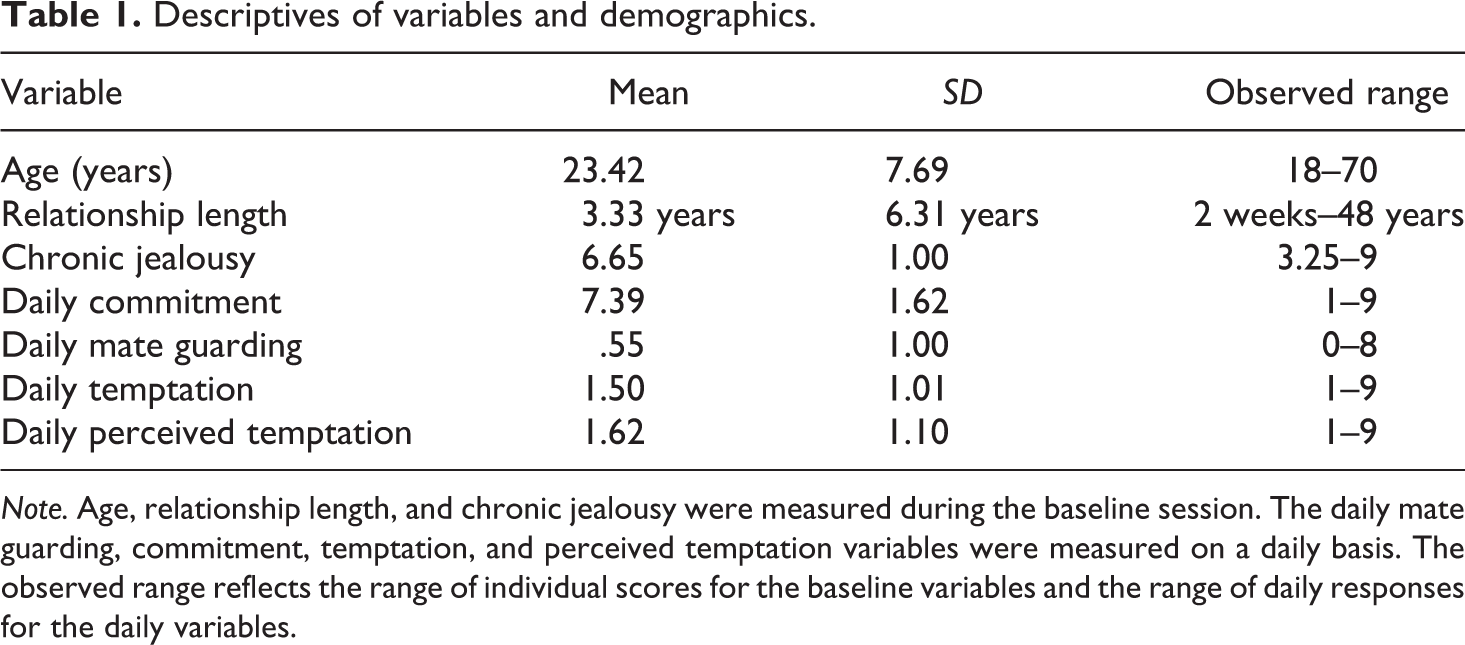
Note. Age, relationship length, and chronic jealousy were measured during the baseline session. The daily mate guarding, commitment, temptation, and perceived temptation variables were measured on a daily basis. The observed range reflects the range of individual scores for the baseline variables and the range of daily responses for the daily variables.
Procedure
Participants arrived at the laboratory with their romantic partner to complete an initial study session in which they completed the baseline measure of jealousy (among other measures unrelated to this article). Participants were asked to complete a daily questionnaire between 7 p.m. and midnight every evening starting the day following the laboratory session and continuing for 7 days. Overall, participants completed the majority of their required days (M = 6.38 days; 91.1% completion rate).
Baseline measure
Chronic jealousy
During the baseline laboratory session, participants completed the eight items comprising the Emotional Jealousy subscale of Pfeiffer and Wong’s (1989) Multidimensional Jealousy Scale (MJS). 5 Examples of these items are “How would you feel if X comments to you on how great looking a particular member of the opposite sex is?” and “How would you feel if X works very closely with a member of the opposite sex (in school or work)?” These items were completed using a 9-point scale (1 = extremely displeased; 9 = extremely pleased) and were reverse scored so higher values indicate more jealousy. Responses to these items were then averaged to form a reliable composite score (Cronbach’s α = .87) reflecting each participant’s trait jealousy. On average, participants indicated moderate levels of jealousy (3.25–9.00; M = 6.65, SD = 1.00).
Daily measures
The following measures were completed each evening during the daily report phase of the study.
Commitment
Participants completed one item assessing their daily commitment to their partner (“Today, to what extent did you feel committed to your relationship with your partner?”). This item was completed using a 9-point response scale (1 = not at all committed; 9 = extremely committed).
Mate guarding
Participants completed 11 items assessing enactment of mate-guarding behaviors that day. Most of these items were based on Buss’s (1988) direct guarding strategies and the monitoring and protective behaviors measured by the Behavioral Jealousy subscale of Pfeiffer and Wong’s (1989) MJS. We focused on the direct guarding strategies from the Buss measure because these are behaviors directed at the partner rather than outsiders and, hence, are most likely to affect the relationship between the participant and the partner. However, some of the behaviors included in these prior measures were not included in our measure because the situations assessed by the items seemed unlikely to occur on a daily basis, because the item seemed outdated, or because the behavior was not directly perpetrated by the participant or targeted at the partner. Items assessing reading personal mail (from Buss, 1988), questioning the partner about telephone calls (from Pfeiffer & Wong, 1989), saying something nasty about someone of the opposite sex (from Pfeiffer & Wong, 1989), and asking friends to monitor the partner (from Buss, 1988) were excluded for these reasons. With these exceptions, the 11 items assessed all of the direct mate-guarding behaviors described by Buss (1988) and the detective and protective behaviors described by Pfeiffer and Wong, which overlap considerably. In the interest of brevity (given that the mate-guarding measure was completed every day), several of the similar items from these prior measures were reworded and combined into a single item. Examples of the items are “I tried to take up all of my partner’s free time,” “I made it clear to others that my partner was with me,” and “I looked through my partner’s things (e.g., drawers, handbag, pockets, phone) without his/her approval.” We created additional items to measure mate-guarding behaviors that should directly follow from the threats measured by items assessing daily perceptions of the partner’s temptation (e.g., “I kept an eye out for people showing romantic/sexual interest in my partner”; “I accused my partner of flirting with someone else”). Participants indicated whether they enacted each behavior on the current day. These items were completed using a dichotomous yes/no format and are presented in the Appendix 1. The number of behaviors participants claimed to enact was used as an index of daily overall mate guarding.
Satisfaction
Participants completed one item assessing their daily satisfaction (“Today, I felt happy.”). This item was completed using a 9-point response scale (1 = extremely disagree; 9 = extremely agree).
Temptation/interest in alternative partners
Participants completed four items rating the degree to which they were interested in alternative partners. These items consisted of “Today, I feel interested in having a romantic or sexual encounter with someone else (besides my partner)” (9-point scale: 1 = extremely disagree; 9 = extremely agree), “Today, how much time did you spend thinking about having a romantic or sexual encounter with someone else (besides your partner)?” (9-point scale: 1 = did not occur; 9 = the entire day), “How many other people (besides your partner) did you check out (i.e., look at with romantic or sexual interest) today?” (9-point scale: 1 = 0; 9 = 8 or more), and “How many other people (besides your partner) did you flirt with today?” (9-point scale: 1 = 0; 9 = 8 or more). Responses to these four items were standardized (with reference to the sample mean and SD) and then averaged to form a reliable composite score (Cronbach’s α = .83) indicating each participant’s daily temptation. Higher scores indicate greater temptation or interest in alternative partners.
Perceived partner temptation/interest in alternative partners
Participants completed four daily items, which were analogous to the temptation items described above, assessing the degree to which they perceived that their partner was interested in alternative partners (e.g., “Today, my partner is interested in having a romantic or sexual encounter with someone else [besides me]”). Responses were provided using the same response scales and were averaged to form a reliable composite score (Cronbach’s α = .86) reflecting each participant’s daily perceptions of their partner’s temptation for extradyadic involvement.
Results
We tested predictions using multilevel models that treated people (i.e., the two dyad members) and the daily observations as crossed and nested within dyads (see Kenny, Kashy, & Cook, 2006). A random statement modeled the variance of individuals’ means across the days, which accounts for the interdependence due to the same individual making multiple daily reports, as well as the covariance of these two means across both dyad members, which accounts for the interdependence due to two dyad members belonging to the same dyad. A repeated statement also modeled the covariance of the daily error terms across the two partners, accounting for the possibility that the two dyad members’ reports are correlated at the daily level. Effects of the various daily predictor variables (i.e., target temptation for alternatives, perceivers’ perception of this temptation, perceivers’ mate-guarding behaviors, and commitment) were modeled as fixed variables, due to the restricted nature of the degrees of freedom in dyadic data sets. For further clarity, we refer to “perceivers” as those individuals who are perceiving their partners’ temptation for alternative romantic partners and engaging in mate-guarding behaviors, and their partners are “targets,” the individuals whose temptation are being recognized by perceivers. However, each participant provided data relevant to both of these roles, and thus data from both members of each dyad were considered in the analyses for each role.
We first examined the effect of target partners’ daily temptation for involvement with alternatives on perceivers’ perceptions of that temptation. That is, are perceivers sensitive to target partners’ daily fluctuations in extradyadic temptation (H1)? We regressed perceivers’ daily perceptions of targets’ temptation on targets’ daily temptation. The target partners’ daily temptation predictor variable was centered on each target person’s mean. As a result, this analysis examines whether perceivers view targets as especially tempted on days when targets were, in fact, especially tempted (relative to their average level of temptation). Daily fluctuations in target partners’ daily temptation were indeed related to daily fluctuations in perceivers’ perception of that temptation, b = .22, t = 7.85, p < .001. Hence, perceivers did seem sensitive to partners’ fluctuations in extradyadic temptation (H1).
Did targets’ reduced relationship satisfaction explain why perceivers detected targets’ temptation? Perhaps perceivers are able to detect dissatisfaction but not temptation per se. To test this alternative explanation, we examined the effect of targets’ temptation on perceivers’ perceptions after controlling for targets’ daily satisfaction. While fluctuations in targets’ satisfaction also predicted perceivers’ perceptions of target partners’ temptation (b = −.03, t = −2.47, p < .05), the effect of targets’ temptation on perceptions of targets’ temptation remained significant after controlling for targets’ daily satisfaction (b = .14, t = 4.6, p < .001), suggesting that daily fluctuations in partners’ satisfaction do not explain the detection of temptation. Thus, perceivers’ perceptions of temptation seem partially accurate, in that they are tied to target partners’ temptation.
Next, we examined the effect of perceivers’ daily perceptions of target partners’ extradyadic temptation on perceivers’ same-day mate-guarding behaviors (H2). That is, do perceivers enact mate-guarding behaviors on days when they perceive their partner as tempted? Daily perceptions of partners’ temptation were centered on each perceiver’s mean. Hence, this analysis examines whether perceivers engage in more mate guarding on days when their perceptions of their partners’ temptation is especially high (relative to their average perceptions). Consistent with predictions, perceivers’ perceptions of targets’ extradyadic temptation were related to perceivers’ mate-guarding behaviors, b = .07, t = 2.00, p < .05. This effect indicates that perceivers were especially likely to engage in mate guarding on days when their perceptions of partners’ temptation were especially high (relative to their average perceptions). This result is consistent with the prediction that perceivers have a calibrated behavioral response system—they engage in more mate-guarding behaviors on days when they perceive more threats to their partner’s fidelity (H2). We tested another model in which we use the partner’s daily reports of their own temptation as the predictor and found that this was also related to perceivers’ daily mate guarding, b = .20, t = 5.45, p < .001, showing an across-person effect in which targets’ self-reported temptation was related to perceivers engaging in more mate-guarding behaviors.
Next, we examined whether perceivers’ mate-guarding behaviors predicted changes in targets’ commitment (H3). We tested a lagged model in which perceivers’ daily mate-guarding behaviors is modeled as a predictor of targets’ commitment the following day. This lagged model establishes temporal precedence of perceivers’ mate-guarding behaviors and rules out the alternative explanation that the effect of mate guarding on targets’ commitment is due to the reversed causal effect (i.e., targets’ commitment, or lack of commitment, causing mate guarding). Target partners’ commitment the following day (i.e., on day d + 1) was regressed on target partners’ daily commitment (on day d) and perceivers’ daily mate guarding (also on day d). Perceivers’ daily mate guarding predicted increases in targets’ subsequent commitment at a marginal level, b = .10, t = 1.86, p = .06. Targets’ lagged commitment did not predict their subsequent commitment, p > .49. This suggests that targets respond to perceivers’ mate-guarding behaviors on one day by reporting increased commitment to the perceivers the next day (H3). 6
We also examined effects of mate guarding on partners’ relationship satisfaction. Target partners’ satisfaction the following day (i.e., on day d + 1) was regressed on target partners’ daily satisfaction (on day d) and perceivers’ daily mate guarding (also on day d). Perceivers’ daily mate guarding marginally predicted increases in targets’ subsequent satisfaction, b = .12, t = 1.73, p = .08. Hence, target partners became more satisfied with the relationship on days following perceivers’ mate guarding.
Chronic jealousy as a moderator variable
We conducted additional analyses to examine whether the effects reported above were moderated by perceivers’ chronic jealousy (H4). First, to examine whether perceivers’ chronic jealousy moderated the detection of targets’ daily temptation, we regressed perceivers’ daily perceptions of targets’ temptation on targets’ daily temptation, perceivers’ chronic jealousy, and a product term representing their interaction. The interaction was significant, b = .07, t = 2.24, p < .05. Predicted values for this interaction are displayed in Figure 1. Target partners’ daily temptation was related to perceivers’ daily perceptions of that temptation more strongly for perceivers who were high in chronic jealousy (1 SD above the mean), b = .35, t = 6.69, p < .001, relative to perceivers who were low in chronic jealousy (1 SD below the mean), b = .18, t = 4.86, p < .001.
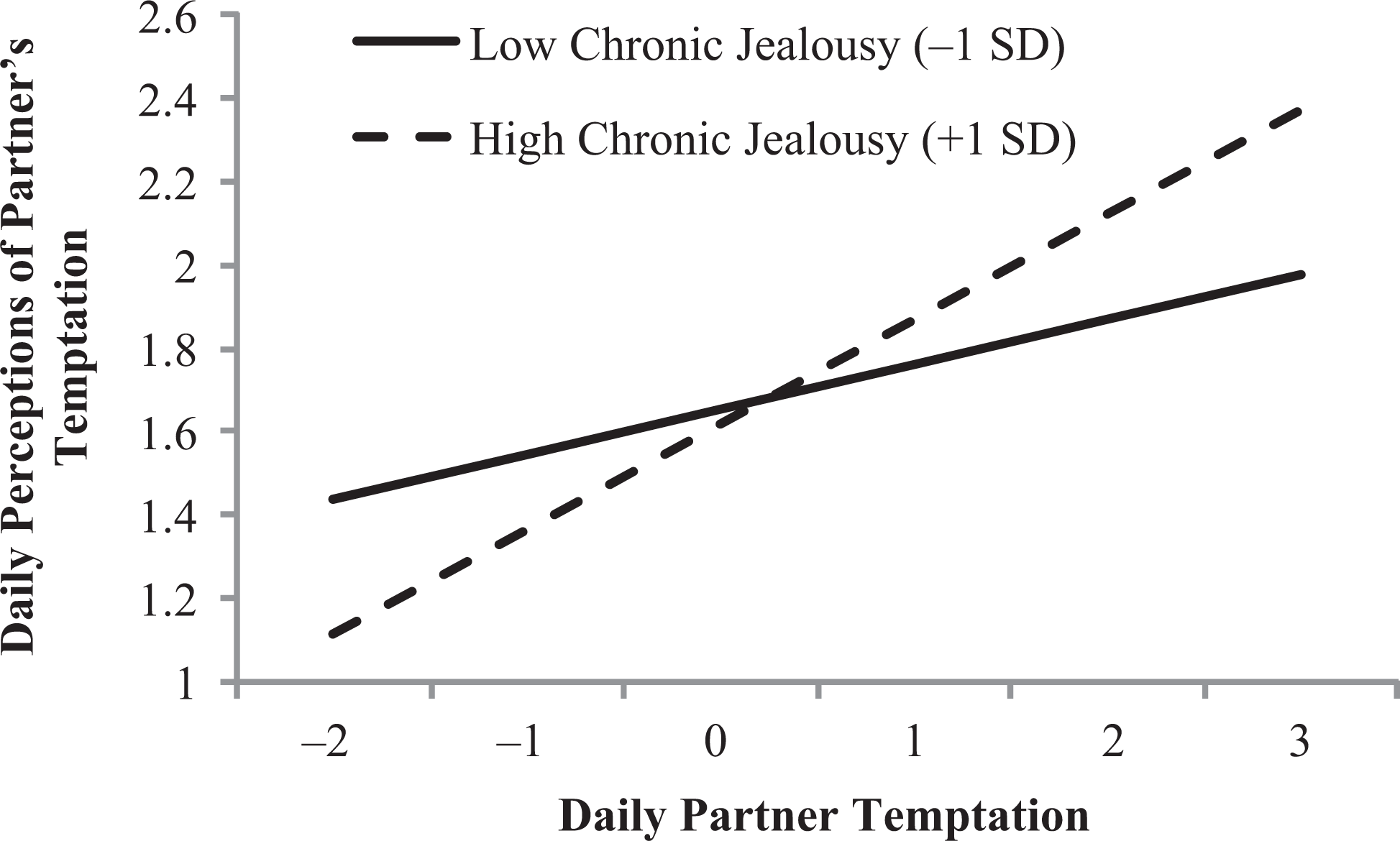
Daily perceptions of partner’s temptation as a function of daily partner temptation and chronic jealousy.
To examine whether perceivers’ chronic jealousy moderated the link between their daily perceptions of partners’ temptation and their daily mate guarding, we regressed perceivers’ daily mate guarding on their daily perceptions of the target partner’s temptation, chronic jealousy, and a product term representing their interaction. This interaction was marginal, b = .06, t = 1.74, p = .08. Predicted values are displayed in Figure 2. Daily perceptions of the partner’s temptation predicted more daily mate guarding for perceivers who were high in chronic jealousy (1 SD above the mean), b = .13, t = 2.68, p < .01, but not for perceivers who were low in chronic jealousy (1 SD below the mean), p > .77. 7
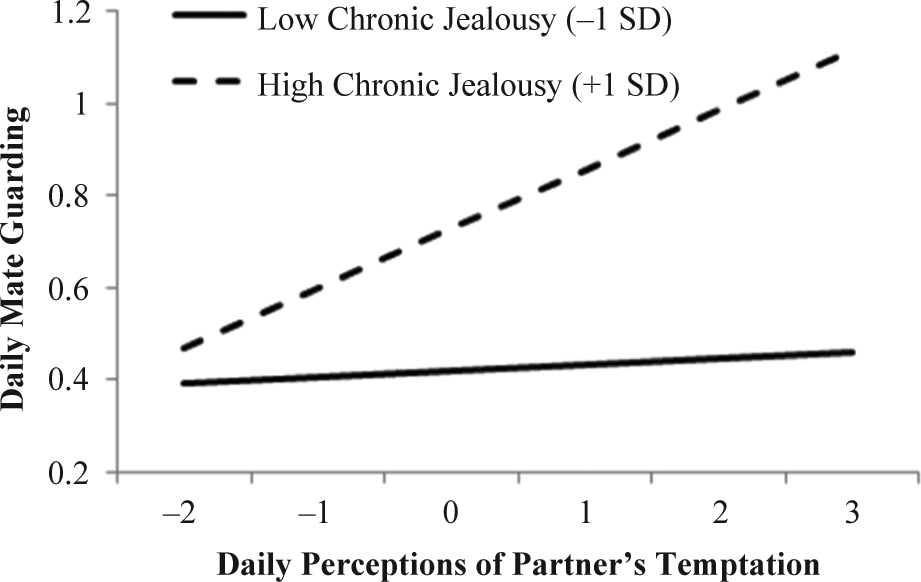
Daily mate guarding as a function of daily perceptions of partner’s temptation and chronic jealousy.
Discussion
In the current research, we examined perceivers’ everyday detection and management of relationship threats related to the partner’s infidelity. We found that perceivers’ cognitive, emotional, and behavioral responses to the threat of targets’ interest in alternative partners predicted targets’ subsequent commitment to the relationship, suggesting that perceivers, in part, were regulating targets’ relationship commitment via their mate-guarding behaviors.
Cognitive responses to perceptions of partner temptation: A threat-detection system
In the current study, we found evidence that people tend to be sensitive to their partners’ temptations to engage in relations with alternative partners. That is, perceivers seemed to have a sense of when their partners were feeling especially tempted. This supports findings that suggest people tend to be vigilant to their partner’s potential infidelity (Buss, 1988; Maner et al., 2007, 2009; Maner, Gailliot, Rouby, et al., 2007). Thus, they are more likely to detect partners who may be interested in alternatives. However, prior studies utilized infidelity primes and photographs of attractive men and women (Maner et al., 2007, 2009; Maner, Gailliot, Rouby, et al., 2007), as opposed to actual everyday experiences of infidelity threat. Perceivers in our study tended to perceive targets as interested in alternatives on days in which they actually were more interested in alternatives, highlighting this vigilance to infidelity threat (Buss, 1988; Maner et al., 2007, 2009; Maner, Gailliot, Rouby, et al., 2007) and indicating an active and sensitive threat-monitoring system. In addition, by studying naturally occurring interest in alternative partners, our findings extend literature on infidelity beyond primes and photographs of attractive unknown rivals to real-life alternative romantic partners.
Behavioral responses to perceptions of partner temptation
Perceiving a partner’s interest in romantic alternatives may activate perceivers’ behavioral response system. Often, people may respond to threat by defending their relationships, increasing closeness to their partners (e.g., Murray et al., 2006), and exhibiting a variety of other responses to defend against threats of partner loss (Buss, 1988, 2002; Buss et al., 2008; Shackelford & Buss, 1997a). In instances in which the threat is related to infidelity, this relationship-protective behavior consists of engaging in mate guarding, such as making it clear that their partners are with them (e.g., Buss, 1988, 2002; Buss et al., 2008). Previous studies have identified the mate-guarding tactics people tend to use (e.g., Buss, 1988; Buss et al., 2008; Buss & Shackelford, 1997). However, these studies focus on general use of mate-guarding tactics, overlooking the potential tendency of mate guarding to fluctuate as a function of perceived target temptation. Our findings expand literature on mate guarding by showing that these relationship-protective tactics are not fixed and instead may vary depending on the extent of infidelity threat perceived. This positive day-to-day association between perceptions of partners’ temptation and daily mate guarding underscores that mate-guarding functions to manage infidelity threats.
Chronic jealousy as a moderator
People high in chronic jealousy tend to detect more target temptation than perceivers low in jealousy (Buss, 1988; Maner et al., 2007, 2009). Our findings regarding the association of jealousy with detection suggest that detections of relationship threat may not simply be escalations of the worry that is typical of the chronically jealous (e.g., Easton, Schipper, & Shackelford, 2007; Maner et al., 2009; Maner, Gailliot, Rouby, et al., 2007) but may also reflect perceptions of very real threat, highlighting the existence of more sensitive threat-detection systems for the chronically jealous. That is, the link between partners’ daily temptation and perceivers’ daily perceptions of that temptation was stronger for highly jealous perceivers, suggesting heightened sensitivity to partner temptation.
In addition, daily perceptions of partner temptation were related to daily mate guarding more strongly for high jealous participants than for low jealous participants. Thus, perceivers high in chronic jealousy were more likely to respond to perceptions of target temptation by engaging in mate guarding. These findings are consistent with the findings of studies utilizing infidelity primes and photographs of attractive men and women, which suggest that chronic jealousy impacts whether or not people perceive a threat and proceed to attend to potential rivals (e.g., Maner et al., 2007, 2009; Maner, Gailliot, Rouby, et al., 2007) and remember and negatively evaluate these rivals (Maner et al., 2009). Our research expands the literature beyond cognitive biases to behavioral responses to potential rivals (i.e., mate guarding). In addition, our findings extend this work to how chronic jealousy and naturally occurring target temptation may interact to predict these protective behaviors. In other words, our findings show a link between perceiving a tempted partner and mate guarding, depending on one’s jealousy. Thus, our findings have implications for how perceived relationship threat and jealousy may work together in everyday life. Upon perceiving a partner as interested in alternative romantic partners, one is likely to engage in mate-guarding behaviors if they are highly jealous, whereas those low in jealousy are likely to refrain from guarding their partners. Perhaps chronically jealousy people feel personal threat when they detect their partner’s temptation and engage in mate-guarding behaviors to reduce this threat.
Partners’ response to mate-guarding behaviors
When people engage in mate guarding, how do their partners respond? While some studies have shown negative effects of mate-guarding tactics on targets’ satisfaction (e.g., Buss, 1988, 1989; Shackelford & Buss, 1997a,1997b; Yoshimura, 2004), our findings are consistent with the findings suggesting that mate-guarding behaviors create positive emotional responses in the guarded partners (Shackelford & Buss, 1997a, 2000; Yoshimura, 2004), perhaps being seen by them as displays of affection (e.g., Guerrero & Andersen, 1998). Furthermore, to our knowledge, these findings are the first to show the temporal effects of mate guarding on target partners’ commitment in everyday life. The goal of mate guarding is to secure the relationship (e.g., Buss, 1988, 2002; Buss et al., 2008; Shackelford & Buss, 1997a), as opposed to driving the mate away. Our results show that mate guarding, at least in the short term, may be a behavioral response to infidelity threat that works to fulfill that goal.
Prior research on the effects of mate guarding utilized methodology involving hypothetical vignettes and retrospective reports (e.g., Shackelford & Buss, 1997b, 2000; Yoshimura, 2004) and did not examine daily, naturally occurring mate-guarding behaviors. In addition, while research has looked at emotional and cognitive jealousy using a longitudinal methodology (e.g., Theiss & Solomon, 2006), prospective effects of mate guarding have not been examined. The current study expands on the mate-guarding literature by addressing these points and utilizes a methodology that allows for participants to report their mate-guarding behaviors each day, accounting for any potential reporting biases that may be evident in retrospective and hypothetical studies.
Limitations and future directions
Future research should examine temptation, perceptions of temptation, and mate-guarding behaviors specifically during times of relationship conflict. The present study investigated these constructs during ordinary days, for 1 week, not during times when threats to the relationship should be especially high. Therefore, scores on these variables were low, on average. The constrained variance on these measures likely attenuated estimates of associations between variables, working against our ability to find support for our predictions.
Additionally, in light of restrictions on length in daily questionnaires, we only used single items to measure daily satisfaction and commitment. Future research should use more expansive measures of satisfaction and commitment. Furthermore, because of restrictions on length, we only used Pfeiffer and Wong’s (1989) Behavioral Jealousy items and Buss’s (1988) vigilance and direct guarding tactics to index daily mate guarding, but there are other tactics that Buss (1988) identified, such as intrasexual manipulations (e.g., negative inducements such as yelling at or threatening rivals or derogating one’s mate to rivals) and intersexual manipulations (e.g., positive inducements such as making oneself look more attractive or emphasizing one’s love for the partner). Thus, future research should examine these other mate-guarding strategies.
The current study did not examine intentional communication of extradyadic temptation. That is, perhaps some targets were intentionally communicating interest in alternative partners to make perceivers jealous (e.g., Fleischmann, Spitzberg, Andersen, & Roesch, 2005). Furthermore, the current study did not examine intentional communication of jealousy. For instance, people may communicate jealousy to make their partners feel valued, not because they actually feel jealous and want to regulate infidelity threat. This should be examined in future research. In addition, the current study assessed chronic, trait jealousy, as opposed to state jealousy. Future studies should consider the ability of jealousy to change with respect to current perceptions of the partner’s temptation.
Of course, there are also negative aspects of jealousy and mate guarding. For example, cognitive aspects of jealousy involve suspiciousness regarding partners’ infidelity (Pfeiffer & Wong, 1989) that could lead perceivers into overestimating their partner’s extradyadic temptation, and there are some mate-guarding behaviors that are more controlling and violent than the behaviors examined in the current research. Hence, whereas some responses to infidelity threats could be considered relationship protective, as we have demonstrated, other responses may be damaging to relationships. This parallels the divergent ways in which people respond to more general threats regarding their partner’s commitment, which sometimes involves maintaining connection and at other times (or for other people) involves distancing from the partner and devaluing the relationship (Murray et al., 2006). Thus, future research should examine both relationship-protective and relationship-destructive behavioral responses to infidelity threats and the person, situation, and relationship factors that moderate these responses.
Future research should also investigate the potential curvilinearity of effects of jealousy. Perhaps there is some degree of optimum jealousy that motivates relationship protection and does not motivate more aversive behaviors, such as those that are violent or controlling. When jealousy is too far below this optimum threshold, relationships may be endangered because people are not motivated to dispel threats. When jealousy is too far above this threshold, relationships may be endangered because people overreact to threats and engage in aversive behaviors.
In addition, future research should examine the mechanisms that explain why mate-guarding behaviors predicted the partner’s increased commitment. Several processes seem likely, many of which are consistent with the investment model (Rusbult, 1983), such as the partner interpreting mate-guarding behaviors as signs of care or investment, the partner perceiving reduced access to quality alternative partners, and the partner investing more in the current relationship. Moreover, consideration of a broader array of mate-guarding behaviors may indicate some behaviors that have negative effects on the partner’s commitment (e.g., violence, punishment), and this would provide important boundary conditions on the interpersonal effectiveness of mate guarding. Furthermore, research is needed to investigate long-term implications for our findings. In particular, are the pro-relationship effects of mate guarding limited to short-term benefits, or do these behaviors benefit relationships in the long term? It is possible, if investigated over an extended period of time, that these guarding behaviors may not only cease to predict increases in partner commitment, but they may also actually start to predict decreases in commitment. For instance, in the short-term, looking through one’s partner’s things, keeping a lookout for rivals, as well as other guarding behaviors, may effectively dispel threat and appear as a display of love or motivate prosocial behavior and thus increase that guarded partner’s commitment to the relationship. However, if those behaviors persist over time, the very same behaviors that were once displays of affection may turn into displays of possessiveness and invasions of privacy. Future research should thus implement longitudinal methodology to investigate the long-term effects of mate guarding on partner’s commitment.
Conclusion
The results of this research provide an understanding of the interpersonal processes involved in managing infidelity threats in romantic relationships. Through detection of threats and engaging in mate-guarding behaviors that ameliorate these threats, perceivers seem to defend their relationships from the threat of their partner’s infidelity and regulate their partner’s commitment level. This research extends literature on jealousy and mate guarding, suggesting that these processes often have the function of protecting interpersonal relationships, and underscore the inherently dyadic and dynamic nature of these processes.
Footnotes
Appendix 1
Acknowledgement
We thank members of the Interpersonal Relationships Lab at the University of New Hampshire, New Hampshire, USA, for their assistance with data collection.
Funding
This research was supported by National Science Foundation Research Grant BCS 1145349 awarded to E.L.