



Abstract
Using data from the 2006 Japanese General Social Survey, we examine the association between gender role attitudes, spousal “troubles talk,” and marital satisfaction. We find that, in line with prior research, belief in gender egalitarianism is associated with higher marital satisfaction for men, whereas it is negatively associated with women’s marital satisfaction. More troubles talk is associated with higher marital satisfaction for both genders. Only for women, troubles talk significantly mediates the association between gender role attitudes and marital satisfaction. Compared with gender-traditional women, egalitarian women have troubles talk less frequently and thus experience lower marital satisfaction.
Keywords
Marital satisfaction is a powerful predictor of quality of life in Japan (Inoguchi & Fujii, 2009). Yet there is some indication that Japanese women are delaying or avoiding marriage because of its persistence as a patriarchal institution (Nemoto, 2008). Despite being among the most developed country in the world, Japan ranks in the bottom third of gender equality according to the Global Gender Gap Report (Hausmann, Tyson, & Zahidi, 2011). This gender inequality is a potential cause of Japanese women’s increasing dissatisfaction with traditional married life (North, 2009; Retherford, Ogawa, & Matsukura, 2001). While traditional Japanese marital relationships have been characterized by the husband’s dominance, a traditional division of household labor, and a lack of emotive communications, Yuzawa (1994) asserts that equal partnership and emotional satisfaction are the most important factors in contemporary Japanese marital relationships. Our study seeks to investigate the effect of gender role attitudes and marital communication on marital satisfaction among a national sample of Japanese adults.
Marriage in Japan
Japan can be considered a particularly interesting country to examine marital satisfaction because of the sometimes conflicting patterns of persistent cultural traditions that place it in a category with other East Asian countries and advanced economic growth that places it in a category with highly developed Western countries. In this section, we discuss relevant trends in Japanese marriage over the past several decades.
Before World War II, couples in Japan married for economic stability rather than romantic love (Yuzawa, 1994). Japan’s cultural traditions have placed it firmly in the category of collectivistic cultures, along with other East Asian societies. In these societies, there is an emphasis on the “self in relation to others,” whereby individuals define themselves through their connections with others (Markus & Kitayama, 1991). In this context, marital relationships may be seen as less important than other family relationships (Dion & Dion, 1993). Instead, marriage serves a more pragmatic purpose, namely providing a union in which to raise children (Bell & Bell, 2000; Kamo, 1993).
Given the emphasis on other relationships and larger family needs, there has been less emphasis on romance and fulfillment of personal psychological needs in Japanese marriages (Bell & Bell, 2000; Rothbaum, Pott, Azuma, Miyake, & Weisz, 2000). Unlike in Western societies, spouses are not necessarily seen as companions or soul mates (Wong & Goodwin, 2009). On the other hand, collectivistic cultures generally emphasize relationship harmony (Chan & Lee, 1995; Kwan, Bond, & Singelis, 1997). Yamagishi and Yamagishi (1994) find that Japanese value loyalty, cooperation, and the absence of conflict in close relationships.
Nevertheless, several trends have occurred in Japan over the last several decades that suggest traditional marriage may be on the decline. For example, the number of arranged marriages has plummeted. Whereas a clear majority of marriages were arranged in the mid-20th century, only 7% were arranged by the end of the 20th century (Retherford et al., 2001). Likewise, married couples were much less likely to coreside with parents by the turn of the 21st century (Retherford et al., 2001). Finally, divorce rates, while still low in comparison with the United States, are now comparable to Western European countries (Ono, 2009), prompting Fuess (2004) to characterize Japan’s current divorce rate as “normal.” Over one-half of Japanese women now hold favorable attitudes toward divorce for those who are dissatisfied with their marriage (Retherford et al., 2001). These trends suggest the modernization of Japanese marriage, which may be accompanied by greater emphasis on romantic love, marriage as partnership, and subsequent evaluation of marital relationships (Beck-Gernsheim, 2002). Alternatively, Ochiai (2011) argues that the persistence of familialism rather than a rise in individualism promotes family changes such as increases in age at first marriage and divorce rates. With continued emphasis on duty and responsibility above individual desire, Japanese may seek to delay marriage and the resulting family burden until they are ready to commit fully.
Gender roles and attitudes
Japanese marriages, influenced by Confucian familial piety, promote highly gendered roles (Yang & Yen, 2011). In the post–World War II period, the housewife role was strongly normative (Ochiai, 1997), while men’s family role was almost entirely defined by the breadwinner role (Iwao, 1993). Patriarchal ideology continues to emphasize Japanese women’s caregiving role within families (Sodei, 1995; Ueno, 2009). Traditional notions of wives’ obligations mean that husbands are expected to do little household labor (North, 2009), and recent evidence shows that care work is still defined as a wife’s obligation (Lee, 2010). Therefore, Japanese marriages continue to be characterized by more traditional roles, with one recent cross-national study finding Japanese husbands performing the lowest share of housework among 34 countries (Knudsen & Waerness, 2008).
These traditional roles are not always in agreement with the current attitudes regarding gender roles in Japan. While a vast majority of Japanese men and women believed in gender-specific roles in the early 1970s, only one-quarter of women and one-third of men agreed with those roles by 1990 (Tsuya & Mason, 1995). There was also a sharp decrease in the percentage agreeing with the need for a breadwinner husband/homemaker wife division of labor in the last two decades of the 20th century (Retherford et al., 2001). Furthermore, between 1994 and 2002, Japanese adults’ attitudes became more egalitarian, and this shift was even more marked among Japanese men than women (Lee, Tufis, & Alwin, 2010).
Gender egalitarianism must be understood, beyond its basic definition as beliefs and attitudes about the equality between men and women, in its multiple aspects and meanings. Researchers of marital relations often define gender egalitarianism as the extent to which individuals in a society believe that gender role differences should be minimized and gender equality promoted (Emrich, Denmark, & den Hartog, 2004). This definition is based on the widely established evidence that what are traditionally seen as women’s roles (e.g., housework) tend to be less valued economically, politically, and socially than men’s roles (e.g., breadwinning). Women tend to hold more egalitarian attitudes than men, and Aono and Kashiwagi (2011) suggest that differences in gender role attitudes within marriage may contribute to Japanese wives’ dissatisfaction.
The question remains whether changing gender role attitudes will affect family dynamics, specifically marital relationships. Previous research, primarily based in the U.S., has identified gender role attitude as a significant predictor of marital quality, although findings have been mixed on specific associations between the two variables for husbands and wives. For instance, egalitarian wives often have more disagreements in their marriage (Blair, 1993) and experience lower marital happiness (Lueptow, Guss, & Hyden, 1989). Yet the positive association between gender traditionalism and women’s marital happiness disappears when the commitment to marriage shared with their spouse is considered, which suggests that traditional wives are happier because they tend to share a higher commitment to marriage with their husbands (Wilcox & Nock, 2006). For men, studies find no effect of gender ideology on marital happiness (Lueptow et al., 1989) or a positive association between preferences for gender egalitarianism and marital quality and stability (Blair, 1993; Kaufman, 2000; Lye & Biblarz, 1993).
While numerous studies in the U.S. focus on gender role attitudes and marital satisfaction, evidence outside the U.S. is limited. Nevertheless, we may look to studies that examine the relationship between husbands’ participation in domestic labor (e.g., housework and child care) and marital satisfaction in Japan. Here there are mixed findings on that husbands’ domestic labor has no effect or a positive effect on wives’ marital satisfaction (Suemori, 1999; Yamato, 2001, 2008). Kipyong (2008) focuses on the concept of expectation sufficiency, that is, the extent to which husbands meet their wife’s expectations regarding household work. Based on a Japanese sample of married couples in 1994, Kipyong finds that the greater the expectation sufficiency, the greater is the wives’ marital satisfaction. On the other hand, wives who hold more traditional attitudes may expect less from their husbands and therefore be more content with an unequal division of labor (Fuwa & Tsutsui, 2010). Traditional attitudes and corresponding lower expectations of husbands may be particularly important for wives’ marital satisfaction in the Japanese context in which husbands perform a particularly low amount of housework (Knudsen & Waerness, 2008). Indeed, gender-traditional Japanese wives tend to report greater marital happiness than gender-egalitarian wives (Kaufman & Taniguchi, 2009). At the same time, Kaufman and Taniguchi (2009) find no comparable pattern among husbands. With the exception of the latter study, these studies tend to focus on husband’s behaviors and wife’s attitudes and marital satisfaction. Our study examines the gender role attitudes of both Japanese men and women, along with the level of housework spouses share, as correlates of marital satisfaction. Despite mixed evidence in previous studies, we expect that belief in gender egalitarianism is positively associated with men’s marital satisfaction (Hypothesis 1) and is negatively associated with women’s marital satisfaction (Hypothesis 2).
Communication
Western family theorists often refer to unromantic marriages with limited communication as “maladaptive.” Yet the notion of romantic spousal relationships with open communication may not be as important in non-Western cultures such as Japan (Rothbaum, Rosen, Ujiie, & Uchida, 2002). Japanese men and women engage in indirect communication for a number of reasons, including maintenance of harmony, preservation of privacy, and avoidance of direct confrontation (Gudykunst & Nishida, 1994; Tomita, 1994). Matsunaga and Imahori (2009) refer to this as high-context communication in which people communicate by figuring out what others want through indirect means rather than directly telling each other. They find that almost four-fifths of Japanese support this kind of communication. More direct communication is often seen as a cause of conflict. This carries over to Japanese marriages, which are often characterized by indirect communication, limited openness, and conflict avoidance (Matsunaga & Imahori, 2009; Rothbaum et al., 2002).
Ingersoll-Dayton, Campbell, and Mattson (1998) find that Japanese couples talk less and that this pattern is reinforced by the notion that talking less is an indication of adulthood. Traditionally, the Confucian gender ideology that emphasizes the distance between spouses shaped couples’ communication pattern (Lebra, 1998). Japanese husbands’ emotional reticence is well known, which may be in part due to the “traditional denigration of [men’s] talkativeness” (Lebra, 1998, p. 216). Limited communication between the spouses also may be the reason for fewer marital conflicts in Japan. Long (1996) finds that only 10% of married Japanese argue with their spouse once a month or more. Although marital conflict may be limited, efforts at openly communicating to resolve conflicts are also limited (Rothbaum et al., 2002). Indeed, more recent evidence also suggests that there is relative indifference to spousal communication among young Japanese. As with other East Asians, Japanese young adults tend to emphasize “family focus, provider” for a “good marriage,” with twice as many Japanese as Americans nominating this characteristic. On the other hand, Japanese young adults are least likely to say “love, caring,” “supportiveness, understanding,” and “communication, open, listens,” which are characteristics of a “good marriage” (Kline et al., 2012).
Why is the style of communication so important in marriage? In the broader literature, subjective perceptions of spousal interactions are emphasized as a key aspect of marital support (Acitelli, 1996; Depner & Ingersoll-Dayton, 1985; Sarason, Levine, Basham, & Sarason, 1983), and supportive marital communication is one of the strongest predictors of marital quality (Knobloch, 2008; Ogolsky & Bowers, 2013; Uebelacker, Courtnage, & Whisman, 2003). In Japan, wives’ explicit agreement via discussion, compared with tacit agreement, with husbands is associated with higher levels of marital satisfaction (Kadono, 1995). Shi (2000), however, rules out frankness or directness (socchoku sa) in marital communication as a facilitator of marital satisfaction in his study of 221 individuals in intercultural marriages where one spouse is a Japanese citizen and the other spouse is a noncitizen. Yet the same study finds an emotive aspect of communication significantly increases satisfaction for both Japanese and non-Japanese spouses. Spouses are perhaps better able to provide emotional support to each other via direct than indirect communication. Yamato (2008) finds that among Japanese couples with small children, wives who perceive their husband provides more emotional support are also more satisfied with their marriage. Similarly, Suemori’s (1999) study of 122 married women in Japan finds that husbands’ emotional support is related to wives’ marital satisfaction (see also Suzuki, 2007).
Troubles talk, the term originally coined by Jefferson (1974), is an important aspect of marital communication because it is “a type of conversation where social support is enacted” (Goldsmith, 2004, p. 4). This study defines troubles talk as the acts of listening to one’s spouse talk about his or her troubles and having one’s spouse listen to one’s own troubles. Following Goldsmith (2004), in conceptualizing troubles talk, we downplay the type of conversations in which partners discuss, or complain about, problems directly pertaining to their relationship, or the so-called relationship talk. Instead, we look at troubles talk as a means by which spouses may build rapport or empathy with each other without necessarily explicitly expressing their feelings. Thus, our use of the concept puts more emphasis on the acts of communicating, and less on “how” spouses communicate troubles. Using the concept of troubles talk in this manner may be more culturally appropriate and effective to elicit the self-report of supportive communication between spouses in Japan. Although the notion of romantic relationships with open communication may be less important in Japanese marriages, the level of occurrence of supportive communication is likely to vary among married Japanese and may indeed matter in predicting their marital satisfaction. We thus hypothesize for both genders that more supportive communication, or troubles talk, is associated with higher marital satisfaction (Hypothesis 3).
Gender role attitude, troubles talk, and marital satisfaction
So far our literature review has covered the association of gender ideology with marital satisfaction and the association of troubles talk with marital satisfaction. Now we explore some complexity in the relationship between gender role attitudes, troubles talk, and marital satisfaction.
Our focus is first to examine how gender role attitudes and troubles talk are related. Classical sociological theory has long recognized the tensions between authority and intimacy (Wilcox & Nock, 2006). In relation to marriage, one explanation of men’s lower expressiveness is that men can protect their dominance by limiting their emotional support (Wilcox & Nock, 2006). Traditionally, women were also socialized to be reticent, especially about negative emotions, to keep their marriage together (Blood & Wolfe, [1960] 1962; Thompson & Walker, 1989, Wilcox & Nock, 2006). To the extent to which traditional gender ideology promotes patriarchal authority, traditionalism may in fact be detrimental to marital intimacy.
Conversely, individuals with egalitarian gender role attitudes may more openly express their thoughts and feelings in their marriages, and this may particularly apply to men (Goldscheider & Waite, 1991; Gottman, 1994; Wilcox & Nock, 2006). Egalitarian men may be less perceptive that emotion work (e.g., engaging in troubles talk) could compromise their masculinity and be more likely to embrace the notion of “counter-stereotypical masculinity,” which is defined as the type of masculinity where feelings of vulnerability can be more easily expressed (McQuillan & Ferree, 1998; Wilcox & Nock, 2006). Yet Wilcox and Nock (2006) find no evidence that egalitarian men do more emotional work.
Meanwhile, for women, egalitarian gender attitude may operate in the opposite direction. Egalitarian women may place less value on emotional work because its association with femininity could conflict with their belief that gender role differences should be minimized. They may take a more confrontational approach to express their dissatisfaction within marriage. Consistent with this argument, there is evidence that egalitarian women are less likely to avoid marital conflict over the division of labor than are women with traditional gender role attitudes (Kluwer, Heesink, & Van de Vliert, 1997). Also consistent is Wilcox and Nock’s (2006) finding that traditional wives tend to receive more emotion work from their husbands.
Based on the studies just noted, we expect that gender role attitude has no effect on the level of men’s troubles talk, whereas for women belief in gender egalitarianism is associated with less troubles talk, and conversely, belief in gender traditionalism is associated with more troubles talk. In this study, troubles talk is primarily treated as a mediator in the relationship between gender role attitudes and marital satisfaction. Thus, we hypothesize that for women, egalitarian gender attitude is associated with less troubles talk which, in turn, is linked to lower marital satisfaction (Hypothesis 4).
Our second focus is to see whether the relationship between the levels of troubles talk and marital satisfaction varies by gender role attitude. Suemori (1999) finds, as mentioned above, that Japanese wives’ marital satisfaction is positively affected by perceived emotional support received from their husbands, but she also finds this relationship to be stronger for wives with traditional than egalitarian gender role attitudes. Although evidence is incomplete (due to lack of evidence for men), following Suemori (1999), we expect that at least for women, the relationship between the levels of troubles talk and marital satisfaction is stronger for those with traditional than egalitarian gender role attitudes (Hypothesis 5).
Method
Data and sample
Data for this study come from the 2006 Japanese General Social Survey (JGSS). The JGSS began in 2000 modeled on the U.S. General Social Survey while at the same time taking Japan’s national context into account in designing questions and response categories (Iwai, 2001). In 2003, the JGSS experimented with modules using two self-administered questionnaires (Forms A and B), and in 2006 this method became standardized. The 2006 JGSS family module (Form B) contains items that are highly relevant to this study, such as marital relationship, troubles talk for married respondents, and gender role attitudes. The JGSS collected data for a two-stage random sample, stratified by regional block and population size, of Japanese citizens with the right to vote. For Form B, the response rate was 59.8%, and 2130 valid responses were obtained (ICPSR, 2010). Given our dependent variable, we consider only those who were married at the time of the survey. After deleting cases from the initial sample of 1526 married individuals due to missing data, we obtained an analytical sample of 1458 (692 men and 766 women).
Measures
Dependent variable
We measure the dependent variable, marital satisfaction, with two questions: “Considering all things together, how would you describe your marriage (in terms of satisfaction)?” and “How much satisfaction do you get from your relationship with your spouse?” The second question is part of a 5-item question on life satisfaction. Responses to the questions range from 1 (very satisfied) to 5 (very dissatisfied). We reversed the scale so that higher scores indicate greater satisfaction. Whereas a majority of married respondents reported high levels of marital satisfaction—61% (based on the first question) or 64% (based on the second question) were either very satisfied or somewhat satisfied, 31 or 28% chose the neutral rating of 3. Based on both the questions, about 8% were either very dissatisfied or somewhat dissatisfied. For this study, we combine responses to these two questions into a scale of 2–10. Alpha Reliability coefficient is .80.
Independent variables
Our key predictors are gender role attitude and the extent of troubles talk between spouses. In addition, we control for demographic, socioeconomic, and other variables as they may logically correlate with marital satisfaction and at least one of our key predictors.
As noted above, we define gender egalitarianism as the extent to which individuals in a society believe that gender role differences should be minimized and thus gender equality promoted. We measure gender egalitarianism with four questions to which respondents expressed on a 7-point scale (strongly agree to strongly disagree) the extent of their agreement or disagreement with each of the following statements: “It is more important for a wife to help her husband’s career than to pursue her own career”; “A husband’s job is to earn money; a wife’s job is to look after the home and family”; “Men ought to do a larger share of household work than they do now”; “During economic recession, it is all right for women to be laid off than prior to men.” We reverse the scale for the third item so that higher scores indicate more egalitarian attitudes. (We performed a factor analysis of four indicators of gender role attitude and derived a single factor, on which 3 items (the first, second, and fourth items) had a factor loading larger than .5 (eigenvalue: 1.391).) Alpha reliability coefficient is .68.
Simply adding scores across the items may not be ideal to measure gender egalitarianism. First, the reliability coefficient is low. Second, gender role attitude is a hard-to-define construct and is likely to be measured with more errors than the other variables considered in this study. Summing responses across the gender role attitudinal items will compound those errors. Therefore, we treat gender role attitude as a latent variable using the two parameter ordinal item response theory model (Rabe-Hesketh, Skrondal, & Pickles, 2004). Latent variable measurement is useful to capture the relationship between measures across items and the construct(s) they represent. Here we assume that an unobserved continuous variable underlies observed ordinal responses to the four questions mentioned above to varying degrees while allowing residual variances to differ among items. Moreover, we allow different linear transformations of the thresholds for the observed responses.
We measure troubles talk between spouses with two single-item questions. Respondents rated, on a 7-point scale (very true to not true at all), the truth of the statements: “My spouse listens to my troubles” and “My spouse speaks his/her troubles to me.” We reverse the scale so that higher scores indicate more troubles talk. We combine responses about roles in troubles talk as talker and listener into a scale of 2–14. Alpha reliability coefficient is .82.
In addition to the key predictors, we include several variables—age, subjective economic standing, health, spouse’s health, involvement in housework, spouse’s involvement in housework, and family centrism, as controls because of their expected links to marital satisfaction, and at least one of the key predictors. (In our preliminary analysis, we identified family centrism as a significant positive predictor of both troubles talk and marital satisfaction among men.)
Age is coded in years ranging from 22 to 88. We measure subjective economic standing by how respondents perceive their family income relative to what they consider the average on a 5-point scale (far below average to far above average). Although our measure of family’s economic standing is not ideal, the more straightforward household income item has many missing responses. As many as 27% of the married respondents (Form B) indicated that they did not want to answer the question, said they did not know their family income, or they simply did not respond. The health variables come from respondents’ ratings of their own and spouse’s health on a 5-point scale, with higher scores indicating better subjective health.
We construct measures of respondents’ and their spouses’ involvement in housework using multiple items. Respondents reported how often they prepare dinner, do laundry, go grocery shopping, clean the house, and take out the garbage, on a scale from 1 (almost every day) to 7 (never). We reverse the original codes so that higher scores indicate higher frequencies. For this study, we combine responses concerning these five areas of a respondent’s and spouse’s housework into a scale of 5–35. Alpha reliability coefficients are .90 and.92, respectively. We measure family centrism by respondents’ evaluation of the statement: “One must put familial well-being and interest before one’s own” on a 7-point scale (strongly agree to strongly disagree). We reverse the scale so that higher scores indicate stronger family centrism.
Analysis
We estimate the ordinary least square (OLS) regressions by gender to test the hypotheses mentioned earlier. We considered specifications such as ordered logit models in our preliminary data analysis. Results from these models were similar to the results from the OLS models that we report here. First, we regress marital satisfaction on gender egalitarianism and controls (age, family income, own and spouse’s health, own and spouse’s housework, family centrism) to examine whether belief in gender egalitarianism is positively associated with men’s marital satisfaction (Hypothesis 1) and is negatively associated with women’s marital satisfaction (Hypothesis 2). Next, troubles talk is regressed on gender egalitarianism and controls. Third, marital satisfaction is regressed on gender egalitarianism, troubles talk, and controls in order to test Hypothesis 3 that, for both men and women, more troubles talk, is associated with higher marital satisfaction. We then test Hypothesis 4 that, for women, belief in gender egalitarianism is associated with less troubles talk which, in turn, is linked to lower marital satisfaction, by assessing and comparing the effects of gender egalitarianism in the first and third set of equations. A reduction in the size of the effect of gender egalitarianism in the third set of equations from the first set of equations, together with a positive effect of troubles talk, should indicate partial mediation (Baron & Kenny, 1986). Meanwhile, the coefficient of zero on gender egalitarianism in the last set of equations indicates perfect mediation. Furthermore, we test statistical significance of mediation, if any, with Sobel’s methods suggested by Baron and Kenny (1986, p. 1177) and a standard test of a linear combination of coefficients (Greene, 2012). Finally, we include an interaction of gender egalitarianism and troubles talk to test Hypothesis 5 that, especially for women the relationship between the levels of troubles talk and marital satisfaction is stronger for those with traditional than egalitarian gender role attitudes.
Results
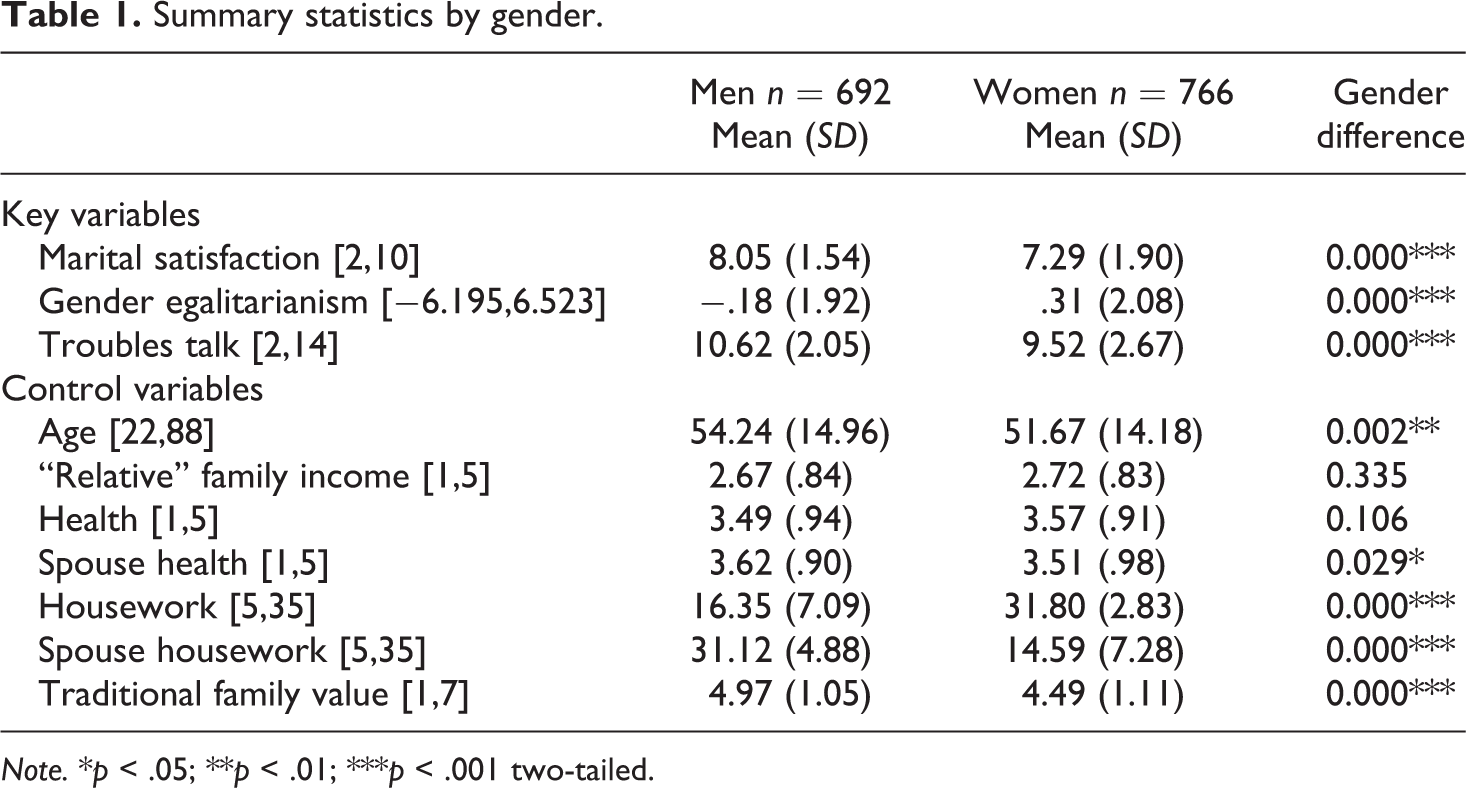
Table 1 shows the gender-specific weighted means, standard deviations, and ranges of our independent variables. We make gender comparisons of means with t tests.
Summary statistics by gender.
Note. *p < .05; **p < .01; ***p < .001 two-tailed.
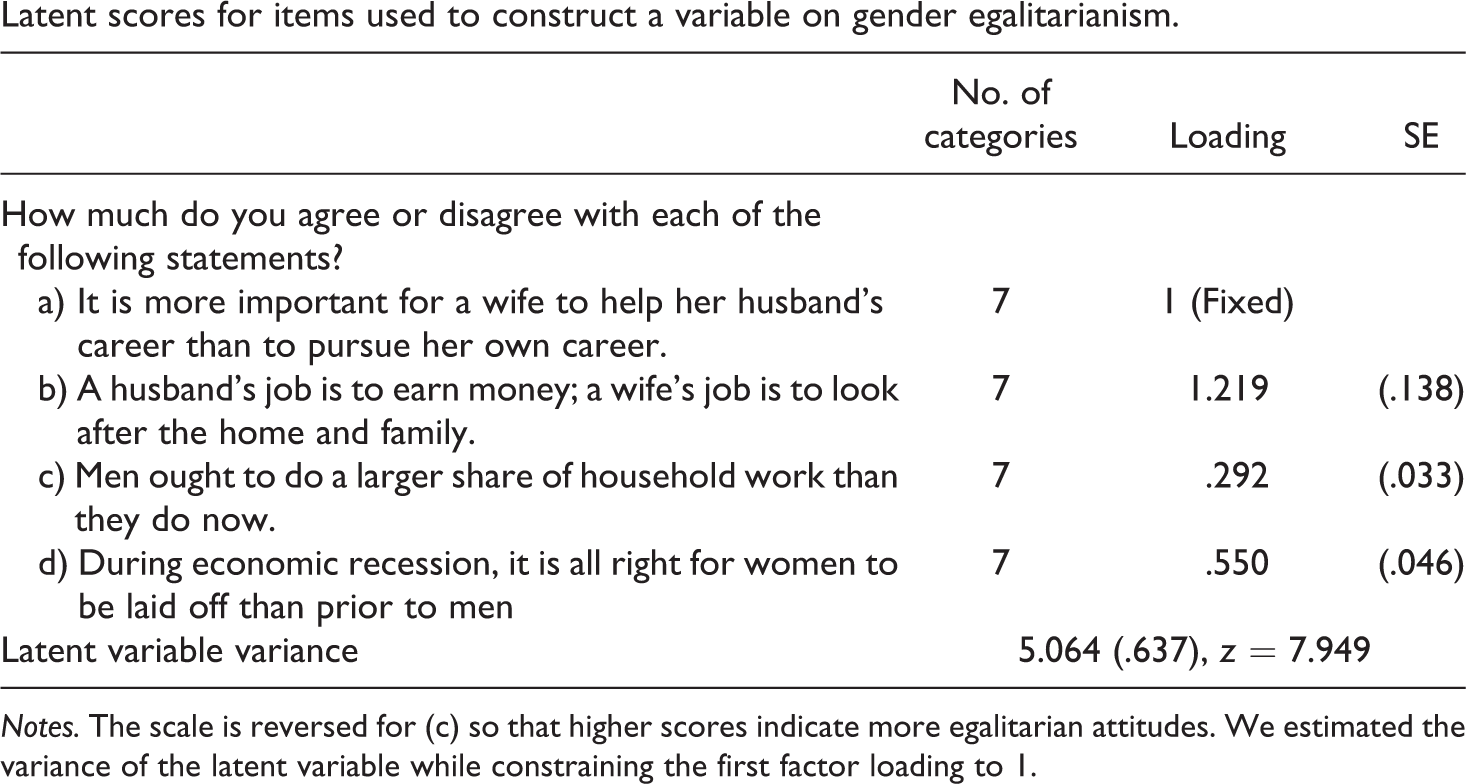
Men report significantly higher marital satisfaction than women. Consistent with earlier studies, men are significantly less gender egalitarian than women. As mentioned earlier, we treat gender role attitude as a latent variable. In Appendix 1, we show parameter estimates for this variable. The z statistic for the variance of the latent construct represents the strength of an underlying dimension. The factor loadings shown in this appendix suggest that although the first, second, and fourth items substantially contribute to the underlying dimension, the third item (i.e., “Men ought to do a larger share of household work than they do now”) does not contribute to it as well. Statistics on the “troubles talk” measure are inconsistent with the common notion that women are more engaged than men in supportive communication. Instead, they are more in line with Antonucci and Akiyama’s (1987) finding that men engage in significantly more troubles talk with their spouse than women. This is also the case when we consider the roles as talker and listener separately (results not shown).
On average, men are older than women. There are no gender differences in relative family income or health, but men’s reports of spouse’s health is somewhat higher than women’s reports on their spouses. Not surprisingly, women do substantially more housework than men, and this is confirmed by men’s reports of spouse’s housework. Men hold significantly stronger family-centric attitude than women.
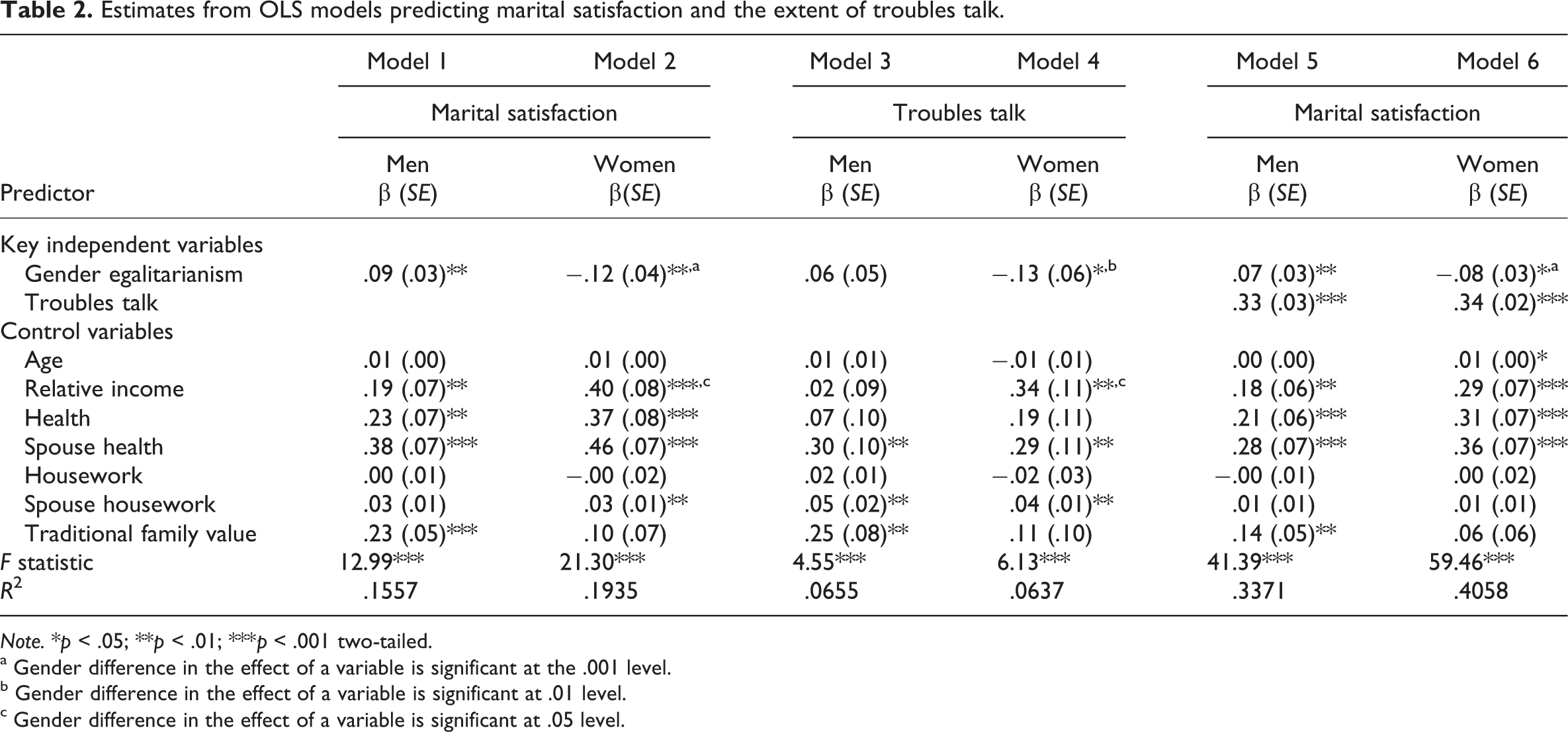
Table 2 shows the OLS regression models of marital satisfaction estimated by gender. We examine significance of gender differences with the standard test of a linear combination of coefficients (Stata, 2007). To reiterate, we regress marital satisfaction on gender egalitarianism and controls (Models 1 and 2), troubles talk on gender egalitarianism and controls (Models 3 and 4), and marital satisfaction on gender egalitarianism, troubles talk, and controls (Models 5 and 6).
Estimates from OLS models predicting marital satisfaction and the extent of troubles talk.
Note. *p < .05; **p < .01; ***p < .001 two-tailed.
a Gender difference in the effect of a variable is significant at the .001 level. b Gender difference in the effect of a variable is significant at .01 level.
c Gender difference in the effect of a variable is significant at .05 level.
Consistent with Hypothesis 1, gender egalitarianism has a significant positive association with men’s marital satisfaction, indicating that men with more egalitarian attitudes report higher marital satisfaction (see Model 1). Consistent with Hypothesis 2, there is a significant negative association between women’s gender role attitudes and marital satisfaction, indicating that women with egalitarian attitudes report lower satisfaction. Furthermore, this gender difference is statistically significant at the .001 level.
Models 3 and 4 show a positive though insignificant association of gender egalitarianism and troubles talk for men, and a negative and significant association of egalitarianism and troubles talk for women. The gender difference in the effect of egalitarianism is significant. These findings are consistent with the study by Wilcox and Nock (2006) who noted earlier that gender role attitude has little impact on the amount of emotional work husbands do, but wives with traditional attitudes are more likely to have husbands who do more emotion work.
Models 5 and 6 suggest that troubles talk is significantly and positively associated with both men and women’s marital satisfaction, consistent with Hypothesis 3. Therefore, those who engage more in troubles talk experience greater marital satisfaction than those who engage less in troubles talk. Once we add troubles talk to the baseline models of marital satisfaction, the effect of gender egalitarianism becomes smaller for both genders, although the effect remains statistically significant (see Models 5 and 6). A comparison of Models 2 and 6 indicates a one-third reduction in the size of the coefficient on gender egalitarianism for women, consistent with Hypothesis 4.
The standard test of a linear combination of coefficients suggests that the reduction in size of the effect of gender egalitarianism on women’s satisfaction is significant at the .05 level. Sobel’s test produces similar results. Our mediation analysis suggests that troubles talk partially mediates the negative effect of gender egalitarianism on women’s marital satisfaction. That is, for women, gender egalitarianism is associated with less troubles talk, which in turn is associated with lower marital satisfaction. (Conversely, traditionalism is associated with more troubles talk, which, in turn, is associated with higher marital satisfaction.)
We considered an interaction of the levels of gender egalitarianism and troubles talk to investigate a possible moderating role of gender role attitude in the association of troubles talk and marital satisfaction but found no significant interaction (results not shown). We are thus unable to support Hypothesis 5.
Results for the effects of our control variables are largely consistent with previous work based in Japan. Somewhat interestingly, in our baseline model for women (Model 2), we see that the more housework a husband does, the significantly more satisfied a wife is with her marriage. Next, spouse’s housework significantly and positively predicts women’s troubles talk (Model 4). Finally, including troubles talk in the full model (Model 6) completely wipes out the previously significant positive effect of spouse’s housework on women’s satisfaction, hinting at a possibility that troubles talk mediates the association between spouse’s housework and marital satisfaction. This result is consistent with Holloway’s (2010) finding that the Japanese wives she interviewed, who were dissatisfied with their husbands’ lack of participation in housework, also seemed to have limited verbal communication. We find no comparable pattern among men involving spouse’s housework, troubles talk, and marital satisfaction. However, for men, family centrism is positively associated with marital satisfaction and troubles talk (Models 1 and 3), while including troubles talk in the full model attenuates the effect of family centrism on marital satisfaction (Model 6), indicating a possible mediating effect of troubles talk in the relationship between family centrism and marital satisfaction among men. There is no comparable pattern for women.
Age has little effect on marital satisfaction, with the exception of a slight yet significant positive association with women’s marital satisfaction in Model 6. Relative income has a strong positive influence on men and women’s marital satisfaction and women’s troubles talk. Both health and spouse’s health are positively associated with marital satisfaction for men and women. Furthermore, those with healthier spouses also experience significantly more troubles talk.
Discussion
It is typical for Western observers of contemporary Japan to stress the relative stability of marriages in the country, attested to by its relatively low, although rising, divorce rate. Meanwhile, we are reminded that the flip side of Japan’s marital stability could be its compromised marital quality. Indeed, Japanese report lower marital satisfaction than Americans (Kamo, 1993). Some scholars suggest that married people in Japan make little conscious effort to develop companionate relationships with their spouses (Iwao, 1993; Kamo, 1993). For example, Iwao (1993) observed that for married Japanese “the verbal expression of feelings of affection or attachment is practically taboo” (p. 76). In Japan, affective communication or intimacy between spouses is relatively uncommon. Referring to this situation widely known among Japanese, the writer Iku Hayahi coined the term (and titled her book) Kateinai Rikon (in-house or de facto divorce) in 1983. Overall, Japanese appear to have a more practical outlook on marriage, seeing it as a means to raise children and/or to increase their social standing in the community (Kamo, 1993; Kaufman & Taniguchi, 2009). Whereas most previous studies in Japan have focused on women’s marital satisfaction, we are able to build on past research by highlighting the importance of gender role attitudes and troubles talk for Japanese husbands as well as wives. Because the model of marital quality share many predictors with the model of marital stability (Kurdek, 1991), our findings may have important implications for how gender role attitudes and couple communication may predict marital stability.
Although in Japan people may have different expectations for the institution of marriage, we find that belief in gender egalitarianism is positively associated with men’s marital satisfaction, whereas it is negatively associated with women’s marital satisfaction, consistent with research based in Western societies (the U.S. in particular) and recent studies in Japan (Fuwa & Tsutsui, 2010; Kaufman & Taniguchi, 2009). Because most Japanese marriages are characterized by more traditional roles, women who continue to approve of a gendered division of economic and household roles are likely to be more satisfied with their marriages (Fuwa & Tsutsui, 2010). On the other hand, Japanese men who approve of more shared roles are unlikely to be hindered by such egalitarian views and may rather find some benefit in relating to their wives.
We also find the evidence of the benefit of supportive communication similar to that found by Suemori (1999) and Yamato (2008). Despite the stereotypical image of married Japanese who are ill at ease communicating emotions and feelings with their spouse, this study shows a positive association between the extent of troubles talk and marital satisfaction for both genders. To reiterate, our use of the concept of troubles talk focuses less on how feelings are expressed and more on the acts of communicating, which we argue is a culturally more sensitive approach. While Japanese may not rate communication highly for a good marriage (Kline et al., 2012) and it may be a rare position for a married Japanese to have a spouse who engages in troubles talk, those who talk and listen to their spouses are likely to be more satisfied with their marriage. Although troubles talk may be a more direct and open form of communication than the high-context communication that is more common in Japanese culture (Matsunaga & Imahori, 2009), speaking to, and being spoken to by, one’s spouse about troubles can be a way of promoting harmony, which is also important in Japanese marriage.
This study also highlights a possible mediating role of troubles talk in the association between gender role attitude and women’s marital satisfaction. It finds that women who hold egalitarian gender role attitudes are likely to engage in less troubles talk, and therefore have lower marital satisfaction, which is consistent with Suemori’s (1999) earlier findings based on a more limited sample of married women. There may be two mechanisms at work that are relevant to the Japanese context. First, traditional wives may benefit more from speaking about their troubles with their husbands because they expect their husbands to be emotionally strong and rely on them more for this kind of support. Second, and potentially contradictory, traditional wives may see their own role as one of supporter and caregiver, in which case listening to one’s husband’s troubles may be seen as fulfillment of their marital role. Although this study focuses on troubles talk as a measure of supportive communication, future research might consider a broader set of measures of supportive communication to explore how it mediates the relationship between gender ideology and marital satisfaction.
This study has some limitations. Our definition of gender egalitarianism/traditionalism is based on the widely established evidence that what are traditionally seen as women’s roles tend to be less valued than men’s roles. Certainly, the way in which gender-specific roles are prescribed and valued is likely to vary among societies and historical periods (Emrich, Denmark, & den Hartog, 2004; Hofstede, 2001). Researchers have observed that women in East Asia possess tangible power within the household (Buckley, 1997, p. 278). Western feminists tend not to see this as “real” power, but Japanese women (and some feminists) often see the low status attached to domestic labor in the West as “a denigration of a fundamental social role” (Buckley, 1997, p. 279). Indeed, the relatively modest statistical significance of the gender role attitude effects may be due to the more Western-based measures. Moreover, due to data limitations, we are unable to consider the gender role attitude of the respondents’ spouse. It is ideal to consider both spouses’ attitudes. Although some U.S.-based studies have utilized dyadic/couple data to investigate the relationship between gender ideology and marital quality, little research exists on Japanese couples using couple data, especially on a national scale. Also, the cross-sectional nature of this study limits our conclusions about the effect of gender role attitude on marital satisfaction, the effect of troubles talk on marital satisfaction, and the mediating role of troubles talk in the relationship between gender role attitude and women’s marital satisfaction. For instance, although more troubles talk between spouses may indeed improve marital satisfaction, it could also be that couples who are more satisfied with their marriage are more at ease communicating their troubles. We ran additional models to assess the possible endogeneity of troubles talk using an instrumental variable approach. This analysis suggested that at least for women, the level of troubles talk is likely to be a cause rather than an effect of marital satisfaction (results not shown). But we remain inconclusive since it is well known that estimates of potentially endogenous variables are highly dependent on the choice of instrumental variables. In this regard, future research will benefit from richer data—the sort of data that can provide researchers with a wider range of instrumental variables, longitudinal data with repeated measures of relevant variables, or both.
What is ironic about the findings of this study is that the type of gender role attitude associated with greater marital satisfaction is found in the minority of each gender group. Belief in gender egalitarianism is beneficial to men’s marital satisfaction, but husbands’ gender ideology tends to be traditional. Similarly, despite the positive association we see among women between belief in gender traditionalism and marital satisfaction, overall, married women’s gender role attitude leans more toward egalitarianism. As Kaufman and Taniguchi (2009) argue, compared with traditional wives, egalitarian wives expect more of their husbands on the home front, and given that most Japanese husbands’ contributions at home are less than ideal, these egalitarian women tend to be unhappy with their marriages. This is also consistent with Kipyong’s (2008) concept of expectation sufficiency in which wives’ expectations for husbands play a large role in marital satisfaction. Regardless of this pattern, Japanese women are increasingly likely to desire egalitarian husbands who are willing to actively participate in not only housework but also the area of emotion work (e.g., troubles talk). Given that this trend is continuing, it may be necessary for men to change their gender attitude toward egalitarianism. When or if that change happens on a large scale, the association of gender ideology and women’s marital satisfaction will perhaps start resembling the pattern we see today for men.
Footnotes
Appendix 1
Latent scores for items used to construct a variable on gender egalitarianism
| No. of categories | Loading | SE | |
|---|---|---|---|
| How much do you agree or disagree with each of the following statements? | |||
| a) It is more important for a wife to help her husband’s career than to pursue her own career. | 7 | 1 (Fixed) | |
| b) A husband’s job is to earn money; a wife’s job is to look after the home and family. | 7 | 1.219 | (.138) |
| c) Men ought to do a larger share of household work than they do now. | 7 | .292 | (.033) |
| d) During economic recession, it is all right for women to be laid off than prior to men | 7 | .550 | (.046) |
| Latent variable variance | 5.064 (.637), z = 7.949 | ||
Notes.
The scale is reversed for (c) so that higher scores indicate more egalitarian attitudes. We estimated the variance of the latent variable while constraining the first factor loading to 1.
Acknowledgment
The Japanese General Social Surveys (JGSS) are designed and carried out by the JGSS Research Center at Osaka University of Commerce (Joint Usage/Research Center for Japanese General Social Surveys accredited by Minister of Education, Culture, Sports, Science and Technology) in collaboration with the Institute of Social Science at the University of Tokyo.
Funding
This research received no specific grant from any funding agency in the public, commercial, or not-for-profit sectors.