




Abstract
This study used latent change score models to examine how couples make progress toward resolution when they experience conflicts. It examined why negative conflict engagement might sometimes predict increased resolution, and how this process might be moderated by relationship satisfaction. A sample of 734 people in heterosexual marriages or cohabitation relationships were asked to identify an episode of relationship conflict and complete a questionnaire measuring types of negative behavior, attributions, anger, and soft emotion as well as measures of current discord, peak discord, positive behavior, and types of conflict disengagement. Negative engagement predicted peak levels of conflict discord, but for people in satisfying relationships, this effect was benign because large conflicts predicted large resolutions regardless of negative engagement levels.
When couples experience relationship conflicts, partners are likely to have perceptions regarding levels of conflict discord. These perceptions may include appraisals regarding the extent to which a conflict is a cause of personal distress, a source of relationship tension, and an issue that is unresolved. A couple, then, could be defined as making progress toward conflict resolution when partners move from a point of experiencing high discord on a particular issue of conflict to a new point of low discord (or high accord) in regard to the same issue of conflict. It is important to note that this type of progress toward resolution involves experiencing a change in conflict discord, and it is different from merely experiencing a state of resolution at a single point in time. In and of itself, a person’s current state of resolution may not be highly informative, because if a person has a conflict that is small and inconsequential, he or she could easily experience a state of resolution without any meaningful change taking place. Consequently, a state of resolution might not tell us anything about the processes a person uses when he or she experiences a significant conflict and needs to move from a point of discord to a new point of accord with a partner. To understand how people do this, it may be important to assess perceived resolution progress. Perceived resolution progress could be defined as the difference between the level of discord a person recalls experiencing at a previous point in time when a particular conflict was at its peak and that person’s level of discord regarding the same issue of conflict at the current point in time.
This definition sets a foundation for addressing a key question. How is perceived resolution progress influenced by the types of negative behaviors, thoughts, and emotions that often occur during conflict interactions? Although these types of negative conflict variables logically would be inversely correlated with experiencing a state of resolution, it is not clear how they will predict progress toward resolution. Just because a behavior, thought, or emotion occurs during conflict does not mean it hinders progress. In fact, it is possible that couples might use negative behaviors, think negative thoughts, and experience negative emotions as part of the natural process of addressing and resolving conflicts (Fincham & Beach, 1999), and, if so, this raises a possibility that these negative variables might merely be inconsequential or possibly even adaptive (McNulty & Russell, 2010). This issue is important because, presumably, a couple’s relationship health will depend on their ability to make progress toward resolution on those occasions when they experience significant conflicts (Johnson & Roloff, 1998; Markman, Stanley, & Blumberg, 2001).
Although there is scant research on the predictors of perceived resolution progress, clues regarding this process may be drawn from a long line of longitudinal research investigating change in relationship satisfaction. In this area, research has produced two contrasting sets of findings. One set of studies has found that negative communication behaviors and negative attributions during conflict are sometimes associated with beneficial long-term outcomes (Gottman & Krokoff, 1989; Heavey, Layne, & Christensen, 1993; Karney & Bradbury, 1997; McNulty, O’Mara, & Karney, 2008; McNulty & Russell, 2010; Overall, Fletcher, Simpson, & Sibley, 2009). In line with this type of inverse effect, studies have also identified situations where the use of positive communication is associated with an increased risk of future relationship distress (Baucom, Hahlweg, Atkins, Engl, & Thurmaier, 2006; Schilling, Baucom, Burnett, Allen, & Ragland, 2003). This body of research is counterbalanced by another equally persuasive body of research that has failed to find such inverse effects and instead has found that negative conflict variables predict future relationship distress (e.g., Karney & Bradbury,1995; Lavner & Bradbury, 2012; Markman, Rhoades, Stanley, Ragan, & Whitton, 2010). Thus, some studies suggest that negative conflict variables are sometimes adaptive, whereas other studies suggest that these variables are mostly detrimental. Notably, all these studies have focused on predictors of change in relationship satisfaction and not on predictors of perceived conflict resolution progress. However, a consideration of these contrasting findings can suggest three crucial issues for research on conflict resolution. First, there is a need to clarify the function of different negative conflict variables; second, there is a need to consider all relevant pathways when modeling change processes in relationships; and third, there is a need to investigate possible moderating variables.
The first issue is that it is important to clarify the function of negative conflict variables. These variables include types of negative behavior, cognition, and emotion that are commonly observed when couples experience conflict. For example, couples often use hostile forms of communication behavior that include types of criticism and defensiveness (Gottman, 1994; Heyman, 2001), they make cognitive attributions in which they blame each other (Bradbury & Fincham, 1990), and they experience feelings of anger (Sanford, 2007a). In addition, a slightly different negative variable is called “soft” emotion, and it includes feelings of sadness, hurt, and concern, which are associated with expressions of vulnerability (Sanford, 2007a) and which sometimes predict positive outcomes to relationship therapy (Cordova, Jacobson, & Christensen, 1998; Johnson & Greenberg, 1988). In seeking to understand how all these common negative conflict variables might predict perceived resolution progress, each variable could be conceptualized to function in two basic ways. As described below, a negative variable could function primarily as a type of conflict engagement or as a type of adversarial interaction.
The theoretical rationale for explaining why negative behaviors, thoughts, and feelings might be beneficial for conflict resolution is that these variables might reflect types of conflict engagement (Fincham & Beach, 1999), and such engagement may be necessary for making progress toward resolution. Along this line, studies have found that withdrawal from conflict is associated with relationship distress (Eldridge, Sevier, Jones, Atkins, & Christensen, 2007), and researchers have often suggested that negative conflict processes could be adaptive if they reduce avoidance (Gottman & Krokoff, 1989; Karney & Bradbury, 1997; McNulty, 2010). If negative conflict variables reflect types of active conflict engagement, then these variables should have the opposite function from types of conflict disengagement. For example, their function would be opposite from disengagement due to withdrawal (including what Wang, Fink, & Cai, 2012, call “negative withdrawal” and what Gottman, 1994, calls “stonewalling”) as well as from disengagement that occurs when one partner passively hopes the other will take the initiative to address an issue (similar to what Eidelson & Epstein, 1982, call an “expectation of mindreading”).
A contrasting possibility is that negative conflict variables primarily function as types of adversarial interaction and as such they may produce no direct benefits for resolution progress. Accordingly, some negative conflict variables have been described as being “corrosive” (Gottman, 1994) or “hostile” (Heyman, 2001). Moreover, behaviors that involve displays of anger and distress, as well as tactics that involve arguing, combativeness, yelling, and aggression, may violate people’s standards for “rationality” in conflict interaction (Honeycutt & Bryan, 2011). If negative variables are adversarial in nature, then they are likely to produce conflict escalation (Markman et al., 2001) and moreover, negative conflict variables would be expected to have the opposite function from types of collaborative communication. For example, their function would be opposite from the types of listening and constructive self-expression that are promoted in educational programs for couples (Markman et al., 2001). In sum, one way to clarify the function of negative behaviors, thoughts, and emotions is to contrast the function of these negative variables both with conflict disengagement and with collaborative communication.
A second issue involves a need to consider all relevant pathways when modeling change processes. It is especially important to take into account the fact that the “pre-change” level of a variable will often predict the extent to which that variable changes (McArdle, 2009). Thus, in considering perceived resolution progress, it is possible that a person’s level of discord when a conflict is at its peak (the pre-change level of discord) might predict the total extent of perceived resolution progress (defined as the difference between peak discord and current discord). In other words, the size of the conflict could determine the amount of movement toward resolution. This opens a possibility for a mediated effect pathway in which negative conflict variables predict the level of peak discord during a conflict, and peak discord in turn predicts the extent of perceived resolution progress. This would occur, for example, if negative conflict variables were primarily adversarial in nature, if they consequently produced high levels of peak discord during conflicts, and if high peak discord was followed by making substantial progress toward resolution. This would mean that if negative conflict variables predict larger conflicts, and if larger conflicts produce larger resolutions, then negative conflict variables would also predict larger resolutions. An alternate possibility, however, is that there is a direct effect pathway in which negative conflict variables directly predict the extent of perceived resolution progress. That is, negative conflict variables may have a direct effect that remains evident even after controlling for the effects of peak discord. This type of direct effect would occur, for example, if negative conflict variables were a natural part of active conflict engagement and if such active engagement was necessary or beneficial for conflict resolution. In this case, greater engagement would directly predict greater resolution progress even after accounting for effects pertaining to conflict size.
A crucial feature to notice in these examples is that both a mediated effect (in which negative conflict variables have an adversarial function) and a direct effect (in which negative variables function as types of engagement) could potentially produce identical patterns of results showing that negative conflict variables are positively correlated with resolution progress. Thus, it is important to use methods that can tease apart distinctions between direct effects and mediated effects. Notably, this has not always been done in studies investigating change in relationship satisfaction. Although this issue is arguably salient to all studies of change processes in couples, studies that have investigated change across just two time points (e.g., Gottman & Krokoff, 1989) have sometimes been singled out for criticism in this regard (Cramer, 2003; Woody & Costanzo, 1990). However, it is possible to address this issue, and to do so even if change is measured across only two points, by using an approach called a “latent change score model” (McArdle, 2001, 2009). This is a type of structural equation model in which two scores pertaining to a variable are measured in regard to two different points in time. A latent change score is created by first accounting for measurement error in the indicators and then placing constraints on the pair of scores, specifying that the second score (in this case, current discord) is exactly equal to the first score (in this case, recalled peak discord) plus change. This approach produces a latent change score (in this case, representing the extent of perceived resolution progress), which can be used as an outcome variable in path models. Importantly, these models can include a path from peak discord to the latent change score, accounting for the fact that that the size of the conflict might predict the size of the progress toward resolution.
A final issue is that the effects of negative conflict variables may be moderated. Even if negative conflict variables are associated with resolution progress for some couples, they may not predict such progress for all couples. For some couples, engagement might exacerbate conflicts, and large conflicts might fail to produce large resolutions. One likely possibility is that the direction of effect depends on levels of relationship satisfaction. According to Karney and Bradbury’s (1995) vulnerability-stress-adaptation model, a couple’s ability to utilize adaptive processes in their relationship is hindered when satisfaction is low. Similarly, Gottman (1994) suggests that when satisfaction is low, conflict interactions often become “absorbing states,” whereby couples are unable to escape from cycles of negative behavior once those cycles have begun. In this way, dissatisfied couples might easily become stuck at their peak levels of conflict intensity and fail to make progress toward resolution. In contrast, when couples are satisfied with their relationship, the mechanisms of conflict resolution might run more efficiently (Johnson & Roloff, 1998). This suggests that if negative conflict variables are associated with greater levels of conflict resolution, either through direct effects or through mediated effects, these effects may occur primarily when relationship satisfaction is high and not when satisfaction is low.
To investigate these issues, it is first necessary to develop a valid method for assessing peak discord and current discord to provide a measure of perceived resolution progress. Because perceived conflict discord involves personal perceptions of an episode of conflict, assessments may best be obtained via self-report. In addition, ratings specifically pertaining to peak discord may need to be obtained retrospectively. This is because it would be difficult to arrange for participants in a study to provide ratings of peak discord during actual conflict interactions at the precise moments, on the particular days, when those conflicts were reaching their peaks. The convergent validity of both peak discord and current discord could be tested, in part, by examining cross-spouse correlations. Because personal perceptions of conflict discord arise out of a common conflict experience that is shared by two partners, it is likely that ratings from two partners will be at least moderately correlated.
It is important to note that because perceptions of conflict discord are at the core a type of relationship sentiment, ratings of discord are likely to be highly correlated with ratings of relationship satisfaction. However, a distinct feature of conflict discord is that it should pertain to a single issue of conflict, and, thus, ratings of discord should be more specific than general ratings of global relationship sentiment. This means that if two partners make ratings of conflict discord for the same issue of conflict, their ratings should share a context-specific similarity that cannot be explained by partners’ ratings of global relationship satisfaction. In other words, the cross-partner correlation for conflict discord should remain significant after controlling for relationship satisfaction. Another unique feature of conflict discord is that it should often show substantial change over the course of a single conflict, and this would contrast with global measures of relationship satisfaction that often remain relatively stable even over the course of several years.
Overview
This study began with an examination of validity data for a measure of conflict discord, and then it focused on testing a latent change model of perceived conflict resolution. The study included four key independent variables: negative communication behavior, blaming attributions, anger, and soft emotion. Results from these negative conflict variables were contrasted with collaborative communication behavior and two types of disengagement: withdrawal and passive immobility (the latter being a type of conflict disengagement in which a person desires to address an issue but passively waits for a partner to initiate engagement). To the extent that negative conflict variables might produce direct effects, the effects were expected to be positive, to be strongest when satisfaction was high, and to be the opposite of the effects for withdrawal and passive immobility. To the extent that mediated effects might be present, it was expected that negative conflict variables would predict high peak discord, that collaborative engagement would have the opposite effect, that peak discord would positively predict resolution progress, and that this effect would be the strongest when satisfaction was high.
Method
Participants
Participants included 734 people in heterosexual marriages or cohabitation relationships. A total of 687 were married and the remaining 47 were cohabitating (because a majority were married, the terms “wife” and “husband” will be used throughout). Age of participants ranged from 18 to 82 years (M = 40.20, SD = 13.15); and of the married participants, length of marriages ranged from less than 1 to 51 years (M = 13.36, SD = 12.38). The sample comprised 64% female, 11% Asian, 7% Black or African American, 10% Hispanic, 69% White (non-Hispanic), and 3% other races. Annual family income ranged from less than US$10,000 to more than US$500,000 (median = US$78,000, M = US$102,000, SD = US$85,000).
The total sample was divided into two overlapping subsamples. First, a paired-data subsample included 117 couples with two participating partners, with both partners completing an assessment pertaining to the same issue of relationship conflict. Second, an independent-cases subsample had 617 participants. These included (a) 1 randomly selected member from each of the 117 couples in the paired-data subsample, (b) 1 randomly selected member from each of 28 couples where partners completed assessments pertaining to different issues of conflict, and (c) 472 married or cohabitating individuals participating without their partners.
Procedure
An interactive Web site was created, which allowed participants to create an anonymous account, complete an assessment, submit responses, receive personalized feedback, and view a resource bank of information for couples. On the first page of the assessment, participants were instructed to “Think about a single, specific episode of conflict in your relationship,” and they were given a text box in which they were asked to write a brief conflict description that would be acceptable to be viewed by their partners (if participating). When both members of a couple participated, the first partners’ incident description was automatically displayed on the first page of the questionnaire for the second partner, and the second partner was asked to indicate whether they had both identified the same incident. When the incident was reported to be the same for both partners, the couple was included in the first subsample of paired partners. No other parts of the assessment were shared between partners, and partners were instructed to complete their assessments independently.
After identifying an episode of conflict, participants then completed several questionnaire scales regarding that conflict. Participants were included in the data set only if they completed the entire questionnaire and responded affirmatively to a question about providing valid answers. A portion of the sample was recruited using procedures outlined by Feeney (1999) in which students from upper level undergraduate psychology courses invited their married parents, relatives, and acquaintances to complete the Web questionnaire. Drawing from student recruitment records, it is estimated that approximately 60% of the couples were recruited by students and that the remaining 40% simply discovered the questionnaire while searching the Internet or via links from other Web sites. Compared with other nonclinical samples of couples (e.g., Funk & Rogge, 2007), the participants in the present study had a lower mean and a wider spread of relationship satisfaction scores (Couples Satisfaction Inventory M = 49.44, SD = 21.54), and there was a significant gender difference, d = .32, t(615) = 3.70, p < .001, with women reporting lower satisfaction than men. There is a possibility that the recruitment methods inadvertently oversampled distressed women compared with distressed men, and, thus, any gender differences in this study should be interpreted with caution.
Measures
Conflict resolution
A new instrument called the conflict resolution questionnaire was created for this study. This questionnaire asked participants to rate 10 pairs of items pertaining to the specific episode of conflict they identified at the beginning of the assessment protocol. The first item of each pair was used to assess peak discord, and each of these items asked respondents to make a rating based on the conflict when it was at its peak. The second item of each pair was used to assess current discord, and each of these items asked participants to rate the same characteristic as the first item but to base the rating on the conflict at the current moment in time. A list of items is provided in Appendix 1. A confirmatory factor analysis of this questionnaire was conducted, and, specifically, a model was tested with (a) six-item parcels, (b) two latent state factors, and also (c) two indicator-specific factors accounting for variance shared by pairs of questions that were repeated in regard to two different time points (Geiser, 2013). This model produced a good fit, χ2(df = 6) = 41.64, comparative fit index (CFI) = .99, standardized root mean square residual (SRMR) = .04; further details regarding this analysis are available from the author. Cronbach’s αs were .87 and .94 for peak discord and current discord, respectively.
Communication behavior
The Conflict Communication Inventory (Sanford, 2010a) was used to assess both adversarial (negative) communication and collaborative (positive) communication during the specific episode of conflict that participants identified at the beginning of the assessment protocol. The adversarial communication scale includes seven items that ask participants to rate their use of negative communication (e.g., “I said something mean” and “I defended my position”). The collaborative communication scale includes seven items that ask participants to rate their use of positive communication (e.g., “I politely talked about my feelings,” and “I carefully listened so I could understand my partner”). Previous research has found that scores on these scales are highly correlated with observer ratings and, moreover, that the scores predict future observed behavior nearly as well as do ratings that are obtained from trained observers (Sanford, 2010a). In the present study, α was .85 for adversarial communication and .86 for collaborative communication.
Negative attributions
Participants used a negative attribution scale (Sanford, 2010b) to rate their appraisals during the episode of conflict that they identified at the beginning of the assessment protocol. On this scale, participants rated the extent to which they agreed with eight different attribution statements, such as “My partner deserves to be blamed” and “My partner did something on purpose that caused this problem.” Previous research has found that scores on this scale correlate with observer ratings of verbalized attributions (Sanford, 2010b) and, in the present sample, α was .89.
Emotion
Two scales from the Couples Emotion Rating Form (CERF; Sanford, 2007a) were used to obtain ratings of negative emotion during the episode of conflict that participants identified at the beginning of the assessment protocol. Anger was assessed with a four-item “hard emotion” scale measuring feelings of anger, annoyance, irritation, and aggravation. Participants also completed a 4-item “soft emotion” scale measuring feelings of sadness, hurt, concern, and disappointment. This instrument was developed and validated in a series of studies (Sanford, 2007a, 2007b, 2012) demonstrating that (a) the CERF fits an expected factor structure, (b) scores on the CERF correspond to observer ratings of expressed emotion, and (c) changes in emotion predict corresponding changes in communication behavior and cognition. In the present study, αs were .85 for anger and .83 for soft emotion.
Conflict disengagement
A new instrument called the Conflict Disengagement Inventory was created. This instrument contains two 7-item scales specifically pertaining to the episode of conflict participants identified at the beginning of the assessment protocol. One scale measures withdrawal and the other measures passive immobility. A list of items is provided in Appendix 2. The instrument was developed through a series of four studies (total n = 3,715) conducted by this author (Sanford) in which pools of potential items were factor analyzed, and items were selected and revised to produce an instrument with two distinct factors. A subsequent validation study (n = 297) comparing the two scales found that the withdrawal scale had significantly stronger correlations with other existing measures of withdrawal (measuring patterns of withdrawal rather than withdrawal in a specific conflict interaction), avoidant attachment, and low relationship commitment. In contrast, passive immobility had significantly stronger correlations with having standards that a partner should be able to “mind read” one’s own desires and with anxious attachment. In the present study, αs were .85 for withdrawal and .88 for passive immobility.
Relationship satisfaction
Participants completed the 16-item version of the Couples Satisfaction Index (Funk & Rogge, 2007). This measure was developed using item response theory analysis to select highly discriminating items from a pool of items drawn from several existing measures. In the present study, α was .97.
Results
The first step in data analysis was to conduct a test of the convergent validity for the ratings of peak discord and current discord. Using only the paired data set of 117 couples, correlations were computed between wives and husbands. These cross-spouse correlations were .60 (p < .001) for peak discord and .76 (p < .001) for current discord. Next, partial correlations were computed after controlling for both wife relationship satisfaction and husband relationship satisfaction. The partial correlations were .59 (p < .001) for peak discord and .61 (p < .001) for current discord. Thus, the strong correlation between partners in their ratings of conflict discord was more specific than merely sharing perspectives that matched their overall relationship satisfaction. This provides initial support for the convergent validity of the resolution scales.
The remaining analyses all used the nonpaired data set of 617 independent cases. First, means, SDs, and correlations were computed for all the variables, and these are listed in Table 1. Correlations between the various independent variables ranged from being small and nonsignificant to large. Consistent with the fact that both conflict discord and relationship satisfaction tap aspects of relationship sentiment, the correlation between relationship satisfaction and current discord was large. However, as reported earlier, the correlation between partners in their ratings of current discord could not be explained by their ratings of satisfaction, suggesting that discord scores are also distinct from satisfaction. Notably, correlations between adversarial communication, anger, and negative attributions were all .50 or greater. Along this line, a confirmatory factor analysis demonstrated a good fit for a model in which these three variables were all indicators of a single factor, and each of the other four variables were sole indicators of separate factors, χ2(df = 8) = 45.06, CFI = .98, SRMR = .03. Thus, to reduce the number of equations tested in subsequent analyses, adversarial communication, anger, and negative attributions were each standardized and then summed together to create a composite variable called “negative process”.
Means, SDs, and correlations between variables using 617 independent cases.
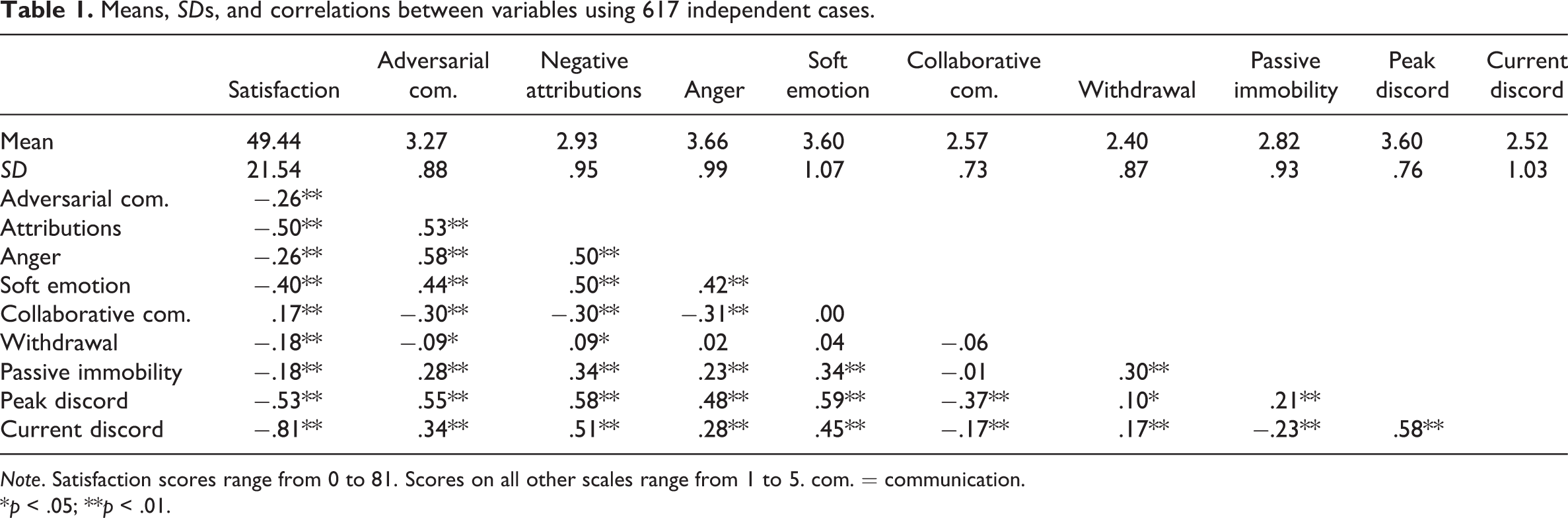
Note. Satisfaction scores range from 0 to 81. Scores on all other scales range from 1 to 5. com. = communication.
*p < .05; **p < .01.
Latent change score models
A series of five latent change score models were estimated, one for each of five conflict process variables: negative process (which was a composite of adversarial communication, anger, and negative attributions), soft emotion, collaborative engagement, withdrawal, and passive immobility. These models were analyzed following procedures described by McArdle (2001, 2009) using LISREL 8.80 software (Scientific Software International, Lincolnwood, Illinois, USA; Jöreskog & Sörbom, 2007). Figure 1 provides a depiction of the basic model. This figure includes all components of the model except for variables pertaining to gender, which were entered as covariates in all analysis but omitted from the figure to simplify the presentation. As seen in the figure, the model includes variables representing peak discord and current discord and also an unobserved variable called “change.” Both peak discord and change have arrows pointing to current discord, and both of these pathways are constrained to equal one. This means that current discord is equal to the sum of peak discord plus change, and hence, change is a latent difference score equal to current discord minus peak discord (if current = peak + change, then change = current − peak). In other words, change is a measure of perceived resolution progress. The model also includes a constant, depicted as a triangle and set equal to one for all participants, which makes it possible to estimate intercepts. For example, the arrow from the constant to change estimates the intercept for change, which is the average amount of change after controlling for other predictors. In each model, peak discord was predicted by (a) one of the conflict process variables, (b) relationship satisfaction, and (c) the interaction between the conflict process variable and relationship satisfaction. Although not depicted in the figure, peak discord was also predicted by (d) gender, (e) the interaction between gender and the conflict process variable, and (f) the interaction between gender and relationship satisfaction. Change was predicted by (a) peak discord (b) one of the conflict process variables, (c) relationship satisfaction, (d) the interaction between the conflict process variable and relationship satisfaction, and (e) the interaction between peak discord and relationship satisfaction. Although not depicted in the figure, change was also predicted by (f) gender, (g) the interaction between gender and peak discord, (h) the interaction between gender and the conflict process variable, and (i) the interaction between gender and relationship satisfaction. In Figure 1, the direct effect of the negative process variable on conflict resolution is labeled as Path C, and the mediated effect is the product of the Paths labeled A and B.
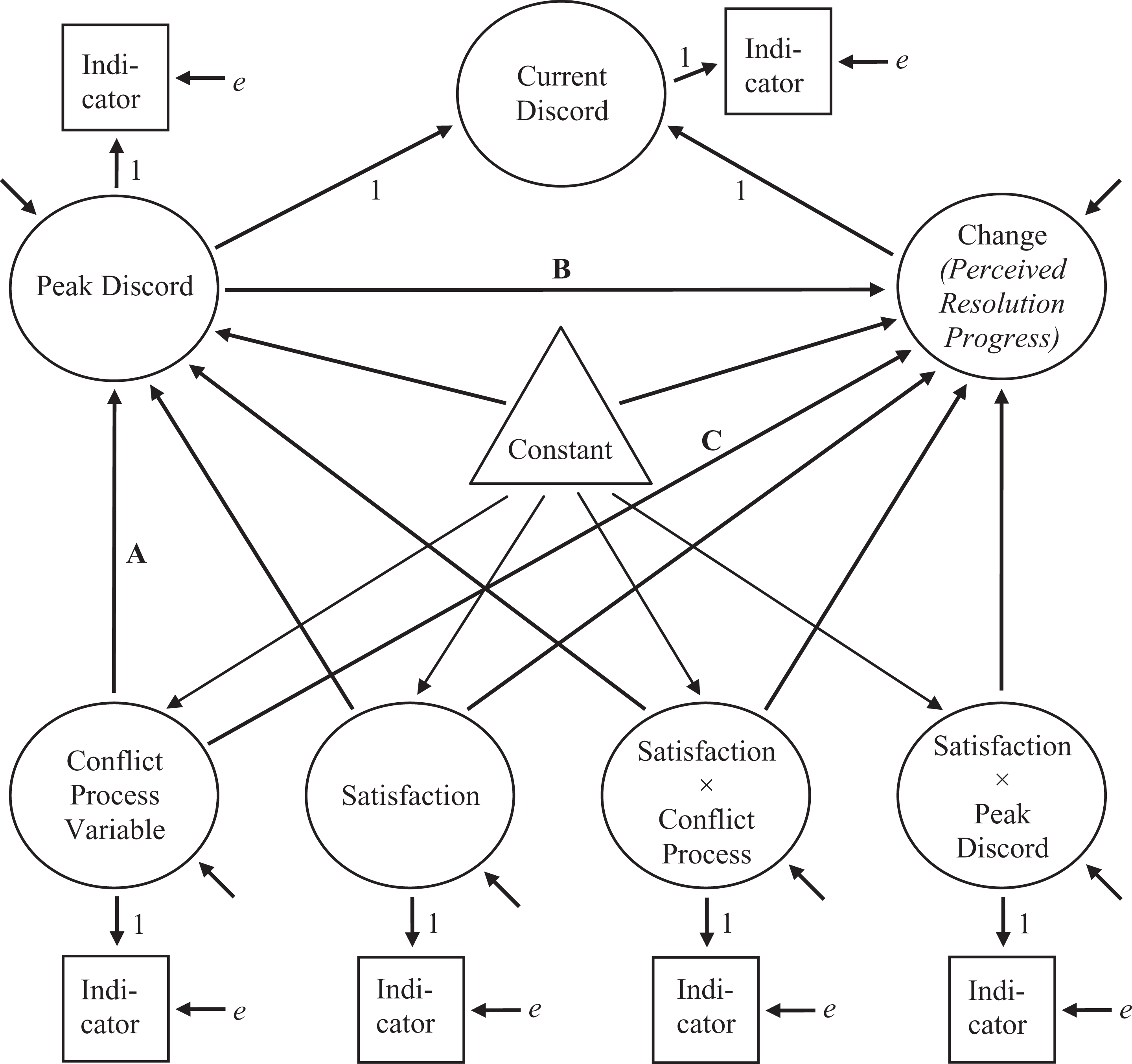
Latent change score model of conflict resolution. Each “e” indicates measurement error variance, which is fixed to equal an indicator’s variance times 1 minus its reliability. Each “1” indicates a pathway fixed to equal one. Current discord is fixed to equal peak discord plus change with no residual variance. Pathways A and B are the mediated effect pathways. Pathway C is the direct effect pathway. To simplify presentation, covariates and interactions involving gender are not depicted in the figure.
As depicted in Figure 1, each latent variable has a single indicator (or observed variable), and each indicator is constrained to have a unit loading on its target latent variable. In line with McArdle (2001), the error variance for each indicator was set to equal the observed variables’ variance times 1 minus its reliability. Prior to analysis, and prior to calculating products for the interaction terms, scores for peak discord, satisfaction, and the conflict process variable were all converted to z scores. Gender was coded so that 0 = wives and 1 = husbands. Scores for current discord were standardized using the mean and SD for peak discord. This means, for example, that a change score of −1 indicates a decrease in conflict discord that is equal to a 1 SD drop on the peak discord scale.
The substantive parameters of interest in the latent change score analysis pertain to the predictors of peak discord and the predictors of change (i.e., perceived resolution progress). The results regarding predictors of peak discord are listed in Table 2. Both negative process and soft emotion strongly predicted higher peak discord, whereas collaborative communication predicted lower peak discord. The two disengagement variables had small effects, with withdrawal being nonsignificant. As might be expected, the level of peak discord was inversely related to relationship satisfaction, and it was also inversely related to being a husband (which is consistent with the gender difference in this sample). Importantly, the effects for negative process, soft emotion, and collaborative communication were all moderated by relationship satisfaction. The direction of these interactions indicated that the effects were stronger when satisfaction was high.
Coefficients for pathways predicting peak discord.
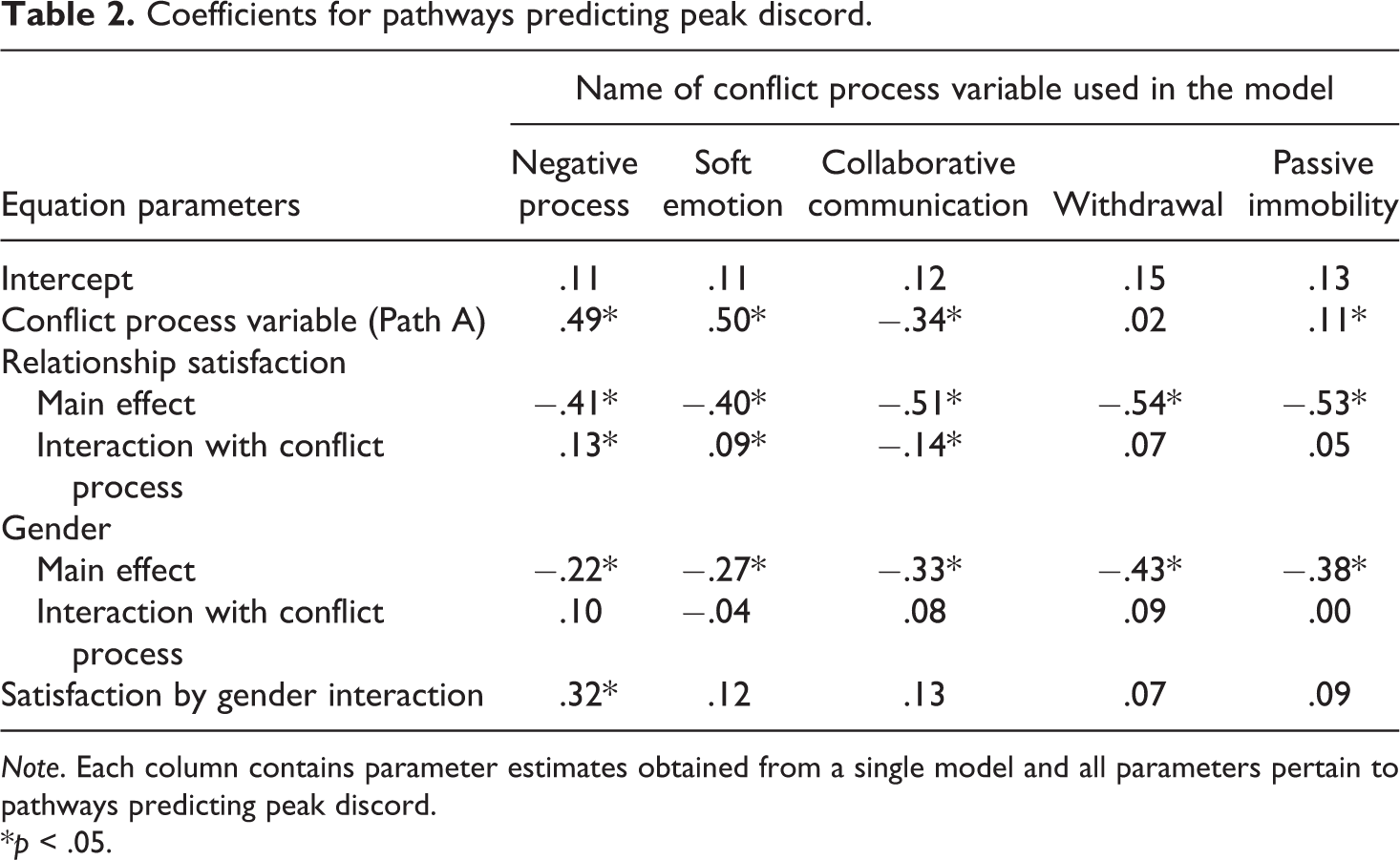
Note. Each column contains parameter estimates obtained from a single model and all parameters pertain to pathways predicting peak discord.
*p < .05.
The results regarding predictors of change are listed in Table 3. Note that change is scored so that negative values indicate conflict resolution progress (i.e., a decrease in discord), whereas positive values indicate conflict escalation. Because units of change were scaled to the SD of peak discord, the change variable itself was not a z score, and, therefore, path loadings near one do not indicate a near perfect correspondence. The intercepts in Table 3 indicate that participants reported average reductions in conflict discord that were approximately equal to 1.55 SDs on the peak discord scale. This is consistent with the expectations that scores regarding conflict discord should have the potential for changing substantially over the course of a single conflict. Importantly, both peak discord and relationship satisfaction were strong predictors of greater perceived resolution progress (predicting greater reductions in discord). In addition, peak discord was moderated by satisfaction. The direction of the interaction indicated that peak discord predicted the most resolution when satisfaction was high. In contrast to the robust effects for peak discord, the direct effects for the conflict process variables were generally small, and the only significant direct effects pertained to negative process, soft emotion, and passive immobility. Each of these variables was associated with reduced progress toward resolution. Thus, the results for passive immobility were consistent with the idea that disengagement might hinder resolution, whereas the results for negative process and soft emotion were opposite from expectations that these variables might be adaptive and might facilitate resolution. Notably, there was an interaction between soft emotion and satisfaction, suggesting that this direct effect for soft emotion was weaker when satisfaction was high. Incidentally, there were also some gender effects in that men reported slightly less progress toward resolution, and in the equation testing effects of soft emotion, the interaction between gender and peak discord fell in the significant range.
Coefficients for pathways predicting change (perceived resolution progress).
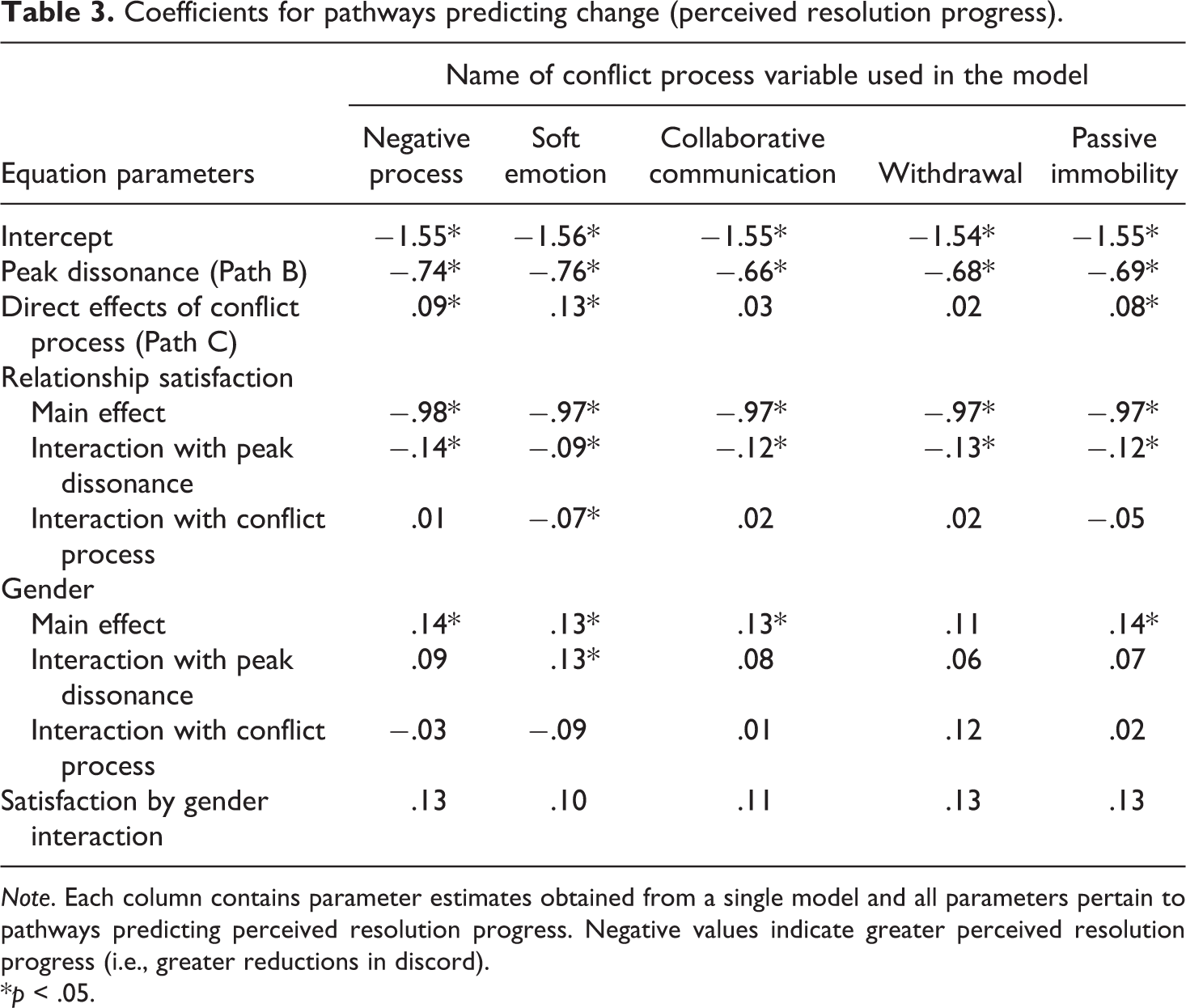
Note. Each column contains parameter estimates obtained from a single model and all parameters pertain to pathways predicting perceived resolution progress. Negative values indicate greater perceived resolution progress (i.e., greater reductions in discord).
*p < .05.
To assist in interpreting the significant interactions in Tables 2 and 3, conditional effects were computed for all variables. Specifically, mediated effects, direct effects, and total effects were calculated for both: (a) people 1 SD above the mean on relationship satisfaction and (b) people 1 SD below the mean. Because there was a significant gender interaction in one of the equations pertaining to soft emotion (Path B), results for this particular variable were calculated separately for wives and husbands. All conditional effects are reported in Table 4. The results indicate that the mediated effects are both robust and strongly moderated by satisfaction. Compared to people with low satisfaction, the results for highly satisfied people show that negative process and soft emotion both predicted comparatively greater increases in peak discord, but this was offset by the fact that peak discord predicted comparatively greater levels of resolution progress. Taken together, these mediated effects were substantial for people with high satisfaction (e.g., negative process-mediated effect was −.56), but small for people with low satisfaction (e.g., negative process-mediated effect was −.22). The total effects listed at the bottom of Table 4 show that these mediated effects were reduced, albeit only slightly, by small direct effects in the opposite direction. Notably, the results for collaborative communication were mostly a mirror image of the results for negative process, suggesting that these variables have opposite functions. In contrast, the two disengagement variables had small effects that were, if anything, in the same direction as negative process rather than opposite.
Conditional effects of conflict process variables predicting change (perceived resolution progress) at levels of relationship satisfaction.
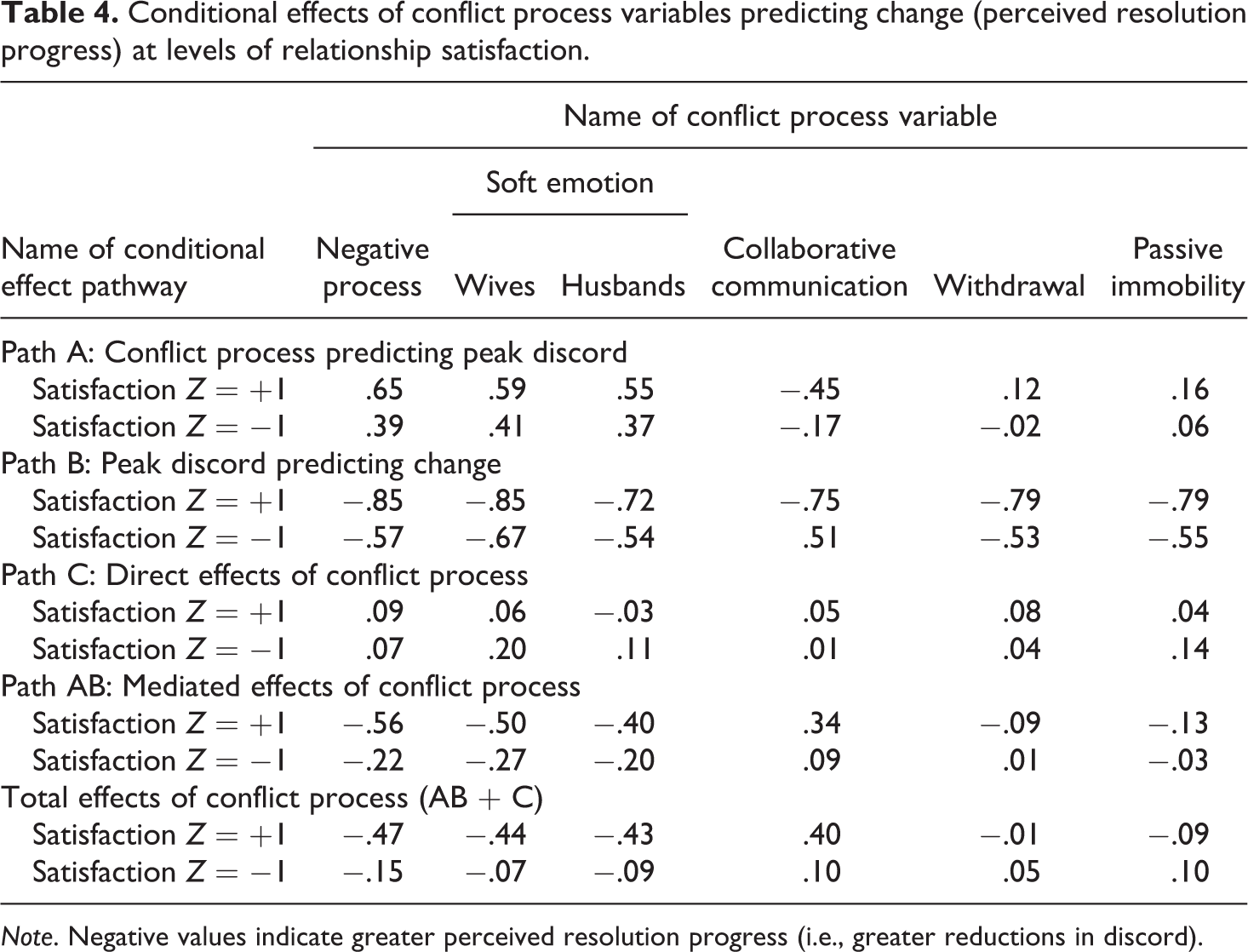
Note. Negative values indicate greater perceived resolution progress (i.e., greater reductions in discord).
Discussion
Perceived conflict resolution progress in couples is a process that involves moving from a point of high discord on a conflict to a new point of low discord. The present study demonstrated how this process can be examined using latent change score models, and it investigated the extent to which perceived resolution progress was associated with a set of three negative process variables (including adversarial communication, blaming attributions, and anger) and also a measure of soft emotion. The results were consistent with a mediated pathway in which negative process variables predicted greater peak discord during conflicts and where greater peak discord in turn predicted greater resolution progress. In other words, large conflicts were offset by large resolutions. Importantly, this mediated pathway was strong for people with high relationship satisfaction, but weak for people with low satisfaction. These results help answer a key question. Are negative process variables sometimes beneficial for resolution progress? Results of the present study suggest that negative process variables do, indeed, predict positive change. However, the reason is not because these variables directly serve a beneficial function, but rather, because when people are in satisfying relationships, perturbations away from a norm are followed by a return to the status quo. After controlling for this robust effect, the remaining direct effect of negative process variables on resolution progress was quite small in magnitude and in the direction of predicting decreased, not increased, resolution.
The results help clarify the extent to which negative process variables function primarily as types of adversarial interaction versus types of conflict engagement. If these variables are adversarial in nature, they should function as the opposite of collaborative engagement. They should violate what Honeycutt and Bryan (2011) call “rules for positive understanding,” and they should be associated with conflict escalation (Markman et al., 2001). In line with this assumption, the present study not only found that negative process variables were correlated with higher peak discord but also that these variables had the opposite effect from collaborative engagement, which predicted reduced levels of peak discord. A contrasting (albeit not incompatible) theoretical perspective is that negative process variables are best conceptualized as types of conflict engagement and that resolution will be facilitated by engagement and hindered by disengagement (Gottman & Krokoff, 1989; Karney & Bradbury, 1997; McNulty, 2010). The results of the present study were mixed regarding the overall salience of variables pertaining to disengagement. One type of disengagement called “passive immobility” had a small but significant direct effect predicting lower perceived resolution progress, but the direct effects for another type of disengagement, called “withdrawal,” were not significant. Importantly, results regarding the two disengagement variables were, if anything, similar in direction (rather than opposite in direction) from the effects for the negative process variables. Thus, the pattern of results provided the strongest support for conceptualizing negative process variables as being primarily adversarial in function.
In the present study, peak discord predicted the extent of perceived resolution progress. These results followed a general pattern in which a pre-change condition of having problems (high peak discord) predicted making subsequent improvements (perceived resolution progress), and, thus, the variables that predicted having problems were also variables that predicted making improvements. A similar pattern of results is evident in longitudinal research on relationship satisfaction. For example, some previous studies have found that forms of negative communication are associated with having initially low levels of satisfaction and also with experiencing future improvements (Gottman & Krokoff, 1989; Heavey et al., 1993). This type of pattern is also found in growth curve modeling studies where the rate of improvement is assessed across multiple time points. These studies have found that, when newly married couples report experiencing marital problems, they tend to have low immediate relationship satisfaction but also a trajectory of improvement over time; and moreover, when these couples with problems use negative communication and make negative attributions, it again predicts low immediate satisfaction, but a trajectory of improvement (McNulty et al., 2008; McNulty & Russell, 2010). Similarly, Karney and Bradbury (1997) found that wives’ negative behavior was inversely related to pre-change satisfaction levels (albeit with most effects falling short of significance in this study), but it had a beneficial effect on that rate of change over time. A mirror image of this effect was also observed in a study of couples attending a premarriage education program where high satisfaction scores at the beginning of the program predicted subsequent declines in satisfaction (Baucom et al., 2006). In sum, several longitudinal studies of satisfaction in couples have produced a pattern of findings that is consistent with a possibility that pre-change levels of satisfaction predict the subsequent direction and rate of change. The findings from these studies are strikingly similar to the total effects in the present study, in which the negative conflict variables were associated with greater perceived improvement. Importantly, the present study also controlled for the extent to which pre-change problems (peak discord) predicted subsequent improvement (perceived resolution progress), and the results indicated that the negative conflict variables were not directly beneficial, but instead they predicted improvement merely because they predicted the extent of pre-change problems. This raises questions about whether this same type of effect might also explain results in longitudinal studies of relationship satisfaction.
Perhaps the most striking results in the present study were the extent to which the mediated effects were moderated by relationship satisfaction. A purview of the conditional effects listed in Table 4 reveals that the total mediated effects were, on average, more than twice as large for satisfied people than for unsatisfied people. These results are consistent with theories suggesting that conflict can be an absorbing state for distressed couples (Gottman, 1994). Not only were the mediation effects moderated by satisfaction, but satisfaction also strongly predicted both peak discord and conflict resolution. This pattern suggests that, for distressed couples, conflicts might often escalate to high levels of peak discord regardless of the presence or absence of negative process variables and that large conflicts often fail to produce large resolutions. In contrast, for satisfied couples, the level of escalation may be commensurate with the level of negative process and the size of the conflict may determine the size of the resolution. If this is true, then it would seem that conflict resolution is more dependent on levels of relationship satisfaction than on other aspects of conflict process.
This does not mean, however, that negative process variables are entirely inert. After controlling for the large effects produced by peak discord and relationship satisfaction, there was still a small direct effect indicating that negative process during conflict predicted reduced progress toward resolution. In addition, the soft emotion variable had a similar direct effect predicting reduced progress toward resolution; however, this effect applied primarily to people with low relationship satisfaction and not people with high satisfaction. Importantly, the direction of these direct effects was opposite from the direction of the mediated effects. When the direct effects were isolated, the negative process variables (including soft emotion for people in unsatisfying relationships) appeared to be more harmful than beneficial for perceived resolution progress. In this respect, the findings of this study are consistent with those longitudinal studies that have shown that negative process variables predict future relationship distress (e.g., Karney & Bradbury,1995; Lavner & Bradbury, 2012; Markman et al., 2010).
There were several gender differences in the results, with women reporting less satisfaction, greater peak dissonance, and greater perceived resolution progress. However, it is not clear if this indicates a genuine difference between women and men or if the recruitment techniques in this study inadvertently oversampled distressed women relative to distressed men. It is possible that men in distressed relationships are disinclined to complete relationship questionnaires on the Internet. Other limitations of the present study include the fact that all variables were assessed via self-report, and data were collected over the Internet without control over the assessment environment. In addition, ratings for peak discord were collected retrospectively (in part, because it did not seem feasible to collect assessments of peak discord at the actual moments when conflicts were reaching their peaks), and there is some risk that participants may have failed to remember their previous conflict experiences accurately. Also, because this study was correlational, it could not address issues regarding direction of effects. For example, are couples able to resolve big conflicts because they are satisfied? Or conversely, does the process of having big conflicts and then resolving those big conflicts produce relationship satisfaction?
Notwithstanding the limitations discussed above, the results of this study are valuable for two key reasons. First, they provide preliminary evidence for a model of conflict resolution in couples. According to this model, the primary function of negative process variables is that they predict peak levels of conflict discord, but at least for people in satisfying relationships, this effect is benign because large conflicts predict large resolutions. Negative process variables may also have a direct effect predicting reduced resolution progress, although this appears to be small in magnitude. Second, the results demonstrate how latent change score models might be especially useful for research with couples, and it highlights the importance of distinguishing between direct and mediated effects. In the present study, scores from a pre-change point in time (peak discord) strongly predicted the extent of subsequent change (perceived conflict resolution). These results suggest that it is crucial for researchers to model this pathway when investigating aspects of change in relationships.
Footnotes
Appendix 1
Appendix 2
Funding
This study was supported in part by a grant from the Baylor University Research Committee.
References
Supplementary Material
Please find the following supplemental material available below.
For Open Access articles published under a Creative Commons License, all supplemental material carries the same license as the article it is associated with.
For non-Open Access articles published, all supplemental material carries a non-exclusive license, and permission requests for re-use of supplemental material or any part of supplemental material shall be sent directly to the copyright owner as specified in the copyright notice associated with the article.
