




Abstract
The goal of this study was to illuminate the processes of how spouses reach an agreement to remain childless, specifically finding out what spouses do, say, and feel in the process using grounded theory methods. This study conceptualized reaching an agreement not to have children as a dyadic process. Based on in-depth conjoint interviews with 20 married couples, 3 decision-making types were identified: mutual early articulator couples, mutual postponer couples, and nonmutual couples. The decision-making processes of voluntarily childless couples included three phases, agreement, acceptance, and closing of the door as well as two driving forces of the process, the strength of conviction and the importance of the relationship. The three types of couples navigated the process differently. The implications of the findings and directions for future research are discussed.
Introduction
Whether or not to become a parent is a significant and serious choice. Many researchers project an increase in the childless population (Edmondson, 1993; Rovi, 1994). For most heterosexual individuals, getting married and starting a family, including having children, are not matters of choice, but instead rites of passage (Letherby, 2002). For others, however, these things are a matter of choice, and some choose not to be a parent. Choosing a less traveled path means doing things differently from those on a well-traveled path. Negotiating with partners, announcing childless decisions and dealing with reactions, properly using birth control, and wondering about the other paths are common (Mawson, 2005; Veevers, 1973, 1980).
Studies on voluntary childlessness have shed some light on the childless path. Scholars now have a better understanding of who voluntarily childless people are (Majumdar, 2004), how they time their decision (Houseknecht, 1979; Veevers, 1973, 1980), their reasoning (Park, 2005; Weston & Qu, 2001), and social pressure, and stigmatization (Gillespie, 2000; Morell, 1994). However, scholars still lack a framework that weaves these pieces together and guides us through the childless path in a cohesive way.
Previous studies have made important contributions to this goal. For example, Veevers (1973, 1980) described how couples finally decide not to have children after years of postponing childbearing. Nason and Poloma (1976) identified four voluntarily childless couple groups with different commitment levels, and Cooper, Cumber, and Hartner (1978) identified different couple decision-making patterns based on each spouse’s influence on the decision. Despite these contributions, scholars still do not know how spouses reach an agreement to not have children (Bulcroft & Teachman, 2004)—specifically what is going on between the spouses when they discuss the matter, how spouses resolve conflicts to arrive at a joint decision, or the specific information discussed between spouses. A dyadic perspective seems to be missing, yet would help researchers to connect other known findings.
Temporal aspects are another missing piece of the voluntary childlessness process. People reach the conclusion of voluntary childlessness in various ways. Some people make up their mind early in their lives and seldom waver. Others find themselves questioning parenthood assumptions they held for a long time and leaning toward the childless choice later in life (Veevers, 1973, 1980). Even after the decision is made, voluntarily childless people sometimes question their childlessness decision for diverse reasons depending on where they are in their life course (Carroll, 2000; Lunneborg, 1999). The experiences of social pressure and stigmatization also change over time. Social pressure seems to get stronger a year or 2 after couples get married and starts to decrease after about 5 years (Bartlett, 1994; Houseknecht, 1987). People either assume couples are infertile or come to terms with couples’ choices. Thus, the framework to explain voluntary childlessness needs to incorporate temporal aspects to capture the fluid and changing nature of the process.
Existing literature on voluntary childlessness almost exclusively focuses on women. Men have been continuously ignored in fertility research in general as well as in childlessness research in particular (Billari, 2005). Voluntarily childless women have been found to suffer social pressure and stigmatization more than childless men (Bartlett, 1994; Houseknecht, 1987). Also, because women are the ones who physically bear the child, women have been positioned as ultimately responsible for the decision (Hird & Abshoff, 2000). What seems to be missing in these arguments is that childbearing in heterosexual married couples usually involves a man and a woman. Consequently, exactly how spouses reach an agreement not to have children is still not known (Bulcroft & Teachman, 2004). These dyadic interactions between spouses seem to be one of the missing pieces in the literature. Since Hill and Scanzoni (1982) called for process-oriented research on couple decision making over 30 years ago, not much progress has been made. In many studies on couple decision making, the focus has been who has more influence in making a decision (e.g., Mottiar & Quinn, 2004; Smith & Moen, 2004) rather than how spouses interact with each other in the process.
Therefore, the current study develops a framework, specifically a grounded theory (Strauss & Corbin, 1998), of the decision-making process of voluntarily heterosexual childless couples that incorporates dyadic and temporal aspects. Grounded theory methods developed by Strauss and Corbin (1998) were used to answer the research question, “What is the decision-making process involved in deciding to remain voluntarily childless as a couple?” The theory developed from this study enhances understandings of voluntarily childless couples and couple decision-making processes by conceptualizing the decision to remain voluntarily childless as a couple.
Method
Participants
The participants of this study were 20 married couples who were voluntarily childless. The age of the husbands ranged from 28 to 57 (M = 40.7) and the age of the wives ranged from 31 to 54 (M = 38.4). All were White, with one couple also identifying as Latino. On average, the couples had been together for 13.65 years (SD = 4.96) and married for 10.95 years (SD = 5.73). Three wives and two husbands were in second marriages, three couples had experienced an abortion, two wives underwent a tubal ligation, and two wives underwent a hysterectomy for health reasons. Five husbands were sterilized and an additional husband had an appointment with a doctor to discuss a vasectomy at the time of the interview.
All the participants had graduated from at least high school, and half of the participants (50%) had at least a bachelor’s degree. All husbands and most wives (71%) had a full-time job (one wife had a disability, another was unemployed, and others had part-time jobs and were attending school). Most of them had professional (e.g., lawyer, teacher, or graphic designer) or managerial (e.g., manager or coordinator) occupations or were self-employed (e.g., carpenter or computer repair). Slightly over half of the couples (57%) had annual household income more than $65,000.
Participants and recruitment
Participants
Twenty heterosexual married couples were recruited through purposeful sampling (Creswell, 2012). Sampling criteria were established based on previous studies (Heaton, Jacobson, & Holland, 1999; Mawson, 2005; Veevers, 1980) to ensure that the participants possessed the ability to contribute to the evolving theory of couples’ decision-making process to remain childless.
The criteria were as follows: (1) both spouses are at least 18 years of age; (2) the couple has been married at least 5 years; (3) they do not have children by choice; (4) neither spouse has any known fertility problem; and (5) neither spouse has any childbearing or child rearing experience from previous relationships. The criterion of length of marriage was expanded during the data collection process. Two couples that had been married only for 4.5 years were included because both couples had been together for at least 10 years. Both couples told the researcher during the telephone interview that they decided to remain voluntarily childless before they were married.
Recruitment
The participants were recruited through various strategies. An advertisement was placed online in the university’s daily e-mail announcement, newspapers, and on Craigslist (http://www.craigslist.org). Furthermore, participants and the first author’s colleagues were asked to recommend couples who met the criteria and might be interested in participating in the study. The recruitment continued until theoretical saturation was reached (Strauss & Corbin, 1998).
Data collection
Pilot study
To ensure the interview questions and procedures were appropriate for the current study, a pilot study with one couple who met the sample criteria was conducted. No changes on interview questions and procedures were made after reviewing feedback from the couple on the interview format and questions. Thus, the pilot couple data were included in the data analysis.
Procedure
The university’s institutional review board approved the procedures for this study. Once couples who were interested in participating in the study were identified, screening occurred through informal telephone interviews conducted with each spouse separately. During these interviews, a series of questions determined eligibility. When the couple agreed to participate in the study and met the criteria, an appointment was set for the interview.
The first author conducted all interviews. Participants chose the interview location (e.g., the participants’ home, the researcher’s or participants’ office, or a coffee shop). The interviews were approximately 40–90 minutes (62 minutes on average). Before the interview, each spouse completed a demographic questionnaire and a personal history chart. Personal history charts were used to orient the participants before the interview. Personal history charts included a list of events related to the decision-making process such as the first time they had talked about having or not having children and the time when they had finally made the decision not to have children together. The participants were first asked whether a certain event had happened to them and to provide when that event happened, if applicable. This exercise helped the participants to remember important markers of the decision-making process, thus facilitating the interview process.
This study used in-depth interviews. Interviews in qualitative research, including grounded theory, attempt to gain a deep understanding of participants’ experience from their perspective (Kvale, 1996). They are in effect guided conversations (Rubin & Rubin, 2011). In this study, a semi-structured interview format was used. This format gives researchers a structure to keep the interview focused as well as the flexibility to probe and explore certain topics (Maykut & Morehouse, 1994). An interview guide with open-ended questions helps researchers not to miss important questions during the interviews and gives researchers competence and comfort to focus on the interview itself (Charmaz, 2006). The interviews were recorded and transcribed verbatim that totaled 572 pages and entered in a qualitative data analysis software program, ATLAS.ti 6.0. Pseudonyms were chosen by the participants or given by the researcher to be used in transcriptions. A cash compensation of US$50 was given to the participants after the interview.
Data analysis
Grounded theory
Grounded theory was developed by Glaser and Strauss (1967) out of the frustration that there was only a limited number of big social theories and that these were often not adequate to explain specific areas of interest (LaRossa, 2005). Glaser and Strauss created a set of principles and guidelines that can be used to develop a theory ‘grounded’ in data (Charmaz, 2006). These guidelines allow researchers to explore raw data, to find new patterns, and ultimately to “discover” or “construct” a theory, which provides an “abstract, conceptual understanding of the studied phenomena” (Charmaz, 2006, p. 6). Inquiries based on grounded theory methods seek to understand what is going on (Glaser & Strauss, 1967), and the researcher is interested in “how individuals act, interact, or engage in a process in response to a phenomenon” (Creswell, 1998, p. 56). Grounded theorists are encouraged to incorporate processes and temporal elements in the analysis (Charmaz, 2006; LaRossa, 2005; Strauss & Corbin, 1998). This study specifically used grounded theory methods developed by Strauss and Corbin (1998).
Constant comparative method
Constant comparisons (Glaser & Strauss, 1967)—also referred to as theoretical comparisons (Strauss & Corbin, 1998)—are an important analytic tool in grounded theory and used in every step of grounded theory coding. For example, the researcher constantly compares incident to incident to find similarities and differences to assign them into appropriate concepts in open coding. Comparisons among concepts and categories occur in axial coding (Glaser & Strauss, 1967; LaRossa, 2005). The researcher also can compare data in terms of different dimensions such as gender and intensity (LaRossa, 2005) or time sequence (Charmaz, 2006). It is during these comparisons that the researcher decides whether theoretical saturation has occurred or not (Strauss & Corbin, 1998).
Coding
The first author conducted the coding. Strauss and Corbin’s (1998) three-phase coding procedure—open coding, axial coding, and selective coding—was used for this study. The three phases are not necessarily sequential but cyclical (LaRossa, 2005; Strauss & Corbin, 1998). Because of the zigzag relationship between the data collection and the analysis, the first author had to go back to the open coding phase whenever new data were collected and to previous phases to modify previous coding. For example, data were coded based on the who, where, when, what, and how of the discussion about having or not having a child and emotions related to the discussion (open coding). The first author also assigned relationships between the codes simultaneously creating categories and subcategories (axial coding). Once open and axial coding was finished, the researcher selected the story line of the study (selective coding; Strauss & Corbin, 1998).
Researcher memos
Memos are crucial analytic tools in grounded theory. They are records of the analysis process as well as spaces where actual analysis takes place (Lempert, 2007). Memos were used to define concepts and categories, to write down any ideas or thoughts about the analysis, and to document the analysis process. It was in the memo-writing processes where concepts and categories were compared and linked to each other, and gaps in data and saturation of concepts and categories were noticed (Strauss & Corbin, 1998). Memos also helped the first author to keep some distance from the data by forcing the first author to work with concepts, not with raw data. At the same time, memos kept the analysis grounded in the data; they contained short quotes and information that can be traced back to the raw data (Strauss & Corbin, 1998).
Peer debriefing
The first author regularly met with the second author for peer debriefing throughout the study. Peer debriefing was used to ensure the credibility and reflexivity of the analysis. The role of the debriefer was to encourage the debriefee to reflect on each decision and to be aware of how the debriefee was constructing the knowledge (Erlandson, Harris, Skipper, & Allen, 1993; Guba & Lincoln, 1989). The debriefer also reviewed the coding and the developing theory. Through this process, the first author could minimize biases within the analysis as well as the study in general.
Results
The couple decision-making process of remaining voluntarily childless consists of three distinguishable phases: agreement, acceptance, and closing of the door. Agreement is the first phase of the decision-making process and couples reach an agreement differently. The acceptance phase is characterized by feeling “at peace” (words spoken by the participants are presented in quotation marks throughout the article) with the decision. The issue of being voluntarily childless “fades into the background.” The main characteristic of the closing of the door phase is the physical inability to have a child.
Whereas agreement, acceptance, and closing of the door mark the process of remaining voluntarily childless, two factors, the importance of the relationship and the strength of the conviction, emerged as driving forces of the process: essentially what makes these couple remain voluntarily childless together. The importance of the relationship refers to the spouse’s desire to continue the relationship with their spouse as well as to the efforts they express to maintain a good relationship.
Depending on the initial positions they held regarding parenthood, spouses seemed to have varying levels of the strength of conviction throughout the process about their choice to remain childless or about their desire to have a child. The balance between the husband’s and the wife’s convictions keep these couples voluntarily childless. The different paths of remaining voluntarily childless and how the importance of the relationship and the strength of the conviction drive the couples to a certain path are discussed in the following sections (Figure 1).
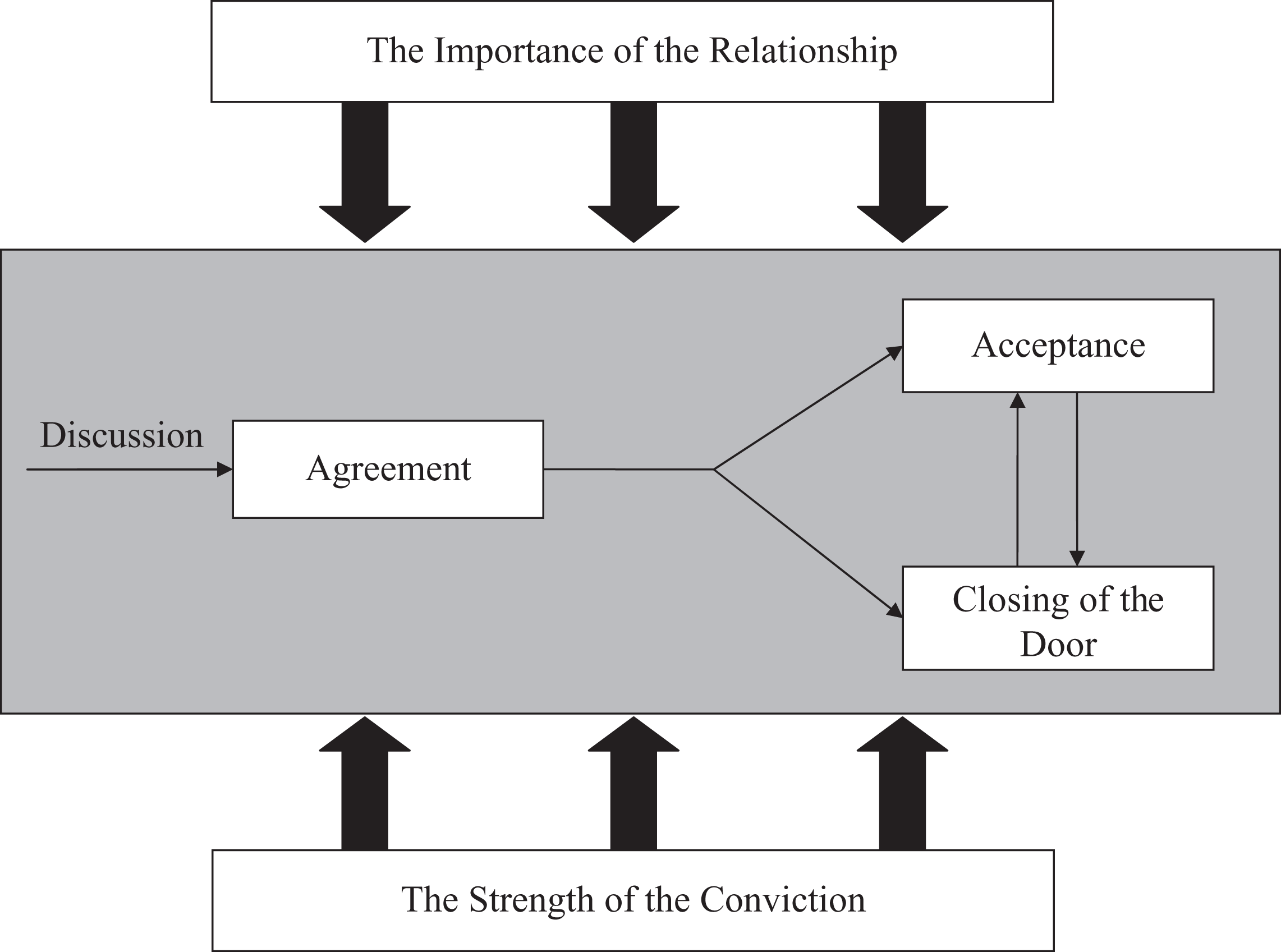
Theoretical model of couples’ decision-making process of remaining voluntarily childless.
Reaching an agreement
The processes of reaching an initial agreement varied depending on the configurations of each spouse’s conviction. Based on the configurations of spouses’ conviction, three different types of reaching an initial agreement emerged: mutual early articulator couples, mutual postponer couples, and nonmutual couples.
Mutual early articulator couples
When two early articulator individuals pair up, they form a mutual early articulator couple. Early articulator individuals had strong childless convictions before they met their spouses. Usually one of the spouses brought up the subject “early” in their relationship in a matter that “informed” their partner of their conviction or “laid it down” on their partner. Many early articulators stated that a potential partner’s desire to have children would be “a deal breaker.” Announcements of one partner’s childless conviction were usually followed by an instant and joyful mutual agreement not to have children. The processes of reaching an agreement in these couples were short.
Mutual postponer couples
The process in which mutual postponer couples reached an agreement not to have children for a while was marked by lack of conviction. Many spouses in mutual postponer couples “assumed” they would have children someday. As Derek described, “When we got married, it was just kind of one of those things that we assumed that we’d get around to wanting … It just hasn’t happened.” For others, the agreement was to “wait and see” because they were not certain about how they felt about having children. The processes of reaching an initial agreement of mutual couples were similar in that they both are short and simple.
Nonmutual couples
The process of reaching an agreement for the nonmutual couples was not as simple as that of mutual couples. The nonmutual couples consisted of an early articulator with a strong childless conviction and one with various degrees of parenthood wishes. The process usually began when the early articulator partner broached the subject to the other partner spurred by the strength of their childless conviction and the potential that their conviction would be a “deal breaker.” The responses of the partners with the initial parenthood wish to this ultimatum from their partner varied depending on how strongly they wanted to have children. Some spouses “had to assess” whether their partner’s wish to remain childless was a deal breaker for them and whether they would be “okay” with remaining voluntarily childless.
These individual assessments of the partners with the initial parenthood wish were usually accompanied by “discussions” with their partner. The early articulator partners would explain to their partner “the reasons” why they made their childless decision. Some partners with the initial parenthood wish understood their partner’s reasoning with relative ease. For others, the process took longer. For example, Natalie, an early articulator wife, would bring up the issue and her husband would meet her “arguments” sometimes with silence and sometimes with counterarguments while they were still dating. The assessments and discussions continued until they reached an agreement not to have children. Dana who initially wanted children called this process “reconciliation”:
I think there was some times I thought, I hoped he would change his mind. I reconciled that, in my mind, that, “Okay, let’s say we don’t get married, let’s say I wait. Okay, by the time, if I wait, I will be too old to have kids.” I thought maybe we might adopt, you know. He might change his mind and we might adopt kids. So, I had a lot of reconciliation going on in my mind … I think in my heart of hearts, I really must not have wanted’em that badly? Because I don’t think I would’ve married him [if I wanted them that badly].
Staying in the agreement phase
The process of remaining voluntarily childless as a couple does not end when the spouses reach the initial agreement. Regardless of the decision-making types, most voluntarily childless couples stay in the agreement phase for a while before they move on to either the acceptance or closing of the door. The time they spend in the agreement phase again depends on the importance of the relationship and the strength of the conviction, thus also on the decision-making types. It is important to note that one spouse can move on to the acceptance phase while the other stays in the agreement phase. These couples, however, still need to be considered to be in the agreement phase as a couple because the issue of childlessness may continue to be introduced by the partner still in the agreement phase.
Revisitation and reaffirmation
Being childless was not in the forefront of the voluntarily childless spouses’ minds continuously. Months could go by without either spouse thinking about it or mentioning the topic to their spouse. However, the subject would surface from time to time. Once the subject was brought up, it could lead to a serious reconsideration or discussion of the decision, or it could register in their consciousness and disappear shortly, a process called revisitation. Revisitations usually began with a “trigger.” The triggers can be categorized into three groups: external (e.g., someone’s pregnancy or birth of a baby or death of a family member), internal (e.g., feeling or fear of getting old), and relational triggers (e.g., spouse’s illness or pregnancy). Many spouses recalled having experienced individual revisitations without letting the other spouse know. Most of the time, they explained that they did not feel the need to share the experience with their spouse. In other situations, the process was so “fleeting” and “short” that it disappeared from their mind quickly.
Couple revisitations started either when they experienced a trigger situation together or when one spouse brought up the subject to the other spouse. A common couple revisitation pattern that emerged from the data was “checking ins.” Spouses checked with their spouse to find out whether they were still “on the same page.” Spouses wanted to give their spouse room to change their minds just in case and to make sure that the decision remained mutual. One mutual articulator couple explained:
We also always wanna check in and make sure because we know we’re human and people grow and they change and we’ve always wanted to have open dialogue so that the other person didn’t feel like, you know, “If I woke up one day and there was something in there that was different, that I wouldn’t have an open forum to talk about that and be respected for wanting that.” That’s never happened to us. I mean you know we…
We’ve always believed very much in open communication, absolutely a 100% talk about everything and that’s really been a real strength for us. I mean, I think, you know, and so neither one of us wanted to have what I would consider a pressure cooker of wondering.
Interestingly, checking ins usually happened among mutual early articulator couples. These checking in processes demonstrate that, for these spouses, maintaining a good relationship with their partner where both spouses could be themselves and grow together at the same time was at least as much important as their childless conviction.
Some revisitations are more serious than others. For example, several couples used the term “baby crazy” to describe a fleeting situation where one spouse, usually the wife, expresses that she wants to have a child. When spouses experienced a baby-crazy episode or a serious wavering moment, the responses of their partner depended on the strength of the childless conviction. Most spouses in mutual couples tended to be supportive and try to figure out whether having a child was what their spouse really wanted and whether it was the right decision for them as a couple. As in the process of reaching the initial agreement, reasoning played a big part in the revisitation process. Early articulators in nonmutual couples tended not to engage in the discussion eagerly. They tried to avoid or change the subject, because for them the decision was already made when their spouse agreed to remain voluntarily childless. For some early articulators, the strength of the childless conviction is such that the decision to remain childless seemed nonnegotiable.
Many spouses mentioned some experiences that helped to end the revisitation process in addition to the discussions with their spouse, such as babysitting nieces or nephews or crying babies in grocery stores. Reaffirmation refers to a process wherein the spouses realize that they made the “right” decision. For the spouses in this study, every revisitation ended with a reaffirmation of their initial decision. Lily and Christian, a mutual early articulator couple, described how they reaffirmed their decision through questions about what they want in their life:
… I remember saying to him because [sigh] we always went, we love to go to bookstores together, like Borders and Barnes and Noble and just sit there for hours and read in the big comfy leather chairs.
And talk.
Yeah, it’s, it’s, a lot of times we observe that when we are there, we’re just enjoying ourselves. Parents come in pushing strollers and they try to sit down and enjoy themselves and they try to, like, get into a book but like with 5, 10, 15 minutes they’re ripped out of the book. They have to leave the store and I said to him, “You know, what do you want? Do you want a child or do you want Borders?”
[laughing] And you know what? That was more powerful than you can even imagine. I was like, “I want Borders” … you have to ask the good questions … I said “you wanna have, if you had a choice, if you had to choose having a book published or having children, which one would you?” She said “A book.”
As in the process of reaching the initial agreement, reasoning plays a big part in the revisitation process. Mark and Brenda, a mutual postponer couple, described:
… then [I] finally just go, “Oh, There’s not, we’re not, it’s still not in the position that we’d like to be.” And we have friends and relatives who have said, “Well, you never are in the position where you can really afford to have a child,” and right, well, yeah, but “We’re not satisfied with what we would be able to do, and what we would have to sacrifice is that we would have to make uh, in our present lifestyle maybe. If we had a, another person to feed, or another person to clothe, or another person we had to buy school supplies for, or another person we had to pay for travel expenses, or whatever. We’re just, uh like, well, we’re just not comfortable.”
And I’m, I’m logical. I have a logical mind, so I understood what he, what he was talking about and that made sense to me. So it never was an argument or nothin’ like that. It was just kind of like a [pause] discussion.
The revisitation process of mutual postponer couples always ended with “indecision,” reaffirming their initial decision. Most mutual postponer couples mentioned that they were still “waiting” or that they were “not ready, yet” as reasons for the indecision. To the question what they were waiting for, their answer was usually that they were waiting for the “urge to have a child” to hit them, or for “the right time” to have a child. The idea of the right time was different from couple to couple, but they all agreed that they had not felt that they were ready to have a child yet, thus ending their revisitations with reaffirmation of indecision.
Besides marking the end of the revisitation processes, reaffirmation was also a separate experience that solidified the voluntarily childless spouses’ decisions over time. As with the revisitation process, the process of reaffirmation started with a trigger. Some of the triggers include freedom, realizing the parent’s responsibilities, witnessing screaming babies at a grocery store or a restaurant, observing the deterioration of the marital relationships of other couples after they start having children, believing that the world is unsafe for children, witnessing death or illness of a baby or a child, observing parents with troubled adolescent children, and concluding that they would have not been good parents. Whereas there were spouses who never experienced revisitations individually, every spouse in this study, even the spouses who initially wanted to have children, reported that they had experienced many reaffirming moments.
Musings
Many voluntarily childless couples also described experiences of wondering about what it would be like to be a parent or what the child would be like, “musings.” The spouses in this study characterized these moments as “fun,” something like a “joke.” These musings were short-lived and usually did not lead to revisitation. Many spouses qualified the experiences by adding that these were “fleeting,” that these were different from regret or longing, or that these musings did not make them want to have a baby.
Dealing with inquiries and pressure
Another important part of remaining voluntarily childless was dealing with other peoples’ inquiries about whether the couple had any children and when they planned to start having children. The sources of the inquiries ranged from their family members to strangers. The inquiries usually did not begin with the question whether they plan to have any children, because many people had underlying assumptions that married couples wanted and would have children. People assumed that these couples were waiting to conceive, that they were having some problems with their marriage or with conceiving, or that these couples would change their minds.
Considering these assumptions, it is not surprising that the most common reaction the voluntarily childless couples got from people was disbelief. After the shock of learning the couples’ decision not to have children, some people wanted to know why. Many spouses in this study described “pat answers” they would provide that would avoid long discussions and would not offend those who have children. One couple explained:
… sometimes coworkers would be like, “Yeah, when you get home and your kids blah-blah-blah,” I don’t usually say, “Oh, I don’t have kids.” just because I know, well, one, I might get grilled about it or two, they might be sensitive about it. I know it might be a big deal to them … I haven’t been prodded to getting annoyed. It’s been more like, “How can I answer this and not upset this person because I don’t know what their stance is on it?”
That’s pretty much, yeah, that’s why you come up with the pat answer … and I’m not gonna do a pat answer that’s not what I mean, you know, just to make someone feel better. I’m gonna say, “Look, I’m gonna put this in words that you understand, so then we are not gonna have an issue.”
Besides using pat answers to the inquiries, the voluntarily childless spouses used other strategies such as “changing subjects” or “blaming their spouse” in an effort not to engage in a lengthy discussion. Other couples mentioned that they had considered telling people that they were infertile. How often and how much these spouses got asked about children varied. In some couples, the wives were asked about children more than the husbands, whereas in other couples, the opposite was true. One common aspect, however, was that the number of inquiries decreased over time. Many spouses attributed the decrease to the age and others’ assumption that if they did not have children by now, there must be some problems.
While disbelief was a common reaction from people, spouses had friends and family who “understood” and “accepted” their decision without any question. Some spouses also received envious remarks from friends and family members who were parents. Encouragement not to change their mind was also reported. Many spouses in this study reported having been “pressured” by their family members, especially their parents. Their parents were usually described as “pressuring,” being “pushy,” or “hinting.” Sometimes, the births of their nieces or nephews released some of the pressure. As with the inquiries, pressure decreased over time. Some parents of the voluntarily childless spouses became resigned to the fact that the couples would not have a child once they realized that the couple’s decision was solid. Some parents had taught their children from when they were young that having or not having a child was a choice and that being a parent implied great responsibilities. These parents accepted and respected their children’s decision to remain childless readily and easily.
From agreement to acceptance
For many voluntarily childless couples, the next phase of the agreement was the acceptance phase. Moving from the agreement phase to the acceptance phase was different depending on the strength of the conviction and the importance of the relationship. Some mutual early articulator couples, whose spouses shared a strong conviction to remain voluntarily childless, moved to the acceptance phase rather quickly after the initial agreement. The main characteristic of these couples was that they rarely experience revisitations after the initial agreement. For these couples, the transition from the agreement phase to the acceptance phase was seamless and the difference between being in one phase and the next one was not apparent.
For other couples, however, the difference was notable. Floyd described the difference between agreement and acceptance:
… Agreeing was the first, really the first thing. Acceptance was the second thing … now that I think about it. It’s like, true because she said, “I’m not gonna have kids” and I would go, “Okay.” That’s me agreeing. Accepting it took a little bit longer … I mean, I accept that’s what it is, right? … the accepting means, we should not have kids. I mean, like by the time we are 30, it’s like, “It’s never going to happen.” It’s really total acceptance. “This is never gonna happen.” Spot: … when we were talking about “does she get an abortion?” I was walking a bit of a tight rope because part of me wanted her to say “I don’t want kids, don’t even think about it” and another part of me wanted to be, you know, what, “It’s your body and you, this is an important moral decision and I’m gonna just let you make it and stay out of your way.” I did feel like it was a big violation of personal values and I said “Well, we need to do this and we’ll just see what happens,” I know you would have been supportive but I also know that it would have been the end of, I actually felt like I would be breaking a marriage vow to do that cause we had really promised each other that we weren’t gonna do that.
Staying in the acceptance phase
Most of the voluntarily childless couples spent time in the acceptance phase before they moved on to their final phase, closing of the door. However, the reasons for the delay between the acceptance and the closing of the door phases were different from those for the delay between the agreement and the acceptance phases. In the agreement phase, the voluntarily childless spouses solidified their decision through repeated revisitations and reaffirmations, shedding any doubt or hope. The fact that they were childless “fades into the background.” Thus, it is not surprising that some of them were not in a hurry to close the door as long as their current contraceptive method was effective.
There are many reasons why these spouses had not been sterilized. Many spouses did not like the idea of having an “elective surgery” done to their body or they were afraid of going through the procedure. Some husbands expressed a different kind of fear: losing their manliness. For other spouses, it was the doctor’s refusal or a huge amount of paperwork that prevented them from being sterilized. Several wives in this study had previously experienced a doctor’s refusal to perform sterilization due to their young age. Finally, medical reasons also prevented couples from getting sterilized. Some wives in this study were on the birth control pill for medical reasons, usually to control cyst formation.
One major difference between the agreement and acceptance phases was the lack of revisitation in the acceptance phase except for under one condition: pregnancy. As discussed above, for the spouses in the acceptance phase, the decision to remain voluntarily childless was irreversible for them although physically they were still able to have a child. However, pregnancy could force these couples to revisit their decision one last time. The pregnancy and the subsequent abortion in the acceptance phase played a crucial role in pushing some couples to close the door permanently.
Another difference between the agreement and acceptance phases was the experience of wistfulness, a feeling of longing. Whereas the feelings of wistfulness began a process of revisitation in the agreement phase for many spouses, in the acceptance phase, they were experienced as fleeting because spouses truly had accepted that they would remain childless. Voluntarily childless couples still experienced reaffirmations and musings. They still had to deal with inquiries from other people. However, as discussed above, the frequency of the inquiries decreased over time.
From acceptance to closing of the door
The closing of the door happened in either an active or a passive form. Some spouses actively closed the door by getting sterilized to “finalize” the decision. Some couples who experienced an abortion chose to be sterilized to make sure that they would not have to go through the same experience. For other couples, the door closed due to either medical reasons. It is important to note that, strictly speaking, sterilization means the closing of the door only to the sterilized spouse; however, spouses perceived their partner’s sterilization as the closing of the door as a couple.
From agreement to acceptance through closing of the door
A few nonmutual couples arrived at closing of the door via a different pathway, which merits mention due to the underlying dyadic process, intentionally closing the door in order to reach acceptance. Christina who initially wanted to have children explained her thinking as she urged her husband to get sterilized:
It’s like, “Look if we’re not gonna have a kid, there is no reason why you’re not going to get a vasectomy because I don’t want that even um, possible.” You know, it’s kind of like “Stop it now.” It’s almost like a tease, like I could still get pregnant. So I wanted to finalize it and that was my way of finalizing it … actually that may be really what got me over. I just needed, uh, somebody to say stop, you know, stop thinking about it.
After the door is closed
There was no apparent difference between the acceptance and the closing of the door phases, other than the physical inability to conceive a child. In addition to being happy and content with their decision as the couples in the acceptance phase, most spouses felt “relieved,” “glad,” or “liberated” after the door was closed.
Discussion
This study revealed that a decision to remain voluntarily childless needs to be understood as a married couple’s journey over time, not as one person’s decision. Using grounded theory methods, we examined dyadic processes of how spouses reach agreement to remain childless. Our results illuminate the process of spouses discussing whether or not to have children, something identified as a deficiency of current scholarship in the area (Bulcroft & Teachman, 2004; Houseknecht, 1987).
Three different couple decision-making types were identified: mutual early articulator couples, mutual postponer couples, and nonmutual couples. These three types are similar to Cooper and colleagues’ (1978) decision-making patterns, which are themselves an expansion of Veevers’ (1973, 1980) typology of voluntarily childless individuals. In those studies, approximately one third of participants were mutual early articulator couples, whereas in our study more than half of the couples were mutual early articulator couples. Our study expanded previous work on decision-making patterns by delineating the chronological paths the couples follow depending on their decision-making types. Veevers (1973, 1980) and Cooper and colleagues (1978) only examined how the couples reached the initial agreement. Based on our couple conjoint interviews, we illustrate how different couple interactions throughout the process depend on the decision-making types.
This study also reveals temporality in the decision to remain voluntarily childless. Three distinct temporal phases were identified: agreement, acceptance, and closing of the door. These phases illuminate how couples navigated the processes of remaining voluntarily childless by identifying subsequent phases beyond the agreement and by delineating the processes between the phases, thereby expanding understanding of decision-making processes substantially.
In addition to identifying three phases, the current study demonstrates two underlying forces behind the process of remaining voluntarily childless: the strength of conviction and the importance of the relationship. Voluntarily childless couple status at any moment is a result of delicate balancing acts between partners or within a partner. Consistent with previous studies (Carroll, 2000; Mawson, 2005; Nason & Poloma, 1976), partners for whom the relationship was more important than being a parent chose to remain childless when faced with a partner with a strong childless conviction. A new finding of this study is that even early articulators with strong conviction sometimes set aside their conviction for the sake of the relationship. When faced with pregnancy, husbands were willing to be supportive of their wives’ decision despite their strong wish to remain childless. Checking ins are another example of prioritizing of the relationship as partners were open to re-discuss their agreement to remain voluntarily childless. In these ways, the importance of the relationship and the strength of the childless conviction exerted a pull on couples.
Power and gender also play into these processes. Resource perspectives argue that the partner with more resources has more power to make decisions (Blau, 1964; Blood & Wolfe, 1960). Power in a relationship also depends on how much partners depend on the relationship for rewards (Johnson & Johnson, 2005). Partners with more power would achieve their goals of remaining childless by obtaining consensus from the other partner (Scanzoni & Szinovacz, 1980), what Thomson (1990) called the “power-rule” (p. 137). Alternately, utility maximization theory argues that spouses specialize in different spheres of family life for efficiency and the domain of expertise determines power (Scanzoni & Szinovacz, 1980). In the case of childbearing decisions, women’s influence would be greater than men’s because of pregnancy, birth, and normative child care responsibilities, which is referred by Thomson (1990) as the “sphere of interest rule” (p. 137).
In nonmutual couples, the strength of conviction of one spouse combined with the other spouse’s desire to stay in the relationship gave the spouse with childless conviction the power over the decision (i.e., the power rule). However, the sphere of interest rule was applied when they were faced with pregnancy. Early articulator husbands with strong childless conviction felt that the decision of having a baby or an abortion had to be their wife’s decision. The gender sphere of influence did operate but only in the case of when a pregnancy occurred, and in this situation, it stayed within the couple. The decision of who would get sterilized was similarly a private decision and did not follow any gender or power rule. The decision was made based on practicality (e.g., cost and recovery time), fear of the procedure, and the strength of the childless conviction.
Based on previous literature (Gillespie, 2000; Mawson, 2005; Veevers, 1980), it had been expected that men and women might differ in their experience of social pressure and inquiries from other people, and indeed, in this sample, wives received more social pressure and inquiries from others when the couple lived in the more conservative, smaller town. However, the experiences of social pressure and inquiries from other people depended more on the spouses’ age, jobs, social network, and their parents’ wish to be a grandparent than participants’ gender. Parents of the spouses in this study tended to make inquiries to and even to pressure their own children, regardless of the gender, about the couple’s fertility intention. Consistent with previous literature (Veevers, 1980), the frequency of the inquiry and the strength of social pressure decreased over time.
These findings may be due to the demographic characteristics of the sample. On average, participants were well educated and many had occupations such as lawyer, professor, and high-level manager. These factors, together, may have created an environment where they were surrounded by people who were open to diverse lifestyles. Spouses with jobs involved with children received more inquiries than others. Many spouses had a social network consisting of singles and childless couples. Some spouses mentioned that they specifically distanced themselves from people who did not respect their decision to remain voluntarily childless. Another possible explanation of these findings is that more people are accepting voluntary childlessness as a viable lifestyle choice than in the past (Abma & Martinez, 2006).
Future research efforts may test this theoretical idea in different relationship demographics or contexts. One approach would be to study individuals who were divorced because of a disagreement with their former spouses in regard to having or not having children, or couples who became parents despite their initial agreement not to have children. Comparing various decision-making processes might help to elucidate the reasons that couples stay childless and expand our understanding of couple decision-making processes related to parenthood.
Conclusion
The current study confirms that remaining voluntarily childless as a couple needs to be understood as an interactive dyadic process in which couples navigate through phases over time. Voluntary childlessness is the result of the balancing acts between the importance of the relationship and the strength of the conviction to remain childless so that the scale remains tipped toward childlessness. Moreover, these balancing acts were also responsible for different tempo and paths the journeys took. Future research might shed a light on couple decision-making processes related to different types of fertility-related decisions.
Footnotes
Funding
This research received no specific grant from any funding agency in the public, commercial, or not-for-profit sectors.