



Abstract
The present study explores how people use social networking sites to adjust to breakups by studying their postdissolution behaviors. We apply Rollie and Duck’s (2006) relationship dissolution model by examining how collegiate Facebook users (N = 208) enact behaviors in breakups to extend the model to online environments during and after breakups. Furthermore, we employed a retrospective design utilizing qualitative methods to define categories of behavioral responses to a breakup on Facebook. The analysis revealed online behaviors that overlapped with the dissolution model as well as paralleled previous research into online behaviors. Results are discussed using the relationship dissolution model framework to individuals modifying online relationship statuses, “unfriending” previous partners, and limiting profile access in order to manage relationship termination.
Keywords
In the last decade, the increased popularity of social networking sites (SNSs) has profoundly influenced the nature of relational communication. SNSs have dominated Internet traffic as individuals logged in daily to check status updates, post articles, and upload photos. Approximately two thirds of online adults have an SNS profile (Madden & Zickuhr, 2011) such as Facebook. Currently, Facebook (2012) reports that more than one half of its over 950 million active members log in everyday, along with an estimated 250 million photo postings uploaded daily to individuals’ profiles. Interacting and perusing SNSs has become a routine ritual; accordingly, certain online behaviors have become especially salient features adding complexity to romantic relationships. The increased popularity and total time spent on the relatively new phenomena of SNS prompts questions as to how interpersonal relationships are assimilating their networks into their lives (Hand, Thomas, Buboltz, Deemer, & Buyanjargal, 2013).
This exploratory study aims to examine the effect of SNSs on relationship dissolution processes. In particular, we examine relationship termination asserting that breakups do not constitute communication finality; rather, relationships can continue to live on in communication and memories, especially through the advent of technology (Koenig Kellas, 2006). There is little known about the overlaps between online and off-line behaviors (Elphinston & Noller, 2011). By gathering descriptive data on the prevalence and variance of relationship termination behaviors off-line, we can determine what is occurring through SNSs, while heeding Parks’ (2009) call for more descriptive research of online communication. Additionally, although recent research has examined the role of Facebook in the development of romantic relationships, more research is needed to examine how SNSs influence the breakup process (Fox, Warber, & Makstaller, 2013). Specifically, this research extends a traditional relationship dissolution model (Rollie & Duck, 2006) by examining phases of online breakup behaviors and their relationship to postdissolution adjustment.
In this study, we consider how SNSs display users’ experience and progress through the processes of relational dissolution as articulated by Rollie and Duck (2006). This study extends this traditional research and examines the impact of technology on the dissolution process. We first discuss existing literature highlighting how technology influences relationships. Then we describe the relationship dissolution model before exploring our research question: What Facebook behaviors do people engage in during and after relationship breakups? After detailing the methodological approaches used to gather data, we report and interpret the results in the discussion.
Technology and relationships
Computer-mediated communication has provided new forums and opportunities for individuals to strategically present themselves through the careful editing of their written messages (Walther, 1996). The present study focuses on Facebook because it is the most frequently used online SNSs (Madden &Zickuhr, 2011), where individuals construct and manage their online identity by posting photographs, status updates, and news stories.
Previous research suggests that the Internet creates a new public space for individuals to disclose information linked to identity (Bargh, McKenna, & Fitzsimons, 2002). Individuals use SNSs to present a public personal image (Boyd & Ellison, 2007) and with a touch of a few buttons, users can gather information about another person’s relationship status, place of employment, political view, common friends, and other highly personal information. The act of observing personal information from another individual is known as interpersonal electronic surveillance. It is defined as “the surreptitious strategies individuals use over communication technologies to gain awareness of another user’s offline and online behaviors” (Tokunaga, 2011, p. 706). In particular, surveillance occurring through technology is considered a conscious and goal-oriented observation strategy that often negatively impacts romantic relationships (Elphinston & Noller, 2011). In other words, interpersonal electronic surveillance offers, with a concerted effort, the ability to collect information by looking at other’s profiles, photos, and wall comments. Facebook operates with the ability to accumulate a larger and larger social network providing tantalizing and incomplete information lending its users to technological techniques that can be risky; implementing Facebook practices in untenable and often destructive ways for their relationships (Gershon, 2011).
SNSs and interpersonal outcomes
Experiencing a romantic breakup can be emotionally distressing and is frequently cited among life’s most distressing psychological events (Kendler, Hettema, Butera, Gardner, & Prescott, 2003); therefore, it is likely that the outcomes of breakups would influence the experience and expression of online emotions. Recent research has found that Facebook behaviors relate to an individual’s predicted relational functioning (Papp, Danielwicz, & Cayemberg, 2012) as demonstrated by mixed findings about satisfaction and intimacy. A dyadic analysis by Papp and colleagues revealed that male use of a “partnered” relational status on Facebook (e.g., listing oneself as “in a relationship”) positively predicted relational satisfaction for both male and female partners. Female partners’ use of a profile picture featuring the relationship was associated with higher levels of male and female relational satisfaction (Papp et al., 2012). Contrarily, Hand and colleagues (2013) found no significant relationships between individual’s usage of SNSs and partners’ perception of relationship satisfaction and intimacy. They argued that attributional bias led individuals to more likely perceive their partner usage as negative compared with their own.
Additionally, the frequent use of Facebook by individuals in relationships has been found to relate to some measures of jealousy. Muise, Christofides, and Desmarais (2009) found that more frequent Facebook use by relational partners related to increased reports of Facebook-related jealousy, such as becoming jealous when a partner adds a member of the opposite sex as a friend. Similarly, Elphinston and Noller (2011) determined cognitive jealousy and surveillance behaviors were linked to relationship dissatisfaction. This research suggests that SNS behavior has an effect on relational outcomes. To examine the interplay of SNSs’ behavior and relational processes more specifically, the present study extends Duck’s (1982) model of relationship dissolution to understand and describe online behavior in response to a breakup. The following section reviews the framework (Duck, 1982; Rollie & Duck, 2006), which highlights the personal cognitions and communication of individuals’ off-line relational behaviors during breakups. This present study situates commonly reported online SNS behaviors of partners in dissolving relationships within a well-established relationship-focused model.
Relationship dissolution model
Relationship dissolution is a normative part of the relationship life cycle. Two commonly utilized communication models of relationship dissolution include Duck (1982) and Knapp (1978). At the fundamental level, these two models (e.g., Duck, 1982; Knapp, 1978; Knapp & Vangelisti, 1992; Rollie & Duck, 2006) discuss the processes in which relational dissolution commonly unfolds as sequential events from couplehood to singlehold. Duck’s dissolution model emphasizes the interface between partners and social network throughout their movement through phases as relationships separate, whereas as Knapp emphasizes what takes place between partners (Vangelisti, 2011). We utilize Duck’s model over other competing relationship dissolution models because it conceptualizes both psychological and communicative approaches addressing individual, dyadic, and network actions through the phases. These elements are particularly salient for understanding how relationship dissolution processes in off-line relationship actions extend to online behaviors.
The original relational dissolution model (Duck, 1982) emphasized psychological states that have recently been modified by Rollie and Duck (2006) extending the communication patterns individuals experience throughout the relationship breakup processes. Their work (e.g., Duck, 1982, 2011; Rollie & Duck, 2006) argued that the relationship dissolution model is a process that individual partners experience as they move through five processes (i.e., intrapsychic, dyadic, social, grave dressing, and resurrection) occurring over variable time periods. Although the five processes are linearly depicted as separate functions, they can overlap and multiple processes can simultaneously occur. Additionally, individuals may experience the demise of a relationship in multifarious fashion based on but not limited to the initiator, nature of the breakup, level of investment and commitment, and relationship length.
These relationship dissolution processes begin with individual psychological cognitions, progressing between partners and social networks and concludes with the individual’s ability to enter a new relationship. First, the intrapsychic process focuses on the partner as an internal desire by one or both partners that stems from an individualistic reflection about the state of the relationship. Next, the dyadic process focuses on the relationship and transpires when the two partners then discuss their problems or reservations about the relationship calling to question and potentially jeopardizing the future or redefinition of the relationship. Partners can choose to dissolve, repair, or postpone the relationship.
After one or both partners have decided to terminate the relationship, news of the breakup is communicated to outside parties in the social process. This process focuses on facing the social and public consequences of publicizing the decision (Duck, 1982) to family, friends, and acquaintances. Rollie and Duck (2006) described the social process unfolding, as account(s) of the relationship dissolution are made public among an individual’s network members.
Duck (1982) highlighted three major goals for this process: (1) to dissolve the relationship, (2) to have the dissolution recognized and accredited by relevant social network members, and (3) to finalize the process socially while remaining psychologically intact. The social process entails first an individualized reflection of what occurred and then presents publicized versions for sharing within networks. Communicative elements within the social process focus on marketing versions of accounts of the breakup in an effort to save face or place blame. Social processes entitle partners the means to create and distribute public stories about their particular version of the relationship dissolution.
The outcome of the social process is to publicly acknowledge the separation and move into grave dressing. This process focuses on tidying up the accounts representing explanations for past actions and events, which includes characterizations of self and significant others (Sorenson, Russell, Harkness, & Harvey, 1993). Through the public and private accounting individuals retrospectively recall their memories and attempt to make sense of their relational history. This adjustment process includes the major goal of putting the relationship to rest, which includes a considerable amount of “post mortem attributional activity” (Duck, 1982, p. 27) where retrospective accounting occurs for both the relationship’s initiation and termination.
Lastly, the new version of the model (e.g., Rollie & Duck, 2006) included the resurrection process, which focuses on the potential lessons learned from the previous relationship as individuals prepare for future romantic relationships. The resurrection phase encompasses a rebirth rising from the end of the previous relationship projecting a new generalized self who has learned from experience (Rollie & Duck, 2006). This process communicates that individuals are ready to start anew and reenter the dating world.
Thus, the relationship dissolution model set forth by Rollie and Duck (2006) provided a generalized theoretical framework depicting the central goals and content of communication during breakups. This study explores how off-line behavior (i.e., breaking up with a partner) affects Facebook activities. The investigation of these processes in online environments strengthens the understanding of relational features and processes while extending the original framework to include technology influences on behaviors.
Exploring online behaviors based on the relationship dissolution model
Although studies have shown that online behavior relates to relational outcomes (e.g., Papp et al., 2012), more research is needed to explore how off-line relational events, such as breakups, influence online behavior (e.g., Gershon, 2011). We utilized a sample of collegiate students because they are particularly frequent users of Facebook, averaging approximately 1–2 hr on Facebook daily (Kalpidou, Costin, & Morris, 2011), which is consistent with our sample’s average daily time spent on Facebook for collegiate students ranging from 30 min to over 2 hr (e.g., Ellison, Steinfeld, & Lampe, 2007; Raacke & Bonds-Raacke, 2008). Approximately 70% of college students have experienced a romantic relationship breakup (Knox, Zusman, & Nieves, 1998). Breakups can be publicly displayed on Facebook at the touch of a button and users must consider how the breakup is then publicized to those in their social network (Fox et al., 2013).
For this study’s purpose, we conceptualize breakups happening as two phases—before and after—because various disengagement strategies and situational factors can alter the process of termination (e.g., Baxter, 1982; Cody, 1982). Additionally, Sprecher, Felmlee, Metts, Fehr, and Vanni (1998) found that individuals experience different types of distress during the breakup than they do after the breakup. Incidentally, by assessing behaviors that individuals enact during and after the relationship dissolution provides insight into the nature of how breakups are communicated and managed throughout the process in online public networks, specifically the most popular SNS, Facebook. Therefore, we propose following research question for our exploratory investigation: RQ: What Facebook behaviors do people engage in during and after relationship breakups?
Method
Participants
Participants (N = 226) in the study were asked to provide information pertaining to the process of romantic relationship dissolution behaviors associated with their Facebook accounts and associated usage. Participants (N =18) without Facebook accounts were asked the same questions about their off-line behavior (not reported in the present study). All participants were allowed to complete the survey for extra credit. However, these individuals were removed from data set in order to address the overarching research question within the context of Facebook interaction. Hence, the final sample consisted of 208 participants.
Participants were recruited from undergraduate courses at a large and diverse southern university. The sample consisted of 77 males and 131 females (M = 20.17 years old, SD = 2.25). Most of the participants were Caucasian (58%), followed by Hispanic (18%), Asian (13%), African American (4%), Multiracial (4%), and Arabic (2%) ethnic origin. Two participants did not report ethnic origin. Most participants reported on opposite sex friendships (N = 198). However, seven participants reported on male–male relationships and three participants reported on female–female relationships. Additionally, participants’ partners were Caucasian (64%), followed by Hispanic (11%), Asian (8%), African American (5%), Multiracial (4%), Arabic (1%), and other (5%) ethnic origin. Four participants did not report on the ethnic origin of their partner.
Participants completed an online survey where they reported on a romantic relationship, which had ended within the past 2 years similar to other relationship dissolution studies (e.g., Koenig Kellas, Bean, Cunningham, & Cheng, 2008). On average, participants reported about relationships that had ended 10.92 months ago (SD = 7.28). Participants were asked to rate the seriousness of their romantic relationship when they were most committed to that partner (1 = Causally involved to 5 = Seriously involved; M = 3.67, SD = 1.16). Prior to the breakup, the relationships had lasted a mean of 18.87 months (SD = 18.25). Regarding who initiated the breakup, 41.3% of the participants reported they initiated the breakup, 21.7% reported their partner initiated the breakup, and 37% of the participants reported the breakup was a mutual decision.
Additionally, participants were asked to indicate how frequently they had communicated face to face with their romantic partner and how frequently they used Facebook. Survey participants, on average, reported 2.84 (SD = 1.93) face-to-face communications with their previous partners on a 7-point Likert-type items (1 = Not at all to 7 = Very frequently). Additionally, participants reported using Facebook for 47.6 months (SD = 28.82; Mdn = 48.00). Participants indicated they spent a mean of 116.09 min (SD = 173.80; Mdn = 60) on Facebook per day. On average, participants reported having 882.02 (SD = 534.41; Mdn = 800) members in their social network (e.g., Facebook friends) and shared approximately 161 (SD = 176.21; Mdn = 110) mutual friends (e.g., network overlap) with their most recent breakup partners.
Procedures and measurements
Each individual who voluntarily agreed to participate was asked to complete an online questionnaire through Qualtrics (www.qualtrics.com). Participants were asked to report on their online communication and behaviors that had occurred during and after their romantic relationship breakups. For the study, the breakup progression was labeled by the distinctive phase—during and after. The questionnaire measured relationship dissolution and Facebook behaviors.
Breakup behaviors
Participants were asked to recall their breakup via several open-ended questions. To provide a baseline, questions were posed to understand the behaviors individuals engaged in during their romantic relationship. Another question was implemented to account for online behaviors unknown or unintended. Participants were asked, “After completing the survey were there any questions you thought might be asked but were not?”
Qualitative analysis procedures
We used an interpretative approach to gather an understanding of Facebook behaviors during and after romantic relationship dissolution to answer the research question. During initial analysis stages, we employed a grounded theory approach (e.g., Glaser & Strauss, 1967) to preliminarily make sense of the data. To begin, each author independently reviewed the open-ended questionnaire responses pertaining to during and after breakup behaviors in an effort to identify primary categories. After several of these independent reviews, we were able to engage in a constant comparative approach using both open and axial coding to examine the emerging likenesses and differences in the multiple behaviors provided by participants. Open coding involved examining the initial responses reported (rather than all behaviors in the open-ended responses) across the breakup experience with the goal of identifying distinct concepts encompassing specific Facebook behavior properties and dimensions. Ultimately, we were then able to organize properties so that behaviors could be grouped into separate categories to explain these unique emerging behaviors (Strauss & Corbin, 1998). Next applying axial coding, we redefined the codebook to incorporate conceptually overlapping phenomena and contexts and establish saturation among categories.
Upon reaching saturation of the reported behaviors emerging from the data, all authors independently reviewed during and after behaviors from 12.5% of the participants (n = 26). Participants identified multiple behaviors within their open-ended responses; however, we examined only the predominant or initial written response behavior (Vangelisti, Young, Carpenter-Theune, & Alexander, 2005), considering the criteria indicated that dissolution occurred within the past 2 years. A relatively high reliability (Krippendorff’s α = .80) was established between the three authors for this process. Authors independently coded the remainder of the sample.
Many of the categories intersected across the breakup time phase of during and after; therefore, the list of all 15 categories represented account modifications, impression management, minimal or no Facebook impact, new relationship interest, normative Facebook activities, off-social network communication, relational cleansing, relational transgressions, self-regulation from Facebook, self-regulation from partner, social network support, surveillance, virtual reconciliation, virtual mourning, and withdrawing access. Those responses unable to be identified or interpreted were coded as miscellaneous. In order to better understand and organize the categories that emerged from participants’ responses, we calculated the frequencies to analyze how often the behaviors occurred in this context.
Results
These results reveal categories produced from Facebook behaviors individuals engaged in during and after their relationship breakup. For reporting purposes, the results are separated into two sections surrounding the relationship dissolution phases—during and after (Table 1).
During and after dissolution online behaviors.
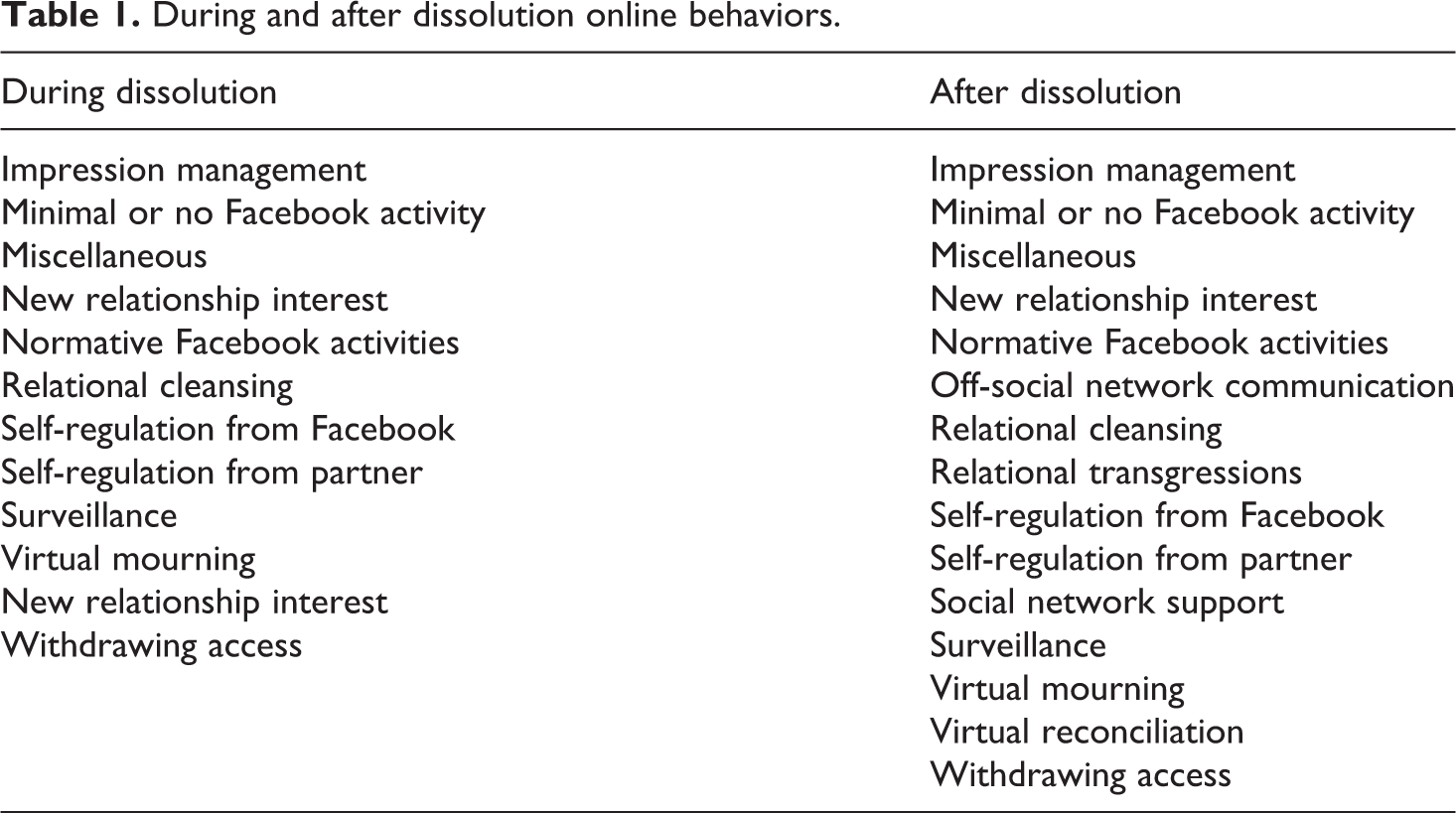
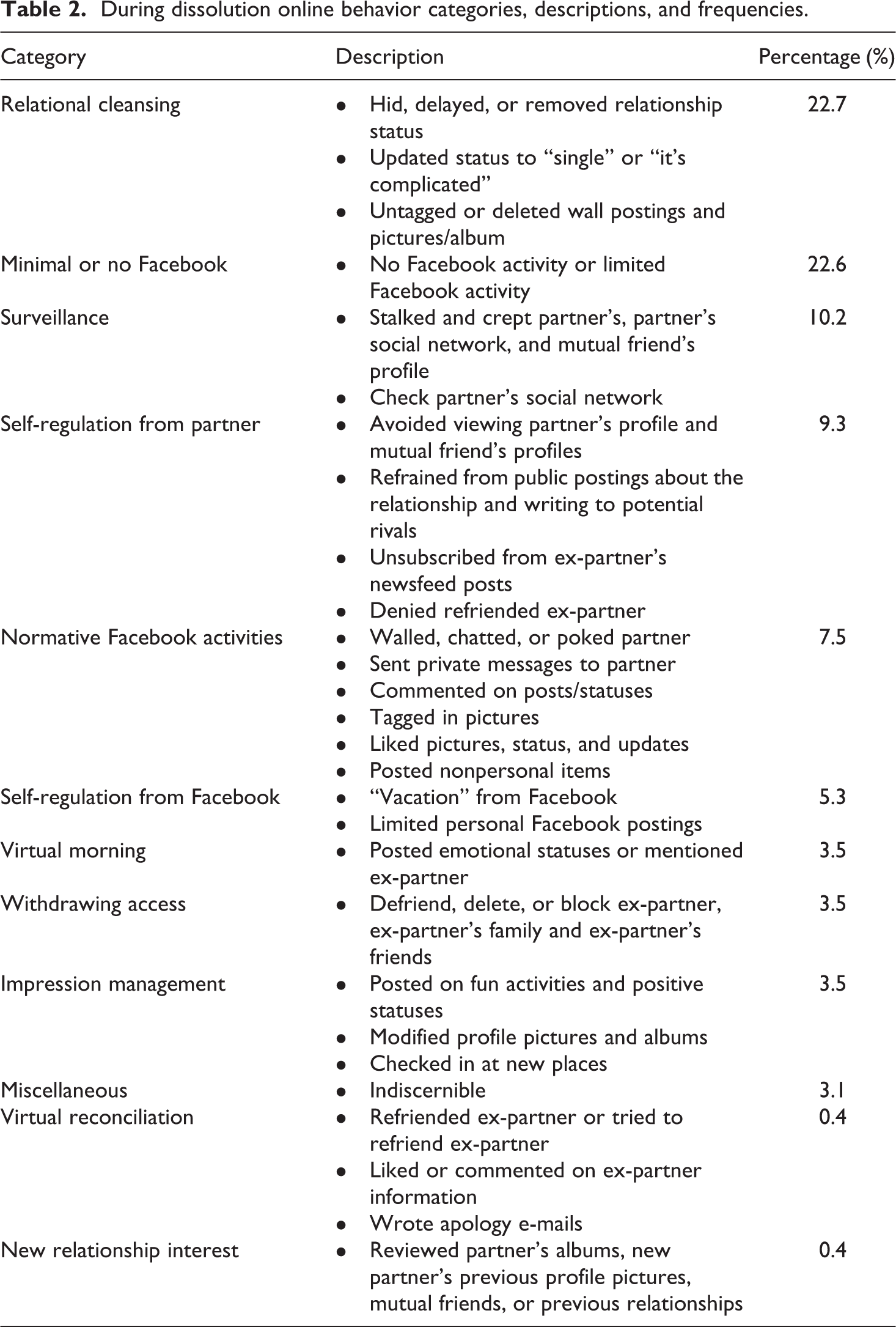
Individuals experience different types of distress during the breakup than they do after the breakup. Assessing behaviors enacted during and after the relationship dissolution provides insight into the nature of how breakups are communicated and managed throughout the process (e.g., Sprecher et al., 1998). Therefore, participants were allowed to interpret the phases to reflect their experiences. These categories are described in order from the most to least frequently occurring Facebook behaviors. Table 2 displays the categories, descriptions, and percentages associated with behaviors that appeared throughout the breakup process. We report the most to least salient categories (reporting frequencies of 5% or higher) below in the results.
During dissolution online behavior categories, descriptions, and frequencies.
During relationship dissolution
The categories that emerged during relationship dissolution involved minimal or no Facebook activity, relational cleansing, surveillance, self-regulation from partner, normative Facebook activities, self-regulation from Facebook, impression management, virtual mourning, withdrawing access, virtual reconciliation, new relationship interest, and miscellaneous.
The most frequent behavior to emerge during dissolution process was minimal or no Facebook activity; thus, suggesting that many respondents did not engage or display Facebook management strategies during relationship deterioration. For instance, one participant articulated, “Our breakup stayed off of Facebook, because I didn’t want to get other people involved in my business.” Here specifically, respondents minimized or did not use technology during their romantic relationship termination.
However, other respondents immediately altered relationship association through relational cleansing. Within this category, individuals employed behaviors that purged or purified their online relational presence by minimizing their public relationship associations. Respondents indicated either hiding or removing their relationship status to conceal relationship changes from their networks (e.g., Facebook friends). More visible examples of relational cleansing included individuals altering their online relationship status to “single” or “it’s complicated.” While other respondents reported clearing away the presence of the previous partner and their relationship by removing wall postings and pictures that demonstrated varying degrees of intimacy, public displays of affection, and togetherness.
Another commonly reported behavior was interpersonal electronic surveillance. These behaviors indicated that respondents felt the need to observe their romantic partners’ online actions during the breakup process, including the interactions their partners had with others. Participants called it “creeping” or “stalking” and used these colloquial terms interchangeably to describe interpersonal electronic surveillance behaviors. One participant said that she “stalked his wall and all the girls who wrote on his wall.” This category involved behaviors about participants’ desires to investigate partners by seeking out information about romantic partners and their social networks. A participant expressed, “I check to see if there was someone else or if he was back with his ex-girlfriend.” Another articulated that, “During the breakup, I would look at his profile religiously checking to see if he was moving on and what not,” and yet another expressed “I checked his page ALL THE TIME. Upwards of 5 times a day.” Clearly, the affordances of SNSs allowed individuals the ability to observe their previous partners’ behavior as they progressed through the relationship termination process.
Many partners choose to distance themselves while dissolving relationships. Although two forms of distancing occurred, the more predominant indicated distancing from their partners. Respondents who undertook self-regulation from partner made a conscious attempt to avoid their romantic partner by refraining from posting about the relationship, not communicating with potential romantic rivals, and shunning other activities to minimize interaction with a romantic partner. For example, one individual described an attempt to self-regulate from his partner post-breakup by “avoiding looking up her Facebook account.” For another individual, this meant limiting information about her partner from any source. She said, “I tried not to look at any of his friend’s pages, in case I saw pictures posted of him.”
For certain individuals, maintaining online normalcy (indicating no deviation from their common Facebook account behaviors) emerged. This category was known as normative Facebook activities that revealed typical online SNS behaviors such as sending messages, posting comments, and posting pictures with no deviation from their usual activities. Respondents typically either did not want to exhibit any public relationship termination behaviors or did not share with their networks.
The second distancing category indicated individuals separating themselves from SNS by eliminating the option to partners’ and social networks’ personal communication, interpersonal electronic surveillance, or inadvertent information about their previous partner. This self-regulation from Facebook emerged as a way for individuals to limit personal Facebook postings. For instance, a participant claimed, “I decreased the frequency of my posting and contacting her via Facebook.” This limit in personal online activity is representative of an online leave of absence or a virtual vacation away from Facebook.
After relationship dissolution
Respondents also reported various behaviors for the time following relationship dissolution. Categories included relational cleansing, minimal or no Facebook activity, surveillance, withdrawing access, self-regulation from partner, impression management, virtual reconciliation, normative Facebook activities, self-regulation from Facebook, virtual mourning, account modification, social network support, off-social network communication, relational transgressions, and miscellaneous (Table 3).
After dissolution online behavior categories, descriptions, and frequencies.

Although there was much overlap in the behaviors reported during and after the breakup, some categories were more prominent after relationship termination. For instance, individuals continued to engage in relational cleansing to signal a public change in romantic status and remove the online existence of the relationship. One respondent wrote, “Well I deleted every single picture of us, deleted her as a friend, and deleted a lot of the posts.” Another respondent stated he, “Unchecked that I was in ‘a relationship’ and changed it to ‘it’s complicated’ and then ‘single.’” These behaviors also encompassed acts of deleting previous wall postings, removal of photos, and limiting connection to their romantic partner. Respondents enacted a virtual cleansing to rid themselves of unwanted relationship remains.
The second most prominent category, yet again, revealed some individuals elected minimal or no Facebook activity. These respondents limited their Facebook activity throughout the process. A more in-depth explanation of this category and group of individuals is provided in the discussion below.
Participants reported interpersonal electronic surveillance of romantic partners after their breakup. Viewing an ex-partner’s social network along with the previous partner’s profile demonstrates failure to disconnect from the relationship. As several respondents expressed, “I couldn't help but look at his profile a lot and see what he was doing, who his pictures were, etc.” and others wrote, “I checked to see what his new girlfriends/boyfriends looked like.” However, some individuals took active steps to cut ties with their romantic partner by withdrawing access. One respondent claimed, “I deleted her and blocked her account.” In other words, individuals defriended, deleted, or blocked Facebook access to their past romantic partner, their family members, and social network of close friends. Other participants reported self-regulation from partner, in which there was a conscious effort to avoid interacting with the past romantic partner without completely severing all communication. As one respondent expressed, “I stopped looking at his profile, I found myself looking at it out of habit and decided it was too hard. It just made me take two steps back every time I looked at it.” Facebook users made a concerted attempt to limit and avoid acquiring information connected to the past partner either through the previous partner’s profile or through mutual friend’s profiles.
The impression management category highlighted respondents’ attempts to positively self-present themselves online. These activities presented a return to previous pre-relationship normalcy status as suggested by respondents, where normalcy represents a return from breakup grieving. This strategy included behaviors aimed to evoke impressions of jealousy or regret from previous partners by presenting themselves as ready to reengage in other romantic interests through positive promotions. For those still adjusting to the recent breakup, participants articulated comments such as “Dressed up and took a lot of pictures for my senior year and with my girlfriends so that he would see current pictures of me and hopefully change his mind.” Others were more concerned with an effort to create positive impressions by posting fun activities, providing exciting statuses, checking in at new places, and posting new attractive pictures. As one respondent described, “I had a lot more status updates and pictures showing how much fun I was having.” These online behaviors were often promoted as a readiness toward reentering the mating market; therefore, in order to present this new image, respondents posted flattering profile pictures and flirted online with new potential romantic prospects.
Follow-up analysis
Because there was such high frequency of respondents who indicated minimal or no Facebook activity throughout the dissolution process, we were compelled to further consider the minimal or no Facebook activity category that emerged during the two dissolution phases. Although we note that it is unconventional to combine interpretative methods that emerge from grounded theory, we argue utilizing empirical support to further explain unanticipated nuances in the open-ended categories expands our understanding of who may be utilizing particular behaviors. Utilizing grounded theory and its basic presumptions led us back to reexamine all the data—rather than looking exclusively at open-ended responses. Thus, we explored how differences existed between individuals who participated in online activities and compared it with those who choose not to participate in social networking relationships by asking an additional research question: RQ2: Do individuals who engaged in breakup-related Facebook behaviors report a different level of postdissolutional adjustment than individuals who reported not engaging in breakup-related Facebook behaviors?
In order to examine the emergence of minimal or no Facebook activity, we examined other measures originally collected as a part of a larger study. Participants had also been asked to complete a variety of measures regarding their perceptions of the breakup (e.g., post-breakup adjustment and Facebook intensity) involving their behaviors on an online social network site.
Measures
Post-breakup adjustment was measured using the six 7-point Likert-type items adapted by Koenig Kellas et al. (2008). Items included “How difficult has it been for you to make an emotional adjustment to this breakup?” “Since the breakup, how much has your typical everyday functioning and routine been disrupted?” and “To what extent do you feel like you have adjusted to the end of the relationship?” Reliability was acceptable (α = .78; M = 4.49; SD = 1.36).
The Facebook intensity scale (Ellison, Heino, & Gibbs, 2006) was utilized as a control variable to measure the importance of Facebook in individuals’ lives. The 6-item measure was rated on a 5-point scale (1 = Strongly disagree to 5 = Strongly agree) and also includes items that tap frequency of Facebook use. Sample items include “Facebook is part of my everyday activity,” and “I am proud to tell people I am on Facebook.” Reliability was very high (α = .97; M = 3.62; SD = .85).
Analysis
These 15 categories were then utilized to designate individuals into 3 groups to answer the research question. The first group (N = 131) included individuals who reported Facebook behavior both during and after the breakup. The second group (N = 54) included individuals who reported minimal or no impact on their Facebook behaviors during at least one phase of their breakup, but not both. The third group (N = 23) included individuals who reported that Facebook had minimal or no impact on their behavior at either phase throughout their breakup.
Post hoc results
We utilized an analysis of covariance to explore how Facebook behaviors affect individuals during the postdissolution adjustment. We controlled for respondents’ report of intensity of Facebook usage, the number of months since the breakup, participant sex, sexual orientation, and breakup initiator. All nominal variables were dummy coded. Postdissolutional adjustment was the dependent variable. The analysis yielded a significant main effect for Facebook behavior, F(2, 206) = 7.82, p = .001, partial η2 = .07. Post hoc Bonferroni comparisons indicated that individuals who reported minimal or no Facebook impact at any phase of their breakup (M = 5.32, SD = .97) reported higher adjustment than individuals who reported a Facebook impact both during (M = 4.28, SD = 1.37) and after their breakups (M = 4.56, SD = 1.39).
Discussion
Theoretical implications
The relationship dissolution model (Rollie & Duck, 2006) provided a theoretical framework for connecting online SNSs and relationship breakup processes. Table 4 maps respondents’ behaviors in relation to the primary dissolutional processes.
During and after online behaviors in the relationship dissolution model.
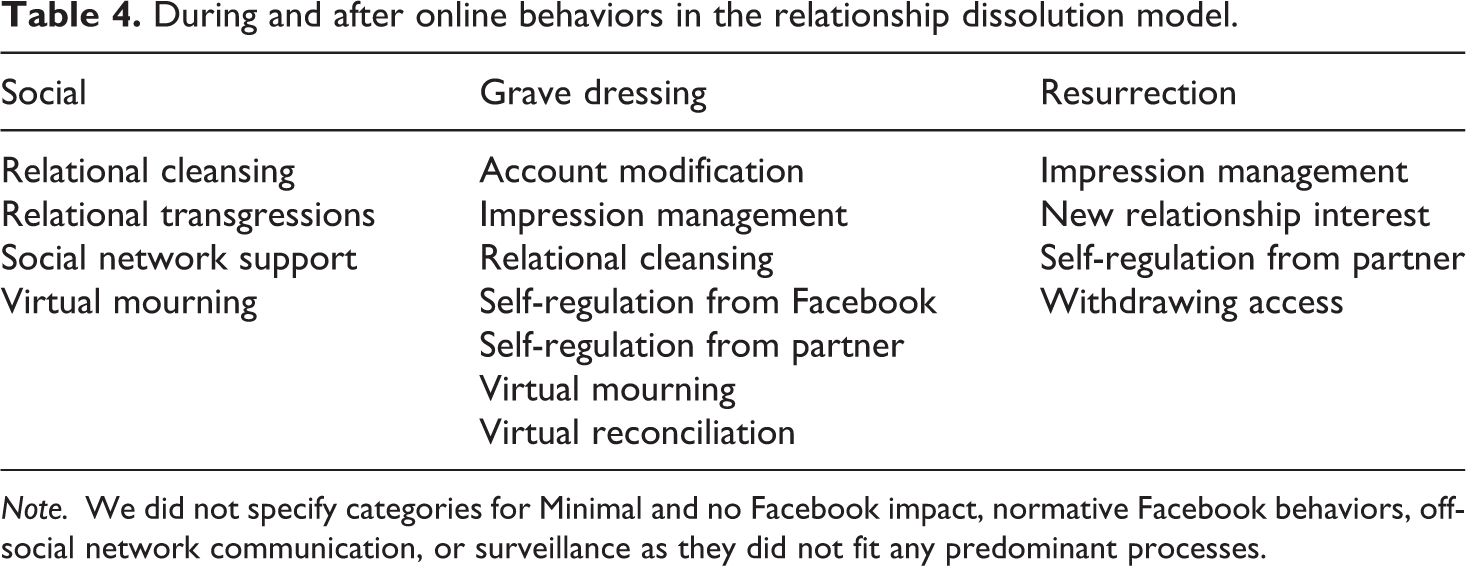
Note. We did not specify categories for Minimal and no Facebook impact, normative Facebook behaviors, off-social network communication, or surveillance as they did not fit any predominant processes.
The social network process is central to SNSs; therefore, individuals’ behaviors displayed through Facebook demonstrate they are engaging in social, grave-dressing, or resurrection processes. Although these processes do not always occur in a linear progression, the ability to see how individuals are adjusting to their new relationship status through their behaviors showcases the communicative process of relationship dissolution.
Participants reported behaviors both during and after their breakup that reflected progression through the relational dissolution processes. For instance, Facebook behaviors during the dissolution process more often than not evidenced engagement in intrapsychic and dyadic processes prior to their public displays through the Internet. Respondents who had ended their relationships appeared to reflect their psychological state by (1) virtually mourning the end of their relationship, (2) acknowledging the breakup with relational cleansing behaviors, (3) continuing to ruminate about their partner and the future through surveillance, or (4) beginning to distance themselves from their ability to communicate with their previous partners or opportunities to interact with them or their social networks through self-regulation. These behaviors communicate various responses to relationship termination. SNSs enabled a readily available exchange of new circumstances and updates, provided public announcements of relationship termination, and mirrored personal adjustment especially when social networks were extensive and overlapping.
Additionally, several Facebook behaviors exemplified grave-dressing processes. These behaviors focused on tidying up memories and attempting to make sense of their relational history. In the time phase following the breakup, individuals reported relational cleansing and interpersonal electronic surveillance behaviors; although, these two behaviors may represent different facets of the process. Relational cleansing includes cleaning up memories and attempting to bring closure to the relationship. While interpersonal electronic surveillance may indicate individuals are still fixating on or ruminating about their previous partners and the relationship. Furthermore, the emergence of “withdrawing access” behaviors demonstrated that many respondents acted to sever connections with their previous partners and bring their relationship to a close.
Respondents indicated participating in a variety of behaviors consistent with the relational dissolution model. Specifically, participants reported defriending or blocking their former relational partners, deleting and untagging pictures, and monitoring their ex-partner’s social networking behavior. Defriending, deleting, and blocking previous partners and their social networks limited participants’ ability to continue interpersonal electronic surveillance the profiles of their ex-partners, and curtailed their ability to counter their ex-partner’s accounts of the breakup. Perhaps in an effort to prepare themselves for future relationships, some participants further curtailed communication with their former partners via self-regulation and began to reconstruct their virtual self through the use of impression management strategies.
Although relationship dissolution is often associated with finality, many relationships never fully dissolve (Rollie & Duck, 2006) and especially with the expansion of technology to encapsulate our relationship memories the ability to erase a relationship’s existence may be even more challenging. People often clean up memories of their relationship history over time (Duck & Sants, 1983) and as shown by these respondents’ behaviors, individuals removed relational artifacts and associations (e.g., untagged photos, removed wall posting, and defriended). These behaviors mirror the grave-dressing resurrection processes as individuals moved on from a previous relationship and prepared for future relationships. The reality is that artifacts of a previous relationship remain retrievable online while evidence of the relationship dissolution and subsequent behaviors also cannot be completely erased. Although cleansing may help bring closure to a relationship, some memories continued to exist in virtual space and influenced the development of subsequent relationships and interactions with potential partners. These memories were difficult to completely purge; rather, they became part of each ensuing relationship via remnants embedded in virtual SNS data.
This study begins to explore how the use of SNSs crystallizes relationship memories after breakups, and how individuals subsequently act to strategically manage their online identity. However, the relationship dissolution model must continue to explore how lingering online traces of past relationships might influence new relationship formation from the resurrection process to relationship initiation phases. The postdissolutional adjustment process may be exacerbated and extended by SNS data, potentially interfering with the process of tidying up public accounts that depict previous relational history and hindering formation of new relationships.
Postdissolutional adjustment
Individuals who reported no Facebook-related behaviors in response to their breakup indicated a higher level of post-breakup adjustment than individuals who reported Facebook-related behaviors during and after the breakup. Koenig Kellas (2006) and Weiss (1975) argued that the connection to a past relationship tends to decrease over time following a breakup, and postdissolutional communication continues to affect adjustment. With the integrated use of technology within interpersonal relationships, individuals are still able to maintain contact—whether through direct interaction or interpersonal electronic surveillance—with their previous partners. Clayton, Nagurney, and Smith (2013) found that high levels of usage of SNSs damaged interpersonal relationships with predicted negative relationship outcomes (e.g., breakup, divorce, and cheating). This ongoing access and connection to their partner might relate to a reduced ability to adjust to the end of a relationship, also perpetuating negative interpersonal and personal outcomes. For instance, previous postdissolutional adjustment research has shown that people can experience a host of negative outcomes following relationship termination (Rollie & Duck, 2006), adjusting to new relationship communication (Koenig Kellas, 2006) and creating a shared social network (Foley & Fraser, 1998). Facebook can encourage jealous thoughts and the engagement of surveillance behaviors, which have been found to be associated with dissatisfying relationships (Elphinston & Noller, 2011). The results of the present study also suggest that undertaking Facebook behavior related to a previous relationship impinged relational recovery from breakups. Overall, people with minimal breakup-related SNS use after a breakup were better adjusted. Via SNSs, individuals are able to continue to access and view their relational partners’ information. In the present study, respondents who chose not to utilize SNSs throughout the breakup process perhaps resulted in higher levels of adjustment. As SNSs becomes an increasingly important component of people’s everyday communication activity, the examination of the communication and relational behaviors of people who do not actively participate in online forums could lend insight into the effects of communication technology on relationships.
Limitations and future research
We are encouraged that our results shed light on online behaviors associated with the relationship dissolution model that was first developed based on off-line behaviors; nonetheless, we recognize there are limitations. The convenience sample consisted of college students who are frequently utilized in research. Previous research by Smith, Rainie, and Zickuhr (2011) found that 87% of college students are members of SNSs; hence, this population is the preeminent sample for exploratory relational studies in an online context due to its overwhelming usage. Future research should continue to examine a more diverse sample and similarities/differences that exist between age, gender, and sexual orientation in the application of the dissolution model through technology.
Additionally, this study applied analysis to retrospective accounts in order to reveal the varied types of behaviors associated with online interactions during the dissolution of a relationship. We examined the first response to open-ended behaviors performed during and after breakups; although, we acknowledge retrospective accounts are polished by hindsight and may alter the occurrences that were much more unclear leading up to and during the dissolution process—this begins the exploration to see how dissolution transpires on SNSs. To increase the understanding of these behaviors, future research should expand beyond the use of retrospective accounts and find ways to examine the process as it occurs over time as with a longitudinal study observing behaviors throughout the relationship process. A future study may seek to recruit individuals at the beginning of a romantic relationship and track these behaviors longitudinally and the corresponding adjustment. In addition, this type of research could shed information on other processes of a romantic relationship as well as how off-line and online behaviors influence SNSs’ activities.
Lastly, future research could assess how the relationship dissolution model addresses the lingering relationship memories that exist outside of the partnerships’ control. SNSs provide individuals with access to constantly and covertly gather, interpret, and evaluate information about potential, current, and past romantic partners (Fox et al., 2013). The ability to draw on relationship memories at the touch of a button (i.e., Facebook, blogs, tagged pictures, etc.) means a relationship never truly “ends”—its effects continue to be visible even during future relationships. The lingering of these online memories may therefore hinder the complete breakup resurrection process. The relationship dissolution model could be used to explore how the persistence of online information available about previous relationships may not allow the “cleansed rebirth” described in Rollie and Duck’s (2006) resurrection process.
Conclusion
With the increasing adoption of new technology, such as Facebook, off-line behavior, such as breaking up with a relational partner, often affects online behavior. The present study extended Rollie and Duck’s (2006) model to examine and understand the types of behaviors individuals enact in online environments, suggesting that continuing to view past partners on SNSs may interfere with postdissolution adjustment. Overall, the findings suggest that certain components of the relationship dissolution model are amplified and altered by the unique affordances of online communication.
Footnotes
Acknowledgment
We would like to thank René Dailey and our anonymous reviewers for their valuable comments.
Authors’ note
This article was presented at the 2012 International Association of Relationship Research Conference in Chicago, Illinois, United States.
Funding
This research received no specific grant from any funding agency in the public, commercial, or not-for-profit sectors.