



Abstract
Mate selection seems to be based to some extent on appearance and physique. Assortative mating suggests that romantic partners select each other based on their similarity in important characteristics. Two studies examined the similarity in physiques of members of romantic couples. Study 1 found that the physical measurements of brides-to-be were positively correlated with those of their fiancés, although the brides were lighter and shorter than their partners. The exception was that brides who lost weight before their wedding initially had body mass indexes (BMIs) very similar to their partners. Study 2 also found similarity in weight and BMI between university couple partners. Partners’ ratings of the participants’ physical attractiveness were higher than participants’ own self-ratings, particularly for females. Romantic couples were thus similar in physique and share the same (inaccurate) view of their partners’ height and weight. These findings support assortative mating and highlight the importance of weight in the partner selection process.
Within Western culture, being overweight has been identified as a significant (negative) predictor of physical attractiveness, especially for women (Swami, Furnham, Georgiades, & Pang, 2007; Weeden & Sabini, 2005). For example, research demonstrates that women with a high body mass index (BMI) are judged to be less attractive by their partner, mainly with regard to physical attributes related to weight (e.g., figure, hips, and thighs; Barelds-Dijkstra & Barelds, 2008). Evidence also suggests that physical attractiveness is related to health; this may be particularly true with respect to body size and shape (e.g., Singh & Singh, 2011; Weeden & Sabini, 2005). Obesity is recognized as a risk factor for various chronic diseases (e.g., Katzmarzyk & Ardern, 2004), and waist–hip ratio in women (i.e., a larger waist in relation to hip size) has been shown to predict levels of risk for major diseases as well as reproductive capabilities (Singh & Singh, 2011). Physical attractiveness judgments based on cues such as body weight and shape could lead to the conclusion that lighter and physically attractive individuals are healthier and may influence dating decisions.
Men and women have been found to use somewhat different criteria in choosing romantic partners; men place more value on physical attractiveness and women place more importance on personality factors (e.g., Buss, 1989; Buss et al., 1990; Schwarz & Hassebrauck, 2012; Shaffer & Bazzini, 1997). When describing themselves online for dating purposes, both men and women misrepresent themselves to seem more impressive than they really are, and when judging dating profiles of themselves compared to specific others, people tend to overestimate their own dating appeal (Preuss & Alicke, 2009). Men exaggerate their personal assets, interests, and attributes, while women tend to lie about their appearance and more specifically their weight (Hall, Park, Song, & Cody, 2010). Despite the tendency to overrate one’s own dating desirability, people seem to recognize that there are limits as to how high on the dating hierarchy they may aim when selecting a dating partner. Similarity is preferred even over such attributes as popularity in making connections to other people (Papadopoulos, Kitsak, Serrano, Boguna, & Krioukov, 2012). For example, men do not value certain character traits in women when such traits (e.g., intelligence and ambition) exceed their own levels (Fisman, Iyengar, Kamenica, & Simonson, 2006). Assortative mating refers to the degree to which individuals choose partners who are similar to themselves (Barelds-Dijkstra & Barelds, 2008; Lau & Klohnen, 2005).
Similarity in physique or BMI of romantic partners appears to play a role in dating selections (Jacobson, Torgerson, Sjöström, & Bouchard, 2007). In fact, the similarity of partners to each other on such features as physical attractiveness, facial symmetry, height, weight, and various social and personality characteristics has been well documented (e.g., Burriss, Roberts, Welling, Puts & Little, 2011; Zeitsch, Verweij, Heath, & Martin, 2011). Research also shows that initial choice rather than later convergence accounts for the similarity between partners (Jacobson et al., 2007; Zeitsch et al., 2011). Lack of weight similarity has been associated with greater conflict within a heterosexual relationship, especially when the woman was overweight and the man was not (Burke, Randall, Corkery, Young, & Butler, 2012).
Men and women tend to marry partners whose height and weight ratios (BMIs) are generally similar to their own (Allison et al., 1996; Silventoinen, Kaprio, Lahelma, Viken, & Rose, 2003; Speakman, Djafarian, Stewart, & Jackson, 2007), possibly representing matching or assortative mating (in evolutionary terms) on this physical shape/appearance dimension. These findings suggest the presence of associations between one’s own and one’s opposite-sex partner’s partialities in terms of weight, body shape, and appearance. Given the societal pressure on women to be thin within Western cultures and findings that heavier women are perceived by others, and more importantly by themselves, as being less attractive, one might expect different reactions to and preferences for particular body sizes in men and women because of the different size expectations for each sex. We attempted to assess what effect the associations between weight/physique and attractiveness ratings among romantic couples has for their behavior. Given that men seem to rate smaller women as more attractive (Swami, Antonakopoulos, Tovée, & Furnham, 2006), but women like men who are larger and more muscular (Crossley, Cornelissen, & Tovée, 2012), the implications are that women should be more motivated to diet and keep themselves lighter than their partners.
There are periods in life when body weight itself and body weight variation are more likely to occur for both men and women, such as during the transition from high school to university (Provencher et al., 2009) or during changes in marital status (Sobal, Rauschenbach, & Frongillo, 2003). Therefore, these periods of time could be considered to be important for examining the influence of weight in people’s lives and their relationship decisions. Our research focuses on weight similarity between couples during these transition periods, investigating actual weight and weight perceptions in romantic partners either about to be married (Study 1) or during their first year of university (Study 2). Specifically, in Study 1, to establish the importance of weight-related similarity in engaged couples, we examined how the physiques of each partner in a couple about to be married are related and how the bride’s perception of the groom’s body size is related to her weight loss efforts before the wedding. Following this, in Study 2, we examined the associations between weight and attractiveness ratings among young heterosexual couples to determine whether weight-related similarity is evident in couples at an earlier stage in their relationship.
Study 1: Pre-wedding weight change in couples
Entering into marriage is a challenging life transition, and the wedding itself is a major life event influenced by various important social norms. Within Western culture, weight norms become particularly prominent at such a time. Bridal magazines and the wedding industry clearly support the importance of weight by promoting different weight management tips and products. Brides-to-be often express a strong desire to lose weight (or at least to prevent weight gain) before their wedding (Prichard & Tiggemann, 2009; Sobal, Bove, & Rauschenbach, 1999). Data from both the United States and Australia indicate that women also desire a significantly lower weight for their wedding compared with their actual weight (Neighbors & Sobal, 2008; Prichard & Tiggemann, 2008, 2009). Moreover, although brides-to-be were not found to be more invested in appearance than other women of their age (Prichard & Tiggemann, 2011), those who were more invested in their appearance planned to engage in significantly more pre-wedding beauty, diet, and exercise schemes to achieve their desired weight reductions and alter other aspects of their appearance for their wedding day.
Research has demonstrated that larger women are encouraged to lose weight for their weddings (Prichard & Tiggemann, 2008, 2009). Brides also report not wanting to look fat in their wedding photos (Prichard & Tiggemann, 2008). Because slimness and heaviness are ultimately relative terms, it is possible that how slim/heavy the bride appears to be on her wedding day will depend on the size of her groom who stands right next to her during the ceremony and in most of the wedding photos. Few studies, however, have addressed premarital weight change with respect to both members of the couple, possibly because weddings mainly focus on the bride (Sobal et al., 1999). Study 1 aimed to assess the similarity between the weight and BMI of brides-to-be and their fiancés and to determine how BMI and weight changes are related in engaged couples. It was hypothesized that although heavier women would self-report greater weight loss before their weddings, this would especially be the case for brides who were not visibly smaller than their grooms.
Method
Participants and study design
A survey was administered to 634 brides-to-be (mean age of 26.4 ± 2.5 years) who were recruited via five Australian bridal websites from September to December 2007. The bridal websites provided a secure link to an online questionnaire, and data were sent to a secure, password-protected database. A gift voucher raffle for a national department store was offered as an incentive for participation. The study was approved by the Social and Behavioural Research Ethics Committee, Flinders University, Australia.
Measures
All bride-to-be participants self-reported their current height and weight and indicated whether their weight had changed in the previous 6 months (no change n = 234, 36.9% of the sample; weight gain n = 195, 30.8% of the sample; or weight loss n = 205, 32.3% of the sample) and the magnitude of the change (i.e., 0, 1–2, 3–5, 5–10, or >10 kg). Brides also reported their fiancés’ height and weight and whether that weight had changed over the previous 6 months (no change n = 319, 50.3% of the sample; weight gain n = 196, 30.9% of the sample; or weight loss n = 119, 18.8% of the sample). All data were analyzed using SAS statistical software (Version 9.1, SAS Institute, Cary, North Carolina).
Results
Not surprisingly, brides-to-be reported lower weight and height for themselves than for their fiancés (weight = 70.1 ± 17.2 kg vs. 86.7 ± 13.7 kg, t(603) = −21.62, p < .0001; height = 1.66 ± 0.07 m vs. 1.80 ± 0.09 m, t(606) = −35.43, p < .0001, respectively). More importantly, however, the weight, height, and BMI of the brides-to-be were all positively correlated with those of their fiancés (r = .29, p < .0001; r = .33, p < .0001; and r = .35, p < .0001, respectively).
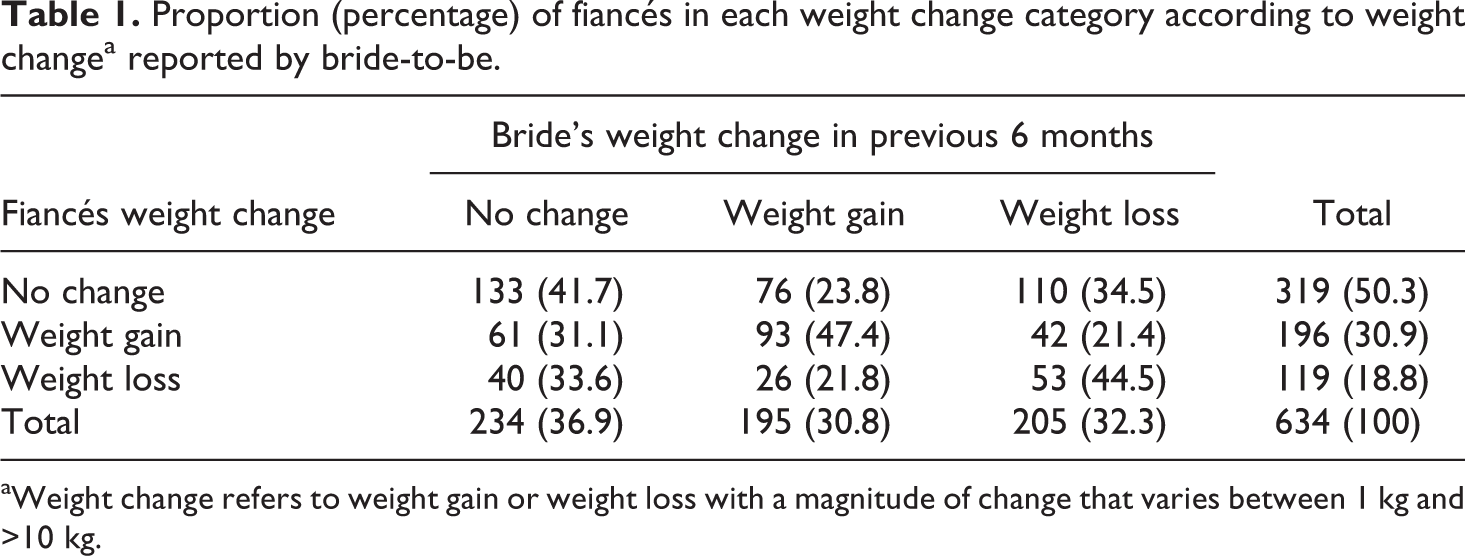
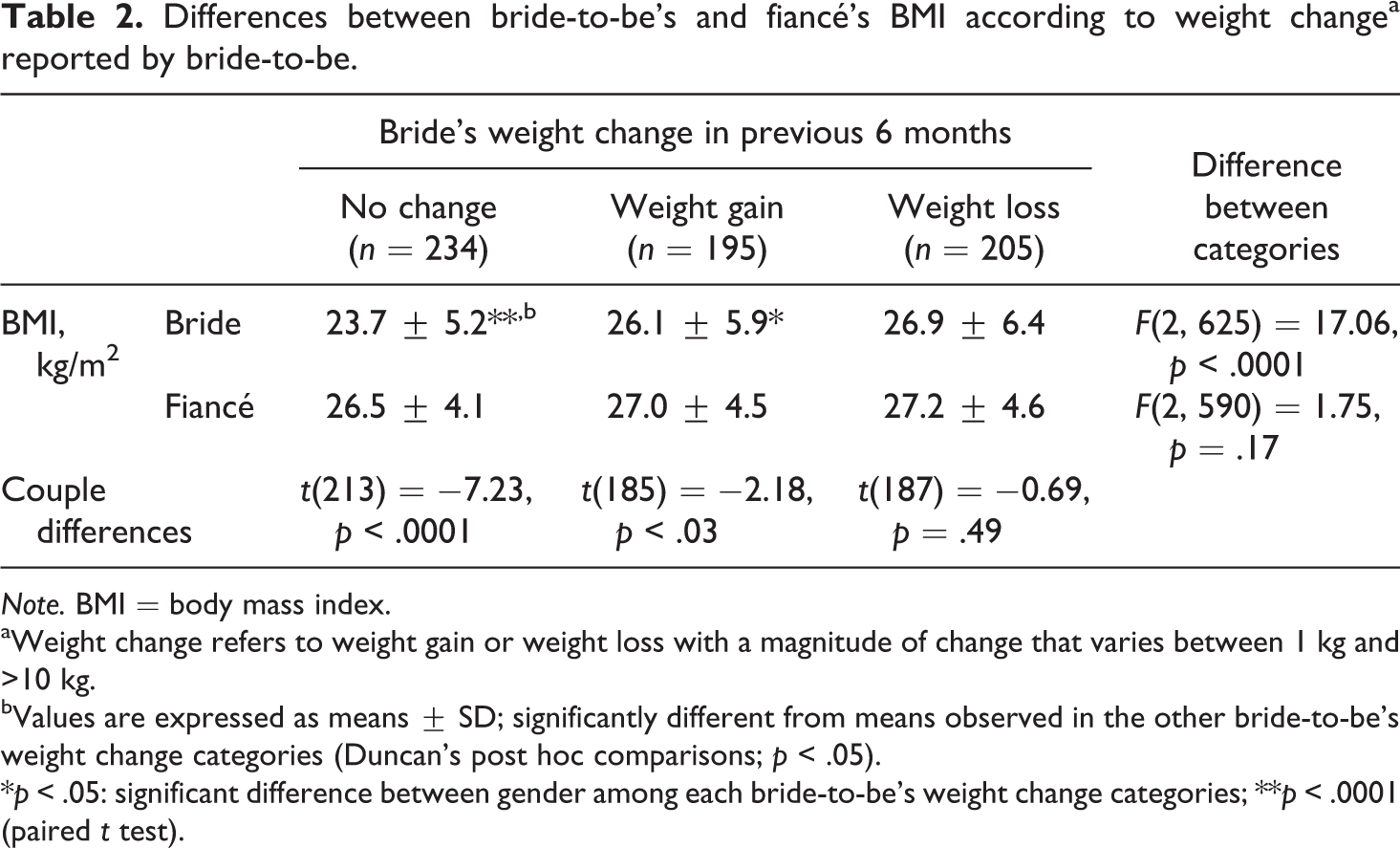
In terms of reported weight change, about a third of women had lost weight, a third gained weight, and a third stayed the same, whereas half the men had stayed the same (see Table 1). The proportion of males in each weight change category significantly differed according to women’s weight change category, χ2(4, N = 634) = 43.06, p < .0001. An analysis of variance with Duncan’s post hoc comparison was performed to evaluate the differences in BMI according to the weight change category of brides-to-be (see Table 2). Women who reported no weight change over the previous 6 months had a lower BMI than did women who had either lost or gained weight. Women who had gained weight reported having partners who also experienced greater weight gain than did partners of women who did not change their weight or who had lost weight (1.7 ± 3.6 kg vs. 0.2 ± 2.9 kg and −0.2 ± 3.3 kg, respectively), F(2, 617) = 19.33; p < .0001, with Duncan’s p < .05. Interestingly, for women who had lost weight in the past 6 months, the current BMIs that they reported did not differ from those of their fiancés, t(187) = −0.69, p = .49. In addition, when the bride-groom BMI discrepancy scores were examined, women who reported no weight change in the past 6 months had a significantly greater bride-groom BMI discrepancy (2.7 ± 5.5) than women who had either lost weight (0.3 ± 6.6) or gained weight in the past 6 months (1.0 ± 5.9), F(2, 585) = 8.46; p < .001, suggesting that they were already visibly smaller than their partners.
Proportion (percentage) of fiancés in each weight change category according to weight changea reported by bride-to-be.
aWeight change refers to weight gain or weight loss with a magnitude of change that varies between 1 kg and >10 kg.
Differences between bride-to-be’s and fiancé’s BMI according to weight changea reported by bride-to-be.
Note. BMI = body mass index.
aWeight change refers to weight gain or weight loss with a magnitude of change that varies between 1 kg and >10 kg.
bValues are expressed as means ± SD; significantly different from means observed in the other bride-to-be’s weight change categories (Duncan’s post hoc comparisons; p < .05).
*p < .05: significant difference between gender among each bride-to-be’s weight change categories; **p < .0001 (paired t test).
Discussion
As has been previously reported (e.g., Allison et al., 1996; Jacobson et al., 2007; Silventoinen et al., 2003; Speakman et al., 2007), as a reflection of assortative mating, individuals with similar heights and weights are more likely to marry each other. Despite brides being substantially lighter and shorter than their grooms in accord with gender norms, weight and height (and therefore BMI) of brides and grooms were correlated with each other.
However, when reported weight changes were examined, women who indicated that they had lost weight in the past 6 months were not significantly smaller than their partners and reported similar BMI to those of their fiancés. In addition, women who reported no weight change were visibly smaller than their fiancés as indicated by significantly greater bridegroom BMI discrepancy scores. These results suggest that despite general weight status matching, it appears important to women to be slimmer than their fiancé. It appears that women might infer from thin ideal norms for body weight and appearance promoted in Western societies (e.g., Slater, Tiggemann, Firth, & Hawkins, 2012; Tiggemann & Polivy, 2010) that they also must be thinner than their partners (particularly for their wedding day). When women evaluate their own body appearance, partner’s body shape could therefore be used as a size comparator, with women evaluating their bodies relative to their partners’. Weddings are an important day for such comparisons as the couple is forever immortalized in the wedding photos (Prichard & Tiggemann, 2008). In addition, expectations about beauty and appearance are particularly high for the bride—more so than for the groom (Sobal et al., 1999). Hence, women may be more likely to (try to) lose weight before their weddings than are men, and this may be particularly true if their BMI is similar to their partner, possibly in order to accentuate the difference between the bride and the groom. Perhaps surprisingly, however, only about one third of brides-to-be reported having actually lost weight in the previous 6 months and close to a third reported gaining weight. These figures may reflect successful and unsuccessful weight loss attempts (weight cycling) respectively. Notwithstanding the widespread reports of Western brides overwhelmingly wanting to lose weight, it appears that having a partner who is visibly larger protects women against feeling compelled to lose weight for their weddings, regardless of their own actual size. However, if one’s partner is the same size or smaller, women may feel compelled to lose weight.
Study 2: Reports of own and partner’s weight and physical attractiveness among young adult heterosexual couples
When attempting to evaluate such weight-related comparisons between partners as those explored in Study 1, it is important to know whether both partners are accurate in their body size evaluations. Studies have indicated that despite the high correlations generally found between measured and reported height and weight values (e.g., Goodman, Hinden, & Kandelwahl, 2000), many individuals, especially women and overweight/obese individuals, under report their weight and over report their height (e.g., Elgar & Stewart, 2008; Hall et al., 2010; Kovalchik, 2009; Larsen, Ouwens, Engels, Eisinga, & van Strien, 2008). Goodman, Hinden, and Kandelwahl (2000) compared teenagers’ self-reported physiques with their parents’ reports and found that although both teens and parents under reported the extent of teen obesity, the parent reports were more accurate. However, to date, very few studies have examined how accurate individuals are at evaluating their spouse or romantic partner’s weight and height. Given the ratings in Study 1 were based on brides’ reports of their grooms’ weight, it is important to determine whether such perceptions are accurate.
Weight concerns may be related to the romantic partner’s weight status for either sex. For instance, although most research shows that it is women who are more concerned about their body size and appearance, both heavier men and women who are in a romantic relationship with a thinner partner are more likely to be concerned about their weight, highlighting the importance of relative rather than absolute weight within a couple (Markey & Markey, 2010). Nevertheless, most of the research has focused on women. For example, in terms of attractiveness, wives report being more dissatisfied with their own bodies than their husbands are with them (Markey, Markey, & Birch, 2004). Wives also perceive that their husbands are more dissatisfied with their bodies than the husbands actually are. Markey and Markey (2006) have also found women were more dissatisfied with their own bodies than they believed their partners were or than the partners actually were.
In Study 1, we examined brides’ reports of their grooms’ weight. While BMI was positively correlated between couples (assortatively matched), overall the brides were still smaller than their grooms (with the exception of women who reported pre-wedding weight loss). Given the potential for groom’s weight to influence the weight change in brides found in Study 1, it is important to examine both members of a couple to determine how they perceive and react to each other’s weights and whether perceptions of attractiveness are related to weight similarity. The objectives of Study 2, conducted in romantically linked young couples, were therefore (1) to assess the associations between participants’ own self-reported and partner-reported weight and height as well as the accuracy of these reports compared to measured values and (2) to assess whether subjective ratings of each other’s physical attractiveness differ among couples. We hypothesized that in line with assortative mating, partners would be generally matched on both self-reported and measured BMI (although in absolute terms women would be consistently smaller than their male partners). It was also hypothesized that given previous research on sociocultural pressures, both male and female participants would be rated by their partner as more physically attractive than they perceive themselves, and the discrepancy between self-rating and partner’s rating of physical attractiveness would be greater for females than for males. In addition, following Study 1, discrepancy between partner’s BMIs was predicted to be associated with ratings of physical attractiveness.
Method
Participants and study design
A sample of 36 heterosexual couples (n = 72 participants) took part in the study. To be included in the study, all participants had to be in a stable heterosexual romantic relationship and to have been dating their partner for at least 6 months. Eligible male and female volunteers were recruited online from the introductory psychology course at the University of Toronto at Mississauga. In compensation for their participation in the study, participants received course credit if they were students from the introductory psychology course or otherwise were paid a small stipend (US$10). Both relationship partners were required to attend the testing session. Participants were assured that their answers would not be shown to their relationship partners, and each member of the couple was tested individually in a separate room. The study was approved by the Office of Research Ethics at the University of Toronto, and all participants provided informed consent.
Measures
Participants were asked to fill out a descriptive questionnaire, asking for some details about their language, ethnicity, religion, and relationship status. Following Barelds-Dijkstra and Barelds (2008), two questions measured subjective ratings of physical attractiveness: (1) “How physically attractive do you think you are?” (i.e., self-rating) and (2) “How physically attractive do you think your partner is?” (i.e., partner ratings), using a 7-point scale (1 = not attractive at all, 7 = very attractive).
Participants were also asked to self-report both their own height and weight and their partner’s height and weight. After some filler questions, height and weight were measured in all participants, and measured BMI (kg/m2) as well as self-report (subjective) BMI (kg/m2) was then calculated. BMI discrepancy was calculated for each couple by subtracting participant’s BMI from their partner’s BMI. All data were analyzed using SAS statistical software (Version 9.2; SAS Institute).
Results
The 36 heterosexual couples who participated in the study had been in their current relationship for a mean of 23.2 ± 20.7 months (range between 6 months and 108 months). Males had a mean age of 19.1 ± 1.5 years and females had a mean age of 18.6 ± 1.5 years.
As expected, in absolute terms, women were lighter, shorter, and smaller in size than their partners (weight = 56.9 ± 10.5 kg vs. 79.7 ± 15.9 kg, t(35) = −10.01, p < .0001; height = 1.61 ± 0.08 m vs. 1.77 ± 0.05 m, t(35) = −10.78, p < .0001; and BMI = 21.8 ± 3.6 vs. 25.4 ± 5.2, t(35) = −5.10, p < .0001). However, in relative terms, measures of weight and BMI were both positively correlated between male and female partners (r = .47, p < .01 for weight and r = .49, p < .01 for BMI), whereas no association was observed for height (r = .00, p = .99).
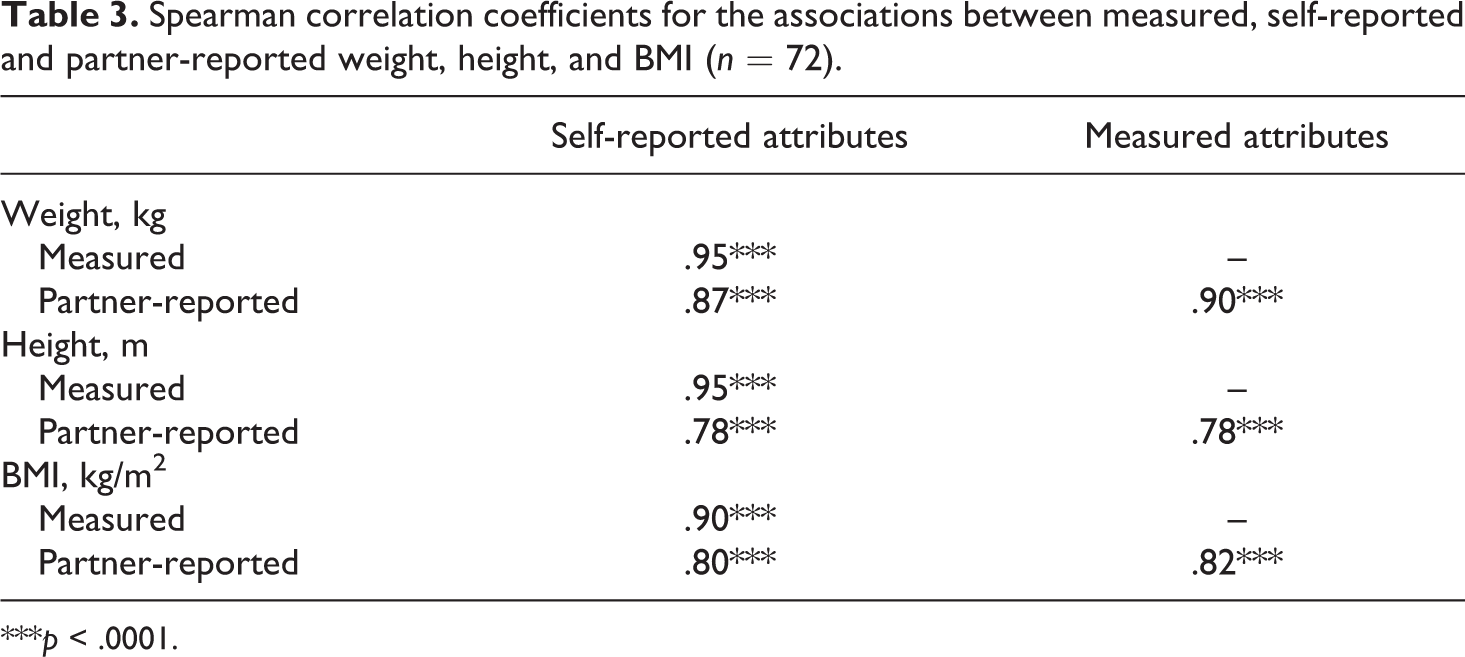
To investigate the relationships between reported and actual weight, height, and BMI among couples, Spearman correlations were performed. As indicated in Table 3, participants’ own self-report and their partner’s report of their own and each other’s weight, height, and BMI as well as with measured values were significantly related. In absolute terms, however, significant differences were observed overall between self-reported and measured weight (−1.7 ± 4.5 kg; t(71) = −3.25, p = .002), height (2.3 ± 3.9 cm; t(71) = 4.95, p < .0001), and BMI (−1.2 ± 2.0 kg/m2; t(71) = −5.23, p < .0001) and between participants’ perceptions of their partner’s weight and their partner’s actual measured weight (−4.0 ± 10.5 kg, t(68) = −3.31, p < .002), height (2.3 ± 7.9 cm, t(64) = 2.35, p < .02), and BMI (−1.7 ± 2.8 kg/m2, t(63) = −4.92, p < .0001). No differences were noted between self-reported and partner’s report of body size measurements (−1.8 ± 7.9 kg, t(63) = −1.85, p = .07 for weight; −0.002 ± 0.069 m, t(64) = −0.21, p = .83 for height; and −0.5 ± 2.6 kg/m2, t(63) = −1.43, p = .16 for BMI). That is, individuals reported both themselves and their partners to be taller and lighter than they actually were, as did their partners.
Spearman correlation coefficients for the associations between measured, self-reported and partner-reported weight, height, and BMI (n = 72).
***p < .0001.
Regarding subjective ratings of physical attractiveness, paired t tests were used to assess differences between the participant’s own self-rating and her/his partner’s ratings. In both male and female participants, the partner’s rating of physical attractiveness (i.e., “How physically attractive do you think your partner is?”) was higher than the participant’s own self-rating (i.e., “How physically attractive do you think you are?”; men: 5.8 ± 1.0 for partner’s rating vs. 5.2 ± 1.0 for own self-rating, t(35) = −2.75, p < .01; women: 6.2 ± 1.0 for partner’s rating vs. 4.8 ± 0.9 for own self-rating, t(35) = −6.21, p < .0001). As predicted, the discrepancy between participant’s own self-rating and partner’s rating of physical attractiveness was significantly greater among female than among male participants (−0.6 ± 1.3 in men vs. −1.3 ± 1.3 in women; t(70) = 2.49, p < .02).
Male participants’ ratings of their female partner’s physical attractiveness were negatively related to her measured BMI (r = −.33; p < .05) and tended to be related to lower weight, (r = −.30; p < .07). On the other hand, female participants rated their male partners as more physically attractive when the male’s measured weight (but not BMI) was higher (r = .32; p < .05). Measured weight and BMI in males and females were not related to their own self-ratings of physical attractiveness. Measured BMI discrepancy was not significantly related to how attractive participants perceived themselves to be for males (r = .02, p = .93) or females (r = .25, p = .15), nor was it related to how physically attractive their partner rated them to be (males: r = .06, p = .73; females: r = .18, p = .33). The same pattern of results was evident for self-reported BMI discrepancy and self-ratings of physical attractiveness (males: r = .02, p = .92; females: r = .22, p = .20). However, when the relationship between self-report BMI discrepancy and partner ratings of physical attractiveness was examined a different pattern of results emerged. Self-report BMI discrepancy was associated with males’ perceptions of their partners’ attractiveness (r = .39, p = .03) but not females’ perceptions of their partners’ attractiveness (r = .03, p = .88), indicating that males perceived their partners to be more physically attractive when there was a greater discrepancy in BMI between the couple, but females did not.
Discussion
Study 2 explored the associations between self- and partner-reported weight and physical attractiveness, allowing us to investigate the relationships between participants’ self- and partner subjective ratings and to determine whether they are similar and whether they are biased or accurate. The associations found between measured, self-reported, and partner-reported weight, height, and BMI suggest that an individual’s own self-reported BMI is comparable with their partner’s report of the individual’s height and weight. Romantic partners therefore seem to share the same view of their partners’ height and weight as the partner has. As predicted, and as found in Study 1, partners’ weights and BMIs were significantly correlated, such that partners did tend to resemble each other on body shape and size. Nevertheless, in line with previous research on self-reported weight (Elgar & Stewart, 2008; Kovalchik, 2009; Larsen et al., 2008), and as is generally true of most people’s weight self-reports (McCabe, McFarlane, Polivy, & Olmsted, 2001), actual weight was slightly but significantly underestimated by both genders and height was overestimated.
Consistent with previous literature (Barelds-Dijkstra & Barelds, 2008; Swami et al., 2007) and our prediction, our results showed a negative association between male partners’ rating of their partner’s physical attractiveness and BMI in those females. There was also a positive association between males’ ratings of their partners’ attractiveness and the subjective discrepancy in BMI between couples. Thus, consistent with previous research, a thinner female figure/visibly smaller partner was considered to be more attractive to male partners (Rand & Wright, 2001). In the present study, there was no association between attractiveness ratings and BMI for males. This is consistent with previous research in urban Western samples (e.g., Swami & Tovée, 2005). However, higher female ratings of their male partner’s physical attractiveness were associated with his having a higher weight (but not BMI). This latter finding may indicate a preference for greater muscle tone and is consistent with current societal norms for men, which prescribe a V-shaped and muscular body as ideal (e.g., Cafri & Thompson, 2004). It is also in line with the findings from Study 1, where some women were attempting to be lighter than their partners, possibly indicating they wanted a partner who was heavier than themselves.
General discussion and conclusion
Considering the pressures to be thin observed among females (Polivy & Herman, 2004), as well as the important role of physical attractiveness when selecting a partner, it is important to better understand the influence of weight and attractiveness on partner selection, as well as the associations between subjective ratings of physical attractiveness among couples, and their connections with participants’ own self-report evaluations. Findings from the two studies presented demonstrate the presence of both objective (measured) and subjective (self-report) similarity in weight, height, and BMI among couples, supporting the hypothesis that mating is assortative, with people seeking out mates similar to themselves on important dimensions (e.g., Allison et al., 1996; Jacobson et al., 2007). Across both studies, there was a strong correlation between partners for weight, height, and BMI.
However, despite the fact that individuals with similar weight are more likely to form a couple (e.g., assortative mating), in line with sociocultural norms, it seems that some women also think that they should appear slimmer than their partners, at least (or especially) on their wedding day (Study 1) and males perceived smaller female partners as more attractive (Study 2). Our results suggest that regardless of actual physique, as long as the bride is smaller than the groom, she does not seem to “need” to lose weight. For those brides who were initially closer in weight to their grooms, however, weight loss was achieved before the wedding. Such weight loss was independent of the bride’s actual BMI but was governed by her size relative to that of the groom. It thus appears that while many, or even most, brides-to-be claim to want to lose weight before the wedding, only the ones who are not visibly smaller than their fiancés are actually motivated enough do so. Women whose BMI is not lower than their partner’s BMI may feel more pressure to lose weight before displaying themselves standing next to their (same-sized or smaller) groom at the wedding. For women who gained weight, their partners also gained weight. Together, these findings suggest that people may be under pressure to maintain the norm of the male being at least somewhat larger than the female partner.
Even if they are not necessarily accurate regarding their reported height and weight, it is interesting to note that each partner is still very aware of her/his partner’s self-perceived body size measurements. Romantic couples share the same view of their partners’ height and weight that their partner has, although both reports are measurably somewhat inaccurate. They are thus very aware of the partner’s view of himself or herself as well as of their own status on the physique dimension.
In both males and females, our findings showed that the partners’ ratings of the participants’ physical attractiveness were more positive than were the participants’ own self-ratings, which is in accordance with previous studies (Barelds-Dijkstra & Barelds, 2008; Swami & Alum, 2012; Swami et al., 2007). With regard to partners’ physical attractiveness, both men and women usually consider their opposite-sex partners to be significantly more attractive than they are themselves (Barelds-Dijkstra & Barelds, 2008; Swami et al., 2007). Research suggests that this overconfidence in the partner’s physical attractiveness could help the person to enhance his/her self-esteem and improve his/her overall well-being (Swami et al., 2007). Romantic relationships, at least among young adults, seem to contain a rosy glow of positive (possibly at least partly illusory) perceptions of the romantic partner. It could be posited that such optimistic views of each other are useful to help to get the relationship started in a constructive manner and help both partners to feel that they are getting the best available mate. In fact, a longitudinal study of couples showed that relationships were more likely to persist when the two partners idealized each other the most (Murray, Holmes, & Griffin, 1996). Moreover, those partners who idealized each other more also became more satisfied and had less conflict as the relationship went on. The degree to which these heightened positive ratings of one’s partner are accurate (or not) and are sustained or change over time is thus a potentially fruitful topic for future research.
Some differences were also observed between how women and men rate/react to weight and attractiveness in their partners and themselves in Study 2. Women were more negative about themselves than their male partners were about them. These data may indicate that male partners value their female partner (or at least her appearance) more than the females value themselves. This supports previous research that shows that women’s ideal figures (for themselves) are much smaller than are men’s ideals for women’s physiques (Fallon & Rozin, 1985). They are also in accord with the findings from Study 1 where women who were visibly smaller than their partners reported no weight loss attempts in the previous 6 months. Also, in line with the thin ideal norms for body weight and appearance that are particularly promoted among women (Polivy & Herman, 2004), a thinner figure seems to be related to physical attractiveness only in females. Accordingly, women who felt compelled to lose weight before their weddings were mainly those whose BMIs were not significantly different than their male partners’, not necessarily simply those with larger BMIs (Study 1). This protective effect on women’s self-perceived need to lose weight of having a heavier partner has not previously been noted. Such a preference on the part of women (for a heavier male partner) as evidenced in Study 2 may contribute to the lack of pressure on men to be thinner, whereas women (at least those with a relatively small male partner) must work to achieve the thin ideal. This notion is supported by the findings in Study 2 where women who were perceived as smaller than their partners were also rated as more attractive by their partners.
The present research should be interpreted in light of some possible limitations. First, in addition to the fact that the data on weight and height were only self-reported for brides-to-be in Study 1, brides were also asked to report the current height and weight of their partner, so no self-report or measured data were available for grooms. It could be argued that a bride’s perception of her partner’s physique may be more influential in terms of motivating her own weight loss rather than her partner’s actual measurements. However, the results from Study 2 indicate that body size measurements were reasonably accurate and consistent across gender for both partners, suggesting that brides’ reports of their partners measurements should be comparable to what their fiancés would have reported. Second, the findings do not take into account muscularity, chest to waist ratio, or hip to waist ratio in relation to the BMI of males. Although a heavier male figure was considered more attractive to female partners in Study 2, it is possible that those heavier men may have been more muscular and that their muscularity accounted for their increased attractiveness. Third, as the study was based on weight and body measurements, we did not account for other factors related to assortative mating such as age, socioeconomic status, or education level, or even other appearance variables such as facial attractiveness. Finally, as the present results are derived from correlational, cross-sectional studies, causal relationships cannot be established. Longitudinal research examining weight change in couples is required to determine actual weight change and the motivations behind any change.
In sum, the present research examined couples’ similarity in weight and ratings of physical attractiveness within the context of assortative mating. We examined brides’ weight in comparison with their perceptions of their partners’ weight as well as couples’ similarity in weight and perceptions of attractiveness. The present data suggest that mating couples really are selective about each other’s physical qualities, and weight/BMI appears to be an important and influential attribute in mate selection for young couples, perhaps because of social norms. People tend to choose partners who are relatively similar to themselves in physique. Featherweight birds do seem to flock together.
Footnotes
Funding
This research project was supported by a grant from the Social Sciences and Humanities Research Council to authors J.P. and C.P.H.