



Abstract
Compassionate love has been identified as one of the major types of love experienced in relationships (Berscheid, 2010), but one that has been overshadowed by the study of romantic love. In this article, we review research on compassionate love, a relative newcomer to the close relationships field, and present findings that more fully flesh-out the nature of the experience of this kind of love. We begin by discussing conceptions and measurement of compassionate love. We then present a study on the relation between compassionate love and love styles, with a focus on distinguishing between compassionate love and the agape (altruistic) love style. The literature on individual differences in compassionate love is discussed next. The spotlight then shifts to research on the link between compassionate love and prosocial relationship behaviors, relationship quality, and relationship stability. Differences between compassionate love given versus received also are highlighted. We end with a discussion of what compassionate love “looks like” in the context of a romantic relationship and recommend directions for future research.
Love has been identified by relationship scientists from multiple disciplines as a major force in the development of romantic relationships (Surra, Gray, Boettcher, Cottle, & West, 2006). The delineation of different categories or types of love, and how these types predict satisfaction and stability of relationships, has been a focus of theory and research over the past few decades (for reviews, see Aron, Fisher, & Strong, 2006; Berscheid, 2010; Fehr, 2013, in press; Felmlee & Sprecher, 2006). Romantic/passionate love has received the lion’s share of the research attention, sometimes coupled with companionate love (Hatfield & Rapson, 1993; Sprecher & Regan, 1998). In a recent treatise on love, Berscheid (2010) argued that the focus on romantic love has obscured the fact that people experience a variety of other kinds of love in relationships, including compassionate love. She articulated a quadrumvirate model in which compassionate love is one of four fundamental kinds of love that romantic partners can experience for one another (along with romantic/passionate love, companionate love, and attachment love). Further, she claimed that compassionate love plays an important role in predicting relationship satisfaction and stability.
Despite Berscheid’s (2010) assertion that compassionate love can be experienced for a romantic partner, and, in fact, has important relationship implications, so far research on this kind of love has focused primarily on nonromantic contexts (e.g., family and friends, strangers, and even all of humanity; see Fehr, Sprecher, & Underwood, 2009, for a review). Fortunately, in the last few years, close relationship scholars have begun to turn their attention to compassionate love in romantic (dating and marital) relationships. The purpose of this article is to review what is known so far and, where relevant, to present some new findings from a study that we conducted in order to sketch a portrait of what compassionate love “looks like” in the context of a romantic relationship. With such a sketch in place, future research can add detail, texture, and color. The final masterpiece may look quite different from the early sketches, but, as in the world of art, it is unlikely that a masterpiece will be created without a process of sketching, evaluating, erasing, and sketching some more.
We begin by addressing the basic question: What is compassionate love? Both experts’ and lay people’s conceptions are discussed. Next, we turn to the issue of measurement and describe the scales that are used to assess compassionate love. We then address the issue of whether compassionate love can be differentiated from the agape love style and present findings from a study that we conducted on the relation between love styles and compassionate love. Next, we raise the question: Who is most likely to experience compassionate love in a romantic relationship? We answer this question by reviewing research on individual differences in the propensity to experience compassionate love, including gender and personality differences. The spotlight then shifts to the dynamics of relationships in which partners love one another compassionately. In this part of the article, we review research on the link between compassionate love and prosocial relationship behaviors. Then we focus on the “outcomes” of compassionate love and present research on the relation between compassionate love and various indices of relationship quality and relationship stability. This is followed by a section on whether it is better to give or receive compassionate love in a romantic relationship. (For each of these topics, we review existing literature and weave in the findings from the study that we conducted where applicable.) We end with some general conclusions about the current state of the literature on compassionate love and suggest directions for future research.
What is compassionate love?
The concept of compassionate love has been defined from a number of different perspectives. Some theorists have constructed general definitions that apply across targets or contexts. Others have crafted definitions that are specific to a romantic relationship. Lay conceptions of compassionate love also have been examined.
Experts’ definitions of compassionate love
Scholars have generated a number of theories and definitions of compassionate love. We will focus on three prominent conceptualizations, namely those articulated by Underwood, Berscheid, and Neff and Karney. We note that psychological theories of human behavior (e.g., behavioral systems and evolutionary theory) also have been applied to compassionate love (e.g., Mikulincer, Shaver, Bar-On, & Sahdra, in press; see Fehr & Sprecher, 2013, for a review).
Underwood’s model
Underwood (2002, 2009) spearheaded scientific inquiry on compassionate love. She offered the following working definition of this concept: “attitudes and actions related to giving of self for the good of the other” (Underwood, 2009, p. 4). This definition was intended to apply to a variety of targets, including known and unknown others. She elaborated on this definition by delineating the characteristics or features of this kind of love. More specifically, she maintained that the following characteristics must be present (to varying degrees) in order for an experience to qualify as compassionate love: free choice (the giver extends this kind of love out of his or her own volition), an accurate understanding of the other’s needs and feelings, valuing the other at a fundamental level, openness and receptivity to the other, and a “response of the heart” (emotional engagement with the other). In her view, this constellation of features distinguishes compassionate love from related constructs such as romantic love, empathy, sympathy, and compassion. For example, she argues that romantic love is often hormonally driven and can be motivated by fulfillment of one’s own needs and desires. Compassionate love differs from sympathy and empathy in that compassionate love is not just an emotional response but includes taking actions that alleviate the other’s suffering. Importantly, in Underwood’s view, compassionate love also includes actions that promote the flourishing of the other, not just reducing distress. Similarly, the concept of compassion is more narrowly focused on a response to another’s suffering—compassion does not include taking actions to promote the growth of another person nor does it necessarily require the level of engagement with the other that compassionate love entails.
Having articulated what compassionate love is, Underwood (2002, 2009) developed a model that specifies the antecedents, motivational factors, and consequences of compassionate love. Antecedents include contextual variables (cultural, social, and situational) and individual-level (e.g., biological, developmental, and personality) variables. For example, she suggests that an early secure and nurturing environment is more likely to lead to compassionate love and that the religious socialization of an individual will affect the likelihood of being compassionate. The next component of the model is more proximal to the expression of compassionate love, namely motive and discernment. For an individual to express compassionate love (the final outcome in the model), his or her motives must be centered on the good of the other. Motivations that are inappropriate or focused on self-gain will impede the expression of compassionate love.
Underwood’s conceptualization of compassionate love inspired other social scientists to formulate definitions and models of this kind of love (see Shacham-Dupont, 2003, for a review). For example, Sprecher and Fehr (2005) offered the following definition:
Compassionate love is an attitude toward the other(s), either close others or strangers or all of humanity; containing feelings, cognitions, and behaviors that are focused on caring, concern, tenderness, and an orientation toward supporting, helping, and understanding the other(s), particularly when the other(s) is (are) perceived to be suffering or in need. (p. 630)
Berscheid’s model
Turning to the context of a romantic relationship, Berscheid (2006, 2010) defined compassionate love as “concern for another’s welfare and taking actions to promote it, regardless of whether those actions are perceived to result in future benefits to the self” (Berscheid, 2006, p. 176). (As mentioned earlier, she developed a model of love in which compassionate love is identified as one of four fundamental kinds (along with romantic/passionate love, companionate love, and attachment love)). Berscheid distinguishes between the historical causes (i.e., evolutionary factors) and more proximal antecedents of compassionate love. She postulates that the principal immediate cause of compassionate love is the perception that the other is in distress. The tendency to respond to others’ distress with care and concern (i.e., the caregiving system) is part of the evolutionary history of humankind, given that infants can only survive when they receive care and protection from caregivers. Thus, according to this model, compassionate love has its basis in human evolution. (This assumption is shared in other models of compassionate love, including the behavioral systems approach articulated by Mikulincer, Shaver, and colleagues, e.g., Mikulincer & Shaver, 2007; Mikulincer, Shaver, & Gillath, 2009; see Mikulincer et al., in press, as well as evolutionary models of compassion, e.g., Goetz, Keltner, & Simon-Thomas, 2010; Keltner, 2009.) The behavior that is enacted depends on an individual’s appraisal of the kind of response that would be most effective in alleviating the other’s distress. In terms of temporal course, Berscheid suggests that this kind of love may develop early on in a relationship but is only put to the test when support and sacrifice are required over an extended period of time.
The other kinds of love specified in Berscheid’s model differ from compassionate love in terms of their antecedents or causes, behavioral responses, and temporal course. For example, romantic love is triggered by the perception of desirable qualities in the other (e.g., physical attractiveness), sexual desire, and being liked by the other. The antecedents of companionate love are proximity, familiarity, and perceptions of similarity. Attachment love is defined as a strong affectional bond with an attachment figure (which Berscheid regards as different from one’s characteristic attachment style). The impetus for this kind of love is a threatening situation. The behaviors that are associated with romantic love are acts that encourage a person to seek out sexual relations with another. Shared, enjoyable activities are among the behaviors associated with companionate love. Proximity-seeking behaviors are the hallmark of attachment love. Finally, in terms of temporal course, Berscheid maintains that romantic love declines over time. She suggests that companionate love may develop early in a relationship but fluctuates with changes in the partners and life circumstances. Attachment love is seen as taking a “slow and steady” developmental course.
Neff and Karney’s model
A rather different conceptualization of compassionate love is offered by Neff and Karney (2005, 2009) who have conducted a program of research on the trajectory of marital relationships. They define compassionate love as a positive global evaluation of a partner along with an accurate understanding of his or her specific strengths and weaknesses. It is the acceptance of the other, coupled with an awareness of his or her shortcomings, that is seen as distinguishing compassionate love from other kinds of love for one’s partner.
Can experts’ models of compassionate love be integrated?
At this early stage, it is difficult to fully integrate these different conceptions and models of compassionate love. However, as a starting point, we highlight some of the differences between them. One major difference is in the breadth of the model. Underwood’s conceptualization of compassionate love is the most extensive in that she identifies and elaborates on a number of defining characteristics of compassionate love, as discussed earlier. She also articulates a model in which she identifies a wide range of distal (e.g., cultural, social, and personal) factors that contribute to compassionate love. She also includes more proximal factors such as motivation and discernment and identifies barriers to the full expression of compassionate love. Berscheid also specifies distal (i.e., evolutionary) and proximal (i.e., perception that other is in distress) causes of compassionate love, although she focuses on a narrower range of causes than does Underwood. Neff and Karney’s model does not address the causal origins of compassionate love. Both Underwood and Berscheid delineate behaviors associated with compassionate love (e.g., social support and sacrifice), although in Berscheid’s model, the behaviors are limited to those that alleviate distress (Underwood's model also includes the promotion of flourishing). In Neff and Karney’s program of research, behaviors such as social support are outcome variables that are predicted by compassionate love.
The models also differ in terms of the range of targets. Underwood’s model is intended to apply to compassionate love as experienced toward close others and nonclose others. (Similarly, Sprecher and Fehr’s, 2005, definition applies to close others, a specific close other, strangers, and even all of humanity.) Berscheid and Neff and Karney focus on compassionate love as experienced toward a romantic partner.
As touched on earlier, these models also differ in terms of whether compassionate love is defined as a response to another’s suffering or distress or whether the definition also includes actions that are taken to promote the flourishing and well-being of the other. Underwood emphasizes both. Berscheid (and many other scholars; see Shacham-Dupont, 2003) regards compassionate love as a response to distress. (Neff and Karney’s conceptualization of acceptance of one’s partner while recognizing his or her shortcomings is not particularly germane to the issue of alleviation of distress or promotion of well-being.)
Another difference between these models lies in their treatment of other kinds of love. Underwood specifies a few key differences between compassionate love and romantic love. In Berscheid’s model, compassionate love is regarded as one of four fundamental kinds of love. Her conceptualization focuses extensively on how this kind of love differs from the other basic kinds in terms of antecedents, behaviors, temporal course, and outcomes. In fact, a unique feature of Berscheid’s model is that she specifies the temporal course of compassionate love. The other models do not specifically address this issue.
In conclusion, extant models of compassionate love differ in terms of their scope, the specified target(s), and so on. Compassionate love is also defined in different ways. Despite this diversity, a common thread that runs through these conceptualizations is that compassionate love involves extending beneficence to another. As discussed next, this is also a theme that emerges in lay conceptions of compassionate love.
Lay conceptions of compassionate love
Fehr and Sprecher (2004, 2009a) conducted a series of studies to uncover conceptions of compassionate love held by ordinary people. In their first study, participants were asked to list the features or characteristics of compassionate love. Sixty-two features were listed by more than one person, suggesting that laypeople have a rich and multifaceted understanding of the meaning of this concept. The responses included feelings and emotions (e.g., “feel sorry for the person”), cognitions (e.g., “caring”, “worrying”), motivation (e.g., “want to spend time with other”), and behaviors (e.g., “support”, “comforting”). In their second study, a new sample of participants rated these features in terms of prototypicality (i.e., how representative each feature was of the construct). The features that received the highest ratings were “trust,” “honesty,” “caring,” “understanding,” and “support.” These are features that receive the highest prototypicality ratings for the concept of love in general (Fehr, 1988). The lowest prototypicality ratings were assigned to features that are prominent in scholars' definitions, such as “do anything for the other,” “put other ahead of self,” and “make sacrifices for the other.” This prototype structure was confirmed in additional studies (e.g., memory was biased in the direction of favoring prototypical features; reaction times were faster to verify prototypical, than nonprototypical, features).
To conclude, as discussed earlier, the idea that compassionate love involves giving of oneself for the good of another is a common thread in most experts’ conceptions of compassionate love. This theme also is present in lay conceptions of compassionate love, although, interestingly, the features of love in general are regarded as most central to the construct. Thus, ordinary people emphasize the “love” in compassionate love. The features that depict giving of oneself for another (e.g., sacrifice) are seen as part of the concept but as more peripheral.
Measurement of compassionate love
In early research on compassionate love, Underwood (2002) assessed the construct with 2 items: “I feel a selfless caring for others” and “I accept others even when they do things I think are wrong.” (These items were taken from Underwood and Teresi’s (2002) Daily Spiritual Experience Scale.) Subsequently, Sprecher and Fehr (2005) created a multiple-item scale to measure compassionate love for a variety of targets—close others in general (family and friends), a specific close other (e.g., romantic partner), and strangers or all of humanity. In constructing the Compassionate Love Scale (CLS), Sprecher and Fehr adapted a few items from existing measures, including Underwood’s compassionate love items, the agape love style scale (Hendrick & Hendrick, 1986), and standard love scales (e.g., Rubin’s, 1970, Love Scale). Selection and construction of items also were informed by their analysis of lay conceptions of compassionate love (Fehr & Sprecher, 2004, 2009a). The final 21-item scale contains items such as “I often have tender feelings toward ___ when he or she seems to be in need” and “When I hear about ___ going through a difficult time, I feel a great deal of compassion for him or her.”
In the close others version of the scale, the items are worded in terms of close others, such as friends and family. The scale also can be completed with respect to a specific close other (as in the sample items above). In the strangers/humanity version, the items are worded in terms of compassionate love for strangers/all of humanity. The CLS has fared well in tests of reliability and validity (see Fehr & Sprecher, 2009b, for a review). Generally, scores on the scale are highest when the target is a romantic partner, followed by close others (family and friends). The lowest scores are obtained when the CLS is completed with respect to strangers/humanity, although the means are still above the midpoint of the scale (see Fehr & Sprecher, 2013).
A brief version of the CLS, the Santa Clara Brief Compassion Scale, also has been published (Hwang, Plante, & Lackey, 2008). Hwang et al.’s intent was to create a brief measure of the construct of compassion (rather than compassionate love per se). Five items from the CLS were selected based on item-to-total correlations, factor analyses, and if they were worded in terms of “compassion” rather than “compassionate love.”
Finally, Neff and Karney’s (2005, 2009) assessment of compassionate love reflects their conceptualization of compassionate love as a global, positive evaluation coupled with an understanding of the partner’s particular strengths and weaknesses. Specifically, participants are asked to evaluate their partner in terms of global qualities (e.g., being a good person) as well as his or her specific traits and abilities (e.g., extraversion, intellect).
To conclude, there are different tools to assess compassionate love. The CLS is essentially a face valid measure in which participants rate the extent to which they feel tenderness, care, and compassion for a range of targets (Sprecher & Fehr, 2005). Neff and Karney’s (2005, 2009) assessment is more indirect and specifically focused on perceptions of the global and specific traits of one’s romantic partner. At this point, the degree of convergence between these measures is not known.
Is compassionate love redundant with the agape love style?
Scholars who introduce a new concept are obliged to demonstrate that the concept differs from similar, existing constructs. In the case of compassionate love, the concept that is arguably most similar, and has a much longer history in the field, is the agape love style. This love style, along with five others, originally was identified by Lee (1973, 1977) based on an analysis of literary and historical sources as well as extensive interviews conducted with individuals about their relationship experiences. More specifically, Lee constructed a typology of love styles that involves three primary love styles and three secondary ones. The primary styles are eros (romantic/passionate love), storge (friendship love), and ludus (game-playing love). The secondary styles are mania (possessive, dependent love), pragma (practical, logical love), and agape (all-giving and selfless love). The secondary styles are compounds of pairs of the primary styles, although all six love styles represent distinct orientations to love. Agape is a compound of eros and storge.
Hendrick and Hendrick (1986, 1989; see Hendrick & Hendrick, 2006, for a review) subsequently conducted an extensive program of research in which they empirically verified Lee’s (1973, 1977) typology and fleshed out the relationship implications of each of the love styles. They originally defined the agape love style as “an ethereal, altruistic love that takes no thought of the self but only of the beloved other” (Hendrick & Hendrick, 1987, p. 144). In later writings, they tempered this definition, describing agape as “sacrificial, placing the loved person’s welfare above one’s own” (Hendrick & Hendrick, 2006, p. 153).
The standard measure of the agape love style is the Love Attitudes Scale (which contains subscales to assess all six love styles; Hendrick & Hendrick, 1986). This scale is a modification of a true–false scale that was developed earlier (Lasswell & Lasswell, 1976). In the Love Attitudes Scale, each love style is assessed with 7 items. Items on the agape scale include: “I would rather suffer myself than let my partner suffer,” “I would endure all things for the sake of my partner,” and “I cannot be happy unless I place my partner’s happiness before my own.” In response to criticism that the scale items assess people’s general orientation to relationships as well as their experiences in specific relationships, Hendrick and Hendrick (1990) created a relationship-specific version of the Love Attitudes Scale. They also constructed a short form of the Love Attitudes Scale (Hendrick, Hendrick, & Dicke, 1998). However, the original scale remains the most widely used measure (see Fehr, 2013, for a review).
Some scholars have criticized the conceptualization (and, by implication, the measurement) of the agape love style for being too extreme. According to Levy and Davis (1988), “Lee’s conception of Agape involves such extreme self-sacrifice that it appears to tend toward a pathological naiveté and is probably rare as an enduring relationship disposition” (Levy & Davis, 1988, p. 433; see Feeney & Noller, 1990, for a similar criticism). Nevertheless, participants seem to be willing to endorse the agape love style items. In diverse samples, agape, along with the storge, and eros love styles tends to receive the highest ratings (with pragma and mania garnering lower ratings and ludus receiving the lowest ratings; e.g. Hendrick & Hendrick, 1986, 1993; Sprecher et al., 1994; see Fehr, 2013, for a review). Agape also is one of two love styles (the other is storge) that is most desired in a partner (Hahn & Blass, 1997).
One of the purposes of the empirical research presented in this article was to differentiate compassionate love from the agape love style. We expected that these two constructs would be substantially related, given that both emphasize giving of oneself for another, but that they would not be identical. The agape love style is conceptualized as an orientation to love that involves extreme sacrifice, including suffering, for the sake of one’s romantic partner. Compassionate love also involves sacrifice and selflessness, although perhaps not to the same extreme degree. It is also seen (and measured) as a broader concept that includes empathy, tenderness, caring, and concern for another. Another distinction is that the agape love style is focused on romantic relationships whereas compassionate love is conceived of as a kind of love that can be experienced for a variety of targets, including strangers or even all of humanity, close others (e.g., friends and family), as well as a romantic partner.
Relation between love styles and compassionate love: Some new findings
The question of whether compassionate love and the agape love style are redundant constructs is ultimately an empirical one. We therefore conducted a study in which we administered scales to assess love styles, compassionate love, and relational outcome measures. Our main prediction was that people who score high on the agape love style would report high levels of compassionate love for their partner. However, we did not expect that the correlations would be so high as to suggest that these are synonymous constructs. We also predicted that there would be moderate associations between the eros (romantic and passionate) and the storge (friendship based) love styles and compassionate love. This prediction was based on past studies showing that measures of romantic/passionate love and companionate love are moderately to strongly correlated with scores on the CLS (see Fehr & Sprecher, 2013, for a review). Predictions for the mania (manic and obsessive love) love style were unclear. It was possible that mania would be highly correlated with compassionate love—those who are consumed by their love interest might express a willingness to “give all” to that person. However, their obsession also might interfere with the ability to experience empathy and compassion. The pragma love style was expected to be unrelated to compassionate love. Whether one takes a practical, “shopping list” approach to love seems independent of whether one loves one’s partner compassionately. Finally, it was hypothesized that the ludus (game playing) love style would be antithetical to compassionate love.
Method
Introductory psychology students from the Subject Pool at the University of Winnipeg (N = 81) and students recruited through classes at Illinois State University (N = 34) participated, yielding a total sample size of N = 115 (59 women and 54 men indicated their gender). Participants ranged in age from 18 to 35 years (M = 20.40 years). A requirement for participation was involvement in a romantic relationship. In terms of relationship status, 16.5% of participants were casually dating, 44.3% were seriously dating, 3.5% were engaged, 24.3% were cohabiting, and 2.6% were married (8.7% reported “other”). Mean relationship duration was 20.46 months (range = .5–84 months). The majority of participants were White (77%), followed by Black (7%), Asian (7%), and other (9%). Most participants were middle class (51.3%), followed by upper middle class (28.7%), working class (7.8%), lower middle class (7.8%), and upper class (2.6%).
We administered a questionnaire package that included Sprecher and Fehr’s (2005) 21-item CLS (rated on a scale where 1 = not at all true and 7 = very true) completed with respect to one’s romantic partner (α = .95 in this sample). Participants also were asked to report on compassionate love received from their partner (“I feel I receive love and compassion from ____”) rated on scale where 7 = very true. Love styles were assessed using the short form of the Love Attitudes Scale (Hendrick et al., 1998). Items were rated on a scale where 1 = strongly disagree and 5 = strongly agree. Cronbach αs were .77 for agape, .65 for eros, .76 for storge, .69 for mania, .73 for pragma, and .64 for ludus. We also assessed relationship satisfaction and commitment. The former was measured with the Relationship Assessment Scale (Hendrick, 1988). Items were rated on a 5-point scale (α = .82). Commitment was assessed with Rusbult’s 7-item scale (Rusbult, Martz, & Agnew, 1998). Response options ranged from 1 = not at all to 7 = very much; α = .91. (We included additional measures that are not relevant here and therefore are not discussed further.)
Results and discussion
In this section, we present the findings on the relation between love styles and compassionate love. (Results for the other variables that were measured, such as giving vs. receiving compassionate love, are reported later.) Mean ratings for compassionate love and the love styles are shown in Table 1. Participants reported experiencing relatively high levels of compassionate love for their partner (M = 5.86 on a 7-point scale). Consistent with past research, women’s and men’s ratings of compassionate love for their romantic partner did not differ significantly. Ratings of the agape love style scale fell above the midpoint of the scale (M = 3.25 on a 5-point scale), surpassed only by ratings of the eros love style. Men scored significantly higher on this scale than did women. 1
Relation between love styles and relational outcomes of compassionate love: Descriptive statistics.
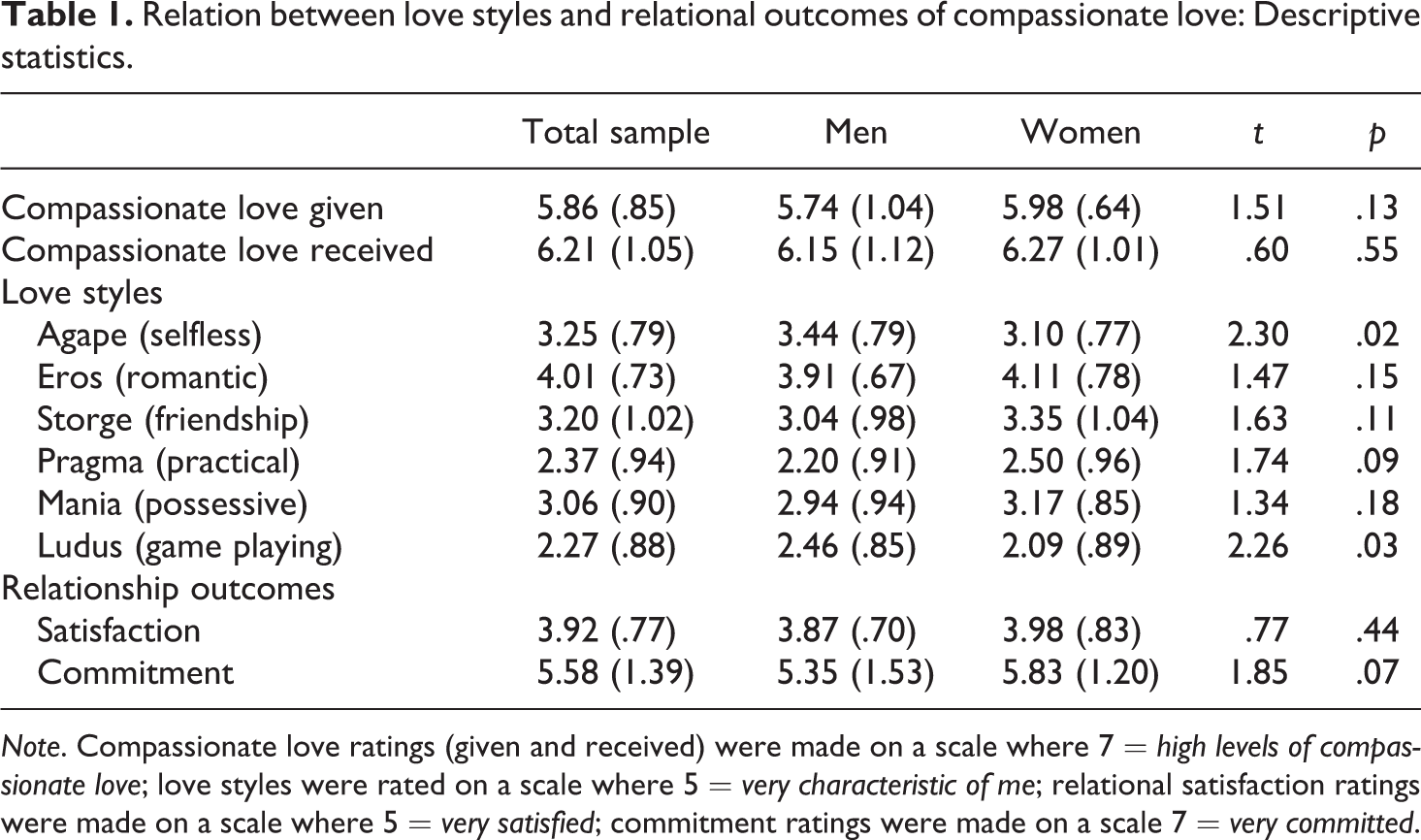
Note. Compassionate love ratings (given and received) were made on a scale where 7 = high levels of compassionate love; love styles were rated on a scale where 5 = very characteristic of me; relational satisfaction ratings were made on a scale where 5 = very satisfied; commitment ratings were made on a scale 7 = very committed.
As predicted, the agape love style was strongly associated with experiencing compassionate love for one’s partner, as shown in Table 2. We had not expected that the strength of this association would vary by gender. However, the correlation between agape and compassionate love was significantly stronger for men than for women. (This was the only love style for which correlations with compassionate love differed by gender; see Table 2.) The eros love style also was strongly associated with compassionate love for a romantic partner, for both women and men. (A moderate correlation had been predicted.) Moderate associations were expected between storge and compassionate love. For men, a moderate correlation was found; for women the correlation was not significant. The mania love style was unrelated to compassionate love for both women and men, as was the pragma love style (although the negative correlation for men reached statistical significance). As hypothesized, the manipulative ludus love style was negatively associated with compassionate love for one’s romantic partner and this held for both women and men (although the correlation was only marginally significant for men).
Correlates of compassionate love given and received in romantic relationships.
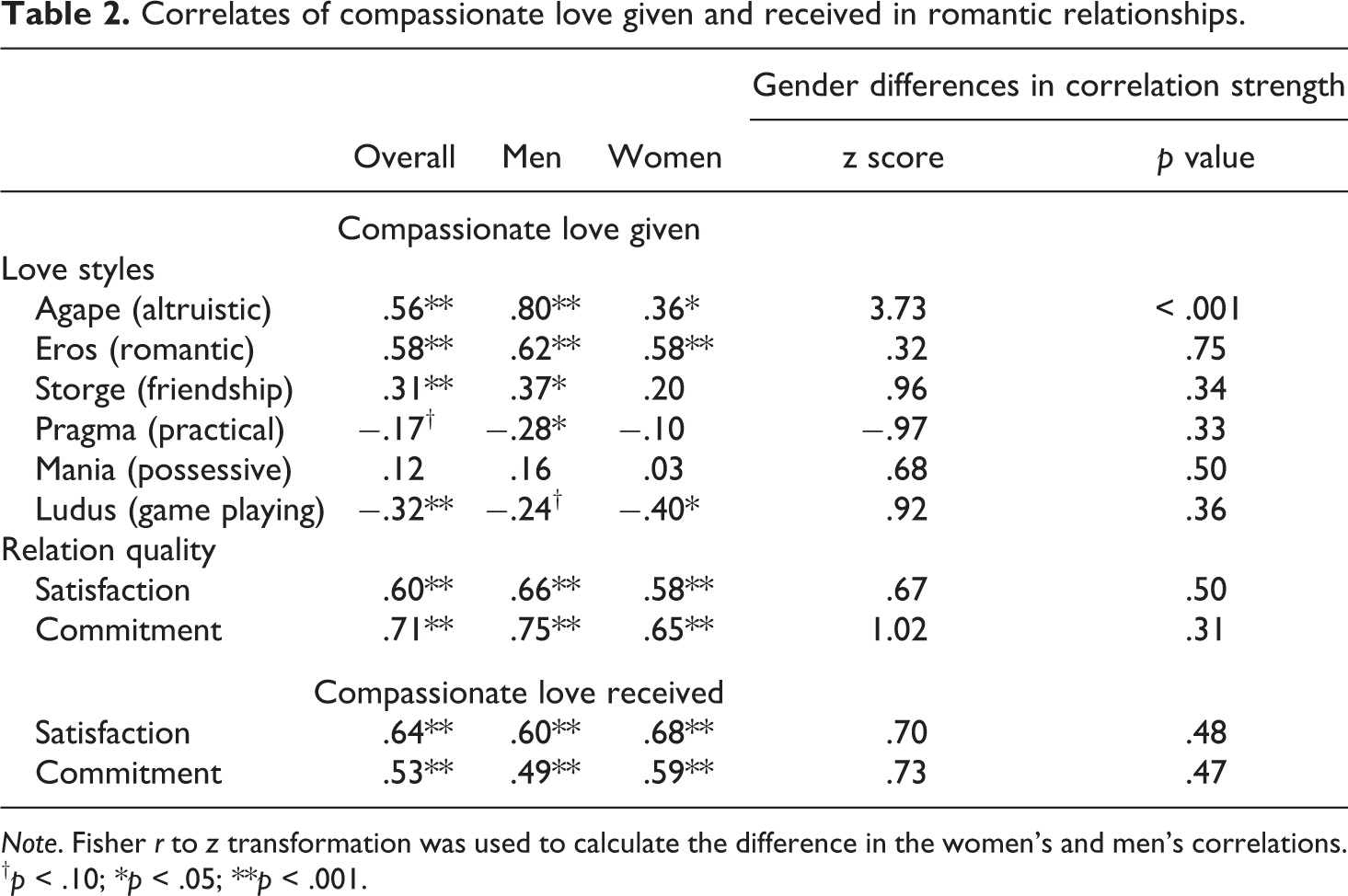
Note. Fisher r to z transformation was used to calculate the difference in the women’s and men’s correlations.
† p < .10; *p < .05; **p < .001.
In short, our key prediction, namely that the agape love style would be strongly associated with compassionate love was supported. However, the magnitude of the association was not so high as to suggest that these were redundant constructs. In order to further differentiate these concepts, we performed additional analyses. First, we conducted a multiple regression analysis in which we entered the six love styles as predictors and compassionate love as the criterion variable. As shown in Table 3, compassionate love for one’s partner was predicted by the agape love style. However, it also was predicted by the eros and storge love styles. The fact that three love styles were significant predictors of compassionate love—not just agape—lends further support to the idea that compassionate love is not equal to the agape love style.
Love styles as predictors of compassionate love.
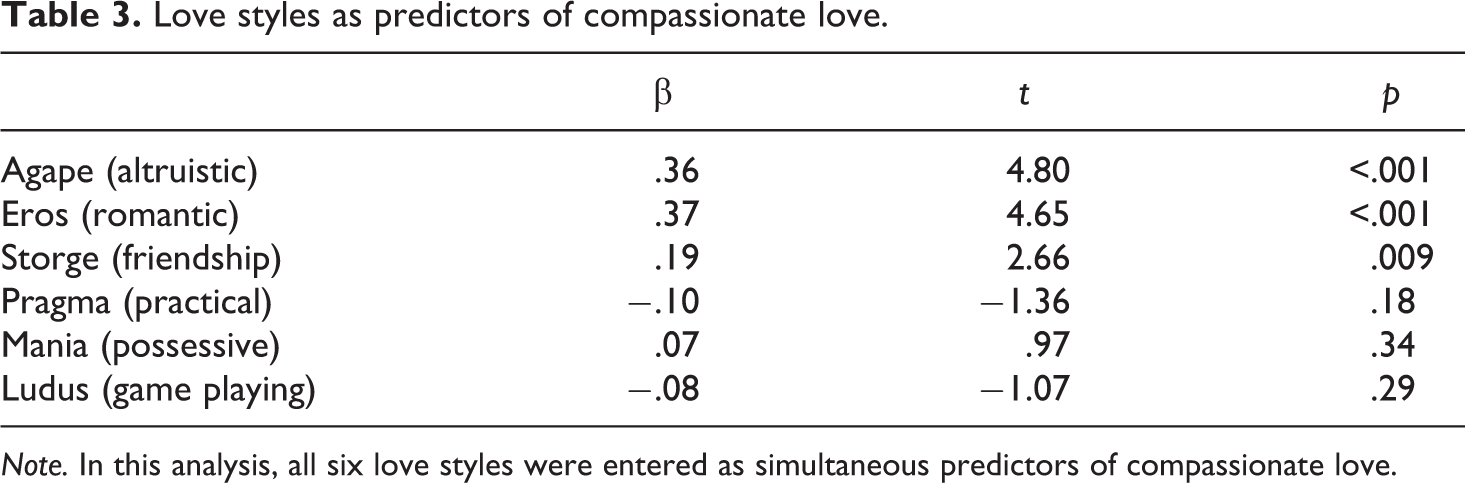
Note. In this analysis, all six love styles were entered as simultaneous predictors of compassionate love.
Next we examined how compassionate love fared when pitted against the agape love style in predicting two key relationship outcome variables, namely satisfaction and commitment. We first conducted a regression analysis in which the agape love style and compassionate love were entered as predictors with satisfaction as the criterion variable. Compassionate love was a significant predictor of satisfaction (β = .59, p < .001), whereas the agape love style was not (β = .01, p = .88). Similar results were obtained when the analysis was conducted with commitment as the outcome variable (compassionate love: β = .70, p < .001; agape love style: β = .03, p = .74). The fact that compassionate love made a unique contribution to the prediction of these relational outcomes beyond its association with the agape love style is compelling evidence for the distinctness of compassionate love.
Finally, we conducted regression analyses in which we included all six love styles and compassionate love as predictors of relational outcomes. As shown in Table 4, once again, compassionate love was a significant predictor of relationship satisfaction. In this analysis, the eros love style also predicted satisfaction, but the agape love style did not. When the analysis was conducted with commitment as the outcome variable, compassionate love again was a significant predictor; the agape love style was not (see Table 4). However, as shown in the table, three other love styles predicted commitment, namely eros and mania (positively) and ludus (negatively).
Love styles and compassionate love as simultaneous predictors of satisfaction and commitment.
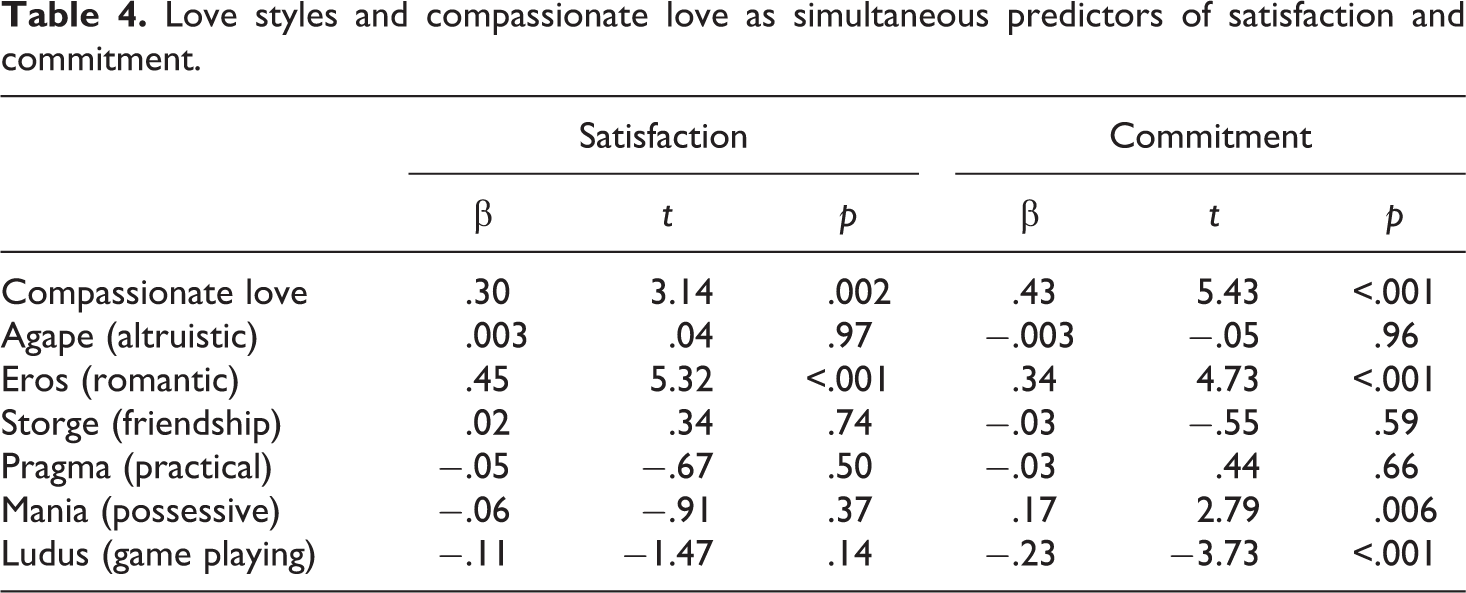
In summary, people’s approach to love, or their love “style”, has implications for how compassionately they love their romantic partner. Those whose orientation to love is self-sacrificing and agapic are likely to report high levels of compassionate love for their partner. (This is especially true for men.) Importantly, the relation between the agape love style and compassionate love is not so strong as to suggest that these are redundant constructs. Those who take a romantic, passionate approach to love also report high levels of compassionate love for their partner as do people who see love in friendship-based terms (although this association was not so strong as that found for eros and agape). Although we had predicted that the highest correlations would be found with the agape love style scale, it is not surprising that measures of eros and storge also were significantly associated with compassionate love. Berscheid (2010) observed that different kinds of love are likely to co-occur in relationships. Indeed, measures of the four kinds of love specified in her model tend to be highly intercorrelated (Fehr & Harasymchuk, 2012; Fehr, Harasymchuk, & Gouriluk, 2010). We further tested the distinctiveness of compassionate love and the agape love style conducted regression analyses in which relationship satisfaction and commitment were the criterion variables. Regardless of whether analyses were conducted with only agape and compassionate love in the equation or all six love styles, compassionate love consistently emerged as a significant predictor whereas the agape love style was nonsignificant. Thus, it would appear that people’s relational happiness and their intention to remain in a relationship are both strongly linked to how much compassionate love they experience for their partner. Whether people subscribe to a selfless, sacrificial orientation to romantic love (i.e., endorse the agape love style) has less bearing on relational outcomes once compassionate love accounted for.
Individual differences in compassionate love
Who is most likely to extend compassionate love toward their romantic partner? Research has examined whether there are personality and gender differences in compassionate love. We review this research and, where applicable, present findings from the study that we conducted.
Gender
Given that women tend to be the nurturers (e.g., Taylor, 2006), one might expect that women would score higher on measures of compassionate love than men. Consistent with this expectation, when the CLS is administered with respect to close others (family and friends) or strangers/humanity, women generally score higher than men (Sprecher & Fehr, 2005; see Fehr & Sprecher, 2013, for a review). However, gender differences are not found when the scale is completed with respect to one’s romantic partner, as has been found with dating samples (Fehr et al., 2010) and married samples (Fehr & Harasymchuk, 2013). This was also the case in our present study (see Table 1).
Personality
In general, scores on love scales are weakly correlated, if at all, with scores on personality scales (see Fehr, 2013, in press, for reviews). Fehr and Broughton (2001) suggested that stronger links between measures of love and personality might be found if researchers selected traits that are high in relevance to relationships. Toward that end, Sprecher and Fehr (2011) correlated scores on the CLS with global and relationship-specific attachment anxiety and avoidance scales given that attachment style is a highly relationship-relevant individual difference variable. Compassionate love for one’s romantic partner was negatively correlated with both global and relationship-specific avoidance. Similar findings were obtained by Fehr and Harasymchuk (2013). 2
Compassionate love and prosocial relationship behaviors
Given that compassionate love involves giving oneself for the good of another, those who experience this kind of love for their romantic partner would be expected to engage in prosocial behaviors in their relationship. Scores on the CLS have been correlated with a number of indices of prosociality, including the provision of support, caregiving, responsiveness, and self-sacrifice. 3
Social support
Scores on scales that assess the provision of social support (e.g., practical support and emotional support) are strongly correlated (in the .50s) with scores on the CLS completed with respect to close others in general (Sprecher & Fehr, 2005; Study 2) and a specific close other (romantic partner or a close friend; Sprecher & Fehr, 2005; Study 3). The same holds true in studies that have focused exclusively on romantic relationships. For example, Fehr et al. (2010) obtained a correlation of r = .52 between scores on the CLS and a measure of social support provided to one’s dating partner. Fehr and Harasymchuk (2013) reported a similar correlation (r = .56) between CLS scores and social support received from one’s dating partner.
In line with these findings, Neff and Karney (2005, 2009) found that a wife’s compassionate love for her husband (operationalized as a positive global evaluation along with an accurate understanding of his specific strengths and weaknesses) was associated with the provision of social support to him during an interaction in the laboratory. However, a husband’s level of compassionate love was unrelated to provision of support to his wife.
Caregiving
Compassionate love is associated with caregiving. Fehr et al. (2010) administered the CLS and Kunce and Shaver’s (1994) measure of caregiving to participants in dating relationships. Correlations between compassionate love and the caregiving subscales were .37 for cooperation, .50 for sensitivity, .64 for proximity, and .18 for compulsive caregiving.
Roberts, Wise, and Du Benske (2009) conducted a qualitative analysis of compassionate love and caregiving in an end-of-life context (most participants were caregivers for their spouse). In this context, compassionate love took the form of providing physical and emotional care, healing and forgiving past transgressions, and letting go of the other.
Responsiveness
People who love their partners compassionately would be expected to be respond to their partner’s needs with behaviors that convey understanding and caring (e.g., Berscheid, 2006, 2010; Clark & Monin, 2006; Laurenceau, Rivera, Schaffer, & Pietromonaco, 2004). Indeed, Reis (2010) found that scores on the CLS were strongly correlated with his measure of perceived partner responsiveness in a marital sample (r = .63). Those who love their partner compassionately also perceive that their partner is responsive to them (r = .56; Fehr et al., 2010).
Sacrifice
It would be expected that people who love their partner compassionately would be more willing to make sacrifices for him or her than those who love their partner less compassionately. In empirical investigations, compassionate love is strongly associated with making sacrifices for a dating partner (r = .50, Fehr et al., 2010; r = .51, Fehr & Harasymchuk, 2013).
Thus, there is mounting evidence that people who are high in compassionate love report engaging in wide range of prosocial behaviors. Interestingly, recent research has shown that people who are high in communal strength (i.e., who are motivated to respond to a partner’s needs without the expectation of reciprocity) are more likely to experience positive emotions when making sacrifices for their partner and to experience enhanced relationship satisfaction on those days when sacrifices are made (Kogan et al., 2010). We suspect that similar results would be found for people who are high in compassionate love. We also would conjecture that the relational benefits documented by Kogan et al. would extend more broadly to the other prosocial behaviors that are associated with compassionate love, such as social support, caregiving, and responsiveness.
Compassionate love and relationship quality
There is growing empirical support that loving one’s partner compassionately is predictive of relationship quality. At this point, this evidence is correlational, leaving open the possibility that being in a fulfilling, happy relationship enhances feelings of compassionate love. It is, of course, very likely that compassionate love and relationship quality are reciprocally causal. In this section, we focus on two indices of relationship quality, namely closeness and satisfaction. 4
Closeness
In studies on the link between compassionate love and closeness, the latter variable has been assessed with the Inclusion of Other in the Self Scale (Aron, Aron, & Smollan, 1992). Correlations between scores on the CLS and this measure of closeness are moderate to strong among samples of newlyweds (r = .49; Reis, 2010) and people in longer term marriages (r = .57; Fehr & Harasymchuk, 2013).
Satisfaction
In our earlier analysis of the relative contribution of compassionate love versus the agape love style scale in predicting satisfaction, compassionate love emerged as a stronger predictor. When we examined the simple correlations between scores on the CLS and scores on the Relationship Assessment Scale (Hendrick, 1988), the coefficients were high for both women and men (see Table 2). High correlations between scores on the CLS and measures of satisfaction also have been found in our past studies (r = .52 in a dating sample; Fehr et al., 2010; r = .67 in a married sample; Fehr & Harasymchuk, 2013). Similarly, strong associations between compassionate love and satisfaction have been found in a program of research examining links between daily acts of compassionate love and satisfaction in a sample of newlyweds (Reis, Maniaci, & Rogge, in press). Thus, regardless of whether compassionate love is assessed in terms of global feelings of compassionate love or in terms of everyday acts of compassion, the higher the scores, the stronger the relation with satisfaction.
Compassionate love and relationship stability
Although less extensively studied than relationship quality, the link between compassionate love and relationship stability has received some attention. In this section, we focus on three facets of relationship stability: commitment, dissolution strategies, and relationship termination. 5
Commitment
To our knowledge, the association between compassionate love and commitment has not been explored empirically. Therefore, in the present investigation, we administered Rusbult et al.’s (1998) commitment scale. We found a very strong correlation between compassionate love for one’s dating partner and commitment for both women and men (see Table 2).
Relationship dissolution strategies
Do people who are high in compassionate love terminate their relationships in a more compassionate way? To find out, Sprecher, Zimmerman, and Abrahams (2010; Study 1) presented participants with a list of tactics for ending a relationship (adapted from Baxter, 1982) and asked them to rate how compassionate each strategy was. Positive tone (e.g., “tell my partner that I didn’t regret the time we had spent together in the relationship”) and openness (e.g., “verbally explain to my partner in person my reasons for desiring to break up”) were perceived to be the most compassionate strategies. Withdrawal/avoidance (e.g., “subtly discourage my partner from sharing aspects of his/her personal life with me”) and manipulative tactics (e.g., “pick an argument with my partner as an excuse to break up”) were rated as low in compassion.
In their second study, Sprecher et al. (2010) asked participants to imagine a relationship dissolution scenario and rate the likelihood that they would use various breakup strategies (taken from their first study). They also manipulated the reasons for the dissolution, ranging from severe transgressions such as infidelity to more benign reasons such as geographical distance. Participants who loved their partners compassionately endorsed the more compassionate strategies. The reason for the breakup also affected the choice of strategies, such that the more severe the transgression, the less compassionate the strategies chosen for ending the relationship.
In more recent research (Sprecher, Zimmerman, & Fehr, in press), participants were asked to report on the strategies that they used to terminate an actual relationship (rather than rely on scenarios). As predicted, those who were high in compassionate love reported using more compassionate breakup strategies.
Relationship termination
In Neff and Karney’s (2005, 2009) longitudinal program of research on compassionate love in newlywed couples, it was found that the wives’ level of compassionate love was a (negative) predictor of the likelihood of divorce after 4 years of marriage. The husbands’ level of compassionate love did not predict relationship outcomes.
Giving versus receiving compassionate love
Relationships are based on a foundation of giving and receiving—either on a tit-for-tat basis, as equity theory would have it (e.g., Hatfield & Walster, 1978), or over the long haul, as in the conceptualization of communal relationships (e.g., Clark & Mills, 1979, 1993). Equity and exchange theories would predict that being on the receiving end of one’s partner’s beneficence should make for a satisfying relationship. Equity theory would add the caveat “so long as one is not overbenefited.” Research on communal responsiveness (e.g., Clark & Monin, 2006) would suggest that when it comes to compassionate love, it might be more gratifying to be the benefactor.
There is some evidence that people believe that both giving and receiving compassionate love result in positive outcomes for the self. Sprecher, Fehr, and Zimmerman (2007) asked participants to forecast their emotional reactions to either giving or receiving compassionate acts in a close friendship (e.g., providing support to a friend who is making a difficult decision [giving condition]; being supported by a friend when making a difficult decision [receiving condition]). People who were high in compassionate love expected to experience an increase in positive emotions (e.g., happiness, joy, and satisfaction), a result of both giving and receiving compassionate acts. In other research, Sprecher and Fehr (2006) asked participants to describe an actual experience of compassionate love. In Study 1, no target was specified; in Study 2, participants were asked to focus on either a close or a nonclose other. In both studies, the experience of compassionate love for another person was associated with a host of (self-reported) positive outcomes including feeling good, increased self-esteem, increased closeness to the other, and heightened feelings of spirituality. The third study in this series was a replication of Study 2, with the addition of a condition in which participants were asked to report on an experience of receiving compassionate love from a close or nonclose other. Both giving and receiving compassionate love were perceived as beneficial, resulting in feeling good, increased self-esteem, and the like. However, mean ratings were significantly higher in the received than given condition for both close and nonclose others.
In our present study, we examined the effects of giving versus receiving compassionate love on relational outcomes. Equity and exchange theories would lead to the prediction that those who report receiving compassionate love from their partner would be more satisfied in their relationship and more committed to it than those who extend compassionate love to their partner (assuming that the partner on the receiving end was not overbenefited). On the other hand, in our past studies (e.g., Sprecher & Fehr, 2006), we found that people reported more benefits to the self when they gave, rather than received, compassionate love. It seemed possible that this would generalize to relational outcomes as well, such that they also would report more positive relational benefits from giving than from receiving compassionate love. To test the effects of giving versus receiving, we first compared the mean levels of compassionate love given and received. (Compassionate love received from the partner was assessed using a 1-item, face-valid question in which participants rated the extent to which they received love and compassion from their partner.) As shown in Table 1, participants reported receiving more compassionate love than they reported giving to their romantic partner. This difference was statistically significant, t(113) = −4.11, p < .001.
Next we turned to relational outcomes. In our earlier analyses, we found that extending compassionate love to one’s partner (i.e., compassionate love given) was strongly associated with satisfaction and commitment (see Table 2). When the correlations were computed for compassionate love received from the partner, once again, strong associations were found, as shown in the bottom of Table 2. We therefore conducted regression analyses to examine which is a stronger predictor of relationship outcomes—compassionate love given or compassionate love received. For satisfaction, compassionate love received was a stronger predictor than compassionate love given (β = .44, p = <.001 for received; β = .35, p < .001 for given). However, for commitment, compassionate love given was a stronger predictor than compassionate love received (β = .61, p < .001 for given; β = .19, p = .02 for received).
In summary, in our past research, there was evidence that people viewed giving and receiving compassionate love in positive terms. When these experiences differed, it was in the direction of reporting more positive outcomes for the self when extending compassionate love to another. In the present study, we found that both giving and receiving compassionate love also were strongly linked with relational outcomes. We had expected that giving this kind of love would be a stronger predictor of relationship satisfaction and commitment than receiving it. This was the case for commitment but not for satisfaction (where the opposite was found). Giving compassionate love can be construed an investment in a relationship, which may account for why it was a stronger predictor of commitment than was receiving compassionate love. The fact that satisfaction was better predicted by receiving than giving compassionate love is not surprising from an equity or exchange point of view but does not line up with our previous findings that people report more benefits to the self when giving rather than receiving compassionate love. Before firm conclusions can be drawn, it will be important to replicate these findings using multi-item measures of both constructs (in the present study, compassionate love given was assessed with a multiitem measure, whereas compassionate love received was assessed with a single item).
General discussion
Although the agape love style has received research attention since the mid-1980s, empirical work on compassionate love is much more recent. Despite its paucity, the research that exists makes important inroads into previously unexplored terrain. It is now possible to get a sense of the kind of person who is likely to extend compassionate love to a romantic partner. Importantly, it is becoming clear that compassionate love plays an important role in the quality and stability of relationships. Thus, there is reason to be optimistic that empirical work on this kind of love will continue to flourish.
What does compassionate love look like in a romantic relationship?
In the literature, compassionate love is broadly conceptualized as a kind of love that involves giving of oneself for the good of another. This is a kind of love that can be experienced in a number of relationships and even toward strangers or all of humanity. We focused on compassionate love in a rather understudied context, namely a romantic relationship. We first examined whether there are particular kinds of people who might be especially likely to extend compassionate love to their romantic partner. The profile that emerges is that the kind of person who loves his or her partner compassionately is low in attachment avoidance, has a sacrificial, altruistic love style and/or a passionate/romantic love style.
The kind of person who loves his or her partner compassionately also is likely to report engaging in prosocial relationship behaviors such as the provision of support, caregiving, responsiveness, and sacrifice. Thus, it would appear that the experience of a selfless, other-oriented kind of love translates into behaviors that promote the partner’s well-being. (This conclusion, however, cannot be firmly made until behavioral data are gathered, as discussed later.) Compassionate love for a partner also predicts relational well-being. Variables such as closeness, satisfaction, and commitment are all substantially correlated with compassionate love. In addition, we found that receiving compassionate love from one’s partner is associated with relationship satisfaction and commitment. Finally, even when relationships end, those who are high in compassionate love report using more compassionate relationship dissolution strategies.
Compassionate love: A new name for the agape love style?
Both compassionate love and the agape love style are focused on giving selflessly to benefit the well-being of another. This raises the question of whether compassionate love is simply a new name for an agapic approach to love. As discussed earlier, the agape love style originally was conceived as one of six different approaches to love and relationships. Scale items are worded in terms of feelings and behaviors toward a romantic partner. Some of the items (e.g., “I would endure all things for the sake of my partner”) probably would not be applicable to other kinds of relationships (e.g., friendships) or to strangers. Compassionate love is conceptualized as a multifaceted kind of love and, in that sense, refers to a particular kind of relational experience. CLS items require respondents to report on the extent to which they experience caring, concern, tenderness, and empathy for another person or persons. Thus, one construct, the agape love style, captures a selfless, sacrificial orientation to romantic relationships; the other construct, compassionate love, refers to a kind of love that people can experience in a romantic relationship but in other contexts as well.
Of course, the most compelling evidence that the agape love style and compassionate love are not identical concepts is empirical. We therefore administered measures of both constructs and assessed the extent to which they are correlated. The correlation (r = .56) was not so high as to suggest that the agape love style and compassionate love are redundant constructs. Importantly, in regression analyses, when we entered both compassionate love and agape love style scores as predictors of relationship outcomes, agape was no longer significant once compassionate love was taken into account. This held whether we designated relationship satisfaction or commitment as the outcome variable and whether we included all six love styles or just the agape love style in the equation.
Limitations and future directions
Current research on compassionate love, including the study that we presented here, is limited in a number of ways. One limitation is the reliance on self-report measures. An important exception is Neff and Karney’s (2005, 2009) program of research in which couples’ interactions were coded for supportive behaviors and couples were followed to see whether their marriages remained intact. This work is a model for compassionate love researchers to follow. Behavioral measures also are called for in studies of the link between compassionate love and prosocial behaviors. The studies that we reviewed relied exclusively on self-reports, which is a particular liability given that this is a domain in which people may feel compelled to respond in socially desirable ways.
Reliance on self-report data also is a limitation of our examination of compassionate love received. Although people’s perceptions of compassionate love received from their partner influenced their relationship satisfaction and commitment, the accuracy of those perceptions remains unknown. In future research, it will be necessary to gather data from both partners to test the veridicality of these perceptions and to determine whether perceptions of compassionate love received or actual levels of compassionate love received are more important in predicting relational outcomes. Reis et al.’s (in press) program of research in which couples reported on their daily compassionate acts as well as their perceptions of their partner’s compassionate acts is exemplary in this respect.
The trajectory of compassionate love over time is another important area for future investigation. According to Berscheid (2010), compassionate love may develop early on in a relationship, but the true test of this kind of love arises when support and sacrifices are required over a sustained period. Longitudinal studies in which the development and maintenance of compassionate love are documented under conditions of high and low adversity would be an invaluable addition to the literature.
It also will be critical to conduct experiments (e.g., priming compassionate love) to allow for causal conclusions. It is assumed that compassionate love translates into prosocial behaviors, for example, but it is quite possible that an experience of caregiving for a partner or making sacrifices for him or her fuels feelings of compassionate love. It also seems reasonable to assume that people who love their partners compassionately will experience greater relationship satisfaction. Indeed, Reis et al. (in press) found that compassionate acts predicted next-day relationship satisfaction. However, the possibility remains that the causal direction could be the reverse or that these variables are reciprocally causal. Research also should be conducted to test more complex causal pathways. For example, it seems likely that compassionate love leads to prosocial behavior, which, in turn, contributes to increased satisfaction, which then results in increased commitment and stability.
Finally, it will be important in future research to demonstrate empirically that compassionate love can be distinguished from other kinds of love that people can experience for a romantic partner. Berscheid (2010) has argued that the four kinds of love identified in her taxonomy are likely to co-occur in relationships, but that they can, and should, be distinguished. In our ongoing research, we are attempting to disentangle these kinds of love (e.g., Fehr & Harasymchuk, 2012). There is clear evidence that different kinds of love “go together,” as Berscheid suggested. The challenge is to demonstrate their distinctness, given the high intercorrelations between scales that assess the various kinds of love.
Conclusion
Even though research on compassionate love is still in its infancy, the studies that have been conducted so far suggest that experiencing a selfless, other-centered kind of love has far-reaching consequences. People who love their partners compassionately report a prosocial relationship climate characterized by caring, sacrifice, and support. Compassionate love also is associated with the most prized relational outcome variables, namely satisfaction and commitment. Relationship scientists have been concerned with developing and implementing strategies for keeping passionate, romantic love alive in relationships (e.g., Aron, Norman, Aron, McKenna, & Heyman, 2000). The research that is accumulating on compassionate love suggests it may be just as important for relationship scientists to find ways of maintaining and enhancing compassionate love.
Footnotes
Funding
Support for this research from the Fetzer Institute and a Social Sciences and Humanities Research Council of Canada grant awarded to the first author is gratefully acknowledged.