



Abstract
Relationship satisfaction is crucial for health and happiness. In the absence of physical contact, people in long-distance romantic relationships (LDRs) may use alternate means of maintaining relationship satisfaction, such as mentally activating feelings of closeness to their partners. This experiment examined the effects of relational savoring, relative to two control conditions, on emotion and relationship satisfaction following a laboratory-based stress task, among 533 people in an LDR. Relational savoring yielded greater positive emotion among participants, particularly those with medium to high baseline relationship satisfaction. Further, emotional state mediated the link between relational savoring and post-stressor relationship satisfaction for participants with average or higher baseline satisfaction. Savoring relational memories resulted in short-term benefits among people in LDRs with average or higher satisfaction. The promise of relational savoring as a brief intervention is discussed as well as the implications of the results for couples in LDRs.
Long-distance romantic relationships (LDRs), or relationships in which romantic partners are separated by geographical distance, are surprisingly common (Bergen, Kirby, & McBride, 2007; Stafford, 2005). Estimates suggest that over 3 million Americans live apart from their spouses for reasons unrelated to conflict or separation (Bergen et al., 2007), amounting to 2.9% of marriages in the U.S. In addition, up to 75% of college students report having been in an LDR at some point, and at any given time, 35% of college students are currently in an LDR (Stafford, 2005). LDRs are of interest to relationship researchers in that they pose a challenge to the ways in which researchers traditionally conceptualize central constructs in relationship research, such as emotional closeness and relationship maintenance (Sahlstein, 2010; Stafford, 2005). Intuitively, LDRs seem as though they would be less satisfying to romantic partners than geographically close relationships (GCRs) simply because face-to-face interaction is scarce, communication may be more difficult, and the financial burdens associated with the relationship may be greater (Stafford, 2005; Stafford & Merolla, 2007). These stressors have the potential to generate downstream psychological effects related to the physical separation, such as concerns regarding loyalty, fidelity, and commitment to the relationship of one’s partner (Pistole, 2010; Roberts & Pistole, 2009; Vormbrock, 1993). And yet, research suggests that many LDRs fare well in terms of standard relationship metrics: LDR members report comparable or even greater satisfaction, trust, stability, and intimacy as compared to members of GCRs (Jiang & Hancock, 2013; Roberts & Pistole, 2009; Stafford, 2005, 2010).
This mismatch between theory and data inspires relationship scientists to refine theoretical conceptualizations of factors that strengthen and weaken relationship satisfaction in LDRs. Attachment theory (Bowlby, 1982 [1969]) is well suited to explain individual differences in felt security and relationship stability in LDRs. Bowlby argued that one’s approach to close relationships throughout the life span is an outgrowth of his/her interactions with primary caregivers during infancy and childhood (Bowlby, 1982 [1969]). These experiences inform the development of an internal working model, a schema comprised of one’s thoughts, feelings, and expectations regarding close relationships (Bowlby, 1982 [1969]). One of the central tenets of Bowlby’s attachment theory is that physical separation from the attachment figure is the most salient threat to children’s attachment relationships, launching an invariant cascade of behavioral and emotional reactions (Bowlby, 1960, 1982 [1969]). In adulthood, too, physical separation from one’s romantic partner is conceptualized as a key attachment stressor (Hazan & Shaver, 1987; Vormbrock, 1993; Zeifman & Hazan, 1997). Although the length of separation required to evoke a distress response may be longer among adults as compared to children, theorists argue that physical separation from one’s romantic partner has the potential to undermine felt security among adults in a manner similar to what transpires among children experiencing prolonged separations from caregivers (Hazan & Shaver, 1987; Vormbrock, 1993). The physical absence of the romantic partner threatens adults’ sense of safety because their secure base is not available (Bowlby, 1988; Vormbrock, 1993). Further, the temporary lapse in partner availability may raise the threat of permanent loss of the relationship, which could permanently destabilize one’s security in the relationship and promote psychological distress (Bowlby, 1973; Cameron & Ross, 2007; Guldner, 1996; Maguire & Kinney, 2010; Pistole, 2010; Sahlstein, 2010; Vormbrock, 1993).
In order for an LDR to be stable, adults must be able to maintain feelings of security vis-à-vis their romantic partner despite long stretches of physical separation (Vormbrock, 1993). Differences in coping with relationship stress secondary to physical separation are likely to emerge. Relationship satisfaction, itself thought to result from the interaction between individual and dyadic factors (e.g., attachment style and relationship quality; Hazan & Shaver, 1987), may be integrally associated with the capacity to maintain felt security in an LDR. Adults who are highly satisfied with their romantic relationship may be able to construe the physical separation as unrelated to the overall stability of the relationship itself and may thereby be able to weather the challenges of an LDR with intact relationship satisfaction. However, LDR members who are relatively unsatisfied with their romantic relationship may have trouble contextualizing insecurity as resulting from the physical separation, instead attributing the feelings to integral aspects of the relationship itself, which in turn may lead to less positive feelings about the relationship and lower relationship stability.
In conclusion, we derive four points from attachment theory and research on LDRs that are relevant to the current study: (1) the physical separation inherent in LDRs has the potential to undermine felt security, (2) underscoring LDR members’ feelings of security may protect the quality of their relationship from the stresses inherent to LDRs, (3) LDR members with higher relationship satisfaction may be more comfortable focusing on feelings of security vis-à-vis their romantic partner, and (4) protecting relationship satisfaction from threats among LDR members is important for ultimately contributing to relationship longevity.
Savoring
Savoring is the process of attending to, intensifying, and prolonging the positive emotions attached to experiences (Bryant & Veroff, 2007). People can savor past memories of events that have actually occurred (retrospective savoring), experiences that are ongoing in nature (concurrent savoring), or even anticipated experiences that may occur in the future (prospective savoring; Bryant & Veroff, 2007). As an emotion regulation tool, savoring has the potential to help people find new perspective and gain insight into their problems (Bryant, Smart, & King, 2005; Tugade & Frederickson, 2006). Indeed, people who savor report more positive moods as well as less hopelessness, anhedonia, and neuroticism (Bryant, 2003; Gentzler, Morey, Palmer, & Yi, 2012). Furthermore, savoring increases happiness (Quoidbach, Wood, & Hansenne, 2009) and improves both depression and negative mood (Hurley & Kwon, 2011; McMakin, Siegle, & Shirk, 2011).
Although existing research demonstrates that relationships are the most commonly reported focus of savoring (Bryant et al., 2005), few studies have explicitly examined the differences between savoring an individual, personal memory (personal savoring) and savoring one that involves a close emotional connection with another person (relational savoring). Relational savoring is defined as savoring an experience that occurs in physical and temporal conjunction with another person with whom one is emotionally close (Borelli et al., 2014). In contrast to relational savoring, personal savoring involves reflecting on a memory of an individual or personal positive experience. Theoretically, the goal of engaging in relational savoring is to activate mental representations of one’s relationship as providing a sense of security, safety, and adoration— in essence, bringing to mind a secure attachment representation of one’s partner (Borelli et al., 2014). Our goal in this investigation is to examine whether, relative to control conditions, relational savoring of retrospective events by LDR members results in better emotional states and protects against relationship threats.
Within the context of the current study, we define relational savoring as savoring a memory or experience that occurred with one’s LDR romantic partner. Borelli and colleagues (2014) used a similar approach to study a small sample of non-deployed spouses (wives) of military service members before and during a military deployment. Among non-deployed spouses with low attachment avoidance, relational savoring completed during the deployment reduced negative emotion in the short term. In other words, relational savoring had positive short-term benefits only among women reporting low levels of baseline attachment avoidance, which according to the authors, may occur because adults low in avoidance are relatively comfortable with focusing on attachment-related thoughts and feelings while undergoing an attachment-related threat, whereas those high in avoidance tend to turn their attention away from such topics during relationship threats (Borelli et al., 2014). Our work builds upon Borelli and colleagues’ (2014) study by (1) evaluating whether this intervention works among a larger sample of adults, (2) testing the efficacy of the intervention in a different sample (adult members of LDRs), (3) comparing relational savoring to two as opposed to one control condition, and (4) examining whether the intervention protects relationship satisfaction from a simulated relationship threat. This project is well positioned to speak to the utility of a brief relational savoring intervention for this population as well as to inform models of the mechanisms underlying relational savoring.
Current investigation
Given that adult members of LDRs have less frequent face-to-face contact with their partners than adults in GCRs (Sahlstein, 2010), it may be especially necessary for them to rely upon nonphysical means of activating feelings of security in their relationship in order to preserve closeness and emotional connection vis-à-vis their partners. Accordingly, encouraging the practice of routine relational savoring may be especially important among this population. It is possible that committed and satisfied LDR partners naturally engage in relational savoring independently or conjointly with their romantic partners on a regular basis, however, whether this happens remains largely unknown, as does the impact of relational savoring on the individual.
Therefore, our primary goal in conducting the current study is to address this question experimentally by evaluating whether relational savoring improves LDR members’ emotional states. Specifically, we predict that participants completing a relational savoring task will report greater positive and lower negative emotions following the task as compared to participants completing a personal savoring and a neutral control condition task, and that participants completing personal savoring will report greater positive and lower negative emotions as compared to participants completing the control task (Hypothesis 1). Confirmation of our hypothesis would support the notion that brief interventions can enhance emotional states (Layous, Nelson, & Lyubomirsky, 2013; Lyubomirsky & Layous, 2013; Sin & Lyubomirsky, 2009).
Second, following Borelli and colleagues (2014), we seek to identify whether baseline relationship satisfaction predicts differential responsiveness to relational savoring. We suspect that LDR members who report higher levels of baseline relationship satisfaction will be more comfortable reliving positive relational memories in our relational savoring task. Further, people with higher baseline relationship satisfaction may also have more positive relational memories to draw upon in completing the task. As a result, their engagement in the reflection task may be deeper and may result in a superior emotional state. Thus, we hypothesize that baseline levels of relationship satisfaction will moderate the association between experimental condition and post-task emotional state such that relational savoring will have the most pronounced impact (i.e., greatest positive emotion, lowest negative emotion) on individuals who began the study with high levels of relationship satisfaction (Hypothesis 2).
Our final goal in conducting the current study is to assess whether emotional states elicited by the mental reflection task serve to buffer individuals against the effects of a simulated relationship stress task. The answer to this question has relevance for our understanding of LDR longevity—if we demonstrate that relational savoring elicits more favorable momentary emotional responses among LDR members, then the logical next step is asking whether this emotional response translates into a meaningful relational outcome for the individual. Studies consistently document that relationship satisfaction declines over time among married couples (Glenn, 1998; VanLaningham, Johnson, & Amato, 2001). Given the robust association between relationship satisfaction and myriad indicators of psychological and physical health (King & Reis, 2012; Myers, 2000; Parker-Pope, 2010; Robles, Slatcher, Trombello, & McGinn, 2014), identifying ways to protect relationship satisfaction from the normative decline observed among members of long-term relationships is crucial. Herein we aim to contribute to the literature documenting the effects of brief, theoretically informed social psychological interventions on relationship satisfaction (cf. Finkel, Slotter, Luchies, Walton, & Gross, 2013).
We accomplish this goal by presenting participants with a simulated, laboratory-based relationship stressor designed to imply a threat to the partner’s availability. Following this task, we again assess their relationship satisfaction. Here, we predict that post-mental reflection task emotion will mediate the link between reflection task condition and post-stressor relationship satisfaction (Hypothesis 3). This hypothesis is consistent with the finding from a study examining the efficacy of a brief relationship event reappraisal task among married adults on marital satisfaction over the course of the following year: Finkel, Slotter, Luchies, Walton, and Gross (2013) found that the protection against declines in relationship satisfaction was mediated through reductions in conflict-related distress.
Finally, we use a moderated mediation framework in an effort to examine how these different aspects of our study might operate as an integrated whole. Specifically, we predict that the degree to which condition affects post-stressor relationship satisfaction indirectly through post-task emotional state will depend on pre-task relationship satisfaction, such that post-task emotion will act as an indirect effect on post-stressor relationship satisfaction only among LDR members with high baseline relationship satisfaction (Hypothesis 4).
Method
Adult members of long-distance relationships, defined as romantic relationships of at least 6 months old in which partners are separated by 100 or more miles, were invited to participate in the study via internet postings on Craigslist in cities in California, Colorado, Georgia, Illinois, Texas, Massachusetts, New York, and the District of Columbia. The Craiglist postings stated that the purpose of the study was to understand how adults cope with long-distance relationships. A total of 533 (65.1% female) adults, M age = 28.75, SD age = 9.99 participated in the study. Most (96.1%) lived within the U.S. (31.6% California, 6.3% Florida, 6.3% Illinois, 5.9% New York, 5.1% Pennsylvania, and the remaining 44.8% from 41 different states). The sample was ethnically (56% Caucasian, 19% Asian American, 12.5% Hispanic, 6% African American, 5% other, and 1% Native American) and socioeconomically diverse (49% reported annual income <US$40,000). On average, the sample was educated (40% reported having obtained a bachelor’s degree and 41% reported having earned an associate’s degree or fewer years of education), worked outside the home (70%), and did not have children (84%). Participants lived relatively far away from their partners as a result of enrollment in college (31.5%), military employment (2.1%), or an unspecified reason (66.4%), M distance = 1,027.24 miles, SD distance = 935.55 miles. On average, study participants had known, M known = 4.83 years, SD known = 1.96 years, been romantically involved with, M dated = 3.77 years, SD dated = 5.18 years, and had been physically separated from their partners for several years, M LD = 2.68 years, SD LD = 1.38 years.
Procedure
All data were collected using Qualtrics (Qualtrics, Provo, UT), an online data collection tool. Prior to beginning the survey, participants completed informed consent. Participants then completed baseline assessments, including reporting on their relationship satisfaction and providing information about their romantic relationships. Qualtrics randomly assigned participants to one of three mental reflection tasks (control, personal savoring, relational savoring), which participants completed next. Following the mental reflection task, participants completed the positive and negative affect schedule (PANAS; Watson, Clark, & Tellegen, 1988). Participants then completed the relationship stressor task and subsequently rated their relationship satisfaction.
Measures
Relationship satisfaction
The Kansas Marital Satisfaction scale (KMS; Schumm, Nichols, Schectman, & Grinsby, 1983) is a brief, 3-item measure of marital satisfaction. The KMS has excellent internal consistency and concurrent validity and is highly correlated with the Dyadic Adjustment scale and the Quality of Marriage Index (Schumm et al., 1986). It is focused on the satisfaction dimension of marital or relationship quality. There is a precedent in the literature of using the KMS with partners in unmarried couples (Paap & Gardner, 2011); in fact, a meta-analysis suggests it may produce more reliable scores in unmarried rather than married couples (Graham, Diebels, & Barnow, 2011; Rochlen & Mahalik, 2004). Similar to the protocol followed in the previous research, the scale was modified for use in our study by replacing “spouse” with “partner” and “marriage” with “relationship.” Participants rate each item on a 7-point Likert-type scale with scores ranging from 1 (extremely dissatisfied) to 7 (extremely satisfied). In our sample, Cronbach’s α was .91 for baseline relationship satisfaction and .94 for post-stressor relationship satisfaction.
Emotional state
The PANAS (Watson et al., 1988) is a 20-item measure comprised of two scales: one assessing positive affect (PA) and the other assessing negative affect (NA). We used the PANAS as a measure of emotional state immediately following the experimental reflection task. Participants were asked to indicate on a 5-point scale (1 = very slightly or not at all, 2 = a little, 3 = moderately, 4 = quite a bit, 5 = extremely) the extent to which they felt 20 different emotions at that moment (e.g., Excited, Scared, Irritable, Proud). Cronbach’s α in this sample was .90 for both PA and NA.
Mental reflection task
We developed the mental reflection tasks for the purposes of the current investigation, though the design and the structure of the personal and relational savoring tasks were adapted from the previous work (Borelli et al., 2014; Borelli, McMakin, & Sbarra, 2010). Participants were randomly assigned to one of three conditions, each of which involved reading instructions and writing out responses to a series of questions. Our first experimental condition (neutral control) was intended to evoke a neutral emotional response and to serve as complete control (on both the impact of positive emotion activation and relational content). We intended our second control task (personal savoring) to serve as a control for positive emotion activation. We expected that participants in the personal savoring condition would show higher positive emotion and lower negative emotion as compared to participants in the neutral control condition, but given that relational memories are commonly the focus of savoring (Bryant et al., 2005), we expected that the personal savoring would not evince as positive an emotional response as the relational savoring task.
In the neutral control condition, participants were asked to think about their morning routine, spend 1 min focusing on it, and then answer a series of questions regarding details of the experience. After answering the questions, participants were asked to spend 2 min mentally replaying the experience (see Figure 1A for a sample response to the control condition reflection task).
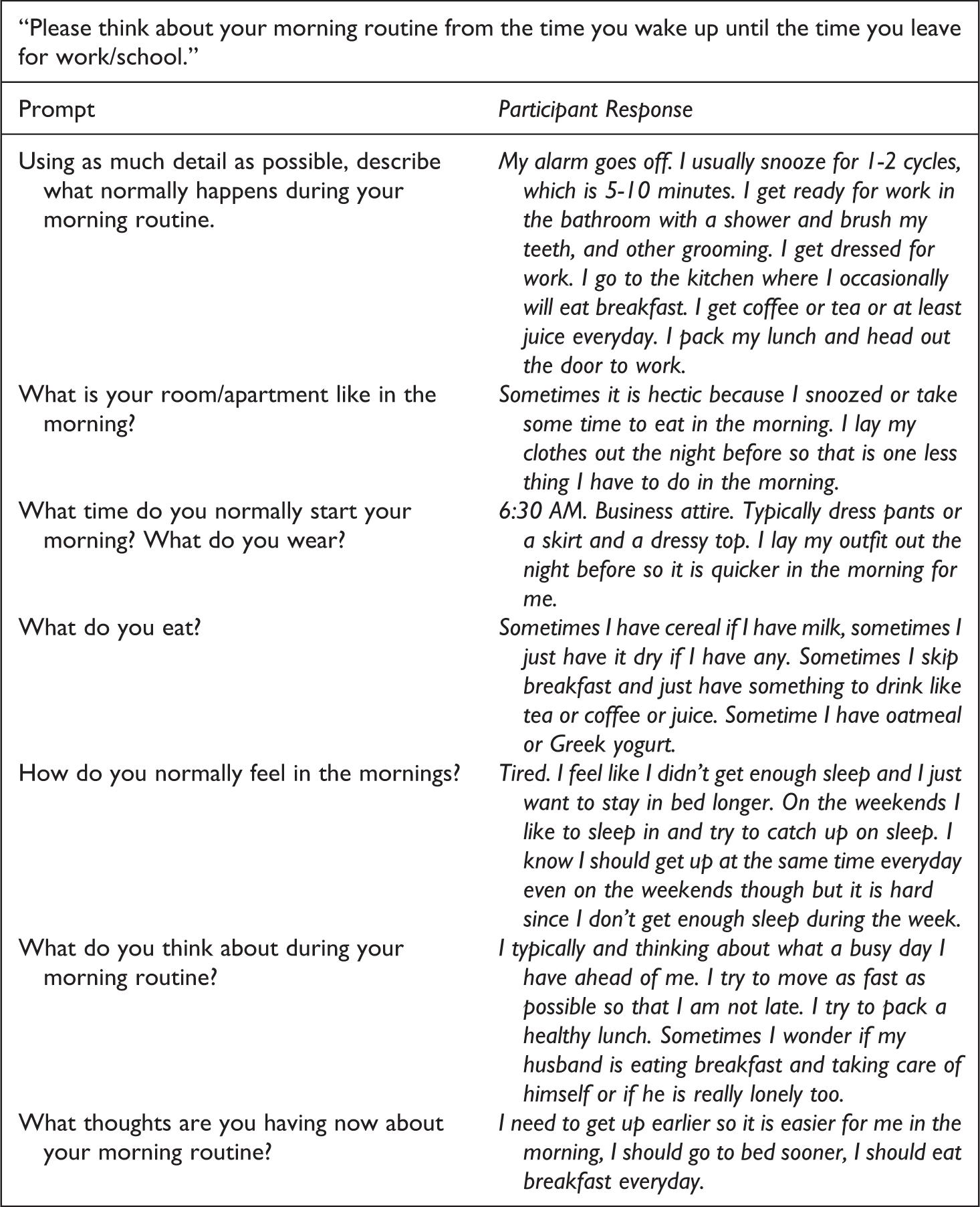
Sample response from the control condition. Participants were asked to think about the prompt and respond to the following questions.
In the personal savoring condition, participants were asked to focus on a personal positive experience they had, which could range from something relatively simple or mundane to something profound or deeply meaningful. Participants were asked to focus on a single memory or incident, spend 1 min reflecting on it, then answer a series of questions, which, among other things, prompted them to describe sensory aspects of the experience (e.g., What was the air like? What were you wearing?) and to describe how they were thinking or feeling. After writing answers to the questions, participants were asked to spend 2 min mentally replaying the experience (see Figure 1B for an example of a personal savoring response).
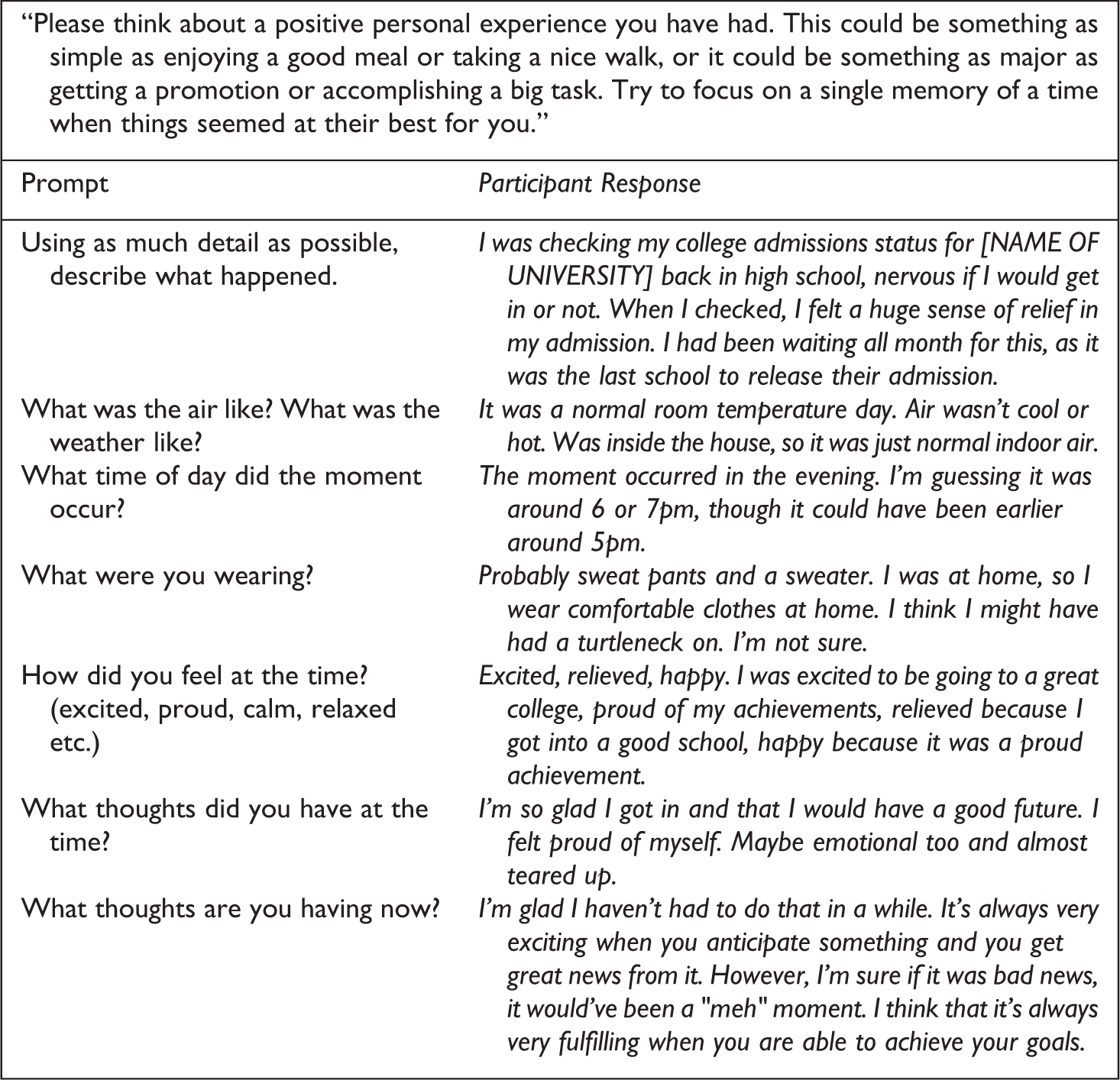
Sample response from the personal savoring condition. Participants were asked to think about the prompt and respond to the following questions. Other example topics include passing an important exam, spending time with friends, going to a favorite place, remembering a successful job interview, and overcoming a physical test.
In the relational savoring condition, participants were prompted to “think about a positive experience (they) had with (their) partner.” They were instructed to select any kind of experience, no matter how minor or major, when they felt especially “cherished, protected, or accepted” by their partner (Borelli et al., 2010, 2014), which was designed to evoke feelings of attachment security. Just as in the personal savoring condition, participants reported on the details of the event, as well as their thoughts and feelings, and then were asked to spend 2 min mentally reliving the event (see Figure 1C for an example of a relational savoring response).

Sample response from the relational savoring condition. Participants were asked to think about the prompt and respond to the following questions.
Relationship stressor
For the purpose of this study, after conducting focus group brainstorming sessions with adult members of LDRs, we developed a vignette presenting an ambiguous situation that our focus group members suggested could be interpreted as threatening the integrity of the relationship. Participants were asked to imagine that their partners were supposed to call them at a certain hour in the evening after they had returned home from a work function but had not yet called and it was 2 hr past the agreed upon time for the phone call. Immediately following the vignette, they answered a series of questions regarding their reactions to the hypothetical situation (e.g., What are the reason(s) why your partner has not called? How does this make you feel about your partner?), which were designed to help participants focus on their (presumably negative) emotional reaction to the scenario (see Figure 2 for a sample response to the vignette). Pilot testing, as well as the examination of transcripts from the actual test sample, suggested that the vignette evoked strong feelings (including threat) from a majority of participants.

Sample response to the relationship stressor. Participants were asked to imagine the vignette was happening to them and respond to the following questions.
Language analysis
In order to establish the validity of both our mental reflection tasks and our simulated relationship stressor, we conducted a linguistic analysis on the transcripts participants produced using the Linguistic Inquiry and Word Count (Pennebaker, Francis, & Booth, 2001). Specifically, to evaluate whether our mental reflection task conditions functioned as they were intended, we examined the frequency of first person plural (“we,” “us,” and “our”) and first person singular (“I,” “me,” and “my”) pronoun use based on the argument that greater first person plural and lower first person singular pronoun use suggests a greater relational focus (Borelli et al., 2014; Rohrbaugh, Mehl, Shoham, Reilly, & Ewy, 2008; Rohrbaugh, Shoham, Skoyen, Jensen, & Mehl, 2012). Further, we evaluated frequency of positive emotion (e.g., “love,” “sweet,” “joy”) based on the assumption that more frequent positive emotion word use would suggest a greater degree of positive emotion experienced during the mental reflection task.
In order to evaluate whether our relationship stressor task functioned as it was intended, we compared participants’ written responses to the post-stressor questions to their responses on the neutral control mental reflection task only. We analyzed frequency of negative emotion words, reasoning that if our stressor worked as intended, it would produce a higher frequency of negative emotion words (e.g., “worried,” “crying,” and “sad”) on the post-stressor questions as compared to the narratives participants produced in response to the neutral control task. We based our hypothesis on the assumption that greater negative emotion word use would signify more pronounced negative emotional experience in response to the task. Although we expected that the relationship stressor would increase negative emotion word use frequency relative to mental reflection task word usage among participants who had completed both the personal and relational savoring tasks as well, we believed this would provide us with less information about the relationship stressor itself than if we compared word use among participants completing the neutral control only.
Data analytic plan
Prior to evaluating our hypotheses, we first conducted validity checks to enhance our confidence that participants engaged in the mental reflection tasks in the way that we intended. We next evaluated the main effect of the experimental conditions on emotion following the mental reflection tasks. When evaluating the moderation, mediation, and moderated mediation hypotheses, we conducted hierarchical linear regressions using the PROCESS macro for SPSS (Hayes, 2012). When conducting tests of moderation and moderated mediation involving continuous moderator variables, to facilitate interpretation of the results, PROCESS automatically provides estimates of simple slopes at low (1 SD below the mean), medium (the mean), and high (1 SD above the mean) levels of the continuous moderator variable. Consistent with research recommendations (Hayes, 2009; Zhao, Lynch, & Chen, 2010), we assessed for the presence of indirect effects even when no direct effects were found.
Results
Table 1 reports mean and standard deviations for all the primary study variables for the sample as a whole and by condition. The mental reflection groups did not differ on any of the demographic or relationship-specific outcomes. 1 Male participants, Asian American participants, and participants having completed graduate education reported significantly lower baseline relationship satisfaction as compared to the rest of the sample, ps < .05. Baseline relationship satisfaction did not significantly differ from relationship satisfaction measured post-stressor, t = −.50, p = .61. Zero-order correlations revealed that participant age was negatively associated with baseline relationship satisfaction, that post-task positive and negative affect were inversely related, and that post-task emotion was associated with both baseline and post-stressor relationship satisfaction (see Table 2).
Mean values (standard deviations) of affect and relationship satisfaction variables by condition.
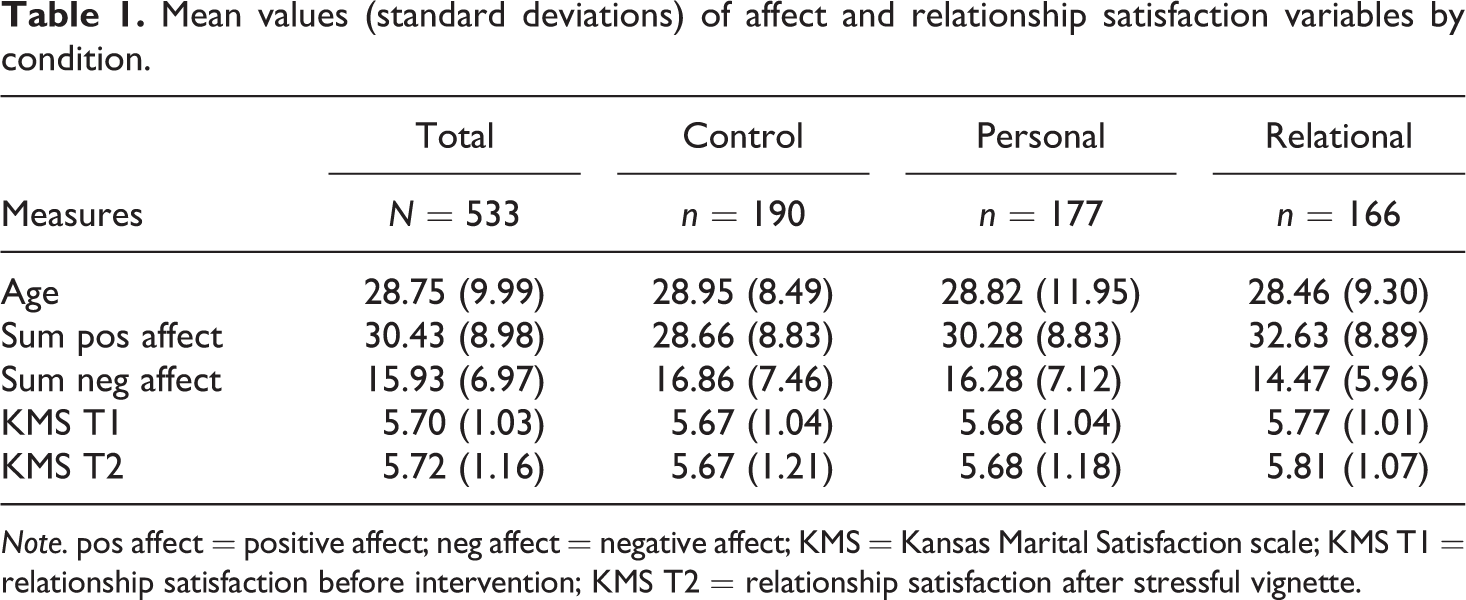
Note. pos affect = positive affect; neg affect = negative affect; KMS = Kansas Marital Satisfaction scale; KMS T1 = relationship satisfaction before intervention; KMS T2 = relationship satisfaction after stressful vignette.
Correlation matrix for key variables.
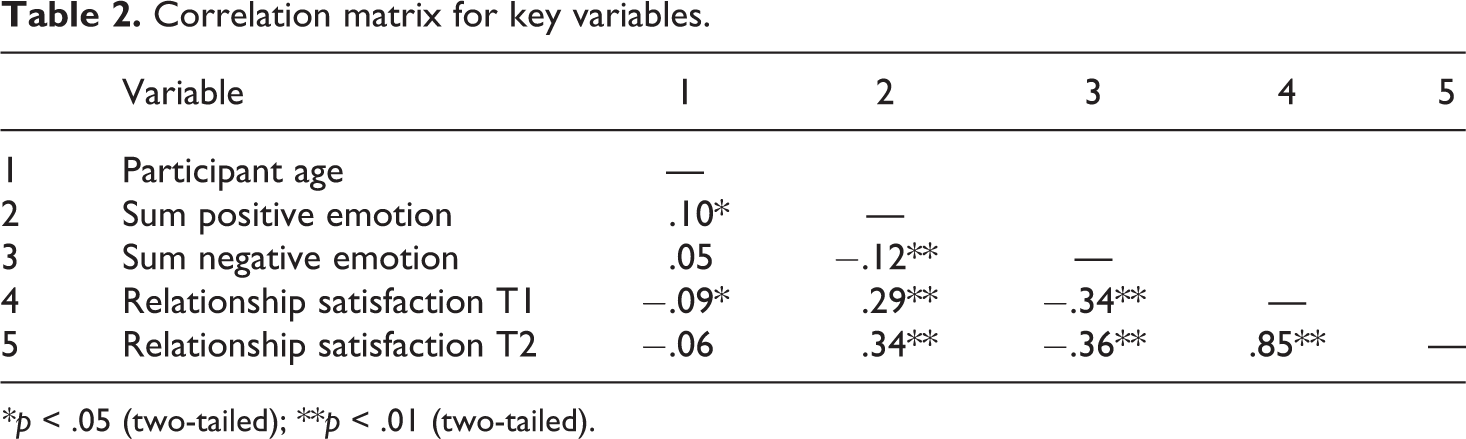
*p < .05 (two-tailed); **p < .01 (two-tailed).
Pre-hypothesis testing validity check one: Language use on mental reflection tasks
We were interested in examining whether language use on the written mental reflection tasks varied as a function of the experimental task condition. Using an analysis of covariance (ANCOVA), we found that after controlling for participant age, F(1, 530) = 1.03, p = .31, and sex, F(1, 530) = 0.24, p = .63, condition was associated with first person plural word use, F(1, 530) = 154.10, p = .000001, ήp 2 = .38. The results of least significant difference (LSD) post hoc tests revealed that the three conditions were all significantly different from one another—participants in the relational savoring condition used significantly more first person plural words than participants in either control condition and participants in the personal savoring condition used significantly more first person plural words than participants in the neutral control condition, all ps < .001. We witnessed the reverse pattern with respect to first person singular word use—after controlling for participant age, F(1, 530) = 4.40, p = .03, ήp 2 = .01, and sex, F(1, 530) = 13.39, p = .0001, ήp 2 = .03, condition was associated with first person singular word use, F(1, 530) = 92.78, p = .0001, ήp 2 = .27. LSD post hoc tests indicated that participants in the neutral control condition used significantly more first person singular words than participants in either savoring condition and that participants in the personal savoring condition used significantly more first person singular pronouns than participants in the relational savoring condition, ps < .0001. As expected, all three groups differed in pronoun use indicative of relational content, such that participants in the personal savoring condition used fewer relationally oriented pronouns than participants in the relational savoring condition but more than participants in the neutral control condition. Further, a global examination of the memories generated among participants in the personal savoring condition suggested that although many (56% of participants) mentioned their partner, none of the personal savoring memories were explicitly about emotional closeness in the romantic relationship.
Next we evaluated participants’ use of positive emotion words. After controlling for participant age, F(1, 530) = 0.06, p = .81, and sex, F(1, 530) = 0.44, p = .51, condition was associated with positive emotion word use, F(1, 530) = 98.72, p = .0001, ήp 2 = .28. LSD post hoc tests indicated that participants in the neutral control condition used significantly fewer positive emotion words than participants in either savoring condition, ps < .0001, but that positive emotion word use did not differ between the personal and relational savoring conditions, p = .49. Therefore, as expected, the two savoring conditions yielded comparable linguistic evidence of positive emotion and greater linguistic evidence of positive emotion compared to the neutral control condition.
Pre-hypothesis testing validity check two: Language use on relationship stressor
To test whether our relationship stressor task elicited negative emotion, we examined differences in negative emotion word use among participants in the neutral control condition only (n = 190). Using a paired samples t-test, we found that participants’ negative emotion word use increased significantly in response to the relationship stressor questions as compared to the control mental reflection task, t(189) = −10.54, p = .0001 (M mental reflection = 1.01, SD mental reflection =1.05; M stressor = 3.11, SD stressor = 3.05). The results confirmed our hypotheses that neutral control participants’ negative emotion word use was significantly higher in their written responses to the post-stressor questions relative to their responses collected during the mental reflection task.
Hypothesis testing
Controlling for participant age, F(1, 530) = 4.47, p = .04, and sex, F(1, 530) = 1.67, p = .20, condition was significantly associated with self-reported positive emotion, F(2, 530) = 9.11, p = .0001, ήp 2 = 0.03. LSD post hoc tests revealed that participants in the relational savoring condition reported more positive emotion immediately following the task as compared to both participants in the control, t(354) = 3.96, p = .0001, d = 0.45, and the personal savoring conditions, t(341) = 2.34, p = .01, d = 0.27. Older participant age and engaging in relational savoring predicted greater positive emotion (see Table 1 for means by experimental group).
We next conducted a univariate ANCOVA, with negative emotion as the dependent variable: controlling for participant age, F(1, 530) = 0.88, p = .35, and sex, F(1, 530) = 15.11, p = .0001, condition was significantly associated with negative emotion, F(2, 530) = 5.94, p = .001, ήp
2 = 0.02. The results of LSD post hoc tests revealed that participants in the relational savoring condition reported less negative emotion as compared to both participants in the control, t(354) = −2.39, p = .01, d = 0.35, and the personal savoring conditions, t(341) = −1.82, p = .03, d = 0.28.
After conducting our preliminary analyses, we observed that the relational savoring group differed from the two other conditions across all of the main outcomes, but the neutral control and the personal savoring conditions did not differ. Therefore, for the sake of simplicity, in the remainder of this paper we present all analyses examining differences between the relational savoring condition and the control conditions (neutral control plus personal savoring). 2
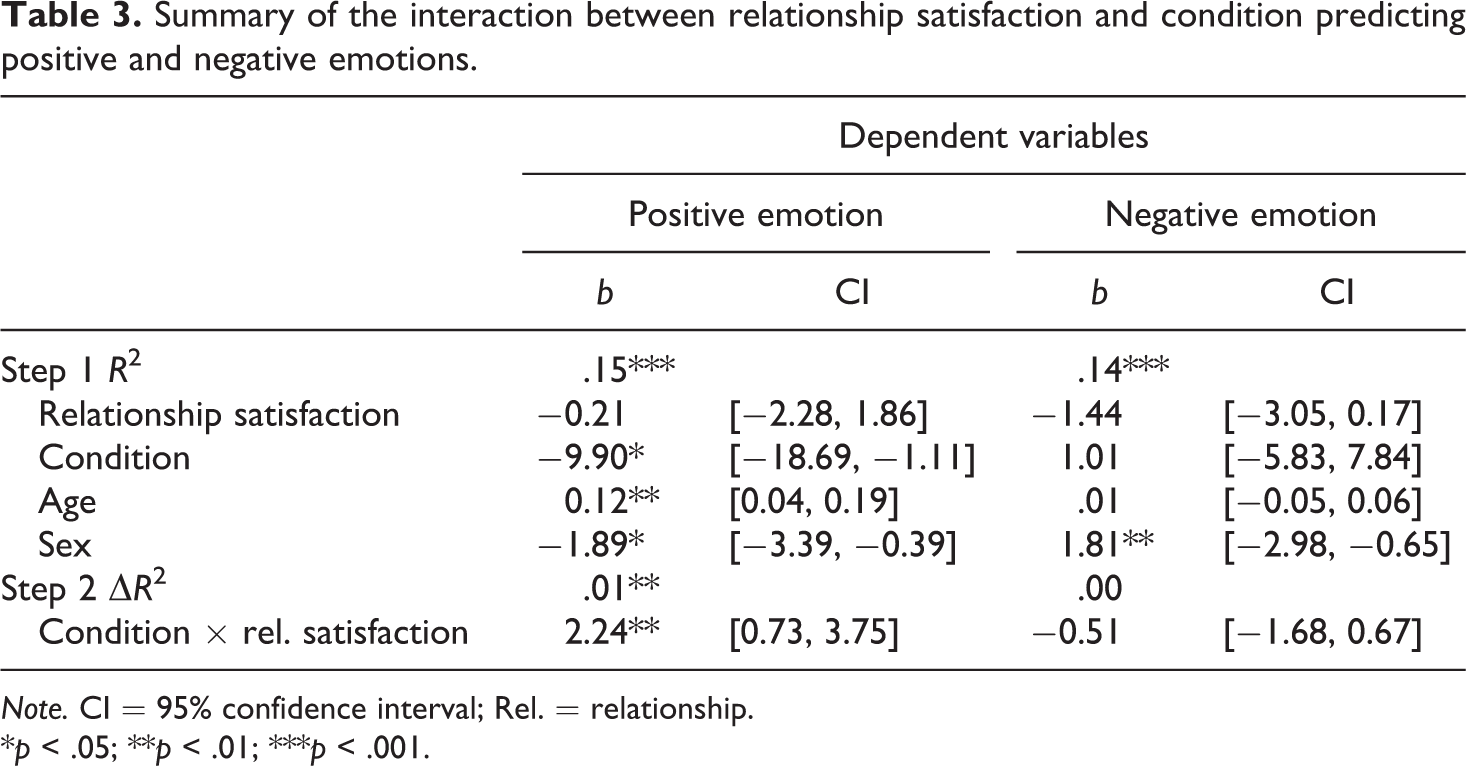
To test Hypothesis 2, we conducted a hierarchical linear regression 3 to evaluate whether baseline relationship satisfaction moderated the association between condition (relational savoring versus controls) and post-task positive and negative emotion. After controlling for covariates, the interaction between condition and baseline relationship satisfaction was significant (see Table 3). Conditional effects analyses revealed that for people reporting low levels of baseline relationship satisfaction (1 SD below the mean), the relational savoring condition did not have an effect on positive emotion relative to the control conditions (see Figure 3; low relationship satisfaction: b = .56, p = .62); however, for participants reporting medium and high levels of baseline relationship satisfaction (mean and 1 SD above the mean, respectively), relational savoring produced greater post-task positive emotion as compared to the control conditions (medium relationship satisfaction: b = 2.86, p = .0001, high relationship satisfaction: b = 5.17, p = .00001). Further, when we reversed the pairwise comparisons to treat the savoring condition as the moderator (and baseline relationship satisfaction as the focal predictor), we observed that baseline relationship satisfaction was associated with post-task positive emotion in both reflection task conditions but the relationship was stronger among participants in the relational savoring condition (control conditions: b = 2.02, p = .00001, relational savoring: b = 4.26, p = .000001).

Interaction between relationship satisfaction pre-task and condition (control: neutral and personal savoring; relational savoring) predicting positive emotion measured by the positive and negative affect schedule (PANAS) post-task. RS = relationship satisfaction.
Summary of the interaction between relationship satisfaction and condition predicting positive and negative emotions.
Note. CI = 95% confidence interval; Rel. = relationship.
*p < .05; **p < .01; ***p < .001.
When evaluating whether baseline relationship satisfaction moderated the association between condition and post-task negative emotion, we found that after controlling for covariates, the interaction between condition and baseline relationship satisfaction interaction was not significant (see Table 3). In other words, relational savoring reduced negative emotion for participants relative to the control conditions regardless of baseline relationship satisfaction.
We conducted a linear regression to test for statistical mediation.
4
Evaluating mediation involves assessing the indirect effect of the independent variable (X) on the dependent variable (Y) through the mediator M. PROCESS tests the significance of the indirect effect through bootstrapping. The indirect effect is calculated by multiplying the unstandardized regression coefficients resulting from X predicting M and from M predicting Y (Baron & Kenny, 1986). The point estimate and confidence interval (CI) are established through the use of bootstrapping: if the 95% CI does not include 0, this signifies that the point estimate is significant at the p < .05 level.
Table 4 presents results of hierarchical linear regressions testing the hypothesis that positive (upper half of Table 4) and negative (lower half) post-task emotion mediated the association between condition and post-stressor relationship satisfaction. After controlling for participant age and gender in a first step, relational savoring was associated with greater positive emotion. After controlling for participant age and gender, positive emotion was significantly associated with post-stressor relationship satisfaction. Next, we examined whether post-task positive emotion acted as an indirect effect in explaining the non-significant association between condition and post-stressor relationship satisfaction. We controlled for the same set of covariates included in previous analyses. The indirect effect in this pathway was significant, point estimate = 0.15; 95% CI [.07, .24], suggesting that positive emotion acted as an indirect-only mediator of the link between condition and post-stressor relationship satisfaction. In other words, after controlling for baseline relationship satisfaction, there was no direct effect between condition and post-stressor relationship satisfaction. However, positive emotion was an indirect effect in the non-significant association between condition and post-stressor relationship satisfaction.
Regressions examining post-task emotion as a mediator of the association between condition and relationship satisfaction.

Note. DV= dependent variable; M = mediator; CI = confidence interval. Boldface values highlight change in independent variable due to inclusion of the mediator in the model.
aIndirect effect in this pathway was significant, point estimate = .5; 95% CI [0.07, 0.24].
bIndirect effect in this pathway was significant, point estimate = .12; 95% CI [0.05, 0.21].
Similarly, after controlling for participant age and gender in a first step, relational savoring was associated with lower negative emotion. After controlling for participant age and gender, negative emotion was significantly associated with post-stressor relationship satisfaction. Next, we examined whether post-task negative emotion acted as an indirect effect in explaining the non-significant association between condition and post-stressor relationship satisfaction. We controlled for the same set of covariates included in previous analyses. The indirect effect in this pathway was significant, point estimate = 0.12; 95% CI [.05, .21], suggesting that negative emotion acted as an indirect-only mediator of the link between condition and post-stressor relationship satisfaction. Similar to the above finding, this finding can be interpreted to mean that when there is an association between condition and post-stressor relationship satisfaction, it is partially explained by post-reflection task negative emotion.
Our final goal was to examine the moderating and mediating processes in combination by assessing whether post-task emotion mediated the link between experimental condition and post-stressor relationship satisfaction to different degrees based on pre-task relationship satisfaction. We posited that pre-task relationship satisfaction would moderate the link between condition and post-task emotion, which in turn would mediate the link between condition and post-stressor relationship satisfaction (see Figure 4).

Visual depiction of the proposed moderated mediation: post-task emotion mediates the link between experimental condition and post-stressor relationship satisfaction to different degrees based on pre-task relationship satisfaction.
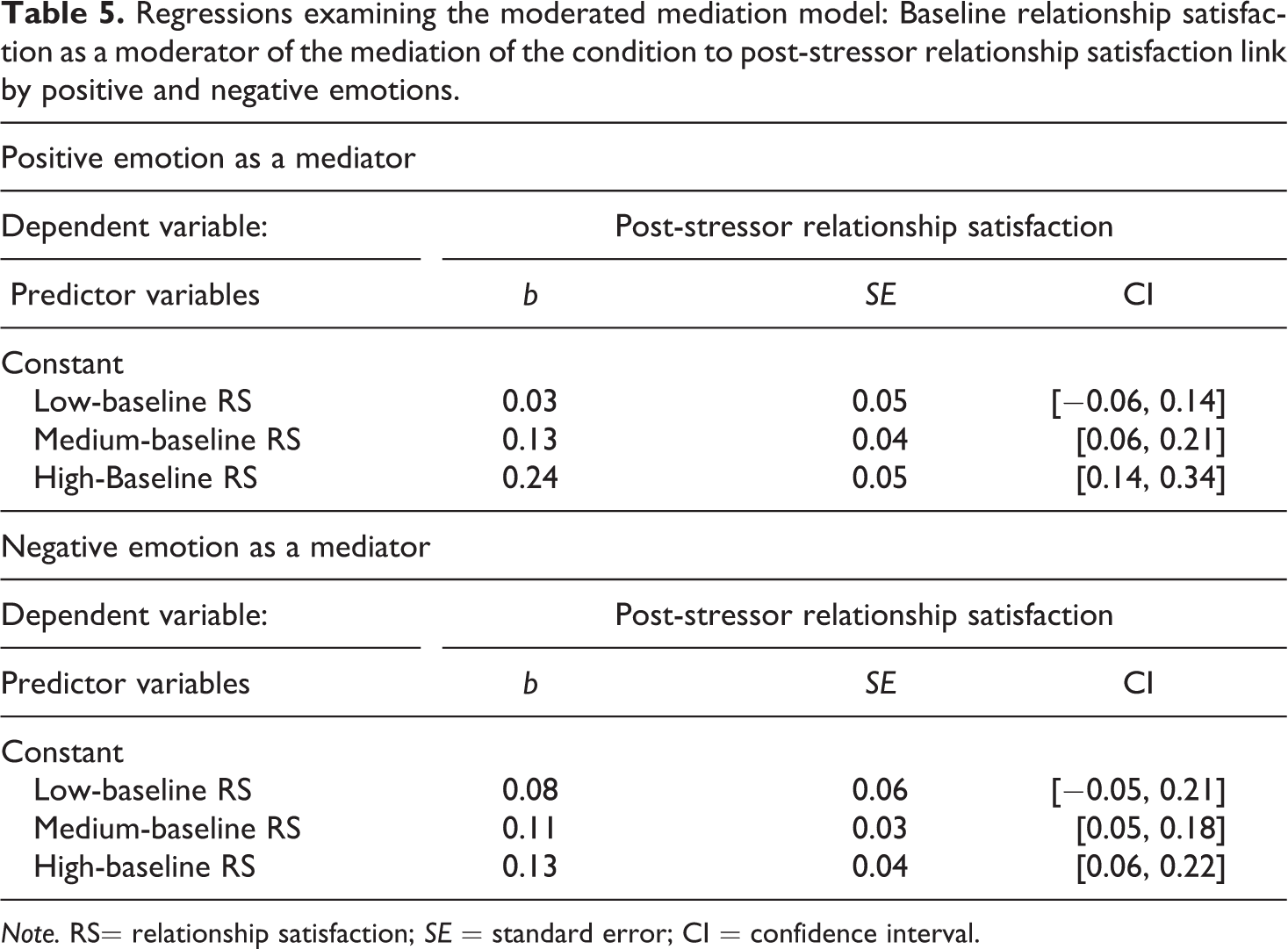
In the first linear regression model, 5 we examined positive emotion as the mediator and found that after controlling for participant age and sex, the degree to which experimental condition affects post-stressor relationship satisfaction indirectly through post-task positive emotion depends on pre-task relationship satisfaction. Table 5 displays the conditional indirect effects of experimental condition on post-stressor relationship satisfaction through positive emotion based on various levels of relationship satisfaction. For individuals reporting low levels of baseline relationship satisfaction, positive emotion did not explain the link between condition and post-stressor relationship satisfaction. Positive emotion acted as a mediator only among participants reporting medium and high levels of baseline relationship satisfaction. In other words, for those with medium and high levels of baseline relationship satisfaction, higher levels of post-reflection task positive emotion explained the link between the relational savoring condition assignment and post-stressor relationship satisfaction.
Regressions examining the moderated mediation model: Baseline relationship satisfaction as a moderator of the mediation of the condition to post-stressor relationship satisfaction link by positive and negative emotions.
Note. RS= relationship satisfaction; SE = standard error; CI = confidence interval.
In the second model, we examined negative emotion as the mediator: after controlling for participant age and sex, we found that the degree to which condition affects post-stressor relationship satisfaction indirectly through post-task negative emotion depends on pre-task relationship satisfaction. Table 5 displays the conditional indirect effects of experimental condition on post-stressor relationship satisfaction through negative emotion based on various levels of relationship satisfaction. Similar to the findings described earlier, negative emotion acted as an indirect effect only among participants reporting medium and high levels of baseline relationship satisfaction. In other words, for those with medium and high levels of baseline relationship satisfaction, lower levels of post-reflection task negative emotion explained the link between the relational savoring condition assignment and post-stressor relationship satisfaction. 6
Discussion
Given that LDRs are quite common (Bergen et al., 2007) and that studies reliably report a link between relationship satisfaction and health (Robles et al., 2014), understanding factors that promote satisfaction in LDRs is of primary importance to the field of relationship science. In line with recent work suggesting that brief theory-driven social psychological interventions can profoundly influence relational and individual well-being in an iterative way (Finkel et al., 2013; Layous et al., 2013; Lyubomirsky & Layous, 2013; Sin & Lyubomirsky, 2009), our study adapted a brief relational savoring task (Borelli et al., 2010, 2014) for administration over the internet among adult members of LDRs; as primary outcomes, we assessed emotional reactions and relationship satisfaction following a simulated relationship stressor.
Consistent with the study predictions, we found that assignment to the relational savoring condition (as opposed to either of the two control conditions) resulted in greater self-reported positive and lower negative emotion. Importantly, the observed effect sizes were small (ranging from .27 to .45). In future work, it will be important to evaluate the practical and long-term significance of these effects. Evidence suggests that increasing positive emotion, in particular, can have significant downstream effects on behavior (see Fredrickson, 2013, for a review), so it may be that a relatively small boost in positive emotion will fuel behaviors that in turn further enhance positive emotion. In future work, it also will be important to assess the impact of repeated engagement in relational savoring. It is possible that greater familiarity completing this mental exercise will result in greater yield (more positive emotion); alternatively, over time the intervention could lose its potency. In sum, although this study suggests small effects on participants’ emotion, further inquiry is required to appreciate the practical and long-term significance of relational savoring for this population.
Of note is that there were no significant differences in emotional states between participants assigned to complete the personal savoring task and the neutral control task. This pattern of findings is especially striking in light of the fact that our linguistic analysis revealed that participants in the two savoring conditions did not differ in the frequency of positive emotion words. When people naturalistically savor, they most often choose to savor relational memories (Bryant et al., 2005) and savoring memories not involving other people actually may be a difficult task for some adults. It is unknown whether the types of memories naturalistically savored by adults in LDRs differs from those savored by other adults (single people or GCR members), but it may be that for some adults in LDRs, savoring personal memories fails to enhance emotional state because these memories underscore the fact that they live apart from their romantic partners, which may evoke feelings of longing or being alone. Future research can examine this issue to determine whether, for people in an LDR, savoring personal memories yields no emotional benefit relative to a control task.
We also found that participants who began the study with medium and high levels of relationship satisfaction benefitted the most from the relational savoring in terms of their reports of positive emotion. Consistent with previous work finding that relational savoring improves emotional state for women low in avoidance but damages it for those high in avoidance (Borelli et al., 2014), our results suggest that relational savoring only works in terms of enhancing emotional states among individuals who begin the task feeling satisfied with their relationships. Importantly, unlike Borelli and colleagues’ (2014) previous work, we did not find that the relational savoring task resulted in negative outcomes for people with low relationship satisfaction (relative to completing the control mental reflection tasks). Therefore, we can conclude that completing a relational savoring task works in terms of generating more positive emotion in the short term for LDR members with medium to high baseline relationship satisfaction, suggesting that relational savoring may be an effective tool for preventing declines in relationship satisfaction. In future work, it will be important to develop and test interventions that improve mood and relationship satisfaction among LDR members with low relationship satisfaction, who are likely more in need of ways to boost their relationship morale. It may be that these people require more intensive intervention to achieve the same outcomes, or a different approach altogether.
With respect to negative emotion, however, baseline relationship satisfaction did not act as a statistically significant moderator. Whereas focusing on a positive relationship memory enhanced positive emotion only for people who entered the study relatively satisfied by their LDR, as compared to the control conditions, completing the relational savoring task decreased negative emotion regardless of pre-task satisfaction. Perhaps it is the case that reducing negative emotion is easier to accomplish with a brief intervention, but in order to enhance positive emotion with a relational savoring task, people must have sufficient access to positive relational memories, which presumably would be higher with greater relationship satisfaction.
We also found that when the relational savoring task buffered participants’ relationship satisfaction from simulated relationship stress, it did so through the improvements in emotional states following the mental reflection task. Further, this effect was moderated by baseline relationship satisfaction, such that post-reflection task emotion (positive and negative emotion) only explained post-stressor relationship satisfaction among adults who began the study with medium-to-high satisfaction with their LDRs. These findings are consistent with earlier work with married couples suggesting that the prevention of declines in relationship satisfaction as a result of a brief intervention can be explained by reductions in distress (Finkel et al., 2013). Although both variables were measured within a relatively short span of time (approximately 30 min from the start of the mental reflection task), these findings are encouraging in that they suggest that a relatively minor, albeit targeted intervention can protect relationship satisfaction in response to a simulated stressor. If we conceptualize relationship processes (both those that promote relationship function and dysfunction) as iterative, then brief, theoretically informed interventions have the potential to have repeating and cascading effects on relationship processes (Finkel et al., 2013). Similarly, even momentary experiences of positive emotion have the potential to lead to cognitions and behaviors that in turn inspire additional boosts in emotional state (Fredrickson & Joiner, 2002).
This study constitutes one of the first experimental examinations of relational savoring in general and the first conducted among LDR members. Our study improved upon previous work by including a large sample with sufficient statistical power to detect main and interactive effects of baseline characteristics. Further, unlike Borelli and colleagues’ (2014) initial work, this study included two control groups (personal savoring and neutral control). These contributions should be interpreted in light of the study’s limitations. In our view, the most significant limitation is the time period spanned by the assessments undertaken in this study: we assessed emotional state immediately following the savoring task and post-stressor relationship satisfaction approximately 15 min afterward. Thus, we are unable to speak to whether this impact has any long-lasting effects on relationship satisfaction. In fact, we did not observe a significant decline in relationship satisfaction from the baseline to the post-stressor assessment, which is not surprising given the relatively short time frame assessed, but this fact undoubtedly limits the variability that our models can explain. Building off of these initial findings, future researchers will be tasked with examining the duration of the observed effects, particularly in terms of whether or not they can protect against a decline in relationship satisfaction.
Second, the vignette task we used to simulate relationship-related stress was developed for the purposes of this study and, as such, does not have a history of extensive research validation. Our linguistic analyses suggest that the relationship stressor worked as intended in that participants in the neutral control condition used significantly more negative emotion words when responding to the post-stressor questions than when completing the neutral mental reflection task; however, we did not obtain data from participants that would speak directly to whether or not they found the simulated relationship stressor realistic or whether it caused a subjective decline in emotional state. This aspect of the study could be improved in future work.
Third, all of the data presented here were collected online; it would be advantageous to supplement these data with other types of assessments (e.g., non–self-report assessments such as behavior observation) as well as with brief interventions delivered in-person, which could help insure that the interventions function in the way they were intended. Fourth, in our work we focused exclusively on one member of an LDR dyad. Although important in laying the groundwork for the observed effects, it will be illuminating in future work to examine dyadic effects of relational savoring conducted individually with each member of a couple as well as conjointly. Finally, in future studies, it would be beneficial to evaluate the effects of relational savoring among GCR members. As it currently stands, we are unable to speak to the specificity of these effects on LDR members. It may be that relational savoring improves outcomes for adults in GCRs as well, or even for single or divorced adults.
Finally, although we speculate that relational savoring works by activating mental representations of attachment security, which in turn activates feelings of safety, we did not have a means to directly assess this in the context of this investigation. In future work, understanding the mechanisms by which relational savoring exerts its impacts on emotion and relationship satisfaction will be important for building both theoretical models of LDRs specifically and attachment representations in general.
Conclusions
Although the findings from this study should be viewed as preliminary until replicated, our intervention (relational savoring) appears to cause increases in positive emotion and decreases in negative emotion, as well as post-task relationship satisfaction following a simulated relationship stressor task. In addition, the positive effects on mood are greater in LDR members with medium-to-high baseline relationship satisfaction. Exploring the long-term impacts of this brief savoring intervention is promising and has the potential to contribute to a body of research demonstrating the potent effect of brief interventions (Finkel et al., 2013; Sin & Lyubomirsky, 2009).
Footnotes
Acknowledgments
The authors wish to thank the adults who participated in this project and research assistants in the Pomona CARE Lab for their help in collecting and processing the data.
Funding
This work was funded by American Psychoanalytic Association Fund for Research grant awarded to the first author.
Notes
References
Supplementary Material
Please find the following supplemental material available below.
For Open Access articles published under a Creative Commons License, all supplemental material carries the same license as the article it is associated with.
For non-Open Access articles published, all supplemental material carries a non-exclusive license, and permission requests for re-use of supplemental material or any part of supplemental material shall be sent directly to the copyright owner as specified in the copyright notice associated with the article.
