



Abstract
A growing body of literature suggests that individuals respond more positively when outperformed by their partner (an upward comparison) than when they outperform the partner (a downward comparison). However, these findings may not apply to individuals high in attachment avoidance due to their negative working models of others. In two studies, we investigated whether feelings of closeness following social comparisons to the romantic partner are moderated by attachment avoidance. Participants were asked to recall (Study 1) and imagine (Study 2) comparisons. Avoidant participants felt closer to their partners following a downward comparison relative to an upward comparison. These studies suggest that for avoidant individuals, outperforming their partners is more beneficial for the relationship than being outperformed by their partners.
Although winning an Oscar for Best Actress may be a blessing for the career of any actress, it may be a curse for her love life (Stuart, Moon, & Casciaro, 2011). Since the awards were first introduced in 1929, Academy Award winning actresses have frequently experienced what the popular press has dubbed the “Oscar Love Curse” (Bielski, 2011; Chaney, 2011; Landers, 2012), the dissolution of their relationships soon after they have won the coveted prize. In many instances, the award winner’s partner was also involved in the movie industry (e.g., as actors, directors, set designers, etc.) and was less successful. Could it be the case that the partner’s sense of inferiority contributed to the dissolution of these relationships?
Past research suggests that after comparisons with more successful others (upward comparisons), individuals feel worse about themselves and view their own accomplishments to be inferior (for reviews, see Collins, 1996; Wood, 1989). They may respond to this upsetting situation by distancing themselves from the superior other (Pleban & Tesser, 1981). Superior others can be particularly distressing when the comparison domain is self-relevant and the superior other is “psychologically close” (Tesser, 1988). That is, it is more distressing for individuals to be outperformed in domains they care about by friends, colleagues, or family members than by acquaintances or strangers. Indeed individuals may prefer to be in the company of less successful others (Wills, 1981) who can remind individuals of their superiority (Taylor & Lobel, 1989; Wood, Michela, & Giordano, 2000).
A growing body of research, however, suggests that when social comparisons involve the romantic partner, individuals feel more positive affect when the partner is superior than inferior to the self, even if the comparison domain is self-relevant (Pinkus, Lockwood, Marshall, & Yoon, 2012; Pinkus, Lockwood, Schimmack, & Fournier, 2008; Scinta & Gable, 2005). When individuals incorporate their partner into their own identity (Aron & Aron, 1986; Aron, Aron, Tudor, & Nelson, 1991), they may take on their partner’s perspectives and characteristics, which may in turn increase empathetic responses and the likelihood that individuals will see a partner’s successes and failures as their own. Indeed the extended self-evaluation maintenance model (Beach & Tesser, 1995) posits that the negative impact of upward social comparisons may be attenuated in romantic relationships because individuals empathize with their partner. In addition, individuals may respond more positively to upward than downward comparisons to their partner because they share in the partner’s fate: That is, they may reap the benefits of a partner’s success and share in the losses incurred by a partner’s failure (Pinkus et al., 2008; 2012). Consistent with this possibility, a number of studies suggest that individuals do respond more positively to upward than downward comparisons involving the partner (Pinkus et al., 2008; 2012; Scinta & Gable, 2005).
It is not clear, however, that all individuals will take pleasure and pride in a partner’s success. Specifically, individuals high in attachment avoidance (avoidant individuals) may be less likely to experience empathetic responses to self-partner comparisons. Avoidant individuals are those who are characterized by chronic discomfort with closeness and intimacy, a tendency to be self-reliant, and negative views of others because they have had past experiences with an attachment figure who was unavailable or rejecting (for review, see Mikulincer & Shaver, 2007). That is, the attachment figure may have rejected or punished these individuals when they attempted to seek proximity under distress. Consequently, avoidant individuals have learned that closeness can be dangerous and that they should avoid relying on others. Furthermore, they tend to hold negative mental representations (i.e., negative working models of others; Bowlby, 1969/1982; Collins & Read, 1990) in order to maintain interpersonal distance from others (for review, see Edelstein & Shaver, 2004).
These characteristics make it unlikely that avoidant individuals will respond positively to upward comparisons to a romantic partner. Their discomfort with closeness makes it less likely that they will see their partner as a valued part of their identity. Consequently, they are less likely to take on their partner’s perspective and see their partner’s successes and failures as their own. Indeed past research has shown that empathy is inhibited by attachment avoidance (Mikulincer et al., 2001). Avoidant individuals’ tendency to avoid intimacy may also lead them to contrast themselves from their partner following an upward comparison (Gabriel, Carvallo, Dean, Tippin, & Renaud, 2005), resulting in more negative responses to a superior partner. Indeed recent research has shown that individuals who contrast their less successful performance to that of their superior partner were more likely to engage in self-protective strategies, such as distancing themselves from their partner (Pinkus, Lockwood, Marshall, et al., 2012). Furthermore, their difficulties relying on others (Bartholomew & Horowitz, 1991; Collins & Read, 1990) and strong preference for self-reliance (Mikulincer & Shaver, 2007) make it improbable that they would see their fate as being tied to their partner. Thus, they may be unlikely to perceive themselves as sharing in their partner’s positive outcomes or suffering some of the costs associated with their partner’s poor performance. Finally, given their negative views of others, including their partner, avoidant individuals may react negatively to an upward comparison; a superior partner would be inconsistent with their negative working model of others, thus violating their expectations. In fact, past research has shown that avoidant individuals are less tolerant of, and may even be threatened by, new information that contradicts existing beliefs about their romantic partner (Mikulincer & Arad, 1999).
Indeed Scinta and Gable (2005) have shown that attachment avoidance does influence how individuals respond to comparisons to their romantic partner. Specifically, they found that individuals lower in attachment avoidance (less avoidant individuals) reported more positive affect after they imagined being outperformed by their romantic partner than by their friends/acquaintances. In contrast, avoidant individuals responded similarly to these imagined comparisons, regardless of whether the comparison involved partners or friends/acquaintances. This research provides important evidence that attachment style does play a key role in determining affective responses to social comparisons to romantic partners. Because this research involved reactions to imagined comparisons, however, it is unclear whether individuals will respond similarly to situations involving actual comparisons to the partner. Avoidant individuals might expect to be distressed by an upward comparison to the partner but, in an actual comparison situation, might nevertheless derive pleasure from their association with a successful partner. In addition, these studies focused on affective responses to comparisons. It remains unclear what the implications of such comparisons might be for the relationship more generally. For example, avoidant individuals may feel more positive affect after outperforming their partner, but it is unclear whether they would draw closer to the partner, secure in their own superiority, or whether they might actually withdraw, viewing the partner as less worthy of their affection.
In the present research, we examined the role of attachment avoidance in determining reactions to both real and imagined comparisons and focused on the impact of these comparisons on a key relationship variable: closeness. Although a handful of studies (Lockwood, Dolderman, Sadler, & Gerchak, 2004; Pinkus et al., 2008, study 3; Ratliff & Oishi, 2013, study 5) have examined how comparisons influence variables such as relationship satisfaction and partner evaluations, research has not yet examined how comparisons to a partner might interact with attachment style to influence closeness within the relationship. Past research suggests that social comparisons even between friends or acquaintances have significant implications for closeness. In his self-evaluation maintenance model, Tesser (1988) argues that individuals may minimize potential threats posed by upward comparisons by distancing the self from the superior other. By decreasing closeness, one can avoid further distressing comparisons. Indeed avoidant individuals may be especially likely to employ this strategy: Because of their past experiences with an unavailable and/or rejecting attachment figure, avoidant individuals have learned that seeking closeness under distress is futile and that a better strategy is to distance themselves from the threat (Ein-Dor, Mikulincer, & Shaver, 2011). In an upward comparison, their partner is the threat; accordingly, avoidant individuals may be especially likely to distance themselves from the partner following such a comparison.
In contrast, avoidant individuals may prefer downward comparisons, which are more consistent with their negative working model of others. Furthermore, these negative views of others may also affect their metaperspectives (i.e., how they believe others view them). Because avoidant individuals view others negatively, they may believe that others are unable to recognize their strengths and do not value them to the degree that they deserve. Indeed, Mikulincer (1995) found that when avoidant individuals were asked to rate how they viewed themselves and how significant others (i.e., mother, father, and friend) viewed them, these individuals’ ratings indicated that they believed that others perceived them more negatively than they perceived themselves. Thus, downward comparisons may also provide avoidant individuals with the opportunity to demonstrate their superiority to others and the chance for others to recognize their value. In one study, for example, when avoidant individuals were led to believe that their partner perceived them to be superior, they felt more confident in their partner’s love and acceptance relative to those in a control condition (Derrick & Murray, 2007). Thus, avoidant individuals may feel more comfortable approaching their partner following a downward comparison because their confidence in their partner’s love and acceptance may quell their concerns about rejection (Murray, Holmes, & Collins, 2006), which in turn may result in more positive relationship outcomes such as more favorable views of their partners (Derrick & Murray, 2007).
In two studies, we examined the role of attachment avoidance in determining individuals’ responses to intrarelationship comparisons. In Study 1, we examined their reactions after they recalled a comparison from their own daily lives. In Study 2, we attempted to replicate the findings of Study 1 using imagined comparisons. In both studies, we predicted that individuals higher in attachment avoidance would feel less close to their partner after making an upward comparison than a downward comparison.
Study 1
In Study 1, participants were asked to describe a time when their partner outperformed them (upward comparison) or when they outperformed their partner (downward comparison) and then rate their own perceived closeness. We predicted that more avoidant participants would report less closeness to their partner, and this would be especially true after an upward comparison relative to a downward comparison. Following the recommendation of Fraley, Heffernan, Vicary, and Brumbaugh (2011), we controlled for the effect of attachment anxiety in both studies to ensure that the effects were uniquely due to attachment avoidance and not attachment insecurity in general.
Method
Participants
Sixty-six undergraduate introductory psychology students at a large Canadian university were recruited by phone if they indicated in a prescreening questionnaire that they were in an exclusive romantic relationship. They participated in exchange for course credit. Six participants were excluded from the study: One participant determined the purpose of the study before the end of the study, three participants recalled comparisons in the wrong direction, one participant was more than 3.36 SDs above the mean on attachment anxiety, and one participant was more than 3.33 SDs below the mean on our key dependent variable, closeness. (We note that results remained significant, except where noted, when these outliers were included.) Thus, 60 participants were retained in the final analyses.
Participants were 41 females and 19 males (M age = 18.65, SD = 1.36) in a romantic relationship (M relationship length = 16.58 months, SD = 15.70, range = 1–82 months). All participants were involved in a heterosexual relationship. Fifty-eight participants described their relationship status as dating, one as cohabiting, and one as married. Twenty-two participants described their ethnic group as Caucasian, 22 as East Asian, 5 as South Asian, 5 as multiracial, 2 as Arab, 1 as Filipino, 1 as Latin American, 1 as Black, and 1 as West Asian. There were no gender effects in our primary analyses, all ts < 1.64, ps > .10; therefore, gender is not discussed further.
Procedure
Participants were invited to participate in a study investigating thoughts and feelings in relationships. Upon arrival at the laboratory, participants received a pretest measure of attachment, the Experiences in Close Relationship-Revised (ECR-R; Fraley, Waller, & Brennan, 2000). This scale includes 18 items measuring attachment avoidance (e.g., “I prefer not to show a partner how I feel deep down”; α = .90) and 18 items measuring attachment anxiety (e.g., “I worry a lot about my relationships”; α = .87), which were rated on a 7-point scale with endpoints labeled 1 (strongly disagree) and 7 (strongly agree). Participants were then randomly assigned to recall either a time when their partner outperformed them (upward comparison condition) or a time when they outperformed their partner (downward comparison condition; Pinkus et al., 2012, study 3) in a domain important to both of them: Please recall an incident in the past 2–6 months when you were outperformed by [you outperformed] your partner in any domain that you both care about (e.g., academic, financial, social). That is, think about a time when your partner was [you were] more successful than you [your partner] in a domain that is important to both of you.
Participants then completed a 4-item measure tapping how close they felt to their partner (e.g., “I am closer to my partner than any other person in my life”; Murray et al., 2005; α = .85). Ratings were made using a 9-point scale ranging from 1 (Not at all true) to 9 (Completely true).
Results
Analytic strategy
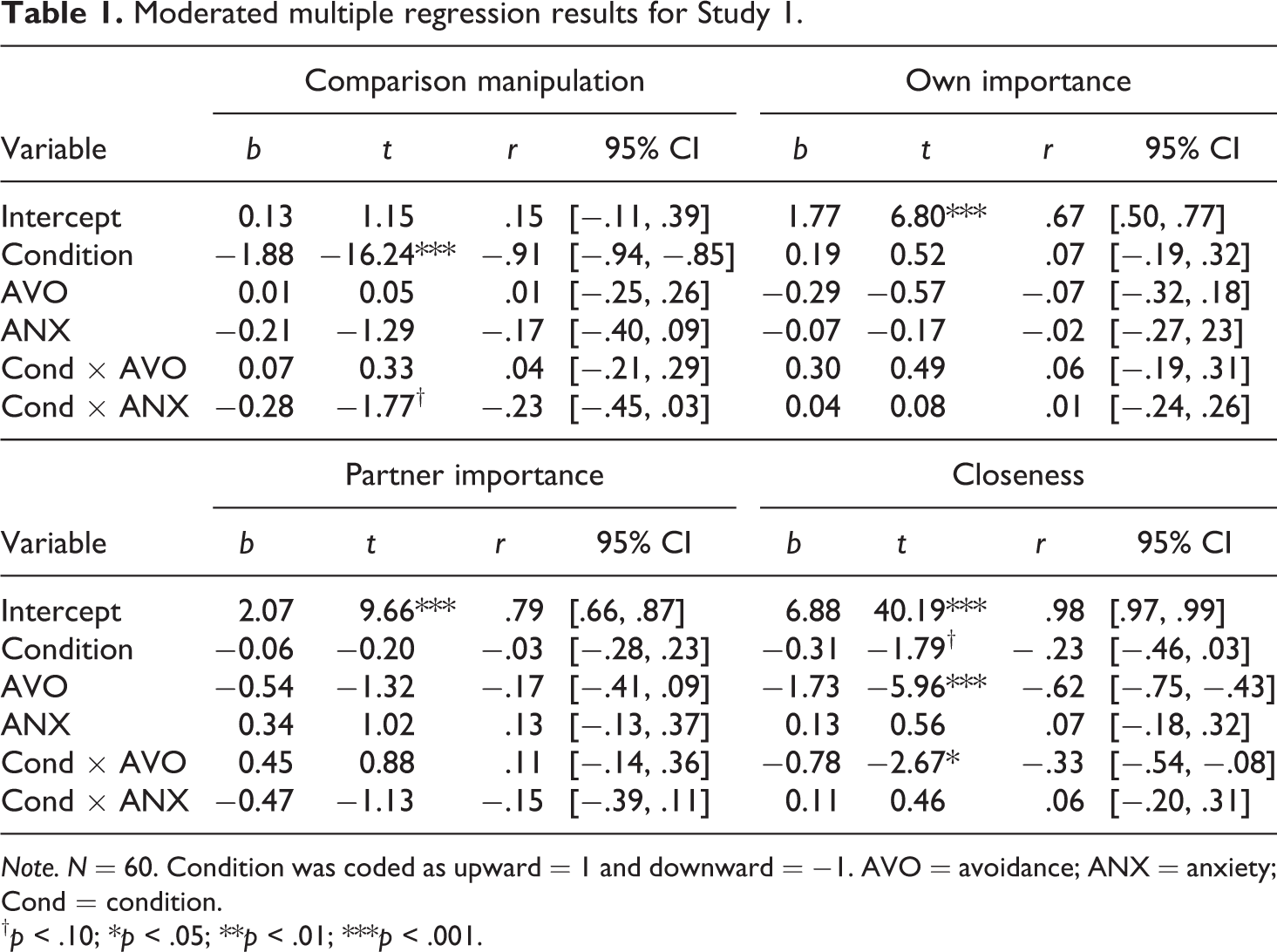
For all the analyses across both studies (unless otherwise noted), we conducted moderated multiple regressions with comparison condition entered as an effects-coded variable (−1 = downward and 1 = upward), attachment avoidance entered as a centered continuous variable, and the comparison condition by attachment avoidance interaction. To control for the effect of attachment anxiety, we followed the recommendations outlined by Yzerbyt, Muller, and Judd (2004) by entering attachment anxiety as a centered continuous variable and the comparison condition by attachment anxiety interaction to ensure that the estimated model was not biased. The results of the analyses for Study 1 are presented in Table 1.
Moderated multiple regression results for Study 1.
Note. N = 60. Condition was coded as upward = 1 and downward = −1. AVO = avoidance; ANX = anxiety; Cond = condition.
† p < .10; *p < .05; **p < .01; ***p < .001.
Comparison manipulation
Participants reported that they performed worse in the upward condition (M = −1.74, SE = 0.16) and performed better in the downward condition (M = 2.01, SE = 0.16), indicating that the comparison manipulation was successful (see Table 1 for parameter estimates).
We then tested whether participants recalled comparisons that were important to both themselves and their partner across comparison conditions and all levels of attachment avoidance. We also confirmed that domain importance did not differ across comparison condition or level of attachment avoidance. To account for the correlation between ratings of participants’ importance and perceived partner’s importance (r = .45, p < .001), we conducted a multivariate regression where importance ratings were regressed simultaneously on comparison condition, attachment avoidance, and their interaction while controlling for attachment anxiety and the comparison condition by anxiety interaction. The result of the multivariate test revealed that importance ratings were not predicted by comparison condition, attachment avoidance, attachment anxiety, or the interactions, Fs < 0.85, ps > .43 (see Table 1 for parameter estimates). Thus, participants recalled comparisons in domains that were similar in importance, regardless of their attachment style or the direction of the comparison. The comparisons participants recalled were in domains important to their partners and themselves in both the upward (M partner = 2.13, SD = 1.33; M participant = 1.80, SD = 1.52) and downward (M partner = 2.00, SD = 0.87; M participant = 1.97, SD = 1.16) conditions. 1
Closeness
There was a significant main effect of avoidance, such that greater avoidance was associated with less closeness. There was also a marginally significant main effect of comparison condition, such that participants tended to feel less close to their partner following an upward comparison than a downward comparison. These main effects, however, were qualified by the predicted attachment avoidance by comparison condition interaction (see Table 1 for parameter estimates). 2
Using the procedure outlined by Aiken and West (1991), we then conducted simple effects analyses to examine the difference between comparison conditions at 1 SD above and below the mean of attachment avoidance while controlling for attachment anxiety and the comparison condition by anxiety interaction. For those lower in attachment avoidance, there was no effect of comparison condition, b = −0.53, SE = 0.53, t(54) = −0.99, p = .33, r = −.13, 95% CI [−.37, .13]. For those higher in attachment avoidance, however, making an upward comparison was associated with significantly less closeness than making a downward comparison, b = −1.75, SE = 0.56, t(54) = −3.10, p = .003, r = −.38, 95% CI [−.58, −.14] (see Figure 1).
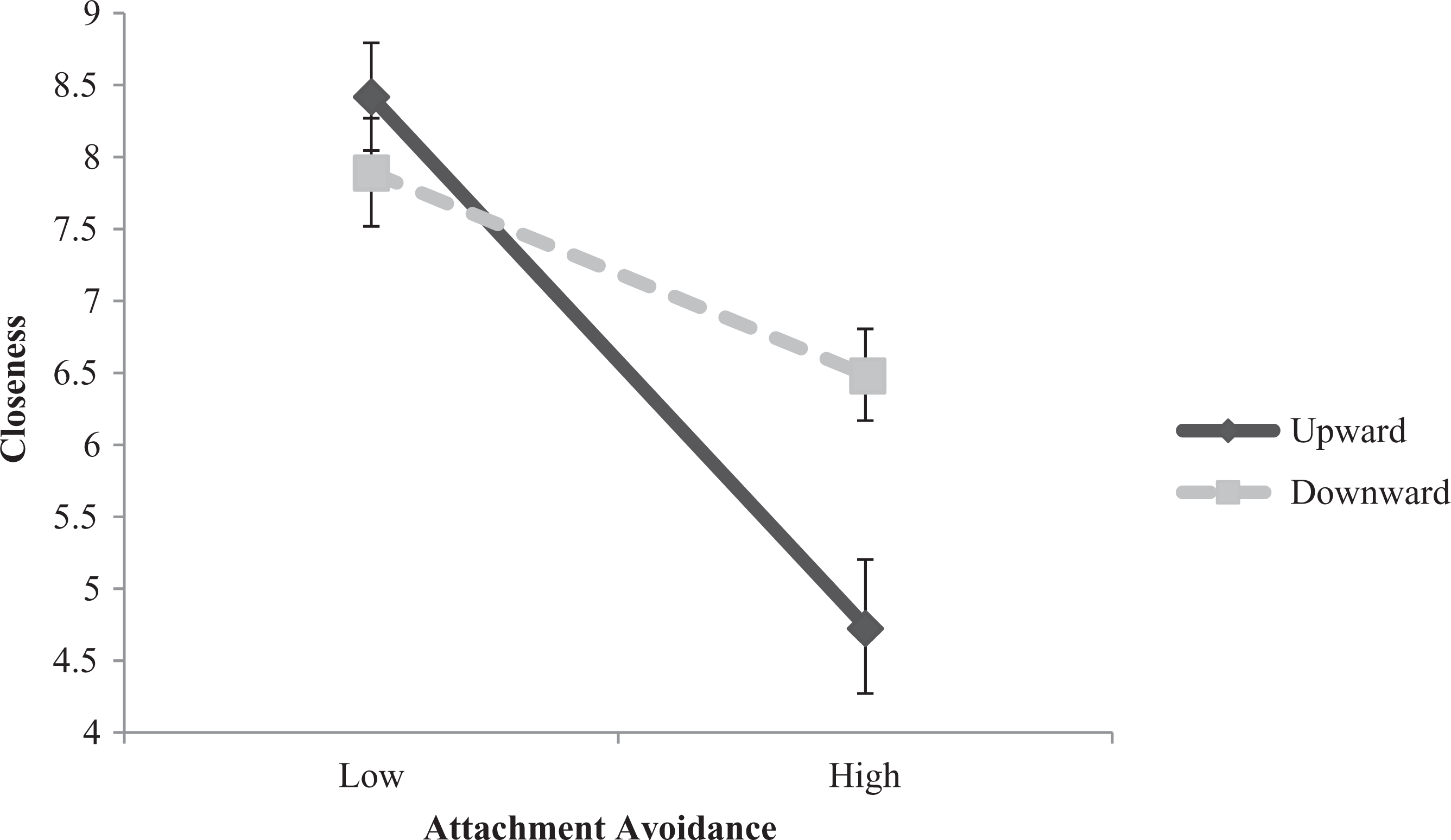
The relationship between attachment avoidance and closeness for the upward and downward conditions while controlling for attachment anxiety using predicted values for participants ±1 SD from the mean in avoidance (Study 1). Error bars represent standard errors.
We also examined the association between attachment avoidance and closeness for each comparison condition. For participants who made an upward comparison, b = −2.51, SE = 0.47, t(54) = −5.34, p < .001, r = −.57, 95% CI [−.72, −.37], and for participants who made a downward comparison, b = −0.96, SE = 0.34, t(54) = −2.79, p = .007, r = −.34, 95% CI [−.55, −.10], greater avoidance predicted less closeness.
Discussion
Study 1 provides evidence that individuals’ level of attachment avoidance does influence how close they feel to their partner following a social comparison. Individuals high in attachment avoidance were more likely to report feeling less close to their partner after thinking about an instance when their partner performed better than them relative to an instance when they outperformed their partner. In contrast, participants low in attachment avoidance felt similarly close to their partner regardless of whether they recalled the partner doing better or worse than them.
Although Study 1 provides initial evidence for the influence of attachment avoidance in response to social comparisons between romantic partners, participants in this study recalled comparisons they had made in the past. This manipulation allowed us to assess the impact of actual comparisons that individuals had encountered in their daily lives. Nevertheless, it is possible that attachment avoidance may have influenced the kinds of comparisons participants recalled. For example, individuals high in avoidance may have recalled upward comparisons in which the partner was especially superior. Consequently, in a second study, we provided a hypothetical comparison scenario to ensure that all participants were thinking about the same kind of comparison. In addition, we included a control condition to determine whether upward comparisons make avoidant individuals feel less close, downward comparisons make avoidant individuals feel closer, or some combination of these two responses.
Study 2
In Study 2, we assessed whether attachment avoidance would moderate the impact of imagined academic comparisons on closeness. As in Study 1, we predicted that, following an upward comparison, higher avoidance would be more strongly associated with less closeness relative to the no comparison control and downward comparison conditions. We also predicted that, following a downward comparison, higher avoidance would be associated with increased closeness relative to the no comparison control condition.
Method
Participants
Sixty-six undergraduate introductory psychology students at a large Canadian university were recruited by phone if they indicated in a prescreening questionnaire that they were in an exclusive romantic relationship. They participated in exchange for course credit. Five participants were excluded from the study: Four participants expressed suspicion about the study and one participant was a multivariate outlier on our primary analysis. Thus, 46 females and 15 males (M age = 20.46, SD = 8.46) were retained in our final analyses. Participants were involved in their current relationship for at least 5 months (M = 23.54, SD = 18.40, range = 5–84 months). One participant was involved in a homosexual relationship and 60 participants were involved in heterosexual relationships. Fifty-three participants described their relationship status as dating, one as engaged, four as cohabiting, and three as married. Twenty-three participants described their ethnic group as Caucasian, 17 as East or Southeast Asian, 10 as South Asian, 3 as Latin, Central, or South American, 2 as Middle Eastern, 1 as African, 1 as Caribbean, and 4 as other.
Procedure
Participants were invited to participate in a study investigating thoughts and feelings in relationships. Upon arrival at the laboratory, participants received a pretest measure of attachment, the Relationship Questionnaire (RQ; Bartholomew & Horowitz, 1991). This measure includes four short paragraphs that describe a prototypical attachment profile (e.g., “I am comfortable without close emotional relationships. It is important to me to feel independent and self-sufficient, and I prefer not to depend on others or have others depends on me”). Participants were asked to rate how well each profile described them on a 7-point scale with end points labeled 1 (not at all like me) and 7 (very much like me), and a midpoint labeled 4 (somewhat like me). We calculated avoidance and anxiety scores for each participant based on the procedure outlined by Griffin and Bartholomew (1994). For the avoidance measure, we summed participants’ responses to the fearful and dismissing descriptions and then subtracted the sum of the responses to the secure and preoccupied descriptions (i.e., [fearful + dismissing] − [secure + preoccupied]). For the anxiety measure, we summed participants’ responses to the fearful and preoccupied descriptions and then subtracted the sum of the responses to the secure and dismissing descriptions (i.e., [fearful + preoccupied] − [secure + dismissing]). Research has demonstrated that the avoidance and anxiety dimensions calculated using the RQ do assess the same dimensions as the ECR-R, and the RQ is an appropriate alternative to the ECR-R when investigating the impact of models of relationships on relationship outcomes (Sibley, Fischer, & Liu, 2005).
Participants were then randomly assigned to imagine either a scenario where their partner outperformed them on a test (upward comparison condition) or a scenario where they outperformed their partner on the test (downward comparison condition). Participants were given the following instructions: Imagine that you and your romantic partner are both in the same psychology course at [the same university]. You have recently written the midterm exam, which you both studied hard for. During your next lecture, the professor mentions that she will post the grades after class outside of her office. At the end of the class, both you and your romantic partner walk over to the professor’s office together to see how you did on the midterm. You scan the list together looking for your grades. Your grade comes up first and you both see that you got a B on the exam. You keep scanning until you find your partner’s grade and you both see that he/she got an A [a C] on the exam.
Results
Comparison manipulation
As Table 2 illustrates, participants reported performing worse than their partner in the upward condition (M = −1.74, SE = 0.18) and performing better than their partner in the downward condition (M = 1.54, SE = 0.17), indicating that the comparison manipulation was successful. Unexpectedly, there was also a main effect of anxiety: Participants higher in anxiety reported performing better than their partners than those lower in anxiety.
Moderated multiple regression results for Study 2 manipulation checks.

Note. N = 40. Condition was coded as −1 = downward and 1 = upward. AVO = avoidance; ANX = anxiety; Cond = condition.
† p < .10; * p < .05; **p < .01; ***p < .001.
We then tested whether domain importance differed across comparison condition or level of attachment by conducting two moderated multiple regression analyses because participant and perceived partner ratings of importance were not correlated (r = −.04, p = .83). Participants rated the academic domain to be important for themselves and their partner in both the upward (M participant = 1.26, SD = 1.05; M partner = 1.74, SD = 1.05) and downward (M participant = 1.90, SD = 0.77; M partner = 1.09, SD = 1.30) conditions. For participants’ own importance ratings, there was a main effect of comparison condition: Participants in the upward condition rated the domain to be less important than did participants in the downward condition. No other effects were significant. For partner’s perceived importance ratings, there were no significant main effects or interactions.
Closeness
To test whether attachment avoidance interacted with comparison condition in predicting closeness, we conducted a moderated multiple regression analysis with comparison condition entered as two effects-coded variables (1 = upward, 0 = downward, −1 = baseline; 0 = upward, 1 = downward, −1 = baseline), attachment avoidance entered as a centered continuous variable, and the comparison condition by attachment avoidance interaction while controlling for attachment anxiety and the comparison condition by anxiety interaction. One participant was a multivariate outlier on this analysis (Studentized residual = −2.50) and was thus excluded from the analysis (Cohen, Cohen, Aiken, & West, 2003). 3 As Table 3 illustrates, there was no main effect of avoidance or comparison condition. However, as predicted, the comparison condition by attachment avoidance interaction was significant.
Moderated multiple regression analysis for Study 2 closeness variable.

Note. Comparison 1 was coded as 1 = upward, 0 = downward, and −1 = control, and comparison 2 was coded as 0 = upward, 1 = downward, and −1 = control.
a F(2, 52) = 1.34, p = .27, η 2 = .05, r = .22.
b F(2, 52) = 3.84, p = .03, η 2 = .13, r = .36.
c F(2, 52) = 3.13, p = .05, η 2 = .11, r = .33.
† p < .10; *p < .05; **p < .01; ***p < .001.
Using the procedure outlined by Aiken and West (1991), we then conducted simple effects analyses to examine the differences between comparison conditions at 1 SD above and below the mean of attachment avoidance while controlling for attachment anxiety and the comparison condition by anxiety interaction. For those lower in attachment avoidance, there was a marginally significant difference between the upward and downward conditions, b = −1.30, SE = 0.71, t(52) = −1.84, p = .07, r = −.23, 95% CI [−.46, .02], such that individuals lower in attachment avoidance tended to feel less close to their partner in the downward condition relative to the upward condition. No other differences were significant, ts < 1.16, ps > .25. For those higher in attachment avoidance, there was a significant difference between the upward and downward conditions, b = 1.69, SE = 0.81, t(52) = 2.10, p = .04, r = .26, 95% CI [.01, .48]: Participants higher in attachment avoidance felt closer to their partner following a downward comparison relative to an upward comparison. There was also a significant difference between the downward and control conditions, b = −1.98, SE = 0.71, t(52) = −2.78, p = .01, r = −.34, 95% CI [−.55, −.10], such that participants higher in attachment avoidance felt closer to their partner following a downward comparison relative to making no comparison. There was no significant difference between the upward and control conditions, b = 0.30, SE = 0.66, t(52) = 0.45, p = .65, r = .06, 95% CI [−.20, .31] (see Figure 2).
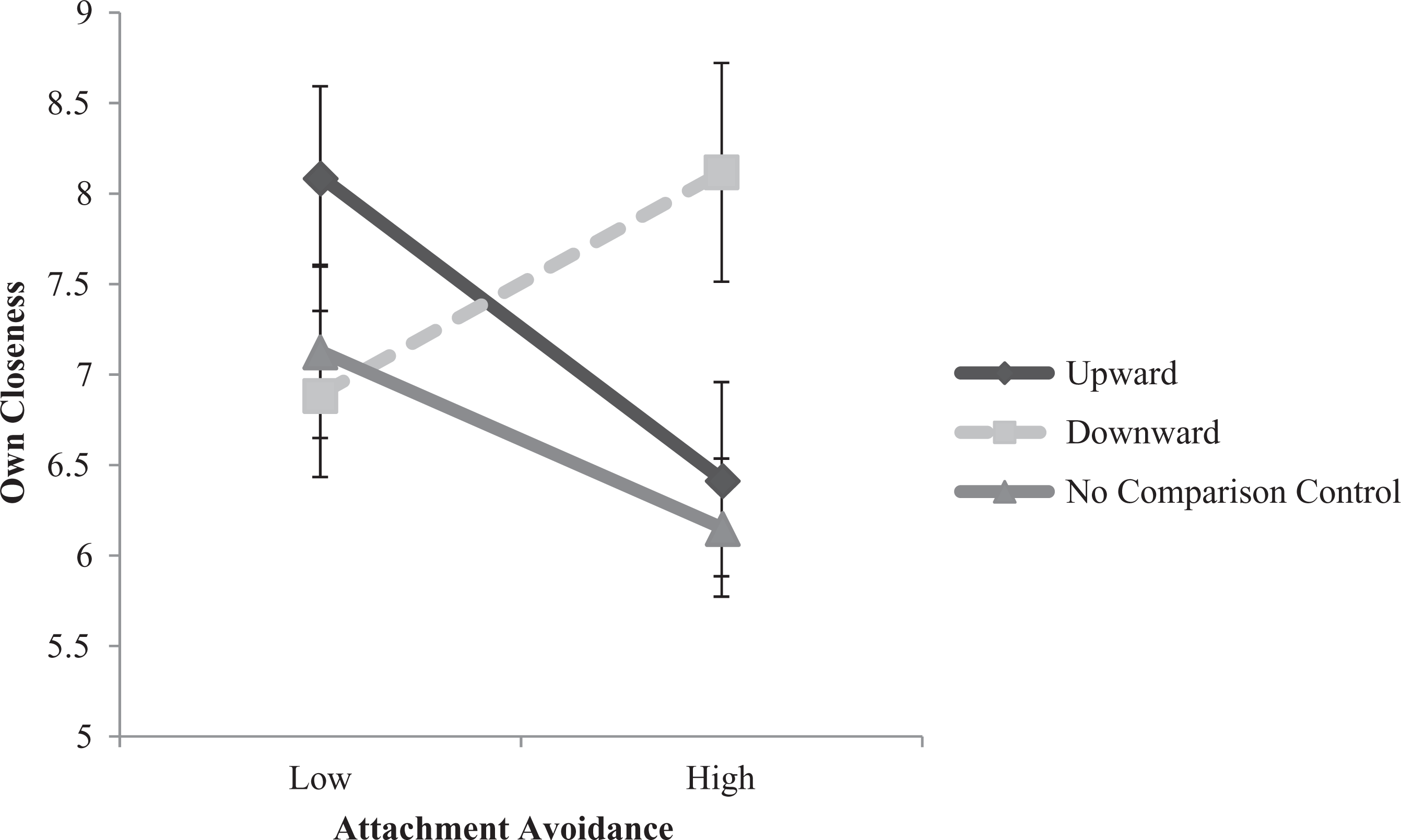
The relationship between attachment avoidance and closeness for upward, downward, and no comparison control conditions while controlling for attachment anxiety using predicted values for participants ±1 SD from the mean in avoidance (Study 2). Error bars represent standard errors.
We also examined the association between attachment avoidance and closeness for each comparison condition. For participants in both the upward comparison condition, b = −0.25, SE = 0.12, t(52) = −2.11, p = .04, r = −.27, 95% CI [−.49, −.01], and no comparison control condition, b = −0.18, SE = 0.07, t(52) = −2.45, p = .02, r = −.30, 95% CI [−.52, −.06], those with higher levels of attachment avoidance felt less close to their partner. This association was not significant in the downward comparison condition, b = 0.18, SE = 0.13, t(52) = 1.46, p = .15, r = .19, 95% CI [−.07, .42].
Discussion
Consistent with Study 1, Study 2 provides evidence that avoidant individuals respond more negatively to upward than downward comparisons to their partner. Moreover, comparisons with the control condition included in Study 2 suggest that this effect is due largely to the positive impact of downward comparisons on the closeness of avoidant individuals rather than the negative impact of upward comparisons. Avoidant individuals felt closer to their partners after imagining outperforming their partner on an academic test.
Unlike Study 1, individuals higher in avoidance did not differ significantly from individuals lower in avoidance in closeness following a downward comparison. It is possible that the difference in simple effects may be due to the domain of comparison. Because participants were students at an academically rigorous institution, it is likely that they valued the academic domain more than other domains. Thus, they may have derived greater pleasure from outperforming their partner academically, and thus felt more comfortable drawing closer to their partner, than in other domains. Indeed, when we examined only recalled academic comparisons from Study 1, we obtained the same pattern of simple effects for avoidance (i.e., a negative slope in upward condition, b = −1.88, SE = 0.74, t(27) = −2.52, p = .02, r = −.32, 95% CI [−.60, .03], and a nonsignificant slope in downward condition, b = −0.47, SE = 0.35, t(27) = −1.37, p = .18, r = −.08, 95% CI [−.42, .27]). Consequently, the difference between the simple effects of avoidance across the two studies is likely due to the inclusion of comparisons in a variety of domains in Study 1.
In contrast, less avoidant individuals felt marginally less close to their partners after imagining outperforming their partners on an academic test. This is consistent with the past research demonstrating that individuals are more likely to report distancing themselves from an inferior partner than a superior partner because the partner’s poor performance may have negative implications for these individuals’ own lives (Pinkus et al., 2008). A partner’s poor academic performance may affect future educational goals, which in turn may affect future financial outcomes and negatively affect an individual’s life. Alternatively, less avoidant participants in the upward condition may have felt extremely proud of their highly successful partner and wanted to draw closer to him or her. Because Study 1 did not find this difference at low levels of attachment avoidance, this finding must be interpreted with caution. It may be that that less avoidant participants in Study 1 recalled downward comparisons in domains that were less likely to have negative implications for their own lives and consequently felt no need to distance themselves from their partner.
General discussion
Individuals interact with their partner on a daily basis, yielding numerous opportunities for social comparisons. The present research suggests that downward comparisons may be especially beneficial for avoidant individuals. When asked to recall past comparison experiences (Study 1) and imagine an academic comparison (Study 2), avoidant individuals tended to feel closer to their partners after downward than upward comparisons. Downward comparisons may be more consistent with their negative working model of the partner (Mikulincer & Shaver, 2007). In addition, avoidant individuals may feel more confident in their partners’ love when partners are inferior; such comparisons allow them to demonstrate their own strengths and provide opportunities for their partners to recognize these strengths. Once avoidant individuals have shifted their metaperspectives about the extent to which their partners value them, they can, in turn, value their partners more and consequently develop more favorable representations of their partners, resulting in more positive relationship outcomes in the future (Derrick & Murray, 2007).
Emerging research suggests that though avoidant individuals are characterized by a chronic discomfort with intimacy, they do value closeness and will pursue it when they perceive proximity seeking to be welcomed by others. In casual, short-term interactions with strangers, avoidant individuals report feeling closer to their interaction partner following a positive interaction relative to a negative interaction (MacDonald & Borsook, 2010). In long-term relationships, avoidant individuals who perceive their relationships to be of high quality are more likely to desire closeness to their partners under distressing circumstances (Slotter & Luchies, 2014). The present research makes a key contribution to this growing literature by identifying a process in close, long-term relationships—downward comparisons to romantic partners—that can foster these feelings of closeness among avoidant individuals.
We had predicted that more avoidant individuals would also distance themselves from the partner following upward comparisons. In Study 2, however, avoidant individuals who had imagined a superior partner did not differ in closeness from those who did not imagine a comparison. It may be that avoidant individuals who are by definition low in closeness to their partners (for review, see Edelstein & Shaver, 2004), were exhibiting a floor effect; our measure of closeness thus may not have been sufficient to detect distancing effects among these individuals. In future research, it will be important to examine more specifically the behaviors exhibited by avoidant individuals with superior partners to see whether these individuals are indeed motivated to steer clear of contact with a partner who outperforms them.
Alternatively, avoidant individuals may not have contrasted themselves from their partner following the upward academic comparison and were thus less likely to engage in self-protective strategies such as distancing themselves (Pinkus et al., 2012). Indeed, Gabriel and colleagues (2005; study 3) also did not find evidence for a contrast effect among avoidant individuals following an implicit upward comparison regarding intelligence. This contrast effect may be absent in domains that are particularly important to avoidant individuals because they are motivated to maintain positive self-perceptions in these domains. Consequently, avoidant individuals may have used other coping strategies to protect themselves from the negative implications of such comparison information. For example, avoidant individuals may have decreased the relevance of their performance on this particular test on their overall psychology grade (Tesser & Paulhus, 1983) or focused on how they outperform their partners in a different subject (cf. Tesser, Crepaz, Collins, Cornell, & Beach, 2000). Both these strategies would allow avoidant individuals to continue viewing themselves positively and protect themselves without having to decrease closeness (Tesser, 1988). Thus, future research should investigate whether avoidant individuals engage in other coping strategies following upward comparisons to their partners, especially in domains of great importance.
Although Studies 1 and 2 had relatively small samples, they both have several features that increased the effect sizes and thus statistical power. First, because both studies were conducted in a laboratory setting, careless responding was minimized, which increases statistical power (Maniaci & Rogge, 2014). Second, both studies recruited mostly dating undergraduate students from the same university, making the sample more homogenous. Third, it is likely that the manipulation in Study 2 was more powerful than the one in Study 1, resulting in a larger effect size, because the comparison experience was more homogeneous. The manipulation in Study 2 specified the degree to which participants outperformed, or were outperformed by, their partner. Furthermore, we asked all participants to imagine an academic comparison, a domain that is likely to be very important to students at an academically rigorous university. Both of these features decrease error variance, and thus increase effect size, because they minimize differences in relative performance and domain importance across participants. In contrast, these differences are inherent to the retrospective manipulation of Study 1. Finally, though the RQ can reliably detect effects that are moderate in size (Sibley et al., 2005), like the one in Study 2 (Cohen, 1992), the effect size of the interaction in Study 2 may even be attenuated because the RQ has more measurement error than more recent measures of attachment such as the ECR-R (Sibley et al., 2005). Consequently, the effect of the hypothetical manipulation may actually be larger than estimated with the result that even a relatively small sample can detect a significant effect.
We also calculated an incredibility (IC) index of 0.50 (the probability that we would obtain more nonsignificant effects than reported given the expected number of nonsignificant results; Schimmack, 2012, see Table 4) to determine the reliability of the comparison condition by attachment avoidance interaction on closeness across both studies. A high IC index (i.e., 0.90; Ioannidis & Trikalinos, 2007) indicates publication bias in a set of studies due to chance, the “file-drawer problem,” questionable research practices, an underestimation of the true effect size, or a combination of these factors (Francis, 2012). Our low IC index suggests that these studies are unbiased.
Sample sizes, effect sizes, power, total power, and incredibility index for Comparison × Aavoidance interaction.

Note. Significant = p < .05; power = calculated using each study’s effect size.
In the present studies, we focused on general attachment representations; however, it will also be important for future research to examine the impact of relationship-specific attachment representations on responses to social comparisons. Past research has found that people have different working models for different relationships (e.g., Baldwin, Keelan, Fehr, Enns, & Koh-Rangarojoo, 1996) and that these relationship-specific attachment representations predict relationship outcomes better than broader attachment measures (Fraley, Heffernan, Vicary, & Brumbaugh, 2011). Accordingly, it may be that when avoidant individuals are asked to think about comparisons to a romantic partner in general, they may feel closer only following downward comparisons. However, if avoidant individuals are currently in a relationship with a warm and responsive partner, they may have more secure attachment representations of that specific partner, which we have not captured through our use of general measures of attachment. These positive working models, in turn, may allow avoidant individuals to feel greater empathy and shared fate with their partner, resulting in more positive responses following upward comparisons and more negative responses following downward comparisons.
Although some research has found gender differences in responses to social comparisons between romantic partners (e.g., Pierce, Dahl, & Nielsen, 2013; Ratliff & Oishi, 2013), we did not predict or observe gender differences in comparison responses. We would argue that both men and women who are avoidant should respond more positively to downward than upward comparisons to a partner. It is possible that these gender differences may be due to the influence of social norms on certain comparison domains rather than actual differences in psychological processes. For instance, Pierce and colleagues examined income comparisons between spouses; men reported more sexual health problems and women reported more mental health problems when wives were breadwinners because it challenged the social norm of the male breadwinner. Furthermore, Ratliff and Oishi’s participants were Dutch, a culture in which the male breadwinner norm is still very relevant (Sainsbury, 1996). Indeed this also provides a partial explanation for why the Oscar Love Curse only affects actresses and not actors. Winning such a coveted prize often results in greater career opportunities and greater increases in income, thus challenging the male breadwinner social norm. In the present studies, we allowed participants to recall comparisons from a variety of domains and asked them to imagine an academic comparison that was unlikely to be influenced by gender norms, which may have dampened the effect of gendered social norms on comparison responses. In future research, however, it will be useful to examine whether avoidant men and women experience different responses to social comparisons in domains influenced by gendered social norms.
We note also that the present studies examined explicit reports of closeness. It is possible that avoidant individuals’ implicit responses may diverge from their self-reported responses. Recent research has found that men reported similar levels of explicit self-esteem following upward and downward comparisons to their female partners; however, men exhibited lower implicit self-esteem after recalling an upward comparison, relative to a downward comparison, to their female partners (Ratliff & Oishi, 2013, study 5). Furthermore, past research has demonstrated that there is often a dissociation between avoidant individuals’ explicit and implicit responses, especially when they experience psychological threats. For example, after thinking about separation from a romantic partner, avoidant individuals’ explicit attitude toward interpersonal distance and self-reliance is positive; however, their implicit attitudes indicate that they actually experience ambivalence about being separated from their partner (Mikulincer, Shaver, Bar-On, & Ein-Dor, 2010). Thus, though we did not find a difference in explicit reports of closeness in avoidant individuals following upward comparisons relative to no comparisons, it is possible that their implicit responses may show a different pattern. It will be important for future research to examine this possibility further.
Finally, these studies only focused on avoidant individuals who are dating. It is possible that the moderating impact of attachment avoidance is limited to dating relationships, in which commitment and interdependence are lower (Johnson, 1999). Indeed past research (Pinkus et al., 2008; 2012) indicates that married individuals tend to respond especially positively to their spouse’s success, in part because they can share in that success. It may also be the case that married individuals are less likely to be avoidant than dating individuals and consequently should be less likely to respond negatively to upward relative to downward comparisons. Indeed past research indicates that secure individuals are more likely to get married than insecure individuals (Senchak & Leonard, 1992). Attachment avoidance may also decrease in a marriage over time: For example, spouses tend to feel more comfortable depending on others (i.e., become less avoidant) as their marriage progresses, possibly because they have a greater sense of relationship stability and security than dating partners (Davila, Karney, & Bradbury, 1999), which may result in greater interdependence. Increased interdependence may result in greater likelihood of gaining benefits associated with a superior partner and greater likelihood of incurring costs associated with an inferior partner, leading to a greater sense of shared fate. This decrease in attachment avoidance and increase in shared fate between partners may result in more positive responses to superior spouses. Future research can explore whether marital status influences avoidant individuals’ responses to upward comparisons.
Comparisons to one’s romantic partner are common in daily life (Pinkus et al., 2008). Most individuals tend to distance themselves from unsuccessful partners, at least temporarily, because such partners can be burdensome due to the costs individuals must often bear as a result of these partners’ failures (Pinkus et al., 2008). Our studies, however, suggest that avoidant individuals actually draw closer to inferior partners because downward comparisons increase their feelings of closeness, despite these individuals’ chronic discomfort with intimacy. Such comparisons may lead these individuals to believe their partners see them positively and will thus be less likely to reject them, quelling their implicit fears of rejection and allowing them to reap the benefits of intimacy.
Footnotes
Acknowledgments
We are grateful to Elizabeth Page-Gould for her advice with statistical analyses. We also thank Nadia Bashir and Tina Sarkissian for their assistance with data collection.
Authors’ note
Portions of the present research were presented at the 2012 IARR conference in Chicago, Illinois, USA, and the 14th Annual Meeting of the Society of Personality and Social Psychology, New Orleans, Louisiana, USA. Portions of the present research were conducted as part of Sabrina Thai’s master’s thesis at the University of Toronto, Toronto, Ontario, Canada.
Funding
The author(s) disclosed receipt of the following financial support for the research, authorship, and/or publication of this article: This research was support by a Social Sciences and Humanities Research Council of Canada (SSHRC) Canadian Graduate (Doctoral) Scholarship to S.T. and an SSHRC Research Grant to P.L.