



Abstract
Romantic beliefs (e.g., love at first sight and soul mates) are common among young people, however, these beliefs are thought to create unrealistic expectations for romantic relationships. The current study assessed the romantic beliefs, romantic expectations, and relationship outcomes (satisfaction and commitment) of 270 young adults (aged 18–28 years) who were involved in dating relationships. Romantic beliefs were associated with greater satisfaction and commitment, whereas unmet romantic expectations were associated with lower satisfaction and commitment. Of note, the endorsement of romantic beliefs was not linked to unmet expectations. Thus, romantic beliefs do not appear to foster false or unobtainable expectations for romantic relationships, and the concerns regarding the endorsement of these beliefs may be misplaced. Individual differences (age, gender, and relationship experience) did not predict romantic beliefs or expectations. The results are discussed with regard to implications for promoting relationship commitment and satisfaction.
Traditional romantic beliefs (e.g., love at first sight, soul mates, love never fades, and love can overcome all barriers) are pervasive in North American culture (Cobb, Larson, & Watson, 2003; Spaulding, 1970; Sprecher & Toro-Morn, 2002). North Americans are zealous consumers of media with romantic themes and are inundated with hyperromanticized messages in the media ranging from Disney® princess stories to reality dating television (Martin & Kazyak, 2009; Zurbriggen & Morgan, 2006). However, these romantic beliefs are thought to create unrealistic expectations for romantic relationships (Galician, 2004; Glenn, 1991; Spaulding, 1970). Indeed, there is a wealth of materials and programs designed to encourage individuals and couples to change these beliefs and develop more realistic expectations for their romantic relationships and ultimately decrease the risk of experiencing negative relational outcomes (Kerpelman, Pittman, Adler-Baeder, Eryigit, & Paulk, 2009; Kilmann, Urbaniak, & Parnell, 2006; Markman, Stanley, & Blumberg, 1994). But are those efforts warranted? The current study examines how romantic beliefs, and specifically the expectations that they create for romantic relationships, are linked to relationship satisfaction and commitment. For the purposes of the current study, beliefs are defined as cognitions about one’s general orientation to love and romantic relationships (e.g., “I believe that to be truly in love is to be in love forever”; Sprecher & Metts, 1989). Expectations are conceptualized as the product of beliefs but refer to the anticipated characteristics of a specific relationship (i.e., “In my ideal relationship, feelings of love will never fade”). Young adults’ dating relationships will be the focus of the current study, as early adulthood is a period of time in which people are expected to gain experience in establishing and maintaining a well-functioning romantic relationship (Arnett, 2004).
Romantic beliefs and relationship outcomes
Despite efforts to examine the link between romantic beliefs and relationship outcomes, the nature of this association remains unclear. The endorsement of romantic beliefs has been associated with positive outcomes such as feelings of love and liking for a partner, feelings of passion, falling in love faster, relationship satisfaction, agreement with a partner on relationship issues, and relationship longevity (Barelds & Dijkstra, 2009; Jones & Cunningham, 1996; Niehuis, 2006; Sprecher & Metts, 1989; Swami & Furnham, 2008). However, endorsement of romantic beliefs also has been linked to negative outcomes, such as lower relationship commitment, lower relationship satisfaction, perceiving more costs associated with the relationship, increased use of passive or disengaging coping strategies during relationship conflict, and experience and perpetration of relationship violence (Fitzpatrick & Sollie, 1999; Franiuk, Shain, Bieritz, & Murray, 2012; Stackert & Bursik, 2003). Other research has reported mixed results of both positive and negative relationships outcomes (Knee, Nanyakkara, Vietor, & Patrick, 2001; Knox & Sporakowski, 1968; Sprecher & Metts, 1999).
Romantic expectations and relationship outcomes
One potential reason for this inconsistent pattern of results is that most past research has measured romantic beliefs but has not measured the application of these beliefs in terms of expectations for romantic relationships. This gap is problematic, as the concerns regarding the endorsement of romantic beliefs emphasize the importance of expectations about one’s own relationship (Galician, 2004; Glenn, 1991; Spaulding, 1970). In brief, romantic beliefs create romantic expectations for relationships that are inherently unrealistic and unobtainable and cannot be met by an actual relationship. This discrepancy between expectations for a relationship and perceptions of a current relationship leads to negative relationship outcomes, such as reduced relationship satisfaction and commitment. Thus, having unmet expectations, and not romantic beliefs per se, is hypothesized to be the mechanism leading to poor relationship outcomes. Past research has focused primarily on measuring the endorsement of romantic beliefs and has neglected to measure the expectations that these beliefs are presumed to create, or more importantly we argue, has failed to measure the extent to which these expectations are met by a current relationship. However, without measuring the degree to which romantic expectations (presumed to be created by romantic beliefs) are met, it is difficult to determine what effect, if any, endorsing romantic beliefs has on relationship outcomes. The current study extends past research by measuring both romantic beliefs and romantic expectations and assessing unmet expectations by calculating the discrepancy between romantic expectations and perceptions of a current relationship.
Interdependence theory as a conceptual framework
Identifying unmet expectations as a key mechanism in the association between romantic beliefs and relationship outcomes is consistent with interdependence theory (Kelley & Thibault, 1978; Thibault & Kelley, 1959). According to interdependence theory, to predict relationship satisfaction and commitment, it is necessary to understand an individual’s expectations for a romantic relationship and the extent to which that individual perceives his/her current relationship to be meeting or falling below these expectations. The theory proposes two types of expectations. First, comparison level (CL) captures an individual’s expectations for a relationship as it “reflects the quality of outcomes that the participant feels he or she deserves” (Kelley & Thibault, 1978, p. 9) and is based on observation of others, personal experiences in both past and current relationships, and cultural ideals (Merolla, Weber, Myer, & Booth-Butterfield, 2004; Weigel, 2007). Second, CL for alternatives (CL-Alt) refers to an individual’s expectations about the characteristics of a relationship that he/she could enter if their current relationship were to end.
According to interdependence theory, satisfaction is determined by the discrepancy between perceptions of a current relationship and CL (Satisfaction = Current − CL). Indeed, research has found consistently that discrepancies between expectations for an ideal relationship (CL) and perceptions of a current relationship have been linked consistently with lower relationship satisfaction in young adults (Campbell, Simpson, Kashy, & Fletcher, 2001; Ciccocioppo, Frieze, & Votruba-Drzal, 2011; Sternberg & Barnes, 1985). Similarly, according to interdependence theory, commitment is determined by the discrepancy between perceptions of a current relationship and CL-Alt (Commitment = Current – CL-Alt). There is also extensive research support for this component of the theory: the discrepancy between an individual’s expectations for available alternatives (CL-Alt) and their perceptions of a current relationship is associated with lower relationship commitment among young adults (Choice & Lamke, 1999; Jemmott, Ashby, & Lindenfeld, 1989; Simpson, 1987).
We examined how unmet expectations for an ideal relationship (CL) and unmet expectations for an alternative relationship (CL-Alt) are associated with relationship outcomes. Consistent with interdependence theory, it was expected that unmet expectations for an ideal relationship would be associated with lower relationship satisfaction, whereas unmet expectations for an alternative relationship would be associated with lower relationship commitment.
Research assessing romanticized expectations and relationship outcomes
A limited number of studies to date have measured explicitly the extent to which romantic expectations are met. One of the few studies to do so focused exclusively on expectations created as a result of the belief that a good romantic partner knows what the other person is thinking (“mind reading”) and the belief that partners in a good relationship do not argue or experience conflict (“disagreement is destructive”). Johnson, Fine, Polzella, and Graetz (2000) had 63 U.S. college students in dating relationships complete three parallel versions of a measure assessing assumptions about mind reading in a typical romantic relationship (e.g., “In a typical relationship, partners can sense all of each other’s moods”), expectations for mind reading in their own romantic relationship (e.g., “My partner should sense all my moods”), and perceptions of mind reading in their current romantic relationship (e.g., “My partner does sense all my moods”). Both the discrepancy between assumption and perception and the discrepancy between expectation and perception were negatively correlated with relationship satisfaction. The extent to which participants’ perceptions of mind reading in their own relationship met their expectations for mind reading predicted positive relationship outcomes. However, the study had a very small sample and focused on just two romantic beliefs and their associated relationship expectations.
In addition to the work by Johnson and colleagues (2000), a small number of studies have assessed the extent to which romantic expectations are met (Burnette & Franiuk, 2010; Franiuk, Cohen, & Pomerantz, 2002; Franiuk, Pomerantz, & Cohen, 2004; Knee et al., 2001) but typically they have focused on a very restricted set of expectations created by soul mates and destiny romantic beliefs or relied on broad measures of the extent to which expectations were met (e.g., “My current partner is __ % of what I would ideally want in a partner;” Knee et al., 2001). This narrow focus limits our understanding of the possible impact of endorsing a wide range of romantic expectations and does not provide an accurate measure of the extent to which expectations created by romantic beliefs are being met. In addition, it makes it difficult to determine whether there are specific types of romantic expectations that are more likely to be unmet than others and thus more likely to lead to negative outcomes. We examined a broad range of romantic expectations thought to be created by romantic beliefs. Finally, asking participants to directly compare their current relationship to an imagined ideal relationship may produce assimilation or contrast effects and cause shifts in participants’ CL and CL-Alt. For example, Broemer and Diehl (2003) reported that participants who were asked to contrast their actual relationship to a romantic stereotype (i.e., “please compare your current relationship with the stereotype”) reported lower relationship satisfaction than participants who were asked to assimilate their actual relationship to a romantic stereotype (i.e., “please compare this stereotype of romantic involvements with your current relationship”).
Individual differences in endorsement of romantic expectations
Although very little research has measured expectations, it is hypothesized that the individual differences variables that influence the endorsement of romantic beliefs may also predict the endorsement of romantic expectations as well as the discrepancy between expectations and perceptions of a current relationship. The majority of research examining young adults’ romantic beliefs has not found a gender difference (Jones & Cunningham, 1996; Montgomery, 2005; Neto, 2012; Regan & Anguiano, 2010; Sprecher & Metts, 1989), although gender differences do emerge, they typically indicate that men are more likely to endorse romantic beliefs than are women (Haferkamp, 1999; Sharp & Ganong, 2000; Sharpe & Taylor, 1999; Sprecher & Metts, 1999; Sprecher & Toro-Morn, 2002; Stackert & Bursik, 2003). In addition, romantic beliefs and romantic expectations can be developed through personal experience, observation, or knowledge transfer (Duran-Aydintug, 1997; Haferkamp, 1999; Segrin & Nabi, 2006 ). The endorsement of romantic beliefs tends to decrease with age (Cobb et al., 2003; Neto, 2012; Regan & Anguiano, 2010), relationship length (Niehus, 2006; Sprecher & Metts, 1999), and number of previous romantic relationships (Franiuk et al., 2002). Thus, gender, age, relationship length, and relationship experience were assessed to provide further insight into the link between individual differences and romantic expectations.
The current study
The primary objectives of the current study were to determine whether unmet expectations are associated with the endorsement of romantic beliefs and whether these unmet expectations are associated with reduced relationship satisfaction and commitment. We extended the past research by measuring explicitly both romantic beliefs and romantic expectations and by calculating the discrepancy between expectations and perceptions of a current relationship. As guided by interdependence theory, we assessed both expectations for an ideal relationship and expectations for an alternative relationship. Finally, using a comprehensive measure of romantic expectations, we were able to identify the types of expectations that are most likely to be unmet as well as the types of unmet expectations that are most likely to result in negative relationship outcomes.
Several of the research goals of the current study were descriptive or exploratory in nature. These were to examine: (1) the extent to which young adults endorse romantic beliefs and romantic expectations, (2) the extent to which young adults report a discrepancy between expectations (ideal or alternative) and perceptions of a current relationship, (3) the types of expectations that are most likely to be unmet, and (4) the types of expectations that are the best predictors of negative relationship outcomes. In addition, the following hypotheses were made based on previous literature:
Method
Participants
Participants were recruited from Amazon Mechanical Turk®, a website that allows researchers to crowdsource their data. Samples recruited via Mechanical Turk are more diverse than samples surveyed using traditional recruitment methods, such as introductory psychology participant pools (Buhrmester, Kwang, & Gosling, 2011). Participants clicked on a link advertising a “25- to 30-min survey on close relationships.” They completed a short screening questionnaire and those who indicated they were between the ages of 18 and 28 and dating one partner exclusively were directed to our survey.
Participants included 275 (148 male, 121 female, 6 genderqueer/agender) U.S. young adults between the ages of 18 and 28 years (M = 23.7; SD = 2.8). Participant ethnicities were Caucasian (74.5%), African American (8.4%), Asian/Asian American (5.8%), Hispanic (5.8%), multiracial (4.4%), and other (<2%). Most (99.3%) spoke English as a primary language. The majority (88%) had obtained some form of postsecondary education: A third (32%) had completed college, technical school, or university and 8% had pursued graduate education. The sample was predominantly heterosexual (76.7%), although participants also identified as bisexual (11.3%), gay (2.9%), asexual (1.8%), lesbian (1.5%), pansexual (1%), and queer (<1%). A few (4%) indicated that they preferred no labels. All participants were involved in either a dating (62.5%) or cohabitating (37.5%) romantic relationship. The majority (90%) of these relationships were male–female dyads.
Measures
Demographics and relationship history
A measure designed for the current study was used to collect background information on age, gender, place of residence, race/ethnicity, language, level of education, sexual orientation, relationship status, relationship length, partner gender, and number of previous romantic relationships.
Romantic expectations
Romantic expectations were measured using the Romantic Discrepancy Scale (RDS; Vannier & O’Sullivan, 2012). The RDS is a 36-item scale that assesses the discrepancy between participants’ perceptions of the romanticized characteristics of their current relationship and participants’ expectations for the romantic characteristics of their ideal or potential alternative relationship. The measure can be divided into four subscales: Connection (5 items, e.g., “I seem to know what my partner is thinking” and “My partner is my best friend”) assesses feelings of affinity, communion, and understanding between partners; Passion (13 items, e.g., “I feel a magnetic pull towards my partner” and “I want to spend as much time as possible with my partner”) assesses attraction, arousal, and desire to be in close physical proximity to a partner; Destiny (13 items, e.g., “My partner is my soul mate” and “We will live happily ever after”) assesses the belief that a relationship is predestined; and Instant (5 items, e.g., “I fell in love at first sight” and “We had an instant connection”) assesses the speed at which romantic feelings emerged between partners. Participants responded to each item on a 5-point Likert-type scale (1 = not at all to to 5 = extremely). The RDS has shown external validity and internal reliability in past research (Vannier & O’Sullivan, 2012) and demonstrated high reliability in the current study (αs = .85–.97).
Based on the methods used by Johnson and colleagues (2000), participants completed three parallel versions of the scale to capture their perceptions of their current, ideal, and possible alternative relationship. In the first version, they were asked to indicate “How much does each of these statements describe your current relationship with a romantic partner?” In the second version, they were asked to indicate “How much does each of these statements describe your ideal relationship with a romantic partner?” In the third version, they were asked to indicate “If you were no longer in your current relationship, how likely do you think it is that you would end up involved in a relationship that has each of the following characteristics?” Correlations among the subscales within each of the three versions were moderate to high: current rs = .51–.80, ideal rs = .40–.75, and alternative rs = .70–.85.
Ideal/current discrepancy scores were calculated by subtracting participants’ scores on the current-RDS from their scores on the ideal-RDS. Similarly, alternative/current discrepancy scores were calculated by subtracting participants’ scores on the current-RDS from their scores on the alternative-RDS. Positive discrepancy scores indicate that the current relationship falls below expectations for an ideal or alternative relationship. Negative discrepancy scores indicate that the current relationship exceeds expectations for an ideal or alternative relationship.
Romantic beliefs
Romantic beliefs were assessed using the Romantic Beliefs Scale (RBS; Sprecher & Metts, 1989). The RBS is a 15-item measure that comprises four subscales: “Love Finds a Way” (6 items, e.g., “If I love someone, I know I can make the relationship work, despite any obstacles”), “Love at First Sight” (3 items, e.g., “I am likely to fall in love almost immediately if I find the right person”), “One and Only” (3 items, e.g., “I believe to be truly in love is to be in love forever”), and “Idealization” (3 items, e.g., “The person I love will make a perfect romantic partner; e.g., he/she will be completely accepting, loving, and understanding.” Participants responded to each item on a 7-point Likert-type scale (1 = strongly disagree to 7 = strongly agree). Participants’ responses to each item were averaged to create overall and subscale scores. The RBS has high reliability (α = .81, test–retest r = .75) and convergent validity (Sprecher & Metts, 1989) and demonstrated high reliability in the current study (α = .91).
Satisfaction and commitment
Relationship outcomes were measured using the Satisfaction and Commitment subscales of the Investment Model Scale (IMS; Rusbult, Martz, & Agnew, 1998). Satisfaction was measured using 5 items (e.g., “I feel satisfied with our relationship” and “Our relationship is close to ideal”). Commitment was measured using 7 items (e.g., “I want our relationship to last for a very long time” and “I feel very attached to our relationship-very strongly linked to my partner”). Participants respond to each global item on a 9-point Likert-type scale (0 = do not agree at all to 8 = agree completely). Responses to each item were averaged to create overall and subscale scores that range between 0 and 8. Previous research using the IMS subscales has found evidence for high reliability (αs = .91–.95) and convergent, discriminate, and predictive validity (Rusbult et al., 1998). Both the Satisfaction (α = .95) and Commitment (α = .87) subscales demonstrated high reliability in the current study.
Procedure
Participants were recruited from Amazon Mechanical Turk for a “study on close relationships.” Participants were screened using an initial survey requesting demographic information. Participants who met eligibility criteria (e.g., U.S. resident, aged 18–28, identified themselves as involved in a committed dating or cohabitating relationship) were directed to a link for the current study. Participants completed the online survey in 22 min on average and received US$1.00 for their time. This payment amount is consistent with guidelines for equitable payment for participants recruited via Mechanical Turk for surveys of comparable length (Mason & Suri, 2012).
Data conditioning and analyses
Thirty participants were removed from the original sample for not providing a date of birth (n = 9), being outside the required age range (n = 1), having more than 20% missing data on any one measure (n = 12), or for being multivariate outliers (n = 8). Excluded participants did not differ from the final sample with regard to age, gender, sexual orientation, education, relationship status, or relationship length. After removing these participants, there was very little missing data (M per variable = .5%, range = 0%–2.1%). We used mean substitution to replace missing values, which is considered acceptable when very few (<5%) data points are missing (Tabachnick & Fidell, 2007). Skewed variables (commitment, satisfaction, relationship length, and number of past relationships) were transformed using a square root transformation (Tabachnick & Fidell, 2007). The reported means and standard deviations reflect nontransformed data. The six participants who identified as agender or genderqueer were excluded from analyses examining gender differences but retained for all other analyses.
Results
Means and standard deviations for measured variables are presented in Table 1. On average, participants reported high relationship satisfaction and high relationship commitment. A one-way analysis of variance (ANOVA) was used to compare reports from men and women. A Bonferroni correction was applied to adjust for the number of gender comparisons; the significance level was set at p < .002 (.05/22 comparisons). Although women reported slightly higher relationship commitment as compared to men (Ms = 6.72 and 6.24, respectively), F(1, 265) = 6.54, p = .011, η2 = .02, this difference did not meet our significance level. There were no gender differences on any other variables. 1
Descriptive statistics and bivariate correlations among variables.
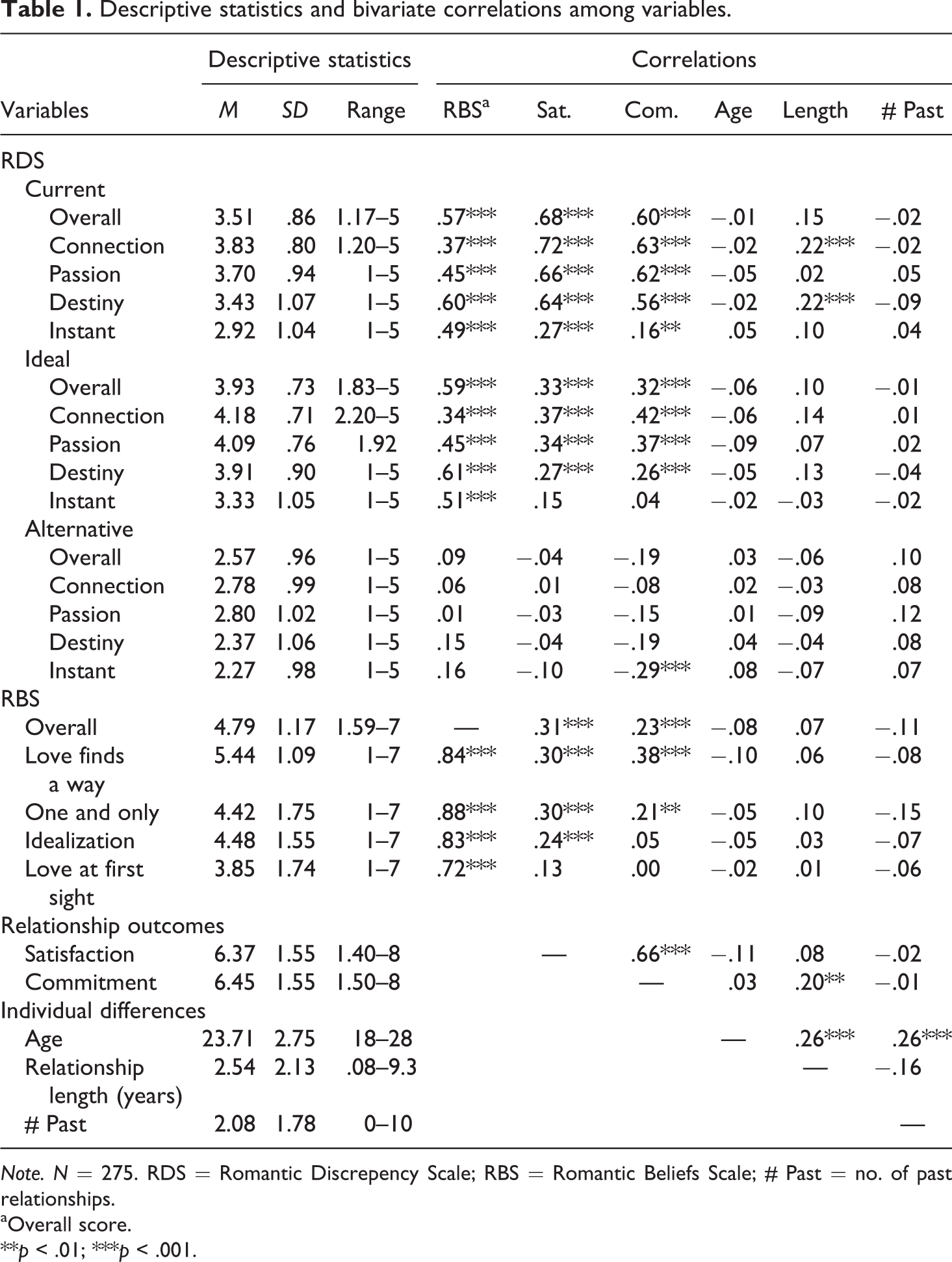
Note. N = 275. RDS = Romantic Discrepency Scale; RBS = Romantic Beliefs Scale; # Past = no. of past relationships.
aOverall score.
**p < .01; ***p < .001.
Participants endorsed moderate levels of romantic beliefs. Average scores on the RBS (M = 4.79) were slightly above the scale midpoint. Participants also endorsed moderate romantic expectations. A one-way repeated-measures ANOVA was conducted to compare ratings on the three versions of the RDS (current, ideal, and alternative) and revealed a significant difference, F(2, 273) = 222, p < .001, η2 = .62. Pairwise comparisons indicated that expectations for an ideal relationship received the strongest level of endorsement, followed by perceptions of a current relationship. Expectations for an alternative relationship received the lowest degree of endorsement. Average expectations for an ideal romantic relationship were above the scale mean and ranged between 3.33 and 4.18 (5-point Likert-type scale). A one-way repeated-measures ANOVA was conducted to compare ratings on the four subscales of the ideal-RDS. This analysis was significant, F(3, 272) = 69.16, p < .001, η2 = .43. Pairwise comparisons indicated that the Connection subscale received the strongest endorsement, followed by the Passion subscale and Destiny subscale. The Instant subscale was the least strongly endorsed, and average expectations of an alternative romantic relationship were lower and ranged between 2.27 and 2.80. A one-way repeated-measures ANOVA was conducted to compare ratings on the four subscales of the alternative-RDS. This analysis was significant, F(3, 272) = 68.95, p < .001, η2 = .43. Pairwise comparisons revealed that participants endorsed the Connection and Passion subscales the most, followed by the Destiny subscale. Again, the Instant subscale was the least endorsed.
Bivariate correlations among variables are presented in Table 1. Because of the large number of correlations, only those significant at p < .001 were interpreted. Scores on the current and ideal version of the RDS were highly correlated (r = .58, p < .001). Scores on the alterative version of the RDS were unrelated to scores on the current (r = −.02, p = .70) and ideal (r = .10, p = .11) RDS. The ideal-RDS was positively correlated with romantic beliefs. The strength of this correlation (r = .57) suggests that expectations for an ideal relationship are related to, but not identical to, romantic beliefs. Endorsement of both the current-RDS and ideal-RDS was positively correlated with relationship satisfaction and commitment. In contrast, endorsement of the alternative-RDS was unrelated to satisfaction and only the Instant subscale of the alternative-RDS was negatively correlated with commitment. Finally, age, relationship length, and number of past relationships were not consistently associated with any of the overall versions of the RDS. However, relationship length was positively correlated with the Connection and Destiny subscales of the current-RDS.
Discrepancies between current, ideal, and alternatives
Two repeated-measures ANOVAs were conducted to examine gender differences in discrepancy scores. Using a Bonferroni correction, the significance level was set at p < .005 (.05/10 comparisons) to adjust for multiple gender comparisons. There were no gender differences in ideal/current and alternative/current discrepancies. Thus, the sample was analyzed as a whole for all other analyses. Means are reported in Table 2.
Discrepancy scores: Descriptive statistics and bivariate correlations among variables.
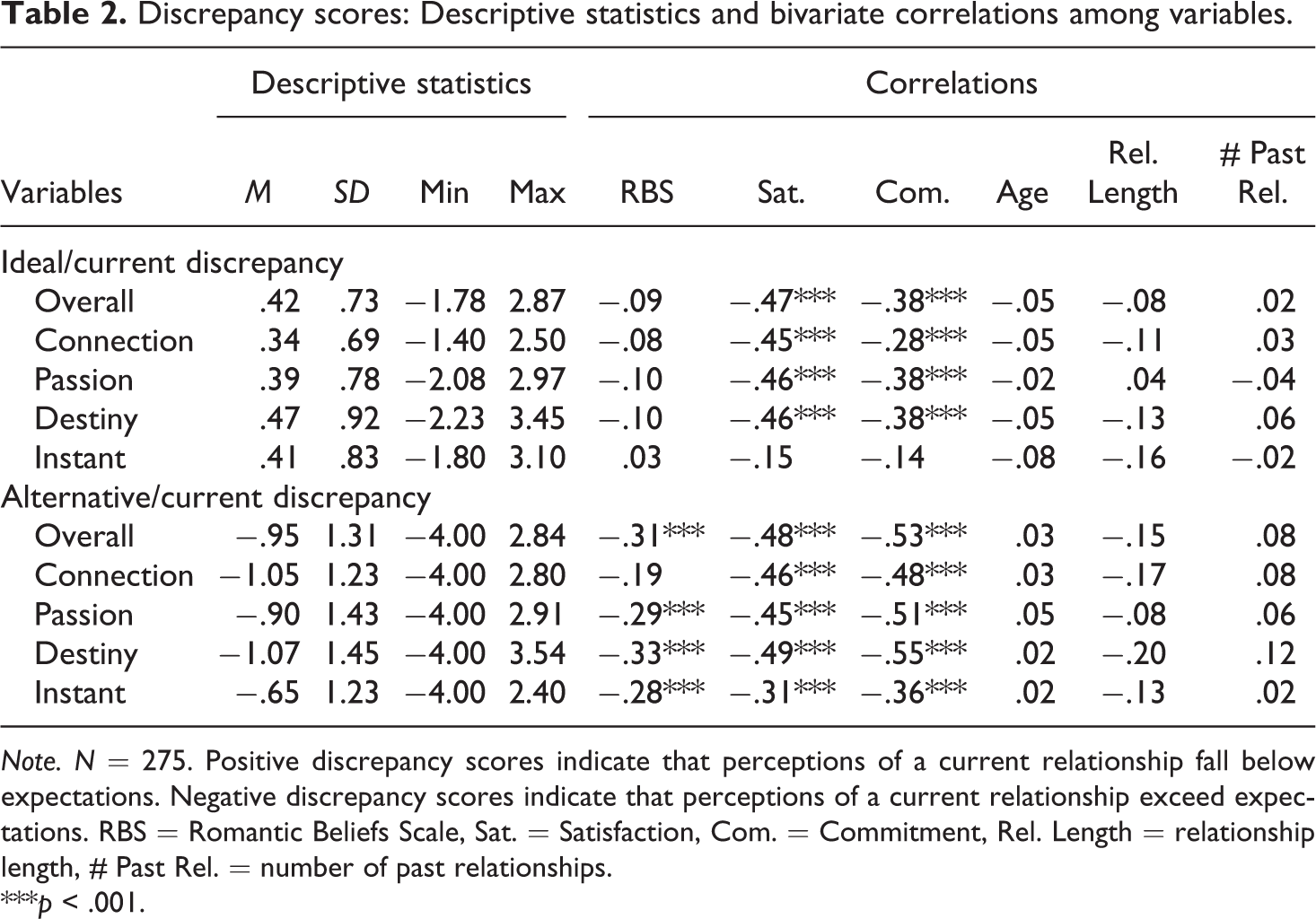
Note. N = 275. Positive discrepancy scores indicate that perceptions of a current relationship fall below expectations. Negative discrepancy scores indicate that perceptions of a current relationship exceed expectations. RBS = Romantic Beliefs Scale, Sat. = Satisfaction, Com. = Commitment, Rel. Length = relationship length, # Past Rel. = number of past relationships.
***p < .001.
On average, participants reported a small positive ideal/current discrepancy in which perceptions of a current relationship fell below expectations for an ideal relationship. A one-way repeated-measures ANOVA was conducted to compare discrepancy scores across ideal-RDS subscales. There was a significant difference, F(3, 272) = 3.77, p < .05, η2 = .04. Pairwise comparisons indicated that participants reported the greatest discrepancy on the Destiny subscale. Discrepancies on the Connection, Passion, and Instant subscales were equally common. The pattern was reversed for the alternative/current discrepancy. On average, participants reported a small negative alternative/current discrepancy indicating that perceptions of a current relationship exceeded expectations for an alternative romantic relationship. A one-way repeated-measures ANOVA was conducted to compare discrepancy scores across alternative-RDS subscales. There was a significant difference, F(3, 272) = 26.05 p < .001, η2 = .22. Pairwise comparisons revealed that participants were most likely to perceive their relationship as exceeding an alternative relationship on the Connection and Destiny subscale, followed by the Passion subscale and the Instant subscale.
Association between discrepancies and relationship outcomes
Bivariate correlations among variables are reported in Table 2. Once again, only those correlations significant at p < .001 were interpreted. Ideal/current and alternative/current discrepancy scores were positively correlated (r = .48, p < .001). In contrast to the correlations for the current and ideal versions of the RDS (as shown in Table 1), the ideal/current discrepancy scores were uncorrelated with romantic beliefs. Moreover, the alternative/current discrepancy scores were negatively correlated with romantic beliefs. Overall, these distinct patterns of correlation suggest that our measure of unmet expectations assessed a construct that differs notably from the measure of romantic beliefs and that the endorsement of romantic beliefs is not directly associated with unmet expectations.
To test this possibility further, two hierarchical multiple regressions were used to examine the association between discrepancy scores and relationship outcomes. Individual differences predictors (age, relationship length, and number of past relationships) were entered at Step 1. Romantic beliefs were entered as the predictor at Step 2. Overall ideal/current and alternative/current discrepancy scores were entered as predictors on Step 3. Finally, interactions between romantic beliefs and discrepancy scores were entered on Step 4. Results are presented in Table 3.
Regression analyses predicting relationship satisfaction and commitment.
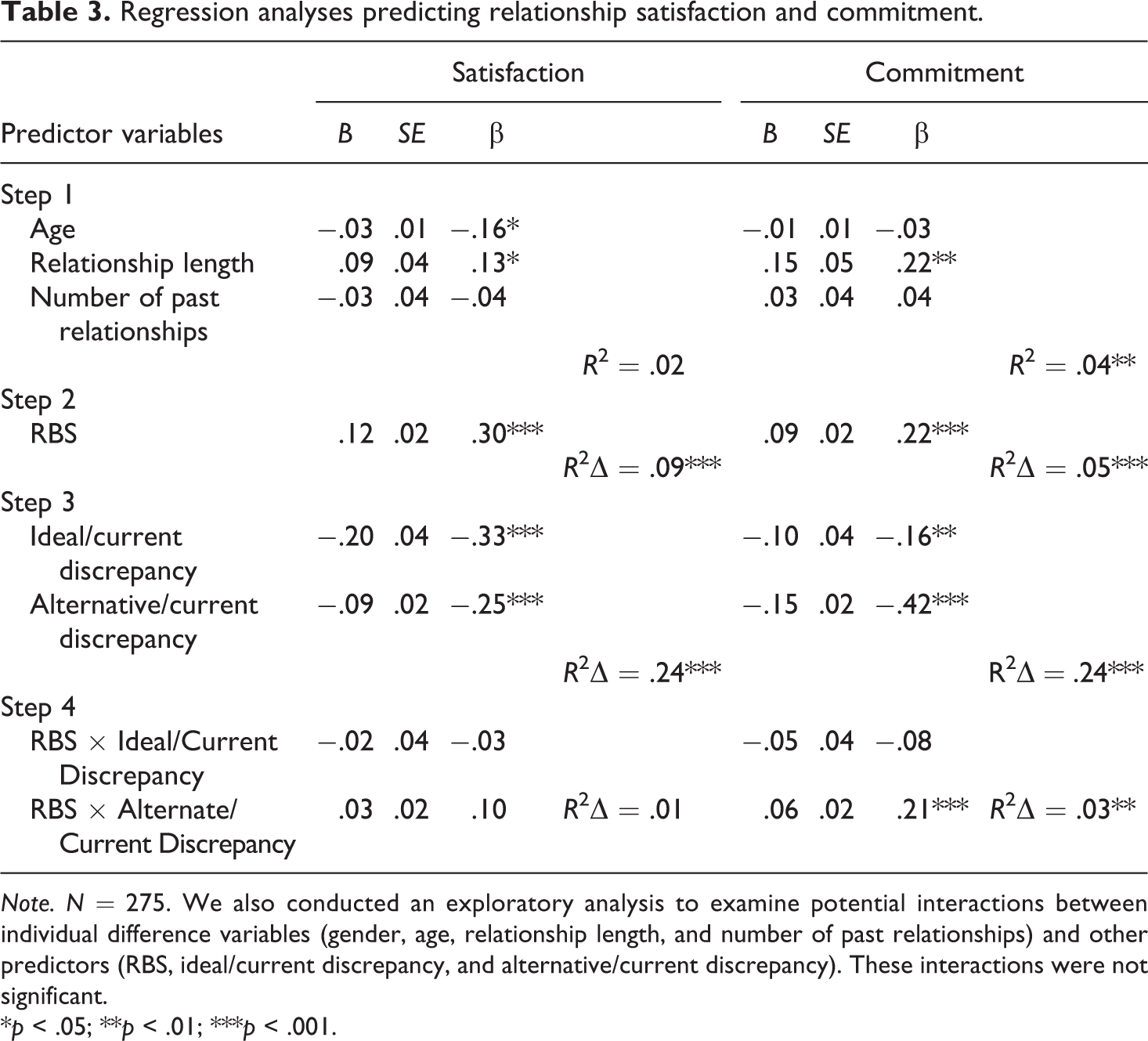
Note. N = 275. We also conducted an exploratory analysis to examine potential interactions between individual difference variables (gender, age, relationship length, and number of past relationships) and other predictors (RBS, ideal/current discrepancy, and alternative/current discrepancy). These interactions were not significant.
*p < .05; **p < .01; ***p < .001.
Satisfaction was entered as the criterion in the first analysis. Step 1 was not significant, F(3, 271) = 2.55, p = .056. Step 2 was significant, F-change(1, 270) = 26.88, p < .001, and accounted for 9% of variance in satisfaction. Romantic beliefs were positively associated with satisfaction. Step 3 was also significant, F-change(2, 268) = 49.65, p < .001, and accounted for an additional 24% of the variance above that predicted by romantic beliefs. Both the ideal/current discrepancy and the alternative/current discrepancy were negatively associated with satisfaction, although the ideal/current discrepancy was a slightly stronger predictor of satisfaction (β = −.33) than was the alternative/current discrepancy (β = –.25). Step 4 was not significant, F-change(2, 266) = 1.71, p = .18
Commitment was entered as the criterion in the second analysis. Step 1 was significant and accounted for 4% of the variance, F(3, 271) = 3.99, p < .01; relationship length (but not age or number of past relationships) was positively associated with commitment. Step 2 was also significant, F-change (1, 270) = 14.47, p < .001, and accounted for 5% of variance in commitment. Romantic beliefs were positively associated with commitment. Finally, Step 3 was significant, F-change(2, 268) = 47.79, p < .001, and accounted for an additional 24% of variance. Both the ideal/current discrepancy and the alternative/current discrepancy were negatively associated with commitment. In contrast to the regression predicting satisfaction, the alternative/current discrepancy was a far stronger predictor of commitment (β = −.42) than was the ideal/current discrepancy (β = −.16). Thus, discrepancy scores were significant predictors of both relationship satisfaction and commitment, and predicted variance above the variance already accounted for by romantic beliefs. Step 4 was significant, F-change(2, 266) = 6.68, p = .001, and accounted for an additional 3% of variance. The interaction between romantic beliefs and the alternative/current discrepancy was a significant predictor of commitment. A simple slopes analysis was conducted to examine the two-way interaction. There was a negative association between alternative/current discrepancy scores and commitment at all levels of RBS scores. However, this relationship was stronger for participants with low RBS scores (1 SD below the mean, b = −.24, p < .001) as compared to participants with high RBS scores (1 SD above the mean, b = −.19, p < .001).
Exploratory analyses
We conducted several additional analyses to examine further the association between romantic beliefs, expectations, and relationship outcomes. First, we considered the possibility that discrepancy scores may be a stronger predictor of relationship outcomes for individuals with high expectations as compared to individuals with low expectations. To test this possibility, we reran the regression analyses presented in Table 3 with two modifications: Expectations (ideal-RDS and alternative-RDS) were added to Step 2, and the interactions between expectations and discrepancy scores were added to Step 4. The interactions were not significant, suggesting that the level of expectation does not moderate the association between discrepancy scores and relationship outcomes.
Second, we considered the possibility that positive discrepancy scores (i.e., perceiving a partner as falling below expectations) were a stronger predictor of relationship outcomes than were negative discrepancy scores (i.e., perceiving a partner as exceeding expectations). To examine this possibility, we split the participants into two groups (positive vs. negative discrepancy scores) and examined the bivariate correlations between discrepancy scores and relationship outcomes. Among participants who see their relationship as exceeding ideal expectations, the discrepancy score was not associated with satisfaction (r = −.03). This suggests that as long as an individual’s relationship expectations are met, there is limited benefit to exceeding these expectations, at least in regard to relationship satisfaction. There were no other differences between groups.
Predicting relationship outcomes from discrepancy scores
To examine further the specific type of discrepancy that bests predict relationship outcomes, four hierarchical regressions were conducted. These were similar to those described above with the exception that discrepancies on the four RDS subscales (Connection, Passion, Destiny, and Instant) were used as predictors in place of the overall discrepancy scores. Thus, the results of the first and second steps of these additional analyses were identical to those presented in Table 3; respective third steps in these analyses are presented below.
Predicting satisfaction
The ideal/current subscales predicted 24% of the variance in satisfaction, F-change(4, 266) = 26.06, p < .001. The Connection (β = −.24, p < .001), Passion (β = −.21, p < .05), and Destiny (β = −.20, p < .05) ideal/current subscales were negatively associated with satisfaction and the Instant subscale was positively associated (β = .18, p < .01) with satisfaction. The alternative/current subscales predicted 20% of the variance in satisfaction, F-change(4, 266) = 19.74, p < .001. The Connection (β = −.31, p < .01) and Destiny (β = −.40, p < .01) subscales were negatively associated with relationship satisfaction, and the Instant (β = .25, p < .01) subscale was positively associated with relationship satisfaction.
Predicting commitment
The ideal/current subscales also predicted 15% of the variance in commitment, F-change(4, 266) = 13.16, p < .001. The Passion subscale (β = .32, p < .01) was negatively associated with relationship commitment. There was a trend for the Instant subscale (β = .13, p = .054) to be positively associated with relationship commitment. The alternative/current subscales also predicted 25% of the variance in commitment, F-change(4, 266) = 24.92, p < .001. The Destiny subscale (β = −.43, p < .01) was negatively associated with relationship commitment, and the Instant subscale (β = .21, p < .05) was positively associated with relationship commitment. Thus, discrepancies on the Connection, Destiny, and Passion subscales were associated with negative relationship outcomes, whereas discrepancies on the Instant subscale of the RDS were associated with positive relationship outcomes.
Discussion
Our media diets appear to indicate that we are a population that craves romantic fodder (Martin & Kazyak, 2009; Zurbriggen & Morgan, 2006), yet the young adults in our sample only endorsed romantic beliefs at a moderate level suggesting that the appeal of these themes does not necessarily imply personal endorsement. Participants also reported moderate levels of romantic expectations for an ideal relationship and lower romantic expectations for an alternative relationship suggesting that the romantic themes and plots we seek out are understood to comprise fantasy or escape roles to some degree. Overall, young people’s relationships do not appear to be suffering as a result of their beliefs and expectations: most participants reported high levels of satisfaction and commitment in their dating relationships. However, as expected, unmet expectations were associated with poorer relationship outcomes.
There was an association between romantic beliefs and romantic expectations for an ideal relationship. That is, participants who endorsed stronger romantic beliefs also had greater expectations that an ideal relationship would conform to these romantic beliefs. Although this finding is not surprising, this is the first study to our knowledge to demonstrate this link empirically. In contrast, romantic beliefs did not predict expectations for an alternative relationship. This finding suggests that romantic beliefs may have unique effects on relationship expectations. Participants may perceive romantic beliefs as reflecting a type of romance that is more aspirational than practical; a relationship that conforms to romantic expectations may be seen as desirable, but not typical. Indeed, very few individuals describe their romantic relationship as conforming to a “picture book fantasy” or overly romantic template (Knobloch-Fedders & Knudson, 2009; Orbuch, Veroff, & Holmberg, 1993). It is also possible that expectations for an ideal relationship are more likely to be shaped by romantic beliefs, whereas expectations for alternative relationships may be more dependent on observation of real-world romantic relationships. Indeed, observation of the relationships around us plays an important role in determining our perceptions of typical or possible romantic relationships (Haferkamp, 1999; Sprecher, Cate, & Levin, 1998). For example, youth who perceived a great deal of conflict in their parents’ relationship have lower expectations for their future marital relationships (Steinberg, Davila, & Fincham, 2006).
Perhaps the most striking finding of the current study was that romantic beliefs were not predictive of the degree to which romantic expectations were met. That is, participants who endorsed high levels of romantic beliefs were no more likely to report that their current relationship did not live up to their expectations as compared to those who reported low levels of beliefs. This is contrary to the arguments which suggest that romantic beliefs create unrealistic and therefore unobtainable expectations (Galician, 2004; Glenn, 1991; Spaulding, 1970). Indeed, we found limited support for the suggestion that romantic expectations are inherently unrealistic, and thus, any romantic expectations for a relationship must be unmet. The majority of our participants reported that their current relationship did not meet their expectations for an ideal relationship, although the average discrepancy was small. Of note, 23% of the sample reported that their current relationship exceeded their expectations for an ideal relationship and the majority (76%) reported that their current relationship exceeded their expectations for an alternative relationship. The extent to which expectations were met varied according to the type of expectation. In our sample, destiny expectations (e.g., “My partner is my soul mate” and “We will live happily ever after”) were the least likely to be met by a current relationship. Thus, programs that are designed to target unmet or unrealistic expectations may benefit from focusing on expectations specific to destiny. Past research has identified both advantages and disadvantages to endorsing destiny beliefs and expectations. For example, young adults who believe that the success of a relationship is predestined are less likely to use positive relationship maintenance strategies and are quicker to reject a potential partner or relationship, although once individuals with destiny beliefs committed to a relationship, they tend to have higher rates of relationship stability (Knee, 1998).
There was strong evidence that unmet romantic expectations are problematic. Participants who described their current relationship as falling short of their expectations for either an ideal or an alternative relationship reported lower relationship commitment and satisfaction. These associations remained after accounting for individual differences and romantic beliefs. Consistent with interdependence theory (Kelley & Thibault, 1978; Thibault & Kelley, 1959), unmet expectations for an ideal relationship (CL) was the strongest predictor of satisfaction, whereas unmet expectations for an alternative relationship (CL-Alt) was the strongest predictor of commitment. This study extends past research that has shown that unmet expectations in a wide variety of domains (partner characteristics, feelings of love and liking, nonsexual exclusivity, etc.) can be harmful to a romantic relationship (Campbell et al., 2001; Ciccocioppo et al., 2011; Sternberg & Barnes, 1985). Thus, unmet expectations provide a potential area for intervention in programs aimed at improving young adults’ relationship outcomes. The current study also adds to previous research that has conceptualized CL as a measure of what one desires in an ideal relationship (Ciccocioppo et al., 2011; Johnson, Fine, Polzella, & Graetz, 2000) and may be beneficial for other researchers wishing to use interdependence theory as a theoretical framework for examining romantic expectations.
Some unmet expectations were notably more problematic than others. Specifically, viewing a current relationship as falling below connection, passion, and destiny expectations was associated with lower relationship satisfaction. In contrast, only unmet passion expectations for an ideal relationship, and unmet destiny expectations for an alternative relationship, predicted lower commitment. The association between relationship outcomes and instant expectations was less clear. Whereas unmet instant expectations were negatively correlated with satisfaction and commitment, once individual differences and romantic beliefs were controlled for the association was reversed. It is possible that after accounting for other types of unmet romantic expectations, participants who perceived that their feelings for their partner had developed slowly over time felt more positive about their relationship, despite having unmet instant expectations. Instant beliefs and expectations are specific to the start of a romantic relationship and thus may have less impact on one’s evaluation of a current relationship as it evolves over time as compared to other types of beliefs and expectations. Indeed, past research has reported that the belief in love at first sight is less predictive of feelings of love for a partner than other types of romantic beliefs (Sprecher & Metts, 1989).
Despite concerns about the effects of romantic beliefs on relationship outcomes (Galician, 2004; Glenn, 1991; Spaulding, 1970), we found that endorsing romantic beliefs and endorsing romantic expectations was associated with greater relationship satisfaction and commitment. This adds to a growing body of work showing that romantic beliefs are linked to positive relationship outcomes (Barelds & Dijkstra, 2009; Jones & Cunningham, 1996; Niehuis, 2006; Sprecher & Metts, 1989; Swami & Furnham, 2008). Why do these beliefs and expectations appear to be beneficial when so many experts are concerned about deleterious effects? One possible explanation is that romantic beliefs lead individuals to approach a relationship in a way that fosters positive outcomes. For example, individuals who endorse soul mate beliefs may perceive more concordance with a partner on relationship issues and are more likely to give in during an argument (Franiuk et al., 2002).
Romantic beliefs may also benefit a relationship because they involve idealization or viewing a partner or relationship through rose-colored glasses. Idealization can include behaviors such as perceiving a partner as possessing more desirable traits than they in fact do, being more optimistic about the number of positive and negative events that will occur in a relationship, and having greater perception of control over positive and negative events in a relationship. Idealization of a romantic partner has been linked consistently to positive relationship outcomes (Barelds & Dijkstra, 2009; 2011; Murray et al., 2011; Niehuis, 2006; Swami & Furnham, 2008). Longitudinal research has found that idealizing a romantic partner predicts future relationship satisfaction and is not simply the result of being involved in a satisfying relationship (Murray & Holmes, 1997). In addition, a recent meta-analysis (Le, Dove, Agnew, Korn, & Mutso, 2010) examined 16 different relationship factors that predict dissolution of dating relationships. Having positive illusions about a partner (i.e., idealizing their traits) was the strongest predictor of relationship stability. Regardless of the specific mechanism, our data suggest that romantic beliefs may be beneficial for romantic relationships.
If unmet romantic expectations are indeed an important mechanism in predicting relationship outcomes, then it is important to understand how unmet expectations emerge. We found little support for individual differences as predictors of romantic beliefs, romantic expectations, or unmet expectations. There was a notable lack of gender differences on any of the measures. Although some studies have found that men endorse romantic beliefs more than do women (e.g., Sharpe & Taylor, 1999; Sprecher & Metts, 1999), more recent research tends to find no gender differences (Neto, 2012; Regan & Anguiano, 2010). This may reflect changing norms surrounding romantic scripts that reflect greater gender equality (Lamont, 2014). There was also no effect of age or number of past relationships, which suggests that gaining additional experience, either personal or observational, with romantic relationships may not alter romantic beliefs or expectations over the course of young adulthood. That romantic beliefs and expectations do not differ as young people gain more relationship experience is inconsistent with developmental theories that describe young adulthood as a period of identity exploration, independence, and instability that creates climate for young people to learn about the characteristics they are looking for in a long-term romantic relationship (Arnett, 2004). Indeed, this is why young adults have been identified as the ideal targets of relationship education programs designed to promote healthy romantic relationships (Finchman, Stanley, & Rhodes, 2011). However, our data suggest that the endorsement of romantic beliefs, romantic expectations, or the extent to which expectations are met does not undergo significant change as young people gain additional life experience.
Finally, it may be noted that our measures of beliefs and expectations were not parallel. That is, the expectations we assess did not directly correspond to the romantic beliefs we assessed. We chose to use the RBS (Sprecher & Metts, 1989), because it is widely used and is a well-validated measure of romantic beliefs. As there was no existing measure of the romantic expectations thought to results from endorsing traditional romantic beliefs, we developed the RDS (Vannier & O’Sullivan, 2012). Although the four subscales or the RDS are not directly parallel to the four subscales of the RBS, the moderate to strong correlation between the RBS and ideal-RDS (r = .59) suggests that these measures do indeed assess a similar underlying construct. Others have speculated that romantic beliefs create romantic expectations (Galician, 2004; Glenn, 1991; Spaulding, 1970). Our data are cross-sectional and correlational and as such cannot provide evidence of causation. However, we propose that the RDS is a valid measure of the romantic expectations for an ideal relationship and encourage other researchers to consider its use in future research examining links between romantic beliefs and expectations.
Limitations and future directions
None of the individual difference variables we examined were associated with unmet expectations. This may be partially related to the scale of measurement. Number of past relationships was defined for participants as “number of past relationships of at least 3 months duration.” By identifying shorter term relationships we may have been able to obtain a more nuanced measure of participants’ previous relationship experience. Future research should examine additional individual differences that have been linked to the endorsement of romantic beliefs and may be related to romantic expectations. These include consumption of romance-oriented media (Haferkamp, 1999), information-processing styles (Cacioppo, Petty, & Kao, 1984), attachment style (Jones & Cunningham, 1996), and culture (Sprecher & Metts, 1989).
Several characteristics of the study may limit the generalizabiltiy of our findings. The sample was comprised of young adults (aged 18–28 years) in dating relationships. Young adulthood often is characterized by serial monogamy in relationships and is the period in which individuals report the highest numbers of new partners and openness to various types of relationships (Laumann, Gagnon, Michael, & Michaels, 1994; Paul, McManus, & Hayes, 2000). Thus, perceptions of a potential ideal relationship or possible alternative partners may be especially important for determining relationship outcomes in this sample as compared to older populations or those in marital relationships. In addition, by only including participants who were involved in a romantic relationship, we may have excluded those whose romantic beliefs and expectations have prevented them from finding and committing to a romantic relationship. As a result, we may have underestimated the potential problematic effect of romantic beliefs and expectations. Finally, all participants resided in the U.S. Cross-cultural research suggest that patterns of endorsement of romantic beliefs differ in Eastern versus Western cultures (Sprecher & Toro-Morn, 2002).
The current study was cross-sectional, making it difficult to identify the direction of the relationships among variables. For example, Sprecher and Metts (1999) found that romantic beliefs were associated with higher feelings of love, satisfaction, and commitment when measured at the same time point, but these beliefs did not predict relationship outcomes over time. The same may be true for the association between unmet expectations and relationship outcomes. It is possible that reduced satisfaction and commitment precedes the perception of unmet expectations. However, longitudinal research has found that perceiving a partner as similar to one’s ideal partner predicts relationship satisfaction over a 3-year period (Murray et al., 2011). Additional longitudinal research will be needed to address these questions.
This study provides new insight into the potential mechanisms underlying the association between romantic beliefs, romantic expectations, and relationship outcomes. Although there are many programs designed to reduce the degree to which young people endorse romantic beliefs (Kerpelman et al., 2009; Markman et al., 1994), the current study suggests that romantic beliefs may actually be beneficial to young adults’ dating relationships and are linked with greater satisfaction and commitment. However, when an individual perceives his/her current relationship as falling below his/her romantic expectations, he/she is less likely to report feelings of satisfaction and commitment. Programs designed to increase relationship well-being may benefit from encouraging participants to identify the extent to which their current relationship is meeting their romantic expectations.
Footnotes
Authors’ note
We gratefully acknowledge research support from a Canada Research Chair held by Lucia F. O’Sullivan.
Funding
The author(s) disclosed receipt of the following financial support for the research, authorship, and/or publication of this article: The present study is supported by Canada Excellence Research Chairs, Government of Canada, Tier 2 Canada Research Chair.