



Abstract
Engaging in romantic relationships at work, especially with one’s superiors (i.e., hierarchical workplace romance; [HWR]), has generally been shown to negatively impact the participants involved. However, less attention has focused on its impact on the career advancement of lower status romance participants and when such an impact is exacerbated. Two experiments show that third-party evaluators were less likely to promote (Study 1) and select lower status HWR participants for training opportunities (Study 2) than their counterparts not in an HWR. Moreover, the negative career ramification of an HWR was stronger for men romantically involved with their female superiors than women with their male superiors (Study 2). This research highlights the need for organizational members to be aware of biases associated with HWR and gender role–based status expectations because past achievements may be discounted for lower status HWR participants, especially men.
Keywords
Romantic relationships may occur in any context and those that originate and develop at work have become increasingly prevalent (Dillard & Witteman, 1985; Horan & Chory, 2013). In his seminal paper on workplace romance (WR), Quinn (1977) discovered that 62% of the respondents were familiar with others involved in such a relationship. More recent statistics show that in the U.S., close to 10 million WRs develop annually (Spragins, 2004). These numbers appear to be increasing. A 2005 poll of over 400 executive-level professionals (Parks, 2006) and subsequently a 2014 survey of over 1,800 professionals (Vault.com, 2014) showed that 40% and 56% of the respondents, respectively, have been involved in a WR themselves. More pertinent to the current research is the finding that romance frequently occurs between people of different hierarchical levels within the same organization (referred to as a hierarchical WR [HWR]; Jones, 1999).1 For instance, CareerBuilder’s (2013) survey of over 4,000 employees across the U.S. found that 29% of the respondents have been in a romantic relationship with an individual higher up in the organization. Despite its rising prevalence and practitioners’ interests in the topic (e.g., love contracts; see Mainiero & Jones, 2013 for a discussion), WR, particularly those that involve women and men of different hierarchy, remains an underexplored research area (see for e.g., Dillard & Broetzmann, 1989; Doll & Rosopa, 2015; Horan & Chory, 2009; Pierce, Byrne, & Aguinis, 1996 for a similar assertion). Of the approximately 33 quantitative studies from the management, psychology, and communication literature on WR published since Quinn’s seminal piece in 1977, 12 have HWR as a main study variable. 2 We believe this topic warrants continued scholarly attention because HWR involving direct reports accounts for significant variance in explaining observers’ evaluations of WR (whether positive or negative; Brown & Allgeier, 1996). Importantly, this form of relationship and work itself are closely intertwined; HWR influences important work outcomes and vice versa (see Fritz, 2014 and Sias, 2009 for a discussion of the current research on workplace relationships).
More germane to the current research is that HWR, especially those that involve subordinates and their immediate supervisors, is seen as having the most potential to cause organizational disruptions (e.g., Pierce et al., 1996). Indeed, HWR elicits coworker and managerial displeasure (Barratt & Nordstrom, 2011), such as in the form of attributing less than genuine motives (e.g., Jones, 1999) toward the lower status participants for engaging in a romantic relationship with their superiors, perceiving them as less trustworthy than their counterparts in a relationship with their peers (Horan & Chory, 2011), and gossiping about the relationship (Cowan & Horan, 2014a). Regardless of whether HWR impacts negatively the actual productivity and work conduct of the romance participants themselves, an important implication of HWR research to date is that HWR participants, especially the subordinates in the romantic relationship (i.e., lower status HWR participants), generally are perceived and thus treated negatively by third-party observers (e.g., Horan & Chory, 2009, Malachowski, Chory, & Claus, 2012; but see Dillard, Hale, & Segrin, 1994, who found no HWR effects). In view of the potential adverse impact HWR has on the romance participants themselves and ultimately their colleagues and organizations, such as via gossips, loss of morale, and deviant behaviors toward the romance participants (Malachowski et al., 2012; Pierce et al., 1996), we assert that gaining a deeper understanding of how HWR participants are appraised in the context of career advancement by third-party evaluators is of significance. Such an understanding may better inform employees of the potential unintended career consequences of being in a relationship with their superiors, as well as managers of the appropriate policies and practices to implement to ameliorate the possible biased negative impact HWR has on their organizations.
Given the negative attention HWR and especially lower status HWR participants receive, we suspect that HWR may have unfavorable ramifications for their career advancement. Extant research on HWR has not specifically examined empirically the question of what career advancement decisions third-party evaluators make for lower status HWR participants versus those who are not engaged in such a relationship. Our first aim is therefore to build on existing literature on the consequences of HWR by addressing this gap. Furthermore, there have been somewhat inconsistent findings regarding the role of lower status HWR participant sex (PS) on third-party observers’ perceptions of them. On the one hand, Devine and Markiewicz (1990) demonstrated that male subordinates in a relationship with their female superiors were the least respected; on the other hand, Horan and Chory (2011) reported that women dating their superiors were seen as less caring and trustworthy than when they date their peers; perceptions of men in a relationship with a female superior or peer did not differ. Other studies such as that by Horan and Chory (2009) found no significant differences in coworkers trust toward a lower status HWR man and woman. By integrating existing HWR research and gender role, status characteristics, and stereotype activation theories, our second aim is to contribute to research on the consequences of HWR by identifying whether these potential negative career ramifications for lower status HWR participants are exacerbated when they are a woman or a man.
The article unfolds as follows. First, we present an overview of the current state of HWR research, emphasizing the theoretical arguments and empirical evidence for its oft-occurring negative consequences for lower status HWR participants. Drawing upon this literature, we argue that these findings will translate into tangible negative career advancement outcomes for lower status HWR participants. Second, we draw on gender role (e.g., Eagly & Wood, 1999), stereotype activation (e.g., Wheeler & Petty, 2001), and status characteristics (Berger, Cohen, & Zelditch, 1972) theories to argue that HWR is especially detrimental to men in relationships with their female superiors. We then present the methodology and results of two studies and discuss the implications and limitations of our findings as well as future avenues for research.
Overview of HWR research
WR is defined as a “nonplatonic relationship between two members of an organization in which sexual attraction is present, affection is communicated, and both members recognize the relationship to be something more than just professional and platonic” (Horan & Chory, 2011, p. 565). Our focal construct, HWR, has a more narrow definition in that it is a consensual romantic relationship that develops between two people at different organizational levels within the same organization (Powell & Foley, 1998). HWR can include relationships between subordinates and their supervisors (e.g., women dating their male superiors or vice versa) and relationships between lower and higher level employees from different departments, where there are no direct reporting relationships (e.g., a male accountant dating a female vice president of marketing). Our research focuses on the former. Additionally, HWR (and more generally, WR) typically differs from other work relationships in that they are not organizationally sanctioned and do not explicitly help organizations achieve their goals (Powell & Foley, 1998).
For the current research, we focus on HWR that involves heterosexual relationships. We recognize that HWR can involve lesbian, gay, bisexual, and transgender (LGBT) individuals; these relationships are, however, less prevalent. According to Gates (2011), approximately 3.5% of the population in the U.S. identify as LGB (but this percentage may underestimate the actual percentage of same-sex relationships because it does not include self-identified heterosexual individuals who engage in same-sex relationships; cf. Horan, 2015). Moreover, same-sex WR may have a different set of dynamics than heterosexual relationships given that LGBT workers are generally evaluated with additional bias (e.g., Ragins & Cornwell, 2001). Indeed, Horan and Chory (2009, 2011, 2013) found that while heterosexual peers’ perceived competence was not influenced by whether they were in a romantic relationship with a superior or peer, LGB peers in a relationship with a superior were seen as less competent than those with their peers (Barratt & Nordstrom (2011) reported similar negative perceptions of same-sex WRs). Conversely, Horan and Chory (2009, 2011, 2013) reported that coworkers viewed gay and lesbian peers in a romantic relationship as more caring and of higher character than their heterosexual counterparts. Because of the additional complexity of same-sex relationships, we chose to focus on heterosexual relationships for our initial research on career advancement decisions for lower status HWR participants.
Below, we identify two issues in current HWR research that are worthy of attention. First, extant research on third-party perceptions of and reactions to HWR participants has mainly focused on how such relationships influence observers’ liking (e.g., favorable vs. unfavorable views and respect; Devine & Markiewicz, 1990), perceived performance (e.g., Dillard, Hale, & Segrin, 1994) as well as communication and relational perceptions (e.g., likelihood to deceive and engage in information manipulation toward lower status HWR participants, trust, and solidarity; Horan & Chory, 2009, 2011; Malachowski et al., 2012) of the romance participants. Several studies also examined observers’ attributions of romance participants’ motives for being in the relationship (e.g., Cowan & Horan, 2014b; Powell, 2001). While this research undeniably informs the theoretical rationale for our current research, past research has not directly empirically examined the question of what career advancement decisions third-party evaluators make for employees who engage in WR (Barratt & Nordstrom, 2011, has, however, asked their participants whether their knowledge of the relationship affected whether they would recommend the romance participants for promotion). On the theoretical side, Pierce, Byrne, and Aguinis (1996) posited a negative effect of WR on managerial decisions, such as relocation, and Horan and Chory (2011, 2013) alluded to how the perceptions of HWR participants (i.e., credibility and competence) they examined may be relevant to their careers. We assert that this is an important line of inquiry because it sheds light on a potential workplace bias where employees’ performance may be unfairly and erroneously evaluated based upon nonwork-relevant information (i.e., HWR is not an organizationally sanctioned relationship as it does not explicitly help achieve organizational goals). Such an inquiry also builds on prior research that examined third parties’/observers’/team members’ perceptions of and reactions to the romance participants (e.g., Horan & Chory, 2009; Jones, 1999) by focusing on third-party evaluators with formal powers to appraise and make career advancement decisions for the romance participants.
Second, HWR research has generally focused on assessing third-party observer’s reactions to and perceptions of individuals involved in a romantic work relationship, without comparison to those for individuals who are not involved (e.g., Barratt & Nordstrom, 2011; Devine & Markiewicz, 1990; Pierce, Aguinis, & Adams, 2000). 3 The comparison group that HWR researchers generally did use was that of individuals who were involved in a lateral romantic relationship. In all of the 12 quantitative HWR studies, only one by Malachowski, Chory, and Claus (2012) used comparison groups to determine if there were differences in coworkers’ perceptions of and responses to their peers engaging in an HWR versus those in a relationship with someone unaffiliated with their organizations (equivalent to no WR). As a result, with the exception of Malachowski et al., existing HWR studies do not clearly differentiate whether the observed effects were specifically due to differences associated with high/low status men and women who enter into HWR or more generally due to stereotypic differences of high/low status men and women not involved in romantic work relationships. In this regard, when researchers assert that HWR is associated with some negative consequences (e.g., elicit negative reactions from coworkers; Devine & Markiewicz, 1990), it is possible that such consequences are the result of something other than WR, such as perceptions fueled by gender stereotypes and status differences. As will be reported, our research addresses this issue by including a control condition (i.e., individuals not involved in an HWR but work for a supervisor of the opposite sex).
HWR and its consequences
Researchers, to date, have identified various important positive and negative consequences of WR (Pierce et al., 1996). On the positive side, such relationships are beneficial in terms of self-rated job performance (Pierce, 1998), job satisfaction (Pierce & Aguinis, 2003), and motivation (Mainiero, 1986). Romance participants also are viewed favorably in job performance and job involvement, especially when they are perceived to have entered the relationships with a love motive (as opposed to job and ego motives; Dillard, 1987). On the negative side, romantic relationships at work can be damaging to the participants themselves (e.g., perceived decline in productivity; Quinn, 1977, perceived to have entered the relationship in the hopes of “hooking-up”; Cowan & Horan, 2014b), coworkers (e.g., perceived decline in team morale; Jones, 1999), and the overall organization (e.g., intra-organizational tension and gossip; Anderson & Hunsaker, 1985). The negative effects are especially pronounced when the romance is between a supervisor and subordinate (e.g., Jones, 1999) and seem more likely to occur to lower status HWR participants. For instance, research has shown that compared to peers in a lateral WR, coworkers: (a) felt less trust and in turn less solidarity and were more likely to engage in information manipulation toward peers in an HWR (Horan & Chory, 2009) and (b) were more likely to view peers in an HWR as less caring and trustworthy (Horan & Chory, 2011) and as driven by job motives than genuine love and in turn more likely to receive unfair advantages (Malachowski et al., 2012). An HWR also has been associated with negative outcomes for the lower status romance participants who are seen as less loyal, hardworking, and successful than their higher status partners (Devine & Markiewicz, 1990). Pierce and his colleagues (1996) likewise proposed that lower status HWR participants suffer detrimental consequences, such as termination, when the relationship is made public.
In explaining the potential negativity arising from romantic relationships between supervisor and subordinate, scholars have drawn on several theoretical frameworks, including social exchange perspective of power (e.g., Mainiero, 1986), equity theory/organizational justice perspective (e.g., Cole, 2009; Foley & Powell, 1999; Horan & Chory, 2009; Karl & Sutton, 2000), work disruption perspective (Powell, 2001), and ethical decision-making perspective (e.g., Pierce & Aguinis, 2009), with the former two being the most common and relevant to the current research. Mainiero (1986) theorized that HWR relationships tilt the balance of the exchange dynamics present in a nonsexual supervisor–subordinate relationship. According to Mainiero, organizational relationships are characterized by the exchange of resources in task (e.g., subordinates getting the work done) and career (e.g., supervisors awarding promotions) domains. A WR, especially one that is hierarchical in nature, disrupts this primary relationship by adding a sexual/personal component, a domain in which coworkers are unable to participate. Specifically, in an HWR, coworkers’ negative reactions may derive from fear that lower status HWR participants exchange resources from the personal domain to gain career benefits in an unfair manner (see Cole, 2009). This view is in line with research on third-party attributions of romance participants’ motives; specifically, lower status participants often are seen as having job motives for engaging in an HWR (Malachowski et al., 2012; Quinn, 1977). Horan and Chory (2009) drew on this perspective and argued that because peers may be perceived as dating their superiors with the goal of advancing their careers, coworkers are less likely to trust them. Drawing on Adams’ (1965) equity theory, Horan and Chory (2009) further argued that to restore such perceived inequities, coworkers are more likely to manipulate information with lower status HWR participants. Having presented the key research findings on the negative effects for lower status HWR participants and provided the main theoretical rationale for why this may be the case, we argue below how such negative consequences translate into negative career advancement outcomes for them.
HWR and evaluators’ career advancement decisions
While research has shed light on the negative consequences for individuals engaging in an HWR (e.g., Jones, 1999), less is known specifically about what career advancement decisions third-party evaluators make for lower status HWR participants. Given that workplace evaluators make biased decisions based on numerous nonwork-relevant qualities, such as race (Luksyte, Waite, Avery, & Roy, 2013) and motherhood status (Correll, Benard, & Paik, 2007), we argue that HWR may be another nonwork-relevant variable (i.e., not an organizationally sanctioned relationship formed to attain organizational goals) that is likely to bias evaluators’ judgments. Empirically, Liberman and Okimoto (2008) showed that observers do indeed perceive employees who engage in social-sexual behaviors to be less effective than identically competent employees not behaving in such a manner. Social-sexual behaviors, or nonwork-relevant behaviors at work that contain a sexual component, include the act of being in a WR (Liberman & Okimoto, 2008). Engaging in an HWR thus may hinder individuals’ careers, regardless of whether there are differences in qualification between these individuals and those who are not in a romantic liaison with their superiors. This argument is bolstered by the fact that extant research discussed above consistently shows that observers negatively perceive and react to lower status HWR participants (e.g., Horan & Chory, 2011). Below, we draw on Feather’s (1992) theory of deservingness/matching hypothesis and argue that third-party evaluators make less favorable career advancement decisions for lower status HWR participants. For the current research, career advancement decisions include those that involve opportunities that are crucial to career success; specifically, promotion and organization-sponsored management training and development (Ng, Eby, Sorensen, & Feldman, 2005).
Earlier, we noted that lower status HWR participants tend to be perceived and treated more negatively by coworkers because they are often attributed job motives for being in a relationship with their supervisors (Malachowski et al., 2012; Powell, 2001). Given that there is a potential for an HWR to result in workplace favoritism and injustice through unfair exchange of sexual resources for career benefits (Cole, 2009; Mainiero, 1986), we argue that workplace evaluators (e.g., human resources [HR] managers), perhaps aware of this potential when making career assessments, may provide fewer opportunities to the lower status HWR participants (e.g., promotion; Pierce et al., 1996). Feather’s (1992) theory of deservingness suggests this may be true.
According to Feather (1992), to assess whether an allocated outcome is fair or well deserved, individuals are judged based upon the extent to which they personally caused the allocated outcome. Specifically, positive outcomes (e.g., bonus increases) are judged as fair and well deserved when they follow positively valued acts (e.g., winning new accounts) and negative outcomes (e.g., not given coveted task assignments) are judged as fair when they follow negatively valued acts (e.g., playing office politics rather than focusing on work). Applied to an HWR, with, for example, promotion as the outcome, the lower status HWR participants should be judged as undeserving of promotion because (1) they are perceived as using their romantic relationship as a tool to get ahead (i.e., a negatively valued act) and (2) the promotion, a positive outcome, is inconsistent with the perceived negative action taken by the lower status HWR participants to achieve it (i.e., using the romantic relationship to gain a promotion). Taken together, we argue that third-party evaluators will provide fewer career advancement opportunities to the lower status HWR participants. More formally, we propose:
Moderating role of sex of lower status HWR participants
Research on WR has generally shown that women in romantic relationships are penalized to a greater extent than men in similar relationships (e.g., termination; Pierce et al., 1996). Some have argued that this is the case because working women in general are viewed as more dispensable to the organization because they often occupy lower level jobs (e.g., Anderson & Fisher, 1991). Accordingly, it is not clear whether the greater negative consequences of engaging in a WR for women are due to their sex or their status (cf. Conway, Pizzamiglo, & Mount, 1996). In response to these arguments, several scholars have examined this issue but, as discussed earlier, yielded somewhat inconsistent findings. Devine and Markiewicz (1990) experimentally manipulated both status and sex of romance participants and found that fellow workers lost most respect and were resentful toward a female superior and a male subordinate couple. In contrast, Powell (2001) showed that female (vs. male) subordinates were perceived negatively as having a job motive when engaging in an HWR with married male (female) supervisors. Horan and Chory (2011) similarly reported women dating their superiors were seen as less caring and trustworthy than when they date their peers; in their study, no effects were found for men in an HWR versus lateral WR. Another study by Horan and Chory (2009), however, showed no significant differences in coworkers’ trust toward a lower status man or woman in an HWR. To reconcile this inconsistency by focusing on subordinates in a relationship with their presumably unmarried superiors and on an important work outcome (i.e., career advancement) and to advance theory in this area, we draw on gender role (e.g., Eagly & Wood, 1999), stereotype activation (e.g., Wheeler & Petty, 2001) as well as status characteristics (Ridgeway, 2001) theories to argue that the negative impact of an HWR on evaluators’ career advancement decisions for the lower status HWR participants is exacerbated when the lower status participants are men. Although less research attention has focused on the backlash or negative effect of gender stereotypes on men because such stereotypes legitimize men’s higher status relative to that of women (Moss-Racusin, Phelan, & Rudman, 2010), we, nevertheless, theorize HWR as one workplace factor that may harm lower status men more than lower status women. As will be seen in our arguments, both sex and status (i.e., gender role–based status differentials) play a role in shaping these negative career outcomes.
Despite the progress made toward gender equality, beliefs about what roles women and men should fulfill in society are still widely held (e.g., Ryan & Haslam, 2007). Social role (Eagly, 1987) and gender role theories (Eagly & Wood, 1999) assert that women are expected to play a role in the family sphere, whereas men are expected to fulfill a role in the work domain. Partly due to the differing social roles women and men are expected to occupy, sex differences in status emerged where men are favored (Eagly, 1987). One can clearly observe such status differences at work when women are paid lower wages than men in 107 out of 111 occupations, regardless of education (Hegewisch, Williams, & Henderson, 2011). Of significance, people have come to expect that men are of higher status than women (Ridgeway, 2001).
In the case of an HWR, because there is an expectation that men should be of higher status than women in general and, especially, in a romantic relationship, when men violate such expectations by being in a romantic relationship with their female superiors, their low status information becomes activated in the evaluators’ minds. The personal choice on the part of lower status men to be in a nonorganizationally sanctioned (i.e., romantic) relationship with their female superiors is both a relatively novel and unexpected stimulus, which positively influence activation level (e.g., Scott, 1966). For lower status women in an HWR, status information is not activated because a romantic relationship with their male supervisors meets status expectations for women and is more prevalent, which produces less stimulus novelty and unexpectedness. Indeed, Dillard (1987) found that of the 70% of her respondents who have engaged in or observed others engage in an HWR as opposed to lateral WR, only 12% of such HWRs were between male subordinates and female supervisors. More recently, CareerBuilder’s (2013) survey showed that among the 29% of its 4,000 respondents who have been in an HWR, women were more likely to be in a relationship with higher ranking men in their organization (38%) than men with higher ranking women (21%). When lower status men and women merely have working relationships with their female and male supervisors, respectively, status information is not as salient because no decisions by the individuals are involved. That is, the working relationship is imposed by the organization. Drawing on stereotype activation theory (Wheeler & Petty, 2001), we therefore argue that HWR acts as a priming stimulus that heightens the accessibility of status information of lower status men in an HWR, which, as will be argued below, negatively impacts third-party evaluators’ decisions regarding career advancement for them.
Status characteristics theory posits that status cues shape performance expectations (Berger et al., 1972). That is, when cues indicative of individuals’ low status are made salient, they are expected to perform poorly. Furthermore, gender role–based status expectations impede individuals when they are in work roles that violate these expectations (e.g., status incongruity; Rudman, 1998, see also Ridgeway, 2001). Specifically, when men are in or succeed in gender incongruent roles, information about their status is emphasized, and as a result, they experience economic and social penalties or backlash (e.g., Brescoll, Uhlmann, Moss-Racusin, & Sarnell, 2012; the same holds true for women in roles traditionally dominated by “higher” status men such as leadership positions, Eagly & Karau, 2002). There likely are many roles in which men occupy that violate gender role–based status expectations. Such roles may entail men working in feminine-typed jobs (e.g., nursing) but more relevant to our research: being in a romantic relationship with their female superiors. A study by Brescoll, Uhlmann, Moss-Racusin, and Sarnell (2012) found that male subordinates who merely worked for female supervisors in masculine jobs and male supervisors in feminine jobs were conferred lower status and were “punished” by being paid lower salaries than the same male subordinates who worked for female supervisors in feminine jobs and male supervisors in masculine jobs. The researchers also found that such evaluations impacted male subordinates more so than their female counterparts. Applying this logic to an HWR, we expect that men may also be evaluated with bias and be awarded fewer career opportunities when they are in a relationship with their female superiors because these women are expected to occupy the role of a homemaker rather than that of a supervisor (i.e., the men’s low status, which is incongruous with their gender role–based status expectations, is activated).
In sum, we argue that because female supervisor–male subordinate romantic relationships violate gender role–based status expectations, lower status men in an HWR trigger their status level in the organization in their evaluators’ minds, which disadvantages them in the form of being awarded fewer career advancement opportunities. We thus predict:
To test our hypotheses, we conducted two studies using an experimental vignette approach. We measured two aspects of third-party evaluators’ career advancement decisions using both students (Study 1) and currently employed participants drawn from a more general population (Study 2). An experimental design provides greater control and can more clearly ascertain the effects of HWR and sex on career outcomes than would a correlational study in the field. For example, the use of vignettes allowed us to hold constant potential confounds (e.g., qualifications and physical attractiveness of the candidate) that may distort our results, while manipulating and isolating our independent variables. Furthermore, in relation to the WR manipulation, in contrast to several previous studies that explicitly asked participants to consider an individual in a WR (e.g., Barratt & Nordstrom, 2011; Horan & Chory, 2009), this was more subtly insinuated in the present study in order to minimize demand characteristics. Consequently, what we lose in ecological validity is offset by gains in internal validity and statistical conclusion validity. Moreover, an experimental design is suitable because the examination of how evaluators judge HWR participants is a rather sensitive topic if carried out in the field (see Aguinis & Bradley, 2014 for a discussion about the suitability and benefits of using the experimental vignette methodology to examine sensitive topics such as the one currently being examined). Previous empirical research of this nature on HWR almost always used this methodology (e.g., Horan & Chory, 2009, 2011; Jones, 1999; Powell, 2001).
Study 1
Students were recruited to initially test the veracity of our hypotheses. The use of such a sample is not uncommon in this literature (e.g., Powell, 2001).
Method
Participants
One hundred and forty-five undergraduate and graduate students (95 females and 50 males) were recruited from an Australian university in 2010 and 2011 in exchange for AUD$10 coupons. The average age was 23 years (SD = 3.4). Most of the participants were Chinese (68%) and other Asian (10%), followed by Indian (8%), Caucasian (7%), and other (7%). Forty-one percent were business students with the knowledge of selection and promotion procedures (i.e., they undertook a core management course, which covered HR management procedures). Thirty-six percent of the participants were employed part-time.
Design and procedure
The experiment features a 2 (HWR: romance vs. no-romance) × 2 (candidate sex [CS]: male vs. female) between-subject design, with each participant randomly assigned to one of the four conditions. The study was conducted online in a laboratory with the presence of an experimenter, who was not aware of our study’s goal. Participants were informed that the study was part of a research program examining the process of how managers make workplace evaluations. They were asked to play the role of a partner (Pat Meyer) in a hypothetical law firm (AA & Co.) and to advice the executive team in making promotion decisions. Participants reviewed the qualifications of the candidate and subsequently made promotion decisions. At the end of the study, participants responded to the manipulation check items and demographics questions; following which they were debriefed of the study purpose.
The study consisted of five sections. In Section 1, participants read a scenario describing AA & Co. and the evaluation task. There, Pat Meyer’s background, AA & Co.’s current objective of promoting a senior associate to partner, and the qualities required of the partner were described. The participants’ task of helping the executive team to decide which of the several candidates to promote was explained. They were told that they and other partners would evaluate one candidate each and their promotion decision would influence firm effectiveness. Next, the candidate was introduced and embedded within this introduction and was the information of whether or not the candidate was in a romantic relationship with his/her superior. Of note, the participant was not the candidate’s superior; she/he merely played the role of a third-party evaluator.
Sex of the candidate was manipulated by using gender-based names (e.g., Christopher vs. Cynthia; Patricia vs. Peter). HWR was manipulated using the following scenario:
In the past few months, he (she) has been getting along especially well with his (her) current boss, Patricia Cummings (Peter Cummings), a partner in his (her) office in Melbourne. Christopher (Cynthia) and Patricia (Peter) are now dating. They meet for lunch whenever they can and spend many nights after work together.
In Section 2, the candidate’s CV and the deputy managing partner’s reference letter recommending the candidate were presented. The following are two of the candidate’s experience and competencies depicted in the two sources: “13 years of relevant work experience” and “displayed good ability to cope in stressful situations.” The two sources were identical in all conditions designed to indicate that the candidate is a qualified contender for the position. In Section 3, the participants decided whether to promote the candidate. Sections 4 and 5 consisted of manipulation check and demographics items, respectively.
Measures
HWR manipulation check
To assess the effectiveness of the HWR manipulation, the following two questions were responded to on a 7-point scale (1 = Strongly disagree; 7 = Strongly agree): (i) “The candidate recently began dating his (her) boss, a Partner” and (ii) “The candidate is involved in a workplace romance”. The average of the 2 items was used to check the manipulation (Cronbach α = .98).
Evaluator’s career advancement decision: Promotion
Promotion decision was assessed using 2 items (“How likely are you going to recommend AA & Co’s Executive Team to promote Cynthia/Christopher Smith to Partner?” (1 = Very unlikely; 6 = Very likely) and “AA & Co should promote this candidate to Partner.” (1 = Strongly disagree; 6 = Strongly agree). The average was taken as the overall measure of promotion decision (Cronbach α = .76).
Results
The means, standard deviations, and correlations of Study 1’s variables are found in Table 1.
Means, SD, and correlations for study variables.
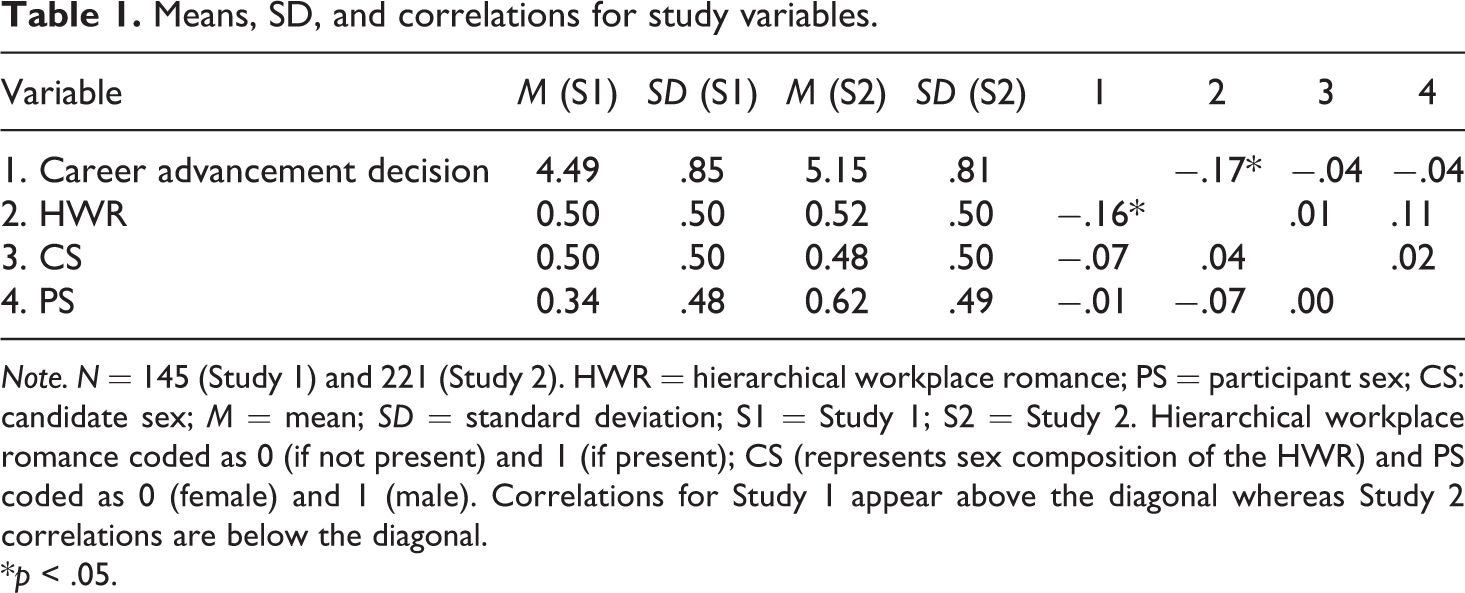
Note. N = 145 (Study 1) and 221 (Study 2). HWR = hierarchical workplace romance; PS = participant sex; CS: candidate sex; M = mean; SD = standard deviation; S1 = Study 1; S2 = Study 2. Hierarchical workplace romance coded as 0 (if not present) and 1 (if present); CS (represents sex composition of the HWR) and PS coded as 0 (female) and 1 (male). Correlations for Study 1 appear above the diagonal whereas Study 2 correlations are below the diagonal.
*p < .05.
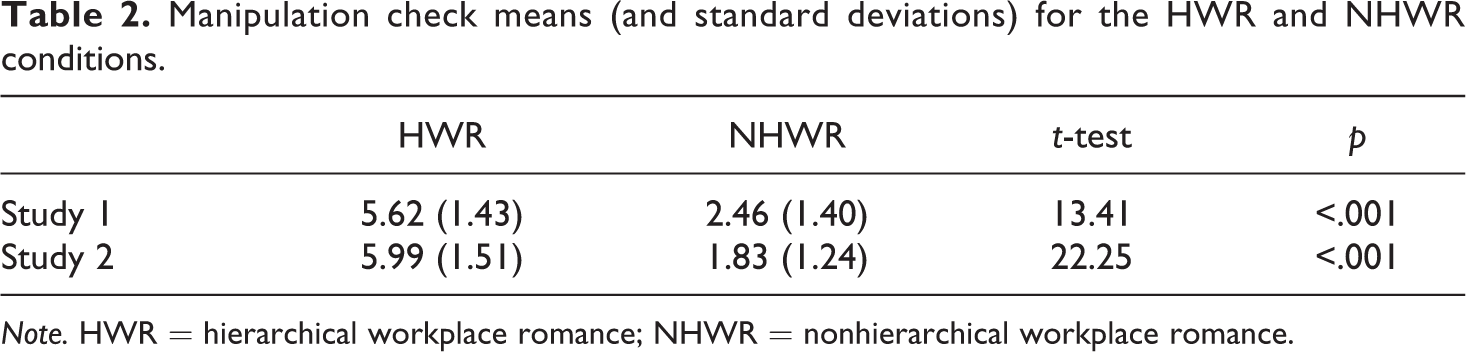
Manipulation check
To conduct a manipulation check for HWR an independent-samples t-test was carried out comparing the HWR and NHWR conditions (see Table 2). This analysis confirmed that participants in the HWR condition scored higher on the manipulation check scale (M = 5.62, SD = 1.43) than the participants not in the HWR condition (M = 2.46, SD= 1.40), t (143) = 13.41, p < .001. Therefore, our manipulation was effective.
Manipulation check means (and standard deviations) for the HWR and NHWR conditions.
Note. HWR = hierarchical workplace romance; NHWR = nonhierarchical workplace romance.
Hypotheses tests
To test the hypotheses, a 2 × 2 × 2 analysis of variance (ANOVA) was carried out in which promotion was the dependent variable, and HWR, CS (representing sex composition of the HWR), and PS were the three independent variables. PS was included to control for any effects that it might have on evaluators’ perceptions of an HWR and especially their career advancement decisions for male versus female candidates. With regard to the former, Powell (1986) reported women to be more opposed to WRs than men and Powell (2001) found that male participants were more likely than female participants to take personal action about the HWR, such as report the HWR to management; Jones (1999), however, did not find any PS effects. In terms of the latter, research has shown that women possess significantly stronger in-group bias than men (e.g., Rudman & Goodwin, 2004), which suggests that, compared to their male counterparts, female participants may evaluate the woman in both HWR and NHWR conditions more favorably than the man in the two conditions. 4 The results of this analysis are presented in the first three columns of Table 3. In support of Hypothesis 1, there was a significant main effect of HWR on promotion, F(1,137) = 4.92, p = .03, η 2 =.04. Both female and male participants were significantly less likely to promote candidates involved in an HWR (M = 4.34, SE = .10) than candidates not involved in such a relationship (M = 4.67, SE = .11). However, Hypothesis 2 was not supported as the interaction between HWR and CS was not significant, F(1,137) = 1.80, p= .18, η 2 =.01. To explore this further, we plotted the cell means that comprise the interaction (see Figure 1) and also tested the simple effects of HWR for male and female candidates, respectively. As can be seen in Figure 1, the direction of the interaction was consistent with Hypothesis 2, such that the negative effect of HWR was greater when the candidate was male (HWR: M = 4.20, SE = .14; NHWR: M = 4.73, SE = .16) than when the candidate was female (HWR: M = 4.47, SE = .15; NHWR: M = 4.60, SE = .15). Furthermore, the former simple effect was significant (p < .05), whereas the latter was not (p = .54). Thus, although the interaction effect was not significant, the data did provide some evidence that HWR has a greater detrimental effect for lower status male candidates than for lower status female candidates.
ANOVA results for the effects of HWR, the sex composition of the HWR (represented by CS) and PS on promotion (Study 1) and organization sponsored management training and development (Study 2) decisions.
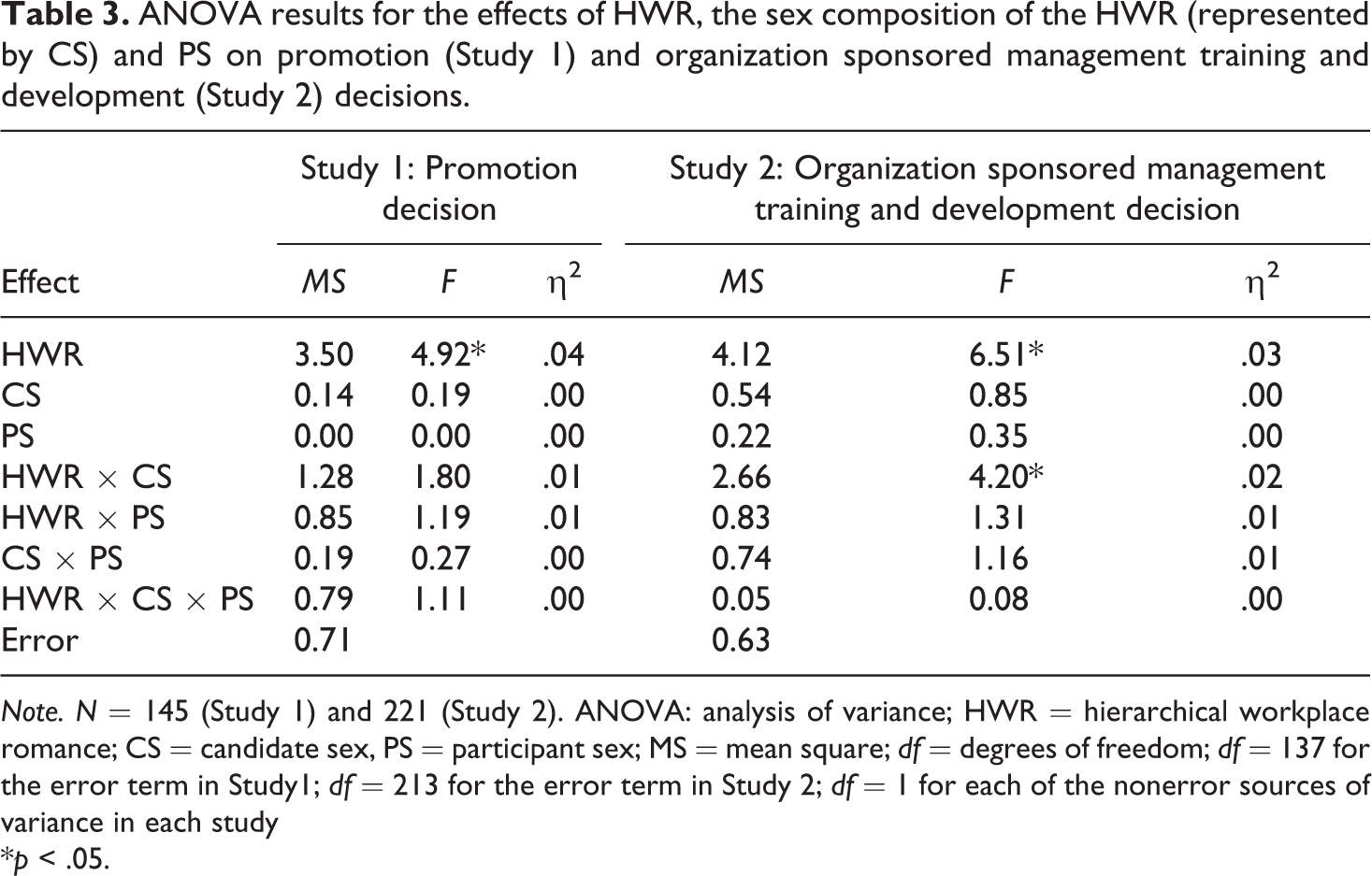
Note. N = 145 (Study 1) and 221 (Study 2). ANOVA: analysis of variance; HWR = hierarchical workplace romance; CS = candidate sex, PS = participant sex; MS = mean square; df = degrees of freedom; df = 137 for the error term in Study1; df = 213 for the error term in Study 2; df = 1 for each of the nonerror sources of variance in each study
*p < .05.
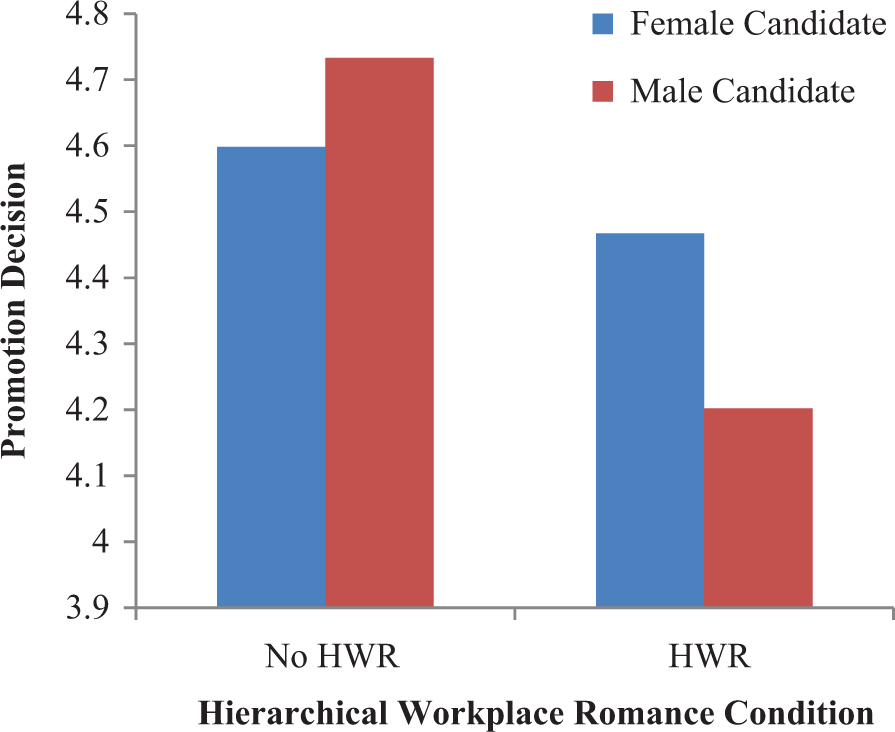
The interaction effect of HWR and the sex composition of an HWR (represented by CS) on promotion decision (Study 1). HWR = hierarchical workplace romance; CS = candidate sex.
Study 2
To test the generalizability of the Study 1 results obtained from students, we recruited currently employed participants from a more general population for Study 2. Various design improvements were made as well as a different dependent variable was used for Study 2.
Method
Participants
Two hundred and thirty-nine participants were recruited from a general population subject pool in the U.S. via Amazon.com’s Mechanical Turk (MTurk), a web-based crowd-sourcing system, in 2013. Of these, 18 participants were omitted as they either failed to pass an attention/validity check item or they were not currently employed. Consequently, the final sample comprised 221 currently employed participants (136 males and 85 females). The majority of these participants were Caucasian (82%), with Asians comprising an additional 11%, and the rest comprising individuals of other ethnic backgrounds (e.g., African Americans and Hispanics). Participants had an average of 14.04 years (SD =10.68) work experience and were dispersed across a wide range of jobs, including information technology (18%), sales (17%), operations (11%), research and development (9%), HR (8%), general management (7%), and the remaining were in accounting, production, finance, marketing, and entrepreneurial work. In addition, 28% reported being in a managerial role. Upon study completion, participants were compensated US$0.75, which is consistent with the typical compensation rate for a 20 min task (Buhrmester, Kwang, & Gosling, 2011). Buhrmester, Kwang, and Gosling (2011) found that data collected from MTurk met or exceeded the psychometric standards associated with published research (see DiDonato, Mcllwee, & Carlucci 2014, for a recent example of its use).
Design and procedure
This online experiment was similar to that of Study 1, except for the dependent variable and various improvements to Study 1 described below. Participants were asked to play the role of an executive (Pat Meyer) in a hypothetical insurance company (AIC) and to decide whether the candidate should be sponsored by AIC to participate in a highly coveted training program (i.e., a 2-year full-time MBA program at a prestigious business school of the candidate’s choice, after which she/he will be promoted at AIC). Information provided to participants (e.g., the candidate’s CV) was modified to match the industry and training scenario. The use of a different industry and career advancement outcome increases the generalizability of the findings. This study consisted of the same five sections as Study 1.
Various improvements were made to the HWR manipulation. First, the HWR manipulation was embedded later on in the task and not within the candidate’s description so HWR appears almost as an afterthought (see scenario below). We believe this change increased the realism of the scenario and minimized potential demand characteristics. Second, we deleted the information about the candidate meeting the supervisor for lunch and spending many nights together at work and changed the word “dating” to being in a romantic relationship. The former further decreased the potential negative connotation attached to WR (i.e., there is now no trade-off between the time they spend on their romantic relationship and on their jobs) and the latter clarified the construct of interest. The following information was provided to participants in the HWR condition:
You, Pat Meyer, sit back a moment and think about the evaluation task ahead. You recall meeting Christopher (Christine) Smith two years ago at an Annual Dinner and since then he (she) has worked on a small project with you. You know Christopher (Christine) Smith is motivated and gets along well with his (her) colleagues. In recent months, you heard that Christopher (Christine) has also been getting along well with his (her) current supervisor, Patricia Cummings (Peter Cummings), a Senior Manager in the California office. In fact, Christopher (Christine) and Patricia (Peter) are now in a romantic relationship.
Measures
HWR manipulation check
To assess the effectiveness of the HWR manipulation, the following two questions were responded to on a 7-point scale (1 = Strongly disagree; 7 = Strongly agree): (i) “The candidate recently began a WR with his (her) supervisor” and (ii) “The candidate is involved in a WR with his (her) supervisor.” The average of the 2 items was used to check the manipulation (Cronbach α = .97).
Evaluator’s career advancement decision: Organization sponsored management training and development
Organization-sponsored management training and development decision was assessed using 3 items responded to on a 6-point scale (1 = Strongly disagree; 6 = Strongly agree): (i) “This candidate should be considered further for the training opportunity”, (ii) “AIC should sponsor this candidate for the 2-year MBA program”, and (iii) reverse-coded “The candidate should not be selected for the training opportunity.” The average of the 3 items was taken as the overall measure of selection intention (Cronbach α = .85).
Results
Manipulation check
Participants in the HWR condition scored higher on the manipulation check scale (M = 5.99, SD = 1.51) than participants not in the HWR condition (M = 1.83, SD = 1.24), t (219) = 22.25, p < .001. The manipulation check was thus effective.
Hypotheses tests
The final three columns in Table 3 present the results of a 2 × 2 × 2 ANOVA in which organization-sponsored management training and development was the dependent variable, and HWR, CS (represented the sex composition of HWR), and PS were the three independent variables. In support of Hypothesis 1, there was a significant main effect of HWR on training and development, F(1,213) = 6.51, p = .01, η 2 =.03. Participants were less likely to select candidates involved in an HWR for the training opportunity (M = 5.02, SE = .08) than candidates not involved in such an HWR (M = 5.31, SE = .08). In support of Hypothesis 2, the interaction effect of CS and HWR condition was statistically significant, F(1,213) = 4.20, p = .04, η 2 =.02. The interaction effect is plotted in Figure 2. Figure 2 shows that decrease in sponsorship decision for the HWR candidate compared to the NHWR candidate was greater when the candidate was male (HWR: M = 4.86, SE = .11; NHWR: M = 5.38, SE = .13) than when the candidate was female (HWR: M = 5.19, SE = .11; NHWR: M = 5.25, SE = .11). Tests of the simple effects found that the detrimental effect of HWR was significant for the male candidate (p = .002) but not for the female (p = .71).
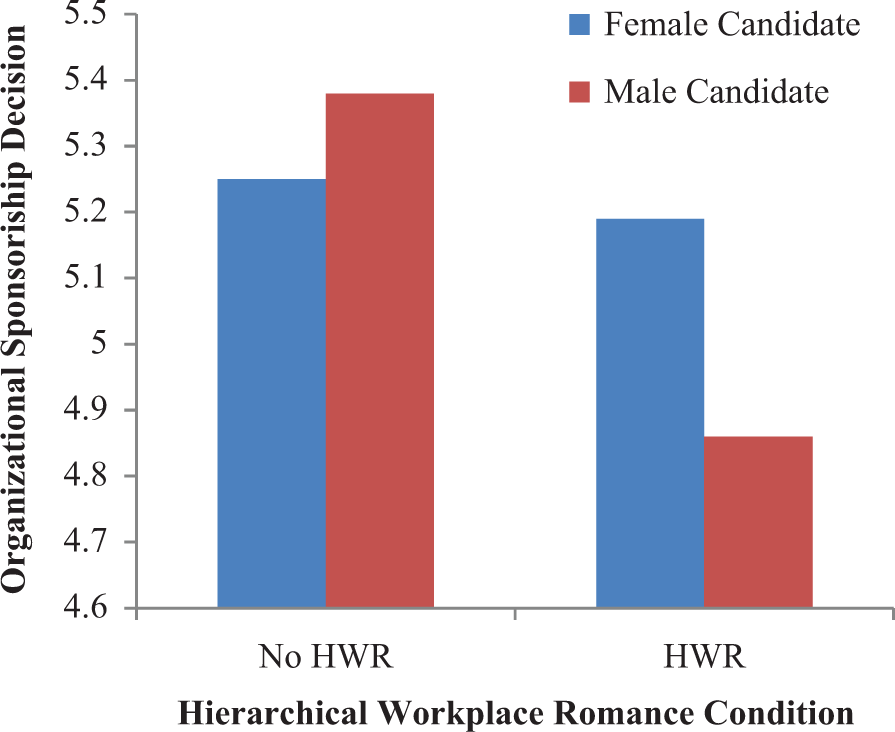
The interaction effect of HWR and the sex composition of an HWR (represented by CS) on organization sponsored management training and development decision (Study 2). Note: HWR = hierarchical workplace romance; CS: candidate sex.
Discussion
Our finding that third-party evaluators use HWR, a nonwork-relevant attribute, when making career advancement decisions reinforces the view that workplace romantic relationships represent a significant organizational issue, worthy of scholarly attention. Our studies show that engaging in a WR has damaging career ramifications for participants in a romantic relationship with higher status individuals. We found that third-party evaluators appraised the lower status HWR participants more negatively than their identical counterparts not involved in an HWR, such that they were given fewer promotion and training opportunities. Evidence of past achievements is likely to be discounted when individuals are involved in romantic relationships with higher status partners (recall, the competencies and achievement information for candidates in all conditions were identical). Furthermore, the results of Study 2 show that the negative impact of HWR is moderated by the sex composition of the HWR, in that lower status men in an HWR were less likely to receive organization sponsored training and development opportunities than lower status women in HWR. Notably, the results of both studies (especially Study 2) show that HWR is more harmful to lower status men than women. This finding contributes to the reconciliation of the inconsistent findings in research area (e.g., Horan & Chory, 2009, 2011). In all, the findings highlight an important scholarly and managerial concern, where supposed objective personnel decisions in the organization are biased by nonwork-relevant information (i.e., engagement in an HWR and sex of lower status HWR participant).
Theoretical and practical implications
Our article makes several contributions to advance research on WR. First, our studies show that negative evaluator judgment of the lower status HWR participants is driven by their involvement in a WR, not necessarily by other variables. Undoubtedly as discussed, the inclusion of control conditions (i.e., no HWR) contributes to extant WR research (with the exception of Malachowski et al., 2012) by offering more evidence that WR is the key variable that drove our results.
Second, our research suggests that for lower status men in an HWR especially, stereotype beliefs about what roles men, and accordingly women, should fulfill in society may sidetrack their career advancement. For lower status women in an HWR, our results indicate that the relationship itself does not cause additional harm to them. If our theorizing is correct, this would be because their low status information does not get activated when they are in an HWR. That is, individuals view such relationships as the norm and hold stereotypic beliefs that a woman should be in a relationship with a man of higher status (cf. Heilman, 2001). Indeed, stereotypes are ubiquitous, held unconsciously, and have the potential to bias important decisions by workplace evaluators, such as those related to career advancement (Cuddy, Glick, & Beninger, 2011).
Third, our research, following the tradition of Horan and Chory’s (2009, 2011, 2013) and Malachowski et al.’s (2012) methodology, contributes to previous empirical work by examining WR without secretive and/or negative connotations attached. In prior research, Jones (1999), for instance, designed for realism, a scenario where participants learned of the romance by seeing their two colleagues kissing in a car, and subsequently assessed their perceptions of the colleagues. Similarly, Powell (2001) showed that coworkers negatively perceived HWR participants when a married participant was involved. A potential limitation of these methods is that we do not know if the negative findings of these studies arose from the observation of the WR itself or from the negative/secretive manner in which the romance was presented. The romantic relationships in our studies (especially Study 2), depicted in an open manner without negative or positive connotations attached, allowed us to investigate how evaluators assess others in an HWR in its purest form possible. Accordingly, the current findings show that even without the secretive and/or negative undertone of, for example, an extra-marital affair, evaluators still disapproved of an HWR between two presumably single participants and provided the lower status participant with fewer career opportunities.
It is also worthwhile to note that workplace evaluators of an HWR are just as likely as observers and coworkers of such relationships to perceive its participants in a negative light. Specifically, past research reporting experiments assigned participants to the role of observers (e.g., coworkers) without the formal power to evaluate and appraise the participants in an HWR (e.g., Devine & Markierwicz, 1990; Horan & Chory, 2009, 2011; Powell, 2001). Similarly, field research reported surveys of uninvolved observers’ reactions to participants in a WR (e.g., Salvaggio, Streich, Hopper, & Pierce, 2011). Missing from such research endeavors, therefore, is the consideration that evaluators with the authority to make important organizational decisions, such as those related to career advancement, may assimilate information about an HWR differently from mere observers. Our assertion is consistent with research showing that vested interests in the outcome of a decision affect processing and categorization of problems, resulting in behaviors different to uninvolved individuals (e.g., Day & Lord, 1992). Moreover, stereotype activation does not necessarily equate to stereotype application (Kunda & Spencer, 2003), which would support our claim that evaluators might act differently to mere observers even though they perceive the lower status romance participants negatively, because they may, for instance, be motivated to avoid acting in a prejudiced manner when awarding them career opportunities. As evidenced in our findings, however, third-party evaluators with formal power to appraise are just as likely as mere observers to view and behave negatively toward lower status HWR participants (cf. Horan & Chory, 2009).
Finally, our findings contain a caution to those individuals who are engaging, or seek to engage, in an HWR (see Horan & Chory, 2011 and Jones, 1999 for similar words of caution). They suggest that these individuals, especially men, need to consider how an HWR may negatively impact their careers; albeit erroneously. This effect is akin to a “reverse halo effect,” a cognitive bias which causes evaluators to judge a person negatively as a result of holding a preexisting negative evaluation of the person deriving from an unrelated source. Moreover, such negative judgments ensue even when there is sufficient information discounting such judgments (Nisbett & Wilson, 1977; i.e., candidates have high qualifications in both studies).
Limitations and avenues for future research
The limitations present in this research should be noted. First, unlike Pierce, Broberg, McClure, and Aguinis (2004), our findings do not generalize to all classes of HWRs; that is, they only apply to lower status participants in a relationship with their direct supervisors. Future research may test whether our findings apply to those in a relationship with indirect reports. We anticipate they will not because such relationships produce less perceived conflicts of interest. Second, although our finding that an HWR disadvantages lower status men is grounded on our theoretical argument that their hierarchical romantic relationships trigger their low status in their evaluators’ minds, we did not assess whether status information of participants in an HWR was indeed activated when evaluators made their judgments, nor did we measure participants’ perceptions of whether the lower status man in an HWR violated gender role–based status expectations when he was given fewer career opportunities. An alternate rationale for this finding is that as women are generally assumed to be attracted to higher status men (they indeed are according to some research in evolutionary psychology, e.g., Buss, 1989), lower status women are more likely to be attributed the genuine love motive for engaging in an HWR. 5 Men, on the other hand, are generally not assumed to be attracted to higher status women and therefore, such men are more likely to be viewed as driven by job rather than love motives. This rationale leads us to predict that because lower status men in an HWR are seen as more instrumental, third-party evaluators will, due to a variety of reasons such as attempting to restore equity for others in the organization and losing respect and trust toward them (cf. Horan & Chory, 2009), provide them with fewer career advancement opportunities. This is consistent with our rationale for Hypothesis 1 and Malachowski et al.’s (2012) findings that when coworkers viewed peers as driven by job motives for engaging in an HWR, they are more likely to treat these peers in a deceptive manner. These theoretical arguments require further empirical investigation.
Third, we recognize the limitation of using a student sample and the potential lack of external validity in Study 1. Even though this sample is not representative of working employees and the majority of our participants from an Australian university have an Asian background, we believe that it provides a conservative test of our hypotheses. The participants were drawn from a large diverse city in Australia; if they viewed WR negatively, we assert that it is reasonable that currently employed participants drawn from a more general population will as well. Indeed this is shown to be the case in Study 2. Of note, the interaction effect in Study 1 was not significant, although the simple effects did provide some evidence that HWR has a greater detrimental effect for lower status male candidates than for lower status female candidates. The nonsignificance of the interaction effect could be because of the slight negative connotation present in the HWR description in Study 1 (i.e., the candidate spent a lot time at lunch and after work together); that is, it could have influenced the participants to evaluate the lower HWR participants of both sexes in a negative manner. When improvements were made in the design for Study 2, a significant interaction effect was found.
Finally, our choice to focus on the evaluation of the lower status HWR participant only tells one side of the story. We propose that future studies ask participants to make similar evaluations of the higher status HWR participant and adapt the current research design in order to avoid the potential confounds present in past research (e.g., no NHWR condition; Jones, 1999). We suspect that higher status HWR participants are more immune to negative judgments (cf. Devine & Markiewicz, 1990) because research has consistently shown that individuals who are perceived as high status often are judged as more competent than individuals perceived as having low status (e.g., Fiske, Cuddy, Glick, & Xu, 2002). However, based on our theorizing, this may not hold true for women in a relationship with their male subordinates. This is because their high status information may be activated in the evaluators’ minds due to the novel and unexpected nature of the romantic relationship (i.e., stereotype activation theory) and such information is incongruous with evaluators’ status expectations about gender roles. That is, evaluators will judge these women more negatively as they “should be” of lower status. If indeed this were the case, HWR may be harmful to both male subordinates in a relationship with their female superiors and women superiors with their male subordinates.
Conclusion
Findings from our research show that engaging in an HWR has deleterious effects on the career advancement opportunities of individuals in a romantic relationship with their superiors. We further demonstrate that the lower status HWR participants are less likely to be rewarded with organization sponsored management training and development opportunities when these participants are men. Our research suggests organizational members who are or plan to be involved in a romantic relationship with their superiors should be conscious that workplace evaluators may judge and appraise them in a biased manner. Similarly, managers with authority to select and promote should especially be aware that romance in the workplace have the potential to insidiously shield them from being able to make objective work decisions.
Footnotes
Acknowledgment
An earlier version of this paper was presented at the 2012 Academy of Management Conference, Boston, Massachusetts, USA.
Funding
The author(s) disclosed receipt of the following financial support for the research, authorship, and/or publication of this article: This research was funded by the UNSW Business School, Special Research Grant (2010) awarded to Suzanne Chan-Serafin and Amirali Minbashian.