



Abstract
Verbal versus nonverbal primacy is a central assertion in interpersonal communication. This study developed an analytical and theoretical framework to assess which of these two channels gains preference, during an exploration of children’s response to their parents’ incongruent communication. Incongruence is conceptualized as a discrepancy or contradiction between verbal/nonverbal communication. Parent–child interactions (n = 160) in structured joint game sequences were filmed in their homes and analyzed using a mixed multivariant design. The study expanded the theory by analyzing a wide range of social and situational contexts. The findings delineated the contexts for nonverbal primacy, verbal primacy, and reciprocal incongruence. The presented framework advanced composite theoretical accounts into a set of conclusions for verbal versus nonverbal primacy.
Keywords
Incongruent communication is conceptualized as a discrepancy or contradiction between integrated verbal and nonverbal communication (Grebelsky-Lichtman, 2014a; Jones & LeBaron, 2002). The current study expands research regarding incongruent communication by analyzing verbal versus nonverbal primacy. The concept of primacy refers to the state of being dominant, more important, or contributing more (Buck & VanLear, 2002). An intriguing question emerges when incongruence exists. This question lies at the heart of this study: Which channel contributes more to communicating attitudes, feelings, and emotions?
Developmental theory shows that incongruent parental messages can affect the development and personality formation of preschool children (Butterworth, 2014). Specifically, such messages may negatively affect children’s perceptions of their own abilities (Burgoon, 2006; Jacobs & Eccles, 1992). However, there is paucity in studies that explore children’s responses to parental incongruent communication and address the question of verbal versus nonverbal primacy. This study aims to fill this gap in the parent–child communication literature. The study contributes by analyzing preschool children at the age of 4, which is an important developmental period for emerging communicative strategies. At this age, parents have a strong influence on children as one of the primary socialization forces in their lives (Kerns & Barth, 1995).
The theoretical foundations for verbal versus nonverbal primacy are conceptualized in reliance theories and channel summation research (Bugental, Kaswan, & Love, 1970; Mehrabian & Weiner, 1967), which determine which types of cues (verbal or nonverbal) are more influential in the perceptions of participants exposed to incongruent communication. This study expands reliance theories by presenting a novel analytical and theoretical framework for analyzing verbal versus nonverbal primacy. The proposed framework uniquely explores the responses to various incongruent patterns. This analysis contributes to comprehensive accounts of the responses to diverse patterns of incongruent communication.
The proffered framework presents a two-stage perspective: expressiveness and responsiveness (Figure 1). Expressiveness constitutes various incongruent communication patterns: incongruent type I, which involves positive verbal communication with negative nonverbal communication (V+N−), and incongruent type II, which involves negative verbal communication with positive nonverbal communication (V−N+). Responsiveness conceptualizes types of responses to these incongruent patterns. Regarding responses to incongruence type I: a positive response represents verbal primacy, a negative response represents nonverbal primacy, and an incongruent response represents a reciprocal pattern. Regarding responses to incongruence type II: a positive response represents nonverbal primacy, a negative response represents verbal primacy, and an incongruent response represents a reciprocal pattern.
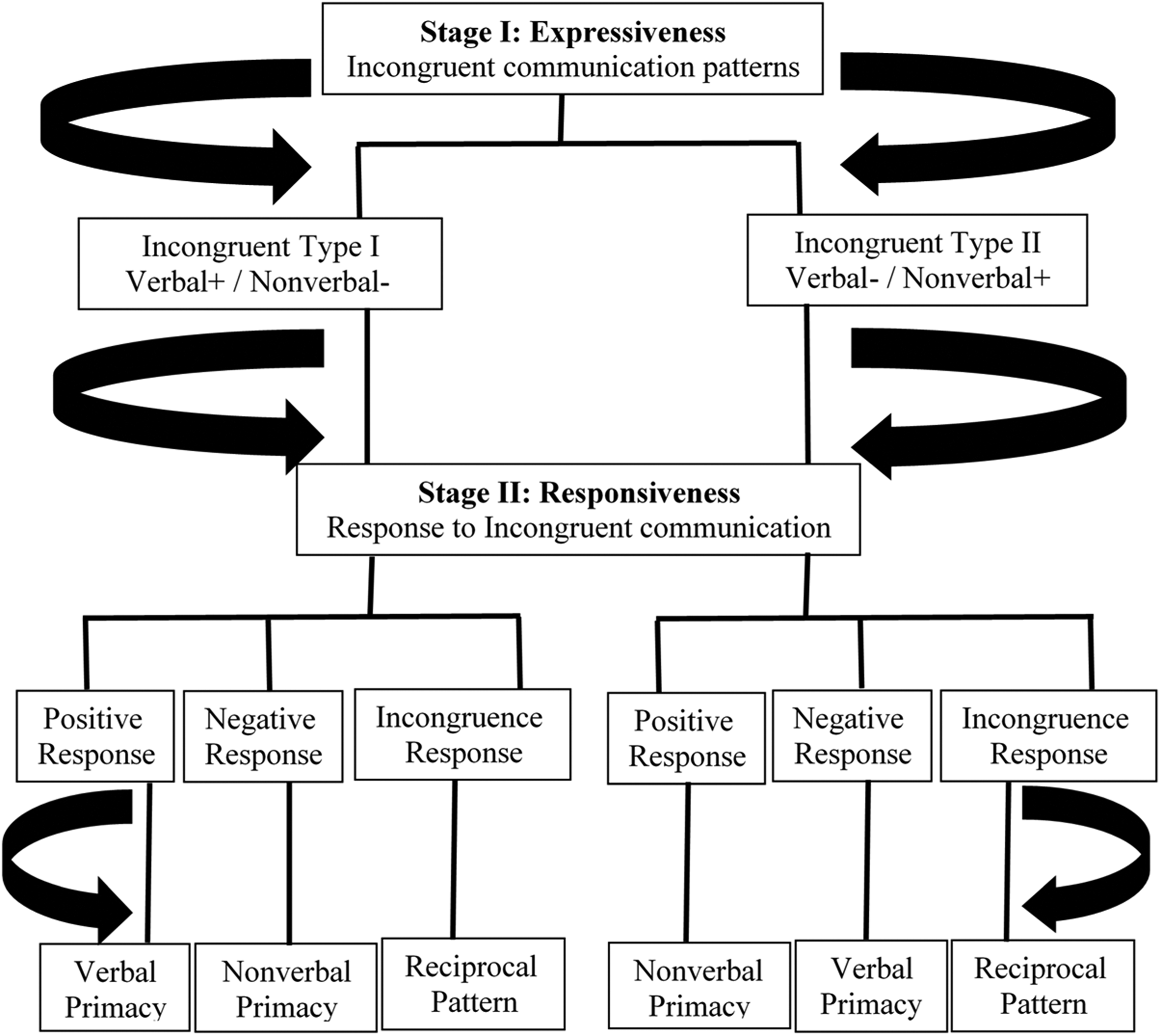
Theoretical and analytical framework for verbal versus nonverbal primacy.
This theoretical framework explains the interpersonal communication process. The first two types of responses indicate verbal or nonverbal primacy. In these patterns, the response refers to one of the communication modes. The third response pattern expresses a reciprocal cycle of mutual incongruent communication. The main contribution of this study is its indication that not all instances of responses to incongruent communication refer to one of the channels. Most previous studies focus on either verbal or nonverbal responses. The proposed framework adds the pattern of reciprocal incongruent response. This presents a new contribution to research regarding mutuality in parent–child interactions and expands the theoretical account regarding channel reliance theories.
The theoretical framework implements the premise of the communication context approach (Grebelsky-Lichtman, 2015; Walker & Trimboli, 1989), which examines verbal versus nonverbal primacy as a complex dynamic process, in which the interpretation placed on a verbal or nonverbal signal is frequently contextually dependent. The current study aims to address the lacuna in the field. This study delineates the contexts among children in which verbal communication gains dominance and those in which nonverbal communication gains preference in parent–child interactions. To achieve this aim, this study analyzes a wide range of social and situational contexts, including parents’ gender, child’s gender, family socioeconomic status (SES), and task difficulty. The study assumes and establishes that children’s responses to parental incongruent communication are affected by the social and situational context that activates nonverbal primacy, verbal primacy, or a reciprocal pattern of incongruence.
Nonverbal primacy
Reliance theories argue that nonverbal primacy is a key element in distinguishing between primary and secondary sources of information in interpersonal contexts (Burgoon et al., 2002). The developmental interactionist theory (Buck & VanLear, 2002) argues that the nonverbal stream may gain primacy. This notion is explained using evolutionary perspectives (Boone & Buck, 2003) and is supported by research that indicates that nonverbal communication gains primacy because the reception process of nonverbal cues is faster than the analysis of verbal messages (Lamy, Salti, & Bar-Haim, 2009).
Early channel reliance theories propose the nonverbal dominance hypothesis (Argyle, Alkema, & Gilmour, 1972; Mehrabian & Weiner, 1967), in an attempt to shed light on the role that verbal and nonverbal cues play in human interaction (Mehrabian, 1981). Typical experiments in these studies use judges who rate the affect conveyed by artificially constructed (directed and displayed by an actor) incongruent messages (V+N− or V−N+). An analysis that rates the combined messages reveals the component (verbal or nonverbal) with the stronger effect. This method is termed the cue opposition paradigm (Walker, 1977). The results of experiments that use the cue opposition paradigm support the nonverbal dominance hypothesis. Whether the affective communication involves interpersonal attitude (Argyle et al., 1972), feelings (Graves & Robinson, 1976), or emotions (Mehrabian & Wiener, 1967), the nonverbal component has a significantly greater effect than the verbal component. Numerous studies confirm this finding and argue that nonverbal communication gains preference (Grahe & Bernieri, 1999; O’Sullivan, Ekman, Friesen, & Scherer, 1985; Walther, Loh, & Granka, 2005).
In the communication context approach (Walker & Trimboli, 1989), the context of a parent’s gender may affect nonverbal primacy. The social learning theory stresses that different parental behavior of mothers and fathers affects socialization during childhood (Bandura, 1986; Fivush, Brotman, Buckner, & Goodman, 2000). However, there is a gap in studies that analyze the effect of parents’ gender on children’s responses to their parents’ incongruent communication. Previous studies that analyze nonverbal communication indicate nonverbal primacy in women’s communication (Durden-Smith & DeSimone, 1983; Gove & Carpenter, 1982). This assumption is grounded in the central role of nonverbal communication in affective communication and female dominance in expression of emotions (Hall, 1985; Irby & Brown, 2011). In line with social learning theory and previous studies, we propose the following hypothesis:
Evolutionary theories further emphasize nonverbal dominance for feminine communication (Darwin, 1872). Previous studies stress feminine sensitivity to the use, and identification, of nonverbal expressions (Berglund, Eriksson, & Westerlund, 2005; Buck, 1984). Rowe and Goldin-Meadow (2009) report an advantage among girls in producing gestures. A recent study shows that girls were ahead of boys in terms of early communicative gestures (Eriksson et al., 2012). The current study contributes to the effect of the context of a child’s gender on verbal versus nonverbal primacy. We hypothesize the following:
Regarding the social context and verbal versus nonverbal primacy, there is insufficient research into SES in response to incongruent communication. Studies show that low-SES parents are more nonverbal than high-SES parents (Blaney & Quay, 1992), and the responses of low-SES mothers toward their children are more tactile (Barratt, 1995). Accordingly, we formulated the following hypothesis:
Regarding the situational context, this study explores children’s responses to their parents’ incongruence across parent–child interaction tasks of varying types and difficulty, thus helping to close the gap in the research literature. By examining interactions involving different levels of difficulty, it is possible to observe communication patterns that would not otherwise occur. In particular, free play enhances nonverbal primacy because in this situation parents tend to be more supportive and exhibit affective communication (Gottman, Murray, Swanson, Tyson, & Swanson, 2005). This lack of task-oriented demands may encourage nonverbal dominance (Grebelsky-Lichtman, 2014a). Therefore, we propose:
Verbal primacy
Although the nonverbal dominance hypothesis is widely accepted, the picture is complex. Studies have pointed out that children tend to interpret messages literally and rely more on verbal communication (Burgoon, 2006; Volkmar & Siegel, 1982). Grounded in the communication context approach, interpersonal communication contexts exist in which verbal communication dominates (Buck, 1984; Swann, Stein-Seroussi, & McNulty, 1992). Several studies into the relative primacy of verbal versus nonverbal communication produce complex conclusions supporting the argument for verbal primacy (Berry, Pennebaker, Mueller, & Hiller, 1997; Grahe & Bernieri, 1999; Walker & Trimboli, 1989).
Verbal primacy is established in research that analyzes the role of verbal and nonverbal signals in interpersonal communication. This approach uses congruent conversational messages, in which the verbal and nonverbal components are consistent and communicate the same affect. These messages are constructed as segments shown to judges, who then rate the audiovisually presented material (Furnham, Trevethan, & Gaskell, 1981; Strahan & Zytowski, 1976). Surprisingly, the results of these studies do not show nonverbal dominance. Instead, they reveal that ratings based only on the verbal component provide the most accurate assessment of a rating given to a full audiovisual performance. This study offers a new perspective regarding the nonverbal dominance hypothesis and undermines the central role that prior research gives to nonverbal signals.
According to the communication context approach, the context of a parent’s gender may enhance verbal primacy. Social learning theories may explain verbal primacy among children (Block, 1983; Huston, 1983). Children view their parents as a model, emulate them, and adopt their patterns of communication (Bandura, 1986). On the basis of studies that emphasize fathers’ task orientation and high need for achievement (Barratt, 1995; Gallaway & Richards, 1994; Henderson, 1991):
Regarding the context of a child’s gender, research points to greater parental demands of boys. Parent–boy communication is more task- and achievement-oriented (Chick, Heilman-Houser, & Hunter, 2002; Irby & Brown, 2011; Lytton & Romney, 1991). Task orientation enhances verbal primacy (Grebelsky-Lichtman, 2015). Therefore, we assume that boys will exhibit verbal primacy in response to their parents’ incongruence. We propose the following hypothesis:
In the social context, family discourse theories maintain that parental SES has an effect on children’s verbal competence and learning abilities (Bornstein & Bradley, 2003). High-SES mothers talk more and expect greater verbalization from their children than do low-SES mothers (Dickinson & Snow, 1987). SES-related differences are found both in measures of children’s comprehension and in their production of vocabularies (Rowe & Goldin-Meadow, 2009). According to family discourse theories and findings from previous research:
Situation-specific aspects of parent–child interaction tasks influence parent–child communication (Ginsburg, Grover, Cord, & Ialongo, 2006). Children are expected to relate to their parents’ verbal communication during a difficult task (Greene, 2007). In complex task situations, parents tend to function as educators and direct the child’s performance of the task (Rogers & Sawyers, 1990). High levels of difficulty force children to concentrate on their parents’ verbal communication to cope with the challenge:
Reciprocal pattern of incongruence
This study adds the reciprocal response pattern of incongruent communication. Reciprocal patterns in parent–child interactions are conceptualized as synchronized responsiveness (Lindsey, Mize, & Pettit, 1997). Synchronized responsiveness represents interactional synchrony as a feature of social exchange between family members (Wahler & Bellamy, 1997). There is a lack of studies that analyze children’s reciprocal incongruent pattern of response. Herein lays this study’s contribution to the research.
The theoretical framework for this pattern draws on an integrated communication approach (Buck & VanLear, 2002; Jones & LeBaron, 2002) that emphasizes the importance of examining both verbal and nonverbal communication modes and their relationships (Schultz, Tulviste, & Konstable, 2012; Sigman, 1995). Research examines the ways in which verbal and nonverbal behaviors are associated with one another and explores their interrelationships (Ekman, 1997; McNeill, Cassell, & McCullough, 1994; Streeck & Knapp, 1992). However, research analyzing children’s reciprocal incongruent response pattern in social and situational contexts is insufficient. This study aims to fill this gap.
Based on the communication context approach, a parent’s gender may affect the reciprocal pattern of incongruence. Previous studies argue that mothers’ communication with their children was more incongruent than that of fathers (Barton & Tomasello, 1994; Grebelsky-Lichtman, 2014a; Neill, 1991). According to social learning theories (Bandura, 1986; Huston, 1983), children acquire patterns of communication with discrepancies or contradictions between verbal and nonverbal messages. These discrepancies encourage reciprocal incongruent patterns among children who imitate their mother’s incongruence. We present the following hypothesis:
In the context of a child’s gender, emotional theoretical perspectives explain that incongruence among children may result from failure to receive full legitimacy for their negative emotions (statements such as “You mustn’t be angry,” or “Big children aren’t jealous”) (Benziman & Marodes, 1997). This may lead to incongruence in children’s behavior (Argyle et al., 1972; Graves & Robinson, 1976; Walker, 1977). Such a communication pattern is more characteristic of boys (Chick et al., 2002; Fox, 2011; Knapp & Hall, 2010). We hypothesize the following framework:
Regarding the social context, action assembly theory (AAT; Greene, 2007), which explains the formulation and production of verbal and nonverbal messages, claims that children’s incongruent responses result from difficulty assembling and integrating verbal and nonverbal procedural records (defined as long-term memory units that contain three types of information: action features, outcome, and situation). The lack of an overarching integration of relevant action features may cause the overall communication to convey conflicting meanings. Incongruence, or problems of assembly, represents a child’s communicative behavior in which the outcome expression lacks coherence or appears disjointed (Greene, 2007). On the basis of AAT, high-SES children should exhibit greater cognitive skills of assembling verbal and nonverbal messages through congruent expressions, while low-SES children will exhibit greater incongruent expressions (Grebelsky-Lichtman, 2014b). We hypothesize:
According to AAT, incongruence or assembly problems are more likely to occur in the context of difficult tasks (Greene, 2007). Difficulty in performing a task results in an assembly process (output representation) in which the entire configuration of action features displays incongruence. Therefore, we hypothesize:
This study examines children’s responses to genuine parental incongruence. The concept of genuine parental incongruence refers to authentic communication conduct. This concept is the opposite of artificially incongruent messages that are constructed, directed, and conveyed by an actor. The importance of reviewing genuine incongruent messages is that they are not isolated but are intrinsic to the communication context. Using observational data, this study establishes incongruent communication from parent–child interactions in structured, joint game sequences filmed in the subjects’ homes.
Methods
Participants
The study included 160 interactions consisting of one child and the mother or father. To enrich the theory and methodology in the context of gender differences regarding complex communication patterns, equal number of boys and girls participated in the study. The average age of the children was 4.2 (range: 3.9–4.6), an age at which children demonstrate verbal and nonverbal communication skills, a range of play skills, the ability to plan ahead, the capacity for representational thinking and imagination, social cognition, and motor skills (Fasulo, Liberti, & Pontecorvo, 2002). First-born children were excluded because studies show that their patterns of communication differ from those of their subsequent siblings (Berglund et al., 2005). Likewise, only children were also excluded (Suitor & Pillemer, 2007).
This study analyzed children’s interactions with both mothers and fathers (Barratt, 1995; Gallaway & Richards, 1994), in order to attain a comprehensive approach toward the array of children’s communication patterns during parent–child interactions. The mothers’ ages ranged from 29 to 45, and the fathers’ ages ranged from 31 to 53 (M = 33.2, SD = 2.1; M = 37.5, SD = 3.5, respectively). All parents were married couples who were living together at the time of the study. All parents who participated in the study were employed, with the exception of two mothers: one with high SES and the other with low SES.
The families were contacted through preschools. Contact was initiated with families that included children who (according to their teachers) had no developmental, cognitive, communicative, or motor problems and came from well-functioning families. Each family filled out a demographic questionnaire. The SES measure was based on the theoretical and empirical arguments that a composite measure (which takes into account various factors, including education level, income, and number of rooms in the home or apartment) is preferable and is the most comprehensive measure (Bornstein & Bradley, 2003; Marks, 2010; Sirin, 2005).
Eighty parents were involved, with each parent engaged in two series of interactions: half from high-SES families and half from low-SES families. The high-SES families had two parents with at least a college education, above-average income, above-average number of rooms in the house or apartment, and residence in at least an upper-middle-class neighborhood. The low-SES families had two parents with no more than a 12th-grade education, below-average income, below-average number of rooms in the house or apartment, and residence in a lower class neighborhood. All parents signed consent forms to participate in the study.
Procedures and research sites
Child–mother and child–father interactions were observed and videotaped in the family’s home. Participants were informed that they were participating in a study on how parents and children play together. Two meetings were held with each family. On the first occasion, an interaction between the child and one of the parents was videotaped. On the second occasion, an interaction between the child and the other parent was videotaped. The interactions were between just the child and one of the parents. The other parent or other children were not present during the interactions. To neutralize a potential order effect, mothers were observed first in half of the sessions. Fathers were observed first in the other half. Moreover, a Latin square design for order effect was conducted. The test revealed no order effect on children’s response to parents’ incongruent communication, F(1,306) = 0.16, NS.
The interactions involved cooperative play with an Etch a Sketch drawing screen (Ginsburg et al., 2006). The Etch a Sketch has two knobs, one on each side, that are turned to create lineographic images. One knob draws only vertical lines and the other knob draws only horizontal lines. The toy is suitable for the cognitive, motor, and social skills of a normal 4-year-old child. The parent and the child were given one Etch a Sketch board and instructed to play together. Each was assigned one of the two controls. Although all of the participants were familiar with Etch a Sketch, none of them had ever used it in such a mutual game structure. The parent–child interactions started with free play, followed by three assigned tasks with increasing levels of difficulty: first task—the participants were asked to draw a square; second task—the participants were asked to draw stairs; and third task—the participants were asked to draw a maze. No time limit was set for task completion. The first 10 min of each of these 160 situations were coded. The coders were blind to the families’ SES.
Instrumentation and coding system
The interactions were coded on the basis of the videos filmed in the families’ homes for nonverbal communication and dialogue transcriptions for verbal communication. The coding involved the free play and the most difficult task. Two undergraduate research assistants, each of whom received approximately 7 hr of training, transcribed the interactions. The transcription system used conversation analysis to transcribe verbal communication (Stivers & Sidnell, 2012). Two other undergraduate research assistants, each of whom received approximately 14 hr of training, coded the verbal and nonverbal communications. In establishing intercoder reliability, disagreements between coders were resolved by clarifying and then reapplying the coding book guidelines.
Coding procedures: Verbal communication
The coding of verbal communication and categories of analysis were based on discourse analysis (Blum-Kulka, 1997). The dialogue transcriptions were first divided into utterances, which are the basic units of semantic content (Courtright, 2014). Utterances as units of analysis preserve meanings conveyed in the dialogue. An utterance may be smaller than a turn, which may include several utterances (Stiles, 1992). This study deals with spoken language, which is characterized by many shortcuts, particularly within family conversations. Therefore, although some utterances may appear to be lacking or incomplete, they stand on their own and derive their meaning from the flow of the interaction. For instance, a child’s utterance of “enough” stands on its own and means “stop turning your knob.” The following example illustrates the division into utterances.
What would you like to draw?1
A giraffe.2 No.3 Um … a tiger with no moustache.4 With no moustache here.5 No,6 in fact I want to draw … Um … this ruler,7 but it is impossible.8
In this example, the discourse is divided into eight utterances. The speech act expressed for each utterance was specified (Stiles, 1992). Positive speech acts include agreement, encouragement, appreciation, and expressions of satisfaction. Negative speech acts include blame, rejection, refusal, disagreement, complaint, derision, warning, and threat.
Intercoder reliability was calculated for 10% of the 160 interactions, which were randomly selected and coded separately by two different coders. The unitizing formula by Guetzkow (1950) was used to divide the interactions into utterances (u = .04). Inter-rater reliability was examined using Scott’s π (Craig, 1981; Scott, 1955) for coding verbal communication strategies (based on the speech acts; .92).
Coding procedures: Nonverbal communication
Coding nonverbal communication was based on functional theory (Afifi, 2007) to analyze gestures and postures. A gesture is a form of nonverbal communication in which visible bodily actions communicate particular messages, either in place of, or in parallel to, words (Rowe & Goldin-Meadow, 2009). Gestures include movements of the hands, face, or other parts of the body (Schultz et al., 2012). A posture is an intentionally or habitually assumed position of the human body (Knapp & Hall, 2010).
Operationally, positive nonverbal gestures include nodding, positive physical contact, guidance, and moving hands in a circular motion. Negative nonverbal gestures include shaking head from side to side, finger-pointing to represent a warning or a threat, negative physical contact, a closed fist, cutting hand movements, and touching external objects or the body. Negative nonverbal postures include enclosing, descending, and retreating. Positive nonverbal postures include spreading, ascending, and advancing. Intercoder reliability using Scott’s π (Craig, 1981; Scott, 1955) was calculated to code nonverbal communication strategies (based on gestures and postures; .89).
Study design
The study used a mixed, multivariable, multifactorial design. The independent variables contained two between-subject variables (the child’s gender and SES) and two within-subject variables (the parent’s gender and task difficulty). These variables were nested to address nonindependence. A parent’s gender was nested in the design, constituting a within-subject variable, based on the interdependence between parents who react to the same child in the collaborative activity. Task difficulty was nested in the design and considered a within-subject variable based on interdependence between the various tasks assigned by the same dyad of parent and child.
The dependent variable was children’s responses to the parents’ incongruence. This variable consisted of the following three communication indices: response to parents’ verbal communication, response to parents’ nonverbal communication, and response through incongruent communication.
Constructing the variable of children’s responses to parental incongruence
Parental incongruence was defined as discrepancy between the channels (N−V+ or N+V−). If the parent expressed incongruence type I (N−V+), and the child expressed a negative response, the child’s response was to the verbal communication. If the child expressed a positive response, the child’s response was to the nonverbal communication. If the child expressed an incongruent response to the parent’s incongruence, the child responded using incongruent communication.
When the parent expressed incongruence type II (N+V−), and the child expressed a positive response, the child’s response was to the nonverbal communication (Figure 1). If the child expressed a negative response, it was to the verbal communication. If the child expressed an incongruent response to the parent’s incongruence, the child responded using incongruent communication.
A multivariate analysis of variance (MANOVA) for repeated measures was conducted to examine the children’s response to parents’ incongruent communication patterns. Three types of responses to the parents’ incongruent patterns were explored in relation to the study’s independent variables: child’s gender, parent’s gender, SES, and task difficulty. Scheffé’s post hoc tests at p < .01 were conducted to correct for multiple comparisons.
Results
The study revealed that in contrast to the nonverbal dominance hypothesis, children’s response to parents’ verbal communication was M = 21.6; SD = 14.9 (45.6%); children’s response to parents’ nonverbal communication was M = 17.9; SD = 10.9 (43.1%); and these differences were not significant, χ2(1) = 7.9, p < .37. As for children’s response through incongruent communication, this pattern was found to be the least common among children: M = 4.4; SD = 3.1 (10.7%). In most cases, children who received incongruent communication involving a contradiction between verbal and nonverbal channels responded to one of these channels (see Table 1).
Children’s response to parental incongruent communication and the research variables.
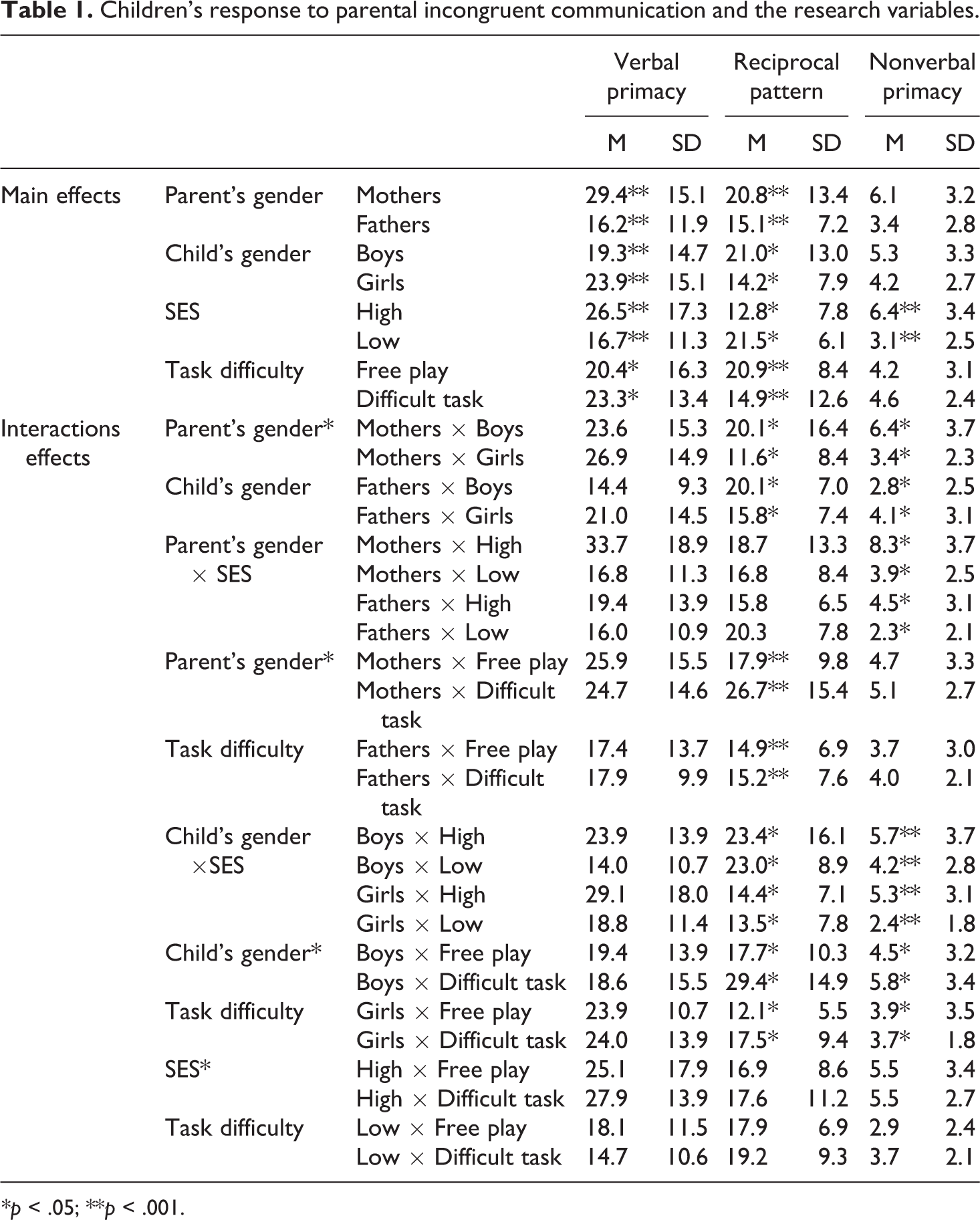
*p < .05; **p < .001.
Children’s responses to parental nonverbal communication
In this pattern, when children received incongruent communication, they responded to the parents’ nonverbal communication and the nonverbal channel gained primacy. MANOVA for repeated measures revealed significant differences in children’s response to parental incongruence toward mothers and fathers; multivariate F(1,144) = 4.78; p < .01; η2 = .21. As confirmed with H1a, children responded more to their mothers’ nonverbal communication (M = 20.8; SD = 13.4) than to their fathers’ nonverbal communication (M = 15.1; SD = 7.2); see Figure 2(a). This finding sheds light on the common perception that nonverbal communication gains primacy in feminine communication.
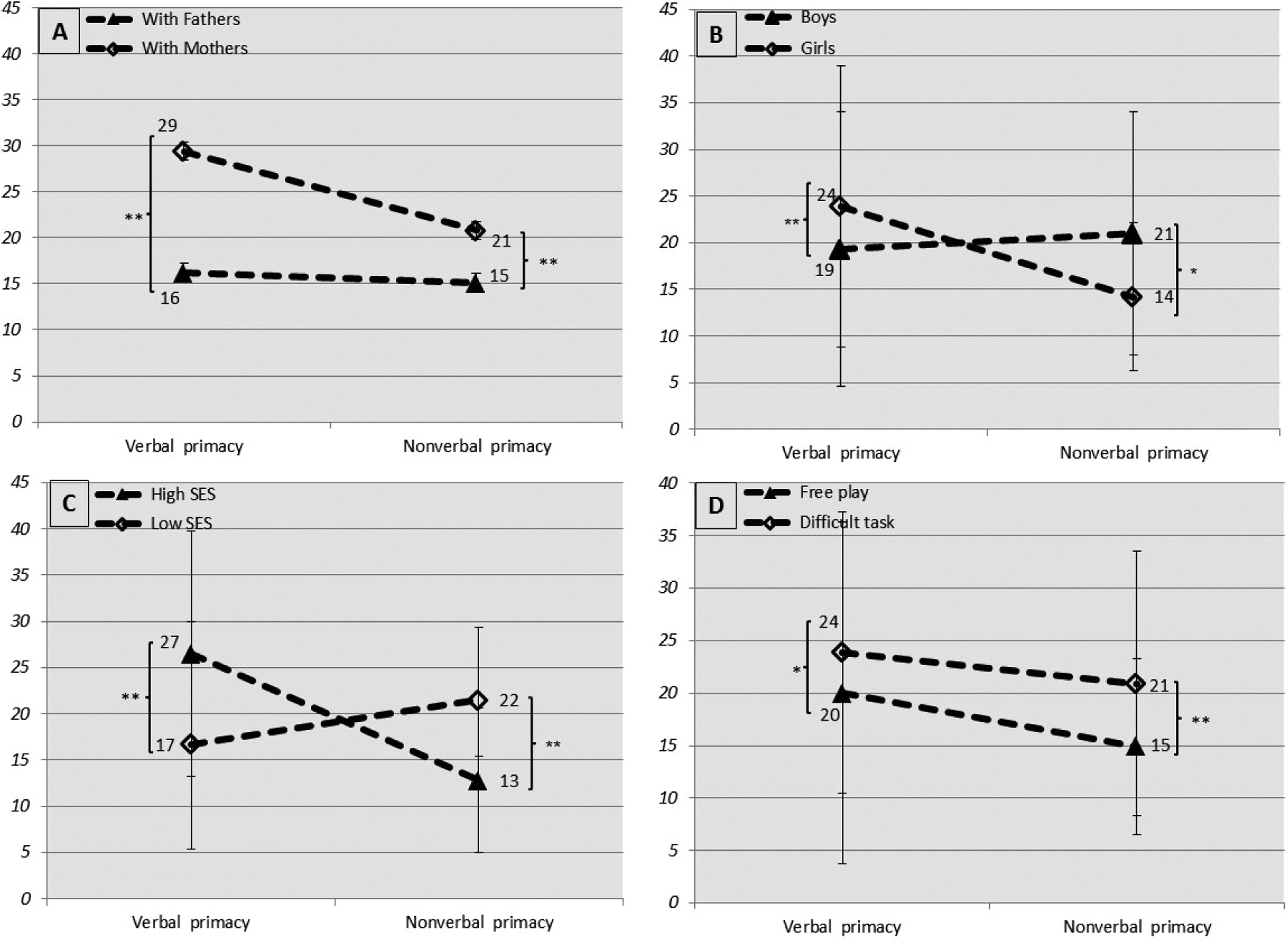
Children’s response to parents’ incongruent communication. Figures (a to d) illustrate children’s response to parental incongruent communication: (a) With fathers and mothers. (b) Boys and girls. (c) High-SES and low-SES. (d) Free play and difficult task. Shown are mean values ± SD. *p < .05; **p < .001.
An analysis of children’s response to parents’ nonverbal communication indicated differential communication pattern among boys and girls; multivariate F(1,144) = 4.98; p < .03; η2 = .11. In contrast to hypothesis H1b, as Figure 2(b) illustrates, boys responded more (M = 21.0; SD = 13.0) than girls (M = 14.2; SD = 7.9) to a parent’s nonverbal communication. Surprisingly, boys were more sensitive to nonverbal communication and to covert emotive levels of behavior in their parents’ communication and emphasized the parents’ nonverbal channel. In addition, when boys received an incongruent pattern, which involved negative verbal communication and positive nonverbal communication, they tended to respond to the positive message.
Importantly, note that the tendency among children was to attach dominance to the channel with the positive content. Children’s dominant channel is content dependent. They gain preference for parental support and react to it. It is also interesting to note that this finding is manifested in various contexts, including girls’ communication, and in other contexts revealed in the current study.
The analysis revealed a significant interaction effect between a child’s gender and SES; multivariate F(1,144) = 28.2; p < .0001; η2 = .38. Scheffé’s post hoc tests indicated that responses to parents’ nonverbal communication were most frequent among high-SES boys (M = 23.4; SD = 16.1). High-SES boys more frequently expressed nonverbal primacy. Low-SES girls less frequently displayed this pattern of response to their parents’ incongruence (M = 13.5; SD = 7.8).
Furthermore, task difficulty had a significant main effect on nonverbal primacy. In contrast to H4a, a significant difference was found in children’s response to their parents’ nonverbal communication during free play, compared with the performance of difficult tasks; multivariate F(1,144) = 4.51; p < .01; η2 = .21. Unexpectedly, children responded more to their parents’ nonverbal communication in difficult tasks (M = 20.9; SD = 12.6) than in free play (M = 14.9; SD = 8.4); see Figure 2(d). During difficult tasks, parents expressed nonverbal communication in a manner that provided concrete and tangible information regarding the execution of the task. Frequently, this information cannot be conveyed in words and may contain affective communication.
MANOVA for repeated measures revealed a significant interaction effect between the task’s level of difficulty and the child’s gender; multivariable F(1,144) = 3.74; p < .03; η2 = .16. Scheffé’s post hoc tests indicated that, among boys, response to parental nonverbal communication was greater during the performance of a difficult task (M = 29.4; SD = 14.9) than in free play (M = 17.7; SD = 10.3). Among girls, the gap between free play (M = 12.1; SD = 5.5) and a difficult task was smaller (M = 17.5, SD = 9.4). This result may stem from the differential perception that boys and girls attach to an assignment and the importance of its successful completion. Boys expressed a more task-oriented approach than girls.
Regarding children’s responses to their parents’ nonverbal communication, a significant interaction effect between the task’s level of difficulty and a parent’s gender was revealed; multivariate F(1,144) = 7.26; p < .01; η2 = .27. Specifically, Scheffé’s post hoc tests indicated that, in interactions with mothers, the gap between children’s communication during free play (M = 14.9; SD = 9.8) was greater than during the difficult tasks (M = 26.7; SD = 15.4) compared with interactions with fathers. Children’s communication toward fathers was much more similar during free play (M = 14.9; SD = 6.9) and difficult tasks (M = 15.2; SD = 7.6). This finding is consistent with the finding that mothers in general attached greater importance than fathers to the implementation of a difficult task. Mothers’ task-oriented approach affected their behavior toward the children, which is reflected in the children’s behavior toward them.
Children’s responses to parental verbal communication
In this pattern of response, when the parent exhibited verbal and nonverbal incongruence, the children responded to the verbal communication and the verbal channel gained primacy. The analysis of this response pattern revealed differential behavior among boys and girls. In contrast to H2b, a significant main effect for the child’s gender was found; multivariate F(1,144) = 10.87; p < .002; η2 = .31. Unexpectedly, as indicated in Figure 2(b), a response to the parent’s verbal communication was more common among girls (M = 23.9; SD = 15.1) than boys (M = 19.3; SD = 14.7). Girls received more parental type I incongruent communication (see Figure 1), which involved positive verbal communication and negative nonverbal communication. Thus, girls reacted to the positive communication and gained preference for the supportive parental content.
Moreover, analyses of children’s responses that indicated verbal primacy revealed differences between high- and low-SES children; multivariate F(1,144) = 6.23; p < .01; η2 = .22. In accordance with H3b, high-SES children placed greater emphasis on the verbal communication and, accordingly, related more to the verbal component of their parents’ behavior. As illustrated in Figure 2(c), this emphasis on verbal communication was reflected in the fact that, when parents conveyed contradictory messages in the verbal and nonverbal channels, high-SES children related more (M = 26.5; SD = 17.3) than low-SES children (M = 16.7; SD = 11.3) to the verbal message. Verbal primacy among high-SES children may be affected by their parents’ behavior. High-SES parents emphasized the verbal message in joint interactions, and this was reflected in the children’s behavior. It is noteworthy that this finding additionally reflects the primacy children attach to positive content.
In accordance with H4b, a significant difference was found between responses to the verbal communication during free play and during the performance of difficult tasks; multivariate F(1,144) = 4.61; p < .03; η2 = .21. Children responded more to their parents’ verbal communication in difficult tasks (M = 23.3; SD = 13.4) than in free play (M = 20.0; SD = 16.3), as shown in Figure 2(d). For children, their parents’ verbal communication gained dominance during difficult task situations and the statements they expressed were relevant to the task. Because of a predetermined task, completing the assignment was essentially meaningless without the presence of speech. During the execution of the difficult task, the child needs the parent more to complete the task. The child awaits concrete instructions. Therefore, the verbal message carries significant information for the child, which may lead to verbal primacy in this context.
Children’s response by incongruent communication
In this pattern, children respond to parents’ incongruent communication using an incongruent pattern. Analyses of children’s responses using incongruent communication revealed a significant main effect for SES. In contrast to H3c, significant differences existed between the behavior of high- and low-SES children; multivariate F(1,144) = 6.18; p < .01; η2 = .26. Unexpectedly, an incongruent response was more common among high-SES children (M = 6.4; SD = 3.4) than among their low-SES peers (M = 3.1; SD = 2.5). When high-SES children were the recipients of incongruent communication, they responded more with similar discrepant communication and displayed an incongruent response rather than by making a clear choice between the channels.
A significant interaction effect was found between SES and the parent’s gender, F(1,144) = 3.23; p < .05; η2 = .12. In line with hypothesis H3a, children expressed a more incongruent response toward mothers than fathers. However, surprisingly, Scheffé’s post hoc tests revealed that high-SES children displayed greater differentiation in their response. Among high-SES children, the gap between the response to mothers (M = 6.3; SD = 3.7) and to fathers (M = 4.7; SD = 3.1) was significant. Among low-SES children, the gap between the response to mothers (M = 3.5; SD = 2.5) and to fathers (M = 3.0; SD = 2.6) was not significant.
Additionally, an interaction effect was found between SES and a child’s gender, F(1,144) = 29.32; p < .0001; η2 = .31. This interaction confirms hypothesis H3b that boys express more incongruent communication than girls. However, Scheffé’s post hoc tests indicated that, whereas the gap between boys (M = 5.7; SD = 3.7) and girls (M = 5.3; SD = 3.1) was not significant among high-SES children, among low-SES children, the gap in the behavior of boys (M = 4.2; SD=2.8) and girls (M = 2.4; SD = 1.8) was significant. Low-SES girls demonstrated the least incongruent communication patterns and were least likely to receive parental incongruence.
Children’s responses through incongruent communication showed a significant interaction effect between the gender of the child and the gender of the parent, F(1,144) = 3.72; p < .03; η2 = .21. An incongruent response was more typical in interactions in which the child and the parent were of the opposite gender than in same-gender dyads. Scheffé’s post hoc tests indicated that children’s reciprocal pattern of incongruent response to parental incongruent communication occurred significantly more in mother–son interactions (M = 6.4; SD = 3.7) and father–daughter interactions (M = 4.1; SD = 3.1) than in mother–daughter interactions (M = 3.4; SD = 2.3) and father–son interactions (M = 2.8; SD = 2.5). Opposite-gender dyads manifested greater discrepancies and incongruent communication.
A significant interaction effect was revealed between a child’s gender and the task difficulty, F(1,144) = 3.89; p < .02; η2 = .18. Scheffé’s post hoc tests indicated that boys and girls demonstrated reverse behavior in the different situations. Girls expressed a reciprocal pattern of incongruent response to parental incongruent communication more during free play (M = 3.9; SD = 3.5) than during a difficult task (M = 3.7; SD = 1.8). Boys expressed a reciprocal incongruent response significantly more during a difficult task (M = 5.4; SD = 3.4) than during free play (M = 4.5; SD = 3.2). Boys behaved differently according to the difficulty of the task, whereas girls’ behavior was largely consistent. Boys demonstrated a task-oriented approach, exhibited high achievement motivation, and attached great importance to completing the complex assignment.
Discussion
This study contributes to a central assertion that concerns the nature of interpersonal communication—whether verbal or nonverbal communication gains preference. This study develops an analytical and theoretical framework that assesses the dominant channel in response to incongruent communication. The study expands the integrated communication approach (Buck & VanLear, 2002; Jones & LeBaron, 2002) into forms of children’s response to parents’ verbal and nonverbal incongruence. Using these novel findings, this study advances composite theoretical accounts into a set of conclusions for verbal versus nonverbal primacy.
Verbal/nonverbal primacy is context dependent
This study demonstrates that it is impossible to discuss a dominant channel without referring to the context. These findings are novel in the context of children’s response to parental incongruent communication. Most previous studies indicate the dominance of one channel (Buck & VanLear, 2002; Burgoon et al., 2002). The prevailing perception addresses the dominance of nonverbal communication and argues that greater importance will be attached to the nonverbal channel in response to incongruent communication (Boone & Buck, 2003; Mehrabian, 1981). Other studies point to verbal dominance and maintain that the verbal element gains preference in the interpretation of the entire message in social communication (Lunger & Wurf, 1999; Swann et al., 1992). This study indicates a slight advantage for verbal primacy among children, which supports studies suggesting that children interpret messages literally and rely more on verbal communication (Burgoon, 2006; Volkmar & Siegel, 1982). However, the study also highlights the complexity of interpersonal communication analysis. Children respond to verbal and nonverbal communication almost equally.
This study extends the communication context approach for analyzing verbal and nonverbal primacy (Walker & Trimboli, 1989). It also shows that it is impossible to attribute an a priori primacy and dominance to one of the channels. In interpersonal communication, primacy attributed to one of the channels depends upon context. This study contributes to the expansion of this theoretical framework by examining a wide range of social and situational contexts and exposes their effect on children’s responses to parents’ incongruent communication. This analysis of various contexts presents a broad theoretical account and a comprehensive picture of the relative dominance of verbal versus nonverbal communication modes in mutual parent–child interactions. This establishes a tapestry of communication patterns derived from social and situational contexts that delineate the contexts in which nonverbal communication gains primacy, contexts in which the verbal channel gains primacy, and contexts in which children’s response to their parents’ incongruence is itself incongruent.
Positive content primacy: An optimistic approach
Children’s communication patterns demonstrate primacy for the channel with positive content, whether in verbal or nonverbal communication. In response to parental incongruent communication, the positive message gains preference. This communication pattern reveals an optimistic approach that emphasizes supportive parental communication (Gottman et al., 2005).
Preference for the positive message is displayed in differential responses to parental incongruence among boys and girls. Surprisingly, boys expressed nonverbal primacy and responded more to parental nonverbal communication, whereas girls expressed verbal primacy and responded more to parental verbal communication. These differences may stem from the types of incongruence that children receive from their parents (Grebelsky-Lichtman, 2014a). Girls receive more incongruence characterized by negative verbal communication and positive nonverbal communication. In contrast, boys receive more incongruence characterized by positive verbal communication and negative nonverbal communication. The response to incongruence indicates that both boys and girls prefer the positive message. When children receive an incongruent communication, they give primacy to the positive content and respond to it.
Preference for positive content is also activated in the social context that expands AAT (Greene, 2007). Accordingly, high-SES children receive more positive verbal messages and negative nonverbal messages and respond more to the verbal message. However, low-SES children receive more negative verbal messages and positive nonverbal messages and respond more to the nonverbal message. This attitude reflects children’s optimistic approach and may have implications for improving parent–children interactions.
Nonverbal primacy gains preference in affective communication
Nonverbal primacy is manifested in emotional communication. This concept emphasizes the central role of nonverbal communication in communicating affect (Walker & Trimboli, 1989) and reinforces previous studies that show that an intimate partner has an easier time exposing verbal attempts to conceal emotions through nonverbal leaks (Buck, 1984; Ekman, 1997). Nonverbal expressions gain preference in emotional communication. People more precisely decipher nonverbal cues of those with whom they feel greater familiarity (Sabatelli, Buck, & Dreyer, 1980; Zuckerman, DePaulo, & Rosenthal, 1981). The current study substantiates this finding in relation to parent–child incongruent communication.
Social learning theory shows that communication patterns in the family are affected by the parents’ gender (Fox, 2011). This study reveals that the children attributed dominance to the nonverbal channel during interactions with their mothers. These interactions express more emotional communication, advancing previous studies that emphasize women’s sensitivity to the use, and identification, of nonverbal expressions (Berman & Smith, 1984; Buck, 1984; Hall, 1985). This nonverbal maternal sensitivity creates a communication pattern that affects the children, who attach dominance to the mothers’ nonverbal messages. When the mothers demonstrate incongruence between verbal and nonverbal messages, the children respond to the nonverbal communication.
Furthermore, nonverbal primacy is expressed during affective communication in the context of a difficult task. The parent may nonverbally convey emotional availability (Biringen & Robinson, 1991), assisting the child in managing difficult feelings. In particular, high levels of difficulty may create frustration among children, so parents’ nonverbal support may serve as emotional scaffolding.
Verbal primacy gains dominance in achievement-oriented communication
Achievement-oriented communication establishes verbal primacy, and children give preference to the verbal channel. In this context, verbal primacy adheres to AAT in describing the cognitive process that leads to this communication pattern (Greene, 2007). In achievement-oriented communication, the child grants primacy to the messages that promote successfully completing the task. The emphasis is on the verbal channel when the approach is task-oriented and achievement-based.
This study exposed several contexts characterized by achievement orientation. In the social context, children from high-SES demonstrate achievement orientation and a greater need for achievement. This finding confirms studies that indicate a strong orientation of high-SES parents toward achievement (McClelland, Atkinson, Clark, & Lowell, 1953; Sirin, 2005). In interactions between high-SES parents and children, the emphasis is on verbal communication, to which the children give primacy and attach greater importance. This behavior is anchored in studies that argue that high-SES children talk more because their parents’ conversational style improves the acquisition of a higher level of verbal response (Dickinson & Snow, 1987; McCabe & Peterson, 1994; Pine, 1994). A cyclical process is created, which may contribute to the perpetuation of social differences. High-SES parents talk more, their children talk more, so the resultant discourse is richer. The emphasis on verbal communication creates a situation that develops high-SES children’s verbal competence.
In the situational context, the difficult task constitutes a situation of achievement-oriented communication for children. In this situation, children exhibit stronger task orientation and a greater need for achievement. McClelland et al. (1953) define the need for achievement as a matter of success when striving for a standard of excellence. When confronted with difficulties, children depend more on the parents and emphasize parental information that could expedite the completion of the task. This dependence is associated with the children’s social and interactional roles, which vary as the task’s complexity changes (Weizman, 2008). During free play, children’s interactional role dominates. Free play enabled the children to establish the role of instructors—a leading role. In such situations, the social hierarchical role is less prominent. However, when executing a complex task, the difference between the parent and the child gains importance. In this situation, the parents’ social role positions them as guides and mentors, while putting the children in the position of listeners and executors (Grebelsky-Lichtman, 2014b). In the course of the difficult task, children are more attentive to parents’ instructions on how to perform the task, as the verbal channel gains dominance.
In the gender context, boys exhibited greater assignment orientation than girls and attach greater importance to succeeding in completing the task. Boys demonstrated a stronger need for achievement and gave primacy to the verbal channel to successfully complete the task. This result confirms gender stereotypes and may contribute to the perpetuation of gender differences (Irby & Brown, 2011). This also confirms research regarding the higher demands that parents have of boys, particularly in task- and achievement-oriented situations (Chick et al., 2002; Lytton & Romney, 1991), which affect boys’ strong need for achievement. Studies stress the importance of children’s need for achievement. Children with a strong need for achievement are more independent in their thoughts and actions and are more motivated to study. They also make a greater effort to attain goals and display a stronger sense of personal responsibility and persistence than children whose achievement orientation is weaker (Sirin, 2005).
In addition, children present achievement-oriented communication and a stronger need for achievement in interactions with their mothers than their fathers. In contrast to studies that emphasize the fathers’ task orientation (Barratt, 1995; Gallaway & Richards, 1994; Henderson, 1991), this study surprisingly demonstrated that mothers attach greater emphasis on completion of the predetermined task. This emphasis may affect children’s behavior toward their mothers. In interactions with mothers, the children were more task- and achievement-oriented and gave primacy to the verbal channel.
Emotional availability and reciprocal incongruent communication
Emotional availability theory emphasizes parents’ importance to provide a sense of security when the child verbally or nonverbally expresses emotional distress (Biringen & Robinson, 1991). Grounded in emotional availability theory, incongruent communication expresses an absence of affective communication and emotional support (Ziv, Aviezer, Gini, Sagi, & Karie, 2000). Parental incongruent communication represents leakage of their emotional state through nonverbal behavior (Ekman, 1997). Drawing on AAT (Greene, 2007), this occurs in situations in which parents’ verbal expressions are not grounded in the emotions they nonverbally express. A gap between the two messages may form through less conscious communication modes (Grebelsky-Lichtman, 2015). The end result is a reciprocal, incongruent communication pattern that may be experienced as a lack of emotional availability.
Modeling and reciprocal incongruent communication
Reciprocal incongruent communication involves responses to parental incongruence through children’s incongruence. This pattern creates mutual reciprocity in which each party presents an inconsistent, discrepant message that is mirrored by the other person. Most previous studies confine examining the response to incongruence to verbal or nonverbal communication (Berry et al., 1997; Grahe & Bernieri, 1999; Walker & Trimboli, 1989). This study’s contribution is that it exposes contexts in which the response to parents’ incongruence is through children’s incongruence. This finding has theoretical implications that broaden the social learning theory of modeling behavior (Bandura, 1986; Block, 1983) and extend the integrated communication approach toward the study of responses to incongruent verbal and nonverbal modes in interpersonal communication (Buck & VanLear, 2002; Jones & LeBaron, 2002).
This pattern of children’s incongruent communication is expressed more toward mothers, who exhibit greater incongruence (Barton & Tomasello, 1994; Grebelsky-Lichtman, 2014b; Neill, 1991). Children observe their mothers as a model and acquire general patterns of communication that refer to the relationship between verbal and nonverbal channels. In particular, they present the modeling behavior of an incongruent pattern of communication that involves a contradiction between verbal and nonverbal communications.
Reciprocal incongruence characterizes boys’ communication. When boys receive an incongruent parental message, they tend to pursue the ambiguity and respond to the parent by using the same pattern of incongruence. This may stem from parents’ behavior toward boys, which involves more incongruence. According to social learning theory (Bandura, 1986), and in light of shaping theory (Maccoby, 1990), boys’ communication constitutes an acquisition of the parental model.
In the situational context, a difficult task generates reciprocal incongruence. Based on AAT (Greene, 2007), this situation is more enigmatic for children. They are less confident regarding the message that they want to address (Grebelsky-Lichtman, 2014a). When the parent conveys incongruent communication, the children respond to messages transmitted through both verbal and nonverbal channels.
Summary and additional avenues for future research
This study presented an analytical and theoretical framework using an integrated approach to verbal and nonverbal communication in parent–child interactions. The framework provides composite theoretical accounts of diverse patterns of children’s response to parental incongruent communication, which delineates a comprehensive profile of the contexts in which verbal or nonverbal communication gain preference.
The proposed framework may offer additional avenues for future research in a variety of interpersonal communications. Future research in this area should examine children’s response to parents’ incongruence that contain other criteria for participant selection. Additionally, although this study focused on children’s communication patterns, future research could examine parents’ response to their children’s incongruent communication patterns.
Future research may explore the implications of the presented framework for parents, particularly regarding parents’ awareness of their incongruent communication patterns. The framework suggests that by increasing their awareness of both their verbal and nonverbal communication as well as the types of responses of their children to incongruence, parents can improve their communication skills and enhance their interaction patterns. This awareness may have wide-ranging implications, including the effect of training parents to improve the quality of their parent–child communication.
Footnotes
Acknowledgment
The author expresses her thanks to Professor Gadi Wolfsfeld and Professor Yaacov Shamir for their contribution and helpful comments.
Declaration of Conflicting Interests
The author(s) declared no potential conflicts of interest with respect to the research, authorship, and/or publication of this article.
Funding
The author(s) disclosed receipt of the following financial support for the research, authorship, and/or publication of this article: The author would like to give thanks for the financial support of Ono Research Institute (ORI) of Ono Academic College-Israel.