




Abstract
The aim of this study was to test a specific model according to which representations of sexuality (sexual motivation, sexual satisfaction, sexual anxiety, and fear of sex) act as mediators between attachment tendencies and sexual activities (frequency of dyadic and solitary sexual activity and frequency of sexual desire). A community sample of men and women (N = 490; 25–45 years) engaged in an ongoing couple relationship completed questionnaires related to the study variables. After age, duration of relationship, and marital satisfaction were controlled for, the main results showed that (a) in women, higher attachment anxiety was predictive of a higher frequency of dyadic sex and desire for sex; avoidance was predictive of a lower sexual desire; (b) in men, attachment avoidance was predictive of a lower frequency of dyadic sex and desire for sex and of a higher frequency of solitary activity; and (c) most of these effects were indirect and mediated through representations; the paths linking avoidance to sexual activities went mainly through lower positive representations in both women and men (sexual motivation and satisfaction), whereas the paths for anxiety went through a higher negative representation in men (sexual anxiety) and through a higher positive representation in women (sexual motivation). These results were consistent with the deactivation and hyperactivation strategies described for avoidant and anxious tendencies, respectively. However, several suppressor effects were observed, highlighting complex mediational paths. Finally, structural invariance showed that the links between attachment and sexual activities were mediated by representations for both women and men.
Sexuality is an important component of individual well-being and is closely related to satisfaction in dating and in the marital relationship (Byers, 2005; Davison, Bell, LaChina, Holden, & Davis, 2009; Sprecher, 2002). Sexual well-being has been shown to be mainly determined by the frequency of sexual activities on the one hand (Costa & Brody, 2012; Laumann, Gagnon, Michael, & Michaels, 1994) and by positive representations associated with sexuality on the other (Birnbaum, 2007; Simpson, Wilson, & Winterheld, 2004). Frequency refers to how often people engage in a sexual activity; there is large inter-individual variability in frequency but also intra-individual variability, a decrease in frequency occurring with age and with the duration of the relationship (Christopher & Kisler, 2004; Costa & Brody, 2012; Karraker, DeLamater, & Schwartz, 2011; McNulty, Wenner, & Fisher, 2016; Willetts, Sprecher, & Beck, 2004). Representations of sexuality refer to images, fantasies, and affects associated with sexual activities; they are shaped by several variables, such as individual personality, sexual experiences, education about sex, and the internalization of social expectations of gender roles (see Laumann et al., 1994; McClelland, 2010). The link between representations and frequency is not univocal: A high frequency of sexual activity may be associated with positive representations, the individual being motivated to engage in rewarding and self-enhancing activities but also with negative representations, as is the case in sexual addiction; similarly, a decrease in frequency, as occurs with age, may be associated with negative representations of a less motivating activity but also with positive representations of sexual activity that occurs rarely but is more affectionate and intimate (Christopher & Kisler, 2004; Karraker et al., 2011; Reid, Harper, & Anderson, 2009; Zapf, Greiner, & Carroll, 2008).
Attachment theory provides an ideal framework to understand individual differences in the interplay between representations of sexuality and sexual activities (Birnbaum, 2007, 2015; Birnbaum, Reis, Mikulincer, Gillath, & Orpaz, 2006; Cooper et al., 2006). According to attachment theory, sex is a motivational system involved in the intimate relationship, closely related to the motivational systems of attachment and caregiving (Bowlby, 1979; Shaver, Hazan, & Bradshaw, 1988). The three systems are interdependent and influence each other (Hazan & Shaver, 1994). Since the publication of the seminal paper by Hazan & Shaver (1987), numerous studies have shown that romantic attachment may be understood as a system that is similar to child attachment, with two main dimensions underlying the relationship with the partner: anxiety and avoidance. Individuals high on the avoidance dimension have a history of rejection by attachment figures, so that others are viewed as untrustworthy and the self as being alone to regulate emotions. As a consequence, more avoidant people tend to adopt deactivation strategies (Cassidy & Kobak, 1988) of the attachment system: They tend to minimize their relational needs and try not to show their emotions, and any activation of the attachment system is perceived as threatening to the self. Individuals high on the anxiety dimension have experienced an unpredictable environment so that the self is viewed as unworthy and others as more able and competent. As a consequence, more anxious people tend to adopt hyperactivation strategies (Cassidy & Berlin, 1994) of the attachment system: They tend to exaggerate their relational needs, in order to “force” others to react and to take care of them (Mikulincer & Shaver, 2007; Shaver & Mikulincer, 2002). Individuals with a history of responsive attachment figures are low on avoidance and anxiety dimensions and are considered to be secure (Hazan & Shaver, 1987, 1994).
Several studies have shown the influence of attachment tendencies on sexual life. In more secure people, sexuality includes not only sexual intercourse but also other intimate and more affection-based aspects of the sexual relationship (Birnbaum et al., 2006; Cooper et al., 2006). Secure attachment indeed allows sexuality to be deeply interconnected with attachment and caregiving (Davis, Shaver, & Vernon, 2004; Hazan & Shaver, 1994). Relating to someone, being in touch with another individual, taking care of that person, and being taken care of are among the main motivations mentioned by secure individuals for engaging in sexual activity (Birnbaum, Orr, Mikulincer, & Florian, 1997; Birnbaum & Reis, 2012; Feeney, 2002; Mikulincer & Shaver, 2004; Schachner & Shaver, 2004; Shaver, Schachner, & Mikulincer, 2005). As a consequence, sexual satisfaction and motivation for sexual activities are elevated; sexuality is viewed as a positive activity that reinforces the ongoing relationship by enhancing relational satisfaction (Butzer & Campbell, 2008; Rogers, Bidwell, & Wilson, 2005; Stefanou & McCabe, 2012).
Individuals with avoidant tendencies tend to disconnect sexuality from emotions, as the loosening of self that is implied by sexual activity is perceived as threatening. As a consequence, sexual activity may be accomplished without affection and tenderness (Bartholomew, Henderson, & Dutton, 2001). Sex may be used as a pseudo-expression of positive affect in order to deflect the partner’s negative affects without having to openly express emotions related to the relationship (Davis et al., 2004, 2006). For some very avoidant people, sexuality is completely avoided (Brassard, Shaver, & Lussier, 2007; Paul, McManus, & Hayes, 2000) or is strictly focused on solitary activity, that is, masturbation. The latter may be associated with lowered sexual satisfaction and a negative representation of sexuality, especially in men (Bogaert & Sadava, 2002; Gerressu, Mercer, Graham, Wellings, & Johnson, 2008). Finally, avoidant tendencies are linked with extradyadic sex (Allen & Baucom, 2004; Beaulieu-Pelletier, Philippe, Lecours, & Couture, 2011).
Individuals with anxiety tendencies tend to use sexuality to meet their attachment needs rather than being realized for itself. Sexuality is thus used to increase closeness to others, even in the absence of sexual motivation, when there is increased insecurity felt about the relationship (Birnbaum et al., 2006). Anxiety tendencies lead women to be more likely to accept sexual solicitations, as they are afraid that refusal may be followed by rejection by the other person, which is especially threatening for the integrity of the self in anxious individuals (Allen & Baucom, 2004; Impett & Peplau, 2002); these tendencies lead men, on the other hand, to stop trying to engage in sexual activities with a partner, as they do not want to risk facing refusal of their solicitations (Gentzler & Kerns, 2004; Gillath & Schachner, 2006; see Cooper et al., 2006, for a review on gender differences). Interestingly, this is a reverse pattern from the gender difference usually described in general surveys about sexuality: Men have been repeatedly described as more frequently experiencing sexual desire and fantasies and as being more prone to initiate sex than women are (Baumeister, Catanese, & Vohs, 2001; Christopher & Kisler, 2004).
These studies have shown first that attachment tendencies are directly linked to sexual behavior and frequency of sexual activities; second, that attachment tendencies explain representations of sexuality; and third, that representations of sexuality predict sexual activities. In the present study, we proposed to test a specific model according to which representations of sexuality might act as mediators between attachment tendencies and sexual activities. Sexual activities were considered in terms of frequency of desire for sexual activities, frequency of dyadic sexual activities, and frequency of solitary sexual activities. In accordance with the literature, we had the following specific hypotheses: (1) We expected higher avoidance to predict a lower frequency of dyadic sexual activities and sexual desire and a higher frequency of solitary sexual activities. (2) We expected the effect of anxiety on sexual activities to depend on gender: High anxiety would lead women to report more sexual desire and to engage in more dyadic sexual activities and would lead men to be more withdrawn from dyadic sexual life. (3) Finally, we expected representations to mediate the link between anxiety and avoidance and the frequency of sexual activities and sexual desire. In the tests of these hypotheses, other variables known to be predictive of sexual behavior were controlled for, including age, duration of the relationship in established couples, and marital satisfaction.
Method
Sample
This study was a part of a larger study on sexual desire and the couple relationship conducted at the University of Geneva (Switzerland). A community sample of 490 participants took part in the study, comprising 246 women (mean age = 36.3 years, standard deviation [SD] = 5.7) and 244 men (mean age = 36.3 years, SD = 5.4). Participants were recruited through a polling institute that randomly selected 10,000 addresses from a list of households in Geneva. A letter was sent to make first contact and to introduce the topic and the aim of the study. People were then contacted by phone in order to assess whether they met the criteria for this study (25–45 years old and a native or fluent French speaker) and whether they were eligible according to predefined quotas (so that the final sample comprised 50% women and 50% men with comparable ages). Among the people who were successfully contacted (N = 7,344) and met the defined criteria (N = 3,881), 867 agreed to participate in the study and 600 participated effectively (300 women and 300 men), according to the predetermined total in the study protocol. Of the 600 participants, 311 were married (51.8%), 179 were in a couple relationship but not married (29.8%), and 110 were single (18.3%). For the present study, we selected only those participants who were in a committed relationship and we excluded singles. The mean duration of their relationships was 10.3 years (SD = 6.5). Participants received 20 Swiss francs in compensation for their participation.
Procedure
After the participants were contacted by the polling institute and agreed to participate, an appointment was made at home with an interviewer, who collected the data. Some data pertaining to the larger study were collected through a face-to-face interview (e.g., regarding the participant’s social network). The data relevant for this study were collected through questionnaires given to the participants to complete by themselves.
This study and its procedure were approved by the Ethical Committee of the Faculty of Psychology and Educational Sciences of the University of Geneva.
Measures
Romantic attachment
Attachment was assessed with the Experiences in Close Relationships–Revised Questionnaire (Fraley, Waller, & Brennan, 2000; French version: Favez, Tissot, Ghisletta, Golay, & Cairo Notari, 2016). This instrument consists of 36 items that assess the dimensions of anxiety (e.g., “I’m afraid that I will lose my partner’s love”) and avoidance in adults (“I find it difficult to allow myself to depend on romantic partners”). Participants were asked to rate each item using 7-point rating scales (1 = strongly disagree to 7 = strongly agree). A total score was obtained for each dimension by computing the mean of the 18 items (some scores had to be reversed, as some items were worded in the secure direction) related to avoidance (α = .89) and to anxiety (α = .86). The higher the scores, the higher the avoidance and anxiety. Low scores on both dimensions indicate secure attachment.
Representations of sexuality
Representations of sexuality were assessed with the Multidimensional Sexuality Questionnaire (Snell, Fisher, & Walters, 1993; French version: Dosch, 2010). It consists of 60 items assessing 12 dimensions on 5-point scales (0 = not at all characteristic of me, 4 = very characteristic of me), with 5 items per dimension. For our study, four dimensions (20 items) that were shown by previous studies to be associated with attachment tendencies were selected: sexual motivation, defined as the drive to be involved in a sexual relationship (α = .81); sexual satisfaction, defined as the tendency to be satisfied with the sexual aspects of one’s life (α = .89); sexual anxiety, defined as the tendency to feel tension, discomfort, and anxiety about the sexual aspects of one’s life (α = .87); and fear of sex, defined as the fear of engaging in sexual relations with another individual (α = .71). A total score was obtained for each dimension by computing the mean of the five related items.
Frequency of sexual activity and sexual desire
Three items evaluating the frequency of sexual activity and sexual desire were created ad hoc for this study. Participants were asked to rate the frequency with which they had sexual activity (dyadic activity with a partner: “How often do you have intercourse or other sexual activity with a partner?”; solitary activity: “How often do you masturbate?”; sexual desire: “How often do you feel a sexual desire?”), using a 9-point rating scale from 1 (more than once a day) to 9 (never). For the analyses, scores were reversed so that a higher score indicates more frequent sexual activity and desire. The three scores were used separately: (1) frequency of dyadic activity, (2) frequency of solitary activity, and (3) frequency of sexual desire.
Marital satisfaction
Dating and marital satisfaction was assessed with the Marital Adjustment Test (Locke & Wallace, 1959; French version: Wright & Sabourin, 1985). Fifteen items relative to the couple relationship were evaluated on scales with various metrics and different weights. The total score ranged from 2 to 158 (α = .78); the higher the score, the more satisfied the person is.
Statistical analyses
A full set of descriptive statistics (including mean and standard deviation) was computed for all variables of the study as well as the zero-order correlations between all variables. We then used structural equation modeling techniques to test the hypothesis that attachment influences the frequency of sexual activities and sexual desire and that this effect is mediated by representations of sexuality. The mediation effects were analyzed according to the recommendations of Shrout and Bolger (2002). Considering a model with an independent variable X, a dependent variable Y, and a mediator M, the classic step-by-step procedure to establish mediation (Baron & Kenny, 1986) is as follows: First, the total effect of the independent variable X on a dependent variable Y (effect c′), that is, the effect of X on Y when M is not included in the model, is significant. Second, when entering M in the model, the direct effect of X on Y (effect c) is no longer significant (or at least, weaker than c′). In turn, the product of the effect of X on M (effect a) and M on Y (effect b) is significant, which suggests that the total effect c′ can be mostly (in case of partial mediation) or totally (in case of full mediation) explained by the indirect effect of X on Y via M (i.e., effect ab). Shrout and Bolger (2002) have suggested following these steps, but that Step 1 of the procedure is not mandatory, particularly when suppressor effects (direct and indirect effects going in opposite directions) are present.
To complete this procedure, we specified the mediation model, including the direct effect of attachment on the frequency of sexual activities and sexual desire as well as the indirect effects mediated by representations of sex. Indirect paths were avoidance and anxiety predicting sexual motivation, sexual satisfaction, sexual anxiety, and fear of sex, which in turn predicted the frequency of dyadic and solitary sexual activities as well as the frequency of sexual desire. This model also included age, duration of the relationship, and marital satisfaction as covariates. We used a nonparametric bootstrap on n = 5,000 samples to compute bias-corrected confidence intervals (CIs) of direct, indirect, and total effects. The total effects were computed by summing direct and indirect effects. The mediation effects were established by comparing the significance of direct, indirect, and total effects in the model. As gender differences have been consistently reported in the links between romantic attachment and sexuality, this model was tested separately for men and women by using multigroup analyses in order to test for structural invariance across gender. To this end, the model in which all the parameters were freely estimated for men and women was tested against a more restrictive model that introduced equality constraints between men and women. All model fits were estimated by using a maximum likelihood estimator. All statistical analyses were performed with IBM SPSS 23 and Mplus 6.12.
Results
Descriptive statistics for the study variables and gender comparisons
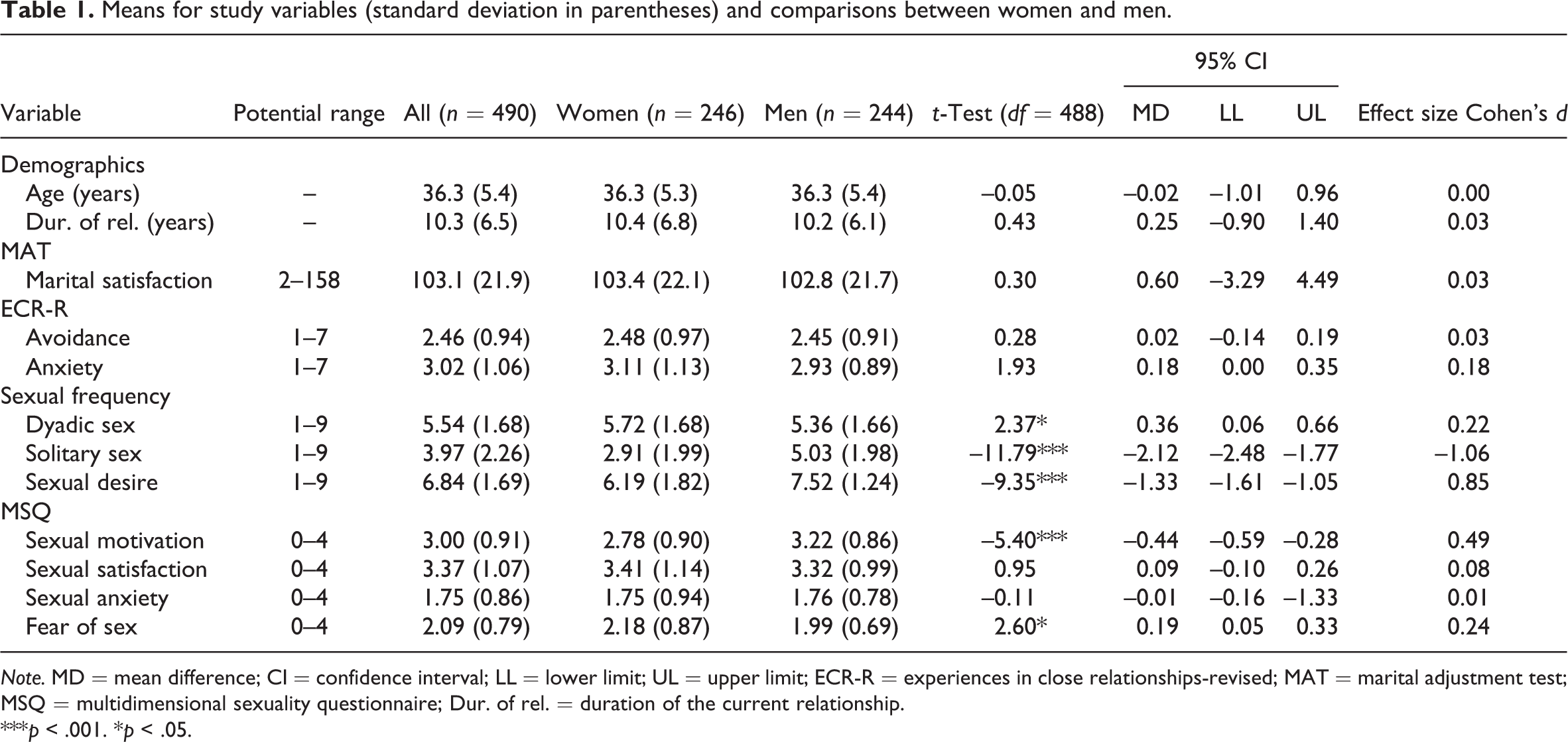
Descriptive statistics and mean comparisons between women and men for the study variables are provided in Table 1. Several differences were observed between women and men regarding sexual frequencies and representations: Men reported significantly more solitary sexual activities and sexual desire than women did; on the other hand, women reported more dyadic sexual activities. Regarding representations, men reported greater sexual motivation, and women reported more fear of sex. There was no difference between women and men regarding the duration of the relationship, marital satisfaction, or attachment tendencies.
Means for study variables (standard deviation in parentheses) and comparisons between women and men.
Note. MD = mean difference; CI = confidence interval; LL = lower limit; UL = upper limit; ECR-R = experiences in close relationships-revised; MAT = marital adjustment test; MSQ = multidimensional sexuality questionnaire; Dur. of rel. = duration of the current relationship.
***p < .001. *p < .05.
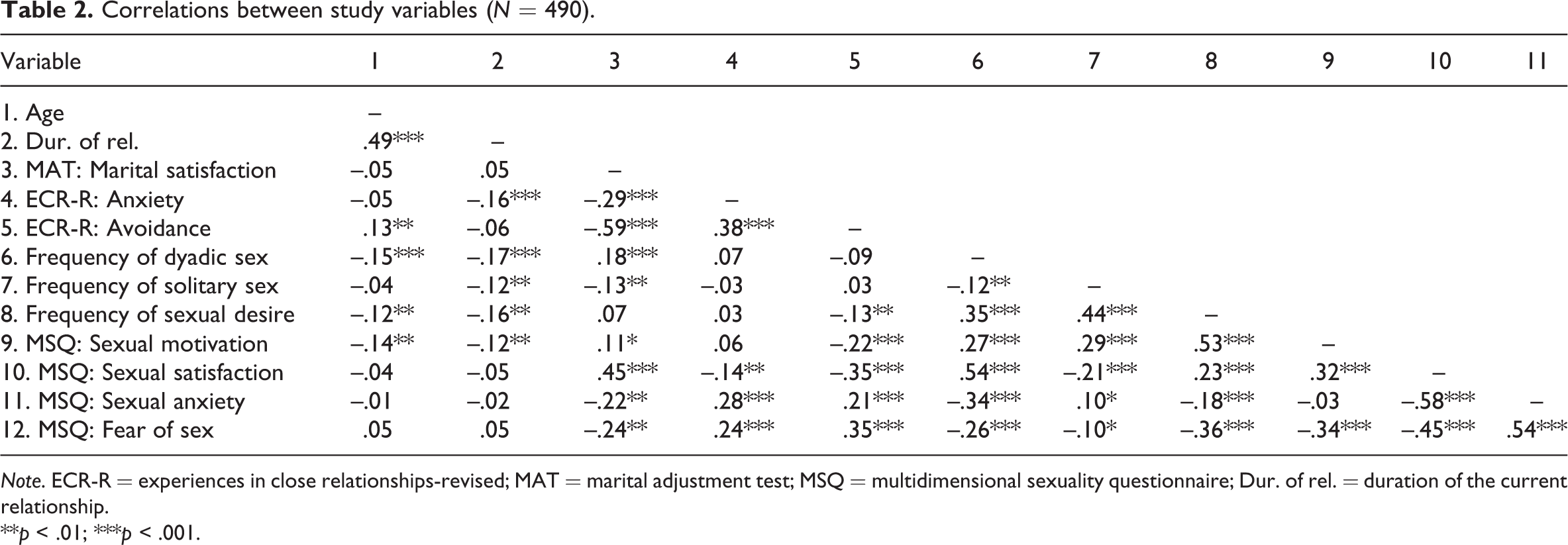
We found several bivariate links between the study variables, but only one link is between attachment tendencies and sexual activities: The more that people had avoidant tendencies, the less they reported sexual desire (see Table 2). On the other hand, both avoidance and anxiety were linked with almost all dimensions of representations. The latter were all correlated with the frequency of sexual activities and the frequency of sexual desire. Regarding control variables, age and duration of relationship were negatively linked with the frequency of dyadic sexual activities, sexual desire, and sexual motivation. The duration of the relationship was negatively linked with solitary sexual activities. Marital satisfaction was strongly positively linked with dyadic sexual activities, sexual motivation, and sexual satisfaction but negatively linked with attachment tendencies, solitary sexual activities, sexual anxiety, and fear of sex. We repeated the correlational analyses with partial correlations, controlling for gender. They yielded equivalent results.
Correlations between study variables (N = 490).
Note. ECR-R = experiences in close relationships-revised; MAT = marital adjustment test; MSQ = multidimensional sexuality questionnaire; Dur. of rel. = duration of the current relationship.
**p < .01; ***p < .001.
Representations of sexuality as mediators between attachment and frequency of sexual activities
We tested for the adjustment of a model that included avoidance and anxiety along with control variables (age, duration of relationship, and marital satisfaction) as independent variables; sexual motivation, sexual satisfaction, sexual anxiety, and fear of sex as mediators; and frequency of sexual desire and frequency of dyadic and solitary sexual activities as dependent variables (age, duration of relationship, and marital satisfaction included as covariates).
First, in order to investigate the structural invariance of this model between men and women, we first specified a model with invariance constraints imposed on the regression weights linking the target variables of the study. The fit indices for this model indicated a fair rather than an excellent fit, χ2 = 43.989, df = 28, p = .028, comparative fit index (CFI) = .990, root mean square error of approximation (RMSEA) = .048, 90% CI [.016, .075], standardized root mean square residual (SRMR) = .063.
As a comparison, the same model with regression weights freely estimated for men and women showed an excellent fit: χ2 = 0.133, df = 2, p = .936, CFI = 1.000, RMSEA = .000, 90% CI [.000, .033], SRMR = .002. The results of a likelihood ratio test showed that this second model should be preferred: χ2 = 43.856, df = 26, p = .016. The adjustment of the model was equally excellent for both women and men, respectively: χ2 = 0.043, df = 1, p = .837, CFI = 1.000, RMSEA = .000, 90% CI [.000, .099], SRMR = .001 and χ2 = 0.091, df = 1, p = .763, CFI = 1.000, RMSEA = .000, 90% CI [.000, .115], SRMR = .002. As a comparison, the equality constraints imposed on the regression weights between men and women in the structural invariance model significantly hampered the fit of the model. These results suggested that a model hypothesizing that the links between attachment and frequency of sexual activities are mediated by the representations of sexuality is correct for men and women, but that the strength of the associations between these variables is different for each gender. As a consequence, the following description of the mediation effects will focus on the separate parameter estimation for men and women obtained in this second model.
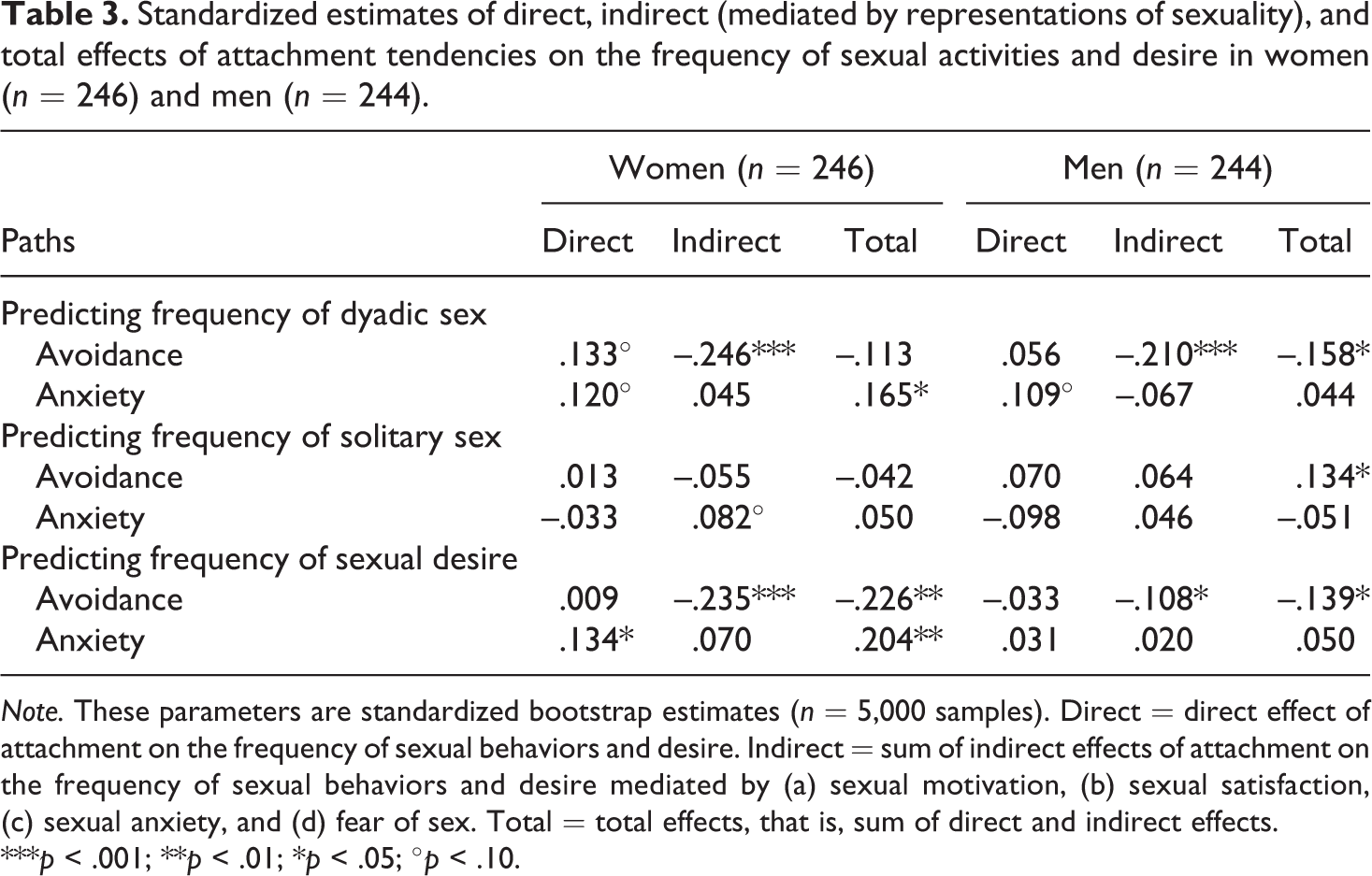
In order to analyze the significance of the mediation effects in this second model, we first looked at the total effects of attachment on the frequency of dyadic sex, solitary sex, and sexual desire. Significant total effects were of particular interest: Each of them was closely investigated to see whether this significant effect was due to a direct or an indirect (mediated) effect. We also had a particular interest in the mediators for which an indirect effect was significant, but the related total effect was not, as these situations suggested the presence of a suppressor effect. A summary of the results of direct, indirect, and total effects is shown in Table 3.
Standardized estimates of direct, indirect (mediated by representations of sexuality), and total effects of attachment tendencies on the frequency of sexual activities and desire in women (n = 246) and men (n = 244).
Note. These parameters are standardized bootstrap estimates (n = 5,000 samples). Direct = direct effect of attachment on the frequency of sexual behaviors and desire. Indirect = sum of indirect effects of attachment on the frequency of sexual behaviors and desire mediated by (a) sexual motivation, (b) sexual satisfaction, (c) sexual anxiety, and (d) fear of sex. Total = total effects, that is, sum of direct and indirect effects.
***p < .001; **p < .01; *p < .05; °p < .10.
Mediation effects in women
Concerning women, three total effects of attachment on the frequencies of sexual activities and desire were significant: First, higher attachment anxiety predicted a higher frequency of dyadic sex, b = .245, 95% CI [−.001, .477], β = .165, p < .05. Decomposing this total effect, we noticed that neither direct nor indirect effects alone were significant. Yet, the direct effect of anxiety on the frequency of dyadic sex was close to significance and accounted for most of the total effect, b = .178, 95% CI [−.022, .369], β = .12, p = .071. Although the sum of the four indirect effects were not significant, the indirect path through sexual motivation was significant, as anxiety was linked to higher sexual motivation, which predicted a higher frequency of dyadic sex (indirect effect: b = .07, 95% CI [.024, .152], β = .047, p < .05; see Figure 1). Although they were not significant, the indirect paths through sexual anxiety and fear of sex went in the opposite direction, partly suppressing the effect of sexual motivation. Thus, we could conclude from these results that sexual motivation was a significant mediator, when sexual satisfaction, sexual anxiety, and fear of sex were held constant.
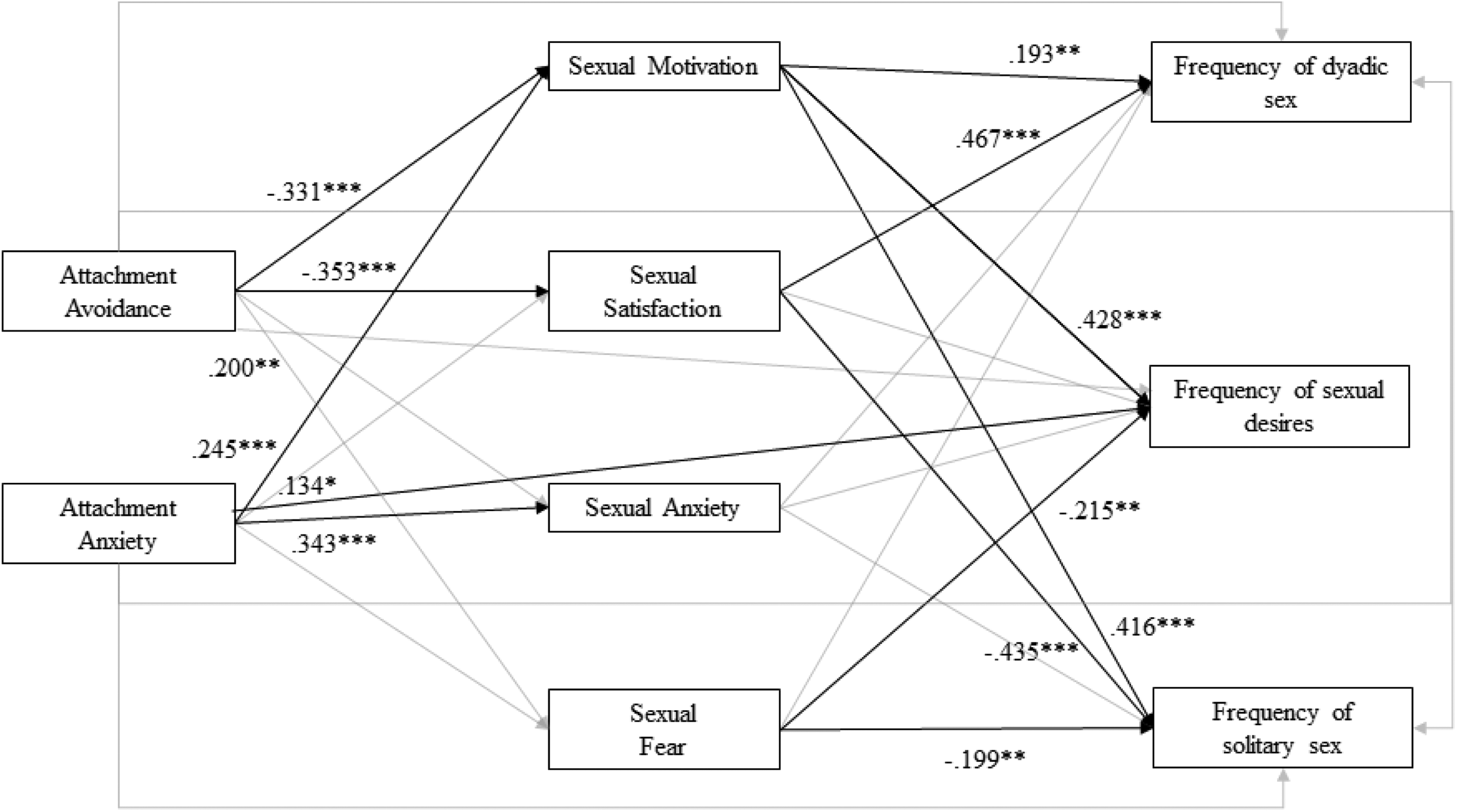
Mediation model of the links between attachment tendencies, sexual representations, and sexual activities in women. Only standardized coefficients for the regression weights are displayed. In lighter grey: nonsignificant paths. Values for error variables as well as means and intercepts for all variables were estimated but are not reported here. Estimates for covariances can be obtained upon request. *p < .05; **p < .01; ***p < .001.
Second, attachment anxiety predicted more frequent sexual desire, b = .329, 95% CI [.087, .549], β = .204, p < .01. This significant total effect was mostly due to a significant direct effect of anxiety, which seemed to predict the frequency of sexual desire when the representations were held constant (direct effect: b = .217, 95% CI [.022, .405], β = .134, p < .05.). Although the sum of indirect effects was not significant, the indirect path through sexual motivation was significant: Anxiety was linked to higher sexual motivation, which predicted a higher frequency of sexual desire (indirect effect: b = .07, 95% CI [.024, .152], β = .047, p < .05). Although they were not significant, the indirect paths through sexual anxiety and fear of sex went in the opposite direction, partly suppressing the effect of sexual motivation. As both the direct effect of anxiety and the mediated effect of sexual motivation were significant, the results suggested the presence of a partial mediation of sexual motivation when sexual satisfaction, sexual anxiety, and fear of sex were held constant.
Third, the total effect of avoidance on the frequency of sexual desire was negative and significant, b = −.427, 95% CI [−.712, −.132], β = −.226, p < .01, showing that higher avoidance was linked to less frequent sexual desire. The representations of sexuality accounted for most of this effect, as only the sum of indirect effects was significant, b = −.444, 95% CI [−.634, −.265], β = −.235, p < .001, whereas the direct effect was not. In particular, avoidance predicted a lower sexual motivation and more fear of sex, which led to less sexual desire (indirect effects: b = −.267, 95% CI [−.417, −.154], β = −.141, p < .001 and b = −.139, 95% CI [−.267, −.046], β = −.074, p < .05, respectively). This result suggested a full mediation of sexual motivation and fear of sex.
Another result was of interest concerning women: Although the total effect of avoidance on the frequency of dyadic sex was not significant, a clear suppression effect appeared. Indeed, whereas avoidance had a positive—but not significant—direct effect on the frequency of dyadic sex, b = .232, 95% CI [−.006, .468], β = .133, p = .056, the sum of indirect paths through the representations of sexuality was significant but led in the opposite direction, b = −.428, 95% CI [−.612, .264], β = −.246, p < .001. This negative sum of indirect effects was mostly due to avoidance predicting lower sexual motivation and lower sexual satisfaction, which led to less frequent dyadic sex (indirect effects: b = −.111, 95% CI [−.212, −.039], β = −.064, p < .01 and b = −.286, 95% CI [−.485, −.146], β = −.165, p < .001, respectively). This suppression effect indicated that, when the representations of sexuality were held constant, avoidance led to more frequent dyadic sex. However, when the representations were taken into account, a decrease in sexual motivation and satisfaction due to avoidance suppressed this effect.
Finally, several indirect links between attachment and the frequency of solitary sex turned out to be significant: Avoidance led to less motivation which led to less solitary sex, b = −.284, 95% CI [−.457, −.154], β = −.137, p = .000, whereas it also predicted less satisfaction which predicted more solitary sex, b = .317, 95% CI [.170, .514], β = .154, p = .000. Higher avoidance was also associated with more fear of sex, which in turn led to less solitary sex, b = −.141, 95% CI [−.290, −.036], β = −.068, p = .027. However, as these effects went in opposite directions, the sum of indirect effects was not significant.
Mediation effects in men
Concerning men, two total effects were significant: First, avoidance predicted less frequent dyadic sex and sexual desire, b = −.287, 95% CI [−.543, −.017], β = −.158, p < .05 and b = −.195, 95% CI [−.382, −.024], β = −.139, p < .05, respectively. Both total effects were mostly due to significant sums of indirect effects, b = −.382, 95% CI [−.566, −.214], β = −.210, p < .001 and b = −.147, 95% CI [−.289, −.042], β = −.108, p < .05, respectively. These results suggested two full mediation effects, as only indirect effects were significant in both cases, whereas direct effects were not. The details of indirect paths between avoidance and frequency of dyadic sex revealed that the mediation effect was mostly due to sexual satisfaction (see Figure 2). Indeed, avoidance in men led to less sexual satisfaction, which predicted less frequent dyadic sex, b = −.275, 95% CI [−.431, −.154], β = −.151, p < .001. Concerning the indirect links between avoidance and frequency of sexual desire, the mediation effect was mostly due to sexual motivation, as a higher avoidance predicted less sexual motivation, which predicted less sexual desire, b = −.144, 95% CI [−.261, −.067], β = −.106, p < .01.
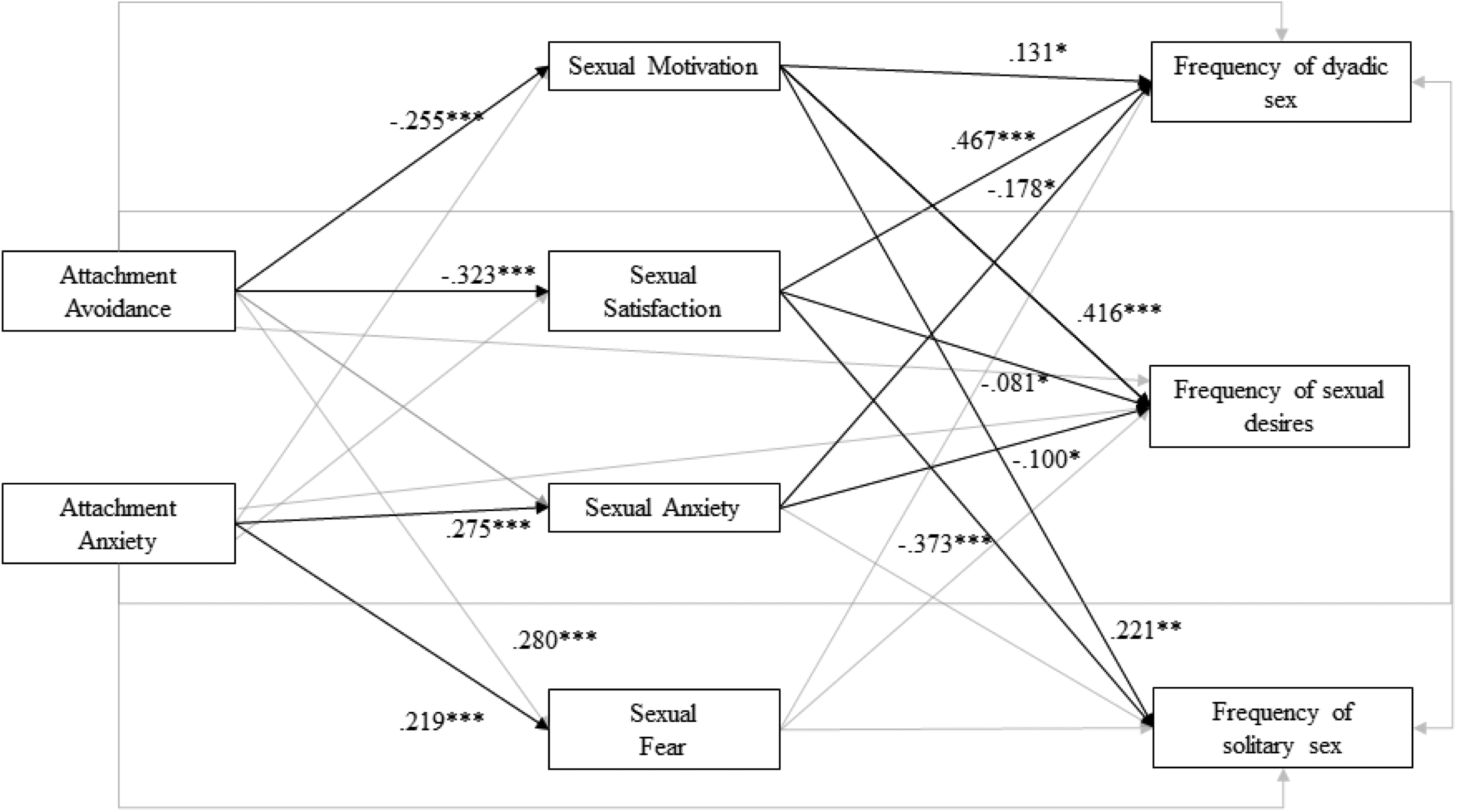
Mediation model of the links between attachment tendencies, sexual representations, and sexual activities in men. Only standardized coefficients for the regression weights are displayed. In lighter grey: nonsignificant paths. Values for error variables as well as means and intercepts for all variables were estimated but are not reported here. Estimates for covariances can be obtained upon request. *p < .05; **p < .01; ***p < .001.
Second, avoidance predicted more frequent solitary sex, b = .291, 95% CI [.019, .541], β = .134, p < .05. However, when analyzing this total effect, we noticed that neither direct effects nor the sum of indirect effects alone was significant, although they went in the same direction. For indirect effects, the results showed that two indirect paths were significant but went in opposite directions: On the one hand, avoidance predicted less sexual satisfaction, which was linked with more frequent solitary sex, b = .261, 95% CI [.141, .423], β = .120, p < .001. On the other hand, avoidance predicted less sexual motivation, which predicted a lower frequency of solitary sex, b = −.122, 95% CI [−.248, −.043], β = −.056, p < .05. These opposite indirect effects explained why the sum of indirect effects was not significant. This result suggested that low sexual satisfaction acted as a mediator between avoidance and solitary sex. In turn, sexual motivation acted as a suppressor of this indirect effect.
Finally, one last indirect effect appeared: attachment anxiety predicted sexual anxiety, which predicted less dyadic sex, b = −.091, 95% CI [−.203, −.014], β = −.049, p = .049. However, despite this significant effect, the sum of the indirect effects going from attachment anxiety to the frequency of dyadic sex through the representations of sexuality remained not significant.
The relative strength of motivation and satisfaction as mediators of avoidance
In order to increase our understanding of the indirect influence of attachment on the frequency of sexual behaviors, we focused on the two main mediation paths through which attachment avoidance influenced the frequency of sexual behaviors in both men and women. Indeed, as the results showed that attachment avoidance influenced both sexual motivation and satisfaction, which in turn predicted the frequency of dyadic and solitary sex, we compared the strength of the association between avoidance and motivation on the one hand, and avoidance and satisfaction on the other hand, in order to test whether one mediation path seemed to prevail. In an alternative model, we constrained both paths going from avoidance to motivation and satisfaction to be equal. The adjustment of this model with equality constraints was tested against a model in which both paths were freely estimated. A comparison between these two models was conducted separately in men and women. The results showed that, in both men and women, the adjustment of the model with equality constraints was not significantly different from the model in which both paths had been freely estimated, suggesting that both paths could be considered as equally strong.
Discussion
This study aimed to assess the mediating role of representations of sex between attachment anxiety/avoidance and sexual activities in a community sample. Several variables known to be predictors of sexuality were controlled for: age, duration of relationship, and marital satisfaction. Because gender differences have consistently been reported in the literature regarding sexual activities, representations of sexuality, and attachment tendencies (Baumeister et al., 2001; Christopher & Kisler, 2004; Del Giudice, 2011), we tested the mediation model separately for women and for men.
The results highlighted several links in accordance with our hypotheses: According to our first hypothesis, avoidant tendencies predict a lower frequency of dyadic sex and a higher frequency of solitary sex as well as a lower frequency of sexual desire. However, the first two links were observed for men only, which we did not anticipate in our hypothesis. According to our second hypothesis, attachment anxiety in women is linked with a higher frequency of dyadic sex and of sexual desire; anxiety was not, however, linked with lowered sexual activities in men as we expected. According to our third hypothesis, most of these links are mediated by representations. The details of the different effects, direct and indirect, allowed us to understand the processes by which attachment influences sexual activities and highlighted suppressor effects, which explained some of the nonsignificant associations between attachment and sexual activities.
First, concerning women, higher avoidance was linked with a lowered sexual desire through the mediation of a lower sexual motivation for sex and a higher fear of sex. A suppressor effect was observed for the link between avoidance and the frequency of dyadic sex, explaining the absence of a link between the two variables: Although there was an almost significant direct negative effect of avoidance (meaning that avoidance in women may be predictive of more dyadic sex), the indirect effects of representations went in the opposite direction through low sexual motivation and satisfaction. Although the indirect effects are in accordance with our hypothesis, the almost significant positive direct link between avoidance and frequency of dyadic sex may be explained by the fact that, as shown in previous studies, attachment avoidance does not completely imply avoidance of sexuality; sexual activities may be accomplished but dissociated from affects and thus not related to an intimate affective exchange with a partner (Brassard et al., 2007; Davis et al., 2004). On the other hand, attachment anxiety was predictive of a higher frequency of sexual desire in women, directly and through the mediation of a higher sexual motivation. The same effect and combination of direct and indirect paths was found for the links between attachment anxiety and the frequency of dyadic sex, although each path was only close to significance, whereas the total effect was significant. Both of these results are in line with studies that have described high motivations to have sex in more anxious individuals, their primary goal being increased closeness rather than the sexual activity in itself. As mentioned in the introduction, this pattern has been observed mainly in women (Birnbaum et al., 2006; Cooper et al., 2006; Gillath & Schachner, 2006).
Second, concerning men, a higher avoidance was linked with a lower frequency of dyadic sex and a lower frequency of sexual desire through the mediation of lowered sexual satisfaction and sexual motivation. On the other hand, higher avoidance was linked with an elevated frequency of solitary sex; however, neither direct nor indirect links were significant. For the latter, a suppressor effect appeared: Avoidance was predictive of a lower sexual motivation, which was predictive of a lower frequency of solitary sex, whereas avoidance was predictive of a lower sexual satisfaction, which was in turn predictive of more solitary sex. There is thus an ambivalence associated with solitary sex in more avoidant men: On the one hand, increased solitary activities may be a “palliative” response to sexual dissatisfaction that may result from the paucity of dyadic activities; on the other hand, the lowered sexual motivation associated with avoidance also has as a consequence a decrease in solitary activities.
The examination of the indirect links allowed us to highlight that, in accordance with the theory, avoidance was mainly linked to dyadic sexual activities through the mediation of lowered positive representations—motivation and satisfaction, that is, through the deactivation of emotions that might trigger the search for a partner in order to engage in sexual activities. In both women and men, motivation and satisfaction were equally responsible for the mediation effects. On the other hand, anxiety was linked to sexual activities through elevated negative emotions in men (sexual anxiety) and, in women, through an increase in one positive representation: sexual motivation. For women and for men, attachment anxiety thus tends to be linked to an increase in emotional arousal, in accordance with a hyperactivation strategy. The suppressor effects observed for both avoidance and anxiety tend, however, to show that the links between attachment tendencies and sexual behavior are not straightforward: The influence of attachment is exerted through a complex interplay of contradictory forces. Deactivation and hyperactivation thus do not concern all drives or motivations to engage in sexual activities. This complex interplay may explain why there are individual differences within more avoidant or more anxious individuals: Although representations of sex are influenced by attachment tendencies, they are also influenced by other factors such as sexual experiences, social norms, and expectations (Alexander & Fisher, 2003). Finally, even though the specific associations were different for women than for men, the main results of structural invariance of the model showed that women and men differ in the level of the associations between the variables but not in the structural links between variables regarding mediation effects. Thus, for both genders, attachment is linked with sexual activities mainly through the mediation of representational variables.
In order to explain how attachment exerts a significant but not exclusive influence on sexual behaviors, a recent proposal has suggested that the activation of the sexual system may in itself lead to deactivation or hyperactivation strategies, when individuals hold negative representations of sex that interfere with the primary strategy of having sex as a response to sexual arousal (Birnbaum, Mikulincer, Szepsenwol, Shaver, & Mizrahi, 2014; Mikulincer & Shaver, 2012). Hyperactivation of the sexual system may result from doubts about one’s own attractiveness and sexual skills. As a consequence, individuals have repeated and numerous sexual experiences in order to cope with negative feelings associated with sexual activation, but they remain anxious about their sexual performances. Deactivation may result from repeated disappointment in sexual experiences. As a consequence, the person tends to suppress sexual needs and inhibit sexual behaviors. These strategies that are specific to the sexual system may in part be independent of, yet interrelated with, the attachment system (Birnbaum, Simpson, Weisberg, Barnea, & Assulin-Simhon, 2012; Szepsenwol, Mizrahi, & Birnbaum, 2015). Considering how these two systems work conjointly or antagonistically may help to explain the complex links that we have highlighted in this study.
In view of exploring this topic further, we need to mention the strengths and limitations of the present study and to make suggestions for subsequent research strategies. Among the strengths, our study involved a community sample randomly selected so that results ensure a certain external validity; moreover, we included both solitary and dyadic sexual activities, which have been often studied separately in the literature. Several limitations also need to be mentioned. First, the variables that shape the representations of sexuality need to be explored further in order to have a more comprehensive picture of the mediators of the link between attachment and sexual activities. In this regard, taking into account explicit motivations of individuals (the way that individuals explain their sexual behavior), as well as implicit motivations (through the internalization of social values), would be necessary. Second, an important limitation is the fact that our participants did not include couples among them. The same study could be conducted with couples in a paired sample design, and not only with separate individuals, in order to assess the impact of possible discrepancies between the partners.
In conclusion, our results show that attachment tendencies explain a significant part (but not the whole) of sexual activities, this influence being largely mediated by representations of sexuality. They should thus be considered in future studies on sexuality along with other variables that predict sexual behavior in synergy or antagonistically with attachment tendencies, such as the value and meaning that individuals attribute to sexuality. Such considerations may be useful in the development of a comprehensive picture of the sexual life of men and women.
Footnotes
Declaration of Conflicting Interests
The author(s) declared no potential conflicts of interest with respect to the research, authorship, and/or publication of this article.
Funding
The author(s) disclosed receipt of the following financial support for the research, authorship, and/or publication of this article: This research was supported by the Fonds Universitaire Maurice Chalumeau.