




Abstract
This study examined whether adolescents’ perceptions of maternal warmth and monitoring were associated with dating experience (experience vs. no experience) and romantic relationship duration in Mexico. We also explored whether respeto, age, and gender moderated these associations. Mexican adolescents (54% girls), aged 12–19, self-reported on their perceptions of maternal warmth and monitoring and romantic relationships. Findings suggest that more perceived maternal warmth was associated with longer relationships. The association between monitoring and relationship length was moderated by age and respeto. Specifically, more monitoring was associated with shorter relationships among older adolescents and those who reported lower levels of respeto. Adolescents who endorse respeto and those who are younger may not perceive maternal monitoring as an attempt to hinder their romantic relationships. Findings highlight the importance of cultural context and parental relationships in Mexican adolescents’ romantic experiences.
Limited research in Mexico indicates that adolescent romantic relationships are normative. Many individuals (68%), aged 12–18, have experienced dating, love, exclusive romantic relationships, and some sexual behaviors (e.g., holding hands, making out; Espinosa-Hernández & Vasilenko, 2015). Although the cultural ecological framework (Harkness & Super, 1996) posits the importance of understanding romantic relationships in their cultural context, we have little understanding of the roles parenting and cultural values play in Mexican adolescents’ romantic relationships. Examining these associations in Mexico, an understudied cultural context, may help understand whether links between parenting and romantic relationships found in industrialized nations (e.g., U.S.) are culture specific or universal (i.e., can be generalized to other parts of the world). This study examined the role of respeto (i.e., respect and obedience toward parents; Unger et al., 2002), age, and gender in associations between maternal warmth and monitoring and adolescent dating experience (vs. no experience) and duration in Mexico. Guided by the cultural ecological framework (Harkness & Super, 1996), we expected that endorsing cultural values such as respeto would strengthen the positive impact of parenting on adolescent romantic experiences.
Maternal parenting and adolescents’ romantic relationships
Prior theoretical and empirical work on parent–adolescent relationships has emphasized the importance of parental warmth and control for adolescent well-being (Steinberg, 2001). Most Mexican American mothers (65%), especially those who endorse values of familism and respeto, display authoritative parenting, which is characterized by high levels of warmth and control (White, Zeiders, Gonzales, Tein, & Roosa, 2013). Research on Latinos in the U.S. has consistently found that parental warmth and monitoring, an aspect of control, are associated with adolescents exhibiting a lesser degree of risky behaviors, including alcohol use and delinquency (Clark, Donnella, Robinson, & Conger, 2015; Mogro-Wilson, 2008). The positive role of both maternal warmth and monitoring may also extend to romantic relationship experiences. Research in the U.S. has found that parental warmth and monitoring (i.e., authoritative parenting) are positively associated with adolescents’ romantic relationship satisfaction (Auslander, Short, Succop, & Rosenthal, 2009; Tuggle, Kerpelman, & Pittman, 2014). Although the link between parenting and adolescents’ romantic relationships has been studied with U.S. Latinos (Bouris et al., 2012), we know little about the role of parenting behaviors in Mexican adolescent romantic relationships.
The role of respeto in parenting and romantic relationships
Cultural ecological frameworks explain that parenting and adolescent relationships are embedded in their cultural context. Cultural values may influence parenting behaviors and adolescent relationships (Bronfenbrenner, 2005; Harkness & Super, 1996). Moreover, the positive effect of parenting on adolescent behaviors may be strengthened when adolescents internalize these cultural values.
Respeto 1 is a Latino value that emphasizes respect for family members, while familism value focuses on family loyalty (Halgunseth, Ispa, & Rudy, 2006). Although past research has examined the association between cultural values and parenting (e.g., White et al., 2013) and identified familism as a protective factor for adolescents (German, Gonzales, & Dumka, 2009), less is known about how respeto impacts the association between parenting and adolescents’ romantic relationships. It is possible that maternal warmth and monitoring may have a stronger effect on romantic relationships for Mexican adolescents who endorse respeto, because they may be more receptive to parental input.
The role of gender and age in parenting and romantic relationships
The association between parenting and romantic relationships may also be moderated by individual factors such as gender and age. A review of theoretical and empirical work has concluded that gender is a critical factor in the link between parenting and adolescent sexual behavior in the U.S. Specifically, warmth, including maternal warmth, has been found to be a stronger predictor of sexual behavior for girls compared to boys. In contrast, monitoring, including maternal monitoring, seems to be a stronger predictor of sexual behavior for boys compared to girls (Kincaid, Jones, Sterrett, & McKee, 2012). Research also indicates that maternal influence on adolescent behavior may decrease as adolescents’ age (Bauman, Carver, & Gleiter, 2001). Because many sexual behaviors occur in the context of romantic relationships, and similar parenting factors affect both sexual and romantic relations, we consider the role of gender and age will also be critical in associations between parenting and romantic relationships.
To summarize, we examined associations between maternal warmth and monitoring and adolescent dating experience and duration in Mexico. Based on previous studies (Auslander et al., 2009; Tuggle et al., 2014), we had the following hypotheses. We predicted more warmth and monitoring would be associated with having dating experience (experience vs. no experience) and longer romantic relationship duration (Hypothesis 1). Guided by both theory and empirical evidence, we also examined the moderating role of age (Hypothesis 2), respeto (Hypothesis 3), and gender (Hypothesis 4) in these associations. We predicted stronger associations among younger adolescents and those who reported higher respeto. We also predicted warmth would be a stronger predictor for girls’ romantic behaviors (as compared to boys’) and that monitoring would be a stronger predictor for boys’ romantic behaviors (as compared to girls’).
Method
Participants and procedure
We utilized data from the second cohort of a study conducted in middle and high schools in Puebla, Mexico. For this study, the principal investigator contacted schools that had previously participated (Espinosa-Hernández, Vasilenko, & Bámaca-Colbert, 2015). Principals of two different public and nonreligious middle schools and one high school agreed to be part of this study. Classrooms were chosen to participate based on convenience (e.g., exam or class schedules). University’s Institutional Review Board procedures were followed and a waiver of written parental consent was obtained. Adolescents assented, completed a Spanish language survey in about an hour and a half in their classrooms, and received candy for participating.
Participants were 1071 adolescents (54% girls, 68% middle schoolers) living in Puebla, Mexico. Their age ranged from 12 to 19 years (M = 15.1, SD = 1.50). About 90% of the sample lived with their birth mother and another 2% lived with either a stepmother or an adoptive mother. Of the participants in the sample, 68% lived with both biological parents, 16% lived with their birth mother only, 6% lived with their birth mother and stepfather, 2% lived with their birth father only, 1% lived with their birth father and stepmother, 1% lived with their adoptive parents, 3% reported “other” for family structure, and 3% were missing on this variable.
Measures
We translated measures from English to Spanish by committee approach (Cha, Kim, & Erlen, 2007). That is, bilingual research assistants and the first author translated the items as a group. Items were reviewed and suggestions for revisions were made during a pilot study. See Table 1 for means and standard deviations for main study measures. For scales, we created all composite scores by summing all items belonging to each scale. Higher scores on scales indicated participants’ higher endorsement of each construct.
Descriptive statistics by gender and age.

aχ2 for gender = 3.30, n.s.; χ2 for age = 16.25.
*p < .05; **p < .01.
Dating experience
Based on focus groups conducted by the principal investigator, we noticed that committed and exclusive relationships might be the norm in this population. We therefore chose the popular Mexican terms “andando con alguien” (going steady) and “novios(as)” (boyfriend/girlfriend) to assess dating experience. Participants were asked to indicate “yes” (coded as 1) or “no” (coded as 0) to this question: “Have you ever gone steady with someone or had a boyfriend/girlfriend?” (¿Has andado con alguien o has tenido novio(a)?)
Romantic relationship duration
For models that focused on this dependent variable, we selected only adolescents with dating experience (n = 990). We assessed duration with 1 item “In the past 12 months, how long do your relationships typically last (when you are dating someone)?” [“¿En los pasados 12 meses, normalmente cuanto tiempo han durado tus relaciones (cuando andas con alguien)?”] Participants were asked to choose one option: (1) “2 weeks or less,” (2) “2–4 weeks,” (3) “1–2 months,” (4) “3–6 months,” (5) “7–12 months,” or (6) “more than a year,” mode = 1–2 months (28.6% of sample).
Perceptions of maternal warmth
We utilized the warmth subscale of the Mexican Parenting Questionnaire for Adolescents (MPQ-A; Halgunseth et al., in press). All items of the MPQ-A were adapted from the MPQ (Halgunseth & Ispa, 2012), a measure that consisted of six subscales and was originally developed to assess parenting of U.S. Mexican immigrant mothers. Later, Halgunseth et al. (in press) tested the MPQ-A with adolescents from Mexico and found the original six factor structure. The warmth subscale consisted of 4 items assessing adolescents’ perceptions of their mothers’ warmth (e.g., “In general, my mom uses affectionate nicknames with me” [“En general, mi mamá usa nombres cariñosos (e.g., mi amor, mi gordo, mi cielo) cuando me habla”]). Adolescents responded using a 5-point Likert-type scale ranging from 1 (almost never) to 5 (almost always). Similar to previous studies (α = .73; Halgunseth et al., in press), reliability was good (α = .80).
Perceptions of maternal monitoring
We utilized the monitoring subscale of the MPQ-A (Halgunseth et al., in press). This subscale consisted of 6 items assessing adolescents’ perceptions of their mothers’ protective monitoring behaviors (e.g., “In general, my mom knows where I am and what I am doing” [“En general, mi mamá sabe donde estoy y lo que estoy haciendo”]). Adolescents responded using a 5-point Likert-type scale ranging from 1 (almost never) to 5 (almost always). In contrast to past studies (α = .74 Halgunseth et al., in press), reliability was marginal (α = .59).
Respeto
We utilized the filial piety subscale of the Cultural Values Scale (Unger et al., 2002). It is a 13-item subscale assessing adolescents’ reports of respect and obedience to their parents (e.g., “The worst thing a person can do is disrespect his or her parents” [“Lo peor que una persona puede hacer es faltarle al respeto a sus padres”]). Participants responded using a 4-point Likert-type scale ranging from 1 (strongly disagree) to 4 (strongly agree). Similar to previous studies among Latino adolescent samples (α = .87; Unger et al., 2002), reliability was good (α = .80).
Results
Data analysis
First, we conducted t-tests and χ2 analyses to generate descriptive data by gender and age for our variables. Second, in three ordinary least squares regression models, we examined associations between the parenting variables and relationship duration; one model was used for each moderator (age, respeto, and gender). Third, we used logistic regression analyses to examine associations between the parenting variables and dating experience; again, we used three models, one for each moderator. In all models, we mean centered the continuous variables that were used to create the interaction terms (maternal warmth, maternal monitoring, age, and respeto). In all models, age and gender were also entered as control variables, as there are likely age and gender differences in romantic relationship variables.
Findings
Descriptive statistics by gender and age are shown in Table 1. We first examined associations between the parenting variables and relationship duration. We will discuss the results from each of the three moderation models (age, respeto, and gender) for relationship duration. In the regression model examining age as a moderator, after controlling for gender, greater maternal warmth was associated with longer relationships (see Table 2). There was also a main effect for maternal monitoring, but this was moderated by age; at older, but not younger ages, more monitoring was associated with shorter relationships (see Figure 1). In the regression model examining respeto as a moderator, maternal warmth was again positively associated with relationship length and there was a main effect for maternal monitoring. This main effect, however, was moderated by respeto (see Table 2), such that more monitoring was associated with shorter relationships at lower, but not higher, levels of respeto (see Figure 2). In the regression model examining gender as a moderator, there were significant, positive main effects for gender, β = .14, p < .05, age, β = .22, p < .05, and maternal warmth, β = .15, p < .05. These effects indicate that females (as compared to males), older participants, and participants who report greater maternal warmth report longer relationships. There were no significant interaction effects.

Predicting relationship duration with monitoring for older versus younger adolescents. The slope for the older adolescents (age = 1 SD above the mean) is significant, p < .05. The slope for the younger adolescents (age = 1 SD below the mean) is not significant.
Ordinary least squares regression models predicting relationship duration.
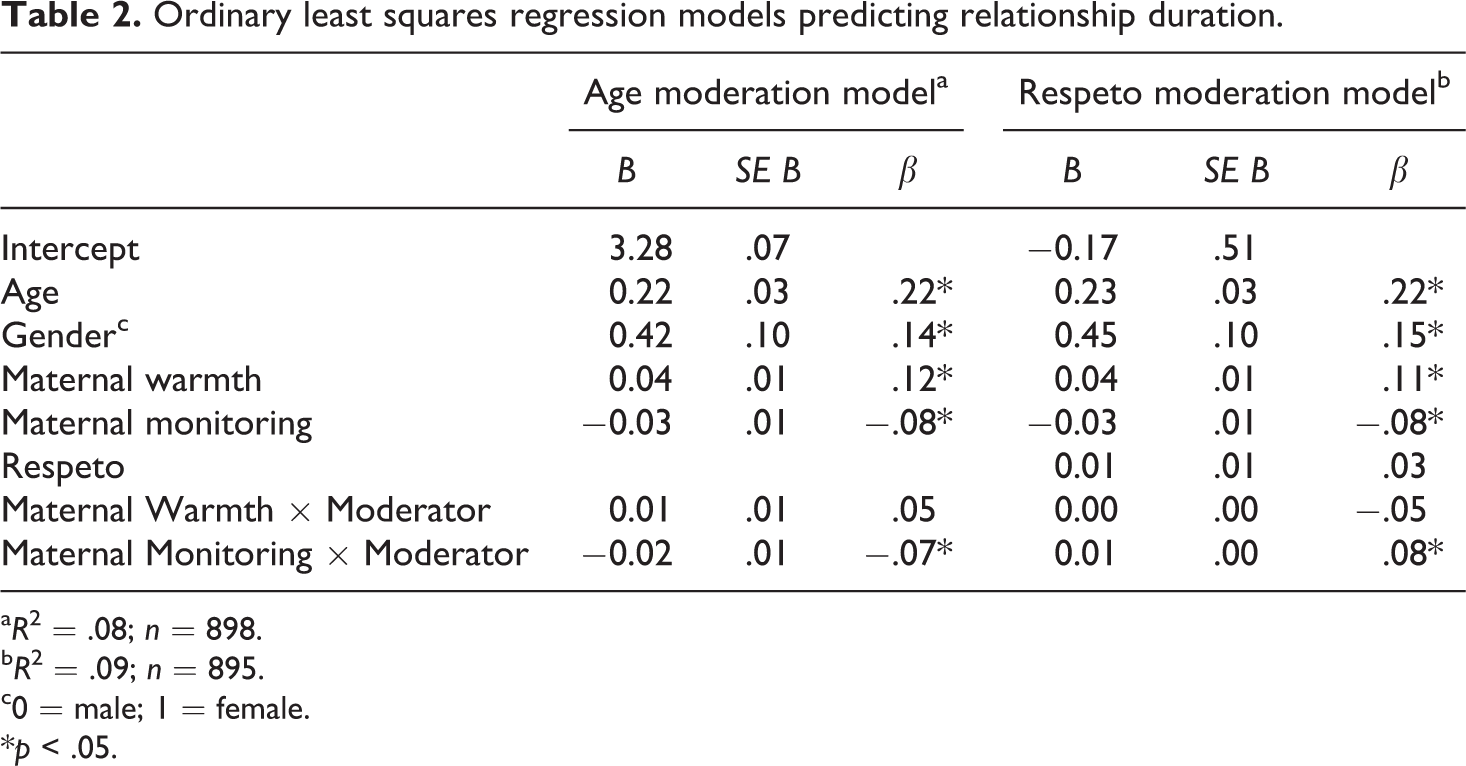
a R 2 = .08; n = 898.
b R 2 = .09; n = 895.
c0 = male; 1 = female.
*p < .05.
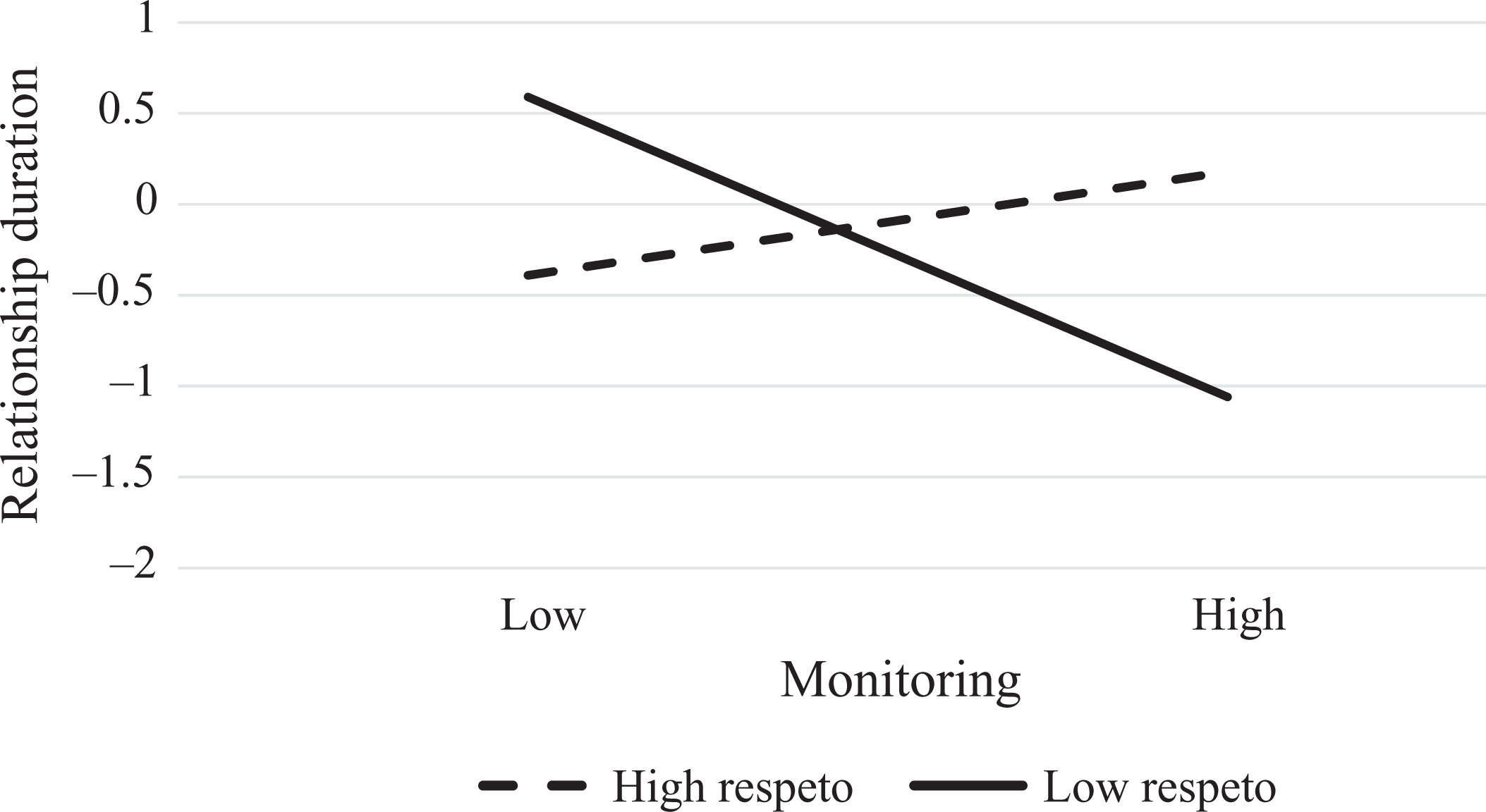
Predicting relationship duration with monitoring for high versus low respeto. The slope for the high respeto group (respeto is 1 SD above the mean) is not significant. The slope for the low respeto group (respeto is 1 SD below the mean) is significant, p < .05.
In the three models predicting dating experience, there were no significant interaction effects for age, respeto, or gender. There was a significant main effect for age in all three models, with higher ages indicating a greater likelihood of having dating experience (OR = 1.49, p < .05 in the age moderation model; OR = 1.48, p < .05 in the respeto moderation model, OR = 1.46, p < .05 in the gender moderation model). There was also a significant main effect for gender in the gender moderation model, OR = .1.70, p < .05, indicating that females had a greater likelihood than males of having dating experience.
Discussion
We examined associations between maternal warmth and monitoring and Mexican adolescents’ romantic experience and duration and the moderating roles of respeto, age, and gender on these associations. Findings revealed that Mexican adolescents tended to have longer romantic relationships when they perceived higher levels of maternal warmth. Maternal warmth may foster the development of positive relationship models and skills (Collins & Sroufe, 1999), which may enable longer, more successful romantic relationships. In addition, we found that more monitoring was associated with shorter romantic relationships but only among older adolescents. At older ages, romantic relationships become increasingly normative; thus, high parental monitoring during late adolescence may disrupt a normative developmental process in that it limits adolescents’ ability to spend time with their romantic partners, which may be necessary to develop longer lasting relationships.
Our findings also indicated that maternal monitoring is associated with shorter romantic relationships, but only when respeto was low. Respeto encourages respect of others, especially of elders such as parents, in order to maintain harmonious family relationships (Halgunseth et al., 2006). Thus, adolescents in our sample who endorse respeto may not perceive maternal monitoring as intrusive, enmeshment, or overly strict behavior. Because previous studies have found maternal warmth and control to be positively correlated among Latinos (Deater-Deckard et al., 2011), it is possible that the adolescents in this study perceived higher levels of monitoring as mother’s caring about their well-being and safety and, hence, may be indicative of a more positive parent–adolescent relationship. Within this context, Mexican adolescents who endorse respeto may feel more supported, cared for, and comfortable exploring romantic relationships in adolescence. Finally, previous studies indicate that gender is a critical factor in the link between parenting and adolescent behavior. That is, warmth may be more likely to affect girls’ behaviors because girls emphasize interpersonal connection and social bonding, whereas boys’ behavior may be shaped by monitoring because they place more value on authority (Kincaid et al., 2012). In this study, however, gender did not moderate associations between parenting and romantic experiences. Hence, our findings suggest that parenting may affect boys’ and girls’ romantic experiences in similar ways.
In support of cultural ecological frameworks, this study demonstrated the importance of understanding adolescent romantic relationships within their cultural and parental context, extending knowledge on the role of parenting in normative romantic relationship experiences of Mexican adolescents. This study also had limitations. The convenience sample limits generalizability of findings to all Mexican adolescents. The cross-sectional design of the study does not allow for causal inferences. Our romantic relationship constructs may not have captured the diversity of adolescent experiences in that our dating experience outcome was binary and most of our adolescents reported having dating experience. Moreover, our maternal monitoring scale displayed marginal reliability which may have attenuated the effect for maternal monitoring that we observed in our regression models. Similarly, our respeto measure was not developed in Mexico, and validity issues may exist. Future studies should examine other constructs such as relationship quality and communication. Practitioners should consider the role of cultural values in their work with Mexican adolescents.
Footnotes
Acknowledgments
We also want to thank Jackie Darazsdi, Julia Daugherty, Alvaro Luis Espinosa, Frankie Machado, Sarahi Zamores Rodriguez, and Roderick Yow for their help with data collection and data entry. You can e-mail Graciela Espinosa-Hernández (
Authors’ note
An earlier version of this article was presented at the 2015 Biennial Meeting of the Society for Research in Child Development at Philadelphia, PA. We gratefully acknowledge the UNCW Cahill Award to Graciela Espinosa-Hernandez for funding this study.
Funding
The author(s) received no financial support for the research, authorship, and/or publication of this article.