



Abstract
This research studied the development of self-esteem through adolescence and emerging adulthood. It also analyzed sex differences and the role of family and peers in developmental trends in self-esteem. Data comes from a longitudinal study in which we administered the Rosenberg Self-Esteem Scale to 90 Spanish boys and girls at ages 13, 15, 17, and 21 years. Results showed a linear increase in self-esteem, higher for boys than for girls, during adolescence and emerging adulthood. Initial variability was related to care received from the mother during childhood, whereas the increase in self-esteem throughout adolescence and emerging adulthood was related to peer attachment.
Keywords
The study of the development of self-esteem throughout a person’s life span requires longitudinal approaches, something that has become more frequent in recent years. Adolescence and emerging adulthood are two relevant life transitions in which self-esteem could experience changes. Some studies that analyze developmental trend in self-esteem during these stages indicate that self-esteem remains stable during adolescence (Block & Robins, 1993; Savin-Williams & Demo, 1984; Young & Mroczek, 2003) and some works find that it decreases (Robins & Trzesniewsky, 2005). Nevertheless, most of the longitudinal research concludes that, from the beginning of adolescence, self-esteem increases gradually (Erol & Orth, 2011; Huang, 2010; Twenge & Campbell, 2001; Wigfield, Eccles, Mac Iver, Reuman, & Midgley, 1991) and that self-esteem continues to increase during emerging adulthood (Baldwin & Hoffmann, 2002; Galambos, Barker, & Krahn, 2006; Wagner, Lüdtke, Jonkmann, & Trautwein, 2013). However, the majority of longitudinal research, which are taken into account for the purposes of meta-analyses and theoretical reviews, are carried out in a Northern European/Anglo-Saxon context (Orth & Robins, 2014; Sowislo & Orth, 2013; Twenge & Campbell, 2001). Little is known at an international level of other contexts since researchers who do not have English as their mother tongue or second language face a number of difficulties, including linguistic disadvantages, in securing publication of their work in international scientific journals (Ammon, 2000, 2012). What is more, studies that analyze the change in self-esteem with longitudinal models and complex statistical analysis and that confirm the findings of less sophisticated research to date are necessary (Robins & Trzesniewsky, 2005).
With regard to sex differences, although some studies find no differences in adolescent self-esteem between sexes (Erol & Orth, 2011), most of the research, including some meta-analyses (Gentile et al., 2009; Huang, 2010; Kling, Hyde, Showers, & Buswell, 1999), find higher scores in boys (Supple, Su, Plunkett, Peterson, & Bush, 2013; Twenge & Campell, 2001; Wigfield et al., 1991). Nevertheless, the research done remains inconclusive as to differences between sexes in the trajectories of self-esteem during adolescence (age–sex interaction). For example, Block and Robins (1993) found that, whereas boys’ self-esteem increased during adolescence, girls’ self-esteem decreased. The work of Baldwin and Hoffmann (2002) showed that girls suffer a decrease in self-esteem from age 12 onwards, which is not recovered until age 17. On the other hand, boys’ self-esteem decreases from the age of 14—2 years later than the girls—and they start to recover it at age 16—1 year before. However, in a meta-analysis, Huang (2010) found an increasing trajectory from age 12 to 18 for both boys and girls. Although there is no agreement regarding the trajectory of self-esteem during adolescence between sexes, research coincides in pointing out that sex differences begin during adolescence and do not exist in childhood (Alsaker & Kroger, 2006; Baldwin & Hoffmann, 2002; Robins & Trzesniewski, 2005). In contrast, differences as a function of sex are found to begin to decrease during emerging adulthood (Baldwin & Hoffmann, 2002; Galambos et al., 2006). Nevertheless, some studies also report that differences between sexes are maintained throughout adulthood and only decrease at old age (Robins & Trzesniewski, 2005). Consequently, a continued deepening of our analyses of the differences in changes in self-esteem during adolescence and emerging adulthood between boys and girls is necessary, whereby we look for sources of changes and differences.
The study of the role of the family in the formation and maintenance of self-esteem has a long history (Dusek & McIntyre, 2003; Rosenberg, 1989). According to these authors, regardless of ethnic group and sex, parents who employ positive parenting practices encourage their children to value themselves and to learn skills in a healthy way. In the same vein are the results of studies that relate self-esteem to secure attachment to the parents (Allen, Hauser, Bell, & O’Connor, 1994; Arbona & Power, 2003; Armsden & Greenberg, 1987; Mattanah, Lopez, & Gover, 2011). The bond of attachment consists of, among other things, an inner belief of how easily accepted one is in the eyes of others (Bowlby, 1973), something that is developed through interaction with primary caregivers (Bowlby, 1969, 1973). If affectionate and responsive caregivers facilitate the construction of a secure bond, they will be promoting the development of positive self-esteem (Luke, Maio, & Carnelley, 2004). Positive self-esteem is, therefore, grounded in close, affectionate, and sensitive family relationships (Amato & Fowler, 2002; Baldwin & Hoffman, 2002; Holmbeck, Paikoff, & Brooks-Gunn, 1995; Lamborn, Mounts, Steinberg, & Dornbush, 1991; Rosenberg, 1965; Supple et al., 2013). The influence of family relationships in self-esteem could be especially relevant in Spain. Like other Southern European countries, Spain is a cultural context characterized by a family orientation and great connections/closeness between family members (Seiffge-Krenke, 2013).
A defining feature of adolescence is the salience of peers during this stage (Bornstein, Jager, & Steinberg, 2012; Sullivan, 1953). In their company, adolescents will explore the new world that opens up before them and practice the new skills they are acquiring. From the viewpoint of the attachment theory, from adolescence onwards, peers—specifically those characterized by caring relationships and trust—are considered to perform the functions of attachment figures, especially those related to adolescents seeking proximity and needing a secure base from which to explore the world (Armsden & Greenberg, 1987; Fraley & Davis, 1997; Gorrese & Ruggieri, 2012). Therefore, it is not surprising to find that peer attachment is related to self-esteem, and this has been confirmed in the pioneering work of Armsden and Greenberg (1987) and in the recent meta-analysis carried out by Gorrese and Ruggieri (2012). Once again, peer relationships can be a powerful enhancer of self-esteem in Spain, a country with a culture that stresses interpersonal connection.
As already described, research has shown that good social relationships, both within the family and in peer groups, have a positive influence on self-esteem. For that reason, it is not surprising to think that in Mediterranean cultures such as Spanish, where emotional closeness is fostered, these social relationships could be influencing self-esteem in a different way to that experienced in Northern European/Anglo-Saxon cultures, since the influence is not only limited to infancy but also extends into adolescence and early adulthood. This differential influence has previously been demonstrated with regards to other psychological outcomes (Kagitcibasi, 2007; Parra, Oliva, & Sánchez-Queija, 2015).
Despite the evidence of the relationship, which family and peer relationships have with self-esteem, some research found that when taking into account both relationships, the link between self-esteem and peer attachment disappears (Noom, Dekovic, & Meeus, 1999). For this reason, it is important to conjointly analyze the influence of family and peer relationships on self-esteem.
The present study
The present longitudinal study had the following three goals: First, to analyze the trajectory of self-esteem during two life transitions: adolescence and emerging adulthood. In line with English language–based longitudinal research and previous cross-sectional studies in Spain (Parra, Oliva, & Sánchez-Queija, 2004; Povedano, Hendry, Ramos, & Varela, 2011), we expected to find a normative increase in self-esteem during adolescence and emerging adulthood (Hypothesis 1). Since chronological age has no causal force to change self-esteem per se (Robins & Trzesniewsky, 2005), research into the variables that affect self-esteem is required. The second goal was to analyze differences in self-esteem trajectories between boys and girls during this stage. Longitudinal studies carried out in other cultures have shown unclear results regarding differences between sexes in trajectories of self-esteem but, in line with cross-sectional studies in Spain, we expected to find a higher increase in boys’ self-esteem than in girls (Hypothesis 2). Finally, the third goal was to study family and peer influences on self-esteem. We consider both contexts family and peers to be essential at times of transition. We expected to find that parental bonding (Hypothesis 3) would contribute both to an initial level of self-esteem and to an increase in self-esteem throughout this period. Finally, we expected that peer attachment would contribute to increase self-esteem throughout adolescence and emerging adulthood (Hypothesis 4).
Method
Participants
This research consists of the monitoring of 136 Spanish adolescents who were aged between 12 and 14 years at Wave 1. This tracking took place for 10 years, until they were 21–23 years old. They were recruited from 10 different schools in the city of Seville (southern Spain) and its province. The choice of primary and secondary schools where the adolescents were recruited took into account criteria such as whether they were studying in rural or urban, public or charter school, and the socioeconomic level of the families. For further information about the sampling procedure, see Parra et al. (2004); Sánchez-Queija and Oliva (2015). The final sample was made up of 90 adolescents of the 136 from the initial sample, that is, 66.17% of the participants who began the study.
These 90 participants completed the evaluation instruments during early, mid, and late adolescence, called Wave 1 (W1), Wave 2 (W2), and Wave 3 (W3), respectively, as well as in emerging adulthood (W4). The final sample included 35 boys and 55 girls. The average ages in early (W1), mid (W2), late (W3) adolescence, and emerging adulthood (W4) were as follows: W1 (mean (M) = 13.11, standard deviation (SD) = 0.44); W2 (M = 15.38, SD = 0.56); W3 (M = 17.85, SD = 0.52); W4 (M = 21.73, SD = 0.61).
At W4, most of the young people lived with their parents (77% of the boys and 96.4% of the girls). Half of the boys were employed, 43.3% exclusively, and 16.7% combined work with studies. The percentage of girls who were studying was greater, 50% were dedicated exclusively to their university or vocational and educational training, and almost 21% were also working. None of the females but one of the males in the sample had children at the time when the data was collected.
To know whether the subjects who continued participating in the research until emerging adulthood showed differential characteristics when compared to those who decided not to participate, an attrition analysis was carried out. The results indicated that the adolescents who continued participating in the W4 research and those who decided not to do so were similar with regards to gender, χ2 = 1.54, p = .21, paternal educational level, χ2 = 4.09, p = .13, and their rural or urban habitat, χ2 = 1.03, p = .31. We found no significant, but marginal differences with regard to overprotection, F(1, 130) = 3.2, p = .08; peer attachment, F(1, 131) = 3.41, p = .07; and self-esteem F(1, 133) = 3.56, p = .06. Those participants who continued showed higher peer attachment and self-esteem and lower overprotection scores.
There were significant differences between those participants who had attended charter schools compared with those who had attended state schools, χ2 = 4.11, p = .043. Among those who continued, there were slightly more young people who had attended charter schools, although these differences were small—Cramer’s V = .17—(Rea & Parker, 1992). There were more dropouts among the boys and girls who recalled less care from their mothers, F(1, 129) = 6.13, p = .015, η2= .045, although the effect size of differences was small (Cohen, 1988).
Instruments
Self-esteem
Self-esteem was assessed with the Spanish adaptation (Atienza, Moreno, & Balaguer, 2000) of the Rosenberg Self-Esteem Scale (Rosenberg, 1965). It includes 10 Likert-type scale items, with response options ranging from 1 (totally disagree) to 4 (totally agree). Sample items include “I am able to do things as well as most other people” and “I wish I could have more respect for myself.” Items were scored so that higher scores reflected higher self-esteem.
Parental bonding instrument
Parental bonding instrument (PBI) of Parker, Tupling, and Brown (1979) has shown its validity and reliability in Spanish samples (Ballús-Creus, 1991; Gómez-Beneyto, Pedrós, Tomás, Aguilar & Leal, 1993). Adolescents complete the mother’s form of the PBI retrospectively relating their experiences of parenting during their infancy. As a retrospective measure, PBI was completed only once, at W1. The PBI assesses attachment in two dimensions: maternal care, ranging from maternal care and involvement to indifference and neglect, and maternal overprotection, ranging from over-control to encouragement of independence and autonomy. The dimension care is assessed with 12 items (My mother spoke to me in a warm and friendly voice), and the dimension overprotection with 13 items (Did not want me to grow up), ranging on a 4-point Likert-type scale from very like to very unlike. Items were scored so that higher scores reflected higher care and overprotection.
Inventory of peer attachment
Peer subscale of Inventory of Parent and Peer Attachment (Armsden & Greenberg, 1987) consists of 25 items that assess the positive and negative affective and cognitive dimensions of adolescents’ relationships with peers on three dimensions: trust (My friends accept me as I am), communication (My friends can tell when I’m upset about something), and alienation (Talking over my problems with friends makes me feel ashamed or foolish), which form a global score of peer attachment. This is evaluated on a 5-point Likert-type scale from almost never or never true to almost always or always true. Higher scores indicated more attachment to peers.
Data analysis
In order to analyze the normative change in self-esteem, we performed repeated measures analysis of variance (ANOVA) using the SPSS version 19.0 (SPSS Inc., Chicago, Illinois, USA). This model allows the effect of one or more variables to be studied when at least one of them is an intrasubject factor. This is very useful for longitudinal designs in which the effect of the time factor on the variables of the same group of subjects is analyzed. However, analyzing the general trends of the variables over time does not report changes in the individual subjects (Alder & Scher, 1994; Collins & Laursen, 2004). That is why the relative stability of the variables was also analyzed in this work.
The relative stability allows us to know to what extent the subjects of a sample maintain their relative position when compared with the average at a different point of the observation or whether there are major fluctuations (Alder & Scher, 1994). Only longitudinal analysis allows us to discover whether the subjects, over time, continue in the same position when compared with their reference group, with respect to the variables that are the object of study, or if there are changes. To determine the relative or rank-order stability of the self-esteem, test–retest correlations were calculated (Donnellan, Trzesniewski, & Robins, 2006).
Subsequently, we carried out a hierarchical linear model (HLM) that determines the percentage of intraindividual variability in self-esteem. High test–retest correlations and little variability support the theory of self-esteem intraindividual stability, whereas low correlations and a great deal of intraindividual variability suggest the lability of self-esteem.
Finally, in order to determine the role of the family and peer relationships in the change in self-esteem during adolescence and emerging adulthood, we included maternal care, overprotection, and peer attachment in the HLM model. This analysis aims to model the individual growth curves and subsequently to analyze the possible differences among individuals in the parameters (mother care, overprotection, and peer attachment) describing the growth patterns. In this case, we used the HLM program, version 7 (Raudenbush, Bryk, & Congdon, 2011).
Following the recommendations of McCoach (2010), all the steps of the analysis performed with HLM are presented. The results are presented in a table that includes the fixed and random effects. The steps were the following: first, we developed the null model, which indicated the existence of self-esteem variability among subjects throughout adolescence, that is, each individual’s mean self-esteem score at the four measurement times differed from that of the other adolescents. Subsequently, we developed the model of random intercepts and slopes, in which it was found that the subjects were different from each other at the beginning of the study (early adolescence) and that self-esteem changed over time. For this purpose, W1 received the value of 0, that is, the fixed effect of the equation indicates the value of self-esteem at the beginning of the study. Finally, we entered variables that could explain the individual differences at the beginning of the study (intercept) and the different paths they followed during the study (slope). The method of estimation was restricted maximum likelihood. We decided to include the random effects at all the levels because we considered that the information gained about the model exceeds the disadvantages of a less parsimonious model. Finally, as indicators of improvement of the new model as compared to a previous model, we used both the deviance provided by the HLM statistical package and the pseudo-R 2 (spss 19) (Singer & Willett, 2003).
Results
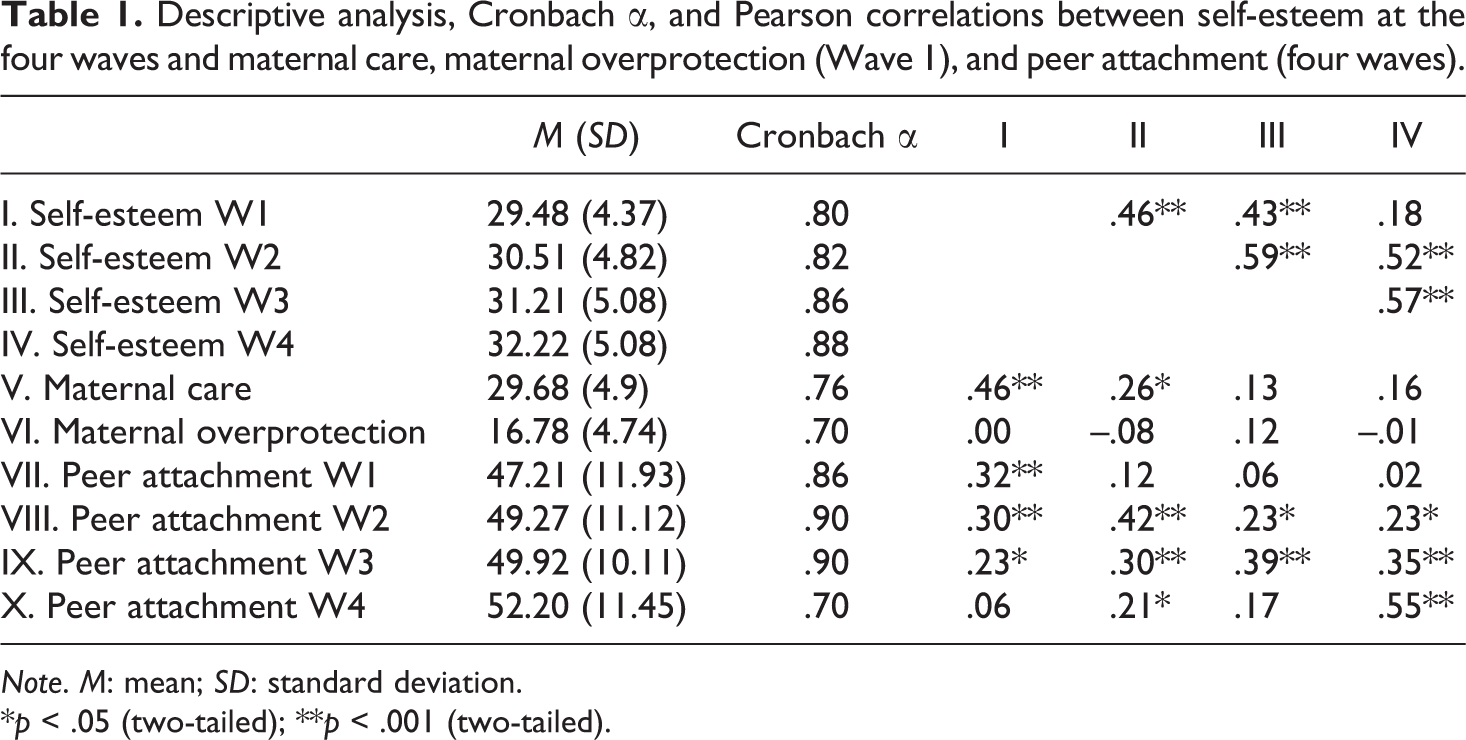
Table 1 shows descriptive analysis, reliability, and correlations of the study variables.
Descriptive analysis, Cronbach α, and Pearson correlations between self-esteem at the four waves and maternal care, maternal overprotection (Wave 1), and peer attachment (four waves).
Note. M: mean; SD: standard deviation.
*p < .05 (two-tailed); **p < .001 (two-tailed).
A linear normative increase of self-esteem F(3, 86) = 6.69, p = .000, partial η2 = .19 was found. The effect size of the increase was medium, according to the criterion of Cohen (1988). The post hoc contrasts showed that a significant change occurred between W1 and the rest of the waves and between W2 and W4, but the rest of the contrasts were not significant (see Figure 1). Differences between sexes also appeared, such that boys showed more self-esteem than girls, F(1, 88) = 5.14, p = .03, partial η2 = .05. This global datum was due to the differences between sexes in mid, t(88) = 2.2, p = .30, and late adolescence, t(88) = 2.79, p = .006. The differences at initial adolescence, t(88) = 0.51, p = .61, and emerging adulthood, t(88) = 1.36, p = .18, were not significant. These data were confirmed with the quadratic interaction between time and sex in the variable self-esteem, F(1) = 6.33, p = .014, partial η2 = .07, although the effect size was negligible.
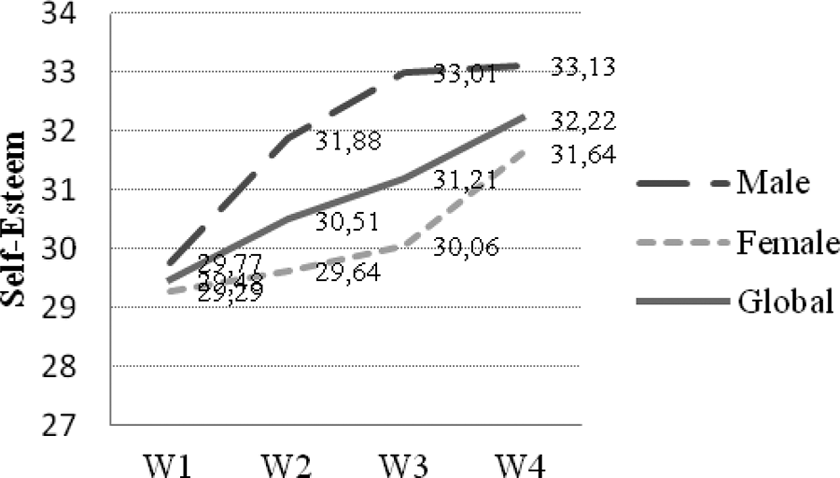
Means in self-esteem throughout adolescence.
Test–retest correlations (Table 1) checked the rank-order stability of self-esteem. Correlations fluctuated between r W1−W4 = .18, p = .09 and r W2–W3 = .59, p < .001 of medium size effect (Cohen, 1988). These correlations indicated variability in self-esteem throughout the period of study, but to a much more limited extent between each wave and the next one.
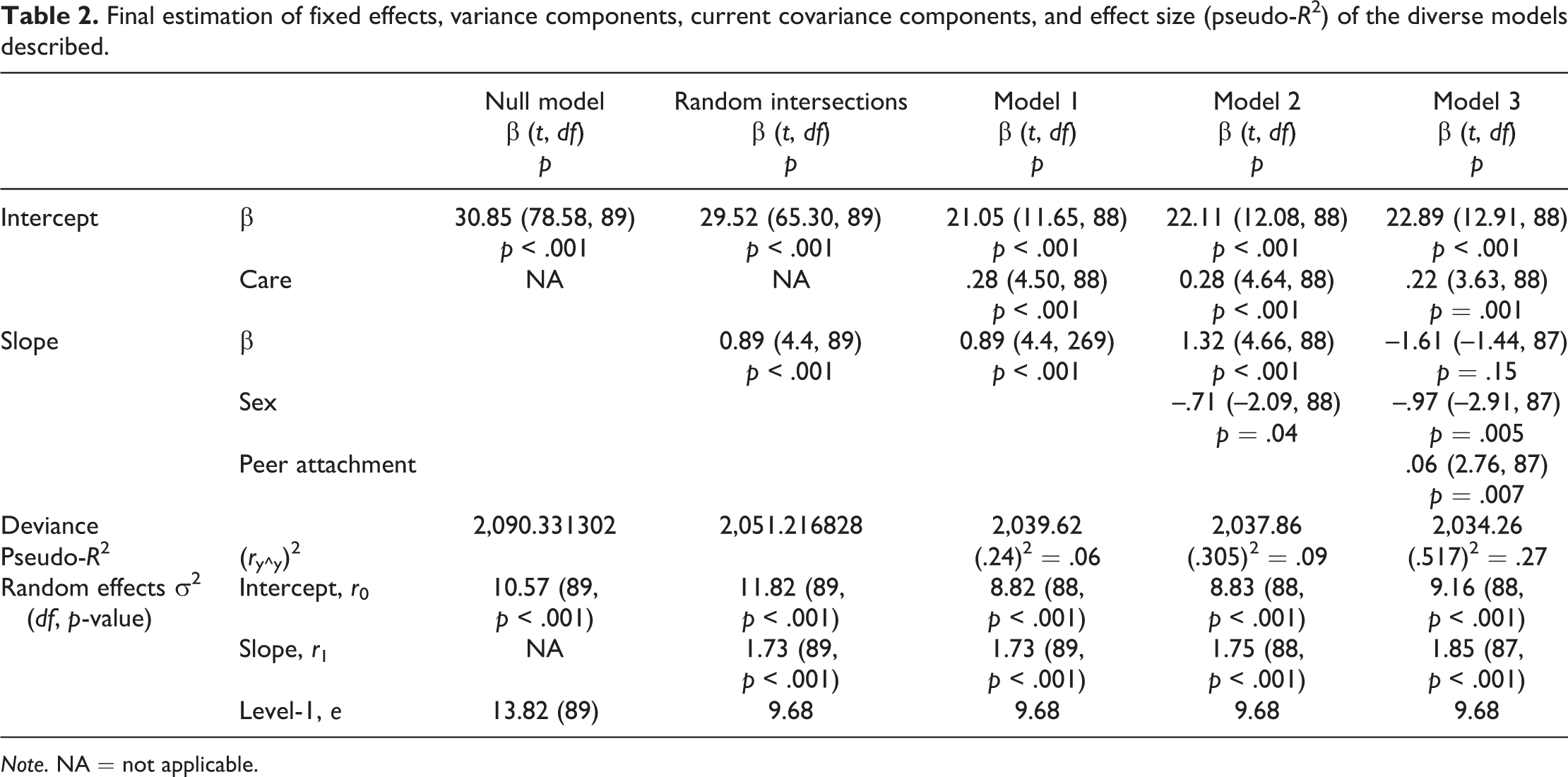
To determine the percentage of intraindividual variability in self-esteem throughout these years, we performed an HLM analysis. The first step was to calculate the null model. This model (Table 2, Equation 1) revealed that the mean level of self-esteem of all the subjects in the four waves was 30.85. Based on the null model, we calculated the intraclass correlation coefficient by dividing the ratio of between-subject variance or intercept variance (
Final estimation of fixed effects, variance components, current covariance components, and effect size (pseudo-R 2) of the diverse models described.
Note. NA = not applicable.
Null model

Note. S-E = self-esteem.
Subsequently, we calculated the model of random intercepts and slopes. This model (Table 2, Equation 2) showed that, at the beginning of the study, the participants differed significantly from each other in their level of self-esteem (r 0 = 11.82, p < .001) and, moreover, that their development of self-esteem over time followed different paths (r 1 = 1.73, p < .001). The positive sign of the value β10 indicated that self-esteem increased during adolescence and emerging adulthood.
Model of random intersections and slopes.

Note. S-E = self-esteem.
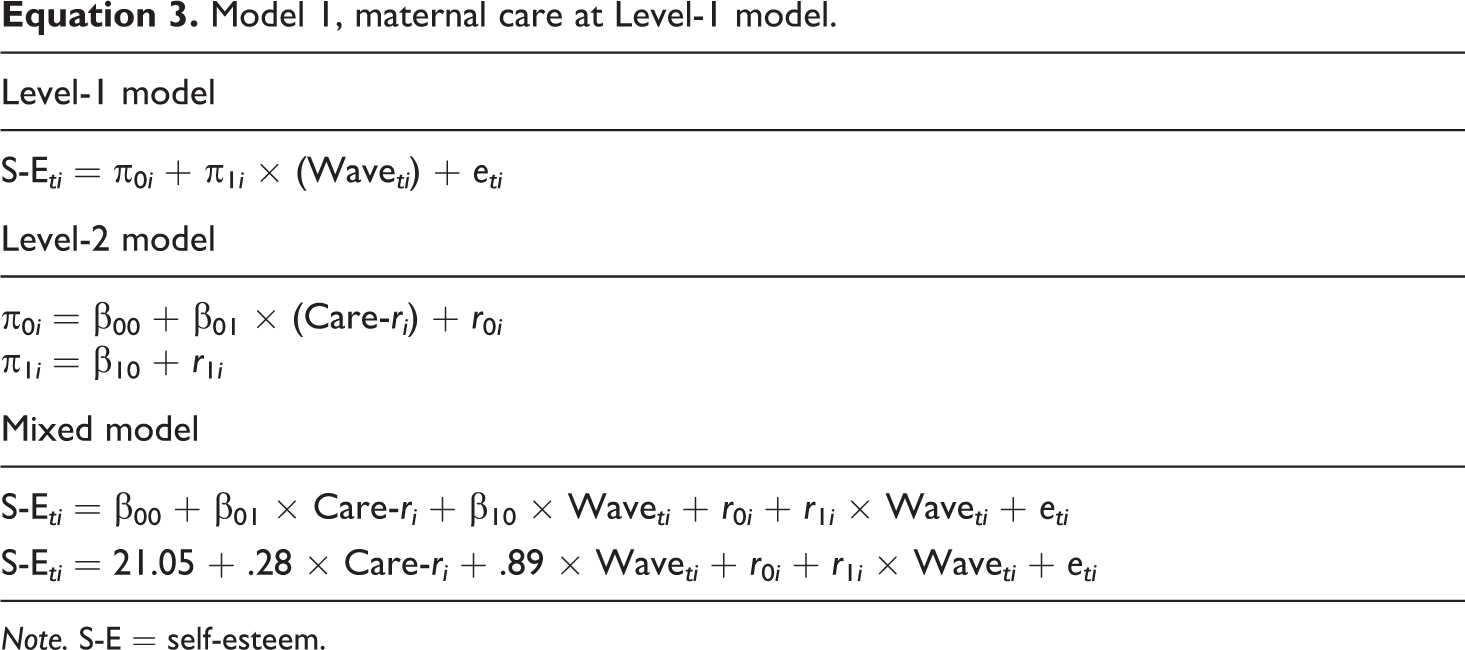
Do people who recalled high maternal care and/or low overprotection show a rise in self-esteem over time? What is the role of sex in increasing self-esteem? To address these questions, we performed a correlation analysis between maternal care, maternal overprotection and self-esteem (Table 1), and an HLM analysis. From the first analysis, we note the correlation between maternal care and self-esteem at W1 (r = 0.46) and self-esteem at W2 (r = 0.26). In HLM Model 1 (Table 2), the role of maternal care was related to self-esteem at early adolescence, that is, at the intercept (β01 = .28, p < .001). We did not include either sex, nor overprotection because the repeated measures’ analyses indicated no significant differences between sexes at W1, and the correlational analysis did not show any relationship between overprotection or sex and self-esteem. Model 1 (Equation 3 ) showed that adolescents who recalled more care showed more self-esteem at early adolescence.
Model 1, maternal care at Level-1 model.
Note. S-E = self-esteem.
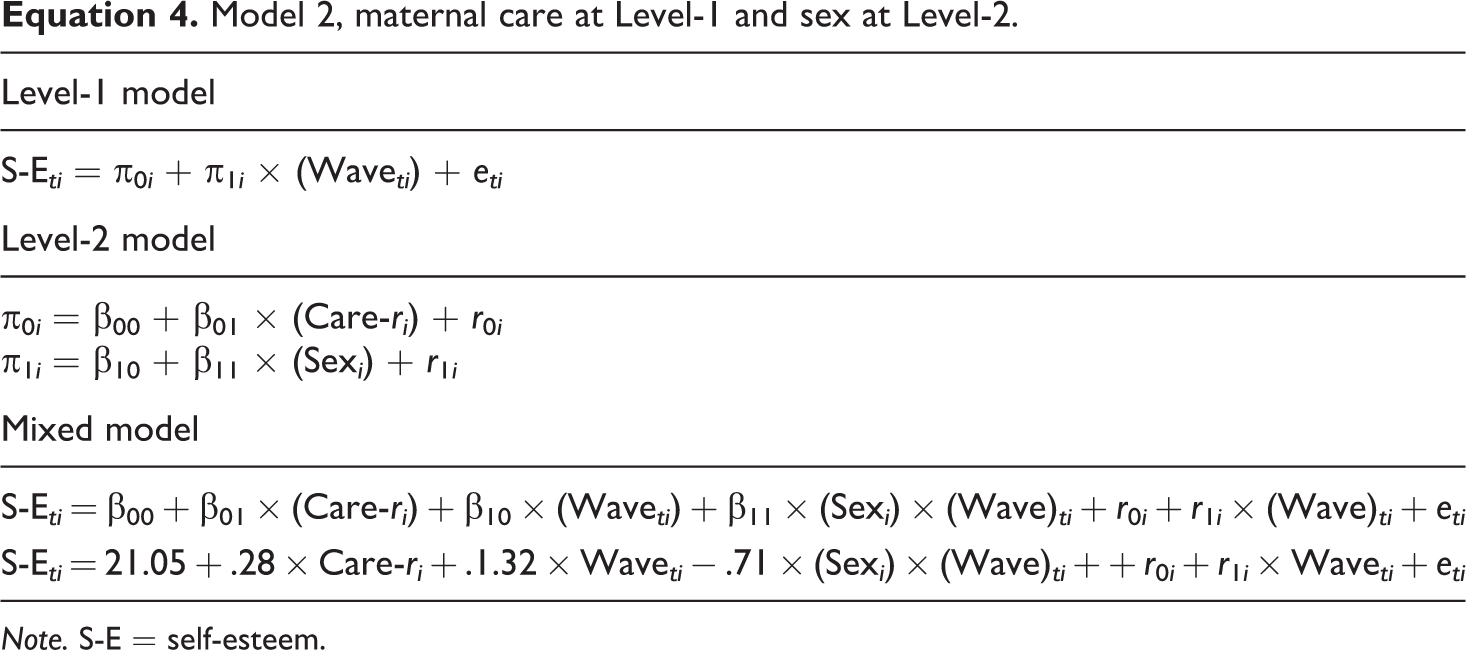
The next step (Model 2, Equation 4; Table 2) was to analyze the role of sex in the individual change that occurred throughout adolescence (slope). The effect of interaction showed that girls’ (coded as 1) self-esteem increased less than boys (coded as 0) throughout the years of the study (β11 = −.71, p = .04). Subsequently, we introduced the variable maternal care in the model to explain the change in self-esteem over time (slope). The model does not converge.
Model 2, maternal care at Level-1 and sex at Level-2.
Note. S-E = self-esteem.
Finally, does peer attachment increase adolescent and emerging adult self-esteem? To address this question, we have introduced the variable peer attachment in Model 3 (Table 2, Equation 5). On the one hand, the variable peer attachment was entered in a regression equation, reflecting that boys and girls who had better peer relationships increased their self-esteem to a greater extent than those with less peer attachment (β12 = .06, p = .007). On the other hand, the slope ceased to be significant (β10 = −1.61, p = .15), so that the contextual—maternal care (β01 = .22, p = .001) and peer attachment (β12 = .06, p = .007)—and subject—sex (β11 = −.97, p = .005)—variables explained this increase in self-esteem better than the passage of time.
Model 3, maternal care at Level-1, and sex and peer attachment at Level-2.

Note. S-E = self-esteem.
As can be seen in the three explanatory models of the changes in self-esteem during adolescence and emerging adulthood, the third model has the best fit. The deviance fit index improved in Model 3, and the increase of pseudo-R 2 in this model—from .09 to .27—was especially relevant.
Discussion
In line with previous findings (Arnett, 2007; Chung et al., 2014 ; Erol & Orth, 2011; Shaw, Liang, & Krause, 2010; Twenge & Campbell, 2001; Wagner et al., 2013), our longitudinal data showed that self-esteem improved over time both throughout adolescence and in emerging adulthood. We have tested it with ANOVA and HLM analyses, which offer unprecedented flexibility in modeling longitudinal data (Raudenbush et al., 2011), in order to measure the developmental trend of self-esteem with a more sophisticated and accurate methodology (Robins & Trzesniewski, 2005). As a result, we are able to confirm that self-esteem increases normatively during these years in a Spanish context. Regarding the influence of sex in the trajectory of self-esteem, the data indicated that there were no differences in the level of self-esteem between boys and girls at the beginning of adolescence, but that boys increased their self-esteem more than girls over time. In addition, the data supported the results of Baldwin and Hoffmann (2002), who, besides finding a sex–age interaction, found that differences in self-esteem between sexes increased during mid and late adolescence and decreased in emerging adulthood, subsequently disappearing (Baldwin & Hoffman, 2002; Kling et al., 1999).
These results may be explained by the effect of puberty and the differential effect of puberty in boys and girls. Major biological changes and the overall number of stressful life events occurring at the beginning of adolescence (Brooks-Gunn & Attie, 1996; Spear, 2000) lead to a decrease in self-esteem, which is recovered gradually as biological changes are less pronounced and as boys and girls learn to manage their new physical appearance and social lives. It is important to point out the differential influence that the alterations in the levels of androgen and estrogen may have on the mood of both boys and girls. Estrogen is related with depressive mood and can partially explain less self-esteem among girls. However, the biological hypothesis is unable to explain convergence in self-esteem at emerging adulthood or the similar levels of self-esteem at early adolescence (13 years old) when major physical changes take place. Neither is biological hypothesis enough to explain the self-esteem increase and sex differences during adolescence and emerging adulthood.
Social hypothesis explains that whereas the changes occurring in girls distance them from the ideal of feminine beauty, the changes occurring in boys—greater strength, vigor, and corpulence—tend to be better accepted (Susman & Dorn, 2009). In emerging adulthood, one’s physical appearance might no longer be such a priority, which may explain why the differences in self-esteem between sexes decrease and even disappear. Moreover, girls tend to be more controlled by their parents than boys and, as has been revealed in other studies, parental control is usually associated with lower levels of self-esteem (Benjet & Hernández-Guzmán, 2001). As girls come into adulthood, parental control could decline as in the case of boys, which may lead to a decrease in self-esteem differences between sexes too.
With regard to relative stability, medium size effects correlations were observed between waves of data collections and a 56.6% of variability in self-esteem between subjects. Stability was lower at early adolescence, a stage of important personal and contextual changes, which could cause self-esteem and other personality traits to be more volatile than at other life stages (Bornstein et al., 2012; Donnellan et al., 2006; Yurgelun-Todd, 2007). According to the cumulative continuity principle of personality development (Caspi, Roberts, & Shiner, 2005), as life goes on self-esteem may become increasingly stable. The work of Roberts and DelVeccio (2000) or Trzesniewski, Donnellan, and Robins (2003) contributed data in this sense, because they found greater relative stability in adolescence than in childhood and in early adulthood than in adolescence. These results led us to believe there is a requirement to implement strategies that improve self-esteem during this stage of life before it becomes more difficult to change.
Our last hypothesis was related to the influence of family and peers in self-esteem changes. Our data indicated that boys and girls who recalled having received more maternal care as children showed more self-esteem than other adolescents in early adolescence. However, as maternal care was not related to an increase in self-esteem in the period of this study, Hypothesis 3 was partially refuted. Our results also indicate that those who scored higher in peer attachment in adolescence and emerging adulthood increased their self-esteem during the time of the study. In fact, the HLM analysis carried out showed that the role of these two relational variables, conjointly with the variable sex, explained both the initial level (maternal care) and the increase in self-esteem (peer attachment) better than simply the passage of time. These results empirically support Robins and Trzesnewski (2005) idea that chronological age has no causal force to increase self-esteem per se. It is no wonder that the self-esteem of boys and girls at the beginning of adolescence was related to their recalled maternal care during childhood. Many decades ago, the relationship between self-esteem and parental care and closeness was shown (Baumrind, 1968; Coopersmith, 1967; Herz & Gullone, 1999; Lamborn et al., 1991). The family context is essential during childhood, and in particular, the care received from parents. People who are raised in contexts in which they feel loved learn to love themselves.
However, when they reach adolescence, another context emerges, which is central to adolescents’ lives, that of their peers (Rubin, Bukowski, & Parker, 2006). Our data indicated that self-esteem increased more in boys and girls who scored higher in peer attachment during adolescence and emerging adulthood than in those who scored lower in peer attachment. The relationship between greater peer attachment and higher self-esteem during adolescence and emerging adulthood was reflected in the meta-analysis of Gorrese and Ruggieri (2013), carried out with cross-sectional studies. Our longitudinal study further indicates that not only are peer attachment and self-esteem significantly related, but the results of HLM analysis also indicate that peer attachment brings about an increase in self-esteem during adolescence and emerging adulthood in this nonspecialized sample. In HLM Model 3, slope wasn’t significant. Peer attachment, which increases over time during adolescence and emerging adulthood (Sánchez-Queija & Oliva, 2015), can partially explain the increase observed in self-esteem. Social support provided by peers is essential during this transitional period (Bornstein et al., 2012), and this need is probably even greater in a community-orientated culture like Spain. Moreover, sociometer theory research has found that likability nominations predicted adolescents’ increase in self-esteem, being mediated by the adolescents’ self-perceptions of their likability (Reitz, Motti-Stefanidi, & Aendorpf, 2014). Therefore, perhaps people with higher peer attachment scoring could perceive that they are likable and this perception could contribute to increase their self-esteem.
However, these results must be considered with caution, because the peer attachment taken into account at this level in the HLM analysis is an average of the level of peer attachment during the entire interval studied, and Pearson correlational analysis showed that peer attachment scores do not always precede self-esteem, but instead, sometimes the opposite occurs. Therefore, we cannot refer to causality, and it makes more sense to consider that the relationship between self-esteem and peer attachment is bidirectional. To be loved by friends can lead to loving oneself. But also, to feel self-worth and to respect oneself can be attractive traits that aid in forming friendships with peers.
Finally, this study has some limitations that should be taken into account, such as the fact that all the information was measured by self-reports completed by the participants. Using only one informant may have caused some bias because this practice creates a common method variance problem that may increase the size of the correlations among the variables. For instance, it is possible that self-esteem is distorting the level of maternal care which subjects recall receiving in such a way that those participants who have more self-esteem are remembering better care that is inflating the relationship between these two variables. Another limitation is the small sample size, which hinders generalization of the results. However, as proposed by Nesselroade and Molenaar (2010), when analyzing the development of psychological constructs over the years, longitudinal samples, even small ones, contribute more information and of more value than cross-sectional samples, no matter how large they are. Moreover, we consider it a strength of this research to have analyzed change in self-esteem at two crucial times of the life span: adolescence and emerging adulthood. This analysis has been carried out in Spain, where there are no previous longitudinal studies about development of self-esteem. We also emphasize the fact of having used different statistical techniques to analyze the data, advancing in the direction proposed by Robins and Tresniewski (2005), who indicated the need to replicate the findings concerning the development of self-esteem with more sophisticated longitudinal designs, which, in turn, allow us to search for the mechanisms underlying the increase of self-esteem during these stages. The results, which reveal a certain amount of intraindividual variability in self-esteem during adolescence and emerging adulthood, suggest the importance of taking action to improve the level of self-esteem at this stage.
Footnotes
Funding
The author(s) disclosed receipt of the following financial support for the research, authorship, and/or publication of this article: This study was funded by the Ministries of Education, Culture and Sports, and Education and Science of the Government of Spain (References: BSO2002-03022/SEJ2006-06433).