



Abstract
Framed in the uncertainty literature, the present study explores the uncertainty issues and management practices of adult children who are in the estrangement process with their parents. Results from 52 narrative interviews reveal six types of uncertainty and six management processes. Taken together, results suggest that the estrangement process is marked by chronic uncertainty that can serve multiple functions. Theoretical implications and practical applications are discussed.
Family membership can provide individuals with efficacy, self-esteem, self-worth and feelings of distinction, and success (Haslam, Jetten, Postmes, & Haslam, 2009). Indeed, being a part of a well-functioning family can support well-being, help individuals cope with stigma, and also provide individuals with social capital (Furstenberg & Kaplan, 2004). Unfortunately, abuse, maltreatment, gross indifference, addiction, and mental illness are present in some families. To address these abuses, some children engage in the process of estrangement. For the purpose of this study, estrangement occurs when a family member voluntarily and intentionally distances him or herself from another family member in an attempt to sever relational ties or create boundaries that limit interaction (Agllias, 2015; Scharp, 2016a; Scharp, Thomas, & Paxman, 2015). Two recent studies conservatively estimate that 12% of adult children are estranged from at least one parent (see Conti, 2015; Gilligan, Suitor, & Pillemer, 2015). In addition to the reasons for the estrangement, the distancing process itself is a significant life rupture associated with deleterious outcomes, such as extreme negative emotions (Agllias, 2011), decreased capacity to self-regulate, and heightened physiological response patterns, such as amplified brain wave patterns and high muscle tension (Friesen, 2003). Thus, the estrangement process can have serious consequences for the parties involved, even if leaving the relationship is a healthy solution to an unhealthy relationship (see Scharp, 2014; Scharp & Dorrance Hall, 2017).
Existing research suggests that one reason the process of estrangement might be difficult is that individuals must negotiate the loss of a parent–child relationship as well as the loss of a shared family identity (Rollie & Duck, 2006). Because belonging to a family is often a central part of people’s identities, research suggests that the estrangement process sparks a lot of doubts for adult children about their personal identity (Agllias, 2013a) and family membership (Agllias, 2011) as well as worries about how others will perceive a decision to estrange themselves from their parents (Agllias, 2013a). Indeed, Agllias (2013b) argues that the entire estrangement process is one marked by ambiguity. Put simply, the loss of a life-long relationship can create uncertainty for adult children. Uncertainty, as Brashers (2001) describes, occurs “when details of situations are ambiguous, complex, unpredictable, or probabilistic; when information is unavailable or inconsistent; and when people feel insecure about their own state of knowledge or the state of knowledge in general” (p. 478). Engaging in the estrangement process is rife with uncertainty—the situation is ambiguous, complex, and unpredictable. There is no script or pathway for ending a family relationship because these bonds are typically perceived as nonvoluntary (Hess, 2000).
In light of the potential of the estrangement process to proliferate uncertainty, we have three main goals in this article. The first goal of this study is to illuminate the uncertainties that adults experience during the estrangement process. Second, we seek to identify the different strategies adult children use to manage their uncertainties. Our final goal is to provide an overarching picture of estrangement-related uncertainties that can help clinicians, social network members, and adult children who are in the estrangement process to better understand the experience and make informed recommendations or decisions about their relationships. Toward this end, we begin by positioning parent–child estrangement as a communicative process and then turn to the uncertainty management literatures to frame the present study. We report the results from a qualitative analysis of 52 interviews with adult children who are estranged from a parent and then discuss the implications of our findings.
Parent–child estrangement and uncertainty
Historically, parent–child estrangement has been conceptualized as a psychological cutoff (Bowen, 1982) or legal classification (Drozd & Olesen, 2004), but new definitions of estrangement are emerging. Family estrangement researchers are starting to explore estrangement as a communication process instead of a psychological state (see Scharp, 2016a). Accordingly, we define estrangement as a communicative process of decreasing interdependence that occurs when children (or parents) voluntarily and intentionally create distance between themselves and the other person because of a negative relationship (Scharp & Thomas, 2016). This distance is typically meant to sever relational ties or at a least create boundaries that limit interaction (Scharp, 2016a). Focusing on the communicative interdependence between family members allows researchers to capture the complexity of the estrangement experience. For example, part of what makes estrangement complex is that adult children might oscillate between one end of the continuum, where they are closer to parents, and the other end, where they are independent and distant. For example, a study by Agllias (2015) reveals that adult children initially engage in on-again/off-again relationships with their parents until they are ultimately able to create and maintain a level of distance they desire. Put simply, the estrangement process is one in flux; a constant transition as family members move along the estrangement continuum. Transitions in relationships are often marked by persistent uncertainty (e.g., Solomon, Weber, & Steuber, 2010), as people have questions about how they will handle the transition and the nature of their relationship in the future. In the next section, we discuss uncertainty and how it relates to the estrangement process.
Defining uncertainty
The literature on uncertainty is vast, as the experience of uncertainty represents a fundamental aspect of the human experience (Berger & Bradac, 1982). In fact, virtually anything can be the source of uncertainty (Berger & Bradac, 1982). Uncertainty has been examined as an individual experience as well as a relational one. Relational uncertainty refers to the level of confidence people have in their involvement in their relationship (Solomon & Knobloch, 2004) and stems from doubts about romantic partners’ own involvement in the relationship (self uncertainty), people’s confidence in their partner’s level of involvement (partner uncertainty), and people’s doubts about the future of the relationship as a unit (relationship uncertainty). Although the work on relational uncertainty has focused largely on uncertainty in the romantic dyad, several empirical studies illustrate the types of experiences that spark uncertainty in broader familial contexts. For example, Colaner and Kranstuber (2010) found that adoptive children have uncertainty about the meaning of their adoption, information about their birth parents, and how their adoptive parents feel about their birth parents. Other scholars have demonstrated that relational uncertainty is not just relevant to romantic associations but is also salient in sibling relationships (Bevan, Stetzenbach, Batson, & Bullo, 2006). Finally, during the transition to marriage, children-in-law have uncertainty about their in-law relationships and uncertainty about how their marriage fits into the larger family system (Mikucki-Enyart, Caughlin, & Rittenour, 2015). Taken together, it is clear that uncertainty is salient to many types of family relationships, but that it manifests differently depending on situational characteristics.
In the context of estrangement, it is likely that people might experience various types of uncertainty related to their relationship with their parent and how confident they are in their level of involvement with the parental relationship. And yet, no studies of which we are aware have examined uncertainty surrounding the estrangement process. Doing so presents an opportunity to better understand the unique ways in which uncertainty might manifest and be resolved in this complex relationship. Because “the uncertainty about the state of the relationship might lead to role ambiguity” the process has the potential to be chronic, long-lasting, and consequential (Agllias, 2013b, p. 317). Indeed, Agllias suggests that those in the estrangement process might be unsure who counts as in or out of the family and often struggle with whether to mourn or be hopeful for reconciliation. A recent study by Scharp (2016b) suggests that adult children might also have concerns about how social network members might evaluate their disclosures about the estrangement. Thus, there are many features of the estrangement experience that could be ambiguous or unpredictable. Furthermore, adult children might be uncertain about whether they will be able to support themselves without tangible support and resources (Jerrome, 1994), whether their grief will be acknowledged by their social network (Agllias, 2013b), or whether they will ever reconnect with their family (Agllias, 2015). In light of the fact that the content of uncertainty can change depending on the relational context (Knobloch, 2008), our first goal is to explore the types of issues or questions that adult children experience during the estrangement process. Thus, our first research question is:
Uncertainty management surrounding estrangement
When people experience uncertainty, they have choices about how to respond. According to uncertainty management theory, people might choose to reduce, maintain, or even increase their uncertainty through a number of communicative strategies (Brashers, 2001). Brashers’ research on uncertainty management in the context of chronic illness suggests that people respond to uncertainty in one of three ways. First, they could seek or avoid information to help maintain their preferred level of uncertainty. Specifically, information can help support or refute beliefs about issues (Heyman, Henrikson, & Maughan, 1998). Second, adult children could manage their chronic uncertainty by accepting that their situation comes with unknowns. Third, they could gain assistance by talking to others and garnering social support. Yet, other uncertainty management options remain, especially because the estrangement process is complicated by limited access to information and the fact that the process is constantly changing.
Research has uncovered various ways that people manage uncertainty in family contexts. For example, some adoptees handle their uncertainty through indirect information-seeking strategies, in an effort to reduce their chances of being rejected by their birth mother (Powell & Afifi, 2005). For individuals in postdivorce families, the more uncertainty they feel, the more they are likely to avoid information about the state of their family (Afifi & Schrodt, 2003). In the context of estrangement, adult children might choose a number of different management strategies depending on the types of questions and doubts they have about the estrangement process. Perhaps adult children want to avoid any information about their estranged family member, because they know it will be upsetting, distressing, or make them feel guilty. Estranged adult children might also manage uncertainty by coming to accept that elements of their situation might always be surrounded by doubts, such as whether the estranged parent will change or whether they will ever have a relationship in the future. Because reducing uncertainty in one area might beget new uncertainties or questions, adult children who are uncomfortable with unpredictability might try to define their own terms of engagement, thereby attempting to create a “cocoon of certainty” (Merry, 1995, p. 128) and trying to insulate themselves from uncertainty-provoking information. In an effort to examine the possibilities for how adult children manage uncertainty surrounding the estrangement experience, we pose the second research question:
Method
We engaged in qualitative research methods that correspond to the goals of interpretive family research outlined by Ganong and Coleman (2014) which aim to (1) provide an evocative account of a particular experience (i.e., identifying uncertainties), (2) provide a rich description of a process (i.e., uncertainty management), (3) examine the family within a context (i.e., estrangement), and (4) provide family members with a disenfranchised experience a way to express their unique stories.
Data collection
As part of a larger research project with Institutional Review Board approval, and in concert with our conceptualization of estrangement, we identified adult children who were at least 18 years of age, had a negative relationship with at least one parent, and had voluntarily and intentionally sought distance from that parent because of the negative relationship. Although we avoided using the word “estranged” because of the associated stigma (see Agllias, 2013b), the vast majority of the adult children referred to themselves as estranged during the narrative interview (n = 46) and all of the participants discussed that the distance they sought was ongoing. On average, participants began the distancing process at age 21 and those participants who have been able to maintain distance, reported being able to do so for an average of 9 years. Other participants described their negative relationship with a parent(s) as being on-again/off-again for an average of 15 years. Of the 52 adult children, all of them reported some form of maltreatment, abuse, or gross neglect by a parent.
Adult children responded to a listserv call distributed to all students and employees at a large Midwestern university. After completing a demographics questionnaire, adult children took part in a narrative interview. The least structured type of interview, narrative interviews allow participants to share their story in their own way (Langellier, 1989). Specifically, adult children were asked to think of themselves as the author of a novel and to share their story about distancing themselves from their parents from the beginning (see Holmberg, Orbuch, & Veroff, 2004). In addition, participants were asked a series of semi-structured interview questions meant to garner more detail about the major events in their story, some of which were intended to explore the role of uncertainty in the estrangement process (see McCracken, 1988). Of note, the majority of participants brought up that they were feeling “uncertain,” “unsure,” or “concerned” without any prompting and were simply asked to elaborate (e.g., How did you feel? How do you negotiate this?). For those participants who did not use those exact words, they expressed their uncertainty by asking rhetorical questions (e.g., “And all moms love their kids, right?” Interview #5) or expressing their fear of an unknown outcome (e.g., “I’m deathly afraid I might exhibit a learned behavior.” Interview #13). When taken together, all participants expressed and discussed some sort of uncertainty by the end of the narrative interview.
On average, interviews lasted 47 min and ranged from 15 to 112 min. During the transcription process, all identifying information was de-identified. Of the 52 narrative interviews, the first author transcribed the first 32 interviews to help become familiar with the data (see Braun & Clarke, 2006), and research assistants transcribed the remaining 20 interviews. This process resulted in about 650 pages of single-spaced text.
Participant demographics
Of the 52 adult children ranging in age from 20 to 66 (M = 35.73; SD = 11.05), 32 (61.5%) identified one parent, 18 identified both parents (34.6%), and 2 identified more than two parents (3.8%; includes stepparents) with whom they gained distance. The majority of these participants were women (69.2%) and White (n = 48, 94.1%), with one participant who reported an American Indian or Alaskan Native (2.0%) ethnicity, two who reported an Asian (3.9%) ethnicity, one who reported a Black or African American (2.0%) ethnicity, and four who reported a Hispanic or Latino (7.8%) ethnicity (participants could select multiple ethnicities).
Data analysis
To answer the research questions, we engaged in a thematic analysis. Determining themes was based on the process detailed by Braun and Clarke (2006), which required that we identify, analyze, and report patterns within the data. The following six steps comprise their process: (1) gaining familiarity with the corpus, (2) creating coding categories or subcategories, (3) generating themes, (4) reviewing the themes, (5) labeling the themes, and (6) identifying exemplars. Familiarity was achieved through data transcription and by reading and re-reading the narrative interviews. Coding categories were generated when pertinent features of the data systematically cohered around a single idea. Themes gained expression when those coding categories coalesced into larger systems of meaning. We then named the themes and selected exemplars that evocatively illustrated the themes. Saturation (see Corbin & Strauss, 2008) was reached by Interview 22, although all narratives were analyzed for verification.
Verification procedures
To verify the credibility of this analysis, we engaged in five interrelated verification procedures: (1) peer debriefing, (2) referential adequacy, (3) investigator triangulation, (4) exemplar identification, and (5) the audit trail (see Lincoln & Guba, 1985). Peer debriefing was accomplished when trained research assistants analyzed the corpus for themes. Two teams worked in pairs (four students in total) to ascertain the themes for each research question. After they identified themes, the two teams came together to discuss any discrepancies and to discuss and compare their findings. The first author engaged in a separate analysis (i.e., investigator triangulation) and began by splitting the data corpus in half so that the second half of the data could be compared to the first half of the analysis after the initial analysis (i.e., referential adequacy). The first author found that there were no new emergent themes in the second half of the data corpus. Finally, the first author and research assistants met to discuss their findings, argue through differences, and choose exemplars that best represented each theme (i.e., exemplar identification). Throughout this process, everyone who engaged in data analysis kept detailed notes of their decision rules and codes (i.e., audit trail).
Results
Identifying uncertainty (Research Question 1)
Six themes, detailed in Table 1, emerged as the uncertainties adult children experienced when gaining distance from their parents. Some of these uncertainties reflected doubts they seemed to be coping with since they were children and in other cases, uncertainties seemed to emerge as adults attempted to create more distance from a parent. We discuss each of the themes and offer exemplars in the paragraphs that follow (also see Table 1).
Types of uncertainty in the estrangement experience.
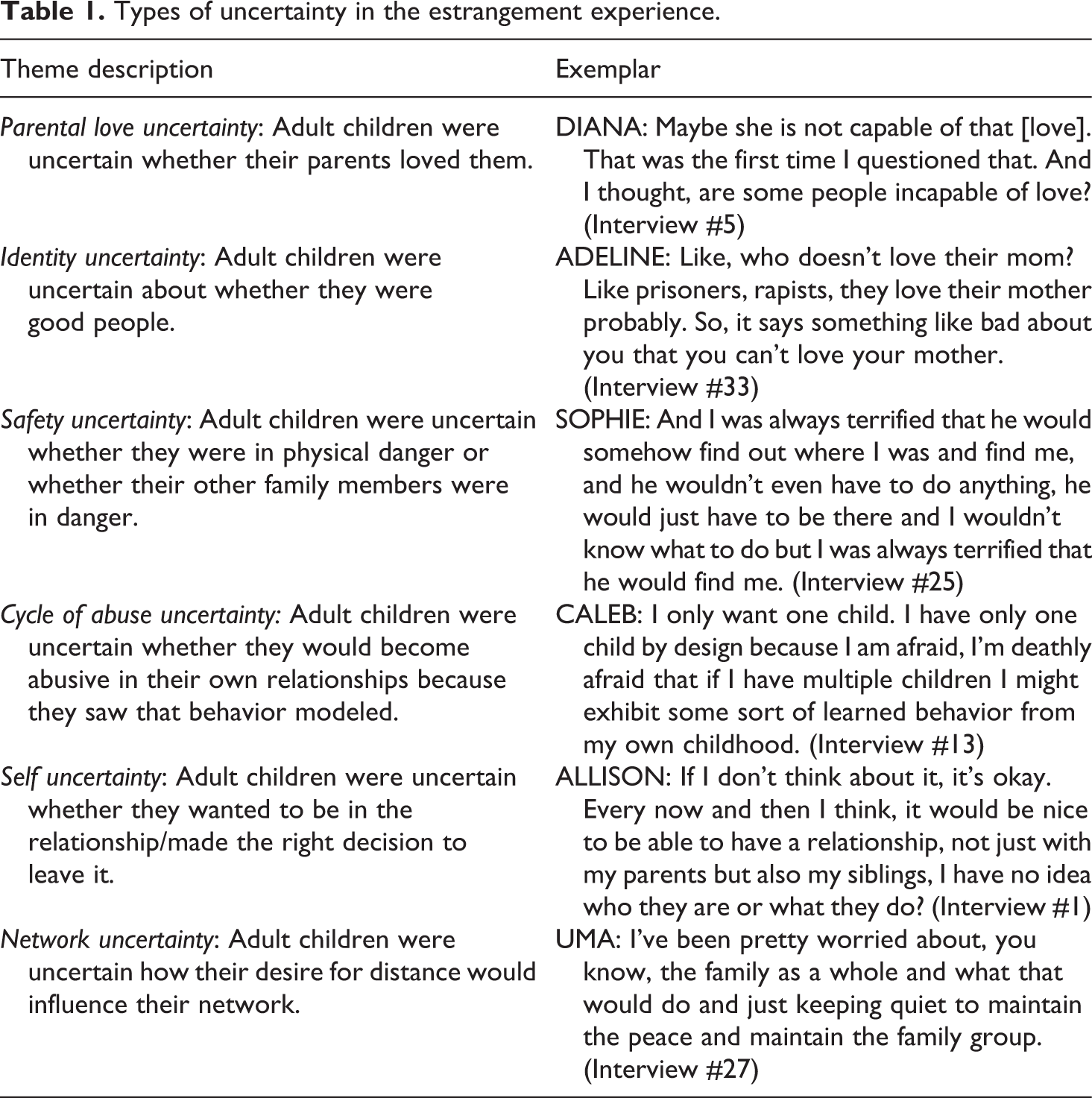
Across the corpus, adult children expressed uncertainty about whether or not their parents loved them. The first theme, uncertainty about parental love, refers to doubts that children have about their parents’ feelings about them or their relationship. Counterintuitive to cultural understandings of what it means to be in a parent–child relationship, adult children found themselves asking, “It’s your parents, it’s supposed to be unconditional love, right?” (Interview #35) or as Ellie recalled: It was very, “I love you. I love you,” but there was nothing behind it. You know, it was all words and no action…the intent wasn’t really behind it. Um, so I think meaningful communication has, it’s more than I love you. It’s followed up with action. It’s followed up with support. It’s followed up with showing your love and not just saying it.
Adult children also struggled with identity uncertainty, which comprised the second theme. Because of their difficult relationship with their parents, children struggled with their identity as “good children,” and felt uncertain about their identity as a good son or daughter. Greg explained: You’re supposed to take care of your parents, you’re supposed to be the good son, you’re supposed to be the confidant, you are supposed to be there to pick them up when they fall. How many times? I don’t know. I missed that somewhere in the book, how to take care of your parents. (Interview #22)
The third uncertainty theme was safety uncertainty and referred to people’s concerns about whether they were in danger and whether or not their other family members were in danger. Safety and protection emerged as a serious concern for some participants. Xenia shared, “So I, I felt it wasn’t safe for me or healthy for me to be around my mom” (Interview #31). In this case, Xenia described both physical and psychological abuse and never knowing when her mother would lose control. Thus, she had to consistently worry she would be physically assaulted. Even after gaining some distance, Sophie described feeling “terrified” that her father would find her given her past abuse (Interview #25). This type of prolonged or chronic uncertainty can be difficult for people to manage and result in negative consequences for those who experience it. Adult children also feared for their family’s safety. For example, Lily explained, “I just want to be free of everything. I don’t want to have to think about what he’s going to do next to try and hurt my family” (Interview #15). Lily conveys that she was exhausted by her persistent uncertainty about how her estranged father would influence the rest of her family. Thus, in addition to their own uncertainties, adult children’s worries ranged from trying to keep themselves safe to ensuring the safety of their loved ones.
Fourth, adult children were exceedingly afraid that they would be abusive or be bad parents or bad partners themselves. This theme, uncertainty about the cycle of abuse, refers to participants’ doubts or questions about whether they would continue (or be a part of) the cycle of abuse they experienced. Hannah shared, “I’m not sure if I’m ever going to have kids. I’m terrified of the thought that for some reason, against all odds, I’m somehow going to be anything like her [referring to her mom]” (Interview #42). Likewise, Caleb (see Table 1) acknowledged that children learn behavior from their parents. Finally, Horace expresses his uncertainty about whether or not he will become abusive, “So, my relationship with him [referring to his dad], I’m very worried that I’m going to become abusive. And so, I’m, I don’t want that ever to happen” (Interview #29). Horace goes on to explain that the uncertainty about whether he will become abusive prevents him from even going on dates and considering starting a romantic relationship because he does not want to have the opportunity to become like his father. Taken together, the negative relationship with at least one parent not only influences the parent–child relationship but also future relationships and identities such as parent and partner.
The fifth theme, self uncertainty, captures how adult children felt unsure about whether they wanted to have a relationship with their parent or whether they made the right decision to gain distance. For example, participants discussed whether they could continue to have their parents in their life and Patrick explained, “I was worried that I had made the wrong decision” (Interview #52). This self uncertainty resonates with existing research that suggests adult children struggle to maintain the distance they are able to create, often engaging in an on-again/off-again cycle of coming together and coming apart (see Agllias, 2015).
Perhaps more salient than self uncertainty, however, was adult children’s concern regarding whether or not their decision for distance would influence their other familial and friend relationships. Not typically taken into consideration as a source of relational uncertainty (see Solomon & Knobloch, 2004), this network uncertainty pervaded the data corpus. Adult children were particularly concerned about how they could maintain relationships with their friends and family who were tied to their estranged parent. For example, Georgia explained: I have two sisters and another brother who no longer speak to me because they feel like I have so wronged the family, and disrespected my dad and I don’t know how much of that is real and how much of that is that they are still financially reliant on my parents. I don’t know how much of that is that they saw an example of how far he would take things if he didn’t see the results he expected. (Interview #9)
Managing uncertainty (Research Question 2)
Our second research question focused on how adult children manage the uncertainties surrounding the estrangement experience. Results showed that adult children engaged in a variety of practices to manage their uncertainty (see Table 2). Because uncertainties often beget new uncertainties, we frame our findings as uncertainty management, recognizing that there is an undefined push and pull between reducing and increasing uncertainty. Specifically, we found evidence of six different strategies adult children used to manage their uncertainty which include (1) contrasting themselves to their parents, (2) making it difficult for their parents to find them, (3) limiting their close relationships, (4) sharing their story with others, (5) contending with their social network, and (6) managing questions about whether their parents loved them.
Uncertainty management strategies.
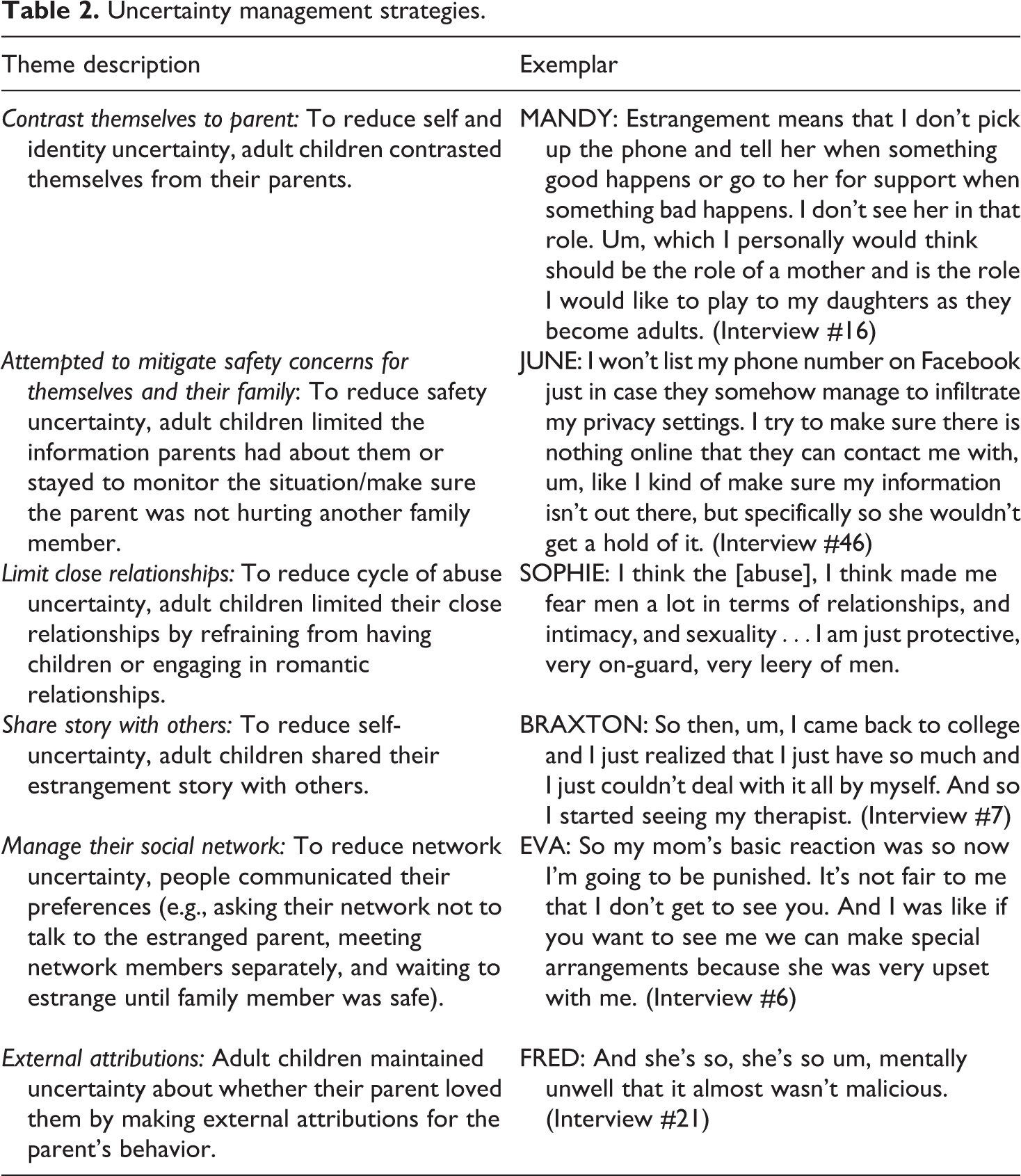
Throughout their stories, participants spent notable time discussing how they were different from their parents to manage their identity and self uncertainty. Thus, even though they often felt guilty for not being a “good” son or daughter, they provided unprompted detail about their identities as “good parents.” Jon narrated: Even though you shouldn’t have guilt, I remember feeling guilty…But my mom chooses drugs…And my dad still chose to get back into drugs…And they didn’t go out of their way to support me. Um, where I am the complete opposite. I will coach my daughter. I have coached my daughter’s soccer team, her softball team. I go to just about every, every activity I can go to. I show up at, volunteer at her school when I can for field trips and stuff like that. So, I am trying to be um, almost the complete opposite of my parents as far as trying to be very involved in my daughter’s life. (Interview #38) My husband…he would say that you’re not nice enough to your mom. And I would say, “Here’s the deal, you need to validate my feelings and if you can’t, I don’t want you talking to me about my family.”…My daughter got it…I’m not like my parents. (Interview #8)
Corresponding to safety uncertainty, one way adult children attempted to manage their fear was to engage in communicative behaviors that made it hard for their parents to find them. Janey revealed, “She [her mother] no longer has my cell phone number. I had changed cell phone numbers. Um, and I have moved and she does not know that address” (Interview #12). Indeed, many participants did not communicate their location with their parents and made efforts to ensure they could not be found via social media. Other participants made explicit disclosure rules so that their network would not discuss any personal information with the estranged parent. For example, Sophie explained, “I have told her [her sister] outright, I don’t want you tell him [her father] where I am and I don’t want you to tell him anything about me” (Interview #25). Thus, even though the fear of continued abuse was still a real threat for many of the participants, they were able to gain some agency by not divulging new information or by developing privacy rules to keep the information about their whereabouts secret.
Although the majority of adult children made it hard for their parents to find them, we thought it important to note that some adult children felt compelled to stay in their abusive relationship for fear the parent would hurt another family member. Roxy explained, “I was afraid she would turn to one of my younger sisters if she didn’t have me to dump this stuff on and a lot of it was about my parent’s marriage and I felt like well, I felt kind of wrecked by it a little bit and I was like well, at least my younger sisters don’t have to know” (Interview #24). Thus, to manage the safety concern for others, one strategy for adult children was to remain in an abusive relationship. Indeed, some estrangement-related uncertainty can prove very costly to those who experience it.
In response to their uncertainty that they would continue the cycle of abuse and be bad partners or parents, some adult children expressed that they would not have many or any children or even date. For example, Iliana expressed: I’m often kind of amazed when I see functional families, because I don’t have one. I think that I’m sure that I have less faith in my ability to have one because I didn’t see it modeled. I don’t think, I don’t want to have children. If I had a better relationship with my mother…I think I would have been more optimistic about the ability to raise children. (Interview #11)
To help manage adult children’s self uncertainty regarding their decision to distance from their parent, participants discussed the helpfulness of sharing their story with others. According to these participants, talking and writing about the experiences that led to the estrangement helped remind the adult children why that distance was important, thus helping them reconcile their decision to gain distance. Adult children did not talk about their story primarily as a way to disclose their estrangement experience, but rather as a personal way to make sense of their actions. Kayla recounted sharing her estrangement narrative with her teachers: In high school and college I always wrote about my dad and I think it was more of a coping mechanism…It helps with the distancing because you know, I see like I’ll write about the situations he put me through and things like that and then I see oh well you know, I can’t let up now because this happened. (Interview #14)
Finally, two subthemes depicted the ways adult children managed friends and family to reduce their network uncertainty: (1) they asked others to stop talking with the parent and (2) they asked to meet with network members separately. One way adult children tried to manage their network uncertainty was to try to convince the network member to gain distance from the parent as well. For example, Ilene, who was estranged from her father, explained she had a confrontation with her mother, “I actually moved my mom out of the house and said, ‘You’re done. You need to get a divorce. This is ridiculous. It’s over. He’s nuts and you need to be free’” (Interview #45). Another way adult children tried to manage their network uncertainty was by asking other members to interact with them separately from their estranged family member. This appeared to be an attempt by the participants to retain certain (especially family) relationships and maintain distance with the estranged parent. Despite experiencing initial uncertainty about how they negotiate the distance in her estranged relationship with her father, Georgia explained, “Like I said, I’m very close with my mom. We talk all the time. You know, sometimes twice a day. And that’s good. She and I have come to a healthy place” (Interview #9). Although perhaps not a perfect solution, participants generally described parsing out their relationships as a viable alternative.
Finally, participants actively tried to manage their uncertainty about whether their parents loved them. This might come as no surprise considering a cultural assumption exists that parents should love their children unconditionally. To manage their parental love uncertainty, some participants provided external attributions for their parents’ inconsistent behavior. For example, Phoebe explained: I don’t feel love. I mean my mother has said it. But I don’t really feel it. I don’t really remember my father saying it…I mean, I think I’ve let go a lot of my expectations, I don’t know. It’s hard with a person, when you are dealing with a person who has some mental health issues going on. So I know now that it isn’t all about me. (Interview #23)
Discussion
We began this study with the goal of examining the experience of uncertainty during adult children’s estrangement from their parents. The present study illuminates six types of uncertainty that illustrate the unique challenges and questions related to the estrangement experience as well as the ways that adult children manage their uncertainty. Next, we discuss the theoretical implications for the uncertainty management literatures, the practical applications as well as possible areas for future inquiry.
Connections to the relational uncertainty literature
Knobloch and Solomon (1999) argue that during times of transitions, romantic couples often experience self, partner, and relationship uncertainties. This study extends the relational uncertainty literature by illuminating the self, love, and network uncertainties experienced in parent–child dyads from the perspective of estranged adult children. Although these types of uncertainty relate to those described in existing literature in some ways, this study suggests that relational uncertainty manifests differently in the context of parent–child estrangement.
Related to self uncertainty, adult children wondered whether gaining distance was the right choice and whether they were doing the right thing. This doubt might have sparked, or is at least related to, identity uncertainty. Because the parent–child relationship is so central to one’s identity, gaining distance seemed to ignite doubts about how people felt about themselves. Relatedly, adult children had questions about how their identity would be viewed by social network members who knew about the estrangement. Thus, in addition to questioning personal investment, the “self” was also implicated when adult children wondered whether they were good children. Overall, uncertainty about estrangement decisions and personal identity have the potential to be exhausting experiences, especially as the questions might reoccur and bubble up again, even after people feel they have been resolved.
One of the most unique and difficult uncertainties to manage is parental love uncertainty. Although it is similar to partner uncertainty (Knobloch & Solomon, 1999), it is distinct because in parent–child relationships, there is a cultural assumption that these relationships are loving and close. Thus, the uncertainty people experience around whether a parent love them or not seems particularly painful. Neither outcome is particularly satisfying when asking oneself, “does my parent love me?” If estranged adults conclude that their parent does not love them, then they might be left wondering whether their parent does not love them because they are a bad person or unlovable in some way. Alternatively, concluding that their parent does love them raises other questions, related to why the parent does not engage in loving behaviors or why their behaviors do not match their verbalization of love. To manage this uncertainty, adult children try to attribute their parents’ behaviors to external causes, such as mental illness. In doing so, this allowed them to side-step either of the above alternatives (i.e., that their parent does not love them because they are unlovable or their parent loves them, but does not act like it). Attributing negative behaviors to external causes, such as mental illness, allows for the future possibility that a parent could overcome the illness and show love toward the adult child. Overall, parental love uncertainty seems central to the estrangement process in that it sparks questions and other domains of uncertainty.
Our findings also extend the work on relational uncertainty by suggesting that people also experience network uncertainty. Although this is technically outside of the parent–child relationship, network uncertainty stems from the estranged adult’s relationship (or lack thereof) with the parent. Specifically, our participants voiced doubts about how their network members would react to and handle the estrangement. They also questioned how they would maintain relationships with some family members in the midst of the estrangement. This is not a type of relational uncertainty captured in current research, but it presents an interesting area for future studies. For example, research shows that family members’ approval of romantic relationships affects the quality and stability of that relationship (e.g., Sprecher & Femlee, 1992). Thus, we imagine it would be difficult for estranged adult children to maintain the distance when other family members are unsupportive.
Our findings highlight that estrangement-related uncertainty is chronic and cyclical. First, adult children discussed uncertainty as chronic. Indeed, they reported feeling uncertain both before they initiated distance from a parent and after they were estranged. In fact, it seems that in some cases, the act of creating distance from a parent was one way that adult children managed their uncertainty about their relationship. Interestingly, participants often traded old uncertainties for new ones, as engaging in the estrangement process produced new kinds of questions and issues. Part of the reason is that estrangement is unique. Uncertainties in other contexts can be resolved by gaining particular information, but information is not always the antidote for uncertainty about the estrangement experience. In fact, new information and events might cause adult children to reappraise their uncertainty, such as when a parent becomes seriously ill (Hogan & Brashers, 2009). In light of new information, adult children might be forced to reconsider their decision to gain distance, which could either spark new uncertainties or resurface old uncertainties. Future research could examine the ups and downs of uncertainty throughout the estrangement experience to get a deeper understanding of the chronic and cyclical nature of doubts in this context.
Potential practical applications
The results of this study suggest that there can be many opportunities for social network members who want to provide supportive communication. Although we did not test adult children’s psychosocial functioning, given the uncertainties they expressed, we offer some potential recommendations. For example, social network members might have an opportunity to help manage identity uncertainty by providing esteem support. Esteem support increases people’s self-worth in the face of a stressor especially when the provider reminds the recipient that he or she is valued and a worthwhile person (see Holmstrom & Burleson, 2011). Thus, network members might remind the estranged adult child that they are still good people and that it does not make them a bad person to exit an unhealthy relationship. Furthermore, contrary to what might be intuitive, network members might consider refraining from reassuring estranged adult children that their parents love them. Although this suggestion might seem hurtful, our findings suggest that adult children are comfortable maintaining parental love uncertainty. Providing reassurances has the potential to do more harm than good. Finally, network members might help estranged adult children by listening to their stories. Indeed, our findings suggest that one way participants tried to manage their self uncertainty was to share their stories with others. Offering a sympathetic ear could be very helpful for those who want to reduce their uncertainty through sharing their experience. If adult children do not want to share their story with their network, they might also consider writing about their experience in a journal. Engaging in therapeutic writing has been shown to be helpful for dealing with traumatic experiences and improving one’s overall well-being (e.g., Pennebaker, 1997).
Opportunities also exist for counselors/clinicians. For example, our research suggests that safety uncertainty is particularly severe because adult children are fearful for their protection and the well-being of their loved ones. Although some adult children manage their uncertainty by taking measures to make sure their parent never finds them, they seem to live in constant fear, because they are never really sure that they are safe. Counselors might be able to help these adult children manage their fear around the experience in way that they can be safe but not be debilitated by fear. Anecdotally, before coming in for the interview, several adult children made inquiries about how we would use the data and whether their identities would be protected. They stated that they wanted to contribute to the study but would not participate if it meant they would be exposed.
Practically, counselors or concerned adults should be aware that children might refuse help if they think that garnering support would put their siblings at risk. For some participants, the fear for their family member’s safety was so great, that they delayed their own departure and distancing from a parent in order to stay and continue to take the abuse so younger siblings would not have to endure it. This finding echoes Cottrell (2004) who found that adolescents’ fear for their siblings stopped them from escaping abusive parents as well as findings reported by the American Veterinary Medical Association (2015) that suggests approximately one-third of domestic violence victims delay leaving an abusive relationship due to concern for their pets (an integral part of their family). Although siblings are obviously not the same as pets, both potentially lack the agency or resources to leave the abusive relationship on their own.
Limitations and directions for future research
The findings in this article should be interpreted in light of the limitations. One particular limitation is that we only collected stories from adult children. Thus, we only report the uncertainty challenges from one perspective. It is likely that parents also experience a range of uncertainties, especially because (in our study) they did not initiate the distance. Another limitation is that we did not collect financial data. It is possible that adult children had more or less uncertainty depending on their tangible ability to leave the relationship. This limitation is also related to the potential to better understand the ways that adult children’s respective ages could influence the estrangement process. For example, younger children might experience safety uncertainty more acutely than older adults. Researchers might consider surveying adult children longitudinally. A survey study might also be useful in parsing out gender differences between and among same and different gendered parent–child dyads.
We also collected stories from adult children who were in the process of estrangement for varying amounts of time. It is possible that certain uncertainties are more or less salient depending on how long adult children are in the process. Alternatively, it is also possible that participants’ ages influence the uncertainties they face and how they manage them. Future researchers might engage in longitudinal survey data to explore variables such as age and time.
Despite the limitations, we see a number of exciting areas for future research. First, people’s emotional response to uncertainty is an important component for understanding how people respond to uncertainty (Brashers, 2001). Future research could examine people’s emotions with regard to the uncertainty they have surrounding estrangement. Second, researchers could use the relational turbulence model (Solomon & Knobloch, 2004) to examine people’s cognitive, emotional, and communicative patterns as they transition from being interdependent family members to being more independent and estranged. Thus far, the relational turbulence model has only been applied to relationships transitioning to being more interdependent; it would be interesting to see how the model applies when people are disentangling their lives from one another and creating distance. Finally, results suggest that understanding the adult children’s social network (from their perspective) might be an important step to holistically understanding the estrangement process.
In conclusion, the estrangement process is wrought with chronic and cyclical uncertainties for those who initiate the distance. Yet, these uncertainties are not necessarily problematic. Indeed, sometimes adult children sought to maintain their uncertainty so they could maintain distance from an unhealthy relationship. As suggested, social network members might have real opportunities to support estranged adult children by helping to reduce some uncertainties and encouraging others.
Footnotes
Funding
The author(s) received no financial support for the research, authorship, and/or publication of this article.