



Abstract
Research on the merging of social networks among married couples tends to focus on the benefits of increased social capital, with the acknowledgment of potential stressors being limited primarily to in-law relationships. The purpose of the present study was to examine both positive (i.e., shared friend support) and negative (i.e., disapproval and interference of partner’s friends) aspects of friend ties on divorce across 16 years. Using a sample of 355 Black and White couples from the Early Years of Marriage project, we examined these associations with a Cox proportional hazard regression, controlling for a number of demographic and relational factors. Our findings indicate that (1) the negative aspects of couples’ friend ties are more powerful predictors of divorce than positive aspects; (2) at least early in marriage, husbands’ negative perceptions of wives’ friends are more predictive of divorce than are wives’ negative perceptions of husbands’ friends; (3) friendship disapproval may be less critical in the marital lives of Black husbands and wives than of White husbands and wives; and (4) the association between disapproval of wives’ friends at Year 1 and divorce may be partially explained by wives’ friends interfering in the marriage. Our findings are interpreted in light of possible mechanisms to explain the link between partner disapproval of friends and divorce, such as diminished interdependence, less network approval, and increased spousal conflict and jealousy.
One of the oft-cited health benefits of marriage is the joining of two social networks, as individuals are thought to be given access to greater social resources (Acock & Demo, 1994; Curran, McLanahan, & Knab, 2003). However, married individuals may not fully capitalize on these social resources, as a recent study found that they reported less contact with their family, friends, and neighbors than their unmarried counterparts (Sarkisian & Gerstel, 2016). Although married individuals may become more isolated as they turn to each other, diminished contact with their larger social network could also be attributed to difficulties merging two separate sets of family and friends. Such difficulty has been well-documented with regard to the challenges of connecting to a partner’s family (e.g., acrimonious relationships with in-laws; Bryant, Conger, & Meehan, 2001; Orbuch, Bauermeister, Brown, & McKinley, 2013), but the literature considering the effects of merging friend networks on marital relationships is comparatively sparse.
This gap in the literature is likely in part due to the assumption that problematic friendships are more easily dissolved or avoided than problematic family relationships. In fact, friendship networks are thought to naturally become more “interdependent” the longer individuals are together (Milardo, 1982), with sharing friends being treated as an indicator of couple commitment (Stafford & Canary, 1991). However, couples do not fully or uniformly combine their networks (Fiori et al., 2017); instead, spouses maintain both mutual and separate friendships (Milardo, 1982). Although maintaining such a mix can enhance individual and marital well-being (Lin & Westcott, 1991), not all spouses will connect equally—nor equally well—with each other’s friends. The benefits of increased social capital may depend on whether these network members are viewed positively or negatively, as separate friendships may be more problematic when the spouse’s friends are not liked. Thus, to fill this gap in the literature and determine how and whether one partner’s opinion of the other partner’s friendship ties is linked to divorce, the present study investigated the role of both positive (husband and wife reports of shared friend support) and negative (husband and wife reports of disapproval of partner’s friends and interference of partner’s friends in the marriage) aspects of couple friendship ties as predictors of divorce across 16 years. We also examined whether the association between disapproval and divorce varied by gender and race.
The benefits and challenges of couples’ friendships
Interdependence theory suggests that as romantic relationships develop, couples share an increasing number of close friends (Milardo, 1982). This greater interdependence is thought to create a sense of ‘couple identity’ (Milardo, 1982) that serves to enhance marital satisfaction (Hansen, Fallon, & Novotny, 1991; Kearns & Leonard, 2004; Orthner, 1975). In fact, Kalmijn (2003) refers to joint social networks as a form of “marital capital” (p. 232). The assumption permeating this literature is that this process of combining social ties (at least friendships) is beneficial, because it is thought to be harmonious. But what happens if an individual does not like one or more of his or her spouse’s friends? Heider’s (1958) classic “balance principle”—which states that the product of three relationships in a triad should be positive—suggests that such tensions are quickly resolved, either by the individual learning to like the spouse’s friend or by the spouse dropping the friend altogether (Kalmijn, 2003; Parks, Stan, & Eggert, 1983). However, in the event that the individual chooses not to end the friendship, the tension will likely remain unresolved and act as a source of stress within the marital relationship.
This possibility is consistent with work illustrating the powerful role that friends and family can exert on romantic relationships, both directly—by providing or withholding approval and support of the relationship (Doxey & Holman, 2002; Sprecher, Felmlee, Orbuch, & Willetts, 2002)—and indirectly—by acting as a sounding board for marital problems (Helms, Crouter, & McHale, 2003). In fact, network members’ approval of a romantic relationship is a strong predictor of its quality and stability (Doxey & Holman, 2002; Sprecher et al., 2002), with approval from females’ friends appearing to be particularly important (Sprecher & Felmlee, 1992). In addition, ongoing positive support of the relationship from one’s own and one’s partner’s social networks has been linked to feelings of love and commitment, relationship satisfaction, and relationship stability (Doxey & Holman, 2002; Larson & Holman, 1994; Surra, 1990). Even perceiving the network to be more supportive appears to yield benefits for the couple, as greater perceived network support has been linked to a decreased intent to divorce (Bryant & Conger, 1999).
However, having two sets of friend networks can also be challenging for couples who must learn to share each other’s time and energies. For example, among married couples in which wives interact with and feel close to dense friend networks, husbands report lower levels of marital satisfaction (Burger & Milardo, 1995). Perhaps, as Sprecher, Felmlee, Orbuch, and Willetts (2002) pointed out, network members may “increase the likelihood of a breakup simply by being good alternative sources of companionship and intimacy” (p. 266). Relatedly, in certain contexts (i.e., low levels of disclosure among spouses), the amount that wives routinely disclose about their marital problems to their closest friends predicts lower levels of love and commitment and greater levels of ineffective arguing between spouses (Helms et al., 2003; Jensen & Rauer, 2014). An obvious explanation is that wives in troubled marriages may simply be disclosing more about their marriage to their close friends, highlighting the role that gender may play in these associations. Supporting such a possibility is research on the interference model (Julien, Markman, Léveillé, Chartrand, & Bégin, 1994), which suggests that network members (in particular, wives’ female confidants) may catalyze feelings of distress by offering negative views of the partner, as well as solutions focused on dissolving the relationship rather than strengthening it. What remains unknown is whether the husband’s opinion of the wife’s close friends and his perceptions of their potential interference in the marriage might further exacerbate marital discord.
The vast majority of existing research is directed toward understanding the effects of the network’s positivity or negativity on the relationship, with little consideration of how the partner’s perceptions (positive or negative) of social network members may independently influence the stability of the relationship. In other words, the link between networks and relationship stability is thought to be primarily, if not exclusively, driven by the network’s perceptions of the relationship. Such an omission of the role of partner’s perceptions of the network is problematic, since spousal perceptions more generally (e.g., of time spent together and marital quality) strongly predict risk of divorce (Gager & Sanchez, 2003). Furthermore, individuals can become jealous of their partner’s friends, particularly when those partners are more central to the individual (Gomillion, Gabriel, & Murray, 2014), which could potentially interfere with the marriage and dilute the marital benefits of having these supportive relationships. Taken together, it is clear that the spouse’s perceptions of the individual’s network members, friends in particular, may have implications for marital stability.
Considering context: A focus on gender and race
The extent to which perceptions of a partner’s friends negatively affect the romantic relationship appears to be sensitive to individual differences (e.g., Gomillion et al., 2014). For example, gender may play a role, such that a wife’s disapproval of her husband’s friends may be less damaging to marital stability than a husband’s disapproval of his wife’s friends. First, women share friends less frequently with their spouse, and the functions of men’s friends can be taken over by the wife more easily than the reverse (e.g., doing activities together; Kalmijn, 2003). Second, wives are much more likely than husbands to discuss marital problems with friends, which weakens the marriage when done in lieu of talking to the husband (Helms et al., 2003). Third, approval of the relationship from wives’ friends appears to be more predictive of relationship stability than approval from husbands’ friends (Sprecher & Felmlee, 1992). Finally, Doxey and Holman (2002) found that husbands appear to need greater approval from their friends and family about their marriage than do their wives. The more peripheral nature of husband’s friends combined with husband’s greater need for approval implies that husband’s perceptions of wife’s friends may be more consequential for marital functioning.
The effect of a partner’s disapproval of one’s friends on marital stability may also vary by race. For example, in our own work using the Early Years of Marriage (EYM) data, we found that the links between social networks and negative marital quality, but not positive marital quality, were weaker for Black couples than for White couples (Fiori et al., 2017). These weaker associations for Black couples could be a reflection of their limiting contact with network members, which has been found to be a coping strategy to prevent marital strain (Orbuch et al., 2013). Such a strategy is thought to be more necessary for Black couples since they tend to face greater demands and potential interference from their network members than do White couples (McLoyd, Hill, & Dodge, 2005; Neighbors, 1997; Taylor, Brown, Chatters, & Lincoln, 2012). Furthermore, interactions with family compared to friends may be more relevant for the well-being and stability of Black families and marriages than for White families (Timmer & Veroff, 2000; Whyte, 1990). However, Jackson, Kennedy, Bradbury, and Karney (2014) found that despite being embedded in networks with more family members, Black wives, in particular, still reported fewer sources of emotional support and fewer good quality relationships in their networks than did White wives. It could be that White wives depend more on friends (e.g., discussing marital problems; Helms et al., 2003) than do Black wives. In sum, the existing empirical work implies that perceptions of friendships may be less central in the marital lives of Black spouses, which may make their marriages less vulnerable to spousal disapproval of friends in particular.
The current study
In spite of the fairly substantial body of research considering the social networks of couples outlined above, very little is known about how spouses’ opinions of individuals’ social network members influence marital stability. We focus on divorce as our outcome because of the high prevalence of (Carrere et al., 2000) and myriad risks associated with divorce (e.g., disrupted parent–child relationships, loss of emotional support, economic hardship; Amato, 2000). The purpose of the present study was to examine the role of both positive (shared friend support at Year 1) and negative (spousal friendship disapproval at Year 1 and interference of partner’s friends at Year 2) aspects of couples’ friend networks on divorce across 16 years in a sample of Black and White couples. Controlling for reports of individual friend support, we hypothesized that both husband and wife reports of shared friend support would be associated with a decreased risk of divorce over time. In addition, we hypothesized that husband’s disapproval of wife’s friends would predict divorce but wife’s disapproval of husband’s friends would not, and that friendship disapproval would be predictive for White couples but not Black couples. Finally, we explored the possibility that Year 2 husband reports of spousal friend interference (in the marriage) would at least partially explain the association between husband disapproval at Year 1 and divorce. Understanding the complexity of the increased social capital associated with marriage is critical, as previous work may have overlooked friends as a potential source of strain in couples’ lives.
Method
Participants and procedure
The EYM project (http://projects.isr.umich.edu/eym/) is a longitudinal panel study following 373 couples (174 White and 199 Black) over the first 16 years of marriage. Eligible couples were same-race couples who were entering into their first marriage and in which the wife was younger than 35. All couples obtained marriage licenses in Wayne County, MI, in 1986. When comparing the EYM sample to a nationally representative sample of Black and White newlywed individuals in the General Social Survey, there were no significant differences by race in income, education, parental status, cohabitation, employment, or other sociodemographic factors (Orbuch, Veroff, Hassan, & Horrocks, 2002).
Participants completed face-to-face individual interviews in their homes with race-matched interviewers in Years 1, 3, 7, and 16 of the study. Although information about divorce for each couple was obtained in each of these years (1 = married; 0 = divorced), more precise estimates of which respondents divorced when during the 16 years were obtained through extensive tracking efforts and telephone interviews in Years 14 and 16. By Year 16, 46.1% (n = 172) of the couples had separated or divorced; this included 63 (36.2%) of the original 174 White couples and 109 (54.8%) of the original 199 Black couples.
At Year 1, the average age of husbands was 26.48 (SD = 4.15) and of wives was 24.31 (SD = 3.88). The mean number of years of education was 13.13 (SD = 1.89) for wives, and 13.11 (SD = 1.92) for husbands, with a range from 8 to 17 years. Average income at Year 1 was $30,933 (SD = $16,864), with a range from $1,500 to $80,000. Approximately 55% of the Black American couples and 23% of the White American couples entered the marriage with at least one child. About 30% of the wives (24% White American; 36% Black American) and 21% of the husbands (12% White American; 29% Black American) had parents who divorced when the respondent was young (under 16; see Table 1 for differences in study variables by race and marital status).
Overall descriptives and race and Year 16 marital status differences on all study variables.
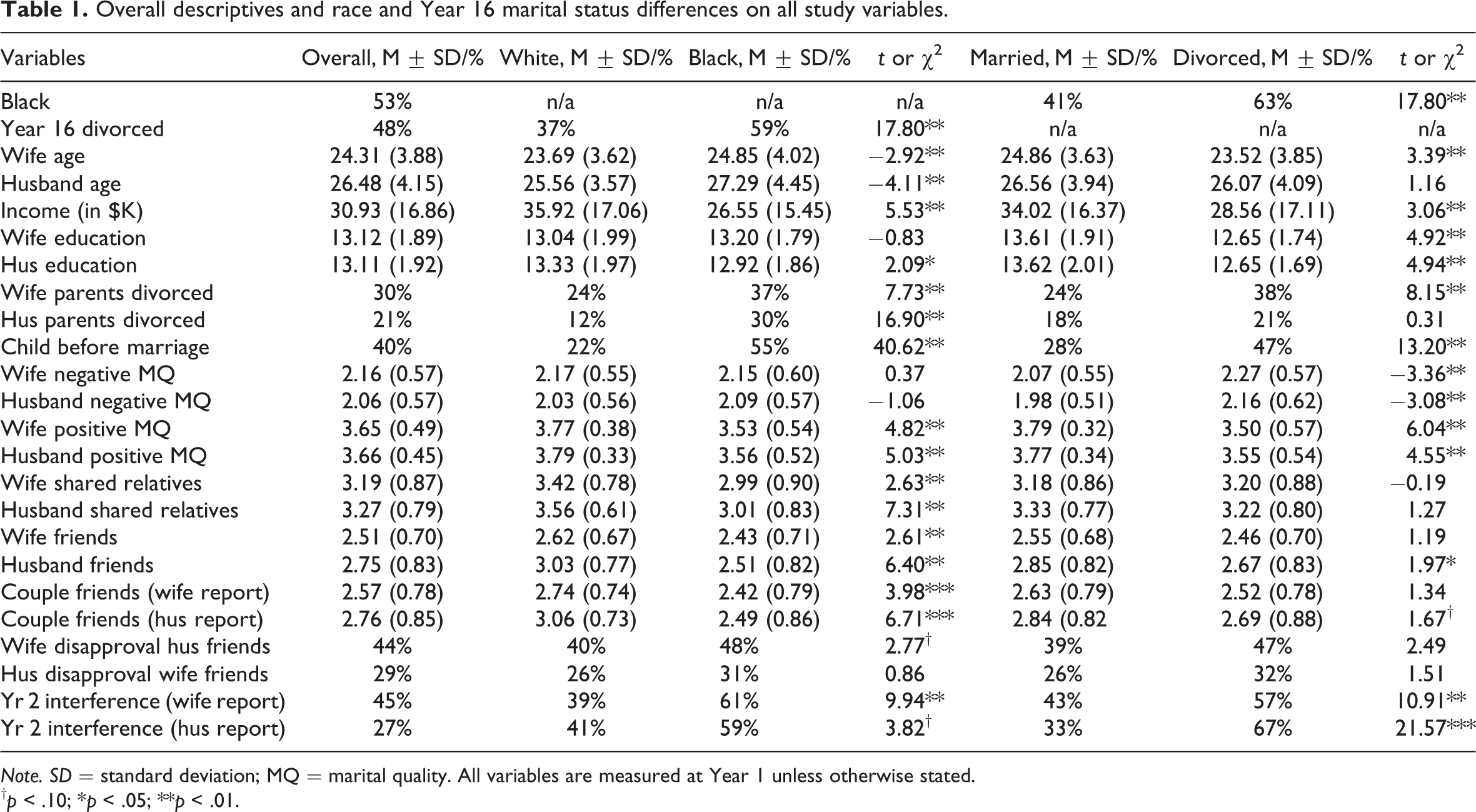
Note. SD = standard deviation; MQ = marital quality. All variables are measured at Year 1 unless otherwise stated.
†p < .10; *p < .05; **p < .01.
In the present analyses, we include only those couples for whom divorce information was available (N = 355). Attrition analyses using a series of independent samples t tests and chi-square tests indicated that the 18 couples missing divorce information had significantly lower income, were more likely to be Black, and were more likely to have a child before marriage than the remaining 355 couples with complete information. In addition, among the 18 couples with missing data, both husbands and wives were significantly older, husbands’ parents were more likely to have divorced when he was a child, and wives were more likely to report that her husband had friends of whom she did not approve.
Measures
Outcomes
Divorce was coded as a dichotomous variable (where 0 = not divorced and 1 = divorced), and included any case of divorce across the 16-year period. Marital duration was used as the time-varying censored dependent variable, allowing us to examine time to divorce.
Positive and negative aspects of couples’ friendships
At Year 1, husbands and wives were asked, “About how many good friends could you call on for advice or help if you ever needed it?” and “About how many good friends could you, as a couple, call on for advice or help if you ever needed it?” both measured on a scale from 1 (many) to 4 (none). We reverse coded these items such that higher numbers represented more network members and created the following four variables: (1) husband report of individual friend support, (2) wife report of individual friend support, (3) husband report of shared friend support, and (4) wife report of shared friend support. Also at Year 1, respondents were asked, “Does your (wife/husband) have friends that you would rather (she/he) not spend time with?” and could respond either yes (1) or no (0). From this question we created two variables: (1) Husband disapproval of wife’s friends, and (2) Wife disapproval of husband’s friends. Finally, at Year 2 only, respondents were asked the following: “Next, I’m going to read a list a things that some couples say interfere with their married life…. How about things your spouse did with or for his/her friends? Tell me how often in the past year you think this interfered with your own married life—often, sometimes, or never?” From this question, we created two variables: (1) Husband’s report of interference from wife’s friends and (2) Wife’s report of interference from husband’s friends. Because very few respondents (husbands or wives) selected “often,” we dichotomized both of these variables to be “often or sometimes” versus “never.”
Covariates
To provide a conservative estimate of the associations of interest, demographic, network, and marital quality covariates were included in our analyses because of their associations with divorce (Orbuch et al., 2002). Race of the couple was operationalized as White American (0) or Black American (1). Husband age and wife age were self-reported at Year 1. For household income, respondents selected from income categories for the entire household before taxes. The response was then coded as the midpoint of the category selected and divided by 10,000 so that unstandardized survival parameter estimates would not round to zero. Husband education and Wife education were operationalized as the total number of years of schooling completed by Year 1. Husband parents’ marital status and wife parents’ marital status identified those respondents whose parents had divorced prior to age 16 (0 = Married household, 1 = Parents divorced before respondent was 16 years old). Finally, child before marriage was created to reflect whether the wife had no child before marriage (0) or had a child or was pregnant before marriage (1). To assess shared family support at Year 1, participants were asked on a scale from 1 (many) to 4 (none), “as a couple, how many family members and relatives could you call on for advice or help if you needed it?” We reverse coded these items such that higher numbers represented more network members, and created the following two variables: (1) husband report of shared relatives and (2) wife report of shared relatives.
Year 1 reports of positive and negative marital quality were also used as control variables. Year 1 positive marital quality was assessed separately for husbands and wives and consisted of the mean of 5 items measured on scales from 1 to 4, as follows: how happy would you describe your marriage, from 1 (very happy) to 4 (not too happy); how certain would you say you are that the two of you will be married 5 years from now, from 1 (very certain) to 4 (not at all certain); how stable do you feel your marriage is, on a scale from 1 (very stable) to 4 (not very stable at all); how satisfied are you with your marriage, on a scale from 1 (very satisfied) to 4 (very dissatisfied); and how often have you considered leaving your spouse, from 1 (often) to 4 (never). With the exception of this last item (considering leaving), all items were reverse coded so that higher numbers represented greater positive marital quality. Cronbach’s alpha for husbands’ and wives’ positive marital quality was .83 and .85, respectively.
Year 1 negative marital quality for husband and wife consisted of the mean of 6 items; 5 of the 6 items were measured on a scale from 1 (often) to 4 (never) as follows: how often did you feel irritated or resentful about things your (wife/husband) did or didn’t do; how often did you feel upset about how you and your (wife/husband) were getting along in the sexual part of your relationship; how often did you feel that your (wife/husband) was upset about how the two of you were getting along in the sexual part of your relationship; how often did you feel tense from fighting, arguing or disagreeing with your (wife/husband); and how often have you felt you were not as good a (wife/husband) as you would like to be. One additional item, “When you think about what each of you puts in and gets out of your marriage, how angry do you feel?” was measured on a scale from 1 (very angry) to 4 (not at all angry). All items were reverse coded so that higher numbers represented greater negative marital quality. Cronbach’s αs for husbands’ and wives’ negative marital quality was .75 and .74, respectively.
Analytic strategy
To evaluate whether husbands’/wives’ reports of shared friend support as well as disapproval of spouses’ friends at Year 1 predicted divorce across Years 1 through 16, we conducted hierarchical Cox regression (proportional hazards) analyses with divorce at Year 16 as the outcome and marital duration as the time-varying censored dependent variable. The advantage of this survival analysis approach is that it allowed for full use of the data, in spite of variations in both whether or not couples divorced and the timing of the divorce (Orbuch et al., 2002). Furthermore, the dyad was the unit of analysis in our data, such that wives’ and husbands’ responses were linked and not treated as independent observations. This structure also allowed us to test for interactions between husband and wife responses. To test for the associations of shared friend support and disapproval with divorce above and beyond the amount of support from individual friends and family, we included husband and wife reports of their individual friend support and shared family support as covariates in our analyses as well as reports of marital quality and all sociodemographic variables.
In Step 1 of our first Cox regression, we entered all Year 1 sociodemographic variables, husband and wife shared family support variables, and husband and wife positive and negative marital quality variables. In Step 2, we added all Year 1 “friend” variables, including husband and wife reports of individual and shared friends as well as husband and wife reports of disapproval of their partner’s friends. In Step 3, we added all 2- and 3-way interactions among race, husbands’ disapproval of wives’ friends, and wives’ disapproval of husbands’ friends. Because of a reduced sample size at Year 2 (N = 309), we conducted a separate Cox regression in which we added Year 2 reports of spousal friend interference at Step 4 to determine whether interference could potentially account for any significant associations that were detected between disapproval and divorce and/or interactions predicting divorce.
Results
Descriptive statistics
Table 1 presents group differences in all study variables by race and by Year 16 marital status. Overall, similar patterns emerged for both race differences and Year 16 marital status differences; for example, Black couples and divorced couples were more likely to have a child before marriage and report significantly lower income than White couples and nondivorced couples, respectively. Table 2 presents correlations among all study variables. Most notably, husband’s disapproval of his wife’s friends was significantly negatively correlated with his own Year 1 positive marital quality (r = −.14**) and positively correlated with his own negative Year 1 marital quality (r = .16**). Wife’s disapproval of her husband’s friends was significantly associated with her own positive (r = −.22**) and negative (r = .20**) Year 1 marital quality and also with her husband’s positive (r = −0.11*) and negative (r = .11*) Year 1 marital quality.
Correlations among all study variables (N = 355).

Note. MQ = marital quality. All variables are measured at Year 1 unless otherwise stated. At Year 2, N = 324–330.
†p < .10; *p < .05; **p < .01.
The roles of shared friend support and friend disapproval in predicting divorce
As seen in Step 1 of Table 3, race and wife’s education predicted divorce. In addition, couples in which the wife reported more shared family support were more likely to divorce, whereas couples in which the wife reported greater positive marital quality at Year 1 were less likely to divorce. However, contrary to our hypotheses, and as seen in Step 2, there were no significant main effects for wife’s report of shared friend support (hazard ratio [HR] = 1.03, p = .82) or husband’s report of shared friend support (HR = 1.00, p = .99). Consistent with our hypotheses that disapproval likely did not have a main effect, neither wife’s disapproval of husband’s friends (HR = .97, p = .83) nor husband’s disapproval of wife’s friends (HR = 1.04, p = .82) were predictive of divorce.
Hierarchical Cox regression predicting divorce across years 1 through 16 from disapproval of spouse’s friends.

Note. HR = hazard ratio; CI = confidence interval; MQ = marital quality. All predictor variables are measured at Year 1.
†p < .10; *p < .05; **p < .01.
Next, we examined potential interactions between disapproval of a spouse’s friends and race. As we predicted, the only significant interaction to emerge in Step 3 (and the only interaction effect included in our final analysis presented in Table 3) was the 2-way interaction between husband’s disapproval of wife’s friends and race (HR = .41, p = .019). Specifically, husband’s disapproval of wife’s friends predicted divorce, but only for White couples, and wife’s disapproval of husband’s friends did not predict divorce for either White or Black couples. It is also important to note that this interaction was significant even after controlling for a number of demographic and relational factors (e.g., household income and Year 1 marital quality). Figure 1 provides a visualization of this interaction: for White couples in which the husband disapproved of the wife’s friends at Year 1, the couple was less likely to remain married across 16 years than for White couples in which the husband did not disapprove of the wife’s friends. Post hoc contrast tests using a four-group variable (White husbands who do and do not disapprove of wives’ friends and Black husbands who do and do not disapprove of wives’ friends) as an indicator within a Cox regression revealed that the HR of the difference between White husbands who disapproved of their wives’ friends at Wave 1 and those who did not was significant (HR = 1.75, p < .05). In contrast, the HR of the difference between Black husbands who disapproved of their wives’ friends and those who did not was not significant (HR = 1.40, p = .185).

‘Survival’ curves (odds of remaining married) shown separately for Black and White couples in which the husbands either disapprove (red) or do not disapprove (green) of the wife’s friends.
Finally, to explore the potential role of interference in explaining this association between disapproval of a spouse’s friends and race, we ran a second Cox regression (not shown) with the same variables in Steps 1 through 3. However, we added husband’s report of wife’s friends’ interference at Year 2 as a predictor in Step 4 to determine if it could (at least partially) account for the significant interaction between husband’s disapproval of wife’s friends at Year 1 and divorce. As hypothesized, the addition of this variable did, in fact, reduce the interaction between race and husband’s disapproval of wife’s friends to nonsignificance (HR = .56, p = .16). Because there is no viable procedure available for testing for mediated moderation with a dichotomous mediator within a survival analysis, it was not possible to formally test for mediation effects (i.e., to test if the addition of husband’s report of wife’s friends’ interference at Year 2 resulted in a statistically significant decrease in the interaction between race and husband’s disapproval of wife’s friends). Although we were unable to formally test for mediation effects, the change in the HR after adding the interference variable does represent a substantial 27% drop (i.e., 1 − (.41/.56) = .27). Husband’s report of interference was itself a very strong predictor of divorce (HR = 1.99, p = .001), even after accounting for all of the study covariates, and did not interact with race. In contrast, neither wife’s report of husband’s friends’ interference nor its interaction with race predicted divorce. Exploratory post hoc contrast tests using the same group variable above as an indicator revealed that the inclusion of husbands’ reports of interference at Year 2 reduced the significant HR comparing White husbands who disapproved of their wives’ friends at Year 1 and White husbands who did not to nonsignificance (HR = 1.29, p = .414), which represents a 26% drop in the HR (i.e., 1 − (1.29/1.75) = .26).
Discussion
Apart from a small body of research specifically examining relationships with in-laws (e.g., Orbuch et al., 2013; Veroff, Douvan, & Hatchett, 1995) and jealousy of partner’s friends (Gomillion et al., 2014), very little is known about how spouses’ opinions of individuals’ social network members influence the stability of the marital relationship itself. Although shared friends are thought to increase both social resources and marital satisfaction (Acock & Demo, 1994; Curran et al., 2003; Hansen et al., 1991; Kearns & Leonard, 2004; Orthner, 1975), a negative opinion of a partner’s network members could both reduce the availability of potential social capital and introduce additional strain into the marriage. Accordingly, the present study examined the role of early shared friend support and spousal friendship disapproval and interference in predicting the rate of divorce across 16 years in a sample of Black and White couples.
Contrary to our hypotheses, shared friend support was unrelated to divorce. However, consistent with our hypotheses, husband’s disapproval of wife’s friends increased the rate of divorce across 16 years, but for White couples only. This association proved surprisingly robust, as it remained even after controlling for a number of demographic and relational factors known to predict divorce (e.g., household income, Year 1 marital quality). As hypothesized, this effect appeared to be explained in part by husband’s report of wife’s friends interfering in their marriage at Year 2. The questions become: Why is only husband’s disapproval of a wife’s friends associated with divorce across 16 years? and Why did this pattern only emerge for White couples?
Considering context: A focus on gender and race
Consistent with our hypotheses, husband’s disapproval of his wife’s friends predicted divorce but wife’s disapproval of her husband’s friends did not. It could be that a wife’s interactions with her friends are more important than a husband’s interactions with his friends in predicting divorce. For example, we know that wives can more easily take over the functions of men’s friends (e.g., doing activities together) than can husbands take on the functions of wives’ friends (e.g., emotional intimacy; Kalmijn, 2003). Thus, husbands might be able to more easily give up those friends who their wives do not like, reducing a source of potential marital strife. In contrast, wives may be less willing or able to give up their friends, even when said friends are disliked by their husbands. Furthermore, wives are much more likely than husbands to discuss their marital problems with their friends (Helms et al., 2003), which, over time, may exacerbate any existing marital concerns and could increase the likelihood of divorce (Julien et al., 1994). Given that our exploratory analyses suggested that husbands’ later reports of interference partially explained the effects of husbands’ early disapproval on marital stability, our results do suggest that perceptions of the wives’ interactions with friends can play an intrusive and ultimately detrimental role in the marriage. Finally, approval of the relationship from wives’ friends is more predictive of relationship stability than approval from husbands’ friends (Sprecher & Felmlee, 1992), and as alluded to above, negative feelings between the husband and the wife’s friends may be mutual. Alternatively, of course, existing marital problems could lead to friend disapproval that, in turn, could lead to spousal disapproval of friends—but given that individuals were asked about their spouse’s friends shortly after marriage, and marital quality tends to be relatively high during this time (Lavner & Bradbury, 2010), this explanation is less likely.
Another, not mutually exclusive, possibility, is that in certain contexts, husbands’ perceptions might be more important than wives’ for marital stability. Gager and Sanchez (2003) found that although wives tended to be more dissatisfied with their marriages, couples in which husbands reported higher levels of marital dissatisfaction had higher odds of divorce after 1 year. They argued that the lack of association between wives’ perceptions and divorce could relate to their greater perceived barriers to leaving a marriage (e.g., economic constraints). Their research also implies that although wives’ perceptions are more important predictors of divorce when proximate measures of marital stability are considered (e.g., perceived chance of divorce), husbands’ perceptions tend to be more important for more distal measures (like the disapproval and interference measures used in the present study). Thus, husbands may be both more likely to perceive problems in their relationship stemming from disapproval of wives’ friends and more likely to act on these perceptions by seeking a divorce. Furthermore, much of the existing research highlighting the importance of wives’ perceptions for divorce has focused on equity in division of household labor (Frisco & Williams, 2003) and marital quality (Gager & Sanchez, 2003). Our findings offer insight into the relatively understudied phenomenon of spouses’ perceptions of their social network and the implications of these perceptions for marital stability.
Interestingly, we did not find evidence that husband disapproval of wife’s friends was predictive of divorce among Black couples. It may be that interactions with family are more relevant for the stability of Black marriages than for White marriages (Timmer & Veroff, 2000; Whyte, 1990), potentially minimizing the role of friends. 1 In fact, our own work (Fiori et al., 2017) has shown that Black couples are more likely to be embedded in family-focused networks than are White couples, who are more likely to be embedded in friend-focused networks. Scholars have suggested that Black Americans even construct extended kin networks with close trusted family and friends (“fictive kin”) as a way to garner support that may be unavailable from more traditional formal sources (Sarkisian & Gerstel, 2004; Taylor, Chatters, & Celious, 2003). Thus, this family-focused network approach could protect the marriages of Black husbands and wives from the otherwise deleterious effects of disapproval of each other’s friends.
Possible mechanisms linking disapproval of spouse’s friends with divorce
Consistent with Julien, Markman, Léveillé, Chartrand, and Bégin’s (1994) work, our findings provide preliminary support for the interference model, such that disapproval of wives’ friends may be at least partially explained by husbands’ perceptions that the social network is actively detracting from, rather than enhancing, the marriage. Although wives, in particular, may turn to friends for solutions to their problems (including marital issues; Helms et al., 2003), their husbands may perceive these social interactions as interfering in their marriage if they do not fully approve of these friends. Julien et al.’s (1994) work implies that interference behaviors can in fact create distance between spouses. Thus, perceived interference may serve to alienate spouses not only from the potential benefits of their shared network but also from each other. Given how powerful a predictor husbands’ perceptions of interference was for marital stability for both Blacks and Whites, it also suggests that there are other pathways to interference aside from disapproval. However, the question remains as to what more proximal mechanisms might contribute to husbands’ perceptions of interference (e.g., jealousy, marital tension).
To understand one of several possible explanations, it is useful to consider the network approval literature, which shows that network members’ approval of a romantic relationship is a strong predictor of its quality and stability (Doxey & Holman, 2002; Sprecher et al., 2002). Perhaps in couples in which the husband does not approve of his wife’s friends, this disapproval is stemming from the fact that the wife’s friends do not like him and may treat him accordingly; in this case, the mechanism driving the association could actually be network disapproval of the spouse. This potential explanation is made less likely by the fact that the association remained after controlling for Year 1 marital quality, an important factor that could explain why a woman’s friends might perceive of a partner as a poor choice (Sprecher & Felmlee, 1992). The fact that the association between spousal disapproval and divorce, as well as interference and divorce, remained after the introduction of both positive and negative marital quality at Year 1 also reduces the possibility that the association is being driven more generally by poor marital quality.
Network approval researchers (e.g., Sprecher & Felmlee, 1992) have proposed a number of possible explanations for why the network’s opinion of the relationship seems to impact the stability of that relationship. Such explanations may work equally well for understanding why the spouse’s opinion of the network may also be important. For example, according to Heider’s (1958) balance principle, if the wife’s friend is not liked by the husband, the existence of that tension could lead to the dissolution of the friendship—but where the friendship remains, such tensions, along with perceptions of interference, could also lead to strain within the marriage or even divorce. Furthermore, not liking one’s spouse’s friends could introduce uncertainty into the marriage, leaving an individual to wonder how he or she could be married to someone with those friends. In addition, the husband’s disapproval of the wife’s friends and his perceptions of their interference may indirectly weaken the couple’s identity by keeping their networks more separate. We know that a greater proportion of shared friends is associated with marital satisfaction (Hansenet al., 1991; Kearns & Leonard, 2004; Orthner, 1975) and at least in theory to couple identity (Milardo, 1982). In contrast, separately held friends may be less invested in whether or not the couple stays together. However, the fact that the association we found was robust to controls for both husband and wife reports of individual and shared friends makes this explanation less likely.
Alternatively, it could be that the husband’s negative opinions of his wife’s friends and perceptions of their interference lead to arguments between the spouses (e.g., when the wife wants to spend time with said friends). We know that conflicts with in-laws can weaken marital stability and satisfaction over time (Bryant et al., 2001); perhaps conflicts over close friends can be equally damaging. Additionally, it could be that the husband is threatened by the wife’s friendship(s), given that individuals can become jealous of their partner’s friends (Gomillion et al., 2014). Perhaps the husband assumes that the friends will remain (or become) the wife’s primary confidants instead of him, which can increase the likelihood of a breakup (Sprecher et al., 2002). Feeling threatened may turn to feelings of jealousy, which, if not addressed, will likely erode the quality of the marital relationship over time and could lead to divorce (Amato & Rogers, 1997; Gigy & Kelly, 1992). This jealousy could be even more influential if the “disapproved” friend(s) are opposite sex, since they could also represent potential romantic alternatives for the wife. Unfortunately in the present study, we could not distinguish between opposite-sex and same-sex friends, a point we address in our limitations below. Regardless, even more concerning is the possibility that such jealousy can become part of a larger constellation of maladaptive relationship behaviors, such as social isolation (Nielsen, Endo, & Ellington, 1992) and humiliation (Follingstad & DeHart, 2000).
This possibility is particularly concerning considering our lack of findings linking shared friend support to marital stability. On the one hand, our results are consistent with work showing a “negativity effect” in older adults’ social relationships; that is, that negative aspects of relationships (e.g., disapproval, interference) tend to have stronger associations with outcomes (particularly negative ones; e.g., divorce) than do positive aspects of relationships (e.g., shared friend support) (Rook, 1990). However, previous research has indicated that network overlap can enhance marital satisfaction (Hansen et al., 1991; Kearns & Leonard, 2004; Orthner, 1975). It could be that reports on the quality of the shared friendships would be more reliably associated with outcomes. Although participants in the present study were asked about shared friends who they could “call on for advice or help if they needed it,” the ambivalence literature (e.g., Fingerman, Hay, & Birditt, 2004) indicates that individuals often simultaneously hold both positive and negative opinions of their social network members. That is, the very friends who the husband disapproves of could also be those he acknowledges as potentially helpful in times of need. Future research will need to examine whether spouses hold overlapping opinions regarding their feelings of closeness, negativity, and/or ambivalence toward specific individual and shared friends to better tap into the nuances of these complex relationships.
Strengths, limitations, and future research directions
Confidence in our findings is bolstered by numerous strengths in our methodological approach, including a diverse sample, longitudinal data spanning 16 years, and the inclusion of a number of relevant control variables known to predict divorce. In spite of these strengths, there are several limitations that also warrant discussion. For example, the data only include spousal disapproval of friends in the first year of marriage and interference in the second year. This “snapshot” early in the marriage may obscure important developments, such as changes in the spouse’s perceptions or changes in the makeup of the respondent’s network over time. In fact, in interpreting our null findings for wives’ opinions of husband’s friends, we speculated that husbands may more easily terminate friendships for which their wives do not approve. As such, we may see declines in the percentage of wives who disapprove of husband’s friends over time. Future research should link changes in opinions of the spouse’s network over time to changes in marital stability, as well as document the effects of any reconfigurations of this network.
Relatedly, our measures of both spousal friendship disapproval and interference were relatively vague and could potentially have been tapping into spouses’ romantic alternatives; that is, we do not know whether the friends under consideration were same sex or opposite sex (or both). Also unknown are whether the friends of whom the spouse disapproves are the same friends they feel are interfering in their marriage, suggesting that additional exploration of interference may be warranted. As alluded to in the discussion above about assessing individual and shared friends, future research should develop more precise measures of “disapproval” to more clearly identify the individuals in question and both spouses’ feelings (positive and negative) toward those individuals.
All of our participants were newlywed young adults at the first wave of data collection, making it difficult to disentangle whether the associations we found are linked to specific developmental periods and/or to specific points in the marriage. For example, older adults tend to be more forgiving of social grievances (Luong, Charles, & Fingerman, 2011), which suggests that they may be less likely to sustain disapproval of their spouse’s friends over time. Future research should examine older adults in both newer and more established marriages to determine whether spousal disapproval of friends may be more sensitive to an individual’s maturity or to familiarity with the partner’s friends. In addition, attrition analyses revealed several differences between couples for whom divorce data were available (N = 355) and those for whom these data were not available (n = 18), most notably that wives in the couples who left the study were more likely to report that their husbands had friends of whom they did not approve. Thus, there is a possibility that the remaining couples are not as representative as the original 373, and that wives’ disapproval may have been predictive with a more complete and representative sample.
Finally, although we speculated about several mechanisms that may explain the associations we found, it is critical for future research to explicitly test how a spouse’s disapproval of one’s friends weakens the relationship. For example, jealousy of a spouse’s friends is one likely suspect (Gomillion et al., 2014). Another is network approval; that is, as mentioned above, the husband may not approve of the wife’s friends because those friends do not like him. Without assessing the network’s view of the relationship, it is difficult to determine the extent to which our findings are driven by network disapproval of the spouse rather than spousal disapproval of the network. As alluded to several times throughout our discussion, change in marital quality over time is also a possible mechanism; consequently, future research should examine how spousal friendship disapproval and interference early in the marriage may relate to change in marital quality over time.
Conclusions
When individuals marry, they must negotiate the merging of not just two people, but of all the family and friends who surround them. This integration is thought to increase the available social capital for both members of the couple (Acock & Demo, 1994). The current study, however, highlights one of the challenges inherent in integrating two sets of social networks—that is, what can happen when one spouse does not approve of the other’s social network members. The extent to which such disapproval confers risk to the couple appears to be independent of spousal and relational characteristics, but sensitive to gender and race. Given the negative consequences of divorce (e.g., disrupted parent–child relationships, loss of emotional support, economic hardship; Amato, 2000) as well as the health and economic benefits of marriage (Waite, 1995), understanding why White couples are more vulnerable to husband’s disapproval of wives’ friends merits further exploration. Compared to other oft-cited predictors of divorce (e.g., education; Orbuch et al., 2002), targeting the integration of couples’ networks may offer a more malleable way to strengthen marriage.
Footnotes
Authors’ note
For permission to use the early years of marriage data, please contact principal investigators: Drs Terri Orbuch and Kira Birditt, University of Michigan, Survey Research Center, Early Years of Marriage Study, P.O. Box 1248, Room 5108, Ann Arbor, MI 48106, USA. (800) 759-7947. E-mail:
Funding
The author(s) disclosed receipt of the following financial support for the research, authorship, and/or publication of this article: The research in this article was supported by a grant from the National Institute of Child Health and Human Development (HD40778) to the last author.
Note
References
Supplementary Material
Please find the following supplemental material available below.
For Open Access articles published under a Creative Commons License, all supplemental material carries the same license as the article it is associated with.
For non-Open Access articles published, all supplemental material carries a non-exclusive license, and permission requests for re-use of supplemental material or any part of supplemental material shall be sent directly to the copyright owner as specified in the copyright notice associated with the article.
