




Abstract
A secondary analysis investigated the influences of verbal stigmatization from family members on the psychological well-being of Latino homosexual males. A model was proposed to explain effects of being exposed to labeling stigma messages that supported both Stigma Communication Model and Revised Labelling Theory. Results showed exposure to verbal stigma messages, especially those with labeling and name calling, was associated with low self-esteem, perceived social support, and highly stigmatized beliefs. Such effects were also related to one’s emotion reactions, especially the feeling of shame, toward verbal stigmatization. Implications for interpersonally communicated stigma messages in general and further study directions were discussed.
Keywords
The long-standing stigma toward homosexuality has been found to affect the physical and psychological well-being of gay men, resulting in outcomes such as suicide, unemployment, and low self-esteem (Crohran & Mays, 2000a, 2000b; Ramirez-Valles, 2007; Ramirez-Valles, Heckathorn, Vázquez, Diaz, & Campbell, 2005; Williamson, 2000). Negative effects of homosexual stigma are especially salient for ethnic minorities such as Latino men who have sex with men (MSM). They are more likely to become the victims of homosexual stigma because of their race and immigration status (Bonilla & Porter, 1990; Finch, Kolody, & Fega, 2000). Morales (1990) pointed out that as Latino MSMs have to live simultaneously in three communities (the gay community, the Latino community, and the non-Latino White mainstream community), they experience “triple stigma” because they have to confront rejection from the gay community for their ethnicity, denial from the Latino community for their sexuality, and discrimination from the mainstream U.S. culture for both (see also, Ramirez-Valles, 2007; Marsigli, 1998; Yep, 1995). Yet, surprisingly no studies have looked at whether and how verbally communicated stigma information through name calling and labeling, especially from people who share close ties with the Latino MSM (e.g., one’s family members), impacts this vulnerable population. The present study examines the characteristics of verbal stigma messages of family members in affecting the psychological well-being and social involvement of Latino MSMs.
To do so, this study turns to the Stigma Communication Model ([SCM], Smith, 2007a, 2007b) and the Revised Labelling Theory ([RLT] Link & Phelan, 2001; Link, Cullen, Strening, Shrout, & Dohrenwend, 1989). Based on the two theories of stigma, this study proposes that verbal stigmatization, conceptualized as verbally communicating stigma-related information, especially those messages characterized by attaching derisive labels, names, and specific marks to the stigmatized population, has an essential role in the stigmatization process such that communication of stigma messages are, in part, responsible for certain psychological impacts on stigmatized individuals. A model based on SCM and RLT is proposed to look at the effects of verbal stigmatization of Latino MSM.
Conceptualization of labeling stigma messages
Goffman (2009) defines stigma as a spoiled identity rejected by the majority population because it bears the common mark of shame and disgrace that potentially jeopardizes the society. That is, stigma is a social phenomenon that is created and transmitted through human interactions, with stigmatizers serving as the major source of the social power to create stigma and to indicate the perils related to it, and those stigmatized being powerless indicators of this societal shame of harming the community (Link & Phelan, 2001). Smith (2007a, 2007b) posits in her SCM that stigmas are built through the communication of stigma messages, which are comprised of information chosen by individuals or society to describe and communicate stigmas. Thus, people learn about stigma through messages received either interpersonally or via the media (Smith, 2007a, 2007b, 2012).
When verbally communicated, messages can carry various features aiming at distinguishing the stigmatized from the community. Both SCM and RLT conclude that stigma messages most often use labels to characterize the rejected group or individuals. Labels have been defined broadly by different theories. In Scheff’s labeling model (1998) and the RLT model (Link et al., 1989), stigma labels are references, names, and specific marks that are assigned to the stigmatized individual. Labels could be simple nominal terms such as “the mental patient” that differentiate some individuals from others (for a review see Link, Cullen, Frank, & Wozinak, 1987). They could also be derisive references that denote distinctive characteristics of the stigmatized such as lepers or queers. In addition to qualifying a group, labels are usually references of stigmatized individuals under interpersonal settings (Link & Phelan, 2001). Smith (2007a) provided the example of name calling to illustrate verbal stigmatization of individuals through the means of labeling: Instead of characterizing one as afflicted by a particular disease, verbal stigmatization through labeling could be exemplified through the phrase “I just saw an elliptic in town today. (p.466).” For the stigmatized (Link, 1987; Scheff, 1998; Smith, 2007a), an identity that is formed through stigmatization messages through labeling and name calling can be responsible for the negative stereotyping, which results in social, psychological, and even physical harm on the labeled population.
Extant studies have predominantly focused on examining the collective identity of group memberships through the transmission of stigma messages. Features of stigma have been examined under mass media or clinical settings. In particular, using the frameworks of the Labelling Theory (Scheff, 1998) and Modified Labelling Theory (Link, 1987; Link et al., 1989), verbal stigma messages with labeling and naming have been consistently associated with depression and the mental distress of those who are labeled as mentally ill (Hereck, 2007; Link, 1987; Link et al., 1989). Indeed, stigma information, either being embedded in media presentations or news coverage (tones and language use), can result in the psychological harm of the stigmatized (see review Smith, 2012) and diffusion of the stereotyping within the community (e.g., Cahill, Valadéz, & Ibarrola, 2013).
To date, surprisingly very few studies have looked at stigmatization from an interpersonal perspective. In fact, studies on verbal stigmatization under the interpersonal setting have a narrow focus on mental illness (e.g., Smith & Hipper, 2010; Link et al., 1989; Link, 1987) but not the negative experiences and potential social and psychological harm experienced by other stigmatized groups. Verbal stigmatizations are prevalent among Latino MSM who have demonstrated increasing fear and mental distress of being attached to homosexual labels of femininity such as joto (faggot) and maricon (sissy, homosexual), which are commonly used in Latino communities to marginalize Latino homosexual males (Guarnero, 2007, 2013; Karr, 1978; Marsiglia, 1998). Indeed, Herek and Gozalez-Rivera (2006) reported in their survey study that those of Latino descent show negative attitudes towards homosexuality, especially those who identify with Latino rather than U.S. culture.
Understanding the role of verbal stigmatization of homosexuality under interpersonal settings, situated in a culture characterized by machismo and close family ties (Marín, Gómez, Tschann, & Gregorich, 1997), can provide unique insight into the psychological stress Latino MSM have to face during social interactions. Specifically, the source of homophobia and stigmatization of homosexual behaviors, rooted in a culture that values a strong “macho” man as the protector of the family, can be a strong oppressive force that disrupts MSM’ lives. The negative attitudes toward homosexuality among the community can be particularly cognitively and affectively taxing and disempowering to MSM (Heatherton, 2003). Specifically, experiencing homophobia and stigmatization can create intense conflicts between MSM’s sexual desires and their internalized view of societal disapproval of their own behaviors (Marín, 2003), which is usually associated with increasingly self-loathing, shame, and low self-esteem (Christensen et al., 2013). Indeed, homophobia experiences have been associated with greater levels of depression and suicidal thoughts among Latino MSM (Diaz, Ayala, Bein, Henne, & Marín, 2001).
Moreover, family members reinforce this societal homophobia (Herek & Gonzalez-Rivera, 2006). In a culture that highly values the primacy and harmony of the family, family members’ negative reactions toward homosexuality is a major source of stress of Latino MSM. Verbal stigma messages in particular have long been reported in Latino family settings (Guarnero, 2007, 2013; Marsiglia, 1998). Latino MSM self-reported to be unwilling to confront their family members’ hostile perceptions toward sexuality for fear of disrupting family harmony. As such, information on how verbal stigma messages with family members affect this particular population could offer researchers further insights into understanding the psychological mechanism MSM have to go through in order to confront their stigmatized identity. This would in turn allow for the creation of better tailored interventions to help this vulnerable group of individuals. Yet, so far, there is no systematic explanation of this particular population’s experience with verbal stigmatization that can offer them help to defy and confront stigmatization there is no systematic explanation on experiencing verbal stigma messages with family members among this particular group of population in order to help them to defy and to confront the stigmatization.
Verbal stigma messages: Message effects and reactions
In order to further understand the unique effects of verbal stigmatization, especially those with labeling and name calling, produced by the family member of the MSM to reduce their mental distress and negative coping, this study proposed a model in Figure 1, which represents the potential affective and cognitive reactions one might demonstrate when being exposed to verbal stigmatization.
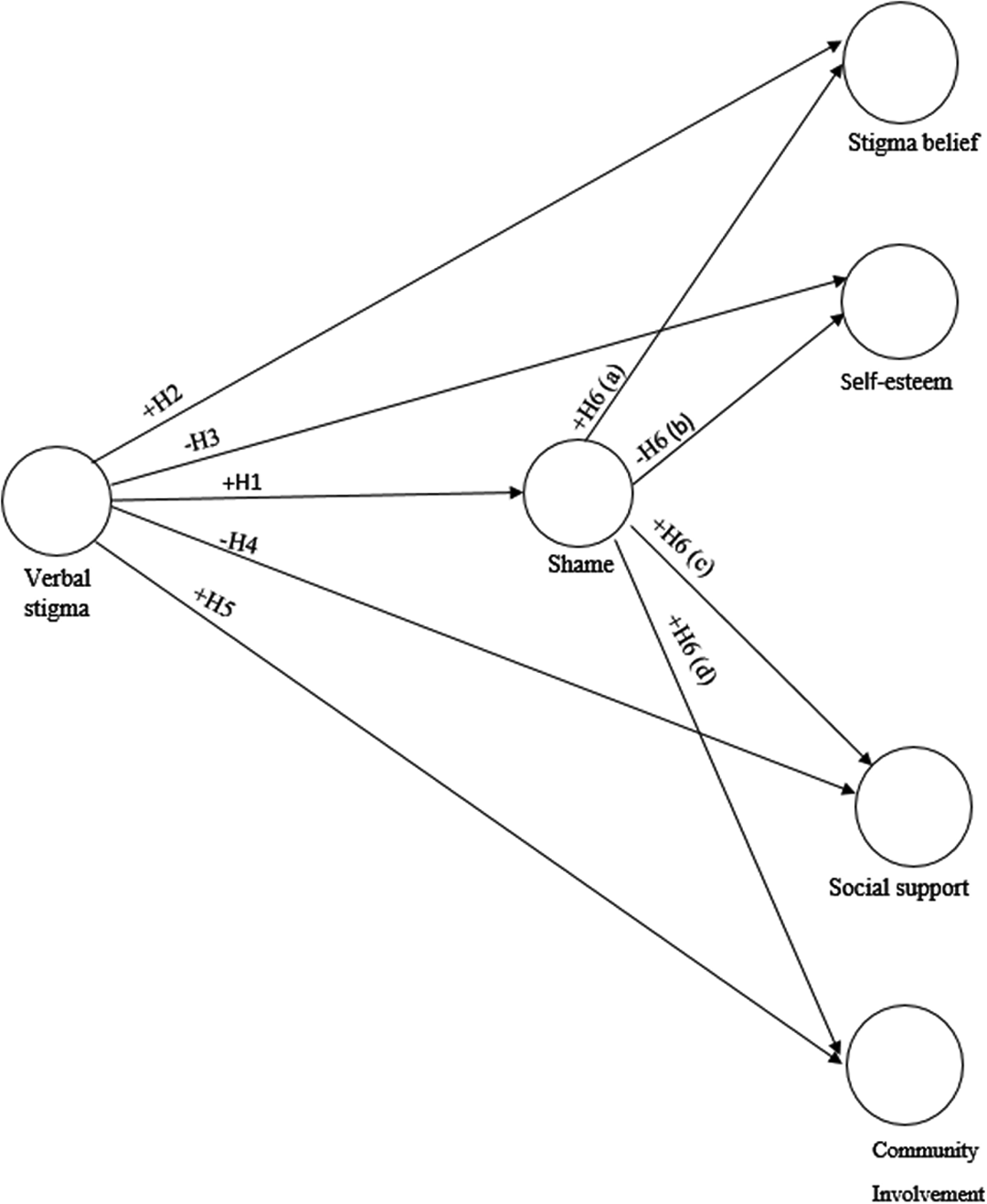
A proposed model of verbal stigmatization.
To elaborate, as posited in SCM (Smith, 2007a), exposure to verbal stigmatization is usually associated with emotional reactions toward the information. When being associated with a salient social identity, individuals internalize the stigma, knowing that they could be a target to be removed and isolated from the community. As such, they further experience subsequent emotional reactions toward this marked identity (Smith, 2007a, 2012). Guided by theories of cognitive appraisal, one of the discrete emotions one has to experience as a result of stigma communication is shame, which refers to the emotional experiences when one could not live up to the standards and responsibility of the community (Lewis, 1998). Specifically, theories of cognitive appraisal postulate that emotions are usually evoked through personal appraisal of situational factors. The major situational factor, or the core relational theme, that induces shame is when one fails to live up an ego-ideal (Lazarus, 1991; Lewis, 1998). Exposure to stigma messages reminds MSM that they are not living up to the social responsibilities and meanwhile experience increasing levels of self-blame, which are associated with shame (Goffman, 2009; Lewis, 1998). Indeed, researchers have been reporting the feeling of shame experienced by different stigmatized populations such as mentally challenged children (Borkowski, Weyhing, & Turner, 1986), HIV/AIDs patients (Duffy, 2005), and homosexuals (Allen & Oleson, 1999). We hypothesize that this association between shame and stigma also exists in terms of the stigmatization of Latino homosexual males, as in:
Moreover, SCM (Smith, 2007, 2012) also delineates that stigma belief, or the attitudes and values one has towards the stigma (Fogel & Ford, 2005), is also developed through verbal stigmatization. That is, communications of stigma information are usually associated with individuals establishing a set of beliefs toward this identity (Smith, 2012). For example, Link et al. (1989) found that experiencing more social interactions with verbal stigmatizations (e.g., being constantly referred as the “mentally ill”), mental patients gradually developed the beliefs that themselves should be devalued and discriminated because of this identity. When being labeled, Latino MSM could also develop similar beliefs in their own devaluation and discrimination. As such, this study proposes that verbal stigmatization should affect the beliefs of the stigmatized. As such,
Additionally, integrating RLT (Link et al., 1989), this study also proposes that exposure to verbal stigmatization would uniquely affect people’s psychological well-being in three other aspects, namely, their low self-esteem, low perceived social support, and their greater tendency to be involved in the gay community. Specifically, through communication of stigma messages, people recognize that they are the target of social blame and bear the identity of community rejection (Ciffon, 2002; Markowitz, 1998; Smith, 2007). The consequence of realizing oneself to be part of a stigma negatively affects one’s self-esteem (Link et al., 1989). Previous studies have demonstrated that Latino MSM usually have low self-esteem when facing higher degree of stigmatization (Herek & Gonzalez-Rivera, 2006; Marin & Marin, 1991; Ramirez-Valles, 2007). As such,
Moreover, both SCM and RLT posit that the realization of being attached with an identity can make people realize that they are being devalued and discriminated against by society (Link, 1987; Smith, 2007). Accordingly, the Latino MSM could demonstrate a low sense of perceived social support, which refers to their perception that they do not receive much care and assistance from other people both emotionally and instrumentally (Larios, Davis, Gallo, Heinrich, & Talavera, 2009). Thus, a greater amount of exposure toward verbal stigmatization can be accompanied by a sense of lacking social support.
Additionally, according to the SCM, the effects of being exposed to stigma messages can be related to the isolation of the stigmatized group. One coping method that has been adopted by the stigmatized group is participating in gay communities to offset the negative outcomes that are brought about by their identity (Ramirez-Valles, 2007). Indeed, researchers have observed that many HIV-positive gay men defy stigmatization and develop a positive sense of self by engaging in volunteering around AIDS work (Weitz, 1991) or altruistic AIDS movements (Kobasa, 1990). That is, community involvement, in the form of participating in unpaid work for the sake of collective good through social networks or organizations (Ramirez-Valles, 2004; Wilson & Musik, 1997), can help confront stigma (Ramirez-Valles et al., 2005).
The argument that community involvement has positive psychological effects on ethnic minority gay men (Ramirez-Valles, 2004) is rooted in social integration theory (Bellah, Madsen, Sullivan, Swidler, & Tipton, 1996), which posits that volunteering in social activities can provide individuals with a sense of self. Ensel and Lin (1991) further extend social integration theory through their postulation that stressors (e.g., experienced stigma) could be mitigated through community involvement because it offers a unique sense of support and reduces the feeling of isolation. Indeed, community involvement has been found to be a contributing factor among gay men by offering contacts to peers, altruistic life purposes, and an enhanced sense of capability (Ramirez-Valles et al., 2005). Research also indicates that involvement in community activities contribute to the well-being of stigmatized groups such HIV-positive Latino MSM (Ramirez-Valles et al., 2005; Ramirez-Valles, Kuhns, Campbell, & Diaz, 2010). As such, this study proposes that as a result of being exposed to stigmatizing messages from one’s family members, Latino MSM might adopt the coping strategy of participating in the community activities of their stigmatized groups.
Furthermore, according to SCM, one’s cognitive and emotional reactions toward stigma message could further enhance the effects of those messages. That is, message reactions such as the feeling of shame and perceived responsibility could further enhance the effects of stigma messages in terms of one’s stigma belief, self-esteem, perceived social support, and involvement in the gay community. For example, stigma group’s feeling of shame has also been found to mediate exposure to verbal stigmatization and one’s enhanced stigma beliefs (Fogel & Ford, 2005). As such, we explore the possibility that shame and perceived responsibility could also mediate the relationship between message exposure and other message effects. Hence, this study hypothesizes that,
Methods
Participants
To test this model, a secondary analysis was conducted of the Bibliography Latino MSM Community Involvement: HIV Protective Effects (retrieved from ICPSR-34385). The sample of Latino homosexual males (N = 643) from Chicago and San Francisco, with both areas considered satisfying the diversity of the Latino backgrounds in the U.S. (Ramirez-Valles et al., 2005, 2010). The data were collected by means of respondent-driven sampling, which relies on the peer referral method to reach the hidden Latino homosexual population (Ramirez-Valles et al., 2005, 2010). All participants answered the survey questions in English. Unless otherwise specified, the mean and standard deviations were computed by averaging the sum of total items that measures each construct.
Instruments
Verbal stigma messages (M = 2.61, SD = 1.05)
Two items were used to assess the labeling experiences with family members: “While growing up, how often you were made fun of or called names (faggot, queer, queer, or sissy, etc.) by your own family because of the way you behaved?” and “As an adult, how often you were made fun of or called names (faggot, queer, queer, or sissy, etc.) because of the way you behaved?” For both indicators, the respondents rated on a 1 (never) to 4 (many times) scale.
Stigma belief (M = 2.72, SD = .71)
Stigma belief was operationalized in terms of how one incorporated the societal perspectives toward homosexual identity, with stronger stigma belief indicating one’s more negative perception toward the stigmatized group. Fifteen items based on Ramize-Valles et al. (2005) were used. Specifically, using a 1 (strongly disagree) to 4 (strongly agree) scale, respondents were asked to rate items including: “Many employers would look down on an effeminate man, regardless of his qualifications for the job” and “Many people believe that gay individuals are promiscuous.”
Feeling of shame (M = 1.81, SD = .94)
Shame was measured with a single item, “sometimes I feel ashamed of my sexual orientation.” Shame was assessed on a 1 (strongly disagree) to 4 (strongly agree) scale.
Self-esteem (M = 3.30, SD = .46)
Rosenberg’s (1965) 10-item Self-Esteem scale was used, with participants answered on a 1 (always) to 4 (never) scale.
Perceived social support (M = 3.42, SD= .56)
Seven items developed by Ramize-Valles et al. (2005) were used to assess perceived social support on a 1 (Always) to 4 (never) scale. Sample items include: “How often do you feel that there is no one to whom you can turn?” and “How often do you have someone whose advice you really trust?”
Gay community involvement (M = 2.75, SD = .64)
The Latino Homosexual Male’s involvements were measured by 5 items developed by Ramirez-Valles, Kuhns, Campbell, & Diaz (2010) on a 1 (More than once a week) to 6 (never) scale. Sample items were “During the past 12 months, how often have you participated in gay social group?” Note that for this item, lower scores indicates greater amount of community involvement.
Data analysis and results
This study used a structural equation modeling (SEM) technique called Partial Least Squares (PLS). The PLS-SEM is a technique that combines principle component analysis, path analysis, and regression to simultaneously evaluate the data (Pedhazur, 1982). The PLS technique has been used widely in fields such as behavioral sciences (Bass, Avolio, Jung, & Berson, 2003), marketing (Hensler, Ringle, & Sinkovics, 2009), organization, management, and business strategies (see review, Wong, 2013). The PLS-SEM technique is used primarily to develop theories in explanatory research and for early-stage model development and testing (Staples, Hulland, & Higgins, 1998). Because the major purpose of this study is to explore possible psychological links resulting from verbal stigmatization, the PLS-SEM technique was considered a good fit for this study. The estimation procedure of PLS-SEM is an ordinary least squares (OLS) regression-based method. It does not estimate measurement models through confirmatory factor analysis nor estimate model fit through fit indices. The measurement model evaluation offered in PLS-SEM uses a set of nonparametric evaluation criteria and procedures such as bootstrapping and blindfolding. Details of the CB-SEM and the PLS-SEM could be found in the works of Hair, Sarstedt, Pieper, & Ringle (2012).
Evaluation of the measurement model
In PLS-SEM, there is no single goodness-of-fit criterion to evaluate measurement models; instead, nonparametric evaluation criteria involving bootstrapping and blindfolding are used (Hair et al., 2012). To evaluate the internal consistency reliability of reflective measurement, this study evaluated the factor loadings, the single regression results of each indicator variable on their corresponding constructs. Indicators that had an outer loading <.40 were deleted because they did not properly measure the construct, according to the measurement criterion of PLS-SEM (Hair et al., 2012). Upon inspecting the model, 3 items from the self-esteem scale and 2 items from the stigma beliefs were dropped because they did not reach the .40 criteria. Examples of such items were “I am able to do things as well as other people,” “I feel I have much to be proud of,” and “I wish I could have more respect for myself.”
The measurement model was examined by following the testing steps of PLS-SEM. First, the outer loadings of each single indicator should have higher outer loadings for the construct it represents in comparison with any other constructs in the model (Hair et al., 2012). Second, the theoretical importance of each indicator were evaluated in terms of the average variance extracted (AVE). An AVE value of .50 or higher indicates that more than 50% of the variances in the construct could be explained by its indicators and thus retained for further statistical analysis (Hair et al., 2012). Third, composite reliability values, a measure of internal reliability, were used to evaluate the internal reliability. Composite reliability with a value above .70 is considered acceptable for exploratory research (Nunally & Bernstein, 1994). Results indicated that every construct has a composite reliability above .70. Finally, detailed statistical results of the aforementioned measurement models demonstrating satisfactory levels of reliability and validity were obtained (see Table 1 for detailed results).
Factor loadings, weights, and composite scale reliability of the measurement model.

Note. Indicators demonstrate a factor loading <.40 is considered not properly measuring the construct. An AVE value of .50 or higher indicates that more than 50% of the variances in the construct could be explained by its indicators and thus should be retained for further statistical analysis (Hair et al., 2012). Composite reliability is used to evaluate internal reliability, a composite reliability with a value of .70 is considered reliable.
a The figure shows standardized path coefficients.
*p < .01; ** p < .05.
Results
Hypothesized relationships
A path analysis was conducted to test the hypotheses. Before testing the proposed model, this study first conducted an analysis on collinearity assessment because the estimation of path coefficients of the structural model in smart PLS is based on OLS regressions of each endogenous latent variables. The same as a regular multiple regression, the path coefficients in PLS-SEM could be biased if there are significant levels of collinearity among the predictor constructs (Hair et al., 2012). Results indicated that none of the variance inflation factor (VIF) values were lower than 0.20 or higher than 5.0, which are the threshold for the presence of collinearity. As such, there was no collinearity issue in the data.
The results of the path model were analyzed and interpreted in terms of the testing criteria of PLS-SEM. Specifically, for PLS analysis, the overall fit statistic is not applicable to PLS modeling (Hulland, 1999). The relationships between each variable in the model are tested by examining the size, sign, and statistical significance of the standardized path coefficients (Vinzi, Trinchera, & Amato, 2010). The standardized path coefficients in PLS-SEM have a value from 1 to −1, with an absolute value of 1 indicating 100% association between two constructs. Moreover, the f 2 effect size in the PLS-SEM assesses the predictive relevance of the model, an equivalence of fit indexes in CB-SEM and an indication that the endogenous constructs are accurate predictors of the path model, is also evaluated in PLS-SEM. Guidelines for assessing f 2 are values of .02, .15, and .35, respectively, represents small, medium, and large effects (Cohen, 1992). Results of the analysis is shown in Figure 2.

Results of the model of verbal stigmatization.
As shown in Figure 2, to test correlations between verbal stigmatization, results indicated that most paths in the proposed model are significant at a p < .05 level with a bootstrapping of 5,000 samples. As indicated in Figure 2, H1 through H6 were supported. Specifically, results indicated that exposure to verbal stigma messages (M = 2.61, SD = 1.05) was significantly related to (H1) MSM’s feeling of shame (M = 1.81, SD = .94, R 2 = .01, p = .03, f 2 = .02), (H2) stigma belief (M = 2.72, SD = .71, R 2 = .33, p =.02, f2 = .01), (H3) self-esteem (M = 3.30, SD = .46, R 2 = .14, p = .03, f2 = .02), (H4) perceived social support (M = 3.42, SD = .56, R 2 = .13, p < .01, f2 = .02), and (H5) involvement in the gay community (M = 2.75, SD = .64, R 2 = .05, p < .001, f2 = .03).
To test the mediating effects of shame, SMART-PLS used the technique proposed by Preacher and Hayes (2008) through bootstrapping. Results indicated that most of the indirect effects are significant at a p < .05 level with a bootstrapping of 5,000 samples. As shown in Figure 2, shame-mediated relationships between verbal stigmatization and most of our exogenous variables in the model. Specifically, shame mediated the relationship between exposure to verbal stigma message (M = 2.61, SD = 1.05) and (H6b) self-esteem (M = 3.30, SD = .46), path coefficient = −.35, 95%CI [0.07, 0.22], (H6c) perceived social support (M = 3.42, SD = .56)., path coefficient = -.29, 95%CI [-.37,-.21], and (H6d) gay community involvement
Discussion
This study presented a model to illustrate how verbal stigmatization significantly affected the mental well-being of Latino MSM. Results revealed that interpersonally communicated messages, especially with people who are close to the stigmatized group, can have strong influences on perceived stigmatization, feeling of shame, isolation, and lack of perceived social support.
Overall, the findings on the significant impacts of verbal stigmatization from family members of Latino MSM were consistent with theories of SCM and RLT, both of which posit that stigma can be communicated in the form of naming, references, or marked characteristics of the isolated group (Link & Phelan, 2001; Smith, 2007). As postulated by SCM, we found stigma information usually goes hand-in-hand with negative emotional reactions. In the case of the community members, SCM stated that communicating stigma is usually accompanied by fear and anger toward the group that is seen as perilous to society (Smith, 2007). Instead of looking at the emotional reactions of the unstigmatized, this study went one step further to investigate psychological experiences one has to go through by being stigmatized through the feeling of shame. That is, instead of looking at how stigmatizers’ attitudes and behaviors are affected by stigma communication, this study further extended the explanatory power of SCM by revealing the importance of affective reactions that are experienced by the stigmatized group.
This study also put SCM to test under the context of interpersonal communication. Consistent with SCM, which maintains that stigma messages are associated with the attitudinal and behavioral changes toward the stigma, this study’s proposed model indicated that greater exposure to those messages were linked to a series of negative psychological impacts on the stigmatized including their low self-esteem, perceived social support, and intensified stigma belief. Especially, this study showed that communication of stigma messages interpersonally enhanced stigma beliefs the same way as media stigma messages, by evoking affective and cognitive reactions on recipients (Smith, 2007). Results of this study demonstrated that as the recipients of the stigma messages, the stigmatized groups’ stigma belief was strengthened as well. Already being the out-groupers of the community, participants in the study demonstrated strong stigma beliefs toward their own sexuality. This means that they were somehow agreeing with the general population by considering they deserved to be rejected because of their stigmatized identity. This conflicting state could create even more mental stress such as self-loathing and greater social avoidance (Ramirez-Valles et al., 2005, 2010; Lewis, 1998).
Results of this study are also consistent with the proposition in the RLT (Link & Phelan, 2001), which posits that individuals tend to go through social withdrawal when they found themselves labeled with a different identity. In the past, effects of stigmatization through labeling have been found to be the major reason of a host of cultural and psychological problems such as loneliness, low self-esteem, depression, and suicide (Ramirez-Valles, 2007; Ramirez-Valles, Fergus, Reisen, Poppen, & Zea, 2005). Results of this study suggested this could still be the case for Latino MSM. They demonstrated lowered self-esteem and perceived themselves as having lower social support or being isolated from the community, and they resorted to becoming part of a smaller social network, namely, the gay community, through volunteering and altruistic work.
Limitation and future directions
Using existing data, this study looked at the role of communication between family members and the Latino MSM aimed at providing some insights into how stigma communication affects a specific ethnic group. Importantly, a major source of the negative experiences brought about by one particular type of verbal stigmatization (i.e., exposure to impersonally communicated stigma messages) was identified. Although previous studies revealed that experiencing stigmatization affects the psychological well-being of the stigmatized population, (Ramirez-Valles et al., 2010; Ramirez-Valles, Fergus, Reisen, Poppen, & Zea, 2005; Ramirez-Valles, 2005), no study so far has pinpointed that a specific type of stigmatizing experience, in this case being exposed to labeling messages, had a stronger negative influence than others. The results of the same data from previous studies suggested that the total stigma effects including the communicated stigma messages and the experienced social injustice due to stigma accounted for 12% (R 2 = .12) of the total variance in explaining low self-esteem (Ramirez-Valles et al., 2005, 2010). Yet, this study found that communication of one particular type of stigma messages alone could explain greater variance in the low self-esteem (R 2 = .14). Thus, it provided further insights for social workers on how family communication of stigma messages affect the coping behaviors of Latino homosexual males, which could help the Latino MSM manage their stigmatized identity more effectively.
Results of this study showed labeling messages alone could have various impacts toward the psychological health of the stigmatized, indicating further needs for more extensive investigations into other types of verbal stigmatization. For example, recent studies have shown that teasing and mocking of transgender and homosexual individuals is prevalent among school-aged adolescents (Braithwaite & Orr, 2016); as such there is an increasing need to know how such forms of verbal stigmatization affect psychological developments of the stigmatized individuals. This study also demonstrates the necessity to understand how micro-aggressions, which refer to minor acts of discrimination (Forrest-Bank & Jenson, 2015), could be related to stigmatization. Although the current study did not measure whether labeling messages from family members could occur as a form of micro-aggression, further investigations into how the two constructs are related and jointly affect stigmatization could provide further insights into creating more efficacious interventions to help confront stigma.
Results of this study also indicated that communication of stigma messages under the interpersonal settings between the family member and the stigmatized individual has significant effects toward the psychological health of the Latino MSM. Yet interestingly, researchers found that families that can overcome the surrounding societal-level homophobia can be a powerful protective factor for Latino gay men even if they are experiencing higher levels of stigmatization from others (Diaz, Ayala, Bein, Henne, & Marin, 2001). Thus, the results of this study provide further insights for the development of interventions and campaigns to help Latino MSM confront the stigmatization they have to face. As family values have been an essential element in Latino culture (Organista, Chun, & Marin, 2013), perhaps one major way to reduce the psychological stress MSM have to go through is to create family acceptance.
However, this study has certain limitations. First, although it was found that affective reaction significantly mediates the relationship between stigma communication and the stigmatized groups’ self-esteem, perceived social support, and gay community involvement, some of those effects are very small. This could also be due to the fact that this study could not fully capture the overall affective reactions towards the labeling stigma messages. As such, further studies are still needed in order to provide the full picture of the stigmatized groups’ emotional reactions towards stigma messages in addition to shame. Thus, further studies should look at the effects of other emotions resulting from stigma communication to further test the influence of emotional reactions within the SCM. Moreover, this study only focused on one aspect of the verbal stigma messages, which is labeling and derisive name calling because they are considered the major prevalent types of stigma messages that affect the stigmatization of Latino homosexuals. Yet, the other stigma messages focusing on mark and peril of the stigma could demonstrate significant effects towards their stigmatization.
Conclusion
In order to obtain a full picture of stigma communications among the family members and friends of the Latino MSM, additional studies are yet needed in testing the entire SCM by including other types of stigma features Also, further research should be carried out to understand how interpersonal stigma messages affect other stigmatized groups in addition to those affected by homosexual stigma. Moreover, based on this study, a better understanding of how shame operates in the interpersonal paradigm of stigma communication is necessary to help MSM to confront stigma and improve their psychological well-being.
Footnotes
Funding
The author(s) received no financial support for the research, authorship, and/or publication of this article.