



Abstract
Recent research has suggested that sexual content and sexual satisfaction are multifaceted. Yet, no study has parceled out how distinct aspects of sexual content may be associated with multiple aspects of sexual satisfaction. In this study of 858 individuals in a committed romantic relationship, we used structural equation models to evaluate how two components of sexual content (pornography use and provocative sexual media use) were associated with several components of sexual satisfaction (time spent on foreplay, variety, overall satisfaction, frequency, love and affection, and time spent on intercourse) for both men and women. The specific path coefficients of the models revealed that higher pornography use was significantly associated with lower satisfaction with sexual variety and time spent on intercourse for men, yet not associated with any sexual satisfaction outcomes for women. However, greater use of provocative sexual media for men and women was significantly associated with lower satisfaction with the love and affection in the sexual relationship. Provocative sexual media use for women was also associated with lower satisfaction with sexual variety, overall sexual satisfaction, and time spent on intercourse. Our results supported the differentiation of different components of sexual content viewed and sexual satisfaction in gaining a more comprehensive understanding of the intricacies of both constructs.
Keywords
Despite research showing that viewing explicit sexual content has a net negative influence on sexual satisfaction (e.g., Wright, Tokunaga, Kraus, & Klann, 2017), enough research has found diverging results that we need more detailed consideration of this association (e.g., Blais-Lecours, Vaillancourt-Morel, Sabourin, & Godbout, 2016; Kohut, Fisher, & Campbell, 2017; Muusses, Kerkhof, & Finkenauer, 2015). One of the likely reasons for mixed results surrounding use of sexual content and couple outcomes is the disregard for the actual content depicted (Willoughby & Busby, 2016) and disregard for multiple aspects of sexual satisfaction (Pascoal, Narciso, & Pereira, 2014). It seems plausible that differing types of sexual content (e.g., explicit versus suggestive) may have differential effects on different aspects of sexual satisfaction (e.g., satisfaction with variety versus satisfaction with love and affection).
We define sexual content as a broad array of sexual depictions that may include videos or images that are intended to bring an erotic sexual experience. More specifically, in our study, we distinguish between two specific types of sexual content: (a) pornography, mainstream heterosexual pornography with explicit depiction of sexual acts; and (b) provocative sexual media, nonexplicit provocative portrayal of women’s sexuality. These two types of sexual content were chosen based on their distinction in a previous study asking participants to rate the extent they believed certain depiction of sexual content to be pornographic (Willoughby & Busby, 2016) and because script theory suggests that sexual content depicting sexual acts may influence outcomes differently than sexual content that has no sexual acts (Gagnon, 1990; Wright, 2011). We define sexual satisfaction as the subjective appraisal of the quality of the sexual relationship but use reasoning from Pascoal, Narciso, and Pereira (2014) to suggest that multiple aspects of subjective appraisal (satisfaction with variety, time spent on foreplay, the overall sexual relationship, love and affection, frequency of intercourse, and time spent on intercourse) should be considered separately in evaluating the construct.
By better understanding the sexual content being used, we hoped to better understand recent suggestions that both sexual content viewed (Malamuth, Addison, & Koss, 2000; Willoughby & Busby, 2016) and sexual satisfaction (McClelland, 2010; Pascoal et al., 2014) are multifaceted and different aspects of each may be associated with each other in unique ways. In short, in this study, we evaluated how pornography use and provocative sexual media use differ in their associations with several aspects of sexual satisfaction. In our review of the literature, we first discuss the theoretical background of why viewing sexual content in general would be related to sexual satisfaction. Second, we establish how and why sexual content and sexual satisfaction should be considered as multifaceted phenomena. Finally, we explain how we have taken into account these conceptual considerations in our current study and make specific hypotheses for how pornography and provocative sexual media may differ in their associations with several aspects of sexual satisfaction.
Theoretical background
Associations between the viewing of sexual content and sexual satisfaction have been suggested by several theoretical frameworks, including script theory (Gagnon & Simon, 1973) and objectification theory (Fredrickson & Roberts, 1997). Sexual script theory claims that sexuality is socially constructed by values, personal experiences, and the mass media (Gagnon, 1990). These scripts may be especially meaningful for heterosexual couples, as many messages in sexual content present a heteronormative script, with men’s sexual dominance and women’s subservience (Bridges, Wosnitzer, Scharrer, Sun, & Liberman, 2010). Recent longitudinal research has suggested that sexual content has a directional influence on sexual attitudes and behavior (Braithwaite, Coulson, Keddington, & Fincham, 2015). Stulhofer, Busko, and Landripet (2010) have also empirically validated the theoretical assertion of sexual content influencing sexual satisfaction through a number of mechanisms.
Objectification theory (Fredrickson & Roberts, 1997) has the potential to complement sexual script theory as it could be argued that some sexual content depicts a script of objectification (Klaassen & Peter, 2015). According to objectification theory, the Western sociocultural emphasis on women’s beauty can result in men objectifying women and women self-objectifying. One study that coded for the level of objectification found in participants’ favorite types of media content (television shows, films, and magazines) showed that men’s use of sexual content was associated with lower sexual satisfaction, partially because they were more likely to objectify their partner (Zurbriggen , Ramsey, & Jaworski, 2011). Meanwhile, women’s use of sexual content has been found to be associated with higher self-objectification (Vandenbosch & Eggermont, 2012; Zurbriggen et al., 2011), which is associated with lower sexual satisfaction (Claudat & Warren, 2014).
Multiple aspects of sexual content and sexual satisfaction
Despite clear theoretical and limited empirical evidence of links between viewing sexual content and sexual satisfaction, such research to date has a major limitation: the almost universal operationalization of sexual content viewed and sexual satisfaction as monolithic constructs. Malamuth, Addison, and Koss (2000) noted the difficulties in operationalizing use of sexual content, as questions typically used continue to be vague and vary from study to study (Short, Black, Smith, Wetterneck, & Wells, 2012). For example, many studies include general questions about how often participants have used sexual content over an allotted period of time, without any specification of what type of sexual content was used (Short et al., 2012). In fact, researchers also have often neglected defining what they mean by “pornography,” not letting participants know whether they are referring to explicit sexual acts, nude pictures, or other material.
Noticing the consistent one-item measurement and occasionally eclectic methodology used in assessing use of sexual content, studies by Hald and Stulhofer (2016) and Willoughby and Busby (2016) have suggested perhaps the clearest call for a multidimensional approach to sexual content viewed. Hald and Stulhofer (2016) showed that paraphilic (e.g., violent/coercive) pornography differed from mainstream pornography (e.g., vaginal or oral sex). Meanwhile, Willoughby and Busby (2016) found variation in what content participants considered pornographic, with two clear clusters of perceptions emerging. Within their results, they found that the vast majority of participants agreed upon certain forms of sexual content being defined as pornography (e.g., “A video that graphically depicts a three-way sexual encounter”), while other sexual content in media was not considered to be pornographic (e.g., “An image of a woman alone posing in a suggestive way with underwear on.”), suggesting at least a possible clear distinction between sexual content depicting explicit sexual acts and more general, provocative sexual media that is not explicit.
Like sexual content, scholars have also suggested that sexual satisfaction may be best represented as multifaceted. McClelland (2010, 2011; McClelland & Hunter, 2013) is one scholar in particular who has theoretically interrogated what it means to be sexually satisfied and suggested that scholars’ measurement does not fully capture its multifaceted nature and complexity. One weakness with the measurement of sexual satisfaction is the use of vague, global definitions assessing the subjective assessment of one’s sexual relationship (McClelland, 2010; Sprecher & Cate, 2004). Pascoal et al. (2014) added their voices to the critiques of sexual satisfaction measurement by pointing out that the research has suffered from scarce conceptual definitions of sexual satisfaction, few theoretical models of the understanding of sexual satisfaction, and inconsistency in the indicators used in different measures of sexual satisfaction.
Noticing this gap in the literature surrounding sexual satisfaction measurement, Pascaol et al. (2014) asked participants open-ended questions about what constitutes sexual satisfaction and found several distinct constructs in assessing sexual satisfaction: ludic sexuality (e.g., variety, creativity), sexual frequency, and sexual intimacy (e.g., love and affection, expression of feelings, romance). Additional factors that have been suggested as being worthy of consideration are satisfaction with time spent on foreplay and the amount of time spent on intercourse itself (Rust & Golombok, 1985). Ludic sexuality (Hally & Pollack, 1993), sexual frequency (McNulty, & Fisher, 2008), sexual intimacy (Bois et al., 2016), and satisfaction with time spent on foreplay and intercourse (Rust & Golombok, 1985) have all been evaluated as important indicators for sexual satisfaction and the overall health of the couple relationship. But no study to our knowledge has attempted to evaluate all of these constructs together within the context of viewing sexual content.
Current study
Because different types of sexual content may differ in the type of sexual script being presented, it is likely important to differentiate the type of sexual content being portrayed when exploring associations with sexual satisfaction. We suspected that explicit pornographic content would differ from provocative sexual media in its influences on sexual satisfaction because pornography and provocative sexual media present different sexual scripts. In our study, we evaluated how both pornography use and provocative sexual media use are associated with several aspects of sexual satisfaction that have been suggested in previous research (Pascoal et al., 2014; Rust & Golombok, 1985): time spent on foreplay, variety, the overall sexual relationship, love and affection, time spent on intercourse, and frequency.
Considering meta-analyses showing solitary sexual behavior to be the biggest distinguisher of gendered sexual practices (Oliver & Hyde, 1993; Petersen & Hyde, 2010), we also decided to evaluate all associations separately by gender. Sexual script theory suggests the importance of evaluating these associations for each gender, as pornography’s content (Bridges et al., 2010) presents different sexual scripts for each gender. Therefore, sexual expectations formed from viewing pornography may influence sexual satisfaction differently for men and women. Also, objectification theory suggests the value in assessing these associations for each gender, as the difference between men objectifying women and women self-objectifying may result in differing outcomes. With support from our chosen theories, we asked the broad question (RQ1), how are increased use of pornography and provocative sexual media associated with several aspects of sexual satisfaction for both men and women?
Specific hypotheses
We hypothesized (H1a) that more frequent viewing of pornographic content would be associated with less satisfaction with variety, satisfaction with time spent on foreplay, and satisfaction with time spent on intercourse because most pornographic depictions display nonnormative individuals engaging in nonnormative sexual practices (Bridges et al., 2010). Users of pornography may be disappointed in sexual activity if their partner is unable to engage in the wide variety of scripted sexual acts, sexual activity without sufficient foreplay, and sustaining sexual activity for as lengthy a time as seen in pornographic videos. Provocative sexual media elicits a different script than pornography because it does not portray explicit sexual acts, thus making it less likely to script expectations for specific sexual practices to be employed in the relationship. Because of provocative sexual media’s lack of explicit sexual scripting, we hypothesized (H1b) that more frequent use would not be associated with satisfaction with variety, time spent on foreplay, or time spent on intercourse.
Although pornography and provocative sexual media have several differing scripts, one sexual script they commonly share is objectification (e.g., Klaassen & Peter, 2015; Ward, 2016). For that reason, we hypothesized (H2) that both more frequent pornography and provocative sexual media use would be associated with lower satisfaction with the love and affection in the sexual relationship. Separating an individual’s body parts and sexual function from someone’s identity (objectification) may inhibit an intimate sexual connection based on love and affection. Perhaps as someone views objectifying sexual content, the script of objectification from pornography and provocative sexual media can lead to nonintimate attitudes and behaviors in the sexual relationship that result in less love and affection.
Based on additional commonalities between pornography and provocative sexual media, we also hypothesized (H3) that more frequent use of both pornography and provocative sexual media would result in higher satisfaction with sexual frequency. Many individuals report that sexual content is a good alternative to sex with a partner, when the partner is unwilling to engage in sexual activity (Kohut et al., 2017). Being able to have an alternative sexual release may result in some individuals reporting higher satisfaction with sexual frequency due to lower likelihood of experiencing unfulfilled sexual desires. Pornography use and provocative sexual media use are unlikely to differ in their associations with this particular outcome, as both can act as viable alternative outlets for sexual release.
With pornography use, some studies have suggested that men’s use of pornography is negatively associated with sexual satisfaction while women using pornography may result in higher sexual satisfaction for the couple (Bridges & Morokoff, 2011; Poulsen, Busby, & Galovan, 2013). For that reason, we hypothesized (H4a) that more frequent pornography use would be associated with lower overall sexual satisfaction for men and higher overall sexual satisfaction for women. However, use of objectifying sexual media has more consistently been associated with negative sexual outcomes for both men and women (Vandenbosch & Eggermont, 2012; Zurbriggen et al., 2011), so we hypothesized (H4b) that more frequent provocative sexual media would be associated with lower overall sexual satisfaction for both men and women.
In summary, our hypotheses and research question for this study are as follows:
Method
Sample and procedure
The sample of the present study consisted of 858 individuals in relationships, sampled from the Amazon Mechanical Turk (MTurk) website (http://www.mturk.com). The criterion for being in a committed relationship was self-defined, as we asked participants “Are you currently in a committed romantic relationship of any kind?” MTurk is a website dedicated to online labor and is used to employ “workers” from around the world to complete specific tasks. In regard to the current project, a job was posted inviting participants to complete a short 10- to 15-min survey on dating and relationships. Participants were instructed that they needed to be English speaking, and those who were interested were directed to a separate website to complete an online assessment. Before beginning the online survey, participants were asked to indicate consent and were informed about their rights as a research participant. Upon completion of the survey, participants were thanked for their time and given compensation of US$0.25, a rate similar to comparable tasks on the MTurk website. Scholars have noted that samples from MTurk are very similar to other diverse behavioral research samples, and several scholars have replicated previous research results on MTurk to provide evidence for the validity of the sample (Paolacci, Chandler, & Ipeirotis, 2010; Suri & Watts, 2011). All demographic information is included in Table 1.
Descriptive statistics for demographic control variables.
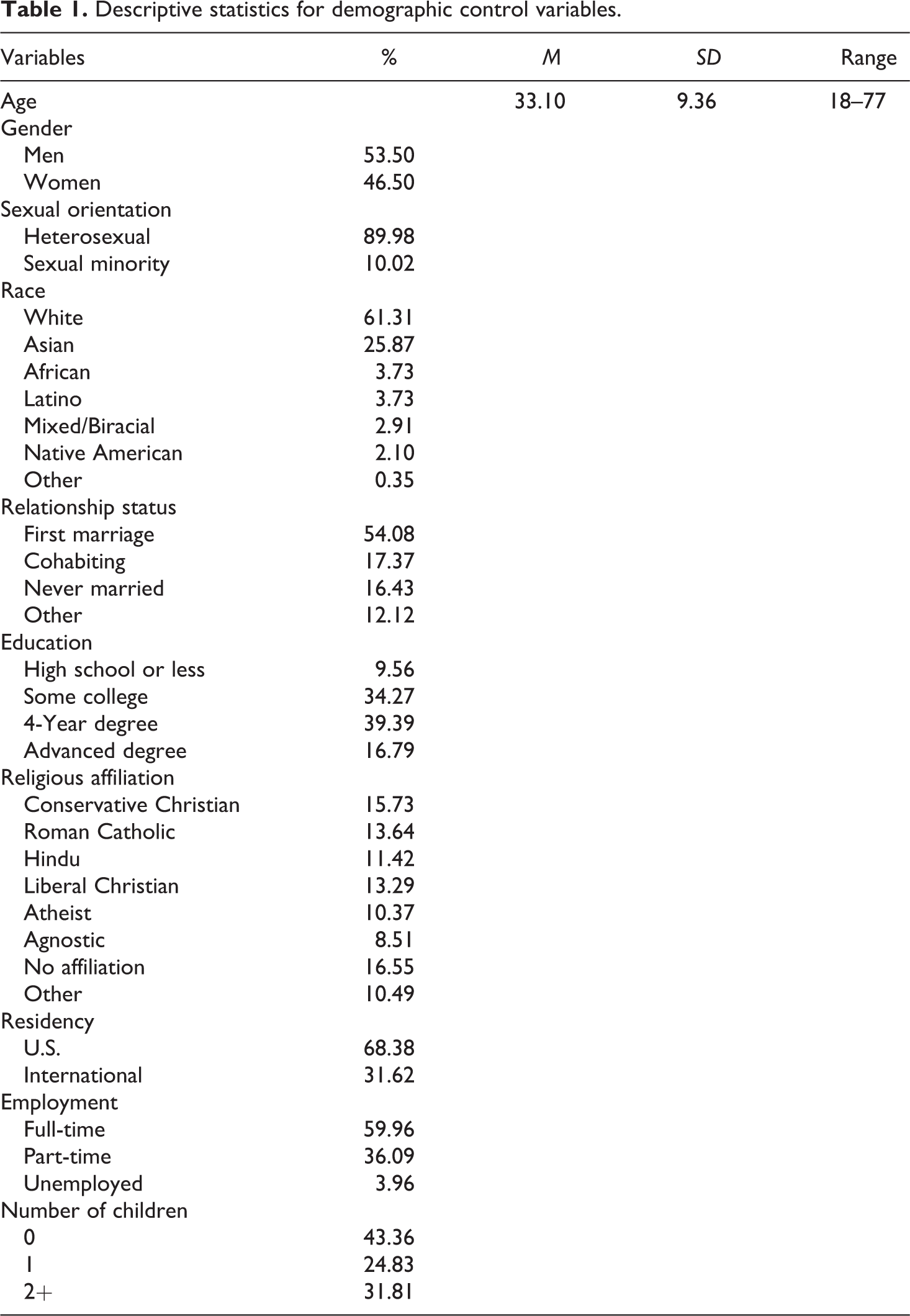
We increased confidence in the quality of the responses by carefully assessing how long each participant spent on the survey and having several reading comprehension questions. In our questionnaire, we had three Likert scale–type questions stating things like, “If you are reading this, select ‘3 to 5 days a week’.” If they filled in any option that was not “3 to 5 days a week,” we did not use their data. Aside from the reading comprehension questions, we also eliminated participants if they took far less than the allotted period of time (<6 min). For those who took slightly less than 10 min (6–10), we closely inspected their answers for any major inconsistencies that suggest little thought in completing the survey. After careful evaluation, 304 individuals were dropped from the original 1162 participants who were in a committed relationship to end up with our final sample of 858 individuals. A multivariate analysis of variance (MANOVA) was also conducted to assess the demographic differences between those who completed the survey adequately as opposed to those who incorrectly answered security check questions. A significant difference was found in the MANOVA, Wilks λ = .917, F (6, 1028) = 15.59, p < .01. Participants who completed the survey adequately were more likely to be White (p < .01), heterosexual (p = .03), less religious (p < .01), and have no children (p < .01). This could suggest some potential bias in participants that should be considered with interpreted results.
Measures
Measurement for both pornography use and provocative sexual media use was derived from a study by Willoughby and Busby (2016). In the study, participants were given 20 items and asked to rate the extent they believed each item to be pornography (0 = definitely not pornography; 10 = definitely pornography). In our study, the items used for pornography were those most agreed upon in the study of Willoughby and Busby (2016) to be pornographic content (all had a mean above 8.0). Meanwhile, the items used for sexual media were items with lowest consensus from the study of Willoughby and Busby (2016) about the content being pornographic (had a mean rating lower than 5.0). Again, the biggest distinction between these two aspects of sexual content was that the pornography scale assessed explicit sexual acts, whereas the provocative sexual media scale assessed suggestive, nonexplicit sexual media. Of note, we specifically focused on the provocative portrayal of women in sexual media, as research suggests it to be a very prevalent, specific subtype of sexual media. In fact, studies have suggested that women are sexually objectified in 52% of magazine advertisements (Stankiewicz & Rosselli, 2008). We were concerned that if we created a scale focused on the provocative portrayal of both men and women, then it would lack internal consistency and the results would be less interpretable.
Pornography use
Pornography use was assessed by averaging the responses of four items assessing the use of sexually explicit videos and images (e.g., “An image of a heterosexual couple having sex which shows the man’s penis penetrating the woman.”). A 6-point Likert-type scale measured how often in the last 12 months participants had viewed or used the sexual content (1 = none and 6 = every day or almost every day). These items showed strong internal reliability for men (α = .85) and women (α = .91)
Provocative sexual media use
Provocative sexual media use was assessed by averaging the responses of four items assessing sexualized media (e.g., “An image of a woman alone posing in a suggestive way with underwear on.”) A 6-point Likert-type scale measured how often in the last 12 months participants had viewed or used the sexual content (1 = none and 6 = every day or almost every day). These items showed strong internal reliability for men (α = .87) and women (α = .89).
Sexual satisfaction
Sexual satisfaction was assessed by analyzing items separately from the GRISS scale subscale for satisfaction (Rust & Golombok, 1985). The measure has shown adequate test–retest reliability over the years, with a correlation of .84 for men and .85 for women (for a detailed analysis of psychometric properties, see Ter Kuile, van Lankwd, Kalkhown, & van Egmond, 1999). Six individual items were included to assess the various aspects of sexual satisfaction: “Are you dissatisfied with the amount of variety in your sex life with your partner (reverse coded)?” “Do you find the sexual relationship with your partner satisfactory?” “Do you feel there is a lack of love and affection in your sexual relationship (reverse coded)?” “Are you satisfied with the amount of time you and your partner spend on foreplay?” “Do you have sexual intercourse as often as you would like?” “Do you feel dissatisfied with the amount of time your partner spends on intercourse itself (reverse coded)?” A 5-point Likert-type scale assessed participants’ answers to these questions (1 = never and 5 = very often).
Control variables
Controls variables used for the analyses were age, U.S. residency, race, sexual orientation, education, whether the individual had a child, impulsivity, body image, and religiosity. Age was controlled for because younger adults are particularly likely to use sexual content (e.g., Carroll et al., 2008) and because, on average, sexual satisfaction tends to decline with age (Call, Sprecher, & Schwartz, 1995). Race was controlled for because certain races have a higher likelihood of experiencing different types of sexual dysfunctions that can impact their sexual satisfaction (e.g., White women report more sexual dysfunction than Black women; Hughes, Rostant, & Pelon, 2015). We took into account U.S. residency because culture is associated with sexual self-schemas, which are connected to perceptions of sexuality (Aumer, 2014). We used sexual orientation as a control because heteronormative gender expectations in sexual/romantic relationships portrayed in sexual scripts (Gagnon & Simon, 1973) may influence heterosexual women and men more than nonheterosexual women and men. Also, sexual orientation, whether the participant has a child, and education were used because each variable has been shown to be associated with sexual satisfaction (e.g., Gil, 2007; Henderson, Lehavot, & Simoni, 2009; Yoo, Bartle-Haring, Day, Gangamma, 2014). Impulsivity (Wetterneck, Burgess, Short, Smith, & Cervantes, 2012), body image (Sanchez & Kiefer, 2007), and religiosity (Perry, 2016) were all controlled for because they are potential confounds for the associations between viewing sexual content and sexual satisfaction.
Participants were coded as White (0) or non-White (1), heterosexual (0) or nonheterosexual (1), had no children (0), had at least one child (1), and resident of the U.S. (0) or nonresident (1). Age was measured with an open-response item asking participants to list their age, and education was measured by a single item: What is the highest level of education you have obtained? (1 = less than high school and 7 = doctorate PhD, J.D., M.D., etc.).
Impulsivity was assessed by averaging the responses of five items (e.g., “I have difficulty controlling my temper”) from the Emotional Self-Regulation scale from Novak and Clayton (2001). A 5-point Likert-type scale measured the agreement with these items (1 = never true and 5 = always true). These items showed strong internal reliability for men (α = .89) and women (α = .87).
Body image was assessed by averaging the responses of four items (e.g., “I like what I see when I look in the mirror”) from the Body-Esteem Scale for Adolescents and Adults (Mendelson, Mendelson, & White, 2001). A 5-point Likert-type scale measured the agreement with these items (1 = never and 5 = always). These items showed strong internal reliability for men (α = .81) and women (α = .86).
Religiosity was assessed by averaging the responses of three items (e.g., “Spirituality is an important part of my life”) all assessed on a 5-point (1 = never and 5 = very often) Likert-type scale. These items showed strong internal reliability for men (α = .87) and women (α = .87).
Results
Descriptive statistics
Gender differences were explored for all the variables. A MANOVA revealed an overall significant gender difference, F (17, 807) = 14.73, p < .01, partial η2 = .24. Levene’s test was significant for several variables (all p < .01), including race, sexual orientation, U.S. residence, whether the participant has a child, pornography use, sexual media use, and sexual satisfaction with time spent on foreplay. This suggests that we should be cautious in directly comparing pornography and sexual media use of men and women. Table 2 shows means, standard deviations, ranges, and F values for each variable.
Descriptive statistics and gender differences of control, independent, and dependent variables.
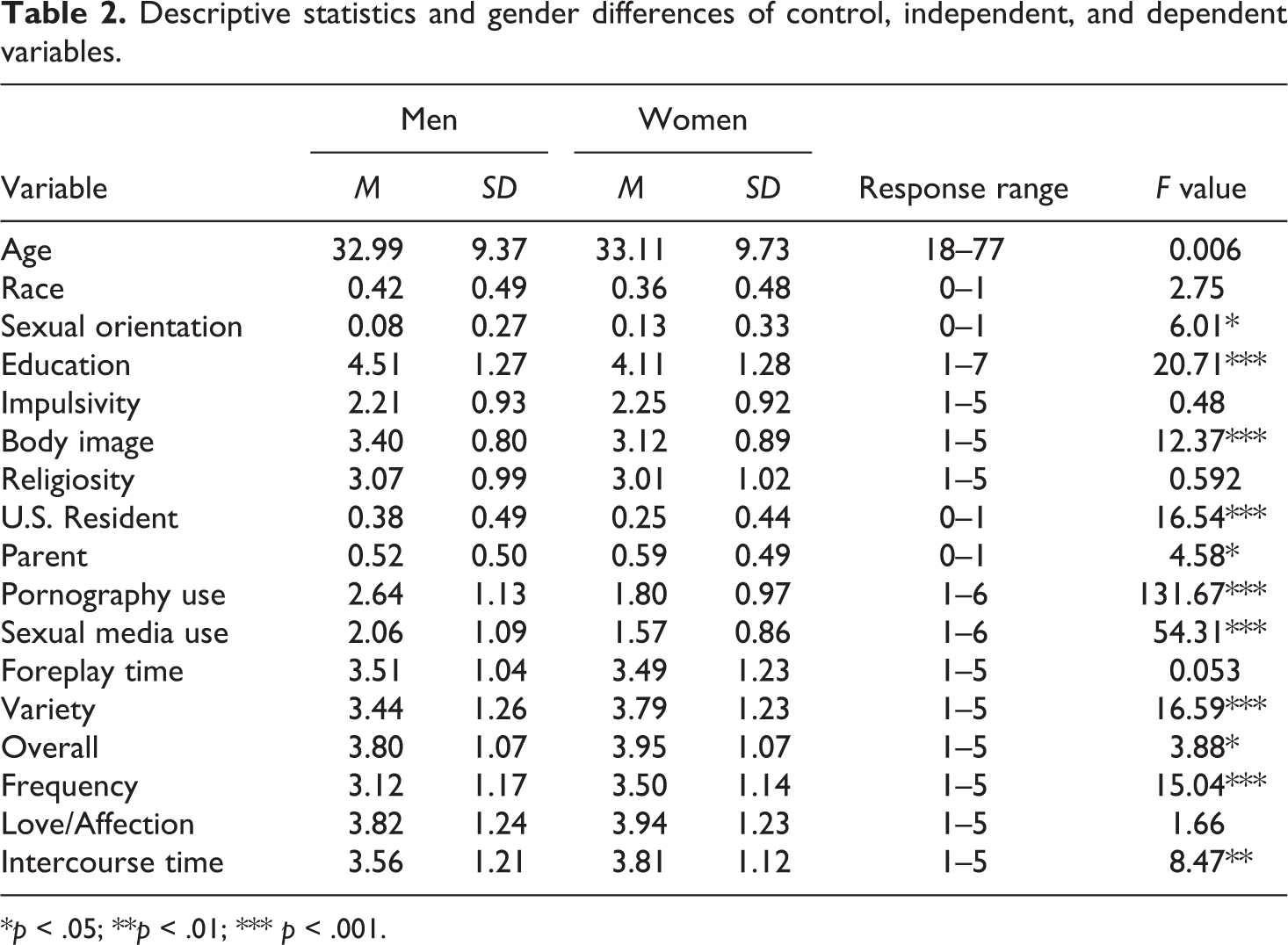
*p < .05; **p < .01; *** p < .001.
Bivariate associations
Table 3 shows correlations between all variables in the study, but we briefly report the highlights from our variables of interest. For men, greater pornography use was associated with less satisfaction with sexual variety (r = −.11, p = .02), love and affection (r = −13, p < .01), and time spent on intercourse (r = −.21, p < .01) but positively associated with satisfaction with frequency (r = .10, p = .04). Men’s provocative sexual media use was associated with lower sexual satisfaction with love and affection (r = −.19, p < .01) and time spent on intercourse (r = −.17, p < .01) but higher satisfaction with time spent on foreplay (r = .14, p = .03) and frequency (r = .24, p < .01). For women, pornography use was not associated with any of the sexual satisfaction outcomes. However, provocative sexual media use was associated with lower sexual satisfaction with love and affection (r = −.12, p = .02) and time spent on intercourse (r = −.11, p = .04).
Bivariate correlations between control variables, independent variables, and outcome variables.
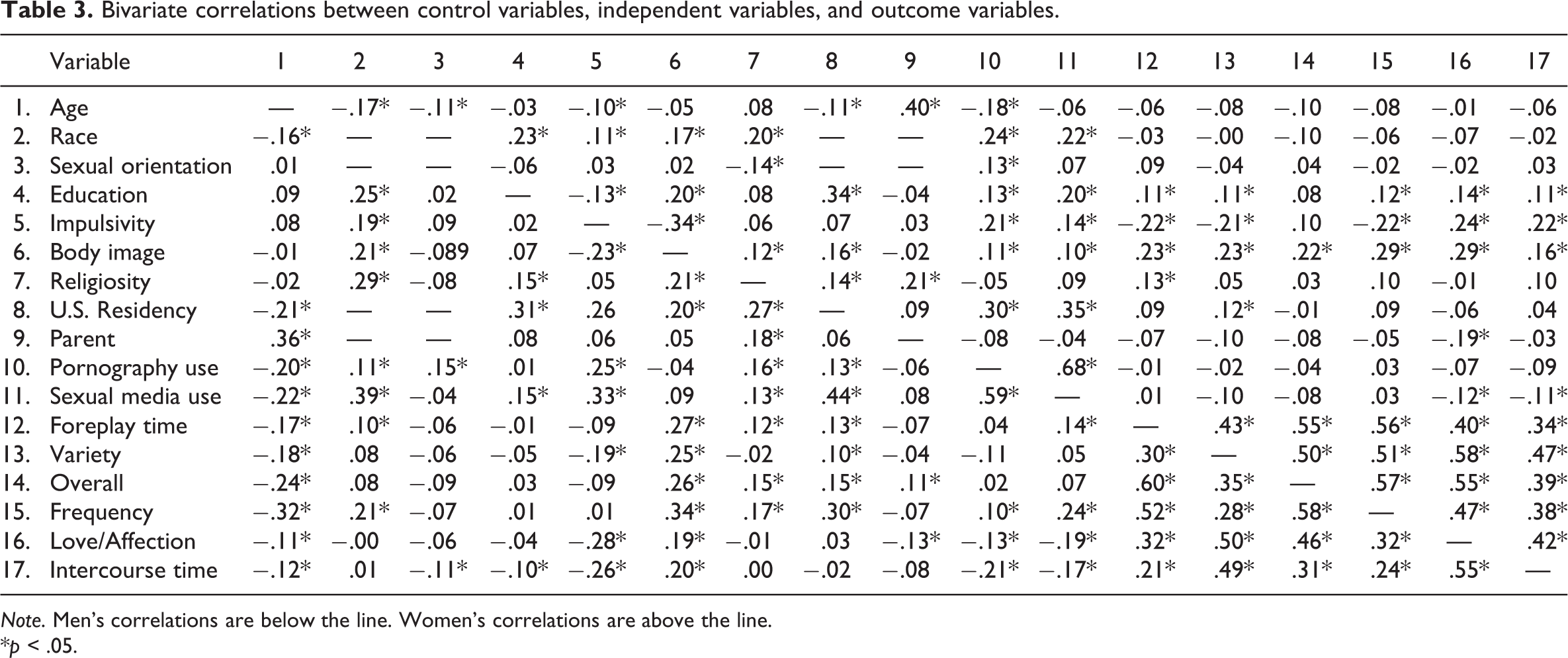
Note. Men’s correlations are below the line. Women’s correlations are above the line.
*p < .05.
Structural equation models
For each structural equation model, a comparative fit index (CFI) of .95, a root mean square error of approximation (RMSEA) of .08, and a standardized root mean square residual (SRMR) of .08 as they represent conservative estimates (Browne & Cudeck, 1993; Kline, 2010). All analyses were conducted in MPlus 7.0 using robust maximum likelihood to account for nonnormality in the data. There were 23 participants who had some level of missingness (<3% of the data), which were accounted by using maximum likelihood. We first conducted a confirmatory factor analysis and measurement invariance tests to better understand the psychometric properties of our sexual content constructs. Afterward, we created measurement models for our latent variables and full structural models to test our hypotheses.
Measurement tests
Confirmatory factor analyses confirmed the distinction of the constructs for pornography and sexual media. For men, when all eight items were forced onto a single factor, the model had poor fit (χ2(12) = 456.33, p < .01, CFI = .66, RMSEA =.28, SRMR = .12). However, when we grouped the eight items into the two distinct factors of pornography use and sexual media, the model fit was more acceptable (χ2(11) = 38.52, p < .01, CFI = .98, RMSEA =.07, SRMR = .03). The same was true for women’s CFA, as the one-factor fit (χ2(12) = 178.99, p < .01, CFI = .83, RMSEA =.19, SRMR = 10) was less acceptable than the two-factor fit (χ2(11) = 22.02, p < .01, CFI = .99, RMSEA =.05, SRMR = .02). This provided strong evidence that pornography and provocative sexual media are distinct constructs for both men and women.
We tested for measurement invariance between men and women for the constructs of pornography use and provocative sexual media use. The tests revealed that weak invariance did not exist for either of the constructs. For pornography use, model fit became significantly worse when constraining the factor loadings: χ2 difference (3) = 20.30, p < .01. Fit also became significantly worse when constraining factor loadings for sexual media: χ2 difference (3) = 8.29, p < .01. For both pornography and sexual media, the CFI also suggested that criterion for weak invariance was unmet, as the CFI dropped exactly .01 for both constructs when testing for weak measurement invariance. The CFI dropping .01 or more indicates a lack of invariance (Dyer, 2015; Little 2013). The lack of measurement invariance further justified our decision to evaluate men and women’s results separately.
Measurement model for men
Modification indices suggested multiple error correlations for the latent construct of pornography use and provocative sexual media that substantially improved model fit. The final measurement model fits the data adequately (χ2(105) = 269.55, p < .01, CFI = .95, RMSEA =.06, SRMR = .07), with all factor loadings above .45
Measurement model for women
Modification indices suggested multiple error correlations for the latent construct of pornography use and sexual media that substantially improved model fit. The final measurement model fits the data adequately (χ2(106) = 188.13, p < .01, CFI = .98, RMSEA =.05, SRMR = .04), with all factor loadings above .54 (see Table 4 for factor loadings of all latent variables for both genders).
Factor loadings for all latent variables.

Structural model for men
The model showed adequate fit (χ2(274) = 488.43, CFI = .96, p < .01, RMSEA =.04, SRMR = .04) and explained the following variances for the different dimensions of sexual satisfaction: variety (R2 = .15), overall (R2 = .15), love and affection (R2 = .17), time spent on foreplay (R2 = .12), frequency (R2 = .25), and time spent on intercourse (R2 = .14).
Figure 1 shows that higher pornography use among men was significantly associated with lower satisfaction with sexual variety (β = −.16, p = .01) and lower satisfaction with the amount of time spent on intercourse (β = −.15, p = .02). Also, greater use of sexual media for men was significantly associated with lower satisfaction with the love and affection in the sexual relationship (β = −.20, p < .01).
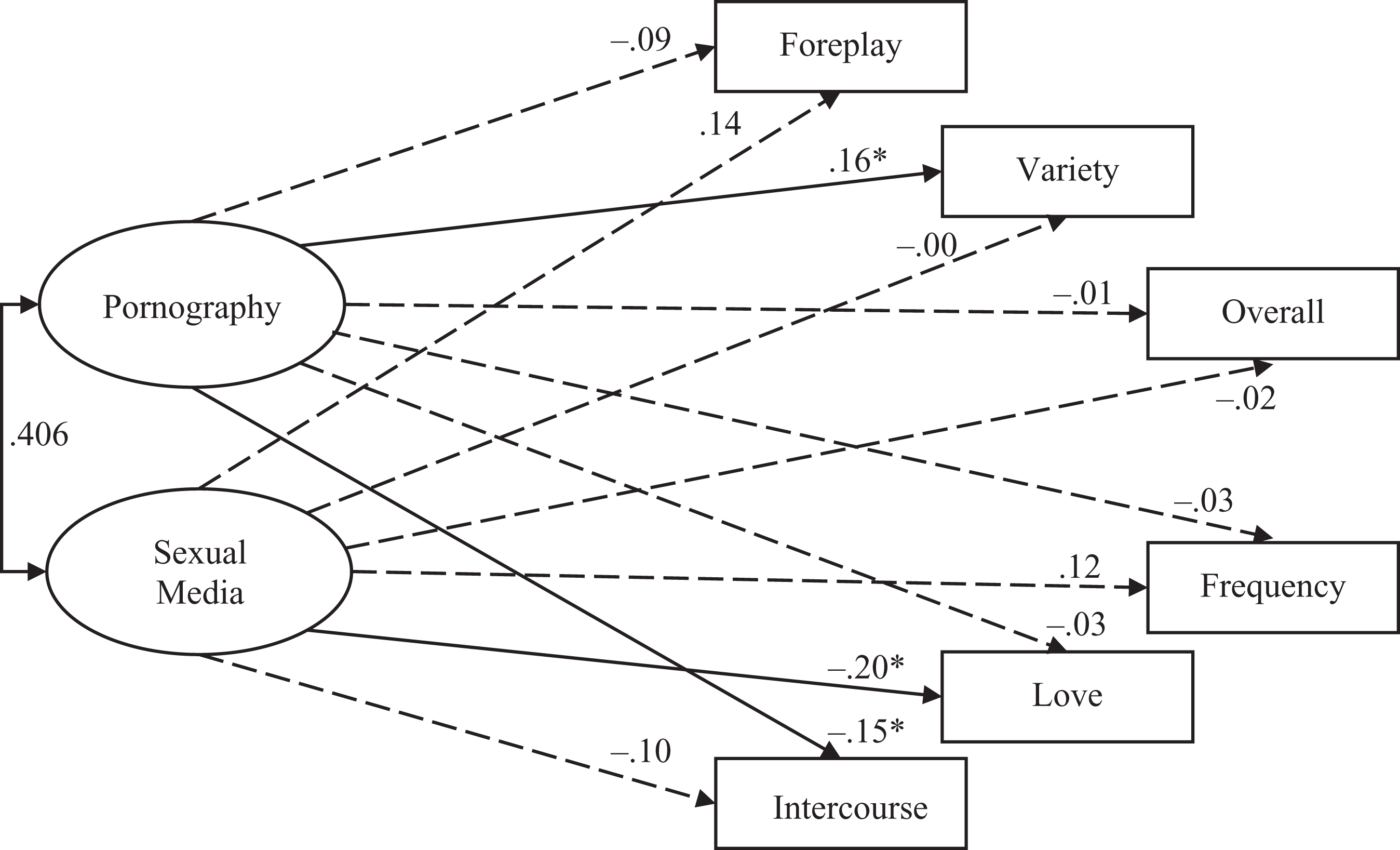
Structural equation model for men’s use of sexual content and sexual satisfaction. χ2(274) = 488.43, p < .01, CFI = .98, RMSEA = .04, SRMR = .04. Analyses controlled for age, race, sexual orientation, education, impulsivity, body image, religiosity, whether the participant had a child, and U.S. residency. Space constraints required abbreviations of several terms. “Foreplay” indicates satisfaction with time spent on foreplay. “Love” indicates satisfaction with love and affection. “Intercourse” indicates satisfaction with time spent on intercourse. *p < .05.
For the control variables, higher impulsivity was associated with lower satisfaction with variety (β = −.19, p = .01), love and affection (β = −.24, p < .01), and time spent on intercourse (β = −.20, p < .01). Higher body image was associated with higher sexual satisfaction with time spent on intercourse (β = .12, p = .03), love and affection (β = 14, p = .02), frequency (β = .33, p < .01), overall (β = .26, p < .01), variety (β = .18, p = .01), and time spent on foreplay (β = .24, p < .01). Higher age was associated with lower sexual satisfaction with time spent on foreplay (β = −.11, p = .02), variety (β = −.18, p < .01), overall (β = −.18, p < .01), frequency (β = −.19, p < .01), and time spent on intercourse (β = −.12, p = .02). Additionally, religiosity was associated with lower satisfaction with sexual variety (β = −.13, p = .02). Finally, those who were not residents of the U.S. reported higher satisfaction with the frequency (β = 20, p < .01) and love and affection (β = .20, p < .01) in their sexual relationships. Whether men had kids, race, sexual orientation, and education did not significantly predict any of the dependent variables.
Structural model for women
The overall model again showed adequate fit (χ2(274) = 387.94, p < .01, CFI = .98, RMSEA = .03, SRMR = .03) and explained the following variances of sexual satisfaction: variety (R2 = .14), overall (R2 = .11), love and affection (R2 = .18), time spent on foreplay (R2 = .13), frequency (R2 = .15), and time spent on intercourse (R2 = .10). Upon finding that the model fit adequately, we proceeded to evaluate the specific path coefficients.
Figure 2 shows that greater pornography use among women was not associated with any aspect of sexual satisfaction. Greater provocative, sexual media use was significantly associated with lower satisfaction with the love and affection in a sexual relationship (β = −.15, p = .01), lower satisfaction with the overall sexual relationship (β = −.14, p = .02), lower satisfaction with the variety in the sexual relationship (β = −.24, p < .01), and lower satisfaction with time spent on intercourse (β = −.14, p = .03).
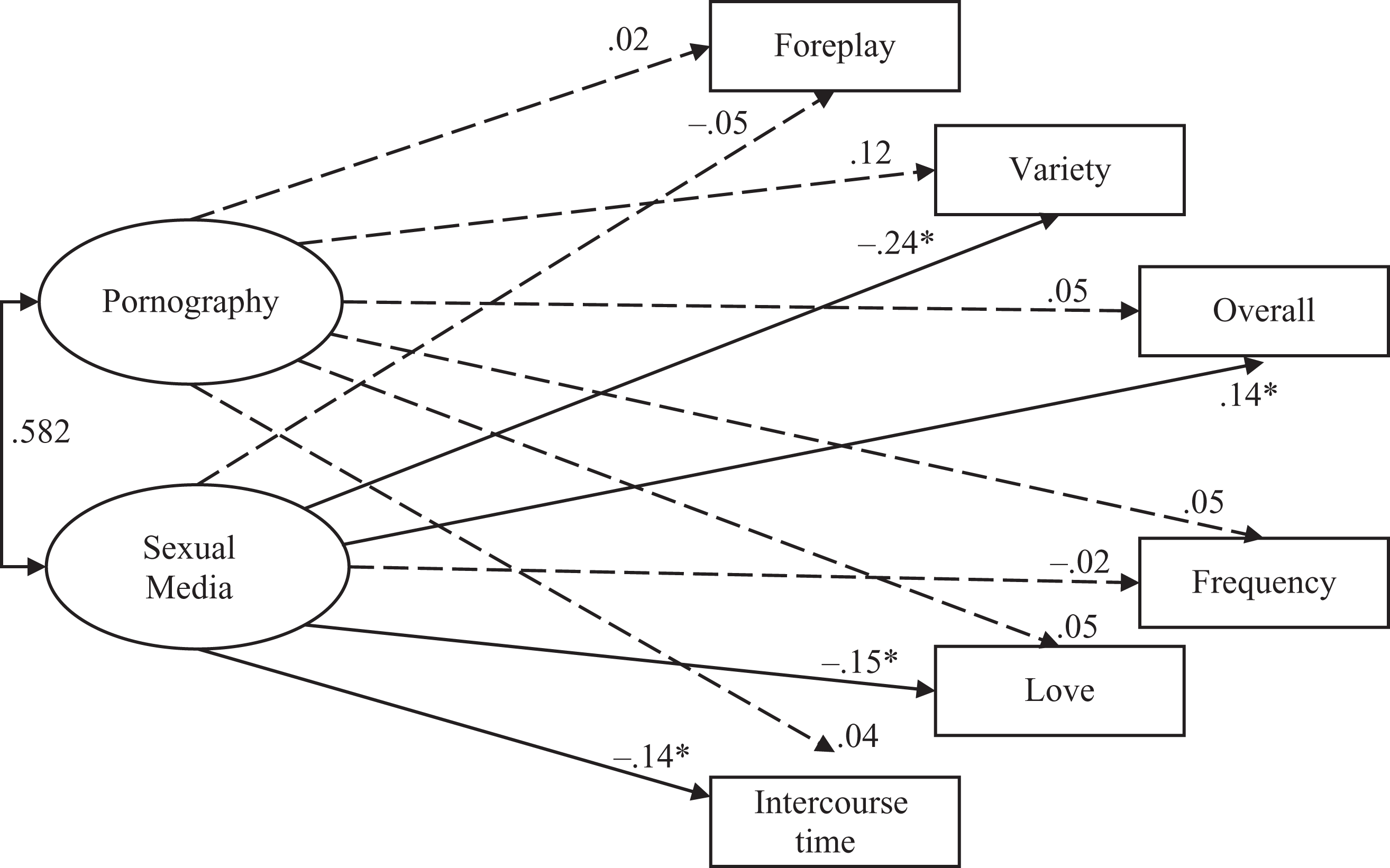
Structural equation model for women’s use of sexual content and sexual satisfaction. χ2(274) = 387.94, p < .01, CFI = .98, RMSEA = .03, SRMR = .03. Analyses controlled for age, race, sexual orientation, education, impulsivity, body image, religiosity, whether the participant had a child, and U.S. residency. Space constraints required abbreviations of several terms. “Foreplay” indicates satisfaction with time spent on foreplay. “Love” indicates satisfaction with love and affection. “Intercourse” indicates satisfaction with time spent on intercourse. *p < .05.
For control variables, higher impulsivity was associated with lower satisfaction with time spent on foreplay (β = −20, p = .01), variety (β = −.16, p < .01), frequency (β = −.18, p < .01), and time spent on intercourse (β = −.21, p < .01). Higher body image was associated with higher satisfaction with love and affection (β = .26, p < .01), frequency (β = .21, p < .01), overall (β = .26, p < .01), variety (β = .15, p = .03), and time spent on foreplay (β = .15, p = .01). Non-White women reported lower satisfaction with time spent on foreplay (β = −.13, p = .02), overall (β = −.18, p < .01), and frequency (β = −.18, p < .01). Those who were not residents of the U.S. reported higher satisfaction with variety (β = .20, p < .01) and frequency (β = .12, p = .04). Higher religiosity was associated with higher satisfaction with time spent on foreplay (β = .14, p < .01) and time spent on intercourse (β = .11, p = .03). Those who had a child reported less satisfaction with love and affection (β = −.20, p < .01). Those in a nonheterosexual relationship reported higher satisfaction with time spent on foreplay (β = .10, p = .03), and those with a higher education reported higher satisfaction with love and affection (β = .12, p = .02). Age was not associated with any of the dependent variables when all variables were evaluated simultaneously.
All covariances between sexual satisfaction items were estimated in the final model and varied between .19, p < .05 and .55, p < .05 (full results available from the first author upon request.)
Discussion
Our study highlighted the complexity of the relationship between sexual content and sexual satisfaction but provided insight into the nuances by clarifying which components of sexual satisfaction are associated with specific types of sexual content. Overall, our results provided strong evidence that although multiple aspects of both sexual content and sexual satisfaction interrelate, enough divergence exists within both overarching constructs to warrant theoretical and empirical work that distinguishes between multiple aspects of these overarching constructs.
Our first hypothesis was partially supported, as men’s pornography use was associated with lower satisfaction with sexual variety and time spent on intercourse itself. Script theory (Gagnon, 1990) may serve as an explanation for this, as men who view pornography may be disappointed in their partner’s lack of ability or desire to perform the sexual acts portrayed in pornography (Bridges et al., 2010) or to engage in sexual activity for as long as the man may like. Future research should carefully consider how relationship length factors into this finding, as habituation surrounding the relationship may be connected with pornography being used to find ways to bring novelty and variety to the relationship (Liu, 2000). Interestingly, the same association was not found for women, as women reported no association between pornography use and satisfaction with sexual variety or time spent on intercourse. This discrepancy between genders falls in line with previous research suggesting that while men’s use of pornography is negatively associated with couple satisfaction, the same does not necessarily hold true for women (Poulsen et al., 2013; Wright, Sun, Steffen, & Tokunaga, 2017). Perhaps, men are more willing to participate in the sexual practices women see in pornography, resulting in women not feeling frustrated by the inability to employ various sexual practices.
As hypothesized, no association was found between provocative sexual media use and sexual variety for men, time spent on foreplay, or time spent on intercourse, possibly because sexually provocative media does not portray a variety of sexual acts, making it less likely to influence specific sexual scripts surrounding sexual acts (Gagnon, 1990), and by extension expectations for sexual variety. Surprisingly, provocative sexual media was associated with lower reported satisfaction with sexual variety and time spent on intercourse for women. It is possible that the objectifying nature of provocative sexual media may lead to issues of body shaming (Noll & Frederickson, 1998), adversely impacting many aspects of women’s sexual satisfaction, an influence that extends to satisfaction with a variety of sexual practices. Future research should specifically account for body shaming and self-objectification as potential mediators in assessing these unexpected findings (Noll & Frederickson, 1998; Vandenbosch & Eggermont, 2012).
Our second hypothesis was partially supported, as greater use of provocative sexual media was associated with lower satisfaction with the love and affection in the sexual relationship for both men and women. As suggested by objectification theory (Fredrickson & Roberts, 1997), people who live in a culture that objectifies the body may become more judgmental of people’s ability to emulate the idealized body type. Because the scale in this study for provocative sexual media use focused on the provocative portrayal of women, these results suggest that provocative sexual media may be linked with men objectifying their partner and women self-objectifying. Previous research has shown that as scripts from sexual content become congruent with scripted expectations in the sexual relationship, sexual content is negatively associated with couple intimacy (Stulhofer, Busko, & Landripet, 2010). Perhaps as someone views objectifying, provocative sexual media, the script of objectification from sexual media is internalized as part of the attitudes and behaviors in the sexual relationship, thus leading to lower love and affection. Yet, although research has found examples of objectification in both provocative sexual media (Ward, 2016) and explicit pornography (Klaassen & Peter, 2015), interestingly, pornography use was not associated with love and affection in the final structural equation models. Understanding the reasons behind this lack of association requires additional studies, but one reason may be that our items used for sexual media clearly implied objectification while the items for pornography use were more ambiguous as to whether the content was objectifying. When both constructs were evaluated together, it seems likely that the provocative sexual media items would be more likely to explain any variance that could result from objectification.
Our third and fourth hypotheses were largely unsupported, as pornography use and sexual media use had no association with satisfaction with sexual frequency, and only women’s use of provocative sexual media was negatively associated with her overall level of sexual satisfaction. Although some individuals in past research have reported that using sexual content is an effective sexual outlet (Kohut et al., 2017), perhaps this does not translate into satisfaction with sexual frequency in the relationship. Perhaps someone may be using sexual content as a sexual outlet but might still be frustrated at being denied the opportunity to engage in sexual activity with his or her partner. As previously mentioned, it is worth noting that women’s use of provocative sexual media is associated with lower overall sexual satisfaction, supporting previous research for overarching negative outcomes when women use objectifying sexual content (Gapinski, Brownell, & LaFrance, 2003; Noll & Frederickson, 1998). However, women’s use of pornography and men’s use of both types of content had no connection to overall sexual satisfaction, further highlighting the potential problems in using vague items that only highlight global sexual satisfaction (Pascoal et al., 2014).
Limitations and future directions
Although our study had many strengths, such as advancing conceptualization of sexual content and sexual satisfaction, a large sample size, and novel use of measurement, the current study has several limitations to consider. One limitation was the use of cross-sectional data. Longitudinal research is needed to establish the directionality of the results and clarify the explanations behind these associations. In particular, clarification is needed for how much use of sexual content influences different aspects of sexual satisfaction and to what extent the sexual relationship leads to use of pornography or provocative sexual media.
We also had limitations in measurement, as we only used one item for each dimension of sexual satisfaction. One of the dangers of one-item measurement is that we have no way to fully account for the reliability or validity of the constructs (DeVellis, 1991). While our study highlights that some distinction may exist in different aspects of sexuality, the one-item measurement limits confidence in what is truly being measured. Future researchers should create expanded scales from the multiple dimensions of sexuality that Pascoal et al. (2014) found to test the validity of these results. One aspect of sexual satisfaction our measurement did not assess that would be valuable to consider in future research is pleasure (Abramson & Pinkerton, 2002). Despite this limitation, it is worth noting that one-item measurement has been successfully used in studies on health (DeSalvo et al., 2006), work satisfaction (Wanous & Hudy, 2001; Wanous, Reichers, & Hudy, 1997), and self-esteem (Robins, Hendin, & Trzesniewski, 2001. Also, one-item measurement in sexual satisfaction research has a surprising amount of validity in comparison to traditionally validated sexual satisfaction scales (Mark, Herbenick, Fortenberry, Sanders, & Reece, 2014).
The items for sexual content also had limitations. We did our best to create scales for pornography use and provocative sexual media use that captured internal reliability within each scale yet also could be distinguished from each other. Overall, we believe that we accomplished this purpose in a way that suited our research question. However, it is important to note that within both pornography and sexual media are a wide variety of depictions of sexuality that we could not fully account for with our measurement. Some research questions may be better suited to evaluating highly specific sexual content that may influence a particular behavior (e.g., depiction of anal sex influencing the likelihood of engaging in anal sex). Additionally, our sexual media items focused specifically on the provocative portrayal of women. Future research should explore how sexual media focused on men differentiates from the focus on women, especially across gender.
Although we were able to establish distinction between pornography use and provocative sexual media use through confirmatory factor analyses, we note that the constructs still did have a moderate (for men) to high (for women) correlation between the scales. This suggests that although distinction exists between the types of content being viewed, when someone is viewing one type of content they also tend to view the other. Both pornography use and sexual media use seem to be tapping into an overall construct of viewing sexual content in general. The possibility also exists that some differences may be found between the items within the scales we used. For example, one item for the pornography scale focused on a solitary sexual act (masturbation), while the other items focused on dyadic acts. Assessing the differences between portrayal of solitary and dyadic acts could be yet another profitable area of future research.
There are also a variety of contextual factors that future research should account for. A clearer lens of the context could be evaluated through the perspective of both members of the relationship, especially since partner discrepancies have been found to be uniquely associated with relational outcomes in pornography research (Willoughby, Carroll, Busby, & Brown, 2016). Future research should explore how one partner’s use of pornography and provocative sexual media influences his or her partner’s multiple dimensions of sexual satisfaction. Other contextual factors worthy of future evaluation include relationship length, sexual orientation, and culture.
Many of our control variables should also be considered in the future as potential mediators and moderators of associations. For example, perhaps body shaming acts as a mediator or moderator between women’s use of provocative sexual media and sexual satisfaction. Body shaming may be the explanation for why viewing provocative sexual media influences sexual satisfaction, or it may act as a moderator, where objectifying sexual content only influences sexual satisfaction insofar as it leads a woman to feel insecure about her body.
Implications and conclusion
This study should be of use to researchers, as our factor analyses and the predictive validity of some of the associations provide a major step forward in acknowledging the multidimensionality of sexual content and sexual satisfaction. While some research has previously suggested distinctions between paraphilic (e.g., violent/coercive) and mainstream (e.g., vaginal or oral sex) pornography (Hald & Stulhofer, 2016), our study highlights that mainstream pornography can be distinguished from provocative sexual media. Researchers now have three distinguishable types of sexual content that they can evaluate in their studies and should feel free to explore the possibilities of different unique aspects of sexual content (e.g., same-sex acts, group sex). Furthermore, our work highlights that several aspects of sexual satisfaction are distinguishable and that there is danger in assessing several aspects as one monolithic construct. Future research should carefully consider whether their measurement of “sexual satisfaction” truly fits as a global appraisal of the sexual relationship, or if the items on the scale are actually differentiable, and should be evaluated separately.
To our knowledge, we have provided the first ever assessment of measurement invariance for men and women viewing sexual content. The lack of measurement invariance supports previous meta-analytical evidence (Oliver & Hyde, 1993; Petersen & Hyde, 2010) suggesting substantial differences between men and women when it comes to solitary sexual behavior. Men and women perceive items asking about sexual content through a fundamentally different lens. For example, when they both see an item such as “A video showing two naked women or men manually stimulating each other,” they are not thinking about this item in the same way. This has implications for the state of the research on sexual content, as it calls into question whether gender difference findings for men and women’s use of sexual content are due to underlying measurement problems that need further exploration.
This study should also be of use to therapists, as they may find it useful to consider with more detail what sexual expectations couples hold for satisfaction in their relationship. Therapists and relationship educators may also find this encouraging to consider more fully what exact sexual content couples are viewing. Therapists and couples should have detailed consideration of how different types of content may be influencing their scripts surrounding sexuality and the extent to which those scripts are congruent or incongruent with both partners’ sexual desires. Also, when relationship educators inform couples about the potential influence of using sexual content in a relationship, they should be very clear about the importance of understanding what specific content is being viewed, and how differing types of content may influence different aspects of sexual satisfaction in different ways, based upon each individual’s expectations of sexuality in the relationship. For example, couples, researchers, therapists, and relationship educators may all consider the extent to which the sexual content presents a script of objectification, as objectification is one aspect of sexual content with clear empirically validated implications for individuals using the content (Zurbriggen et al., 2011).
Script theory and objectification theory provide strong frameworks that researchers can use in future studies and should provide direction to help therapists and relationship educators in efforts in helping couples to navigate use of sexual content in committed relationships. Naturally, the pioneering nature of our study resulted in several limitations. But it is a major step forward theoretically and empirically in opening up a wide range of possibilities for evaluating how different types of sexual content influence multiple aspects of sexual satisfaction.
Footnotes
Authors’ note
This manuscript was originally presented at the International Association of Relationship Research in Toronto, Canada, July 2016.
Funding
This research received no specific grant from any funding agency in the public, commercial, or not-for-profit sectors.