




Abstract
To deepen our understanding of young adults’ sibling relationships in the Italian context, this study examines the psychometric properties of the Italian adaptation and validation of the Lifespan Sibling Relationship Scale (LSRS) in a sample of 350 Italian university students (68.6% females, 31.4% males; ages 19–30 year, M = 23.6, SD = 3.2). Confirmatory factor analysis showed the expected six-factor structure and a close correlation between factors and scales. Internal consistency was adequate and correlation analysis with the Adult Sibling Relationship Questionnaire (ASRQ) confirmed the theoretical relations among the constructs. The findings confirm the transcultural validity of the LSRS. Moreover, results are consistent with research findings, indicating that women show a more positive attitude toward sibling relationships, especially when reporting their relationship with sisters, older siblings show a more positive attitude toward sibling relationships, and perception of current maternal and paternal partiality is related to negative attitudes toward sibling relationships.
The sibling bond represents the most long-lasting and enduring relationship to develop throughout the life span, remaining unique and influential (e.g., Bank & Kahn, 1997; Cicirelli, 1995; Smorti & Guarnieri, 2013; Sommantico, 2012).
While, initially, research has mostly focused on child and adolescent sibling relationships (e.g., Brody, Stoneman, & Burke, 1987; Furman & Buhrmester, 1985; Stocker, Dunn, & Plomin, 1989) or on old-age siblings (Stewart, Verbrugge, & Beilfuss, 1998), more and more attention is now dedicated to adult sibling relationships from a life-span perspective, following the indications of Cicirelli (1995) who underlined a gap in the research on changes that occur in sibling relationships during the transition to young adulthood (18–35 years). These changes are linked to the developmental evolutions of individuals’ roles as well as to the reorientation of their lives toward the world outside the family, that is, friends, romantic partners, completing their education, and job experiences (e.g., Conger & Little, 2010).
Although the importance of young adults’ sibling relationships has been a research topic in the field of psychology, there is a limited number of quantitative tools for assessing the nature of these relationships. Yet, adaptation and validation of instruments assessing the characteristics of sibling relationships represents one of the major steps toward conducting psychological studies on the subject. Moreover, among the existing validated instruments available for assessing sibling relationships for the Italian context, no one takes into account child and adult sibling bonds, thereby focusing on a life-span perspective.
In line with these indications, the present study aims to deepen the understanding of young adults’ sibling relationships in the Italian context by examining the psychometric properties of the Italian adaptation and validation of the Lifespan Sibling Relationship Scale (LSRS; Riggio, 2000). The present study also examines the role of sex, age, and perception of parental partiality in influencing attitudes toward sibling relationships in young adulthood.
Sibling relationships across the life span
In order to analyze and comprehend developmental changes in sibling relationships, more recent research has focused on two main fields of investigation: (1) factors related to sibling relationship quality, taking into account variables such as gender, birth order, family size, and siblings’ age differences (e.g., Floyd, 1995; Lee, Mancini, & Maxwell, 1990; Stocker, Lanthier, & Furman, 1997); and (2) features and function of the adult sibling relationship, such as closeness, frequency of contact, social support, and comparison between the sibling bond and other significant adult close relationships (e.g., Floyd, 1995; Riggio, 2000; Stewart et al., 2001; Stocker et al., 1997; Voorpostel & van der Lippe, 2007).
Literature reviews (e.g., Whiteman, McHale, & Soli, 2011) document that siblings have a central role in the lives of individuals as well as of families across the life span. In particular, siblings serve as companions, confidants, and role models in childhood and adolescence (e.g., Dunn, 2007; McHale, Updegraff, & Whiteman, 2012), as sources of emotional support and security in the face of parental conflict and at different points across the life span (e.g., Jenkins, 1992; Kim, McHale, Osgood, & Crouter, 2006; Voorpostel & Blieszner, 2008; Waite, Shanahan, Calkins, Keane, & O’Brien, 2011; Walęcka-Matyja, 2015b), and as sources of support throughout adulthood and in old age (e.g., Connidis & Campbell, 1995; Folwell, Chung, Nussbaum, Bethea, & Grant, 1997; Lu, 2007; White, 2001). Several significant dimensions emerge from all of the studies dedicated to adult sibling relationships, even if the results are not always concordant.
Firstly, there is a decrease in sibling rivalry for parental attention and affection that, by contrast, characterizes childhood sibling relationships. Indeed, even if differential parental treatments are also common in later life (e.g., Boll, Ferring, & Filipp, 2003; Suitor & Pillemer, 2007), adult sibling relationships seem to be less affected by these dynamics than childhood or adolescent ones. Emerging adults’ capability to perceive and comprehend their siblings and to mitigate conflicts with them increases throughout the maturational process because of decreasing day-to-day interactions. This occurs, as reported by Scharf, Shulman, and Avigad-Spitz (2005), regardless of their relationships with their parents. On the contrary, other studies show that perception of parental favoritism may, however, play a role in influencing siblings’ relationships, specifically affecting warmth, conflict, hostility, and jealousy (e.g., Finzi-Dottan & Cohen, 2011; Rauer & Volling, 2007).
Secondly, during late adolescence and the transition to emerging adulthood (e.g., Arnett, 2000; Aleni Sestito & Parrello, 2004), with all the specific developmental-related tasks entailed therein (e.g., leaving home, completing education, becoming employed, getting married, and having children), and the ensuing focus on new social relationships rather than on family relationships (e.g., Roisman, Masten, Coatsworth, & Tellegen, 2004; Tanner, 2005), sibling ties are generally characterized by less conflict (especially for siblings further apart in age; e.g., Stocker et al., 1997), more warmth, but also less contact and proximity (e.g., Conger & Little, 2010; White, 2001). Moreover, reduced contact between siblings, due to leaving home and the construction of different adult ties, renders sibling relationships more voluntary and more symmetric (e.g., Cicirelli, 1995; Scharf, Shulman, & Avigad-Spitz, 2005; Stewart et al., 2001). As stated by Whiteman, McHale, and Soli (2011), these changes do not reflect the beginning of a fracture in the sibling bond. Rather, they may be related to the physiological developmental phase of the transition to adulthood, where the sibling bond may act as a protective factor for well-being and life satisfaction (e.g., Conger & Little, 2010; Waite et al., 2011). In line with this perspective, the literature findings suggest that emerging adults reported a lower general level of conflict between siblings, with lower levels of quarreling, antagonism, and competition (e.g., Scharf et al., 2005; Stewart et al., 2001) that may favor an increased sense of closeness and warmth (e.g., Collier Portner & Riggs, 2016; Stewart et al., 1998). These data could be interpreted as a reflection of less daily time spent together (e.g., Scharf et al., 2005; Stocker et al., 1997) as well as a greater ability to negotiate disagreement typical of this new phase of the life span (e.g., Laursen, Finkelstein, & Betts, 2001). Despite these findings, the literature also suggests that the sibling bond may continue to be characterized by ambivalent feelings in adulthood (e.g., Fingerman, Hay, & Birditt, 2004; Finzi-Dottan & Cohen, 2011; Myers & Goodboy, 2010; Ross & Milgram, 1982; Stocker et al., 1997; Tani, Guarnieri, & Ingoglia, 2013).
Thirdly, research has showed that in middle/later adulthood and in old-age sibling, ties are characterized by a stabilization of contact between siblings, as well as by an increase in giving/receiving help, and of levels of reciprocal preoccupation and emotional support (e.g., Avioli, 1989; Cicirelli, 1995; Lu, 2007; Szymańska, 2016; Van Volkom, 2006; Van Volkom, Machiz, & Reich, 2011; White, 2001; Whiteman et al., 2011). In particular, there is a general correlation between an increase in social companionship and emotional support and a decrease in instrumental support (e.g., Lu, 2007; Scharf et al., 2005). These data demonstrate that the hierarchical and reciprocal elements that characterize sibling relationships change over time (e.g., Connidis, 2001; Dunn, 2007; McHale, Kim, & Whiteman, 2006; Whiteman et al., 2011).
Fourthly, research findings have shown that there are some structural variables that affect the life transition of siblings, such as siblings’ age, gender, and family characteristics (e.g., Conger & Little, 2010; Connidis, 2001; Riggio, 2006; Tucker, McHale, & Crouter, 2001). Regarding age difference, the literature suggests that, with respect to childhood or adolescence, in emerging adulthood, this variable becomes less relevant, also because, at this stage of the life span, the sibling relationship becomes more egalitarian (e.g., Buhrmester & Furman, 1990; Cicirelli, 1995; Scharf et al., 2005; Stewart et al., 2001). Moreover, it has been indicated that older siblings are more in conflict with their younger brothers or sisters (e.g., Finzi-Dottan & Cohen, 2011; Riggio, 2006; Stewart et al., 1998). Regarding gender, while several studies found that the composition of sibling pairs may affect the sibling relationship in the transition to adulthood (e.g., Bedford, Volling, & Avioli, 2000; Conley, 2004), Mouw (2005) did not find significant gender differences. On the contrary, other studies showed that same-sex siblings are more conflicting and less close than opposite-sex pairs (Cicirelli, 1985; Ross & Milgram, 1982; White & Riedmann, 1992). In particular, sister pairs report the highest levels of intimacy and warmth in western societies (e.g., Buhrmester & Furman, 1990; Dunn, Slomkowski, & Beardsall, 1994; Lee et al., 1990; Milevsky, Smoot, Leh, & Ruppe, 2005; Scharf et al., 2005; Spitze & Trent, 2006; Walęcka-Matyja, 2015b, 2016), while in eastern ones, it seems that brother–brother dyads provide more support (e.g., Lu, 2007). Several studies have demonstrated that parenting behaviors, parents’ marital status, and parents’ marital conflict may play an important role in moderating sibling relationship quality (e.g., Collier Portner & Riggs, 2016; Connidis, 2001; Lewandowska-Walter, Polomski, & Peplińska, 2014; McGuire & Shanahan, 2010; McHale & Crouter, 1996; Milevsky, 2004; Milevsky et al., 2005; Panish & Stricker, 2001; Yu & Gamble, 2008). Finally, siblings who still live together, which is typical especially in Italian emerging adulthood (e.g., ISTAT, 2010), experience more conflicts and rivalry in their relationship with brothers and sisters than the ones who live apart (e.g., Van Volkom et al., 2011; Walęcka-Matyja, 2016).
In sum, research on young adults’ sibling relationships is sparse, and there are not always concordant findings regarding the emotional, behavioral, and cognitive dimensions of sibling relationships during the transition to young adulthood, which also entail structural variables most likely due to methodological biases or to different theoretical perspectives in studying the subject. These findings underline the necessity to further investigations in the field.
Review of instruments for the assessment of the adult sibling relationship
As stated above, there are few self-report measures specifically developed for measuring the quality of adult sibling relationships.
The first instrument developed was the Adult Sibling Relationship Questionnaire (ASRQ; Stocker et al., 1997), an age-appropriate extension of the SRQ (Furman & Buhrmester, 1985), which had been developed for childhood. The ASRQ is an 81-item self-report instrument that assesses adults’ perception of sibling relationships in three dimensions: Warmth (regrouping items from the Intimacy, Affection, Emotional Support, Instrumental Support, Knowledge, Similarity, Admiration, and Acceptance subscales), Conflict (regrouping items from the Dominance, Competition, Antagonism, and Quarreling subscales), and Rivalry (regrouping items from Maternal Rivalry and Paternal Rivalry subscales). Reported internal consistency values range from α = .86 to α = .98 (Stocker et al., 1997; for a more detailed description, see the “Instruments” section). The ASQR assesses individuals’ perceptions of their behavior and feelings toward their siblings as well as their perception of their siblings’ behavior and feelings toward them. The core idea in developing the instrument was that “the psychological meaning of a relationship and the felt support or conflict provided by that relationship reside internally” (Stocker et al., 1997, p. 211). In this sense, an adult’s perception of her/his sibling relationship guides and influences the pattern of interactions within the relationship.
The second instrument to be developed was the LSRS (Riggio, 2000), a 48-item self-report instrument that assesses feelings, behaviors, and thoughts related to sibling relationships in childhood and adulthood in six dimensions: Child and Adult Affect (AA), Child and Adult Behavior (AB), and Child and Adult Cognition (AC). Reported internal consistency values range from α = .87 to α = .91 for dimensions and α = .96 for the total scale (Riggio, 2000; for a more detailed description, see the “Instruments” section). The LSRS was designed for measuring the individuals’ overall attitude toward the adult sibling relationship. In contrast, the ASRQ was designed for measuring the dimensions that characterize the childhood sibling relationship. In this sense, Riggio (2000) refers to the tri-componential conceptualization of attitude (affective, behavioral, and cognitive components; Eagly & Chaiken, 1998). Moreover, the LSRS also focuses on attitudes toward childhood sibling relationships, following the idea that this attitude persistently influences aspects of the adult sibling tie. Finally, the LSRS does not include direct assessment of sibling rivalry, following the idea that this decreases in adulthood (e.g., Cicirelli, 1995). The LSRS was adapted and validated in Korean (Jeong et al., 2013) and Turkish (Öz, 2015; Öz Soysal, Yurdabakan, Uz Baş, & Aysan, 2016) contexts. In particular, for the Korean context (Jeong et al., 2013), the authors reported Cronbach’s α values ranging from .85 to .94, while for the Turkish context, Cronbach’s α values ranged from .78 to .95 in a first study (Öz, 2015) and from .80 to .96 in a second study (Öz Soysal et al., 2016). These data, together with those which emerged from Riggio’s (2000) study, suggest that the LSRS maintains its psychometric properties across different cultural contexts.
The third instrument is the Sibling Type Questionnaire (STQ; Stewart et al., 2001). The STQ is a 50-item self-report instrument designed to classify the type of relationship between siblings in adulthood in five dimensions: Mutuality, Criticism, Apathy, Competition, and Longing. The obtained sibling typology is as follows: (1) Supportive (high Mutuality and low Competition); (2) Longing (high Longing and high Mutuality); (3) Apathetic (low Mutuality and high Apathy); (4) Hostile (low Mutuality, high Criticism, and high Apathy); and (5) Competitive (high Competition). Reported internal consistency values range from α = .89 to α = .97 (Stewart et al., 2001).
The most recently developed instrument is the Adult Sibling Familial Relationship Scale (ASFRS; Walęcka-Matyja, 2015a). The ASFRS is a 20-item self-report questionnaire that assesses emotions, beliefs, and behaviors toward siblings in adulthood in three dimensions: Affective Commitment, Behavioral Commitment, and Cognitive Commitment. Reported internal consistency values range from α = .68 to α = .81 for dimensions and α = .89 for the total scale (Walęcka-Matyja, 2015a). The ASFRS is based on the tri-componential conceptualization of attitude (affective, behavioral, and cognitive components; Eagly & Chaiken, 1998), and this instrument also does not include items referring to rivalry, focusing instead on current experiences with siblings in adulthood.
Among these instruments, only the ASRQ has been validated for the Italian context (Tani et al., 2013). Additionally, only the LSRS takes into account both child and adult sibling relationships, focusing in this way on a broader life-span perspective, and shows internal consistency values higher than those of the ASFRS.
Aims and hypothesis
The main goal of the present study is the adaptation and validation of the LSRS (Riggio, 2000) to the Italian context. Until now, to our knowledge, the LSRS has never been adapted and validated in a European context, while it has been adapted and validated in Korean (Jeong et al., 2013) and Turkish (Öz, 2015; Öz Soysal et al., 2016) contexts, confirming the factorial structure of the scale and showing, in both cases, good internal consistency and test-retest reliability. Moreover, among the non-validated instruments assessing adult sibling relationships for the Italian context, the LSRS seems to be one of the most comprehensive instruments, taking into account feelings, behaviors, and thoughts referring to child and adult sibling ties, and in this way permitting an understanding of the passage from childhood and adolescence to young adulthood. Therefore, four major research questions were addressed as follows: Could the factor structure of the original LSRS be replicated in the Italian context? We hypothesize that (H1) even in the Italian context, there is a correlated six-factor structure as well as a convergence with the two general constructs of adult and child attitudes toward the sibling relationship. What is the role of sex in affecting young adults’ sibling relationships? Based on the literature findings (e.g., Bedford et al., 2000; Conley, 2004), we have hypothesized that sibling pairs’ composition may affect the sibling relationship in the transition to adulthood. In particular, as highlighted by various studies (e.g., Buhrmester & Furman, 1990; Dunn et al., 1994; Lee et al., 1990; Milevsky et al., 2005; Scharf et al., 2005; Spitze & Trent, 2006; Walęcka-Matyja, 2015b, 2016), we have hypothesized (H2) that sister pairs report the highest levels of intimacy and warmth. What is the role of parenting behaviors in moderating young adults’ sibling relationships? Once again based on previous findings (e.g., Collier Portner & Riggs, 2016; Lewandowska-Walter et al., 2014; McHale & Crouter, 1996; Yu & Gamble, 2008), we have hypothesized (H3) that parenting behaviors, especially parental favoritism, may play an important role in moderating sibling relationship quality. What is the role of participants’ age and birth order in influencing young adult attitudes toward sibling relationships? Following indications in the literature (e.g., Finzi-Dottan & Cohen, 2011; Riggio, 2006; Stewart et al., 1998), we have hypothesized (H4) that older siblings show a more positive attitude toward sibling relationships than younger siblings.
Method
Translation process
Following recommendations from the international literature on transcultural adaptation of assessment instruments (e.g., Brislin, 1970; Geisinger, 1994; Gudmundsson, 2009; Kankaraš & Moors, 2010; Krach, McCreery, & Guerard, 2016; van de Vijver & Poortinga, 1997; van de Vijver & Tanzer, 2004), the Italian LSRS was obtained using the translation/back-translation procedure. The first step was the translation of the questionnaire into Italian by two independent Italian translators. The two versions of the questionnaire were then compared and administered to subjects of an average educational level in order to identify possible problems in item comprehensibility. The majority of the translated items were identical and well-comprehended and so were retained. For the remaining items, the decision on which translation to retain was made by the two translators, according to the level of comprehension of the translators themselves. This Italian version was then translated back into English by a native English-language speaker. The discrepancies between the back-translation and the original English version of the questionnaire were then discussed by the three translators and the research team, and a final Italian version was at last agreed upon.
Participants and procedure of recruitment
The sample consisted of 350 students (68.6% females, 31.4% males), aging from 19 to 30 years (M = 23.6, SD = 3.2). Humanity majors were 67.4% of the participants and science majors were 32.6%. The majority of participants (63.4%) have one sibling (44% were first born, 39.4% were second born, and 16.6% were third born or more). More than half of the participants (53.1%) came from upper-middle socioeconomic classes with more than 62.0% of their parents having a high school diploma or university degree.
Participants were recruited from the University of Naples, from April to June 2017. All data were collected with self-report questionnaires using an Internet-based survey (Dillman, 2007; Fielding, Lee, & Blank, 2008; Hewson, Vogel, & Laurent, 2016). Participation in the study was voluntary and anonymous, and participants were encouraged to answer as truthfully as possible. Participants were also encouraged to answer by referring to the sibling with whom they have the closest bond. Given this, participants referring to a sister were 55.1% and those referring to a brother were 44.9%.
Participants gave consent to participate in the study on the first page of the survey, which took approximately 15–20 min to complete.
Instruments
Adult Sibling Relationship Questionnaire
The Italian version of the ASRQ (Tani et al., 2013) is a reduced form of the original ASRQ (Stocker et al., 1997). It is a 43-item self-report instrument that assesses the adult sibling relationship on 14 subscales: Intimacy, Affection, Emotional Support, Instrumental Support, Knowledge, Similarity, Admiration, Acceptance, Dominance, Competition, Antagonism, Quarrelling, Maternal Rivalry, and Paternal Rivalry. The 43 items are combined to form two higher order factors: (1) Warmth (25 items regarding Intimacy, Affection, Emotional Support, Instrumental Support, Knowledge, Similarity, Admiration, and Acceptance subscales; e.g., “How much do you and this sibling have in common?” and “How close do you and this sibling feel to each other?”); (2) Conflict (12 items regarding Dominance, Competition, Antagonism, and Quarreling subscales; e.g., “How much do you and this sibling argue with each other?” and “How much do you and this sibling dominate each other?”). In the confirmatory factor analysis (CFA), the 6 items referring to Maternal Rivalry and Paternal Rivalry (e.g., “Do you and this sibling think your mother supports one of you more?” and “Do you and this sibling think your father is closer to one of you?”) resulted uncorrelated to the two second-order factors (Warmth and Conflict). Participants are asked to respond according to a 5-point Likert-type scale ranging from Hardly at all to Extremely much. For the rivalry scales (mother and father), participants are asked to respond according to a 5-point Likert-type scale ranging from Participant is usually favored to Sibling is usually favored. Participants are also asked to answer as truthfully as possible, by referring to the sibling with whom they have the closest bond. These items are recorded as absolute discrepancy scores (0 = Neither sibling is favored; 1 = Parents sometimes favor one sibling over the other; 2 = Parents usually favor one sibling over the other). Subscale scores are obtained averaging the items that make up each subscale. The two second-order factors are obtained averaging the subscales that make up each factor. Scores for Warmth and Conflict range from 1 to 5, while scores for the Rivalry subscales (Maternal and Paternal) range from 0 to 2. Authors of the Italian validation (Tani et al., 2013) reported satisfactory internal consistency for all factors (Warmth α = .90; Conflict α = .81) and satisfactory convergent validity. In the present study, Cronbach’s α was satisfactory for all factors (Warmth α = .96; Conflict α = .88; Rivalry α = .88).
Lifespan Sibling Relationship Scale
The LSRS is a 48-item self-report instrument (Riggio, 2000), assessing feelings, behaviors, and thoughts related to sibling relationships in childhood and adulthood on six subscales: (1) AA (items 1–8; item 6 ‘reverse keyed’); (2) AB (items 9–16; item 13 ‘reverse keyed’); (3) AC (items 17–24; item 19 ‘reverse keyed’); (4) Child Affect (CA; items 25–32; items 25, 27, and 28 ‘reverse keyed’); (5) Child Behavior (CB; items 33–40; item 38 ‘reverse keyed’); and (6) Child Cognition (CC; items 41–48; item 42 ‘reverse keyed’). The affective component is operationalized assessing emotions toward sibling and sibling relationship (e.g., “My sibling’s feelings are very important to me” and “I was proud of my sibling when I was a child”); the behavioral component is operationalized assessing the degree of interaction with the sibling (e.g., “My sibling and I ‘hang out’ together” and “My sibling and I often helped each other as children”); and the cognitive component is operationalized assessing beliefs about the sibling and the sibling relationship (e.g., “My sibling and I have a lot in common” and “My sibling and I were ‘buddies’ as children”). Participants are asked to respond according to a 5-point Likert-type scale ranging from Strongly disagree to Strongly agree. Participants are also asked to answer as truthfully as possible, by referring to the sibling with whom they have the closest bond. Subscale scores are obtained by summing the items that make up each subscale. The total score is obtained by summing the scores of the six subscales. The author (Riggio, 2000) reported good internal consistency for each subscale (Cronbach’s α ranging from .87 to .91) and for the total score (.96).
A basic demographic questionnaire collects information regarding participant’s age, participant’s sex, number of siblings, birth order, age difference between siblings, course of study, parental educational level, parental occupation, and economic condition. Participants were asked to answer by reporting their relationship with the sibling with whom they have the closest bond, indicating his/her age and sex.
Statistical analyses
Survey data were then entered into LISREL 8.54 (Jöreskog & Sörbom, 2004) and SPSS 18.0 (Coakes & Ong, 2011) databases and checked/verified by project staff for accuracy. The verification of the factorial structure was effected through CFA of the first and second order, using the maximum likelihood estimation method. Based on the existing literature (Kline, 2005), a sample size was considered adequate for analyzing the psychometric properties of LSRS, if more than five cases per variable were included in the model (Bentler & Chou, 1987) and if, considering other factors including magnitude of the loadings, the standardized value was >.60 (Jackson, 2003). The fit indices used in this study are as follows: χ2 distribution and the degrees of freedom (χ2/df), comparative fit index (CFI), non-normed fit index (NNFI), root mean square error of approximation (RMSEA), and standardized root mean square residual (SRMR). According to the recommendations of McDonald and Ho (2002) and Hu and Bentler (1999), the χ2/df must be in a range between 2 and 5, and the values of the CFI and of the NNFI must be >.90. Those of the RMSEA are considered to be good if they are <.05, reasonable if they are <.08, and average if they are <.10 (Kline, 2005). Those of the SRMR must be <.09 (Bentler, 1990).
The reliability analysis was computed using Cronbach’s α and is considered to be satisfactory if the values are greater than .70 (Nunnally & Bernstein, 1995). The concurrent validity was verified by means of Pearson’s correlation analysis (p-value < .05). The differences between the subject groups were verified through analysis of variance (ANOVA) and MANOVA (p-value < .05).
Results
Verification of factorial structure, reliability, and validity
The six-factor model was tested by CFA, which has highlighted the existence of correlations between some error variance items (see Figure 1). This analysis, conducted on 350 subjects with no missing data, resulted in high scores of goodness of fit (χ2/df = 4.17; RMSEA = .095 [.092–.098]; NFI = .92; NNFI = .94; CFI = .94; SRMR = .079; GFI = .95; AGFI = .94). The six subscales are all related to each other. In particular, the correlations between adult attitude subscales ranged from .74 to .90, while those between child attitude subscales ranged from .64 to .95. Also, the correlations between adult attitude and child attitude subscales, although inferior, were still meaningful, with values ranging from .09 to .36. Moreover, in order to verify the convergence of the six dimensions with the two general constructs of adult and child attitudes toward the sibling relationship, a second-order CFA was also performed (Figure 1). The fit indices were found to be even better than those in the basic model (χ2/df = 3.94; RMSEA = .092 [.089–.095]; NFI = .92; NNFI = .93; CFI = .94; SRMR = .079; GFI = .95; AGFI = .94).

Completely standardized solution of the second-order CFA. CFA: confirmatory factor analysis.
These findings completely support H1, showing a six-factor structure of the LSRS in the Italian context, as well as convergence with the two general constructs of adult and child attitudes toward the sibling relationship.
Coefficient αs for the six subscales are shown in detail in Table 3 and ranged from .79 to .90. The coefficient α for the total LSRS score was .94. These coefficients demonstrated, as in Riggio’s (2000) original study, as well as in the other validation studies (Jeong et al., 2013; Öz, 2015; Öz Soysal et al., 2016), the high internal consistency of the LSRS subscales and the total scale.
Intercorrelations among the six subscales of the LSRS and the total LSRS score are shown in Table 1. Five of the six subscales and the total LSRS scores were moderately to highly positively correlated with each other, indicating the significant interrelationships among various attitudinal aspects of the adult sibling relationship. Variations are apparent in the strength of scale intercorrelations according to the childhood/adulthood nature of the scales. The only place a significant correlation was not found was between CA and AB. LSRS adult scales were more strongly correlated with each other than with the three child scales and vice versa.
LSRS intercorrelations.
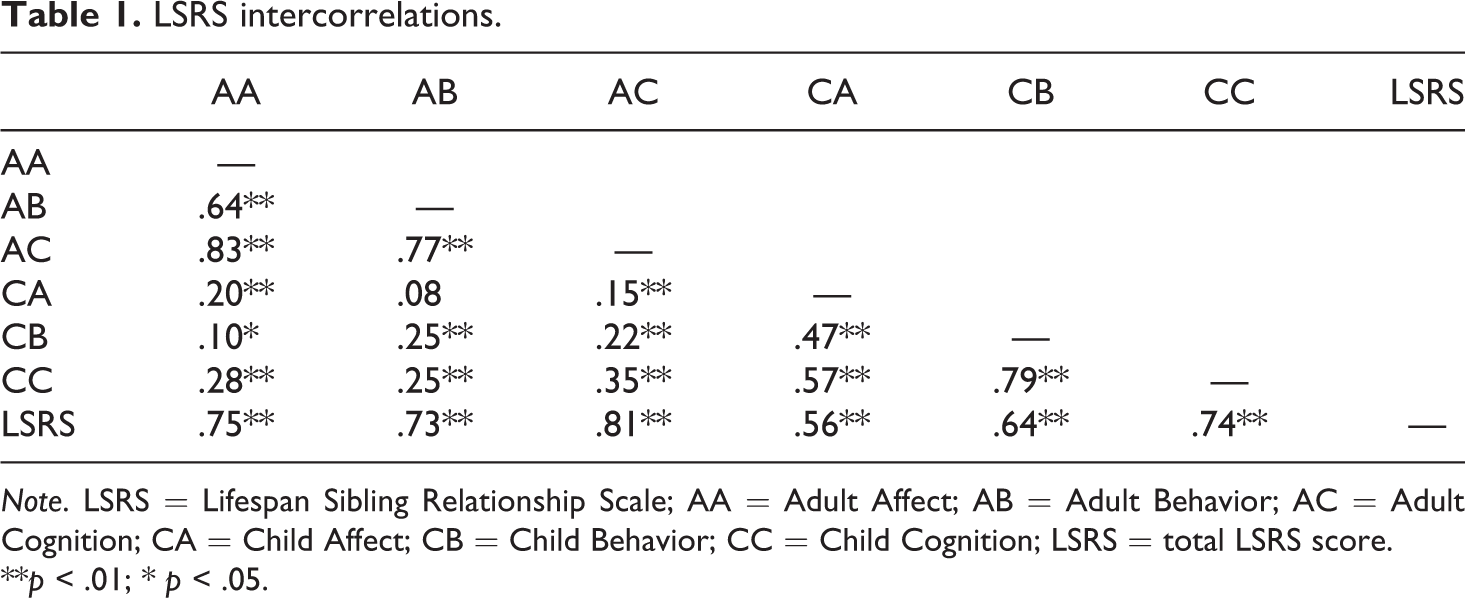
Note. LSRS = Lifespan Sibling Relationship Scale; AA = Adult Affect; AB = Adult Behavior; AC = Adult Cognition; CA = Child Affect; CB = Child Behavior; CC = Child Cognition; LSRS = total LSRS score.
**p < .01; * p < .05.
Participants completed the LSRS and the ASRQ concerning their sibling relationship. Zero-order correlations are shown in Table 2.
Correlations between the LSRS and the ASRQ.
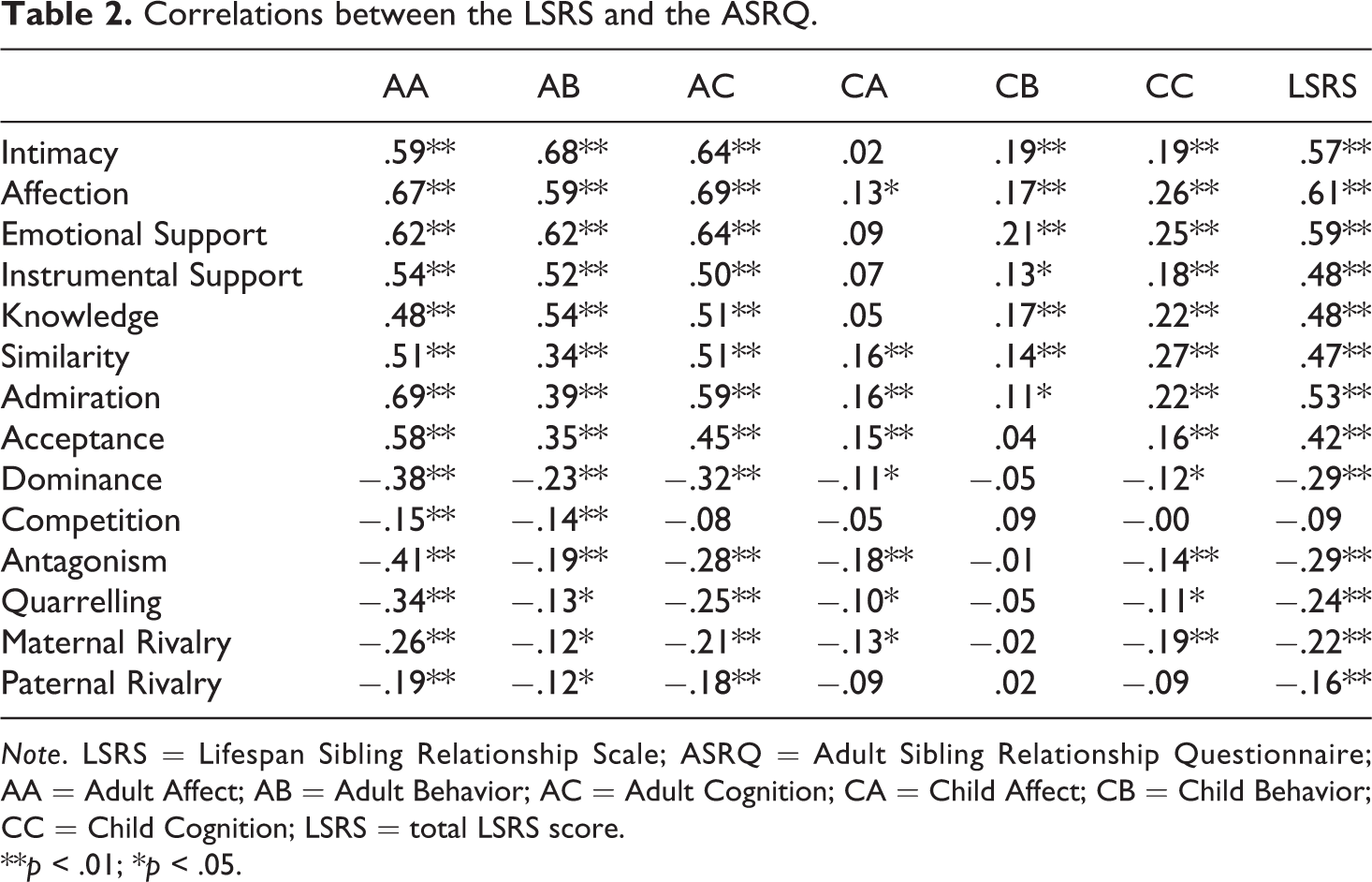
Note. LSRS = Lifespan Sibling Relationship Scale; ASRQ = Adult Sibling Relationship Questionnaire; AA = Adult Affect; AB = Adult Behavior; AC = Adult Cognition; CA = Child Affect; CB = Child Behavior; CC = Child Cognition; LSRS = total LSRS score.
**p < .01; *p < .05.
Results indicate that all ASRQ subscales comprising the Warmth factor were significantly positively correlated with the majority of LSRS subscales and LSRS total scores. In particular, Intimacy, Emotional Support, Instrumental Support, and Knowledge were unrelated to CA (rs = .03, .09, .08, and .05), while Acceptance was unrelated to CB (r = .04), indicating that these dimensions do not influence affective and behavioral attitudes toward sibling relationships in childhood. ASRQ subscales composing the Conflict factor were related to LSRS subscales and total scores in different ways. First, competition scores were only significantly negatively correlated with AA (r = −.15, p < .01) and AB (r = −.14, p < .01). Second, Conflict subscales were unrelated to CB (rs = −.05, .09, −.01, and −.05), indicating that these dimensions do not influence behavioral attitudes toward sibling relationships in childhood. ASRQ subscales composing the Rivalry factor were significantly negatively correlated with the LSRS total score (Maternal Rivalry r = −.22, p < .01; Paternal Rivalry r = −.16, p < .01), while they were differently related to LSRS subscales. In particular, Maternal Rivalry was unrelated to CB (r = −.02), while Paternal Rivalry was unrelated to affective, behavioral, and cognitive (rs = −.09, .03, and −.09) attitudes toward the sibling relationship in childhood.
These findings partially support H3 regarding the role of parental favoritism in moderating the quality of sibling relationships. They appear to indicate that the perception of maternal partiality does not influence the time the siblings spent together in childhood and that the perception of paternal partiality does not influence overall attitudes toward the sibling relationship in childhood. On the contrary, the results indicate that the perception of current maternal and paternal partiality is related to general negative attitudes toward sibling relationships.
Descriptive statistics and groups’ differences
Means, standard deviations, skewness, and kurtosis are presented in Table 3. The mean for the total LSRS score was 163.4 (SD = 26.5), with a range of 104 (high of 238, low of 83), suggesting, like in Riggio’s (2000) original study, that the LSRS is sensitive to wide variations in attitudes toward the adult sibling relationship. Furthermore, kurtosis and skewness, calculated to verify the answers’ variability, have acceptable values, as they are between −1 and 1.
Descriptive statistics for the LSRS.
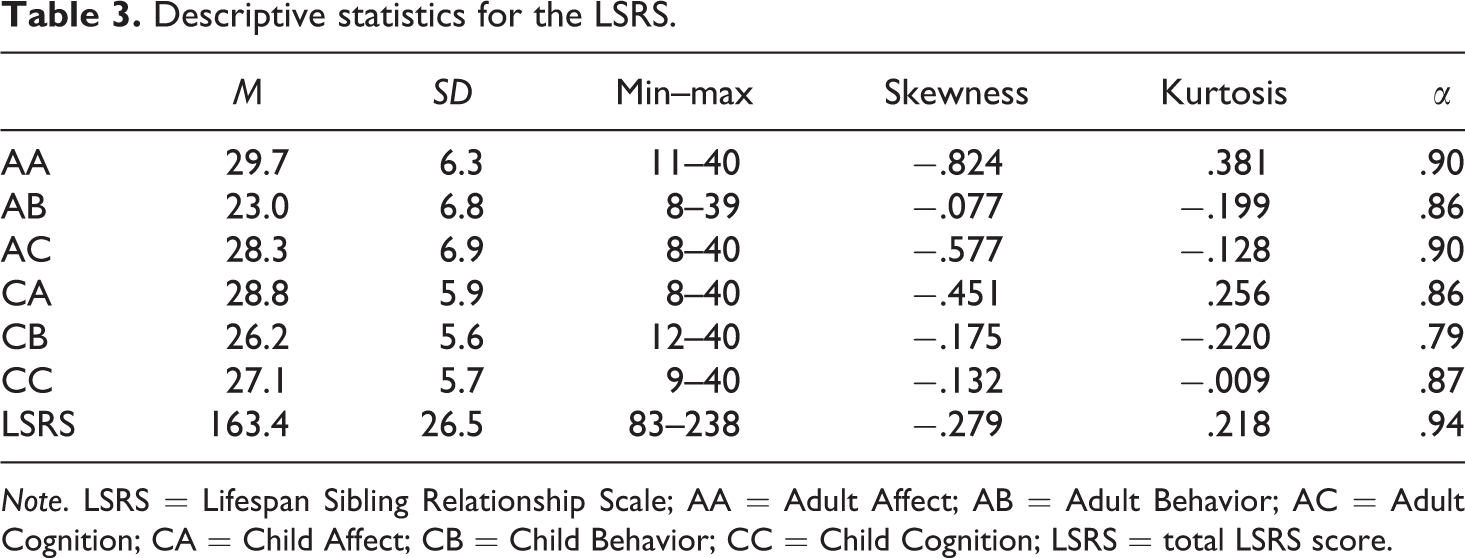
Note. LSRS = Lifespan Sibling Relationship Scale; AA = Adult Affect; AB = Adult Behavior; AC = Adult Cognition; CA = Child Affect; CB = Child Behavior; CC = Child Cognition; LSRS = total LSRS score.
Through two-way ANOVA, it was possible to verify both the direct effects of the participants’ sex and the chosen siblings’ sex as well as their interactions. The main effect of participants’ sex indicated that female participants reported significantly higher scores than male participants on the total LSRS score, MF = 165.5 versus MM = 158.7; F(1, 349) = 5.868, p < .05, and in particular with respect to AA, MF = 30.2 versus MM = 28.8; F(1, 349) = 3.991, p < .05; AB, MF = 23.8 versus MM = 21.2; F(1, 349) = 12.701, p < .001; AC, MF = 28.9 versus MM = 26.9; F(1, 349) = 7.744, p < .05; and CB, MF = 26.6 versus MM = 25.2; F(1, 349) = 5.014, p < .05. In addition, the chosen siblings’ sex also indicated that participants reporting their relationship with a sister showed higher scores than participants reporting on brothers, in the total LSRS score, MS = 166.0 versus MB = 160.2; F(1, 349) = 4.31, p < .05, in particular with respect to CB, MS = 26.8 versus MB = 25.4; F(1, 349) = 5.102, p < .05; and CC, MS = 27.7 versus MB = 26.5; F(1, 349) = 4.115, p < .05. The interaction between participant sex and sibling sex was only significant with respect to AC ( F(1, 349) = 5.147, p < .05): female participants reported higher scores than male participants when referring to brothers (brothers: MM = 25.2 vs. MF = 29.2; sisters: MM = 28.3 vs. MF = 28.7).
These findings completely support H2, indicating that women show a more positive overall attitude toward sibling relationships, especially when reporting their relationship with sisters. No differences regarding the number of siblings were found in participants’ responses to LSRS subscales and total scores.
As in Riggio’s (2000) study, which explored LSRSs ability to measure attitudes toward sibling relationships across the life span, participants were divided into groups: ages 17–23 (N = 202) and ages 24–30 (N = 148). No differences regarding age were found in participants’ responses to LSRS subscales and total scores.
Regarding birth order, ANOVA and Tukey tests showed significant differences. Indeed, the third born (or more) participants reported significantly higher scores than first or second born on AB, F(1, 349) = 3.02, p < .05; MI = 22.7, MII = 22.6, and MIII = 25.0; CA, F(1, 349) = 5.58, p < .01; MI = 28.8, MII = 28.0, and MIII = 31.1; and the LSRS total score, F(1, 349) = 3.51, p < .05; MI = 161.9, MII = 161.5, and MIII = 171.8. This result indicates that younger siblings report a more positive overall attitude toward their brothers or sisters and more generally toward sibling relationships.
This finding also completely supports H4, indicating that older siblings show a more negative overall attitude toward sibling relationships than younger siblings. No differences regarding age difference between siblings were found in participants’ responses to LSRS subscales and total scores.
Discussion
CFA has been carried out to find evidence of the construct validity of the Italian LSRS. The model-data fit index showed good levels, indicating a replication of the coherent six-factor structure of the original study by Riggio (2000) and of other adaptation studies (Jeong et al., 2013; Öz, 2015; Öz Soysal et al., 2016). Also, the internal consistencies of the six subscales and of the total LSRS showed high values. According to Riggio (2000), the lack of differences in LSRS scores between younger and older participants supports the capability of the scale to assess general attitudes toward sibling relationships across the life span.
Previous research examining the influence of sibling pairs’ composition generally indicates that same-sex siblings are more conflicting and less close than opposite-sex pairs (e.g., Cicirelli, 1985; Ross & Milgram, 1982; White & Riedmann, 1992), especially in childhood, as well as that sister pairs report higher levels of intimacy and warmth than brother pairs (e.g., Buhrmester & Furman, 1990; Dunn et al., 1994; Lee et al., 1990; Milevsky et al., 2005; Scharf et al., 2005; Spitze & Trent, 2006; Walęcka-Matyja, 2015b, 2016). Our findings, according to previous validation studies (Jeong et al., 2013; Öz, 2015; Öz Soysal et al., 2016; Riggio, 2000), indicate that women reported significantly more positive adult emotions and beliefs toward siblings, more positive behavioral interactions with child siblings, and more positive overall attitudes toward siblings. In addition, participants reporting on their relationship with sisters showed significantly more positive behavioral interactions and beliefs about the child sibling and more positive overall attitudes toward the sibling relationships than participants reporting on brothers. This reported interaction, characterized as generally more positive with child siblings, seems to be in contrast with previous findings (e.g., Stocker et al., 1997), which indicate a more conflictual interaction between siblings during childhood. But this finding could be interpreted in terms of a physiological decreasing of contact and proximity between siblings during the transition to adulthood (e.g., Conger & Little, 2010; White, 2001), with a parallel decrease of conflictual interactions. Moreover, as indicated by previous studies (e.g., Finzi-Dottan & Cohen, 2011; Riggio, 2006; Stewart et al., 1998), our findings are consistent with the hypothesis that older siblings show a more negative overall attitude toward their brother or sisters and, more generally, toward sibling relationships than younger siblings. Contrary to our expectations, siblings’ number, siblings’ age, and age differences between siblings did not affect attitudes toward sibling relationships in our sample of young adults.
The results also support the instrument’s construct validity by offering evidence of convergent validity. Indeed, scores on the six subscales and on the total LSRS correlated with almost all scores on the subscales and the total ASRQ, supporting the hypothesis that higher LSRS scores indicate a closer and more satisfying sibling relationship. Furthermore, the majority of LSRS scores were positively correlated with ASRQ scores on the subscales composing the Warmth factor. The majority of Conflict factor of ASRQ subscales was negatively correlated with the majority of LSRS scores, with the exception of the Competition subscale, which was negatively correlated only with AA and AB. This result can be interpreted as a difficulty in measuring conflict between siblings with self-report instruments (e.g., Riggio, 2000; Stocker et al., 1997). The Rivalry factor was negatively correlated with the majority of LSRS scores. This result contrasts with Riggio’s (2000) findings, indicating that Paternal Rivalry scores were unrelated to LSRS scores and that Maternal Rivalry scores were unrelated only to AA and AC. This difference indicates that, in our sample, composed of university students, the perception of current rivalry is strongly related to overall attitudes toward the sibling relationship in adulthood, while only Maternal Rivalry also influences emotions and beliefs about the childhood sibling relationship. We can hypothesize that, unlike Paternal Rivalry, which is completely unrelated to perceptions of the childhood sibling relationship, maternal partiality may play a major role in childhood, influencing emotions, beliefs, and attitudes toward the sibling relationship across the span of childhood (e.g., Brody et al., 1987; Riggio, 2000; Stocker et al., 1989).
More generally, our results indicate that high levels of rivalry between siblings, other than involving negative feelings such as anger and jealousy, negatively affect the positivity of attitudes toward siblings (e.g., Newman, 1994; Riggio, 2000). In contrast with previous findings, indicating that adult sibling relationships seem to be less affected by rivalry dynamics than child or adolescent ones (e.g., Riggio, 2000; Scharf et al., 2005; Stocker et al., 1997), our data indicate that perception of parental favoritism may continue playing a role in influencing siblings’ relationship across the life span (e.g., Finzi-Dottan & Cohen, 2011; Rauer & Volling, 2007; Tani et al., 2013).
Strengths and limitations
The principal strength of the study was to provide a useful contribution for the adaptation and validation to the Italian context of a new self-report instrument that assesses the quality of sibling relationships in early adulthood. In particular, this is an instrument that is able to assess affective, behavioral, and cognitive dimensions of child and adult sibling ties and, in this way, permits an understanding of the transition from childhood and adolescence to emerging adulthood.
The first general limitation of the study is related to sampling. Our sample only included university students, and future investigations might try to replicate findings with other Italian emerging adults, such as those who are working. Moreover, community-based sampling implies possible specific biases, for example, volunteers’ bias (related to special characteristics of individuals who voluntarily participate in a study). Another possible bias in the study is the mono-method one, related to the fact that, having assessed all variables of the study using self-report instruments, there would be an inflation in observed association. Moreover, the use of a self-report instrument that is also retrospective (the LSRS) may have produced personal biases and faulty memories. To this end, future investigations could integrate quantitative data with qualitative data, such as clinical interviews, in order to deepen different aspects of the adult siblings’ relationship.
Since our sample only includes university students aged 19–30 years, future investigations could address older sibling samples (e.g., middle ages and older adults) in order to deepen the underlined importance of life span changes in sibling relationships. Finally, future research could be addressed to sibling dyads, also utilizing dyadic analyses (e.g., Kenny, Kashy, & Cook, 2006), in order to deepen the understanding of the interactional nature of sibling relationships.
Conclusions
As stated in the international literature, sibling relationships are the long-lasting relationships in an individual’s life, showing the importance of taking into account this relationship in developmental terms and of analyzing its evolution across the life span. In this sense, the LSRS is a useful self-report instrument for prospectively studying young adults’ and adults’ sibling relationships, based on experiences with the siblings over the life span. As Arnett (2004) suggests, 18–25 years of age is the time when individuals are confronted with adulthood tasks such as taking responsibility for oneself, making independent decisions, and establishing economic independence. Moreover, Cote (2006) suggests extending the transition to adulthood until 30 years of age. Indeed, this is the time when individuals pursue higher levels of education, experiment with different kinds of jobs, and delay long-term commitments such as marriage and childbearing.
In contrast with previous findings, our study indicates that perception of parental favoritism, especially maternal favoritism, may play a role in influencing siblings’ relationship across the life span.
Moreover, the present adaptation and validation study suggests that the Italian LSRS has good psychometric properties, suggesting its ability to assess sibling relationships in the Italian cultural context. The Italian LSRS is expected to be a useful self-report measure in future Italian studies. Among other possibilities, these could include studies examining the relation between the quality perception of sibling relationships and the individual (age, sex, birth order, and psychological variables) as well as family characteristics (i.e., parental status, parenthood styles, number of children, etc.) and studies examining the sibling relationships of the brothers/sisters of disabled or chronically ill siblings, in addition to studies examining the relation between sibling relationships and their psychosocial outcomes.
Footnotes
Acknowledgments
The authors are especially grateful to all the siblings who contributed to this project, ensuring the quality of the participants.
Author contributions
All authors participated in the research and preparation of the manuscript in the same way.
Funding
The author(s) disclosed receipt of the following financial support for the research, authorship, and/or publication of this article: This work was financially supported by the Department of Humanities, University of Naples “Federico II” for the research and publication of this article.