



Abstract
This study distinguishes perceptions of, preferences for, and outcomes related to people’s social ties online. It expands understanding of when and why using social network sites (SNSs) provides people with several types of supportive communication by integrating users’ social capital and preference for weak tie support. Prior research is synthesized and extended to build a heuristic model of social ties and supportive communication in SNSs that considers network-based variables (i.e., social capital, preference for weak ties) as mechanisms that link the use of SNSs to the supportive messages people receive. A community sample (N = 553) completed an online questionnaire. Results indicated that intensity of Facebook use corresponds with both social capital and received support. Moreover, social capital mediates and preference for weak ties moderates the relationship between using Facebook and receiving support, and results differ according to the types of social capital and support under consideration. Facebook use, for example, only corresponds with receiving informational and esteem support when users exhibit sufficient preferences for weak tie support.
Keywords
People who receive supportive messages experience psychosocial benefits, including improved affect, positive reappraisal, and enhanced perceptions of their stressors (MacGeorge, Feng, & Burleson, 2011). By using online networks, including social network sites (SNSs), people access various types of support, including advice, emotional comfort, esteem boosts, and strengthened networks, all of which can facilitate coping (Oh, Lauckner, Boehmer, Fewins-Bliss, & Li, 2013). Although studies confirm that people receive support from SNSs, less research considers how and why using SNSs corresponds with receiving different types of support. The best understanding of the outcomes (i.e., receiving support) from using SNSs might be produced by considering people’s perceptions of and preferences for their online networks. People who perceive that certain resources might be available through their online networks and who prefer to interact with the weaker ties that can comprise these networks might receive different supportive messages than other users. Given that qualities of social networks determine the resources people access (de Jong Gierveld, 1998), we incorporate social capital and preference for weak tie support to explain the association between using SNSs and receiving support.
Although it has multiple definitions (Coleman, 1988; Lin, 1999; Wellman, Haase, Witte, & Hampton, 2001), we align with thinking that views social capital as a perception of the resources potentially available, if needed, within a network (Burt, 2010; Lin, 2001). Believing that resources might be available, however, does not guarantee that any specific resource or message is received when people need it (Sarason, Sarason, & Pierce, 1990; Uchino, Carlisle, Birmingham, & Vaughn, 2011). Whereas social capital measures people’s perceptions of potential resources, received support assesses the particular types of messages people encounter when coping with a problem. Although some research equates these concepts (Burke, Kraut, & Marlow, 2011; Meng, Martinez, Holmstrom, Chung, & Cox, 2016), differentiating social capital and received support allows researchers to better understand and predict how the resources that people believe might exist within their online networks translate to receiving particular types of supportive messages.
Users have preferences for the people with whom they interact online (Wright & Miller, 2010), including a preference for weak ties. A preference for weak ties reflects people’s affinity for communicating with relatively distant members of their network (Adelman, Parks, & Albrecht, 1987; Wright & Bell, 2003) and motivates them to engage in supportive interactions online (Wright & Miller, 2010). Social capital and a preference for weak tie support are similar in that each focuses on people’s social ties; however, the former is a perception of resources that might exist, whereas the latter is a proclivity for receiving support from relatively distant acquaintances. A preference for weak tie support benefits support receivers (Wright & Rains, 2013; Wright, Rains, & Banas, 2010), yet researchers have not tested why this preference produces positive outcomes. It might elicit beneficial outcomes by shaping users’ perceptions of social capital or the messages they receive when coping with a problem. Similar to social capital, however, a preference for interacting with certain ties does not guarantee that any specific resources are obtained. Integrating these variables can provide a more exact account of how and why users’ perceptions of and preferences for their online social networks influence outcomes from using SNSs in the form of the supportive messages they receive.
This study synthesizes, organizes, and differentiates scholarship on supportive communication in SNSs, social capital, and preference for weak tie support to propose a model of social ties and supportive communication in SNSs. It pushes research on online supportive communication forward by integrating variables that explain when and how people receive support from SNSs. By distinguishing perceptions, preferences, and outcomes related to users’ online networks, our model (see Figure 1) posits that using SNSs corresponds with outcomes (i.e., receiving support) based on people’s perceptions of the resources in their networks. The social capital people attribute to their online social ties and the supportive messages they receive from them might also vary depending on their preferences for weak tie support.
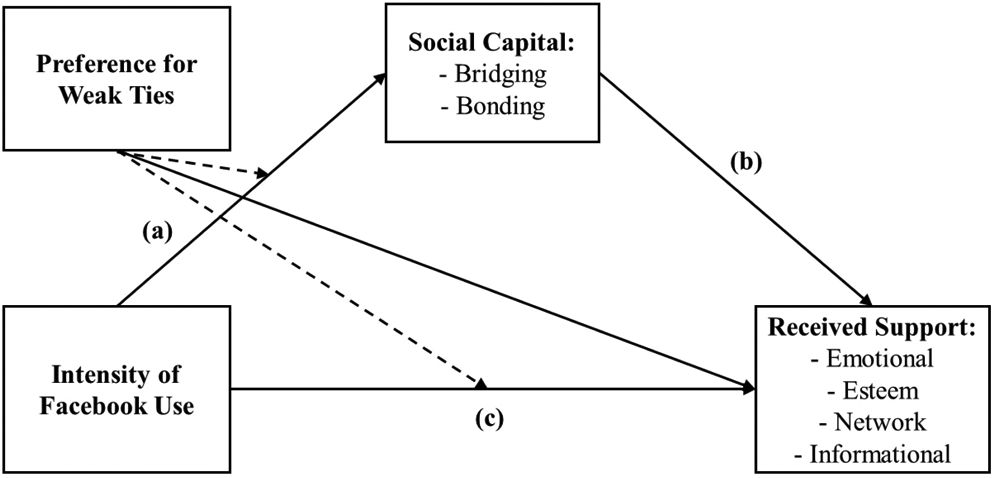
Model used to test the hypotheses. Dotted lines represent the moderating influence of preference for weak ties.
The goals for proposing this model are threefold. First, we seek to distinguish social capital from the supportive messages people receive. We clarify how these variables that are sometimes confounded in prior research (see Meng et al., 2016) are distinct by portraying supportive messages as the realization of the potential resources implied in perceptions of social capital. Second, we increase understanding of how Facebook elicits supportive messages by proposing that social capital mediates the association between using Facebook and the receipt of support. We test whether social capital benefits people in times of need by examining whether and how using Facebook corresponds with receiving distinct types of supportive messages based on specific types of social capital. Third, we extend a preference for weak tie support to SNSs and integrate it as a moderating variable because of its potential to alter people’s networks and the support they receive. A preference for weak ties shapes outcomes in online support groups (Wright & Miller, 2010), and we examine whether it influences social capital and received support. The supportive messages people receive when upset are determined by numerous factors (Burleson, 2009), and this study clarifies how users’ perceptions of and preferences for their online social networks correspond with receiving distinct types of supportive messages.
SNSs, supportive communication, and social capital
Two benefits of using SNSs are receiving supportive communication and increasing perceptions of social capital (Ellison & Vitak, 2015; Kim, Sohn, & Choi, 2011). Burleson and MacGeorge (2002) defined supportive communication as “verbal and nonverbal behavior produced with the intention of providing assistance to others perceived as needing that aid” (p. 374). Individuals can receive several types of support when coping with a stressor, and each type of support conveys different resources (Cutrona & Suhr, 1992). When people receive emotional support, they learn that they are loved and valued, or they are given the opportunity to vent their affect. Esteem support reminds recipients that they are worthwhile individuals, despite their problems. Communicating network support involves connecting others to helpful contacts or offering to spend time with them. People receive informational support when they gain advice, perspective, or opinion about how to remedy a problem. Tangible support is typically provided through actions involving practical aid, such as lending money or helping with chores. Although it is possible to coordinate tangible support in SNSs (Stefanone, Kwon, & Lackaff, 2012), this study focuses on emotional, esteem, network, and informational support because we are most interested in support that is conveyed via messages. Concentrating on the messages people receive from their online networks is valuable because different messages contain different content and help to determine recipients’ well-being and coping ability (MacGeorge et al., 2011). Using SNSs positively predicts the reception of multiple types of support, including informational, emotional, esteem, and network support (Meng et al., 2016; Oh et al., 2013). Previous research commonly examines a single type of support or a general perception of supportiveness in SNSs (Rozzell et al., 2014; Stefanone et al., 2012); however, given the variety of support available online, it is valuable to understand whether there are unique influences on different types of support.
Another benefit of using SNSs is enhancing social capital. Although it is an elastic term with a variety of definitions (Adler & Kwon, 2002), we embrace thinking that defines social capital as a perception of potential resources within a network, should someone need them (Beaudoin & Tao, 2007; Burt, 2010; Lin, 2001). Scholars often differentiate bonding from bridging social capital (Putnam, 2000). Bonding social capital references close or homogeneous social ties (Stefanone et al., 2012), and it is associated with dense networks, trust, and shared norms (Burt, 2001). Bridging social capital, in contrast, describes people’s access to distant social ties and resources (Putnam, 2000). Whereas bonding capital is associated with family, friends, and intimate contacts, bridging capital references diverse or distant ties (Granovetter, 1973). Bridging and bonding capital imply people can use their networks to access different resources, should they need them (Ellison, Vitak, Gray, & Lampe, 2014b).
Stefanone, Kwon, and Lackaff (2012) documented that using SNSs increases users’ social capital (see also Burke, Marlow, & Lento, 2010). People utilize SNSs to maintain both close and distant ties (Ellison, Steinfield, & Lampe, 2007); however, Facebook appears to be particularly effective at increasing bridging capital (Ellison et al., 2007; Ellison, Gray, Lampe, & Fiore, 2014a). Users report having numbers of friends far greater than the contacts they maintain face-to-face (Lampe, Gray, Fiore, & Ellison, 2014). Thus, SNSs are particularly effective at expanding diverse ties and bridging capital.
The research reviewed to this point documents that using SNSs promotes supportive communication and social capital. We replicate findings that document that using SNSs elicits support (see Oh et al., 2013); however, we expand prior research by considering a broad array of types of support that users can receive online. In addition, examining the association between Facebook use and social capital replicates research by Ellison and colleagues (Ellison et al., 2007; Ellison et al., 2014b). We desire to demonstrate the stability of those associations and use the hypotheses to help build the model we propose. The associations between using SNSs and both received support and social capital correspond with paths (c) and (a), respectively, in Figure 1 and are stated as follows:
Path (b) in Figure 1, which links social capital to received support, is more difficult to establish. Psychologists, sociologists, computer scientists, and scholars of communication have all explored connections among Facebook, supportive communication, and social capital (Burke & Kraut, 2013; Ellison et al., 2014a; High, Oeldorf-Hirsch, & Bellur, 2014; Oh et al., 2013). Although this research has produced interesting findings, Meng, Martinez, Holmstrom, Chung, and Cox (2016) reviewed this literature and concluded that the focal variables are often inadequately conceptualized; multiple types of support are rarely considered; and some of the central variables, including social capital and social support, are confounded. Focusing on differences between social capital and received support helps to unpack the association between these variables. Social capital is a perception of potential resources that might be available in a network (Burke & Kraut, 2013; Burt, 2010; Lampe et al., 2014; Lin, 2001), and receiving support is one outcome of using a network. Receiving supportive messages might be the realization of the resources that are perceived to be available from online social ties. A belief that resources are potentially available, however, might not translate to receiving supportive messages when coping with a problem. The messages people receive might also vary based on different types of social capital.
Differentiating social capital and received support helps to explain why social capital matters. Lin (2001) described social capital as “expected returns in the marketplace” (p. 19) and suggested that people can receive resources from the social capital they perceive in their network. Although research has considered how seeking support influences social capital and how social capital corresponds with beliefs that support might be available (Burke & Kraut, 2013; Ellison et al., 2014a; Krämer, Rösner, Eimler, Winter, & Neubaum, 2014), it often equates bonding capital with support, does not measure all types of capital or support, or measures support in terms of the number of people who might be willing to provide assistance, rather than the messages individuals receive. Beaudoin (2007) considered social support to be an outcome of social capital for residents of New Orleans after hurricane Katrina (see also Beaudoin & Tao, 2007, 2008). In addition, both bridging and bonding capital correspond with the number of responses people receive to requests for favors on Facebook (Jung, Gray, Lampe, & Ellison, 2013). Social capital and received support are not isomorphic, however, because people’s beliefs about potentially available resources and what transpires in an interaction do not always match (Sarason et al., 1990; Uchino et al., 2011). Little research has examined the supportive messages people receive based on their perceptions of social capital. Doing so differentiates these variables and tests whether social capital benefits users in times of need.
People intentionally construct their networks for the resources they might produce later (Bourdieu, 1986), and different types of capital might correlate with receiving distinct types of support. Networks that contain high levels of bridging capital are beneficial because they connect people to information or perspective that is not easily accessible face-to-face (Ellison & Vitak, 2015; Wright & Rains, 2013). Contact with relatively distant acquaintances is valuable because these sources provide novel information and diverse resources (Bakshy, Rosenn, Marlow, & Adamic, 2012; Granovetter, 1973). Thus, bridging capital is often associated with informational support, whereas bonding capital typically corresponds with emotional comfort. Bonding capital corresponds with close ties, trusting relationships, and emotional investment (Burt, 2001; Vitak & Ellison, 2013), and support providers who share a relational history often communicate the most sensitive support (Burleson, 2003). Along these lines, Wellman and Wortley (1990) noted that close friends, who increase bonding capital, are more likely to provide emotional aid than acquaintances. Although some research equates bonding capital with emotional support (Burke & Kraut, 2013), we differentiate these concepts to describe how social capital explains the messages people receive.
Besides informational and emotional support, researchers have identified network and esteem support within SNSs (Oh et al., 2013); however, little research connects social capital with either network or esteem support. To gain a better understanding of the relationship between social capital and all of the types of support people receive online, we propose the following hypothesis and research question, which are represented by path (b) in Figure 1:
Synthesizing research on SNSs, supportive communication, and social capital
We have suggested that using Facebook is associated with receiving support (H1) and perceiving social capital (H2). In addition, H3 and RQ1 asserted that social capital corresponds with receiving support, albeit in different ways for distinct types of support. We extend the associations among these variables by examining indirect effects between using Facebook and receiving support via users’ perceptions of social capital. Beaudoin and Tao (2007) asserted that social capital mediates the effect of media use on its outcomes. Extending that logic, we suggest that people receive support because SNSs enable them to maintain different forms of social capital. In other words, people experience outcomes from using SNSs based on their perceptions of the resources in those networks. The resources implied in perceptions of social capital are realized in the messages people receive. We consider the interplay among these variables in the following hypothesis and research question:
Preference for weak tie support and online supportive communication
Users of SNSs have different goals and preferences, and some individuals are quite intentional about their behaviors in these venues (Cheung, Chiu, & Lee, 2011). One preference that influences supportive communication is a preference for weak tie support. Granovetter (1973) differentiated strong ties, or people with whom individuals maintain intimate connections, from weak ties, or contacts who are not especially close but are encountered within certain contexts (Wright et al., 2010). The reasons underlying a preference for weak tie support are varied—an offline network might be lacking, weak ties might seem less biased, or close ties might seem threatening for certain stressors. We integrate this preference into our model to recognize people’s preferences for their networks and to extend a preference for weak ties beyond online support groups, where the previous research on this construct is situated. Users’ preference for weak tie support allows us to examine whether the associations between using Facebook and both social capital and received support exist across a variety of users.
A preference for weak tie support motivates individuals to take their supportive interactions online, where weak ties are more readily accessible (Rozzell et al., 2014; Wright & Miller, 2010). Weaker ties are often thought to be less judgmental, better able to relate to support seekers, and unbiased in their perspective. Research within online support groups documents that a preference for weak ties reduces stress and depression (Wright & Rains, 2013); however, little research considers why this preference influences outcomes. To better understand why a preference for weak tie support benefits coping, we test whether it affects users’ perceptions of social capital and the messages they receive.
People who prefer support from weak ties are expected to construct networks that contain bridging capital because both weak ties and bridging capital correspond with wide-ranging and diverse networks (Vitak, 2012). Along these lines, people’s preference for weak ties likely enhances the previously described positive association between using SNSs and bridging capital. A preference for weak ties has largely been researched in online support groups (Wright et al., 2010; Wright & Rains, 2013); however, it is incorporated in our model to better understand how users’ preferences for certain ties shape their perceptions of the resources that might exist within SNSs. Hence:
A preference for weak tie support might shape the supportive messages users receive. Weak ties are perhaps best suited to offer advice and feedback because they have different worldviews, diverse opinions, and access to novel information (Granovetter, 1973; Rozzell et al., 2014; Wright et al., 2010). We suggest that a preference for weak ties also increases the receipt of network support because if people who prefer weak ties fill their networks with diverse contacts, they should receive more referrals, new companions, and offers to spend time together than people who have less of a preference for weak ties. No research, however, has explored the association between a preference for weak tie support and the types of supportive messages people receive. Doing so increases scholars’ understanding of the mechanisms that produce certain types of assistance. Along these lines, we also expect a preference for weak tie support to amplify the association between using Facebook and receiving informational and network support because this preference should compel users to fill their networks with diverse sources of objective information. Conversely, weak ties are typically not sources of nurturant support; therefore, we posit that this preference dampens the association between using Facebook and receiving emotional and esteem support. We present a final set of hypotheses:
Method
Participants and procedure
A community sample (N = 553) including faculty, staff, and students recruited from the Listserv of a large Midwestern university participated in this study. To be eligible, participants had to be at least 18 years old and have posted on Facebook within the last month. Eligible participants, whose age ranged from 18 to 78 years (M = 32.77, SD = 12.43), completed an online questionnaire in May 2015. The majority of the sample was female (85.5%) and White (87.1%), but it also included people who self-identified as Asian (5.1%), multiracial (2.9%), Hispanic (2.0%), African American (1.4%), and other (1.5%). Unless otherwise noted, all variables were measured using 5-point Likert-type scales (1 = strongly disagree; 5 = strongly agree). We used Facebook as the context for our study because it is perhaps the most popular SNS and a common medium through which users receive support (Oh et al., 2013). Facebook has also been used in prior research examining supportive communication in SNSs (Meng et al., 2016).
Measures
Intensity of Facebook use
We used Ellison et al.’s (2007) intensity of Facebook use scale to capture individuals’ attitudes (e.g., “I am proud to tell people I’m on Facebook”) and behaviors related to Facebook. An example behavioral question used a 6-point scale (1 = less than 10 minutes; 2 = 10–30 minutes; 3 = 31–60 minutes; 4 = 1–2 hr; 5 = 2–3 hr; 6 = more than 3 hr) to assess, “In the past week, on average, approximately how many minutes per day did you spend on Facebook?” This scale provides a composite assessment of people’s use of Facebook and allows us to examine how common attitudes and behaviors correspond with people’s social capital and support (see Ellison et al., 2007). Items were standardized and averaged to create a composite variable (α = .84), where higher scores indicate higher levels of Facebook use.
Social capital on Facebook
We adapted Williams’ (2006) Internet Social Capital Scale (ISCS) to assess people’s perceptions of social capital. Participants responded to 10 items each for bonding (e.g., “The people I interact with on Facebook would put their reputation on the line for me”) and bridging (e.g., “Interacting with people on Facebook gives me new people to talk to”) social capital. We averaged the items to create composite measures of bonding (M = 3.02, SD = 0.76, α = .88) and bridging capital (M = 3.30, SD = 0.71, α = .88).
Preference for weak tie support
Wright and Miller’s (2010) 19-item scale was used to measure people’s preference for weak tie support. Following prior research (Wright & Miller, 2010), all items (e.g., “I find people who don’t know me very well see things more objectively than my family and close friends”) were combined to create a composite variable (M = 2.36, SD = 0.67, α = .90), where higher scores indicate greater preferences for weak tie support.
Received support
Items developed by Xu and Burleson (2001) were adapted to measure the amount of several types of support participants received on Facebook. We adapted the items to ensure that all behaviors were possible on Facebook (i.e., items referencing physical affection were removed). When completing these items, participants were instructed to think of the messages they received via Facebook when coping with a problem. Participants indicated how much they received emotional (e.g., “When I have a problem, my Facebook Friends express sorrow or regret for my situation or distress”), esteem (e.g., “When I am upset, my Facebook Friends assure me that I am a worthwhile person”), network (e.g., “When I have a problem, my Facebook Friends offer to connect me to people I can turn to for help”), and informational (e.g., “My Facebook Friends give me advice about what to do”) support from their friends on Facebook. Respondents used 5-point Likert-type scales (1 = don’t receive at all, 5 = receive a great deal) to answer each item. Composite variables measured the emotional (M = 2.88, SD = .91, α = .85), esteem (M = 2.89, SD = 0.91, α = .85), network (M = 2.69, SD = 0.92, α = .78), and informational (M = 2.46, SD = .96, α = .91) support people received via messages from Facebook friends. Higher scores indicate greater received support.
Results
Preliminary analyses
We began by conducting a confirmatory factor analysis (CFA) to verify that people’s perceptions of social capital and received support are unidimensional and distinct variables. Each item loaded on its respective type of capital or support, and the latent variables were allowed to correlate. After covarying three error variances, all within social capital, we found a model that fit the data adequately, χ2/df = 2.38, p < .01; CFI = 0.94; SRMR = 0.05; RMSEA = 0.05 (see Hu & Bentler, 1999). All of the error terms we covaried were based on wording (e.g., negatively worded statements) or shared content between particular items (e.g., a common focus on contacting new people). 1 We observed no substantial cross loading. Examining correlations among the variables revealed mostly positive and significant associations (see Table 1).
Correlations among variables in the model.

Note. **p < .01. ***p < .001.
Tests of hypotheses
All hypotheses were tested using PROCESS (Hayes, 2013), which provides unstandardized regression coefficients as estimates of direct effects. We employed 10,000 bootstrapped samples to generate estimates of the indirect effects, standard errors of these estimates, and 95% bias-corrected confidence intervals surrounding these effects, which served as estimates of statistical significance. We ran our analyses with each type of received support as a dependent variable. H1–H4 were tested using PROCESS Model 4, and the hypotheses involving a preference for weak tie support were examined using Model 8 (Hayes, 2013). Bonding and bridging capital were entered as parallel mediators between intensity of Facebook use and received support (see Figure 1).
Our first hypothesis predicted that intensity of Facebook use is positively associated with receiving support. In accordance with this hypothesis, we observed positive associations between intensity of Facebook use and receiving informational, emotional, esteem, and network support (see Table 2 for estimates of these direct effects).
Direct effects among variables in the model of social ties and supportive communication in social network sites.
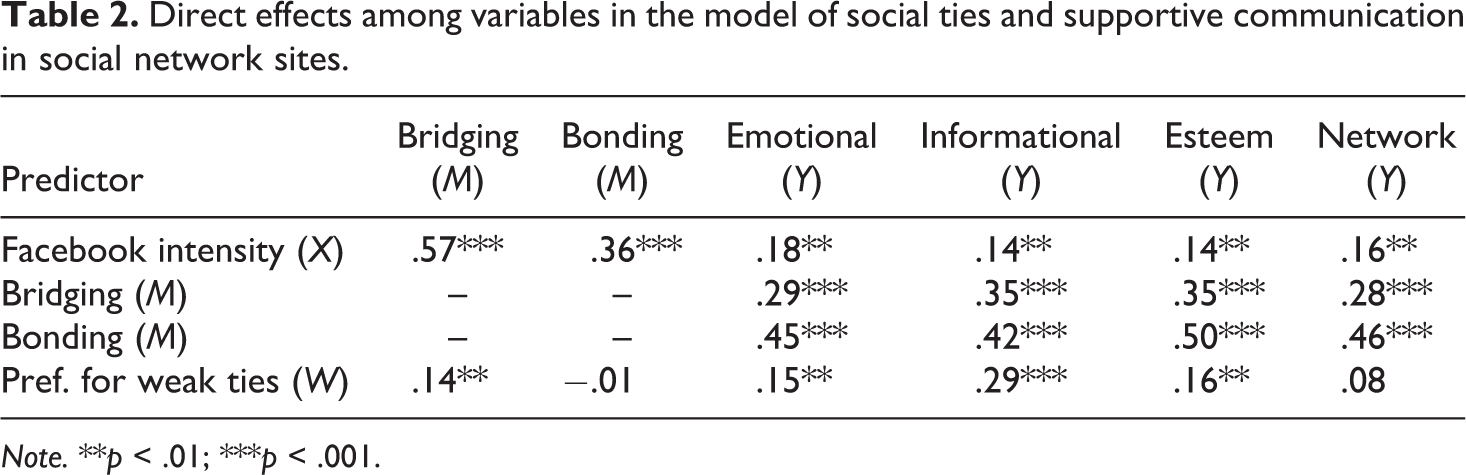
Note. **p < .01; ***p < .001.
Indirect effects between intensity of Facebook use (X) and received support (Y) through bridging (M) and bonding (M) capital.

Note. Indirect effects with different superscript letters in a column are significantly different.
H2 proposed that intensity of Facebook use has a stronger positive association with bridging than bonding capital. We first documented that intensity of Facebook use is positively associated with both bridging and bonding capital. A Fisher’s r-to-z transformation revealed that using Facebook shared a stronger association with bridging than bonding capital, z = 5.70, p < .001. These results support H2.
H3 asserted that whereas (a) receiving informational support is the most common type of support associated with bridging capital, (b) receiving emotional support is the most prevalent type of support associated with bonding capital. RQ1 then asked how perceptions of bridging and bonding capital correspond with receiving network and esteem support messages. Bridging and bonding capital were both positively associated with receiving informational, emotional, esteem, and network support. Follow-up tests indicated that bridging capital had a stronger association with receiving informational support than emotional (z = 4.57, p < .001) and network (z = 3.60, p < .001) but not esteem (z = 1.25, ns) support. In regard to H3b, bonding capital had a stronger association with receiving emotional support than informational (z = 2.47, p < .01) but not network support (z = −1.42, ns). In contrast to H3b, bonding capital produced a stronger association with esteem than emotional support (z = −1.66, p < .05). H3a was largely supported, but H3b only received partial support. We answer RQ1 by stating that bridging and bonding capital were positively associated with receiving network and esteem support (see Table 2).
H4 posited that (a) the indirect effect between Facebook use and informational support is stronger through bridging than through bonding capital and (b) the indirect effect between Facebook use and emotional support is stronger through bonding than through bridging capital. The indirect effect between intensity of Facebook use and receiving informational support was positive and statistically significant through both bridging and bonding capital. Pairwise comparisons indicated that this indirect effect was significantly stronger through bridging than through bonding capital (b difference = 0.10, 95% confidence interval [0.02, 0.19]), which lends support for H4a. Compared to bonding capital, bridging capital better explained why using Facebook elicited informational support. The indirect effect between intensity of Facebook use and receiving emotional support was also positive and significant through both bridging and bonding capital; however, the difference between the size of the indirect effects was not significant (b difference = .001, ns). There was no significant difference in how strongly bonding and bridging capital explained the relationship between Facebook use and receiving emotional support. H4b was not supported.
RQ2 questioned whether indirect effects exist between using Facebook and receiving network and esteem support messages because of users’ social capital. The indirect effects between intensity of Facebook use and receiving network support were significant via bonding and bridging capital. The strength of those indirect effects did not differ based on the type of capital (b difference = .005, ns). Likewise, the indirect effects between intensity of Facebook use and receiving esteem support were significant through both bridging and bonding capital. Again, however, the magnitude of these indirect effects did not differ (b difference = .05, ns). We answer RQ2 by stating that using Facebook corresponded with receiving network and esteem support because of the bridging and bonding capital users attributed to their networks. The strength of those indirect effects did not differ based on the type of social capital.
To address the remaining hypotheses (H5–H8), we created moderated mediation models in which preference for weak ties moderates the paths between intensity of Facebook use and both social capital and received support (see Figure 1). H5 asserted that a preference for weak tie support is positively associated with bridging capital. This preference was positively associated with bridging but not bonding social capital (see Table 2). The more participants articulated an affinity for getting support from weak ties, the more bridging capital they perceived in their networks. H5 was supported.
H6 proposed that a preference for weak tie support moderates the association between using Facebook and bridging capital. The proposed interaction was not significant (b = 0.04, ns); therefore, H6 was not supported.
H7 asserted that a preference for weak tie support translates to receiving higher levels of informational and network support compared to emotional or esteem support from Facebook friends. Our analyses revealed that a preference for weak ties was positively associated with receiving informational, emotional, and esteem but not network support (see Table 2). The more participants preferred to get support from weak ties, the more they received informational, emotional, and esteem support messages from their Facebook friends. Fisher’s transformations revealed that users’ preference for interacting with weak ties maintained a stronger association with receiving informational support than esteem (z = 2.49, p < .001), emotional (z = 2.85, p < .001), or network (z = 4.51, p < .001) support. Of all types of support, receiving informational support shared the strongest relationship with a preference for weak ties. In contrast to H7, the correspondence between a preference for weak ties and the amount of network support people received did not differ from the emotional (z = −1.19, ns) or esteem support they received (z = −1.48, ns). H7 was supported for informational support only.
H8 predicted an interaction between individuals’ intensity of Facebook use and their preference for weak ties, such that (a) the positive association between using Facebook and receiving informational and network support increases as people have greater preferences for weak ties and (b) the positive association between using Facebook and receiving emotional and esteem support increases as people report lower preferences for weak ties. This interaction was significant for informational support (b = 0.15, p < .05). Unpacking the interaction revealed that intensity of Facebook use was not associated with receiving informational support at low preferences for weak ties, but it was positively associated with receiving informational support when people reported average and high preferences for weak ties (see Table 4). In support of H8a, the effect of intensity of Facebook use on receiving informational support was amplified as people’s preference for weak ties increased.
Conditional direct effects of intensity of Facebook use (X) on received support (Y) at various levels of preference for weak ties (W).

Note. Markers of significance indicate whether an effect is significantly different from 0.
*p < .05; **p < .01.
The interaction between Facebook use and preference for weak tie support was not significant for network (b = 0.01, ns), emotional (b = −0.04, ns), or esteem (b = 0.03, ns) support; however, we conducted follow-up tests to examine whether the effects we specified a priori were significant. In contrast to H8a, intensity of Facebook use was significantly associated with receiving network support at low, average, and high preferences for weak tie support. Intensity of Facebook use was also positively associated with receiving emotional support at low, average, and high preferences for weak ties; however, consistent with H8b, the effect of using Facebook on receiving emotional support decreased as users’ preference for weak ties increased. Lastly, intensity of Facebook use was not significantly associated with receiving esteem support when people reported low preferences for weak ties, but it was positively associated with receiving esteem support at average and high preferences for weak ties. The results for esteem support counter the predictions of H8b (see Table 4 for estimates of these effects).
Discussion
This study synthesized prior research and proposed a model of social ties and supportive communication in SNSs (see Figure 1) to examine whether people’s SNS usage corresponds with receiving different types of supportive messages based on the social capital they attribute to their online networks. Because we recognize that some people are intentional about the way they construct their SNSs (Cheung et al., 2011), our model also integrated a preference for weak tie support as a moderating variable. Doing so allowed us to examine whether the associations we proposed held across different types of users. Our model involves a multifaceted depiction of users’ online networks, including their perceptions of the resources within them, their preferences for them, and an outcome they receive from using them. Although some findings replicate prior research, the replications are valuable both to confirm that the effects are robust and because this is perhaps the first study to test informational, emotional, esteem, and network support alongside both bridging and bonding capital. We articulated three goals at the outset of this article, and we discuss the implications of our results in accordance with each goal.
Implications
A first goal of this study was to distinguish received support from social capital. In particular, our model situates received support as an outcome of social capital. Differentiating these variables is valuable, given that people’s beliefs about resources that are available to them often do not translate to receiving supportive messages in an interaction (Sarason et al., 1990; Uchino et al., 2011). Most studies examine predictors of social capital (Burke & Kraut, 2013; Ellison et al., 2014b); however, we explained why social capital is valuable by describing how people’s perceptions of capital correspond with receiving different types of supportive messages. Although Stefanone et al. (2012) reported no association between social capital and support on Facebook, we observed significant associations between social capital and every type of support we measured. A notable difference between Stefanone et al.’s (2012) study and the current study is that they assessed tangible support, whereas we examined informational, emotional, esteem, and network support. Perhaps only types of support that are communicated via messages correspond with variations in social capital.
Previous research often concentrates on emotional and informational support, but we also included network and esteem support in our study because they represent valuable types of assistance that are conveyed on SNSs (Oh et al., 2013). Although both bridging and bonding capital were positively associated with each type of support we measured, we observed some variations that suggest networks that are perceived to entail certain types of social capital are more likely to produce certain types of support. Previous research sometimes equates bonding capital with emotional support; however, we actually observed a stronger association between bonding capital and esteem support than emotional comfort. Holmstrom and Burleson (2011) differentiated esteem and emotional support based on esteem support’s emphasis on improving people’s self-worth, despite their problems. Receiving “likes” and comments on SNSs increases users’ esteem (Newman, Lauterbach, Munson, Resnick, & Morris, 2011), and these outcomes might be common for people who perceive high levels of bonding capital on SNSs. Informational support is most often studied in online support groups (see Rains, Peterson, & Wright, 2015), but our results echo other studies that report that people receive informational support on Facebook (Oh et al., 2013), particularly if they perceive their networks to contain bridging capital. Bridging capital is not limited to informational support, however, because it was positively associated with every type of support we measured. Bridging capital was equally associated with receiving informational and esteem support and less so with the receipt of emotional and network support. Generally, though, bonding capital was a stronger predictor of receiving each type of support we measured.
A second goal of this study was to test a process of supportive communication in SNSs by proposing that social capital mediates the association between using SNSs and receiving support. Prior research rarely considers the pathway between SNS use and supportive responses, and we incorporated people’s perceptions of the resources in their online networks as an explanatory mechanism based on the connection between people’s perceptions of available resources and the messages they receive (MacGeorge et al., 2011; Sarason et al., 1990; Uchino et al., 2011). The support people receive is not fully explained by the intensity with which they use Facebook. It is also shaped by their perceptions of social capital. The indirect effect between Facebook use and receiving informational support messages was stronger through bridging than through bonding capital. That is, part of the reason using Facebook elicits informational support is because people fill their networks with bridging ties. The concept of “crowdsourcing” suggests that people utilize their SNSs to obtain advice, perspective, or opinion about various issues. Researchers also describe high levels of surveillance on SNSs (Fox, Warber, & Makstaller, 2013), and one prosocial function of that surveillance is that it provides opportunities for bridging ties to offer informational support.
Although bonding capital is often associated with emotional support (Burke & Kraut, 2013), there was no difference in the size of the indirect effect between using Facebook and receiving emotional support through bridging or bonding capital. Bridging and bonding capital were equally instrumental in explaining why people receive emotionally supportive messages from using Facebook, which suggests that both close and more diverse contacts provide emotional support. Similarly, using Facebook corresponded with receiving network and esteem support because of the bridging and bonding capital in people’s networks, and there was no difference in the size of those indirect effects.
Studying a range of types of support allowed us to examine whether and how using SNSs corresponds with the variety of support that is valuable to people coping with a problem (Xu & Burleson, 2001). Table 2 includes a ratio that describes the amount of the total effect between using Facebook and receiving supportive messages that is mediated by perceptions of social capital. This ratio estimates the amount of the association between using Facebook and receiving support that is explained by social capital, rather than what is due to Facebook use directly. Across all types of support, between 30% and 40% of the reason using Facebook corresponds with receiving support is based on the social capital people attribute to their networks. This ratio points to the importance of understanding process and the utility of including both social capital and received support in our model. Explaining the support people receive is not simply a matter of using Facebook. Rather, a substantial amount of the variance in the support people receive is explained by an indirect effect through social capital. Practically, these results suggest that if users can construct their networks to contain certain types of capital, those networks might provide different supportive messages when users experience stress.
The third goal of our study was to integrate people’s preference for weak tie support as a moderating variable and examine how this preference shapes supportive communication outside of online support groups. Despite a shared focus on people’s networks, research on social capital and preference for weak ties has remained independent. Our results documented that a preference for weak ties is associated with bridging but not bonding capital. People who prefer to interact with weak ties appear to perceive their networks accordingly, and this is one of the first studies to document that a preference for weak ties shapes people’s perceptions of the resources that are potentially available within their networks. Moreover, people who prefer weak ties received significantly more informational support than any other type of support. This preference helps to cultivate advice, opinions, and information from Facebook friends. The positive association between using Facebook and receiving informational support also increased as people’s preference for weak tie support increased. Gray, Ellison, Vitak, and Lampe (2013) noted that the answers people receive from Facebook friends are more useful when they come from weak than from strong ties, but this informational support might not materialize unless people prefer weak tie support. These findings help to explain why a preference for weak ties produces the beneficial outcomes with which it has been associated in previous research (Wright & Miller, 2010; Wright & Rains, 2013). Rather than simply being a preference for interaction partners, a preference for weak tie support is beneficial because it may shape the perceived resources in people’s networks and the supportive messages they receive. This preference corresponds with both perceptual and communicative resources from online social ties.
Network support is characterized by offers to spend time with someone and attempts to strengthen people’s social contacts, but surprisingly, a preference for weak ties did not increase the network support people received. Perhaps the behaviors that constitute network support violate relational norms or are too intimate for weak ties. A preference for weak ties also decreased the correspondence between using Facebook and receiving emotional support. Providers who share a relational history are best able to convey validating emotional comfort (Burleson, 2003), and although weak ties might have historical knowledge of a person, they lack contemporary insight. A participant in Vitak and Ellison’s (2013) study suggested that supportive messages from weak ties are effective because “you know somebody at least cares enough to respond” (p. 250). Caring enough to respond, however, might be best suited for informational or esteem support, rather than emotional or network comfort.
Future research can expand our model of social ties and supportive communication in SNSs by considering other factors that might shape the supportive messages people receive. For example, Facebook includes different channels, defined by public or private messaging options, and scholars suggest that people’s behavior and the outcomes they experience might differ across these channels (see Papacharissi, 2009). Researchers have also discussed ways that users can strategically enhance social capital on SNSs, such as by commenting directly on friends’ posts or tagging others in posts (Ellison et al., 2014a). It is also no longer a question of whether but how people use multiple channels to enact their social goals. The social capital people perceive and the supportive messages they receive from SNSs might vary based on their use of other channels. Future research can test the applicability of our model in other venues.
Limitations, future directions, and conclusion
Like any study, there are limitations to this study that might temper the generalizability of its findings. One limitation is the cross-sectional, self-report nature of the data. Participants indicated their use of Facebook and how much support they received; however, these self-reports might not match actual behavior. Although this is a possibility, prior research notes that self-report answers about Facebook mirror reality (Hampton, Goulet, Marlow, & Rainie, 2012). Furthermore, the support people believe they receive is often more influential than the messages that are actually communicated during an interaction (Cohen, Lakey, Tiell, & Neely, 2005). Our theorizing implies that people’s use of Facebook causes them to perceive differences in social capital, which, in turn, shape the support they receive. Although we documented the importance of social capital for explaining the association between using Facebook and receiving support, future research can confirm the causal sequence of these variables. These self-reports also produced a strong correlation between emotional and esteem support, which suggests that they might not be separate constructs. Esteem support is a particular type of emotional support; however, scholars recommend distinguishing these types of support because their messages convey different content, influence distinct emotions, and are relevant for different stressors (Holmstrom, Russell, & Clare, 2013). Our sample was predominantly female, which might bias the potential resources people perceive or the types of support they receive from their online networks. The stability of these findings can be demonstrated via replication using a sample that is more balanced in terms of participant sex.
The measure of Facebook intensity we used is a general measure, and some research has documented that specific behaviors (e.g., direct communication vs. broadcasting content) are uniquely associated with outcomes (Burke et al., 2011). Future research can examine how particular ways of seeking support on Facebook function within our model and predict the messages people receive. In addition, the ISCS we used in this study required that we covary some error terms, and despite its wide use, other scholars have reported measurement issues with this scale. Appel et al. (2014) questioned the validity of the ISCS because it did not align with indices of social capital based on people’s position in a network. This problem is complicated because different disciplines conceptualize social capital in distinct ways, and it is unclear how strongly people’s perceptions of resources potentially available in a network must correspond with their structural position within that network. Future researchers can clarify their definition of social capital at the outset of a research project and work to establish best practices for measuring social capital based on their conceptualization. We limited our study to the social capital and support people receive from their Facebook network; however, it is possible that some supportive responses occurred outside of Facebook (see Zhao, Lampe, & Ellison, 2016). Future research can work to understand how interactions that are initiated in SNSs extend to other channels.
Our model of social ties and supportive communication in SNSs expands scholars’ understanding of why using Facebook corresponds with receiving support. The model we proposed describes a process of how using Facebook elicits different types of supportive messages via the social capital in users’ networks. It also acknowledges that people’s preferences for their networks shape both the resources they perceive and the supportive messages they receive. Using SNSs corresponds with receiving supportive messages based on people’s perceptions of social capital and preferences for weak tie support. Informational support, for instance, was received from using SNSs when people perceived bridging capital and when they exhibited sufficient preferences for weak tie support. SNSs can provide a range of social resources, and our model organizes research on the benefits of SNSs and explains when and why using these venues translates to receiving supportive messages.
Footnotes
Authors’ note
A previous version of this study was presented at the 2016 conference of the National Communication Association in Philadelphia, Pennsylvania.
Funding
The author(s) received no financial support for the research, authorship, and/or publication of this article.