



Abstract
Individuals hold implicit beliefs about the nature of romantic relationships. Growth beliefs are characterized by thoughts that romantic relationships can be cultivated over time, whereas destiny beliefs are characterized by thoughts that relationships are either meant to be or not. In the current research, we propose that individuals who hold strong growth beliefs (but not destiny beliefs) should be more likely to experience self-expansion, as these individuals are oriented toward relationship cultivation. In turn, this increase in self-expansion should promote greater relationship quality and maintenance. Across three studies (two cross-sectional and one longitudinal) that sampled from varying populations and relationship types, we found evidence that self-expansion mediates the association between growth beliefs (but not destiny beliefs) and satisfaction, commitment, accommodation, and dissolution consideration. These data provide insights into the mechanisms by which implicit theories influence relationship functioning and establish implicit theories as an individual-level antecedent to the self-expansion experience.
People do not enter into relationships tabula rasa; rather, they possess a multitude of expectations, orientations, and beliefs that color the manner in which they experience relationship events (Mattingly, McIntyre, & Selterman, 2018). For example, individuals’ romantic relationships are affected by attachment orientations, such that childhood attachments with primary caregivers influence the relational scripts and expectations that individuals have in their adult relationships (Waters, Hamilton, & Weinfield, 2000). People also enter into relationships with implicit theories regarding the degree to which relationships are malleable. Much like people possess entity beliefs (i.e., beliefs that personal attributes are fixed and stable) or incremental beliefs (i.e., beliefs that personal attributes are malleable and can be developed) regarding the stability of intrapersonal attributes (Dweck, Chiu, & Hong, 1995), they too possess beliefs regarding the stability of romantic relationships. The current research examines why these implicit beliefs impact relationship quality and maintenance. In particular, we propose that certain implicit beliefs influence relationship functioning by increasing the likelihood that individuals experience changes to the self-concept as a result of their relationship.
Implicit theories of relationships
Individuals commonly possess implicit theories of relationships characterized by two distinct belief sets: growth beliefs and destiny beliefs (Knee, 1998; Knee, Nanayakkara, Vietor, Neighbors, & Patrick, 2001). Growth beliefs reflect the notion that relationships are malleable, develop gradually over time, and require regular maintenance. Independently, destiny beliefs capture the notion that relationships are relatively fixed—that they are either successful or unsuccessful from their start, and partners are inherently either compatible or incompatible. Moreover, individuals differ in how they interpret relationship conflict. People higher (relative to lower) in growth beliefs view relationship problems as challenges to overcome, whereas people higher (relative to lower) in destiny beliefs view relationship problems as diagnostic evidence that the relationship was not meant to be (Knee, Patrick, & Lonsbary, 2003). In support of these conceptualizations, Knee (1998) found that people higher (relative to lower) in growth beliefs are more likely to believe that their partners could change, are less likely to engage in one-night stands, and are more likely to allow a relationship time to flourish. Similarly, Knee et al. (2001) found that people generally become less satisfied with their relationships as the discrepancy between actual partner characteristics and ideal partner characteristics increases, whereas people higher in growth beliefs and lower in destiny beliefs are less affected by such discrepancies. Although both beliefs can result in successful relationships under certain circumstances (Burnette & Franiuk, 2010; Franiuk, Cohen, & Pomerantz, 2002; Franiuk, Shain, Bieritz, & Murray, 2012; Knee, 1998; Knee et al., 2001), there is a modest positive association between growth beliefs and relationship longevity (Franiuk et al., 2002).
An important distinction between growth and destiny beliefs concerns the functional role that these beliefs serve in orienting individuals toward different relational goals. Specifically, growth beliefs function to orient individuals toward relationship cultivation; independently, destiny beliefs function to provide an evaluative framework by which partners can assess whether their relationship is likely to survive. As such, each belief set orients individuals to unique relational goals aimed at relationship functioning. Whereas growth beliefs should sensitize people to opportunities to improve their relationships, and by extension the self, destiny beliefs should direct and sensitize individuals’ attention toward diagnostic criteria regarding relationship viability (Knee et al., 2003). Therefore, though both belief sets may lead to distinct relational benefits, one possible manner in which growth beliefs lead to relational and self-improvement that destiny beliefs likely do not is through the process of self-expansion.
Why might growth beliefs foster self-expansion?
The self-expansion model posits that individuals experience a cognitive reorganization of the self-concept as a result of the formation and maintenance of romantic relationships (Aron, Lewandowski, Mashek, & Aron, 2013; Mattingly et al., 2018; McIntyre, Mattingly, & Lewandowski, 2015). Such cognitive reorganization occurs when individuals increase the number of positive self-concept attributes they possess (Mattingly, Lewandowski, & McIntyre, 2014; McIntyre et al., 2015) as a result of incorporating aspects of their partners into the self, having their partners provide social support that facilitates the acquisition of new perspectives and identities, and completing novel and challenging activities with their partners (Aron et al., 2013; Aron, Norman, Aron, McKenna, & Heyman, 2000; Fivecoat, Tomlinson, Aron, & Caprariello, 2015). For example, as couple members become closer and begin to fall in love, they spontaneously use more plural pronouns (Agnew, Van Lange, Rusbult, & Langston, 1998) and report a larger and more diverse self-concept (Aron, Paris, & Aron, 1995), which is indicative of a cognitive merging of identities. Furthermore, individuals are able to capitalize upon opportunities for self-growth when their partners provide active social support (Fivecoat et al., 2015).
Beyond self-concept changes, self-expansion has myriad benefits for relational quality. Self-expanding relationships tend to be higher in satisfaction and commitment (Aron et al., 2000; Fivecoat et al., 2015; Mattingly et al., 2014; Reissman, Aron, & Bergen, 1993) and exhibit greater levels of both passionate and companionate love (Aron et al., 1995; Mattingly et al., 2014). Furthermore, individuals who experience self-expansion in their relationships are more likely to engage in relationship maintenance strategies, such as being more willing to make sacrifices, behaving with accommodation, forgiving partner transgressions, thinking less about relationship dissolution (McIntyre et al., 2015), paying less attention to attractive alternatives, and being less likely to engage in infidelity (VanderDrift, Lewandowski, & Agnew, 2011). Accordingly, when individuals include their partners into the self (which is a proxy for the self-expansion process; Mattingly & Lewandowski, 2014), relationships tend to persist longer than when partners are not included (Le, Dove, Agnew, Korn, & Mutso, 2010).
Less is known, however, about the origins of the self-expansion process. There is emerging evidence that self-expansion is rooted in a motivational state similar to the cultivation orientation from which growth beliefs derive. Much like how growth-oriented individuals seek ways to improve their relationships (Knee et al., 2003), individuals motivated to maximize relational rewards are more likely to value self-expansion (Mattingly, McIntyre, & Lewandowski, 2012) and capitalize upon self-expansion opportunities (Walker & Harasymchuk, 2017). Specifically, individuals oriented toward gains and improvements are sensitive to the self-expansion opportunities offered by the relationship, such that they are more attracted to individuals who provide ample opportunities for self-expansion (Mattingly et al., 2012) and plan relationship activities that are more self-expanding in nature (Walker & Harasymchuk, 2017). In contrast, individuals oriented toward minimizing losses and avoiding degradation are insensitive to self-expansion opportunities (Mattingly et al., 2012). More directly, growth beliefs are positively correlated with inclusion of other in the self (Knee, 1998), which is one mechanism by which self-expansion can occur (Aron et al., 2013; Mattingly & Lewandowski, 2014). Therefore, growth-oriented individuals are more likely to attend to and capitalize upon available self-expansion opportunities as a way of developing and improving the relationship, indicating that the self-expansion process may be preceded and facilitated by individuals’ implicit growth beliefs.
Moreover, given that growth beliefs create the groundwork from which people experience self-expansion, we posit that self-expansion is the more proximal reason for why individuals high (vs. low) in growth beliefs experience heightened relationship quality (Franiuk, Pomerantz, & Cohen, 2004; Franiuk et al., 2002; Knee, 1998). In particular, because growth beliefs are global beliefs about relationships that operate like an individual difference, we argue that these beliefs increase the likelihood that individuals will seek out self-expansion within specific given relationships (Mattingly et al., 2018). Furthermore, this increased likelihood of self-expansion strengthens the relationship (e.g., Aron et al., 2000) and increases the likelihood that individuals exhibit relationship maintenance cognitions and behaviors (e.g., McIntyre et al., 2015).
Why might destiny beliefs operate differently?
Unlike growth beliefs, which are intrinsic and process driven with the goal of improving a relationship, destiny beliefs are extrinsic and outcome driven with the goal of diagnosing relationship viability (Knee et al., 2003). That is, because individuals high in destiny beliefs view relationships as either compatible or not, they tend to evaluate relationship events to determine whether the relationship should persist. Notably, these individuals view relationship functioning as relatively uncontrollable. However, to the extent that individuals with strong destiny beliefs view their partners as soul mates, they tend to engage in relationship-enhancing cognitive and behavioral patterns, such as holding positive illusions about their partners (Franiuk et al., 2004) and displaying greater forgiveness of transgressions (Burnette & Franiuk, 2010). Thus, the manner in which destiny beliefs enhance and maintain relational functioning is through a process of biased processing and affect regulation that occurs when there is perceived fit between the partner and one’s ideal (Burnette & Franiuk, 2010). In turn, individuals with strong destiny beliefs likely do not actively seek self-expansion opportunities as the fundamental nature of self-expansion is relatively incongruent with this process of biased processing. This is not to suggest that those high in destiny beliefs avoid self-expansion opportunities or are presented with fewer opportunities for self-expansion; in fact, we argue that self-expansion may occur in any relationship. Rather, we posit that those high in destiny beliefs are not seeking self-expansion; thus, when self-expansion does occur, it is likely due to other reasons (e.g., the partner may be seeking expansion opportunities that the individual facilitates, environmental factors create self-expansion opportunities for the couple).
Current research
In the current research, we propose that individuals who hold strong (vs. weak) growth beliefs should be more likely to experience self-expansion, as these individuals are oriented toward relationship cultivation. Moreover, because self-expansion improves relationship quality (Aron et al., 2000; Fivecoat et al., 2015; Mattingly et al., 2014) and promotes relationship maintenance strategies (McIntyre et al., 2015; VanderDrift et al., 2011), we predict that self-expansion will mediate the association between growth beliefs and relational outcomes. Conversely, because destiny beliefs orient individuals toward evaluation rather than relationship cultivation, destiny beliefs should be unrelated to self-expansion. To the degree that destiny beliefs are associated with relational outcomes, we do not expect self-expansion to mediate these associations.
Across three studies, we tested two central predictions (see Figure 1). First, we predicted that growth beliefs would be positively associated with self-expansion, whereas destiny beliefs would not (Hypothesis 1). Second, we predicted that self-expansion would mediate the association between growth beliefs and satisfaction (Studies 1–3), commitment (Studies 1–3), accommodation (Study 3), and dissolution consideration (Study 3), but that self-expansion would not mediate any associations between destiny beliefs and relational outcomes (Hypothesis 2). In Studies 1 and 3, we assessed these predictions in cross-sectional samples of romantically involved adults. In Study 2, we assessed these predictions in a 9-month longitudinal study.
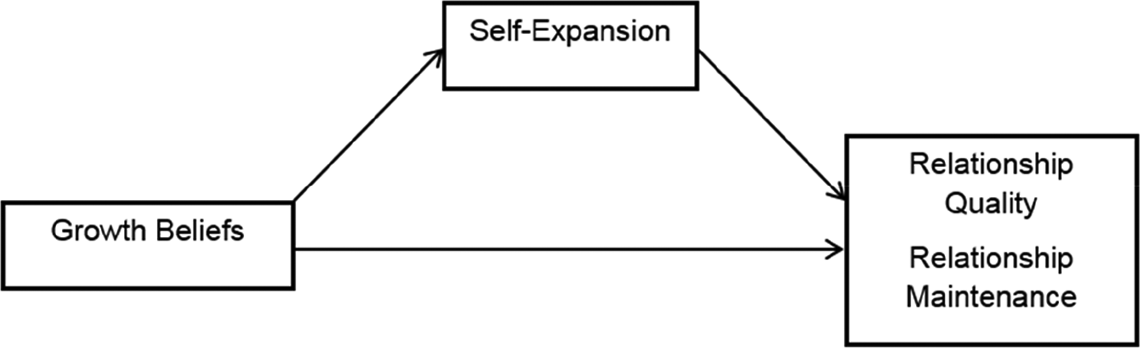
Hypothesized effect of growth beliefs on relational outcomes mediated by self-expansion.
Study 1
Method
Participants
Preliminary evidence suggests that the association between growth beliefs and self-expansion may be small (Knee, 1998). Accordingly, we conducted a power analysis using G*Power 3 (Faul, Erdfelder, Lang, & Buchner, 2007) in which we assumed an estimated effect size of r = .20, α = .05 (two-tailed), and power = .80. This resulted in a required sample size of N = 193. We chose to oversample to account for the possibility of failed attention checks as well as to ensure increased sensitivity. Thus, we aimed for a total sample of approximately N = 300, which would allow us to detect effects of r ≥ .16.
Three hundred twelve romantically involved participants (52.9% female, 47.1% male) were recruited from Amazon’s Mechanical Turk. Fourteen participants failed an attention check (described below) and were therefore excluded from the sample, resulting in a final sample of 298 participants (53.0% female, 47.0% male). Participants ranged in age from 18 to 67 (M = 33.51, SD = 10.78). Participants’ relationships ranged in length from 1 month to 43 years (M = 6.67 years, SD = 7.49), and the majority of participants were either dating their romantic partner (53.0%) or were engaged/married (44.6%; the remaining 2.3% reported their relationship status as “other,” such as long-term partnerships and consensually nonmonogamous relationships).
Measures
Self-expansion
Participants first completed the 14-item Self-Expansion Questionnaire (SEQ; Lewandowski & Aron, 2002). Sample items include “How much does being with your partner result in you having new experiences?” and “How much does your partner help to expand your sense of the kind of person you are?” All items were rated on a 7-point Likert-type scale (1 = not at all, 7 = very much), and the scale demonstrated good reliability in the current study (α = .94). 1
Implicit beliefs
Next, participants completed the 22-item Implicit Theories of Relationships (ITR) Scale (Knee et al., 2003). The ITR Scale consists of two 11-item subscales measuring growth and destiny beliefs. Sample items include “The ideal relationship grows over time” (growth beliefs) and “Relationships that do not start off well inevitably fail” (destiny beliefs). All items were rated on a 7-point Likert-type scale (1 = strongly disagree, 7 = strongly agree). Both subscales demonstrated good reliability: growth beliefs (α = .86) and destiny beliefs (α = .90).
Relationship quality
Participants also completed the 5-item satisfaction subscale and the 7-item commitment subscale of the Investment Model Scale (Rusbult, Martz, & Agnew, 1998). Sample items include “My relationship is close to ideal” (satisfaction) and “I am committed to maintaining my relationship with my partner” (commitment). All items were rated on a 9-point Likert-type scale (1 = do not agree at all, 9 = agree completely). Both subscales demonstrated good reliability: satisfaction (α = .94) and commitment (α = .89).
Attention check
Embedded within the ITR Scale was one item that served as an attention check. Specifically, participants were instructed to select a specific response to verify that they were paying attention (i.e., “Please select the option somewhat disagree”). Participants who selected the correct response were therefore retained in the sample.
Demographic information
Finally, participants provided information regarding their gender, age, ethnicity, and relationship status.
Results
Descriptive statistics
Means and standard deviations for the variables of interest were: growth beliefs (M = 5.21, SD = 0.81), destiny beliefs (M = 3.72, SD = 1.08), self-expansion (M = 5.19, SD = 1.05), satisfaction (M = 7.05, SD = 1.74), and commitment (M = 7.49, SD = 1.65).
Do growth beliefs predict self-expansion?
We first predicted that growth beliefs (but not destiny beliefs) would be associated with self-expansion. In support of Hypothesis 1, growth beliefs were significantly positively correlated with self-expansion (r = .35, p < .001), whereas destiny beliefs were not (r = .04, p = .49). Moreover, when examined simultaneously in a multiple regression, growth beliefs predicted self-expansion (β = .37, p < .001), whereas destiny beliefs did not (β = .09, p = .09).
We next wanted to confirm that self-expansion would be associated with satisfaction and commitment. Replicating previous research (e.g., McIntyre et al., 2015), self-expansion was significantly positively associated with both satisfaction (r = .70, p < .001) and commitment (r = .53, p < .001).
Does self-expansion mediate the association between ITRs and relationship quality?
We predicted that self-expansion would mediate the association between growth beliefs and relationship quality (i.e., satisfaction and commitment), but not for destiny beliefs. To examine this, we conducted a series of mediational analyses using multiple regression and Preacher and Hayes’ (2008) macro for SPSS (Version 24) (we used the same procedure for all tests of mediation across the three studies). First, we tested the relationship between ITRs and self-expansion (reported above). Next, we tested the association between ITRs and satisfaction (Model 1) and commitment (Model 2). We then added self-expansion to the models testing the association between ITRs and satisfaction and commitment, which allowed us to examine the mediating role of self-expansion. In all models, we tested the overall strength of the indirect effect by calculating a 95% confidence interval (CI) through bootstrapping with 5000 resamples. CIs that do not contain zero are indicative of mediation. Finally, because growth and destiny beliefs were significantly correlated (r = −.15, p = .01), we controlled for the other ITR in each analysis. See Table 1 for model summaries.
Indirect effects of growth and destiny beliefs on relationship outcomes, mediated by self-expansion.
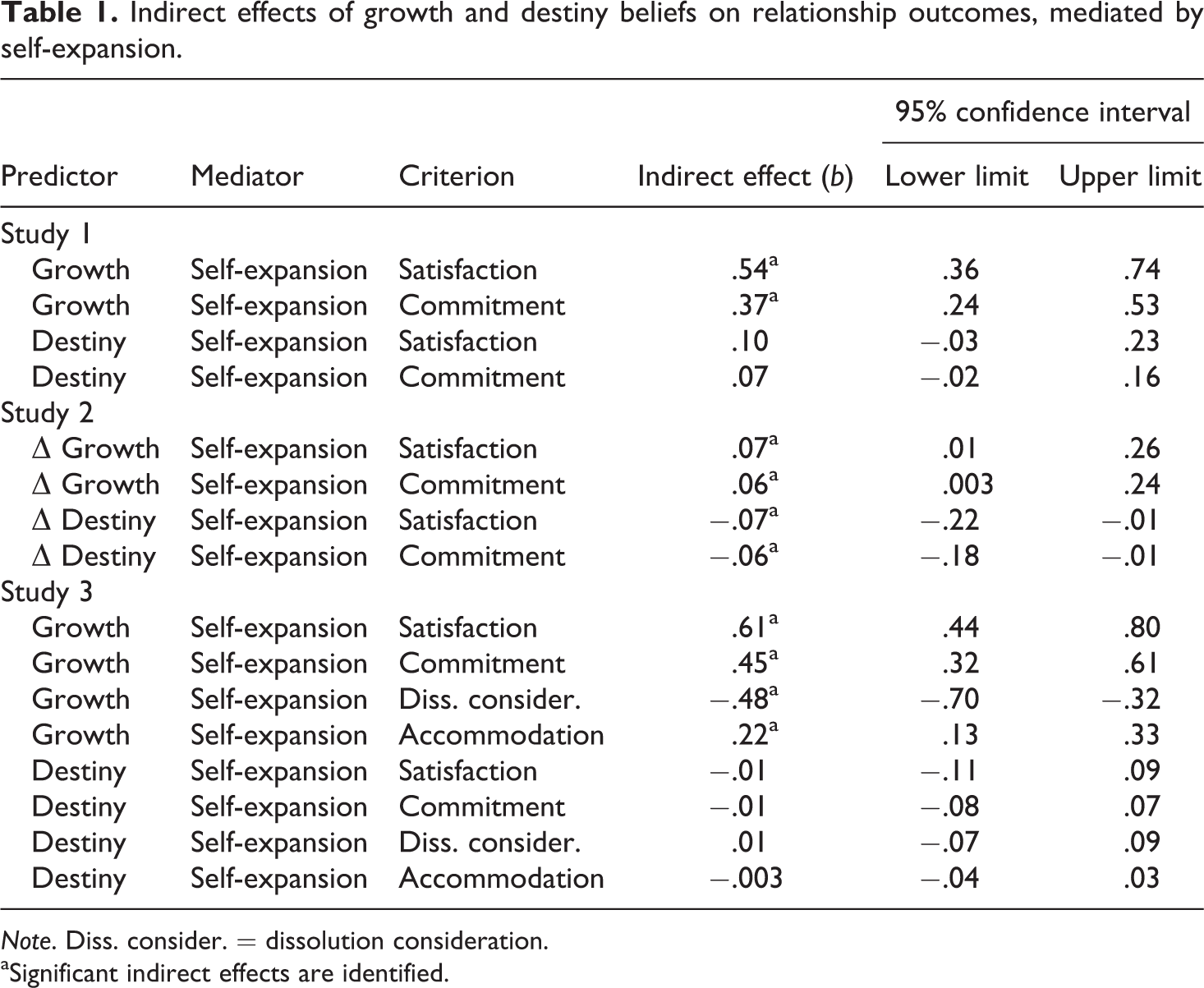
Note. Diss. consider. = dissolution consideration.
aSignificant indirect effects are identified.
In Model 1 (predicting satisfaction), growth beliefs predicted satisfaction (β = .30, p < .001), whereas destiny beliefs did not (β = .04, p = .51). When self-expansion was included in the model, growth beliefs no longer predicted satisfaction (β = .05, p = .28), whereas self-expansion was a significant predictor (β = .68, p < .001). In support of Hypothesis 2, bootstrapping revealed a significant indirect effect of growth beliefs on satisfaction, b = .54 (95% CI: .36, .74), indicating that self-expansion significantly mediates the association between growth beliefs and satisfaction. The indirect effect of destiny beliefs on satisfaction through self-expansion was not significant, b = .10 (95% CI: −.03, .23).
In Model 2 (predicting commitment), growth beliefs predicted commitment (β = .31, p < .001); unexpectedly, destiny beliefs also predicted commitment, in the opposite direction (β = −.12, p = .03). When self-expansion was included in the model (β = .49, p < .001), the association between growth beliefs and commitment was reduced in magnitude (β = .13, p = .01), and in support of Hypothesis 2, this indirect effect was significant, b = .37 (95% CI: .24, .53), indicating that self-expansion significantly mediates the association between growth beliefs and commitment. Interestingly, the association between destiny beliefs and commitment slightly increased in magnitude (β = −.16, p = .001), though this indirect effect was not significant, b = .07 (95% CI: −.02, .16), indicating that self-expansion neither mediates nor suppresses the association between destiny beliefs and commitment. 2 –4
Discussion
Study 1 provides the first empirical evidence that growth beliefs are positively associated with self-expansion, such that individuals who are more strongly oriented toward cultivating their relationship also tend to report greater relational self-expansion. The fact that destiny beliefs do not also predict self-expansion suggests that self-expansion may only align with the motivations of growth-oriented individuals. Moreover, self-expansion significantly mediates the association between growth beliefs and two metrics of relationship quality (i.e., satisfaction and commitment). This indicates that self-expansion is a process by which growth-oriented individuals experience heightened relationship quality.
Of course, one primary limitation of Study 1 is the cross-sectional nature of the design; thus, the temporal sequence of these associations remains unclear (though see the alternate models in Footnote 2). Therefore, in Study 2, we analyzed data from a longitudinal study of early-stage relationships to examine whether strengthened growth beliefs over a 9-month period predicted subsequent self-expansion, which in turn predicted relationship quality. Specifically, we predicted that an increase in growth beliefs (but not destiny beliefs) over the 9-month period would predict subsequent self-expansion, and that self-expansion would mediate the association between strengthened growth beliefs and relationship quality.
Study 2
Method
Participants
The data for Study 2 were drawn from the University of Texas Dating and Transition Experiences Study, a larger study designed to examine emerging adults’ experiences during the early phases of dating relationships. 5 Notably, these data existed prior to the conceptualization of the current research, and thus a corresponding a priori power analysis was not possible. However, the final sample (N = 119) permitted us to detect effects of r ≥ .25 (α = .05, two-tailed, and power = .80); given the size of effects in Study 1, and the repeated-measures nature of Study 2, this would suggest Study 2 was satisfactorily powered.
Participants were recruited over a 12-month period through advertisements (newspaper and online) and fliers posted around the greater Austin, Texas, US metropolitan area. Interested individuals completed an online screening questionnaire, and prospective participants were required to be over the age of 18, in good mental and physical health with no prior diagnosis of depression or an anxiety disorder, residents of Austin or the surrounding area for the duration of the study, and in a relationship of less than 6 months duration. Those who met these criteria were subsequently contacted and provided more details about the study. In total, 245 individuals (70 males, 175 females) were eligible, agreed to participate, and enrolled in the study; however, the current analyses include only those participants who provided information at both baseline and the final survey (9 months later) and whose relationships were intact at the final survey. This final sample included 119 participants (73.1% female, 26.9% male). Participants ranged in age from 18 to 25 (M = 20.55, SD = 1.82). At baseline, participants’ relationships ranged in length from less than 1 week to 6 months (M = 3.12 months, SD = 1.75).
Procedure and materials
After completing the prescreening questionnaire, eligible participants were provided with a link to the baseline (Time 1) questionnaire. Nine months later, participants were sent (again via weblink) a final questionnaire (Time 2). All measures reported below, with the exception of demographics, were completed at both Time 1 and 2.
Demographics
At the start of the study, individuals were asked to provide basic demographic information, including gender, age, ethnicity, and relationship status as well as additional information about their relationship histories.
Self-expansion
Participants completed a 6-item measure of self-expansion (i.e., a shortened version of the measure used in Study 1), adapted from Lewandowski and Aron’s (2002) SEQ. The phrase “my partner” was replaced with the partner’s actual name (e.g., “Being with [partner name] results in my having new experiences”). Respondents indicated their agreement with each statement on a 9-point scale (1 = strongly disagree, 9 = strongly agree). The scale demonstrated high reliability at both time points (Time 1, α = .91; Time 2, α = .95).
Implicit beliefs
Participants completed a shortened version of the ITR Scale (Knee et al., 2003). Specifically, participants completed six items total, three each assessing growth and destiny beliefs. All items were rated on a 9-point Likert-type scale (1 = strongly disagree, 9 = strongly agree). At both time points, the growth belief subscale demonstrated slightly low reliability (Time 1, α = .63; Time 2, α = .60), though the destiny beliefs subscale demonstrated good reliability (Time 1, α = .74; Time 2, α = .80).
Relationship quality
Participants also completed shortened measures of satisfaction and commitment from the Investment Model Scale (Rusbult et al., 1998). Specifically, one item assessed satisfaction (“Our relationship makes me very happy”) and two items assessed commitment (“I am committed to maintaining my relationship with [partner name]” and “I want our relationship to last for a very long time”). All items were rated on a 9-point Likert-type scale (1 = strongly disagree, 9 = strongly agree). Reliability could not be assessed for satisfaction due to the single-item measure. Commitment showed satisfactory reliability, as the two items were strongly positively correlated at both time points (Time 1, r = .77, p < .001; Time 2, r = .89, p < .001).
Results
Descriptive statistics
Means and standard deviations for the variables of interest were as follows: Time 1 growth beliefs (M = 7.33, SD = 1.30), Time 2 growth beliefs (M = 7.56, SD = 1.26), Time 1 destiny beliefs (M = 4.33, SD = 1.86), Time 2 destiny beliefs (M = 4.09, SD = 1.89), Time 1 self-expansion (M = 7.33, SD = 1.38), Time 2 self-expansion (M = 7.57, SD = 1.43), Time 1 satisfaction (M = 8.32, SD = 1.14), Time 2 satisfaction (M = 8.18, SD = 1.43), Time 1 commitment (M = 8.27, SD = 1.08), and Time 2 commitment (M = 8.24, SD = 1.46).
As in Study 1, growth and destiny beliefs were significantly correlated (Time 1, r = −.31, p = .001; Time 2, r = −.19, p = .04), and therefore we controlled for the other ITR in analyses.
Do growth beliefs predict self-expansion?
We predicted that change in growth beliefs (but not change in destiny beliefs) over the 9 months would predict change in self-expansion. To examine this, we first conducted a multiple regression in which change scores for growth and destiny beliefs (i.e., Time 2 − Time 1, such that higher values indicate greater endorsement over time) were entered as predictors and Time 2 self-expansion as the criterion, controlling for Time 1 self-expansion. Supporting Hypothesis 1, change in growth beliefs significantly predicted Time 2 self-expansion (β = .15, p = .03). Unexpectedly, change in destiny beliefs also predicted Time 2 self-expansion (β = −.16, p = .02), such that individuals higher in destiny beliefs experienced less relational self-expansion.
Does self-expansion mediate the association between ITRS and satisfaction?
We next predicted that self-expansion would mediate the association between change in growth beliefs (but not change in destiny beliefs) and Time 2 satisfaction. To assess this, we entered change scores for growth and destiny beliefs as the predictors, Time 2 self-expansion as the mediator (controlling for Time 1 self-expansion), and Time 2 satisfaction as the criterion (controlling for Time 1 satisfaction). As predicted, change in growth beliefs significantly predicted Time 2 satisfaction (β = .17, p = .047), whereas change in destiny beliefs did not (β = −.07, p = .40). When Time 2 self-expansion was entered into the model (β = .52, p < .001), the association between change in growth beliefs and Time 2 satisfaction dropped in magnitude (β = .09, p = .24), and, in support of Hypothesis 2, this indirect effect was significant, b = .07 (95% CI: .01, .26), indicating that Time 2 self-expansion significantly mediated the association between change in growth beliefs and Time 2 satisfaction. Even though the direct effect of destiny on Time 2 satisfaction was nonsignificant, we explored whether self-expansion mediated this association. Interestingly, the magnitude of the association between change in destiny beliefs and Time 2 satisfaction was slightly reduced (β = .01, p = .91), and this indirect effect was significant, b = −.07 (95% CI: −.22, −.01); however, because the direct effect of change in destiny beliefs on Time 2 satisfaction was nonsignificant, this mediation should be interpreted with caution. See Table 1 for model summaries. 6
Does self-expansion mediate the association between ITRs and commitment?
We next predicted that self-expansion would mediate the association between change in growth beliefs and Time 2 commitment. Utilizing the same analytic strategy as above, change in growth beliefs predicted Time 2 commitment (β = .17, p = .04), whereas change in destiny beliefs did not (β = −.07, p = .39). In support of Hypothesis 2, when Time 2 self-expansion was entered into the model (β = .47, p < .001), change in growth beliefs became nonsignificant (β = .11, p = .19), and this indirect effect was significant, b = .06 (95% CI: .003, .24), indicating that Time 2 self-expansion significantly mediated the association between change in growth beliefs and Time 2 commitment. The magnitude of the association between change in destiny beliefs and Time 2 commitment was slightly, yet significantly, reduced (β = .001, p = .99), b = −.06 (95% CI: −.18, −.01), though because the direct effect was nonsignificant this mediation should be interpreted with caution. See Table 1 for model summaries. 7 –9
Discussion
Replicating and extending Study 1, Study 2 provided longitudinal evidence that the strengthening of growth beliefs over time predicts subsequent self-expansion, which in turn predicts relationship quality. These data provide strong and compelling evidence that strong (vs. weak) growth beliefs are associated with experiencing greater self-expansion. Consequently, relationships high in self-expansion result in strengthened relationship quality, a finding previously supported both longitudinally and experimentally (Aron et al., 2000; Reissman et al., 1993). Although the results also provided evidence that self-expansion mediated the association between destiny beliefs and relationship quality, these results should be interpreted with caution. Specifically, the direct effects of destiny beliefs on both satisfaction and commitment (i.e., the criterion variables) were nonsignificant, suggesting that destiny beliefs do not predict subsequent relationship quality.
Studies 1 and 2 provide clear evidence that the heightened relationship quality experienced by individuals high (vs. low) in growth beliefs is due to self-expansion. Notably, there is emerging evidence that individuals who experience self-expansion within their relationships also tend to think and behave in ways to maintain these relationships (McIntyre et al., 2015; VanderDrift et al., 2011). Because individuals stand to suffer personal losses if a self-expanding relationship were to end (Lewandowski, Aron, Bassis, & Kunak, 2006; Slotter, Gardner, & Finkel, 2010), individuals are motivated to maintain self-expanding relationships. Thus, in Study 3, we examine whether individuals who are growth oriented also think and behave in ways that maintain their relationships, and whether these relationship maintenance attempts result from the self-expanding nature of the relationship. In Study 3, we focus on two forms of relationship maintenance: one cognitive mechanism (i.e., thinking less about relationship dissolution) and one behavioral (i.e., responding in an accommodating way to a partner’s negative behavior). As in Studies 1–2, we hypothesized that growth beliefs (but not destiny beliefs) would predict self-expansion, and that self-expansion would mediate the association between growth beliefs and relationship quality (i.e., satisfaction and commitment) and relationship maintenance processes (i.e., reduced dissolution consideration and greater accommodation).
Study 3
Method
Participants
As in Study 1, we assumed an estimated effect size of r = .20, α = .05 (two-tailed), and power = .80 (required sample size: N = 193). We again chose to oversample, given the small percentage of participants who failed attention checks in Study 1, and thus we aimed for a total sample of approximately N = 300.
Three hundred five romantically involved participants (45.6% female, 54.4% male) were recruited from Amazon’s Mechanical Turk. Twenty-one participants failed an attention check (described below) and were therefore excluded from the sample, resulting in a final sample of 284 participants (45.8% female, 54.2% male). Participants ranged in age from 18 to 75 (M = 33.55, SD = 9.97). Participants’ relationships ranged in length from 1 month to about 38 years (M = 6.24 years, SD = 6.55), and the majority of participants were either dating their romantic partner (51.8%) or were engaged/married (46.4%; the remaining 1.8% reported their relationship status as “other,” such as cohabiting or consensually nonmonogamous relationships).
Measures
Self-expansion, implicit beliefs, and relationship quality
As in Study 1, participants completed the 14-item SEQ (Lewandowski & Aron, 2002), the 22-item ITR Scale (Knee et al., 2003), and the satisfaction and commitment subscales of the Investment Model Scale (Rusbult et al., 1998). All scales demonstrated good reliability in the current study: SEQ (α = .93), growth beliefs (α = .85), destiny beliefs (α = .91), satisfaction (α = .94), and commitment (α = .90).
Dissolution consideration
Next, participants completed the 5-item Dissolution Consideration Scale (VanderDrift, Agnew, & Wilson, 2009). A sample item is “I have been close to telling my partner that I want to end our romantic relationship.” Items were rated on a 9-point Likert-type scale (1 = do not agree at all, 9 = agree completely) and the scale demonstrated good reliability (α = .96).
Accommodation
Participants then completed the 12-item Accommodation Scale (Rusbult, Verette, Whitney, Slovik, & Lipkus, 1991). A sample item is “When my partner is rude and inconsiderate with me, I talk to him/her about what’s going on.” Items were rated on a 9-point Likert-type scale (1 = I never do this, 9 = I constantly do this) and a composite score was computed by reverse scoring the six destructive response items and averaging with the six constructive response items (Etcheverry & Le, 2005). The scale demonstrated good reliability (α = .83).
Attention check
As in Study 1, one item embedded within the ITR scale served as an attention check.
Demographic information
Finally, participants provided information regarding their gender, age, ethnicity, and relationship status.
Results
Descriptive statistics
Means and standard deviations for the variables of interest were: growth beliefs (M = 5.18, SD = 0.80), destiny beliefs (M = 3.68, SD = 1.11), self-expansion (M = 5.17, SD = 0.99), satisfaction (M = 7.17, SD = 1.64), commitment (M = 6.93, SD = 1.57), dissolution consideration (M = 2.13, SD = 1.88), and accommodation (M = 5.21, SD = 1.22).
As in Studies 1 and 2, growth and destiny beliefs were significantly correlated (r = −.28, p < .001) and therefore we controlled for the other ITR in analyses.
Do growth beliefs predict self-expansion?
We predicted that growth beliefs (but not destiny beliefs) would predict self-expansion. Supporting Hypothesis 1 and replicating Studies 1 and 2, growth beliefs significantly predicted self-expansion (β = .44, p < .001), whereas destiny beliefs did not (β = −.01, p = .88).
Does self-expansion mediate the association between ITRs and relationship quality?
To further replicate the results of Studies 1 and 2, we examined whether self-expansion mediates the association between growth beliefs (but not destiny beliefs) and relationship quality (i.e., satisfaction and commitment). As noted above, growth beliefs predicted self-expansion, whereas destiny beliefs did not. Additionally, growth beliefs predicted satisfaction (β = .42, p < .001), whereas destiny beliefs did not (β = .02, p = .68). In support of Hypothesis 2, when self-expansion was included in the model (β = .67, p < .001), the effect of growth beliefs on satisfaction (β = .12, p = .01) was significantly reduced, b = .61 (95% CI: .44, .80); however, the effect of destiny beliefs on satisfaction (β = .03, p = .50) was unaffected, b = −.01 (95% CI: −.11, .09). Similarly, growth beliefs predicted commitment (β = .41, p < .001), whereas destiny beliefs did not (β = −.09, p = .11). In support of Hypothesis 2, when self-expansion was included in the model (β = .52, p < .001), the effect of growth beliefs on commitment (β = .18, p = .001) was significantly reduced, b = .45 (95% CI: .32, .61); however, the effect of destiny beliefs on commitment (β = −.09, p = .07) was unaffected, b = −.01 (95% CI: −.08, .07). 10 See Table 1 for model summaries.
Does self-expansion mediate the association between ITRs and relationship maintenance?
We also predicted that self-expansion would mediate the association between growth beliefs (but not destiny beliefs) and relationship maintenance cognitions (i.e., dissolution consideration) and behaviors (i.e., accommodation). Multiple regressions revealed that both growth and destiny beliefs predicted dissolution consideration (growth: β = −.20, p = .001; destiny: β = .21, p = .001) and accommodation (growth: β = .30, p < .001; destiny: β = −.23, p < .001), in opposite directions.
When self-expansion was included in the model predicting dissolution consideration (β = −.46, p < .001), the effect of growth beliefs on dissolution consideration (β = .01, p = .89) was significantly reduced, b = −.48 (95% CI: −.70, −.32), indicating significant mediation. However, the effect of destiny beliefs on dissolution consideration (β = −.20, p < .001) was unaffected, b = .01 (95% CI: −.07, .09); see Table 1.
Similarly, when self-expansion was included in the model predicting accommodation (β = .32, p < .001), the effect of growth beliefs on accommodation (β = .16, p = .01) was significantly reduced, b = .22 (95% CI: .13, .33). However, the effect of destiny beliefs on accommodation (β = −.23, p < .001) was unaffected, b = −.003 (95% CI: −.04, .03); see Table 1.
Discussion
Together, these results replicate and extend the findings of Studies 1 and 2. Growth beliefs (but not destiny beliefs) predicted self-expansion, which in turn predicted satisfaction and commitment. Moreover, self-expansion mediated the association between growth beliefs and two relationship maintenance processes. In contrast, destiny beliefs predicted fewer relationship maintenance attempts and these lessened maintenance attempts were not due to a lack of self-expansion in the relationship.
General discussion
The beliefs that individuals hold about the stability of romantic relationships are known to impact overall relationship functioning (Knee, 1998; Mattingly et al., 2018) but less is known about why these beliefs influence relationship outcomes. Across three studies with varying methodologies in varying populations and relationship types, we examined the broad hypothesis that growth beliefs, which are characterized by thoughts that relationships are malleable and can be cultivated, should foster greater self-expansion, which in turn should enhance relationship quality. Conversely, destiny beliefs, which are characterized by thoughts that relationships are fixed and relationship success is relatively predetermined, should be unrelated to the experience of self-expansion.
Supporting these predictions, we found that growth beliefs significantly predicted self-expansion, and self-expansion significantly mediated the associations between growth beliefs and two metrics of relationship quality (i.e., satisfaction and commitment) in both cross-sectional (Studies 1 and 3) and longitudinal (Study 2) studies. Moreover, in Study 3, self-expansion mediated the association between growth beliefs and two forms of relationship maintenance behavior (i.e., accommodation) and cognition (i.e., dissolution consideration). This provides support for one key mechanism by which growth beliefs influence relationship outcomes, thereby increasing the understanding of the workings of implicit relationship beliefs.
Importantly, we also predicted that individuals higher (vs. lower) in destiny beliefs would not be more likely to experience self-expansion because the nature of self-expansion is relatively distinct from the process of evaluation, partner fit, and biased processing characteristic of destiny beliefs. In Studies 1 and 3, supporting these predictions, destiny beliefs did not predict self-expansion nor did self-expansion significantly mediate the association between destiny beliefs and relationship outcomes. However, in Study 2, increases in destiny beliefs predicted less self-expansion, and the indirect effect of destiny beliefs predicting relationship quality through self-expansion was significant, though it is unclear how to interpret this finding. Importantly, the direct effects of destiny beliefs predicting satisfaction and commitment were nonsignificant, and so it is unclear whether this result is theoretically meaningful or a statistical anomaly. It is possible these inconsistencies in how destiny beliefs predicted relationship functioning across the studies may be due to variance in whether participants perceived that their partner was their soul mate (Burnette & Franiuk, 2010). In fact, Study 2 exclusively sampled individuals in early-stage relationships, which may suggest that many of them had not yet determined whether their partner was their soul mate. Nevertheless, future research should explore this possibility.
Implications for implicit theories of relationships
The current findings provide important insights into how relationship beliefs impact relationship quality and functioning as well as identify one mechanism by which this occurs. Specifically, individuals with stronger (vs. weaker) growth beliefs tend to be more sensitive to opportunities for self-expansion and thus may be more likely to engage in activities with their partner that encourage self-expansion. The motivation that accompanies growth belief is theorized to be more intrinsic and process driven, with the goal of developing and improving the relationship, whereas the motivation behind destiny belief is theorized to be more extrinsic and outcome driven, with the goal of identifying and evaluating whether “this is the one” (Knee et al., 2003; Knee & Petty, 2013). Similarly, to how individuals high in approach motivation are more likely to be attracted to partners who offer opportunities for self-expansion (Mattingly et al., 2012), people high in growth beliefs should also value and seek out self-expansion in their romantic relationships. For example, when planning a date, individuals high in growth beliefs may choose activities that are most likely to foster self-expansion and relationship closeness (cf. Walker & Harasymchuk, 2017).
In contrast, the current findings suggest that those with stronger (vs. weaker) destiny beliefs are not necessarily seeking or capitalizing upon self-expansion opportunities. That is, when expansion occurs for those high in destiny beliefs, it may be incidental to the enactment of other relationship behaviors that are valued by these individuals. This is likely to be the case because self-expansion experiences provide little diagnostic information about the viability and vitality of the relationship nor do they assist in a biased processing of relational events (e.g., Franiuk et al., 2004). Rather, individuals high in destiny beliefs may be sensitive to other types of relationship-induced self-change. Previous theorizing suggests a variety of ways that relationships can lead individuals to experience unwanted and undesirable changes to the self-concept (Mattingly et al., 2014; McIntyre et al., 2015). One such example is when individuals experience an increase in negative traits, termed self-adulteration. Self-adulteration may signal to individuals high in destiny beliefs that they are not compatible with their partner. For example, individuals may acquire bad habits from a romantic partner, reducing their perceptions that their relationship is meant to be, in turn creating a sense of dissatisfaction (though individuals with strong destiny beliefs may evaluate this negative information in a more positive light; Franiuk et al., 2004).
Implications for the self-expansion model
The current research also develops and extends the literature on self-expansion by identifying the yet unexplored beliefs that precede the self-expansion experience. To date, the primary theorized and empirically supported reasons for why self-expanding behaviors are enacted in relationships involve individuals’ fundamental desire to increase self-efficacy (Aron et al., 2013), which is at least partly rooted in approach motivation (Mattingly et al., 2012). Our current research suggests that individual differences regarding relationship beliefs—specifically the endorsement of growth beliefs—may also foster self-expansion. Although the experience of self-expansion may be beneficial for all types of relationships, the current results suggest that self-expansion may be more likely to occur for some people, in some relationships, than others. This indicates that individuals high in growth beliefs may be better able to maximize the benefits of self-expansion.
Limitations
Though there are several strengths of the current studies (e.g., the longitudinal data in Study 2 allow for a more direct test of the temporal sequence of the hypothesized processes; the use of samples that vary in age and relationship status improve the generalizability of the results), there are nevertheless a few limitations. First, the data are correlational in all three studies. Though the use of longitudinal data in Study 2 helps address issues of directionality, an experimental manipulation of implicit theories would provide the most definitive evidence that growth beliefs sensitize individuals to self-expansion opportunities. Second, we measured self-expansion prior to growth beliefs in all three studies. In Studies 1 and 3, it is possible that completing the measure of self-expansion primed individuals’ growth beliefs. However, the longitudinal design of Study 2, in which there was a 9-month gap between assessments, reduces the likelihood that Time 1 measures of self-expansion primed responses of Time 2 growth beliefs. Third, we only measured individuals’ perceptions of self-expansion; thus, it is unclear whether growth beliefs lead individuals to enact more self-expanding behaviors or merely perceive that more self-expansion has occurred. Future research could examine whether individuals with strong (vs. weak) growth beliefs are more likely to behave in ways that fosters relational self-expansion, such as planning a self-expanding date (Walker & Harasymchuk, 2017).
Conclusion
This research represents a theoretical and empirical advance for relationships science by integrating implicit theories of relationships with self-expansion theory. One way that growth and destiny beliefs can be differentiated is by examining the goals and motivations that each belief encourages (Knee et al., 2003). Theoretically, the growth beliefs that individuals bring to a relationship promote the goals of developing the relationship, improving it, and cultivating interdependence with one’s partner. The self-expansion that individuals experience during a relationship is theoretically rooted in similar growth motivation. These goals and motivations differ greatly from those of destiny beliefs, which are theorized as evaluating the relationship and judging its viability. Growth beliefs tend to facilitate interdependence and self-expansion, which in turn facilitates greater relationship quality and maintenance efforts. In sum, our findings across three studies suggest that growth beliefs may be one important antecedent of self-expansion processes, which in turn facilitate relationship functioning, maintenance, and quality.
Supplemental material
Supplemental Material, jspr-17-418-File003_(1) - Implicit theories of relationships and self-expansion: Implications for relationship functioning
Supplemental Material, jspr-17-418-File003_(1) for Implicit theories of relationships and self-expansion: Implications for relationship functioning by Brent A. Mattingly, Kevin P. McIntyre, C. Raymond Knee and Timothy J. Loving in Journal of Social and Personal Relationships
Footnotes
Funding
The author(s) disclosed receipt of the following financial support for the research, authorship, and/or publication of this article: This work was supported by the National Institute of Child Health and Human Development under grant 1R21HD057432-01A2 awarded to the last author.
Supplemental material
Supplementary material for this article is available online.
Notes
References
Supplementary Material
Please find the following supplemental material available below.
For Open Access articles published under a Creative Commons License, all supplemental material carries the same license as the article it is associated with.
For non-Open Access articles published, all supplemental material carries a non-exclusive license, and permission requests for re-use of supplemental material or any part of supplemental material shall be sent directly to the copyright owner as specified in the copyright notice associated with the article.
